
Last updated: September 30, 2026
We may earn a commission when you buy through links on this page, at no extra cost to you. How we research and rate.
The short version
After researching the sourcing, processing, and certifications of the most popular organic coconut oils, our top pick is Nutiva Organic Virgin Coconut Oil. It is USDA organic, cold-pressed and unrefined from non-GMO coconuts, fair-trade sourced, and it hits the sweet spot of quality, flavor, and value, which is why it earned our highest Organic Integrity Score of 92 out of 100. For the best everyday value, Viva Naturals Organic Coconut Oil is our pick, and for the freshest flavor from a tree-to-table process, Anthony’s Organic Virgin Coconut Oil is the best choice.
The most important choice with coconut oil is virgin (unrefined) versus refined. Virgin coconut oil is cold-pressed from fresh coconut and keeps its coconut aroma and flavor, which is what most people want for cooking, baking, and skin and hair care. We flag which oils are USDA organic, cold-pressed, and unrefined.
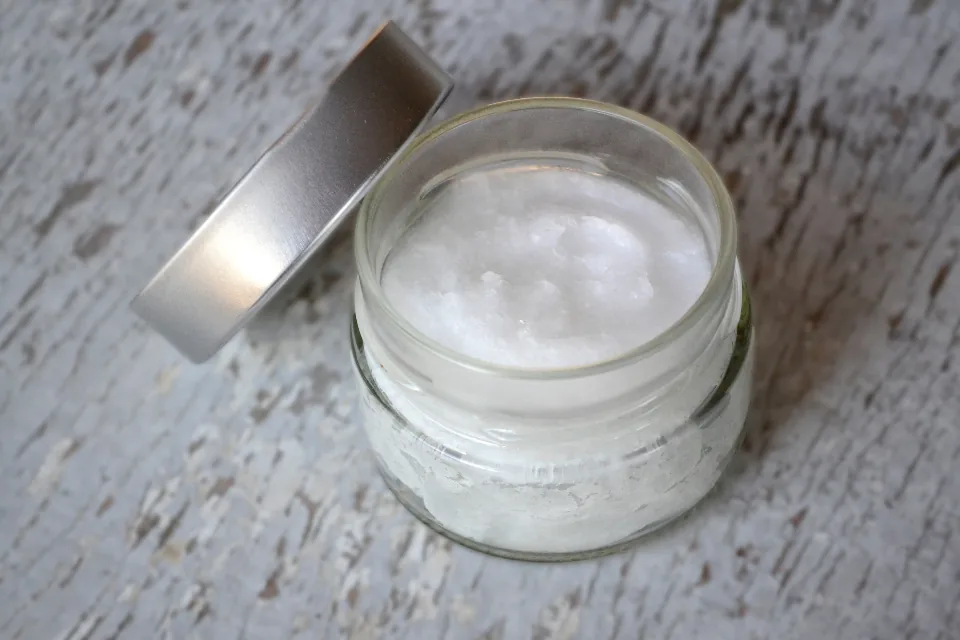
Best organic coconut oil compared
| Best Choice | Best Value | ||||
 | 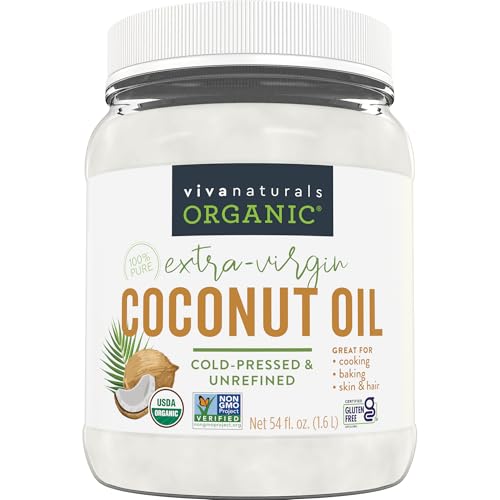 |  |  |  | |
| Product | Nutiva | Viva Naturals | Garden of Life | Anthony’s | Carrington Farms |
| Organic Integrity Score | 92/ 100 | 91/ 100 | 90/ 100 | 87/ 100 | 86/ 100 |
| Our rating | 4.6 | 4.6 | 4.5 | 4.4 | 4.3 |
| Best for | Best overall | Everyday value | Raw cold-pressed | Freshest flavor | Budget large tub |
| Certification | USDA Organic, Non-GMO | USDA Organic, Non-GMO Project Verified, Gluten-free | USDA Organic, Non-GMO Project Verified, Kosher | USDA Organic, Non-GMO, Gluten-free | Certified Organic, Non-GMO, Gluten-free |
| Type | Virgin, unrefined | Virgin, unrefined | Raw, extra virgin | Virgin, tree-to-table | Virgin, unrefined |
| Price | $35.00$0.65 / fluid ounce View on Amazon | $21.99$0.41 / fluid ounce View on Amazon | $8.93$0.64 / ounce View on Amazon | Currently unavailable See buying options | $22.49$0.42 / ounce View on Amazon |
Price and availability as of October 18, 2026 7:10 am EDT. Product prices and availability are accurate as of the date/time indicated and are subject to change. Any price and availability information displayed on Amazon.com at the time of purchase will apply to the purchase of this product.
Scores are ours, based on independent research of certification, sourcing, processing, and value, using the same 10-criteria method we apply to every product. See how we research and rate.
What each certification on an organic coconut oil label actually covers
Most shoppers read a certification as a general signal of quality. Every one of them is narrower than that, and the gaps between them are where the marketing lives.
| Certification | Covers | Key exclusion |
| USDA Organic | Farming and handling: no synthetic pesticides or fertilizers, no GMOs, no sewage sludge or irradiation, audited yearly by an accredited certifier | Three different tiers share the one seal, and it makes no claim about worker pay, food miles, or nutrition |
| Non-GMO Project | Testing and supply-chain traceability showing the ingredients are not genetically engineered | Sets no limit on synthetic pesticides or fertilizers, so it is not an organic claim |
Non-GMO and organic are not two grades of the same thing. The butterfly certifies an absence of genetic engineering and stops there; the USDA seal prohibits genetic engineering as one clause among many, alongside synthetic pesticides, synthetic fertilizers, sewage sludge and irradiation. That makes organic the broader claim by some distance. Where both appear together, the butterfly is adding batch testing on top of a standard that had already banned GMOs.
Key benefits of organic coconut oil
Coconut oil is one of the most versatile items in the pantry, used for cooking, baking, and natural skin and hair care. Choosing an organic, well-processed oil matters for both purity and flavor. Here is what people typically look for.
1. Virgin, unrefined quality
Virgin (unrefined) coconut oil is cold-pressed from fresh coconut, keeping its natural aroma, flavor, and more of its beneficial compounds than bleached and deodorized refined oil.
2. Clean, organic sourcing
USDA-organic certification confirms the coconuts were grown without synthetic pesticides, and the best brands are also non-GMO and often fair-trade.
3. Cold-pressed, hexane-free processing
Cold pressing without heat or chemical solvents like hexane preserves flavor and avoids leaving solvent residues in the oil.
4. Versatility
A good jar works for medium-heat cooking, baking, coffee, and as a natural moisturizer, hair mask, and makeup remover.
Virgin vs refined coconut oil: which should you buy?
Virgin coconut oil is cold-pressed from fresh coconut meat and keeps a distinct coconut aroma and flavor, along with more of the oil’s natural compounds. Refined coconut oil is made from dried coconut (copra) and is typically bleached and deodorized, which gives it a neutral taste and a slightly higher smoke point but strips the coconut flavor and some of the character. For most kitchen and beauty uses, and for anyone choosing organic for purity, virgin unrefined oil is the better pick, which is why every oil in this guide is virgin.
Because coconut oil is high in saturated fat, the healthiest approach is to use it as one fat in a varied diet rather than as a replacement for all other oils. Organic certification and cold-pressed, hexane-free processing are what separate a clean, flavorful virgin oil from a cheaper industrial one, and that is what our scoring rewards, alongside sourcing transparency and value.
The saturated fat question, answered honestly
Coconut oil has been marketed as a health food and criticized as a cardiovascular risk, and both positions overstate. Here is what the evidence actually shows.
It raises LDL. A meta-analysis of 16 well-conducted studies found coconut oil significantly increased LDL cholesterol by about 10.5 mg/dL compared with non-tropical oils when used in cooking. It also raised HDL by around 4 mg/dL, and raising HDL through diet is not considered reliably cardioprotective on its own. That LDL finding is the substantive result and it is not seriously disputed.
The MCT claim is largely a misunderstanding. Coconut oil is promoted on its medium-chain triglyceride content, and the detail matters. Coconut oil is roughly 50% lauric acid (C12) and about 54% MCTs overall, but lauric acid metabolically behaves much more like a long-chain fat: most of it is packaged into chylomicrons and absorbed conventionally rather than being rapidly converted to ketones. True MCT oil is 100% medium-chain and concentrates the C8 and C10 fractions that actually behave the way MCT marketing describes. If you want the metabolic effects attributed to MCTs, coconut oil is a poor way to get them.
The sensible position. Coconut oil is a pleasant, stable cooking fat with a distinctive flavor and a high smoke point in its refined form. It is not a health food, and it is not poison. Use it where its flavor and heat stability suit the dish, and build most of your cooking around extra virgin olive oil, which has far better cardiovascular evidence behind it.
Virgin versus refined, and the skincare caveat
Virgin coconut oil is pressed from fresh mature coconut meat without chemical refining, bleaching, or deodorizing. It keeps the coconut aroma and flavor and more of the minor polyphenols, and it has a lower smoke point. Refined coconut oil is typically made from dried copra and then refined, bleached, and deodorized, producing a neutral-tasting fat with a higher smoke point, better suited to high-heat cooking where you do not want a coconut flavor.
The skincare warning worth knowing. Coconut oil is widely recommended as a facial moisturizer and it is a poor choice for most faces. Lauric acid carries a comedogenicity rating of around 4 on a 5-point scale, meaning a high likelihood of clogging pores. There is an interesting counterpoint, one mouse study found lauric acid more effective than benzoyl peroxide at inhibiting the bacterium implicated in acne, but that is a long way from justifying putting it on an acne-prone face. Coconut oil is excellent on the body, on hair, and as a cleansing balm you remove; it is a bad default facial moisturizer. Jojoba rates 0 to 2 on the same scale and is the better facial option.
How to choose an organic coconut oil
- Choose virgin (unrefined). It is cold-pressed from fresh coconut and keeps the flavor and compounds most people want.
- Look for USDA organic and non-GMO. It confirms the coconuts were grown without synthetic pesticides.
- Check for cold-pressed, hexane-free. This avoids heat damage and chemical solvent residues.
- Mind the packaging. Glass jars avoid any plastic contact; large tubs offer the best value if you use it often.
- Match it to your use. Any virgin organic oil works for cooking, baking, skin, and hair; buy the size you will realistically use.
Who should buy organic coconut oil
Cooking and skincare want different jars. One jar handles both, and it is our top pick. If you want the best everyday value, the freshest flavor, a raw cold-pressed oil, or the best budget large tub for heavy users, we have a pick for each.
Best overall: Nutiva Organic Virgin Coconut Oil
| Organic Integrity Score | 92 / 100 |
| Certification | USDA Organic, Non-GMO |
| Type | Virgin, unrefined, cold-pressed |
| Best for | An all-around trusted organic coconut oil |
Nutiva is our top pick because it combines clean organic sourcing, careful processing, and real value. The oil is USDA organic, cold-pressed and never refined, bleached, or deodorized, made from non-GMO coconuts that are sustainably and fair-trade sourced from Southeast Asia, giving it a fresh, creamy coconut aroma and flavor.
The trade-off is that a fresh unrefined oil carries a real coconut taste, so if you want a completely neutral flavor for savory cooking, a refined oil would be milder. For a trustworthy, flavorful, genuinely organic virgin coconut oil at a fair price, it is our first choice.
What we liked: USDA organic, fair-trade, cold-pressed and unrefined, non-GMO, with fresh coconut flavor and strong value across sizes.
Keep in mind: As a virgin oil it has a genuine coconut taste, so it is not the pick if you want a flavor-neutral cooking oil.
What the listing discloses: Nutiva is explicit about USDA organic certification, and silent on where it was grown or made.
Best everyday value: Viva Naturals Organic Coconut Oil
| Organic Integrity Score | 91 / 100 |
| Certification | USDA Organic, Non-GMO Project Verified, Gluten-free |
| Type | Virgin, unrefined, cold-pressed |
| Best for | Great quality at an everyday price |
Viva Naturals is our value pick. It is a USDA-organic, Non-GMO Project Verified virgin coconut oil, cold-pressed without hexane from hand-picked coconuts grown in the Philippines, and it consistently sells at a friendly price per ounce in the large size, which makes it an easy everyday jar for cooking and beauty use.
It scores just below our top pick mainly on the depth of its fair-trade and sourcing story rather than on quality, which is excellent. For clean organic virgin oil at a great price, it is hard to beat.
What we liked: USDA organic and Non-GMO Verified, cold-pressed and hexane-free, with strong quality at a friendly per-ounce price.
Keep in mind: Its published sourcing and fair-trade story is a little less detailed than the pick above it, though the oil itself is excellent.
What the listing discloses: Viva Naturals states USDA organic certification, Non-GMO Project Verified and Certified Gluten-Free, and does not say where it was grown or made.
Best raw: Garden of Life Raw Extra Virgin Organic Coconut Oil
| Organic Integrity Score | 90 / 100 |
| Certification | USDA Organic, Non-GMO Project Verified, Kosher |
| Type | Raw, extra virgin, cold-pressed |
| Best for | A raw, unrefined oil from a trusted brand |
Garden of Life is our pick for a raw oil. It is a USDA-organic, raw extra-virgin coconut oil, pure, unrefined, and cold-pressed to keep more of its natural compounds, from a well-known clean-supplement brand many shoppers already trust for cooking and body care.
It scores in the value range mainly on price per ounce rather than quality, which is high. For a raw, unrefined organic oil from a recognizable brand, it is a solid choice.
What we liked: USDA organic, raw and cold-pressed, non-GMO, from a trusted clean-label brand, good for both kitchen and body use.
Keep in mind: It usually costs a bit more per ounce than the bulk value tubs.
What the listing discloses: You are told USDA organic certification, Non-GMO Project Verified and kosher certification for Garden of Life; you are not told where it was grown or made.
Best flavor: Anthony’s Organic Virgin Coconut Oil
| Organic Integrity Score | 87 / 100 |
| Certification | USDA Organic, Non-GMO, Gluten-free |
| Type | Virgin, unrefined, cold-pressed |
| Best for | The freshest, mildest coconut flavor |
Anthony’s is our pick for flavor. Its Tree-to-Table process cold-presses organic coconuts within days of harvest and jars the oil at the source within an hour, sealing the jars until they reach you, which avoids the reheating and oxidation that can dull mass-market oils and produces an unusually mild, smooth, fresh coconut taste.
It scores in the middle only because it carries less of the fair-trade and third-party certification stack of the leaders, not on quality. For the freshest possible flavor, it is a standout.
What we liked: USDA organic, a genuinely fresh tree-to-table process, and an unusually mild, smooth coconut flavor.
Keep in mind: It carries fewer additional certifications than the top picks, and it is sold mainly in the large tub.
What the listing discloses: Anthony’s documents a USDA organic claim, and leaves where it was grown or made unsaid.
Best budget large tub: Carrington Farms Organic Coconut Oil
| Organic Integrity Score | 86 / 100 |
| Certification | Certified Organic, Non-GMO, Gluten-free |
| Type | Virgin, unrefined, cold-pressed |
| Best for | Heavy users who want the lowest cost per ounce |
Carrington Farms is our budget pick. It is an organic, Non-GMO Project Verified virgin coconut oil, cold-pressed, hexane-free, and packed in a BPA-free tub, sold in a large size that gives one of the lowest costs per ounce, which makes it ideal if you cook or do body care with coconut oil often.
It scores at the value end because its sourcing and certification story is more basic than the leaders, but for a large, affordable, clean organic tub, it does the job well.
What we liked: Organic and Non-GMO Verified, cold-pressed and hexane-free, BPA-free packaging, and one of the lowest costs per ounce.
Keep in mind: Its sourcing detail is more basic than the premium brands, and the large tub is best only if you use coconut oil regularly.
What the listing discloses: Carrington Farms is thin on detail, and does not say whether the USDA seal applies and where it was grown or made.
How to use coconut oil well
Coconut oil is solid at room temperature and melts around 76°F, with a medium smoke point near 350°F, which makes it good for baking, sautéing, and medium-heat cooking but not for high-heat frying. In the kitchen it works as a butter alternative in baking, in coffee, and on popcorn. For body care, it melts on contact with skin as a moisturizer, hair mask, or makeup remover. Because it is high in saturated fat, use it as one fat among others such as olive oil rather than as your only cooking oil, and store it sealed in a cool, dry place.
The AHA advisory, with the actual numbers
Our section above addresses this honestly. The figures are worth stating, because they are more decisive than the usual hedged summary.
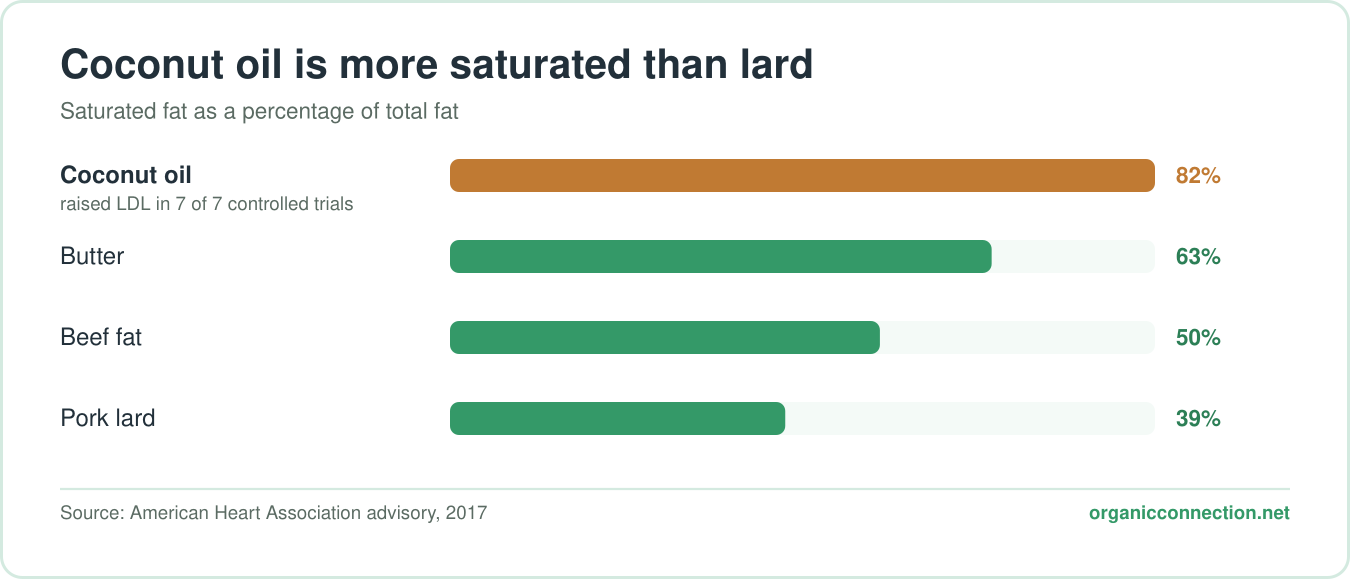
The American Heart Association’s 2017 Presidential Advisory on Dietary Fats and Cardiovascular Disease reviewed the evidence and found that coconut oil increased LDL cholesterol in seven out of seven controlled trials. It advised against its use, concluding there were no known offsetting beneficial effects.
| Fat | Saturated fat content |
| Coconut oil | 82% |
| Butter | 63% |
| Beef fat | 50% |
| Pork lard | 39% |
Keep in mind: coconut oil is more saturated than butter, beef dripping or lard, and the AHA found no difference between it and other high-saturated-fat sources in its effect on LDL. That is an uncomfortable finding for a product marketed as a health food, and we would rather state it than work around it. It does not make coconut oil dangerous or mean you should throw it out — it means it belongs in the same mental category as butter: a fat with real culinary value, used in moderation, not a health supplement. If you are using it specifically for cardiovascular reasons, the evidence points the other way.
Where coconut oil genuinely earns its place is in cooking. It is heat-stable, keeps for a long time without going rancid, is vegan, and contributes a flavor nothing else replicates in Thai, South Indian and Caribbean cooking and in baking.
Coconut oil is not MCT oil
This claim underpins a great deal of coconut oil marketing and it does not survive contact with the chemistry.
Coconut oil is roughly 50% lauric acid (C12). Lauric acid is technically classified as a medium-chain fatty acid, but metabolically it behaves much more like a long-chain fat — it is largely absorbed via the lymphatic system and processed like other long-chain fats, rather than traveling directly to the liver via the portal vein the way C8 and C10 do.
The genuinely fast-acting, ketogenic MCTs are caprylic acid (C8) and capric acid (C10), which together make up only a small fraction of coconut oil. That is precisely why MCT oil exists as a separate product — it is fractionated to concentrate C8 and C10 and to remove the lauric acid.
- “Coconut oil is 60% MCTs” is technically true and practically misleading, because most of that figure is lauric acid.
- If you want ketone production, coconut oil is a weak tool and a C8/C10 MCT oil is the right one.
- If you want to cook, coconut oil is the right one and MCT oil is useless — it has a low smoke point and is not a cooking fat.
Virgin, refined and smoke points
| Virgin / unrefined | Refined (RBD) | |
| Made from | Fresh coconut meat, cold or expeller pressed | Dried copra, then refined, bleached, deodorized |
| Flavor | Distinctly coconut | Neutral |
| Smoke point | ~175°C (350°F) | ~205°C (400°F) |
| Best for | Baking, curries, anywhere coconut flavor is wanted; skin and hair | Higher-heat cooking and anywhere the flavor would intrude |
“Refined” is not automatically worse here — if you are frying at temperature or making a Victoria sponge that should not taste of coconut, refined is the correct choice. Look for expeller-pressed refined oil rather than solvent-extracted, and note that “RBD” simply describes the standard refining process.
Coconut oil melts at about 24°C (76°F), which is why the same jar is solid in winter and liquid in summer. That is normal and changes nothing about quality. For baking, measure it in whichever state the recipe specifies — solid and liquid are not interchangeable by volume in creaming or pastry.
Skin and hair: one strong use, one poor one
- Hair is the genuinely well-supported application. Research comparing coconut, sunflower and mineral oils found coconut oil uniquely reduced protein loss in hair, both before and after washing. The proposed mechanism is that lauric acid’s linear structure and low molecular weight let it penetrate the hair shaft rather than simply coating it. Use it as a pre-wash treatment on lengths and ends, left for an hour or overnight, and washed out.
- The face is a poor use for most people. Coconut oil is highly comedogenic — commonly rated near the top of the scale — and reliably causes breakouts in acne-prone skin. It is an occlusive that seals moisture in, so on damp skin it works as a body moisturizer; on a face prone to congestion it is among the worst choices available.
- It is not sunscreen. Any SPF attributed to coconut oil is negligible and using it as sun protection will get you burnt.
- Oil pulling — swishing oil in the mouth — has no good evidence behind it for whitening, “detoxification” or replacing brushing. It is harmless if you do not inhale it, and it is not a substitute for a toothbrush and fluoride.
- As a personal lubricant it degrades latex condoms, which is a genuine and under-mentioned safety point.
Buying and storage
- Glass jars over plastic, since coconut oil is a solvent that interacts with some plastics over time.
- “Extra virgin” has no legal definition for coconut oil, unlike olive oil. It means nothing beyond marketing — virgin and extra virgin are the same product.
- “Cold pressed” is worth more than “extra virgin” here, as is a stated pressing method.
- Shelf life is 18–24 months, which is long for an oil — high saturation makes it resistant to oxidation. That stability is one of its real advantages.
- Store at room temperature, away from light. No refrigeration needed, and refrigerating makes it rock hard.
- Use a dry spoon. Introducing water is the main way a jar goes off, and it is what causes the occasional mold people report.
- Rancid coconut oil smells sharp and soapy rather than sweet. Yellowing on its own is not spoilage.
How we researched this guide
We are a research-based review site. We compared each coconut oil against its certification, sourcing and fair-trade transparency, processing (cold-pressed, unrefined, hexane-free), packaging, and the weight of aggregated customer feedback, then scored each with our 10-criteria Organic Integrity Score. No brand paid to be included or ranked. Read the full method on our How We Research and Rate page.
Common questions about organic coconut oil
What is the best organic coconut oil?
Our overall pick is Nutiva Organic Virgin Coconut Oil, because it is USDA organic, fair-trade, cold-pressed and unrefined from non-GMO coconuts, with fresh flavor and strong value. For the best everyday value, Viva Naturals is our pick, and for the freshest flavor, Anthony’s.
Is virgin or refined coconut oil better?
Virgin (unrefined) coconut oil is cold-pressed from fresh coconut and keeps its aroma, flavor, and more natural compounds, which is what most people want. Refined oil is bleached and deodorized for a neutral taste and slightly higher smoke point but loses the coconut character. For organic buyers, virgin is usually the better choice.
What can I use coconut oil for?
It works for baking, sautéing, and medium-heat cooking, in coffee, and on popcorn, and as a natural skin moisturizer, deep-conditioning hair mask, and makeup remover. Its medium smoke point makes it less suited to high-heat frying.
How should I store coconut oil?
Keep it sealed in a cool, dry place. It is solid below about 76°F and turns liquid above that, which is normal and does not affect quality. It has a long shelf life thanks to its saturated fat content.
Is coconut oil healthy?
Not in the way it was marketed. The American Heart Association’s 2017 advisory found coconut oil increased LDL cholesterol in seven out of seven controlled trials and advised against it, finding no offsetting benefit. At 82% saturated fat it is more saturated than butter (63%), beef fat (50%) or lard (39%). Treat it as a fat with real culinary value used in moderation — the same mental category as butter — rather than a health supplement.
Is coconut oil an MCT oil?
Not usefully. Coconut oil is roughly 50% lauric acid (C12), which is technically medium-chain but metabolically behaves much more like a long-chain fat, absorbed via the lymphatic system rather than traveling straight to the liver. The genuinely fast, ketogenic MCTs are caprylic (C8) and capric (C10) acid, which make up only a small fraction of coconut oil. That is exactly why MCT oil exists as a separate fractionated product.
Virgin or refined coconut oil?
Depends on the job. Virgin is pressed from fresh coconut meat, tastes distinctly of coconut and smokes around 175°C — good for baking, curries, skin and hair. Refined is made from dried copra and refined, bleached and deodorized, is neutral in flavor and smokes around 205°C — the correct choice for higher-heat cooking or anywhere coconut flavor would intrude. Refined is not automatically worse; look for expeller-pressed rather than solvent-extracted.
Why is my coconut oil sometimes solid and sometimes liquid?
It melts at about 24°C (76°F), so the same jar is solid in winter and liquid in summer. That is normal and says nothing about quality. For baking, measure it in whichever state the recipe specifies — solid and liquid are not interchangeable by volume in creaming or pastry.
Is coconut oil good for hair?
Yes — this is its best-supported topical use. Research comparing coconut, sunflower and mineral oils found coconut oil uniquely reduced protein loss in hair, both before and after washing, apparently because lauric acid’s linear structure and low molecular weight let it penetrate the hair shaft rather than just coating it. Use it as a pre-wash treatment on lengths and ends, left an hour or overnight.
Can you use coconut oil on your face?
Most people should not. Coconut oil is highly comedogenic — rated near the top of the scale — and reliably causes breakouts in acne-prone skin. It works as a body moisturizer on damp skin, since it is an effective occlusive, but on a face prone to congestion it is among the worst choices available. It is also not sunscreen, and any SPF attributed to it is negligible.
Does oil pulling work?
There is no good evidence for it — not for whitening, not for “detoxification”, and certainly not as a replacement for brushing. It is harmless if you do not inhale it. Separately and more practically: coconut oil degrades latex condoms, which is worth knowing if you use it as a personal lubricant.
Does coconut oil go bad?
Slowly — 18 to 24 months, which is long for an oil, because its high saturation makes it resistant to oxidation. Store at room temperature away from light; no refrigeration needed, and refrigerating makes it rock hard. Use a dry spoon, since introducing water is the main way a jar spoils. Rancid coconut oil smells sharp and soapy rather than sweet; yellowing alone is not spoilage. Note also that “extra virgin” has no legal definition for coconut oil, unlike olive oil.
- Organic Food and Pantry hub
- Best Organic Olive Oil
- Best Organic Peanut Butter
- How we research and rate products
- browse all our reviewed products — scores and certifications for 800+ products
Price and availability as of October 18, 2026 7:10 am EDT. Product prices and availability are accurate as of the date/time indicated and are subject to change. Any price and availability information displayed on Amazon.com at the time of purchase will apply to the purchase of this product.
Looking for other organic products?
We have checked more than 800 products across food, household goods, gardening, personal care and pet, every one against its stated certification. Browse all reviews.
Organic Connection is reader-supported. When you buy through links on this page we may earn a commission, at no extra cost to you. As an Amazon Associate we earn from qualifying purchases. We are not paid to feature or rank any product. How we research and rate.