Last updated: September 30, 2026
We may earn a commission when you buy through links on this page, at no extra cost to you. How we research and rate.
Health note: This guide is general information, not medical advice. Supplements are not intended to diagnose, treat, cure, or prevent any disease. Talk to your doctor or pharmacist before starting any supplement, especially if you are pregnant, nursing, have an autoimmune condition, take immune-related medication, or are giving it to a child. Only ever use commercially prepared elderberry, as raw or unripe elderberries, bark, and leaves are toxic.
The short version
After researching the certifications, sourcing, and formulas of the most popular organic elderberry syrups, our top pick is MaryRuth Organics Elderberry. It is USDA Certified Organic, super-concentrated from organic black elderberries (Sambucus nigra), and backed by the brand’s transparent testing, which is why it earned our highest Organic Integrity Score of 92 out of 100. For a sugar-free USDA-organic option, MaryRuth Organics is our pick, and for the best value in a traditional syrup, Nature’s Way Sambucus Organic is the best choice.
Two things separate a good elderberry syrup from a weak one: genuine organic Sambucus nigra sourcing at a real concentration, and honest labeling of what else is in the bottle, sugar, honey, or added vitamin C and zinc. We flag which products are USDA organic, which are sugar-free, and which add honey or immune extras.
Best organic elderberry syrup compared
| Best Choice | Best Value | ||||
 |  |  |  |  | |
| Product | MaryRuth Organics | Gaia Herbs | Nature’s Answer Kids | Zand Herbals | Nature’s Way Sambucus |
| Organic Integrity Score | 92/ 100 | 88/ 100 | 85/ 100 | 83/ 100 | 81/ 100 |
| Our rating | 4.6 | 4.4 | 4.3 | 4.2 | 4.1 |
| Best for | Best overall | Trusted organic elderberry | Kids | Honey & ACV blend | Traditional value |
| Certification | USDA Organic, Non-GMO, Gluten-free | Certified Organic, Vegan | Certified Organic, Kosher, Gluten-free | Non-GMO, Gluten-free, Organic | — |
| Sweetener | Sugar-free | Lightly sweetened | Kid-friendly | Organic honey | Lightly sweetened |
| Price | $19.95 View on Amazon | $33.74$6.25 / fluid ounce View on Amazon | Currently unavailable See buying options | $11.89$2.97 / fluid ounce View on Amazon | $14.79 $21.49 −31%$3.70 / fluid ounce View on Amazon |
Price and availability as of October 17, 2026 7:10 pm EDT. Product prices and availability are accurate as of the date/time indicated and are subject to change. Any price and availability information displayed on Amazon.com at the time of purchase will apply to the purchase of this product.
Scores are ours, based on independent research of certification, sourcing, concentration, sweetener honesty, and value, using the same 10-criteria method we apply to every product. See how we research and rate.
The certification map for organic elderberry syrup, and what each one actually excludes
Seals accumulate on a package faster than meaning does. This is what each of the marks you will see here certifies, and what it leaves out.
| Certification | Covers | Key exclusion |
| USDA Organic | Farming and handling: no synthetic pesticides or fertilizers, no GMOs, no sewage sludge or irradiation, audited yearly by an accredited certifier | Three different tiers share the one seal, and it makes no claim about worker pay, food miles, or nutrition |
| Kosher | Ingredients and production comply with Jewish dietary law, verified by a rabbinic agency that inspects the facility | A dietary-law standard: it makes no claim about pesticides, GMOs or farming practice |
| B Corp | The whole company: social and environmental performance, governance, and transparency | Certifies the company, not the product in your hand |
| Clean Label Project | Testing of finished products for heavy metals, pesticide residues and plasticizers | Not an organic certification, and the thresholds are the organization own |
Kosher and organic answer entirely different questions. A kosher mark, OU, OK, Star-K and others, confirms that ingredients and production follow Jewish dietary law, verified by an agency that inspects the facility. It is a rigorous supply-chain audit and it says nothing about pesticides, GMOs or farming. The two seals appear together often precisely because neither substitutes for the other.
Key benefits of organic elderberry
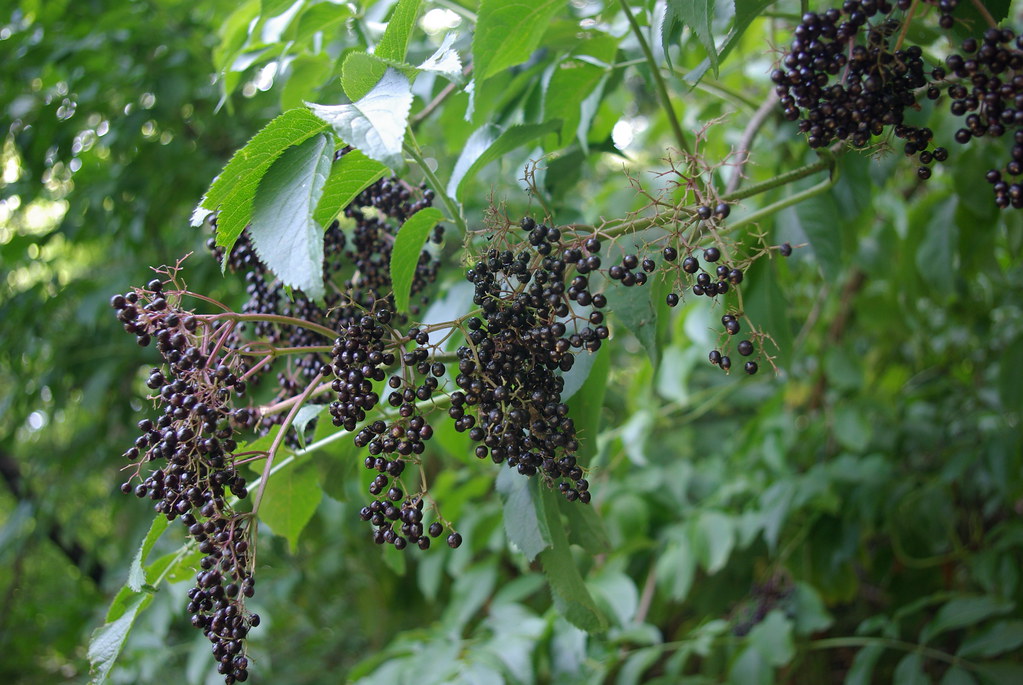
Elderberry syrup is a traditional immune-season staple made from the dark berries of the European black elder. Choosing an organic, well-made syrup matters for both purity and potency. Here is what people typically look for.
1. Antioxidant anthocyanins
Black elderberries are rich in anthocyanins and flavonoids, the antioxidant compounds most associated with elderberry’s traditional immune-support use.
2. Clean, organic berry sourcing
Berries can carry residues from the soil and spraying, so USDA-organic Sambucus nigra, grown without synthetic pesticides, matters for a product you take during cold season.
3. Honest sweeteners
Syrups vary widely: some are sugar-free, some use organic honey or cane syrup for taste and tradition, which matters for kids, diabetics, and daily use.
4. Concentration and testing
A meaningful dose of real elderberry per serving, plus third-party or in-house testing, separates a potent syrup from a watered-down one.
Organic vs conventional elderberry: does it matter?
Elderberry is a berry crop, and berries can concentrate pesticide residues, so USDA-organic certification, confirming the Sambucus nigra was grown without synthetic pesticides, is genuinely meaningful for a syrup you may take daily through the winter. On top of purity, concentration matters: the best syrups state how much berry or extract is in each serving rather than leaning on a long list of added sweeteners.
Because the FDA does not review supplements for safety or effectiveness before sale, third-party or transparent in-house testing is the consumer’s main assurance of what is really in the bottle. Our scoring weights organic certification and sourcing alongside honest concentration and sweetener labeling, not just flavor. And it is worth repeating: only ever use commercially prepared elderberry products, because raw or unripe elderberries and the plant’s bark and leaves are toxic.
How to choose an organic elderberry syrup
- Look for USDA organic Sambucus nigra. It confirms the berries were grown without synthetic pesticides.
- Check the sweetener. Decide whether you want sugar-free, organic honey, or a lightly sweetened syrup, and note that honey is not for infants under one year.
- Check the concentration. Favor syrups that state the amount of elderberry or extract per serving.
- Match it to who is taking it. Kid-specific formulas use gentler doses and flavors; adult formulas are more concentrated.
- Confirm testing. Prefer brands with third-party or transparent in-house testing.
Who should buy organic elderberry syrup
Your needs set the format. Our top pick is the USDA-organic syrup to start with. If you want a sugar-free option, the best traditional value, a whole-food syrup with honey and apple cider vinegar, or a gentle formula for kids, we have a pick for each. Always clear a new supplement with your healthcare provider.
Best overall: MaryRuth Organics Elderberry
| Organic Integrity Score | 92 / 100 |
| Certification | USDA Organic, Non-GMO, Gluten-free |
| Sweetener | Sugar-free |
| Best for | Avoiding added sugar |
MaryRuth Organics is our pick for a sugar-free option. It is USDA Certified Organic and sugar-free, delivering organic elderberry extract for the whole family without the added sugar or honey in traditional syrups, and it is vegan, non-GMO, and Clean Label Project verified from a B Corp brand.
It takes first place on documentation: its listing names USDA Organic, where most of this category asks to be taken on trust.
What we liked: USDA Certified Organic and sugar-free, vegan and non-GMO, Clean Label Project verified, and suitable for the whole family.
Keep in mind: It is a liquid-drop format rather than a thick traditional syrup, and being sugar-free the taste is more tart.
What the listing discloses: MARYRUTH’S lists a USDA organic claim and a B Corp certification. The gap is where it was grown or made.
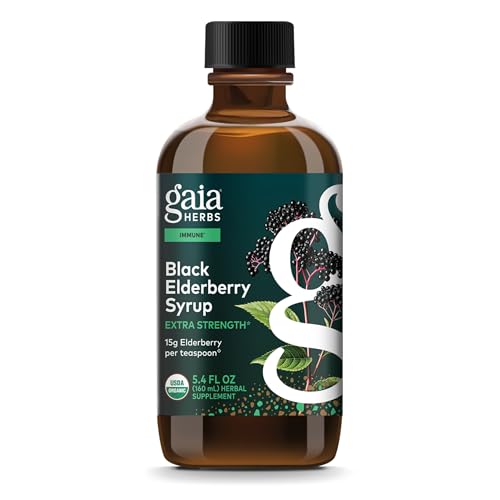
Trusted organic elderberry: Gaia Herbs Black Elderberry Syrup, 5.4 fl oz
| Organic Integrity Score | 88 / 100 |
| Certification | Certified Organic, Vegan |
| Formula | Concentrated organic Sambucus nigra, vegan |
| Best for | An all-around trusted organic elderberry |
Gaia Herbs is worth a look because it combines clean organic sourcing with real concentration and transparency. It is USDA Certified Organic, super-concentrating the juice of many grams of organic black elderberries into each teaspoon, is vegan and purity-tested, and comes from an established herbal brand known for publishing its testing.
The trade-off is that it is priced as a premium herbal syrup rather than a bulk product. For a trustworthy, genuinely organic, concentrated elderberry syrup, it is still worth buying.
What we liked: USDA Certified Organic, a highly concentrated dose per teaspoon, vegan and purity-tested, from a transparent heritage brand.
Keep in mind: It is premium-priced, and the small concentrated bottle has fewer total servings than larger value syrups.
What the listing discloses: Gaia Herbs is thin on detail, and does not say whether the USDA seal applies and where it was grown or made.
Best for kids: Nature’s Answer Bioavailable Sambucus Kids
| Organic Integrity Score | 85 / 100 |
| Certification | Certified Organic, Kosher, Gluten-free |
| Formula | Alcohol-free, gluten-free, kid-friendly taste |
| Best for | A gentle syrup for children |
Nature’s Answer is our pick for kids. Its Bioavailable Sambucus Kids Formula is made from Kosher Certified Organic black elderberries, in an alcohol-free, gluten-free, great-tasting syrup formulated at a gentler dose for children, from a long-established family-owned manufacturer with extensive quality control.
It scores at the value end because it is a lower-dose kids formula rather than a concentrated adult syrup, but for a gentle, organic, kid-friendly elderberry, it does exactly what it should.
What we liked: Kosher Certified Organic elderberries, alcohol-free and gluten-free, a gentle kid-appropriate dose, and a taste children accept.
Keep in mind: It is a lower-dose kids formula, so adults wanting a concentrated dose should choose an adult syrup, and always follow the label for children.
What the listing discloses: Nature’s Answer lists kosher certification. The gap is whether the USDA seal applies and where it was grown or made.
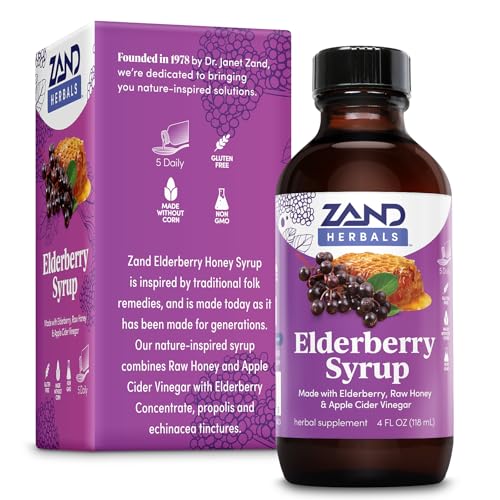
Best whole-food blend: Zand Herbals Elderberry Syrup
| Organic Integrity Score | 83 / 100 |
| Certification | Non-GMO, Gluten-free, Organic |
| Formula | Elderberry, apple cider vinegar, honey, propolis, echinacea |
| Best for | A traditional whole-food immune syrup |
Zand Herbals is our pick for a whole-food blend. Its syrup pairs organic elderberry concentrate with organic raw honey, apple cider vinegar, propolis, and echinacea, the kind of traditional, kitchen-style immune tonic many people make at home, in a non-GMO, gluten-free formula, ready-made.
It scores in the value range because it is made with organic elderberry and honey rather than carrying a whole-product USDA-organic seal, but for a traditional honey-and-ACV immune syrup with extra botanicals, it is a satisfying, well-rounded choice.
What we liked: Organic elderberry with raw honey, apple cider vinegar, propolis, and echinacea, a whole-food tonic style, non-GMO and gluten-free.
Keep in mind: It contains honey, so it is not for infants under one year, and it is made with organic ingredients rather than being a fully USDA-organic certified product.
What the listing discloses: ZAND is thin on detail, and does not say whether the USDA seal applies and where it was grown or made.
Best value: Nature’s Way Sambucus Organic
| Organic Integrity Score | 81 / 100 |
| Certification | — |
| Form | Traditional berry-flavored syrup |
| Best for | An affordable, widely available syrup |
Nature’s Way Sambucus is our value pick. Its Organic Traditional syrup delivers highly concentrated organic black elderberry extract with superfood antioxidants in a classic, palatable berry-flavored syrup, from one of the most recognized and widely available elderberry brands, at a friendly price.
It scores in the middle because it is lightly sweetened and the organic claim is centered on the elderberry extract rather than a whole-product USDA seal, but for an affordable, easy-to-find traditional syrup the whole family will take, it is a dependable choice.
What we liked: Concentrated organic elderberry extract, a classic palatable syrup, wide availability, and a friendly price.
Keep in mind: It is lightly sweetened, and the organic focus is on the elderberry extract rather than a whole-product USDA-organic seal.
What the listing discloses: Nature’s Way is thin on detail, and does not say whether the USDA seal applies and where it was grown or made.
How to use elderberry syrup well
Most people take elderberry syrup daily during cold and flu season for maintenance, and some increase to the label’s higher frequency at the first sign of feeling run down, always following the dosing on your specific product, since concentrations vary. Take it with or without food. Choose a kid-specific formula and dose for children, and remember that syrups containing honey are not for infants under one year. Elderberry may not be appropriate for people with autoimmune conditions or those on immune-related medication, so talk to your doctor or pharmacist first. And only ever use commercially prepared elderberry, because raw or unripe berries and the plant’s bark and leaves are toxic.
What the evidence actually shows
Elderberry is sold with a confidence the research does not entirely support, and since you are being asked to pay a premium for organic sourcing on top of that, the honest picture is worth having.
The supportive trials. Zakay-Rones and colleagues (2004) studied 60 patients with influenza-like illness and reported that symptoms resolved on average four days earlier in the elderberry group, with significantly less use of rescue medication. Tiralongo and colleagues (2016) ran a randomized, double-blind, placebo-controlled trial in 312 long-haul air travelers and found reduced cold duration and symptom severity in those taking elderberry extract.
The trial that did not replicate it. Macknin and colleagues (2020) published a randomized, double-blind, placebo-controlled trial of elderberry extract in emergency department patients aged 5 and above with confirmed influenza. They could not detect a clinical benefit on either duration or severity. The authors noted plainly that their result contradicts the earlier positive studies and that further work is needed.
So: two positive trials, both relatively small, and one well-designed trial in confirmed influenza that found nothing. That is a genuinely unresolved evidence base, not a settled one. Elderberry is rich in anthocyanins and has demonstrable antiviral and immunomodulatory activity in laboratory and ex vivo work, which is why it remains of interest — but laboratory activity and clinical benefit are different claims, and only the second one matters when you are ill.
Our position: elderberry syrup is a reasonable, low-risk thing to keep in the cupboard, and it is not a treatment for influenza. If you have flu symptoms and you are in a higher-risk group, antivirals prescribed early are the intervention with settled evidence behind them. Anyone selling elderberry as a substitute for that is overselling it.
Honey, and why most elderberry syrup is unsafe under 12 months
Keep in mind: the majority of elderberry syrups — including most marketed for children — are sweetened with honey. Honey must not be given to infants under 12 months of age because of the risk of infant botulism. Clostridium botulinum spores are harmless to older children and adults, whose gut flora prevent them germinating, but an infant’s immature gut allows the spores to colonize and produce toxin. This applies to raw honey, pasteurized honey and honey cooked into a syrup alike — heating does not reliably destroy the spores.
This is the single most important safety point in the category and it is largely absent from organic elderberry roundups, which is striking given how many of these products are packaged for families. If you are considering elderberry for a baby under one, check the ingredient list for honey, and speak to your pediatrician first regardless of sweetener. For toddlers and older children, honey-sweetened syrup is fine, and glycerine- or fruit-juice-sweetened products exist if you would rather avoid it.
Why elderberries must be cooked
Raw elderberries, along with the leaves, stems and unripe fruit, contain cyanogenic glycosides — principally sambunigrin — which can release hydrogen cyanide during digestion. Cooking destroys them, which is why every commercial syrup is heat-processed and why traditional preparation always involves simmering.
The consequences of skipping that step are documented. In August 1983 in Monterey County, California, eleven people fell ill within about fifteen minutes of drinking raw juice pressed from fresh elderberries, with leaves and stems included in the press. Eight were airlifted to hospital with nausea, vomiting, abdominal cramps and weakness; some had dizziness and numbness, and one was stuporous. Notably, serum cyanide levels came back normal in all eight, so the mechanism is likely not straightforward cyanide poisoning — but the illness was real, rapid and severe.
For anyone making syrup at home: use only ripe dark berries, strip every stem, and simmer for at least 30–45 minutes. If you are buying rather than making, this is a non-issue — commercial processing handles it — but it is worth knowing why “raw” and “cold-pressed” are not virtues in this particular product.
Species matters more than most labels admit
| Species | Common name | Notes |
| Sambucus nigra | European / black elder | The species in nearly all clinical research and most quality syrups. Highest anthocyanin content. |
| Sambucus canadensis | American elder | Widely used in US-made syrups; similar profile, less studied. Often labeled simply “elderberry”. |
| Sambucus mexicana | Blue elder | The species involved in the 1983 outbreak. Edible cooked. |
| Sambucus racemosa | Red elder | Do not use. Red-berried elder is considered toxic and is not a food species. It should never appear in a product, but matters if you forage. |
A label reading “black elderberry” or naming Sambucus nigra tells you the product uses the species the research was done on. A label reading only “elderberry” usually means canadensis, which is not a problem, but is a slightly different thing from what the trials tested.
Dose and format: syrup, gummies and capsules compared
Elderberry products are labeled inconsistently — some state berry equivalent, some state extract weight, some state nothing useful at all — which makes comparison harder than it should be.
| Format | Typical adult serving | Worth knowing |
| Syrup | 1 tbsp (15 ml), 1–2× daily | Closest to the traditional preparation. Check sugar per serving. |
| Concentrated extract | 1 tsp, standardized to anthocyanins | The trials used standardized extracts, not homemade syrup strength |
| Gummies | 2 gummies, often only 50–100 mg berry equivalent | Frequently a fraction of a syrup dose, with added sugar and pectin. Convenience over potency. |
| Capsules | 300–600 mg extract | No sugar, no refrigeration, no taste. Hard to compare across brands. |
Two label habits are worth learning to spot. “Berry equivalent” figures inflate impressively — 10,000 mg equivalent can mean a small quantity of concentrated extract — and a “proprietary blend” that lists elderberry alongside six other botanicals tells you nothing about how much elderberry is present. Prefer a product that states either a standardized anthocyanin content or a straightforward extract weight.
The sugar nobody mentions
Elderberry syrup is, structurally, a sweet preparation — the sugar or honey is both the preservative and the carrier. A tablespoon commonly delivers 6 to 12 g of sugar, which is fine as an occasional winter measure and less fine as a daily habit through a whole season, particularly for children taking it twice a day for months.
If that concerns you, the alternatives are glycerine-based syrups, capsules, or a genuinely sugar-free liquid extract. Do not, though, assume “organic honey” or “organic cane sugar” changes the metabolic picture: organic sugar is sugar. It is a better-sourced ingredient, not a different nutrient.
Who should be cautious
- Infants under 12 months — no honey-containing product, and pediatric advice first in any case.
- Autoimmune conditions — elderberry has immunomodulatory activity. Whether that meaningfully affects conditions such as rheumatoid arthritis, lupus or MS is not established, but the theoretical concern is real enough to discuss with your clinician.
- Immunosuppressant medication, including after transplant — same reasoning, with more at stake. Do not add it without medical advice.
- Pregnancy and breastfeeding — there is insufficient safety data for a confident recommendation either way.
- Diabetes — account for the sugar in syrup formats; capsules avoid the issue entirely.
Storage and shelf life
- Preservative-free and small-batch syrups generally need refrigeration after opening and are good for roughly 4 to 8 weeks. Check the individual label — this varies more than in most product categories.
- Shelf-stable commercial syrups with a high sugar concentration or added preservative last longer, often several months opened.
- Store away from light. Anthocyanins are the active compounds and they degrade with light, heat and time, so a syrup kept on a sunny windowsill loses potency regardless of the date on the bottle.
- Darkening or thickening is normal; fermentation smell, fizzing or mold means discard it. Homemade syrup with less sugar spoils faster than most people expect.
How we researched this guide
We are a research-based review site. We did not lab-test these syrups ourselves, and we do not make medical claims. We compared each against its certification, sourcing, concentration, sweetener honesty, and the weight of aggregated customer feedback, then scored each with our 10-criteria Organic Integrity Score. No brand paid to be included or ranked. Read the full method on our How We Research and Rate page.
Immune research, and the sugar the syrup is made of
Elderberry syrup is taken for immune support, and the relevant point here is what the delivery form contains.
The immune literature is modest but not empty. Several small trials have examined elderberry extract for duration and severity of cold and influenza symptoms, with some reporting shorter symptom duration. The trials are small, some are industry-funded, and systematic reviews describe the evidence as limited. It is a reasonable thing to take with modest expectations.
The form is where the nutritional cost sits. Syrup requires sugar, both for palatability and as a preservative, and a typical teaspoon carries 3 to 8 grams of sugar depending on the product. Taken as directed during illness, that is trivial. Taken daily as a preventative through an entire winter, it is a regular sugar addition that nobody accounts for, and the products are often given to children on that schedule.
Capsules, lozenges and unsweetened extracts deliver the elderberry without the syrup base, which is worth knowing if daily long-term use is the intention.
There is no weight mechanism here and no research suggesting one. The relevant question is simply whether a daily spoonful of sugar-based syrup is the right delivery form for how you intend to use it.
One safety note that matters more than any of this: raw elderberries, leaves and stems contain cyanogenic glycosides and must be cooked. Commercial syrups are processed appropriately; home preparations require care.
Honest summary: modest immune evidence, a sugar-based delivery form that is irrelevant occasionally and adds up daily, and alternative forms worth considering for long-term use.
Common questions about organic elderberry syrup
What is the best organic elderberry syrup?
Our overall pick is Gaia Herbs Black Elderberry Syrup, 5.4 fl oz, because it is USDA Certified Organic, highly concentrated from organic Sambucus nigra, and backed by transparent testing. For a sugar-free option, MaryRuth Organics is our pick, and for traditional value, Nature’s Way Sambucus Organic. Always check with your doctor first.
Does elderberry syrup actually work?
Black elderberry is one of the more studied immune herbs, and a 2019 meta-analysis found it reduced upper-respiratory symptoms, though researchers called for larger trials. It is a supportive supplement that may help, not a cure or a replacement for vaccines or medical care.
Is elderberry safe to take every day?
Many people take elderberry daily at label doses during cold season, but it may not suit people with autoimmune conditions or those on immune-related medication, and honey-containing syrups are not for infants under one year. Talk to your doctor or pharmacist before daily use.
Can children take elderberry syrup?
Yes, using a kid-specific formula and the dose on the label, like our Nature’s Answer kids pick. Avoid honey-containing syrups for infants under one year, and check with your pediatrician before giving any supplement to a child.
Why must elderberries be cooked or commercially prepared?
Raw or unripe elderberries, along with the plant’s bark, leaves, and seeds, contain compounds that can cause nausea and worse. Commercial syrups are properly prepared to be safe, which is why you should only use commercially made elderberry products.
Is elderberry syrup safe for babies?
Not under 12 months if it contains honey, which most do. Honey carries a risk of infant botulism because an infant’s immature gut allows Clostridium botulinum spores to colonize and produce toxin. This applies to raw, pasteurized and cooked honey alike — heating does not reliably destroy the spores. Check the ingredient list, and speak to your pediatrician before giving elderberry to a baby under one regardless of sweetener.
Does elderberry syrup actually work for flu?
The evidence is genuinely mixed. Zakay-Rones (2004) found symptoms resolving about four days earlier in 60 patients, and Tiralongo (2016) found reduced cold duration in 312 air travelers. But Macknin (2020), a randomized double-blind placebo-controlled trial in emergency department patients with confirmed influenza, found no benefit on duration or severity, and the authors said so plainly. Elderberry is a reasonable low-risk thing to keep in the cupboard; it is not a treatment for influenza, and it is not a substitute for antivirals if you are in a higher-risk group.
Why can’t you eat raw elderberries?
Raw berries, leaves, stems and unripe fruit contain cyanogenic glycosides, principally sambunigrin, which can release hydrogen cyanide during digestion. In 1983 in Monterey County, California, eleven people fell ill within about fifteen minutes of drinking raw elderberry juice pressed with leaves and stems; eight were airlifted to hospital. Cooking destroys the glycosides, which is why all commercial syrup is heat-processed and why “raw” or “cold-pressed” is not a virtue in this product.
Which elderberry species is best?
Sambucus nigra, European or black elder, is the species used in nearly all the clinical research and has the highest anthocyanin content. Sambucus canadensis is common in US-made syrups and is fine, just less studied. Sambucus racemosa, red elder, is considered toxic and is not a food species — relevant if you forage rather than buy.
Are elderberry gummies as good as syrup?
Usually not, on dose. Many gummies deliver only 50 to 100 mg berry equivalent per serving, a fraction of a syrup dose, with added sugar and pectin. They are a convenience format. Be wary of “berry equivalent” figures generally — 10,000 mg equivalent can describe a small quantity of concentrated extract — and of proprietary blends that list elderberry among several botanicals without stating how much.
How much sugar is in elderberry syrup?
Typically 6 to 12 g per tablespoon, because the sugar or honey acts as both preservative and carrier. That is fine as an occasional winter measure and worth thinking about as a daily habit across a whole season, especially for children taking it twice daily. Organic honey and organic cane sugar are better-sourced ingredients, not different nutrients.
Who should avoid elderberry?
Infants under 12 months should not have honey-containing products. People with autoimmune conditions or on immunosuppressant medication, including transplant recipients, should discuss it with their clinician first because elderberry has immunomodulatory activity. There is insufficient safety data for pregnancy and breastfeeding. People with diabetes should account for the sugar in syrup formats or use capsules.
Does elderberry syrup need refrigerating?
Preservative-free and small-batch syrups usually do once opened, and keep about 4 to 8 weeks. Shelf-stable commercial syrups with high sugar or added preservative last longer. Store away from light in all cases — anthocyanins are the active compounds and they degrade with light, heat and time, so a bottle on a sunny shelf loses potency regardless of the printed date.
- Organic Supplements and Wellness hub
- Best Organic Apple Cider Vinegar
- Best Organic Turmeric Supplements
- How we research and rate products
- browse all our reviewed products — scores and certifications for 800+ products
Price and availability as of October 17, 2026 7:10 pm EDT. Product prices and availability are accurate as of the date/time indicated and are subject to change. Any price and availability information displayed on Amazon.com at the time of purchase will apply to the purchase of this product.
Looking for other organic products?
We have checked more than 800 products across food, household goods, gardening, personal care and pet, every one against its stated certification. Browse all reviews.
Organic Connection is reader-supported. When you buy through links on this page we may earn a commission, at no extra cost to you. As an Amazon Associate we earn from qualifying purchases. We are not paid to feature or rank any product. How we research and rate.