Last updated: September 30, 2026
We may earn a commission when you buy through links on this page, at no extra cost to you. How we research and rate.
The short version
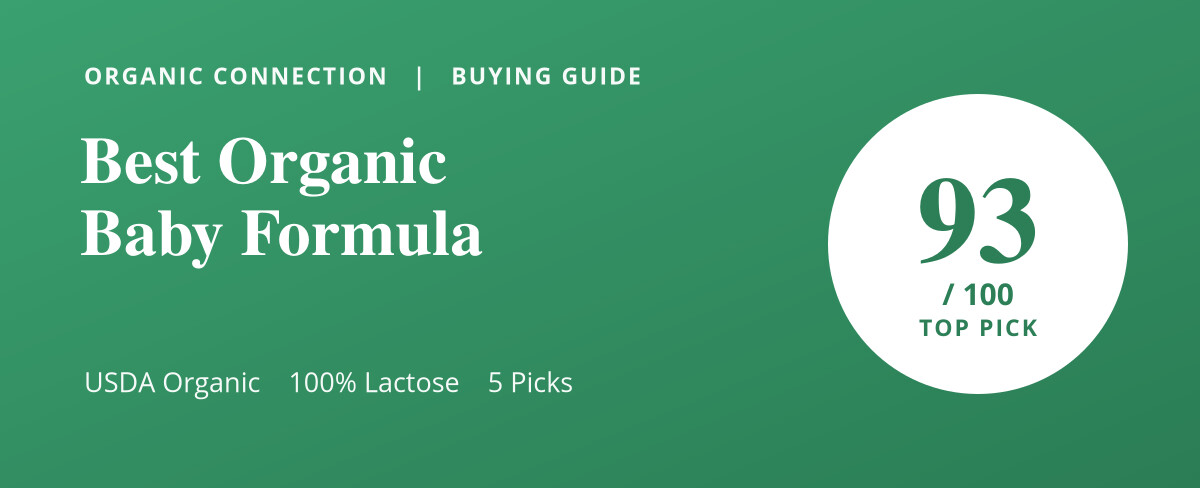
After researching the certifications, ingredients, and carbohydrate sources of the organic infant formulas most widely available in the US, our top pick is Bobbie Organic Infant Formula. It is USDA certified organic, uses lactose as its only carbohydrate rather than corn syrup solids, and is modeled on the composition of breast milk, which is why it earned our highest Organic Integrity Score of 93 out of 100. For the best value, Earth’s Best Organic Dairy Infant Formula is our pick, and for babies with lactose sensitivity, Earth’s Best Organic Sensitivity is the best choice.
With infant formula, the organic seal is only half the story. The carbohydrate source, the fat blend, and whether the formula is FDA-reviewed for the US market matter just as much. We flag each product’s certification and carbohydrate.
Best organic baby formula compared
| Best Choice | Best Value | ||||
 |  |  |  |  | |
| Product | Bobbie Organic | Earth’s Best Dairy | Bobbie Gentle | Happy Baby Stage 1 | Earth’s Best Sensitivity |
| Organic Integrity Score | 93/ 100 | 88/ 100 | 85/ 100 | 81/ 100 | 76/ 100 |
| Our rating | 4.7 | 4.4 | 4.3 | 4.1 | 3.8 |
| Carbohydrate | 100% lactose | Lactose | 100% lactose | Lactose | Reduced lactose + corn syrup solids |
| Best for | Best overall | Best value | Fussiness and gas | Widely stocked standard | Lactose sensitivity |
| Certification | USDA Organic | — | USDA Organic | USDA Organic | — |
| Price | Currently unavailable See buying options | $34.57$1.65 / ounce View on Amazon | Currently unavailable See buying options | $35.09$1.53 / ounce View on Amazon | $34.57 $39.99 −14%$1.65 / ounce View on Amazon |
Price and availability as of October 11, 2026 7:10 pm EDT. Product prices and availability are accurate as of the date/time indicated and are subject to change. Any price and availability information displayed on Amazon.com at the time of purchase will apply to the purchase of this product.
Scores are ours, based on independent research of certification, carbohydrate and fat sources, ingredient quality, and value, using the same 10-criteria method we apply to every product. See how we research and rate.
The certification map for organic baby formula, and what each one actually excludes
Each certification below appears on at least one product on this page. They are not ranked against each other, because they measure different things, but knowing which is which changes what you buy.
| Certification | Covers | Key exclusion |
| USDA Organic | Farming and handling: no synthetic pesticides or fertilizers, no GMOs, no sewage sludge or irradiation, audited yearly by an accredited certifier | Three different tiers share the one seal, and it makes no claim about worker pay, food miles, or nutrition |
| EU Organic | The European Union organic regulation, shown by the green leaf mark | A separate regime from USDA Organic, recognized through negotiated equivalence rather than identical rules |
The USDA seal is a farming standard, and only a farming standard. It is enforced, it is audited annually, and it genuinely prohibits synthetic pesticides, synthetic fertilizers and GMOs. It says nothing about what the people who grew the crop were paid, how far the product traveled, or whether it is good for you. Organic sugar is organic. It is still sugar.
Key things to look for in organic baby formula
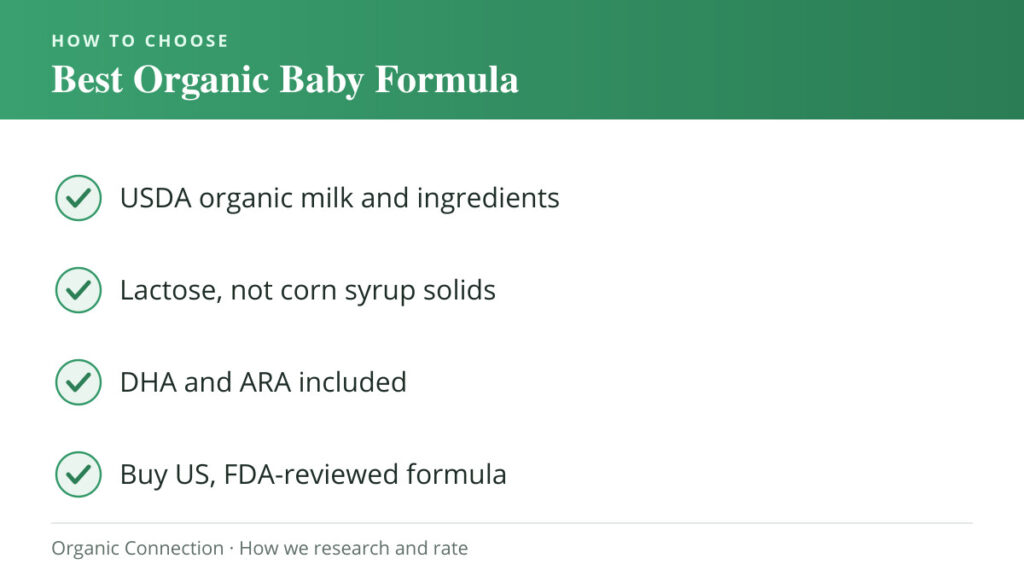
Great organic formula is about certification, carbohydrate, fats, and FDA compliance. Here is what matters.
1. USDA organic certification
It verifies organic milk and ingredients, no GMOs, no synthetic pesticides, and no antibiotics or added growth hormones in the dairy supply.
2. Lactose as the carbohydrate
Lactose is the carbohydrate in breast milk. Formulas that use it as the sole or primary carbohydrate avoid corn syrup solids and glucose syrup.
3. DHA and ARA, and the fat blend
DHA and ARA support brain and eye development. Some parents also prefer formulas without palm olein, which can affect fat and calcium absorption.
4. Sold and reviewed for the US market
Formula sold legally in the US is manufactured to FDA standards and labeled in English with US mixing instructions, which matters for safe preparation.
US formulas vs imported European formulas
European organic formulas, particularly the German and Dutch brands, have a devoted following among parents, and their EU organic standards are genuinely strict. The complication is regulatory, not nutritional. Formula sold through unofficial import channels has not been reviewed by the FDA, does not carry FDA-mandated English labeling, and travels through a supply chain with no US oversight of storage temperature or handling. The FDA has repeatedly warned parents about this, and mixing instructions written for metric scoops and European water standards are a real source of preparation errors.
That is why every formula in this guide is a USDA organic product manufactured and sold for the US market. You get certified organic milk and ingredients, FDA-verified nutrient composition, and clear English instructions in one package. If you specifically want a European formula, buy only from a brand that has completed the FDA’s own import review rather than a gray-market reseller, and talk to your pediatrician first. Never make homemade formula or dilute formula to stretch it; both are genuinely dangerous for infants.
How to choose organic baby formula
- Confirm USDA organic. It rules out GMO ingredients, synthetic pesticides, antibiotics, and added growth hormones.
- Read the carbohydrate first. Lactose as the only carbohydrate is the closest match to breast milk.
- Check for DHA and ARA. Both are standard in the formulas we recommend and support brain and eye development.
- Match the variant to your baby. Standard, gentle (partially broken-down proteins), or sensitivity (reduced lactose) each solve a different problem.
- Change formulas with your pediatrician. Fussiness has many causes, and switching should be a medical decision, not a guess.
Who should buy organic baby formula
The right formula depends on your baby, not on a ranking. If you want the cleanest all-around organic formula, our top pick fits. If you want the best organic value, a gentle formula for fussiness and gas, a reduced-lactose sensitivity formula, or a widely stocked standard option, we have a pick for each. Every formula here is nutritionally complete under FDA rules, so there is no wrong choice on safety grounds.
Best overall: Bobbie Organic Infant Formula
| Organic Integrity Score | 93 / 100 |
| Carbohydrate | 100% lactose, no corn syrup solids |
| Certification | USDA Organic |
| Best for | Newborn to 12 months, a clean all-around formula |
Bobbie is our top pick because it makes the choices that separate a premium formula from a merely certified one. It is USDA certified organic, and its only carbohydrate is lactose, the same sugar found in breast milk, rather than the corn syrup solids or glucose syrup that many formulas use to cut cost. It includes DHA and ARA at meaningful levels, and it is formulated without palm olein oil, which some research links to reduced fat and calcium absorption. It is manufactured for the US market and meets FDA infant formula requirements, so you are not navigating gray-market imports to get European-style composition.
The trade-off is price. Bobbie sits at the premium end of the category, and it is a subscription-first brand, so retail availability can be less predictable than the supermarket names. For parents who want the cleanest ingredient deck in a US-compliant organic formula, it is worth the premium.
What we liked: USDA organic, 100% lactose with no corn syrup solids, no palm olein, DHA and ARA included, and modeled on breast milk composition.
Keep in mind: It is the most expensive option here, and stock through third-party retailers can fluctuate.
What the listing discloses: Bobbie documents a USDA organic claim, and leaves where it was grown or made unsaid.
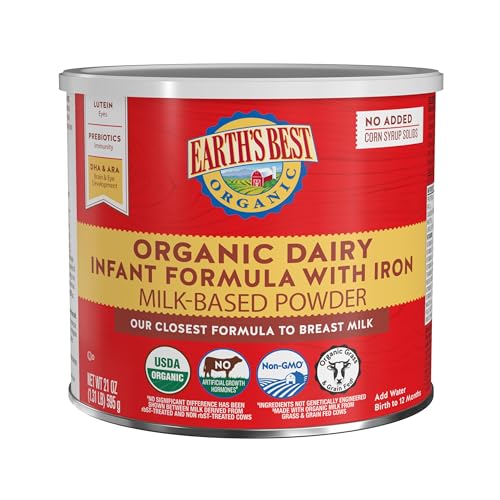
Best value: Earth’s Best Organic Dairy Infant Formula
| Organic Integrity Score | 88 / 100 |
| Carbohydrate | Lactose |
| Certification | — |
| Best for | Everyday organic feeding on a real budget |
Earth’s Best is the value benchmark in organic formula, and it earns that position honestly. It is USDA certified organic, made with organic milk from cows raised without antibiotics or added growth hormones, uses lactose as its carbohydrate, and includes DHA and ARA plus prebiotics and lutein. It is also the organic formula you can actually find, stocked in most supermarkets and pharmacies as well as online, which matters enormously when you are down to your last scoop at 2am.
The trade-off is that the ingredient deck is a step below the premium brands: the fat blend includes palm olein, and the formula is built to a price rather than to a composition ideal. For most families, the combination of genuine USDA organic certification, reliable availability, and a substantially lower cost per ounce makes it the sensible default.
What we liked: USDA organic at a mainstream price, lactose-based, DHA and ARA plus prebiotics, and easy to find almost anywhere.
Keep in mind: The fat blend includes palm olein, which some parents prefer to avoid.
What the listing discloses: Earth’s Best is thin on detail, and does not say whether the USDA seal applies and where it was grown or made.
Best for fussiness and gas: Bobbie Organic Gentle
| Organic Integrity Score | 85 / 100 |
| Carbohydrate | 100% lactose |
| Certification | USDA Organic |
| Best for | Fussiness, gas, and general digestive comfort |
Bobbie Gentle takes the same USDA organic, all-lactose base as the standard Bobbie formula and partially breaks down the milk proteins so they are easier for an immature gut to handle. That is the key distinction from a “sensitivity” formula: gentle formulas keep lactose intact and work on the protein, while sensitivity formulas reduce lactose and often add corn syrup solids to replace it. If your baby’s discomfort is protein-related rather than lactose-related, this is the cleaner route.
The trade-off is the same premium price as the standard formula, plus the reality that switching formulas is not a reliable fix for every fussy baby. Talk to your pediatrician before assuming formula is the cause; reflux, feeding technique, and normal newborn fussiness all present similarly.
What we liked: Gentler partially broken-down proteins without giving up 100% lactose or the organic seal, and no corn syrup solids.
Keep in mind: Premium pricing, and it will not help if the underlying issue is not protein digestion.
What the listing discloses: Bobbie commits to a USDA organic claim but stops short of where it was grown or made.
Best widely stocked standard: Happy Baby Organics Infant Formula Stage 1
| Organic Integrity Score | 81 / 100 |
| Carbohydrate | Lactose |
| Certification | USDA Organic |
| Best for | 0 to 12 months, a reliable everyday organic formula |
Happy Baby’s Stage 1 formula is a solid, unglamorous USDA organic option built around lactose, with DHA and ARA and added prebiotics intended to support gut bacteria. It comes from a brand parents already know from organic baby food, and it is stocked broadly enough that you are unlikely to get stranded. As with Earth’s Best, the value proposition is certified organic milk at a mainstream price rather than a best-in-class ingredient deck.
The trade-off is that packaging and formulation have changed hands and revisions over the years, so it is worth reading the current ingredient panel on the tub you actually receive rather than relying on a review, ours included. That is good practice with any formula.
What we liked: USDA organic, lactose-based, includes DHA, ARA, and prebiotics, from an established organic baby brand.
Keep in mind: Packaging and formulation revisions mean you should check the panel on your current tub.
What the listing discloses: Happy Baby is explicit about USDA organic certification, and silent on where it was grown or made.
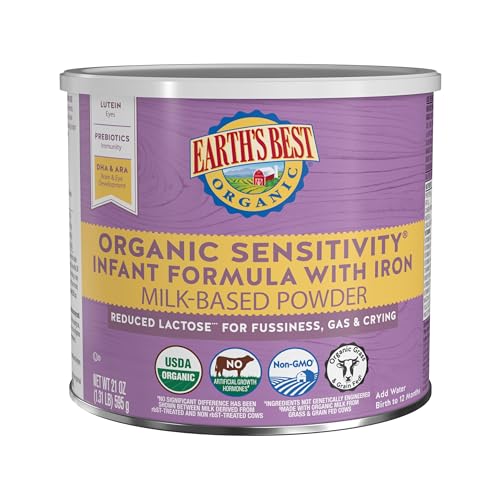
Best for lactose sensitivity: Earth’s Best Organic Sensitivity
| Organic Integrity Score | 76 / 100 |
| Carbohydrate | Reduced lactose, with corn syrup solids |
| Certification | — |
| Best for | Babies with diagnosed lactose sensitivity |
When a pediatrician identifies genuine lactose sensitivity, a reduced-lactose formula is the right tool, and this is the organic version of it. It is USDA certified organic with DHA, ARA, prebiotics, and lutein, and the lactose load is cut substantially compared with standard formula. Being able to address a real digestive issue without leaving the organic category is genuinely useful.
The trade-off is exactly why it scores lowest here: removing lactose means replacing that carbohydrate with something, and that something is corn syrup solids. That is a reasonable trade when it is medically indicated, and a poor one when it is not. Use this formula because your pediatrician recommended it, not as a first response to ordinary fussiness.
What we liked: A genuinely USDA organic answer for diagnosed lactose sensitivity, with DHA, ARA, and prebiotics intact.
Keep in mind: Reduced lactose means added corn syrup solids, so it is a targeted formula, not a general upgrade.
What the listing discloses: Beyond the organic claim itself, Earth’s Best does not say whether the USDA seal applies and where it was grown or made.
Preparing and storing formula safely
Formula safety is mostly about preparation, not brand. Wash your hands and sterilize bottles and nipples before first use. Use the scoop that came with the tub, level rather than packed, and follow that brand’s water-to-powder ratio exactly; never add extra water to stretch a tub, since dilution can cause dangerous electrolyte imbalances in infants. For newborns under two months, premature babies, or babies with weakened immune systems, the CDC advises preparing powdered formula with water heated to at least 70 °C (158 °F) and then cooled, to reduce the risk of Cronobacter. Use prepared formula within two hours at room temperature or 24 hours refrigerated, and discard anything left in a bottle an hour after feeding begins. Store unopened tubs in a cool, dry place and use an opened tub within one month.
Every US infant formula meets the same nutritional floor
This is the most reassuring thing on this page and it is rarely said plainly, because it undercuts a lot of premium marketing.
Infant formula in the US is regulated as its own category, with federally specified minimum — and in some cases maximum — levels for around thirty nutrients, plus manufacturing, testing and record-keeping requirements. A formula cannot legally be sold as infant formula in the US without meeting them. That means an inexpensive supermarket own-brand formula and a premium organic one are both nutritionally complete, and a baby fed either will get what they need.
What organic certification changes is the farming behind the ingredients — no synthetic pesticides on the crops, no antibiotics or added growth hormones in the dairy herd — and, in practice, which optional ingredients a brand chooses. Those are real differences and reasonable things to pay for. What it does not change is nutritional adequacy, because that floor is set by law for everyone.
Keep in mind: the corollary matters more than the reassurance. If cost is a pressure, switching to a cheaper formula is nutritionally safe, and it is a far better decision than the things families sometimes do instead. Never dilute formula to make it last longer — over-diluted formula can cause water intoxication, dangerously low blood sodium, seizures and death in infants. Never make homemade formula, which has caused documented cases of hospitalization from nutrient deficiencies and electrolyte imbalance. And do not switch a baby to cow’s milk before 12 months. If you are struggling to afford formula, speak to your pediatrician or health visitor about WIC and other assistance rather than stretching what you have.
Imported European formula: what the AAP actually says
European organic brands — HiPP, Holle, Lebenswert, Kendamil — are widely recommended in parenting communities, often precisely by parents seeking cleaner ingredients. There is a genuine regulatory issue with buying them through third-party importers, and it deserves stating fairly rather than either ignoring or overstating.
These formulas are made to EU standards, which are rigorous. The problem is the route: formula imported by third-party vendors is not FDA-reviewed or FDA-regulated, so the consumer protections built around US infant formula do not apply to it. The American Academy of Pediatrics has raised this directly, and a comparison study in the Journal of Pediatric Gastroenterology and Nutrition found that non-FDA-registered imported European formulas do not meet all FDA labeling requirements.
The concrete risks are practical rather than about the formula’s original quality:
- No FDA oversight of the import chain — storage temperature, shipping conditions and handling are unverified.
- Labeling and preparation instructions in other languages and other units, with different scoop sizes. Mixing errors are the most common real-world hazard here.
- No US recall mechanism. If a batch is withdrawn in Europe, there is no reliable route to reach US buyers who purchased through a reseller.
- Counterfeit and expired stock has been documented in the gray market.
- The FDA received notification of six adverse events on imported European formulas in 2016–2017 — three HiPP, two Holle, one Lebenswert — including fever, vomiting, diarrhea, lethargy and salmonellosis.
Some European brands have since sought and obtained FDA clearance to sell in the US through official channels; those products are a different proposition from gray-market imports. If you want a European formula, buying a brand that is properly registered for US sale gets you the formulation without the supply chain problem. As always, this is a conversation for your pediatrician.
Preparing powdered formula safely
Powdered infant formula is not a sterile product, and cannot be made sterile by the manufacturer. That surprises most parents and it drives the preparation guidance.
The organism of concern is Cronobacter sakazakii, which can cause sepsis and meningitis in newborns and premature infants in the first weeks of life. Infections are rare, and they are severe when they occur.
- The FDA and WHO recommend reconstituting powdered formula with water that has been boiled and cooled to no lower than 70°C to reduce Cronobacter risk. Cool the made-up bottle rapidly under running water before feeding, and check the temperature on your wrist.
- This matters most for infants under 3 months, premature babies, and any baby who is immunocompromised. For older, healthy infants, guidance in some countries is less strict — follow your own health service’s advice and your pediatrician’s.
- Ready-to-feed liquid formula is commercially sterile and avoids the issue entirely. It is the safest option for a very young or vulnerable baby, at higher cost.
- Wash hands and sterilize bottles and teats before preparing.
- Use prepared formula within 1 hour of starting a feed, and discard what is left — bacteria from the baby’s mouth multiply in the bottle.
- Prepared formula keeps 24 hours refrigerated if it has not been fed from. Never leave made-up formula at room temperature for more than 2 hours.
- Never microwave a bottle. It heats unevenly and creates hot spots that scald.
- Follow the scoop ratio exactly, using the scoop from that tin, and add powder to water rather than the reverse.
The ingredients worth understanding
| Ingredient | What it is doing | Worth knowing |
| Lactose | The carbohydrate in breast milk | What you want as the primary carbohydrate where possible |
| Corn syrup solids / glucose syrup | Alternative carbohydrate | Used in lactose-free and some sensitive formulas. Not inherently harmful, but lactose is the closer match. |
| DHA and ARA | Long-chain fatty acids for brain and eye development | Now near-universal. Present in breast milk. |
| 2′-FL HMO | A human milk oligosaccharide, produced by fermentation | Prebiotic; a genuine formulation advance, though not present in every organic formula |
| Palm olein | Fat blend component | Some evidence it modestly reduces calcium and fat absorption and firms stools. Palm-free formulas exist. |
| Partially hydrolysed protein | Protein broken into smaller pieces | “Gentle” formulas. May help some fussiness; not a treatment for milk allergy. |
| Extensively hydrolysed / amino acid | Fully broken down protein | For diagnosed cow’s milk protein allergy. Prescription territory — a pediatric decision, not a shopping one. |
Two practical notes. Organic formulas more often use lactose as the primary carbohydrate rather than corn syrup solids, which is one of the more meaningful ingredient differences in the category. And goat milk formula is not suitable for cow’s milk protein allergy — the proteins cross-react in most cases, so it is not a substitute for a properly hydrolysed formula.
Switching formulas, and storage
- Switching brands is usually fine and does not require a transition period nutritionally, though a gradual change over several days can ease digestive adjustment. Persistent vomiting, blood in stool, hives or breathing difficulty are not “adjustment” — they need medical attention.
- Give a new formula a full week or two before judging it. Stool changes and mild fussiness in the first days are common and usually settle.
- Unopened tins keep to the printed date, stored cool and dry — never in a garage, car or anywhere that gets hot.
- Once opened, use powdered formula within 1 month. Write the opening date on the lid; it is easy to lose track.
- Keep the scoop dry and inside the tin, never washed and returned wet.
- Do not freeze formula, and do not buy it from resellers or marketplace sellers where storage history is unknown.
- Check for recalls periodically if you buy in bulk, and keep the lot number until the tin is finished.
This guide summarizes published guidance and is not medical advice. Feeding decisions for your baby, including any change of formula, should be made with your pediatrician.
How we researched this guide
We are a research-based review site. We compared each formula against its certification (USDA organic), carbohydrate source, fat blend, presence of DHA and ARA, FDA compliance for US sale, and the weight of aggregated parent feedback on tolerance and mixing, then scored each with our 10-criteria Organic Integrity Score. No brand paid to be included or ranked. Nothing here is medical advice; formula choices for your baby belong with your pediatrician. Read the full method on our How We Research and Rate page.
Common questions about organic baby formula
What is the best organic baby formula?
Our overall pick is Bobbie Organic Infant Formula, because it is USDA certified organic, uses 100% lactose as its carbohydrate with no corn syrup solids, contains no palm olein, and is made to FDA standards for US sale. For the best value, Earth’s Best Organic Dairy is our pick, and for diagnosed lactose sensitivity, Earth’s Best Organic Sensitivity.
Is organic baby formula better than regular formula?
Every infant formula sold in the US must meet the same FDA nutrient requirements, so all of them are nutritionally complete. Organic certification adds assurance about how the ingredients were produced: organic milk from cows raised without antibiotics or added growth hormones, no GMO ingredients, and no synthetic pesticides. That is the difference you are paying for, not superior nutrition.
Why does corn syrup solids in formula matter?
Breast milk’s carbohydrate is lactose, so formulas using lactose as their sole carbohydrate most closely match it. Corn syrup solids and glucose syrup are cheaper, sweeter substitutes used in some formulas, including most reduced-lactose ones. They are safe and FDA-permitted, but if you have the choice and no medical reason to avoid lactose, a lactose-based formula is the closer match.
Are European organic formulas safe to buy?
EU organic standards are strict, but formula bought through unofficial import channels has not been reviewed by the FDA, lacks FDA-mandated English labeling, and moves through a supply chain with no US oversight of storage or handling. The FDA has warned parents about these risks. If you want a European formula, choose a brand that has completed FDA import review and talk to your pediatrician first.
Can I switch my baby between organic formulas?
Most babies switch between milk-based formulas without difficulty, and you can usually change brands directly, though some pediatricians suggest mixing old and new over a few days. Because fussiness has many causes besides formula, make switching decisions with your pediatrician rather than changing repeatedly on your own.
Is expensive organic formula nutritionally better than cheap formula?
No. US infant formula is regulated as its own category with federally specified minimum and sometimes maximum levels for around thirty nutrients, so a formula cannot legally be sold without meeting them. An own-brand supermarket formula and a premium organic one are both nutritionally complete. What organic certification changes is the farming behind the ingredients and which optional ingredients a brand chooses — real differences, but not nutritional adequacy.
Is it safe to buy imported European baby formula?
Formula bought through third-party importers is not FDA-reviewed or FDA-regulated, so US consumer protections do not apply. The AAP has raised this directly, and a study in the Journal of Pediatric Gastroenterology and Nutrition found non-FDA-registered European formulas do not meet all FDA labeling requirements. The practical risks are unverified storage and shipping, instructions in other languages with different scoop sizes, no US recall route, and documented counterfeit and expired stock. The FDA received six adverse event notifications on imported European formulas in 2016–2017. Some European brands now have proper FDA clearance for US sale, which avoids the supply chain problem.
Why do you need 70°C water for powdered formula?
Because powdered infant formula is not a sterile product and cannot be made sterile by the manufacturer. The organism of concern is Cronobacter sakazakii, which can cause sepsis and meningitis in newborns and premature infants. The FDA and WHO recommend reconstituting with water boiled and cooled to no lower than 70°C, then cooling the bottle rapidly before feeding. This matters most for infants under 3 months, premature babies and immunocompromised infants; ready-to-feed liquid formula is commercially sterile and avoids the issue.
Can you dilute formula to make it last longer?
No — never. Over-diluted formula can cause water intoxication, dangerously low blood sodium, seizures and death in infants. Homemade formula is equally dangerous and has caused documented hospitalizations from nutrient deficiency and electrolyte imbalance. If cost is a pressure, switching to a cheaper formula is nutritionally safe, and speaking to your pediatrician about WIC and other assistance is the right route.
How long does prepared formula keep?
One hour from the start of a feed, after which it should be discarded, because bacteria from the baby’s mouth multiply in the bottle. Formula that has been prepared but not fed from keeps 24 hours refrigerated. Never leave made-up formula at room temperature for more than 2 hours, and never microwave a bottle — it heats unevenly and creates scalding hot spots.
What is the difference between lactose and corn syrup solids in formula?
Lactose is the carbohydrate in breast milk and is the closer match. Corn syrup solids or glucose syrup are used in lactose-free and some sensitive formulas — not inherently harmful, but a substitution. Organic formulas more often use lactose as the primary carbohydrate, which is one of the more meaningful ingredient differences in the category.
Is goat milk formula good for milk allergy?
No. Goat and cow milk proteins cross-react in most cases, so goat formula is not a substitute for a properly hydrolysed or amino acid formula. Diagnosed cow’s milk protein allergy is prescription territory and a pediatric decision rather than a shopping one. Partially hydrolysed “gentle” formulas may help some fussiness but are also not a treatment for allergy.
How do you switch baby formula brands?
Usually you can switch directly, though a gradual change over several days can ease digestive adjustment. Give a new formula a full week or two before judging it, since stool changes and mild fussiness in the first days are common and usually settle. Persistent vomiting, blood in stool, hives or breathing difficulty are not adjustment and need medical attention. Once opened, use powdered formula within one month and write the opening date on the lid.
- Organic Food & Pantry hub
- Best Natural Diapers
- Switching to Organic for Babies and Families
- How we research and rate products
- browse all our reviewed products — scores and certifications for 800+ products
- Best Organic Baby Cereal
Price and availability as of October 11, 2026 7:10 pm EDT. Product prices and availability are accurate as of the date/time indicated and are subject to change. Any price and availability information displayed on Amazon.com at the time of purchase will apply to the purchase of this product.
Looking for other organic products?
We have checked more than 800 products across food, household goods, gardening, personal care and pet, every one against its stated certification. Browse all reviews.
Organic Connection is reader-supported. When you buy through links on this page we may earn a commission, at no extra cost to you. As an Amazon Associate we earn from qualifying purchases. We are not paid to feature or rank any product. This page is informational and is not medical advice. How we research and rate.