Last updated: September 30, 2026
Some links in this guide point to our product reviews, which may earn us a commission at no extra cost to you. How we research and rate.
“Organic,” “natural,” “non-GMO,” “clean,” “green,” “eco-friendly.” Product labels are crowded with reassuring words, and most shoppers assume they mean roughly the same thing. They do not. Some are strictly regulated and independently verified; others are marketing you could legally print on almost anything. This guide breaks down what each term actually means, which ones are enforceable, and how to tell a meaningful claim from a hollow one, so you can stop overpaying for words and start buying for substance.
“Organic”: a legal claim with teeth
Of all the terms on this list, “organic” is the most tightly controlled, at least on food. In the United States, the USDA’s National Organic Program defines exactly what organic means and requires certification by an accredited agent before a product can use the word or display the USDA Organic seal. Organic crops are grown without most synthetic pesticides and fertilizers, without GMOs, and without irradiation or sewage sludge. Organic animals eat organic feed, get outdoor access, and are raised without routine antibiotics or added hormones. Farms and facilities are inspected annually, and violations carry real penalties.
Because it is enforced, “organic” is the claim you can lean on hardest. When a bag of rice, a jar of peanut butter, or a bottle of olive oil carries the USDA Organic seal, an independent body has verified how it was grown and processed. This is why our reviews treat the seal as a baseline requirement in categories where it applies, and why we explain it in depth in our complete guide to organic certifications. Outside of food, “organic” is less regulated, which is where terms like GOTS (for textiles) and GOLS (for latex) step in to fill the gap.
“Natural”: the word that means almost nothing
If “organic” is the most regulated term, “natural” is the least. On most products, there is no legal definition of “natural” and no agency verifying the claim. The FDA has historically said it does not object to “natural” meaning nothing artificial or synthetic has been added, but that is an informal position, not an enforced standard, and it does not address how ingredients were grown, whether pesticides were used, or how the product was processed. On cosmetics and household products, “natural” is even less meaningful.
The practical result is that “natural” can appear on a product loaded with synthetic ingredients, highly processed components, or conventionally farmed crops sprayed with pesticides. A “natural” cereal can contain refined sugar and synthetic additives. A “natural” lotion can contain lab-made preservatives and fragrances. None of that is necessarily harmful, but none of it is verified either. When you see “natural,” the correct response is not to trust it or dismiss it, but to flip the package over and read the actual ingredients. That habit is the single most powerful skill an organic shopper can develop.
Related soft words: “clean,” “green,” “eco,” “botanical,” “pure”
“Natural” has a whole family of cousins that share its lack of regulation: clean, green, eco-friendly, botanical, pure, plant-based, non-toxic, chemical-free, and so on. Some of these are actively misleading. “Chemical-free,” for instance, is scientifically meaningless, since water and everything else is made of chemicals. “Non-toxic” has no standard dose or testing behind it on most labels. These words can accompany genuinely good products, but they can equally decorate mediocre ones. Treat every one of them as a conversation starter, not a conclusion. The verification, if it exists, will be in a certification seal or the ingredient list, not in the adjective.
“Non-GMO”: specific, verified, but narrow
“Non-GMO” sits in an interesting middle ground. Unlike “natural,” it can be independently verified: the Non-GMO Project Verified seal (the orange butterfly) is backed by a real standard with testing and traceability. So when you see that seal, the non-GMO claim is trustworthy. The catch is that it is a narrow claim. Non-GMO only tells you the product avoids genetically modified organisms. It says nothing about synthetic pesticides, fertilizers, additives, or how the crop was farmed otherwise.
The relationship to organic is important: certified organic products are already non-GMO, because organic rules ban GMOs outright. So if a product is USDA Organic, a separate non-GMO seal is redundant reassurance rather than extra protection. Where non-GMO genuinely helps is on conventional (non-organic) products, where it lets you avoid GMOs even if the item is not organic. In short, organic is the larger guarantee that already includes non-GMO within it, while a standalone non-GMO seal is a single, useful, but limited promise.
A side-by-side comparison
| Term | Regulated? | What it verifies | What it ignores |
| USDA Organic | Yes, by law | Pesticides, GMOs, fertilizers, processing, animal welfare | Nothing major; strongest food claim |
| Non-GMO Verified | Yes, private standard | Absence of GMOs | Pesticides, fertilizers, processing |
| GOTS (textiles) | Yes, private standard | Organic fiber plus clean processing and labor | Applies to textiles only |
| Natural | No (mostly) | Nothing verifiable | Growing, processing, additives, everything |
| Clean / Green / Eco | No | Nothing verifiable | Everything; pure marketing |
The pattern is clear: the terms that appear on the left with a “Yes” in the regulated column are the ones worth paying a premium for. The unregulated words may still sit on good products, but they are not what makes a product good.
Why “greenwashing” works, and how to resist it
Greenwashing is the practice of using eco and health language to make a product seem more responsible or wholesome than it is. It works because our brains take mental shortcuts: a leaf graphic, an earthy color palette, the word “natural,” and we assume the whole product is virtuous. Marketers know this, so they invest heavily in the look and language of health even when the substance is ordinary.
Resisting greenwashing does not require cynicism, just a couple of habits. First, look for a real certification seal before you trust a health claim, and know what that seal actually covers (our certifications guide walks through the major ones). Second, read the ingredient or fiber list and judge the product by what is in it, not by the adjectives on the front. Third, be especially skeptical of vague superlatives with no standard behind them: “advanced,” “pure,” “clean,” “doctor-recommended,” “clinically shown.” If a claim cannot be pinned to a testable definition, treat it as decoration.
When “natural” is still worth something
To be fair, the absence of regulation does not make “natural” automatically dishonest, and there are cases where an uncertified product is genuinely excellent. Small farms and makers sometimes follow organic and clean practices without paying for formal certification, which can be costly and paperwork-heavy. In those cases, the trustworthy signal is transparency: does the brand tell you specifically where and how the product was made, publish its full ingredient list, and make verifiable claims rather than vague ones? A small producer who says “grown without synthetic pesticides on our farm in Vermont and here is our sourcing” is offering more than a big brand that just prints “natural.”
This is the nuance we try to carry into our reviews. In some categories, genuinely certified organic options are common, and we hold products to that bar. In others, true certification is rare, and we are explicit about the best available standard instead. Our guides to organic linen sheets and natural deodorant, for instance, explain honestly where a full organic certification exists and where the realistic standard is “clean and verified” rather than “certified organic.” Naming that difference is more useful to you than pretending every product clears the highest bar.
Putting it into practice: a 30-second label check
Next time you are deciding between two products, run this quick sequence:
- Look for a real seal. USDA Organic for food and supplements, GOTS for textiles, GOLS for latex, OMRI for garden inputs. A seal means someone checked.
- Discount the soft words. Mentally cross out “natural,” “clean,” “green,” “eco,” and “pure.” They add no verified information.
- Read the list. Short, recognizable, certified ingredients beat a long list padded with synthetics, regardless of the front label.
- Check for transparency. If there is no certification, does the brand tell you specifically how and where the product was made? Specifics beat slogans.
- Match the claim to the category. Know where full certification is realistic (most food) and where it is rare (some textiles, some personal care), and judge accordingly.
Do this a few times and it becomes automatic. You will spend less time seduced by packaging and more time buying products that actually deliver on their promise, which is the entire point of shopping organic in the first place.
Which label actually guarantees what
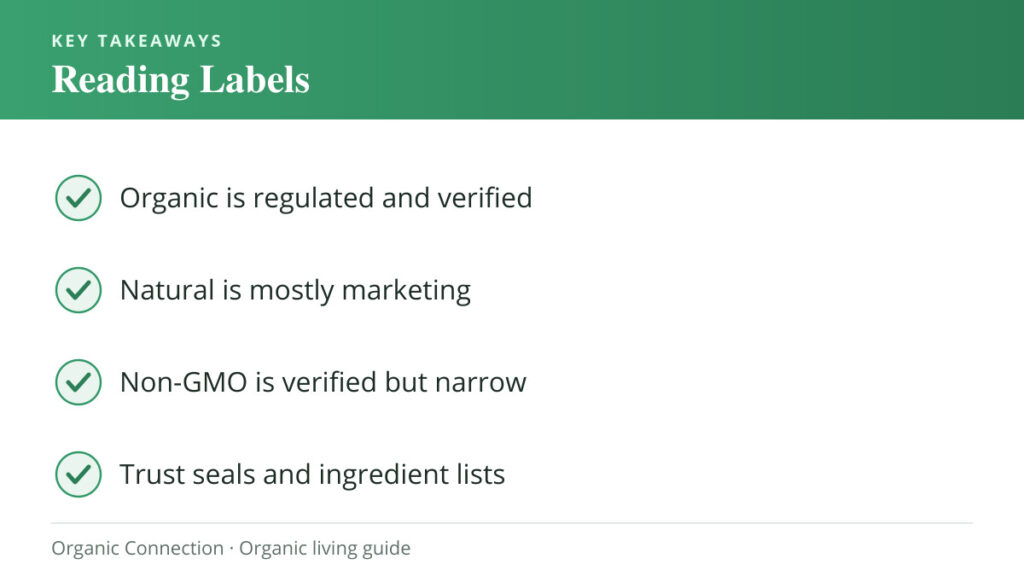
“Organic” is a regulated, inspected claim you can trust, especially on food carrying the USDA seal. “Non-GMO” is verified but narrow, and already included inside organic. “Natural,” “clean,” “green,” and their relatives are, on most products, unregulated marketing that verify nothing. The skill that ties it all together is simple: trust seals and ingredient lists, be skeptical of adjectives, and match your expectations to what is realistic in each category. For the full breakdown of which seals mean what, read our guide to organic certifications, and see the standard in action across our reviews.
Where each claim is worth paying for
Knowing what the words mean only helps if it changes what you put in the basket. Three rules of thumb, in the order they save money.
Pay for organic where the crop is sprayed and the part you eat is exposed. Soft fruit, leafy greens, and the grains where pre-harvest application is common are where certification buys the most. Our Dirty Dozen and Clean Fifteen explainer covers the produce end of that judgement, and it is the one place where a shopping list can be reordered on evidence.
Do not pay twice for the same promise. A certified organic product carrying a separate non-GMO mark is usually charging for a guarantee organic certification already includes, since excluded methods are prohibited in organic production. One seal is doing the work of two.
Treat “natural” as free. It costs the manufacturer nothing to print and it is verified by nobody, so it should not carry a premium. Where a product is genuinely simple, the ingredient list proves it in a way the word never can — which is the method in our explainer on how to read an ingredient list.
The questions each label cannot answer
Even the strongest of these claims leaves gaps, and naming them is the fastest way to stop over-reading a package.
- None of them covers contaminants. Lead, cadmium and arsenic come from soil and water rather than from prohibited inputs, so no seal on this page addresses them. That is the subject of our explainer on heavy metals in organic food.
- None of them measures nutrition. An organic biscuit is a biscuit. The nutrition panel is a separate document answering a separate question.
- None of them guarantees a residue result. Organic certification audits practice; drift and shared equipment exist. Published testing is the only thing that speaks to outcome.
- None of them says anything about labor or price paid to growers. That is what Fair Trade certification addresses, and we compare the two in fair trade versus organic.
- None of them tells you the product is good. Freshness, variety, processing and craft decide that, and they are invisible to every certification scheme.
Read that way, the labels stop competing and start dividing the work. Organic answers how it was grown and handled. Bioengineered disclosure answers one factual question about genetics. Non-GMO verification answers the same question privately. “Natural” answers nothing you could check. And the ingredient panel, the nutrition panel and a published test result answer everything else.
The three organic tiers, with the numbers
“Organic” is not one claim. The National Organic Program rule at 7 CFR 205.301 sets three composition categories, measured by weight or fluid volume excluding water and salt:
| Label category | Required organic content | What it means on the shelf |
| 100 percent organic | 100% organically produced ingredients | Rare on multi-ingredient foods, common on single-ingredient ones such as rolled oats or coffee |
| Organic | Not less than 95% organically produced | The standard case. The remaining 5% must come from the National List |
| Made with organic ingredients | At least 70% organically produced | May name up to three organic ingredients on the front. May not use the USDA seal |
The 70% tier is where shoppers are most often caught out, because the front of the pack can say “made with organic tomatoes” in large type while nearly a third of the product is conventional. Nothing is being hidden: the tier is disclosed by the wording itself, and the absence of the USDA seal is the visual tell.
Below 70%, organic ingredients may only be identified in the ingredient list. A product listing “organic sugar” among its ingredients is making a claim about that ingredient and no claim at all about itself.
“Natural” has no definition, and the FDA says what it does not cover
The contrast with organic could hardly be sharper, and the FDA’s own wording is the clearest statement available.
The agency has not established a formal definition of “natural” through rulemaking. It maintains a longstanding policy under which natural means “nothing artificial or synthetic (including all color additives regardless of source) has been included in, or has been added to, a food that would not normally be expected to be in that food.”
The exclusions are the substance. The FDA states that this policy does not address:
- Food production methods, including pesticide use
- Food processing or manufacturing methods, including thermal technologies, pasteurization and irradiation
- Nutritional or health benefits
So “natural” is a narrow statement about what was added to a food, not about how the crop was grown, how the product was processed, or whether it is good for you. A heavily processed food from a sprayed crop can carry the word without contradiction.
That is the whole difference in one line: organic is an audited claim about a process; natural is an informal claim about ingredients. One has certifiers, annual inspections and a public register. The other has a policy statement and no verification.
Non-GMO, bioengineered, and which one is the law
The third term has changed recently enough that most shelf talkers are out of date.
“Non-GMO Project Verified” is a private certification run by a non-profit. It has a standard, it audits, and it is meaningful within its scope — which is genetic engineering alone. It says nothing about pesticides, and a Non-GMO Project verified crop may be sprayed conventionally.
“Bioengineered” is the regulated term in the United States, under the National Bioengineered Food Disclosure Standard. Where a food contains detectable modified genetic material within scope of the standard, disclosure is required — through on-pack text, a symbol, a digital link or a text message option. It is a disclosure regime rather than a safety judgement.
Organic already excludes it. Under 7 CFR 205.105, excluded methods — the regulation’s term for genetic engineering — may not be used in organic production. This is why paying separately for both an organic seal and a non-GMO seal is usually paying twice for one promise, and the reason we say so on individual guides such as organic soy milk, popcorn, where the two seals appear together most often.
Reading the three together
| Claim | Who verifies it | What it actually covers |
| USDA Organic | Accredited certifier, annual inspection, public register | Farming inputs, processing aids, excluded methods, chain of custody |
| Natural | Nobody | Informally, that nothing artificial was added. Not production, processing or nutrition |
| Non-GMO Project | Private non-profit certification | Genetic engineering only |
| Bioengineered | Mandatory federal disclosure | Presence of detectable modified genetic material, disclosed — not a safety claim |
The practical ranking for a shopper follows directly: an organic seal with a certifier named is the strongest single claim on a food package, a bioengineered disclosure is a fact rather than a judgement, a Non-GMO Project mark is a narrow verified claim, and “natural” is a word. Our guides apply that ranking product by product — see organic oatmeal, peanut butter, honey, ketchup and chicken broth, where “natural” appears most often as a substitute for certification rather than an addition to it.
Common questions about these three labels
Is organic better than natural?
As claims, yes. “Organic” on food is legally regulated and independently verified, while “natural” is unregulated marketing on most products. A product labeled organic has been inspected against a published standard; a product labeled natural has not. That does not mean every natural product is bad, but the organic claim is the one backed by verification.
Can a product be natural but not organic?
Yes, easily. “Natural” has no consistent legal definition, so a product can be marketed as natural while containing conventionally farmed, pesticide-treated, or even synthetic ingredients. Organic certification is a much higher and verified bar. Always check for a real certification seal rather than relying on the word natural.
Is non-GMO the same as organic?
No. Non-GMO only means the absence of genetically modified organisms. Organic covers GMOs plus synthetic pesticides, fertilizers, processing, and more, and is verified by inspection. All organic products are non-GMO, but non-GMO products are not necessarily organic, since they can still use synthetic pesticides.
What does “clean” mean on a label?
On most products, “clean” has no regulated definition and verifies nothing. It is a marketing term that can accompany good or mediocre products alike. To judge a product, look for a real certification seal and read the ingredient list rather than trusting the word clean.
How can I avoid greenwashing?
Look for an independent certification seal before trusting any health or eco claim, read the ingredient or fiber list instead of the front-of-package adjectives, and be skeptical of vague words with no standard behind them, like pure, clean, or non-toxic. Verification lives in seals and ingredient lists, not in marketing language.
Keep reading
- What “Organic” Really Means: A Guide to Certifications
- The Dirty Dozen and Clean Fifteen: Where Buying Organic Matters Most
- How to Build an Organic Pantry Without Overspending
- How we research and rate products
- Organic Product Database — search every product we have reviewed, by certification
Organic Connection is reader-supported. When you buy through links in our reviews we may earn a commission, at no extra cost to you. As an Amazon Associate we earn from qualifying purchases. We are not paid to feature or rank any product. How we research and rate.