Last updated: September 23, 2026
We may earn a commission when you buy through links on this page, at no extra cost to you. How we research and rate.
The short version
Our top pick is 365 by Whole Foods Market Organic Ketchup, with an Organic Integrity Score of 92 out of 100. It is the cheapest bottle in this comparison and the only one whose listing states “USDA certified organic” in those words.
That combination is the finding. We read five organic ketchup listings in full, and the certification language runs from a specific regulated claim down to nothing at all, in inverse order to the price.
Before any of that, the thing worth knowing about ketchup generally: it is roughly a quarter sugar by weight, and choosing organic does not change that. Organic cane sugar is still sugar. If sugar is your reason for shopping, the word to look for is unsweetened or no sugar added, not organic.
Best organic ketchup compared
 |  |  |  |  | |
| Product | 365 Organic Ketchup | Heinz Organic | 365 No Sugar Added | Suzie’s Organic | Woodstock Organic |
| Organic Integrity Score | 92/ 100 | 86/ 100 | 80/ 100 | 66/ 100 | 60/ 100 |
| Our rating | 4.6 | 4.3 | 4.0 | 3.3 | 3.0 |
| Certification wording | “USDA certified organic” | “Certified organic tomatoes” | “Organic”, unqualified | Organic in title only | Organic in title only |
| Sweetener | Sweetened | Sweetened, no HFCS | No sugar added | Sweetened | Sweetened |
| Size | 24 oz | 32 oz squeeze | 16.6 oz | Standard | 20 oz |
| Feature bullets published | 2 | 4 | 2 | 2, marketing only | None |
| Best for | Everyday, best documented | Households that use it | Cutting added sugar | Not our recommendation | Not our recommendation |
| Certification | USDA Organic | Certified Organic, Gluten-free | Non-GMO, Organic | — | — |
| Price | $3.49$0.15 / ounce View on Amazon | $7.48$0.23 / ounce View on Amazon | $3.14$0.19 / fluid ounce View on Amazon | Currently unavailable See buying options | $12.01$0.60 / ounce View on Amazon |
- Organic Food and Pantry hub
- our organic product database — compare brands across every guide
- Best Organic Mayonnaise
- How to read an ingredient list
Price and availability as of October 15, 2026 1:10 pm EDT. Product prices and availability are accurate as of the date/time indicated and are subject to change. Any price and availability information displayed on Amazon.com at the time of purchase will apply to the purchase of this product.
What organic actually changes in ketchup
Ketchup is tomatoes, a sweetener, vinegar, salt and spices. Organic certification governs how those were grown and processed, and its practical effects are narrower than the label suggests.
What it does change: the tomatoes were grown without most synthetic pesticides and fertilizers, the sweetener is organic cane sugar rather than conventional sugar or high-fructose corn syrup, and no synthetic preservatives or artificial colors are permitted.
That HFCS point is the one most people are actually buying. Conventional ketchup in the United States is typically sweetened with high-fructose corn syrup, and every organic ketchup avoids it because HFCS is not permitted under the standard. Heinz makes exactly this point in its organic listing, noting the product has “no high-fructose corn syrup”.
What it does not change: the sugar load. A tablespoon of ketchup contains roughly four grams of sugar, which is about a teaspoon, and it is around a quarter of the product by weight. Organic cane sugar and conventional sugar are metabolically identical. Nor does organic certification make ketchup lower in sodium.
So the honest framing: organic ketchup is a meaningful choice about agriculture and about corn syrup. It is not a meaningful choice about sugar, and a bottle that says organic in large type and nothing about sweetener is answering a different question from the one many shoppers think they are asking.
The certification ladder, cheapest to dearest
This is where the five listings separate, and the ordering is the opposite of what price would predict.
“USDA certified organic”. The 365 Organic Ketchup listing says exactly this. It is the regulated phrase, it refers to the finished product, and at 95% or more organic ingredients by weight it is the tier that may carry the USDA seal. This bottle costs $2.68.
“Made with certified organic tomatoes”. Heinz phrases its claim around the ingredient rather than the product. The title says Organic Tomato Ketchup, which under the standard does imply the 95% tier, but the bullet itself certifies the tomatoes. It is a component claim, and it is the same shape as a water filter certifying its cartridge rather than its system.
“Organic”, unqualified. The 365 No Sugar Added listing says “organic no sugar added ketchup” and “made with organic tomatoes”, and does not repeat the “USDA certified” wording its own sibling product uses. Same brand, same shelf, weaker sentence.
Organic in the title, marketing in the body. Suzie’s says its ketchup “adds organic character to everyday meals”, which is a description of flavor rather than a certification claim.
Nothing in the body at all. The Woodstock listing returns no feature bullets, so the only organic claim attached to it is the word in the product title. It is also the most expensive bottle here.
We want to be careful about what this does and does not prove. All five products are sold as organic and we have no evidence any of them is not. A product title carrying the word organic is itself a regulated claim. What differs is how much each manufacturer was willing to write down where a shopper can read it, and that is what we score.
Sugar, and the sweetener names that hide it
If you are buying ketchup with sugar in mind, the ingredient list matters more than the front of the bottle.
Standard organic ketchup is sweetened with organic cane sugar. The no-sugar-added versions replace it with nothing, or occasionally with a fruit or vegetable concentrate for body.
The names to notice are the ones that read as healthier without being lower in sugar. Organic cane sugar, evaporated cane juice, organic tapioca syrup, brown rice syrup, agave nectar and fruit juice concentrate are all added sugars, and all count toward the added sugars line on the nutrition panel. Agave in particular is often assumed to be a health choice; it is very high in fructose and is sugar by any useful definition.
The one genuinely different option is the no-sugar-added format, which in this comparison is the 365 No Sugar Added bottle. It is not the same product with less sugar. It is a noticeably different condiment, sharper and more tomato-forward, because sugar was doing a lot of work balancing the acidity of concentrated tomato and vinegar.
People who switch either adapt within a week or dislike it permanently, and there is little middle ground. If you are unsure, buy the small bottle first.
What the tomatoes actually give you
Tomato products are one of the few categories where processing improves the nutrition, which is worth knowing because it cuts against instinct.
Lycopene, the carotenoid that makes tomatoes red, becomes more bioavailable when tomatoes are cooked and concentrated. Ketchup is cooked, concentrated tomato, so it delivers lycopene efficiently. Fat helps absorption, which is a small argument for ketchup alongside something cooked in oil.
The caveat is portion size. A tablespoon is a tablespoon, and nobody eats ketchup in quantities that make it a meaningful source of anything. It is a condiment, and the useful goal is choosing a decent one rather than treating it as nutrition.
Where organic tomatoes genuinely matter is the growing question rather than the nutritional one. Tomatoes are not among the crops with the heaviest conventional pesticide load, so the difference is smaller here than it would be for, say, strawberries. It is a real difference and a modest one.
Bottle format is worth more thought than it sounds
Ketchup is a product people keep for months, and format decides how much of it you actually use before it turns.
Inverted squeeze bottles, which is what the Heinz 32 oz is, keep the product at the nozzle and stay usable to the last serving. They are the practical default for a household that gets through ketchup.
Upright glass jars and bottles look better and waste more, because the last inch is difficult to get out and separation is more visible.
Size against household is the real decision. A 32 oz bottle is excellent value per ounce and poor value if half of it is thrown away. Organic ketchup without synthetic preservatives keeps roughly a month in the refrigerator after opening, sometimes a little longer, and the no-sugar-added versions tend to keep less well because sugar is itself a preservative.
That last point matters for the price comparison below. The cheapest bottle per ounce is only the cheapest if you finish it.
What we looked for
We read every feature bullet on every listing in full and scored on what each manufacturer put in writing.
The exact certification wording. “USDA certified organic” is a regulated claim about the finished product. “Made with organic tomatoes” is a claim about an ingredient. The distance between them is the whole of this comparison.
Whether the sweetener is named, and whether a no-sugar-added claim is made explicitly rather than implied.
Whether HFCS is addressed. It is excluded by the standard anyway, so saying so is informative rather than distinguishing, and it tells you the listing was written for a reader.
Price per ounce rather than price, since bottle sizes in this category range from 16.6 oz to 32 oz.
Brand concentration. A point we added after this guide’s previous version: its picks were heavily weighted to a single brand, and when that brand went out of stock the entire comparison went with it. We now spread picks across manufacturers deliberately.
Best overall: 365 by Whole Foods Market Organic Ketchup
| Organic Integrity Score | 92 / 100 |
| Certification | USDA Organic |
| Sweetener | Sweetened; standard organic formulation |
| Size | 24 oz |
| Best for | Everyday ketchup, from the listing that says the most for the least money |
The cheapest bottle in the comparison and the only one that uses the regulated phrase.
The listing is two bullets long, and both of them do work: “USDA certified organic” and “made with organic tomatoes”. The first is the claim that matters, because it refers to the finished product rather than an ingredient, and at that tier the product meets the 95% threshold and may carry the seal.
There is nothing else in the listing, and in this case we do not mind. A short listing that contains the certification claim in its regulated form is worth more than a long one that talks around it, and this is the clearest example of that principle we have found in a food category.
At 24 oz it is the sensible middle size: enough to be good value, not so much that a small household throws half away. It is a conventional sweetened ketchup, so it tastes like ketchup is supposed to, which for most buyers is the point.
The limits are what the listing does not say. No sweetener is named, no sodium figure is given, and there is no statement about high-fructose corn syrup, which is excluded by the standard anyway but which competitors mention. And as a supermarket own-brand it is subject to the availability of a single retailer’s supply chain.
- The only listing here stating “USDA certified organic” in those words.
- Cheapest bottle in the comparison.
- 24 oz is the practical middle size for most households.
- Strong sales rank, so turnover is high and stock is fresh.
- Only two feature bullets, so no sweetener or sodium detail.
- Sweetened, so not the choice if added sugar is your concern.
- Own-brand, tied to one retailer’s supply.
- Upright bottle rather than an inverted squeeze.
What the listing discloses: On the 365 by Whole Foods Market label: USDA organic certification. Not stated: where it was grown or made.
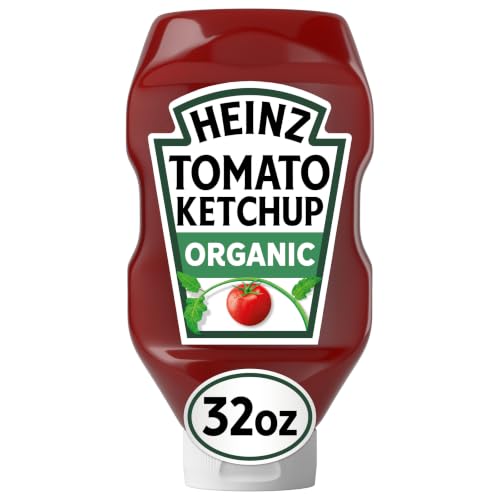
Best for households that use it: Heinz Organic Tomato Ketchup, 32 oz
| Organic Integrity Score | 86 / 100 |
| Certification | Certified Organic, Gluten-free |
| Format | 32 oz inverted squeeze bottle |
| Also stated | No high-fructose corn syrup, gluten-free, SNAP EBT eligible |
| Best for | Families and anyone who gets through a large bottle |
By a wide margin the best selling organic ketchup here, and the one most people will find familiar.
It is also the most informative listing in the comparison, with four bullets covering format, sourcing, sweetener and eligibility. The 32 oz inverted squeeze bottle is the practical winner on format: the product sits at the nozzle, it stays usable to the end, and per ounce it is excellent value if your household actually finishes it.
The stated exclusion of high-fructose corn syrup is worth noting even though it is guaranteed by the standard. It tells you the listing was written to answer the question people actually have about ketchup, and the gluten-free and SNAP EBT lines are the same instinct.
What keeps it below our top pick is the wording of the certification claim. Heinz says the ketchup is “made with certified organic tomatoes”, which certifies the ingredient rather than the finished product. The title, “Organic Tomato Ketchup”, does carry the regulated product-level claim, so the 95% tier applies. But the sentence a shopper reads in the bullets is about the tomatoes, and we score published wording rather than what we can infer around it.
The other consideration is size. 32 oz is a lot of ketchup for a small household, and organic ketchup without synthetic preservatives keeps roughly a month once opened. Excellent per ounce, wasteful if half of it goes.
- Most informative listing here, four substantive bullets.
- Inverted squeeze bottle stays usable to the last serving.
- States plainly that there is no high-fructose corn syrup.
- Best selling organic ketchup in this comparison by a distance.
- Best value per ounce if you finish the bottle.
- Certifies the tomatoes rather than the finished product in its bullets.
- 32 oz is too much for a small household given roughly a month of fridge life.
- Sweetened, with no sugar figure given.
- No sodium information published.
What the listing discloses: Sparse documentation from HEINZ — nothing on whether the USDA seal applies and where it was grown or made.
Best for cutting added sugar: 365 Organic No Sugar Added Ketchup
| Organic Integrity Score | 80 / 100 |
| Certification | Non-GMO, Organic |
| Sweetener | No sugar added |
| Size | 16.6 oz |
| Best for | Cutting added sugar, if you accept a sharper condiment |
The only no-sugar-added bottle in the comparison, and the reason to buy it is straightforward: it is the one product here that changes the thing most people are actually trying to change.
Ketchup is roughly a quarter sugar, and removing it removes about four grams per tablespoon. If you use ketchup daily, that is a real reduction, and it is a larger practical difference than switching from conventional to organic.
Be ready for the taste. Sugar is doing structural work in ketchup, balancing the acidity of concentrated tomato and vinegar, and taking it out leaves something sharper, thinner and much more tomato-forward. It is a different condiment rather than a lighter version of the same one. The 16.6 oz size is the right way to find out whether you like it.
What costs it points is a curiosity we would not have noticed without reading both listings side by side. This product’s sibling, the regular 365 Organic Ketchup, states “USDA certified organic”. This one says only “organic no sugar added ketchup” and “made with organic tomatoes”. Same brand, same retailer, same shelf, and the stronger phrase appears on one and not the other.
We are not suggesting the certification differs. Both are sold as organic and the title claim is regulated. It is a disclosure inconsistency within one brand, and since disclosure is what we score, it costs this bottle the twelve points between it and its sibling.
Practical note: no-sugar-added ketchup keeps less well once opened, because sugar is itself a preservative. Use it faster than you would the regular kind.
- The only no-sugar-added option here, removing roughly four grams per tablespoon.
- 16.6 oz is the right size to trial an unfamiliar taste.
- Same retailer and supply chain as our top pick.
- Inexpensive.
- Drops the “USDA certified” wording its own sibling product uses.
- Noticeably sharper and thinner than standard ketchup.
- Shorter fridge life once opened, since sugar preserves.
- Smallest bottle here, so the worst value per ounce.
What the listing discloses: 365 by Whole Foods Market leaves the basics open, including whether the USDA seal applies and where it was grown or made.
Organic in the title, marketing in the body: Suzie’s Organic Ketchup
| Organic Integrity Score | 66 / 100 |
| Certification | — |
| Body copy | Two bullets, both describing flavor and the brand’s range |
| Availability | Showing limited stock when we checked |
| Best for | Not our recommendation while better documented bottles cost less |
A small-brand organic ketchup whose listing tells you almost nothing about the product.
The two feature bullets describe flavor and the brand’s wider condiment range. One says the ketchup “adds organic character to everyday meals”, which reads as a description of taste rather than a certification claim, and the other is about the company’s mustards, dressings and olives.
The organic claim on the title is real and regulated, and we are not questioning it. What is missing is any statement about certification, sweetener, size or ingredients in the place where a shopper reads about the product.
It also costs roughly three times our top pick and was showing limited stock when we looked, which for a condiment with months of shelf life is worth noticing before ordering.
If you have tried it and like it, none of this is an argument against buying it again. As a recommendation to someone choosing between five bottles on evidence, it does not compete.
- Organic claim on the title is regulated and real.
- Small-brand alternative to supermarket own-label and Heinz.
- Part of a wider organic condiment range if you want to match products.
- No certification statement anywhere in the body copy.
- Bullets describe flavor and the brand rather than the product.
- Roughly three times the price of our top pick.
- Limited stock when we checked.
What the listing discloses: Suzie’s leaves the basics open, including whether the USDA seal applies and where it was grown or made.
The most expensive bottle with the least written down: Woodstock Organic
| Organic Integrity Score | 60 / 100 |
| Certification | — |
| Size | 20 oz |
| Price position | Most expensive bottle in this comparison |
| Best for | Not our recommendation on published evidence |
This bottle exists in this comparison to make a point, and the point is the arithmetic at the top of the page.
The listing returns no feature bullets at all. Not a certification statement, not an ingredient note, not a size description beyond the title. The only organic claim attached to the product is the word in its name.
It is also the most expensive bottle here, at roughly four times the price of our top pick for a smaller bottle. Set the two side by side: $2.68 for a listing that says “USDA certified organic”, and $9.99 for a listing that says nothing.
Woodstock is a long-established organic brand and we have no reason to doubt the product. Empty feature bullets are frequently a listing-maintenance problem rather than a statement about quality, and a well-regarded product can sit behind a neglected page.
But we score what is published, consistently, and a page with nothing on it cannot be evaluated. In a category where a competitor gives you the regulated phrase for a quarter of the money, there is no argument for choosing this on the evidence available.
- Long-established organic brand with a broad natural foods range.
- Organic claim on the title is regulated.
- 20 oz sits between the small and large options here.
- No feature bullets whatsoever, so nothing about the product can be checked.
- Most expensive bottle in the comparison, for a mid-size bottle.
- No certification, sweetener or ingredient statement published.
- Roughly four times the price of the best-documented option.
What the listing discloses: Beyond the organic claim itself, Woodstock Farms does not say whether the USDA seal applies and where it was grown or made.
What we left out and why
We left out the picks from this guide’s previous version. Every one of them had gone out of stock, and four of the five were from a single manufacturer, which is how an entire comparison table went dark at once. That was our error in construction rather than the brand’s, and it is why this version deliberately spreads across five different producers.
We left out conventional ketchups marketed as “natural” or “no sugar added” without an organic claim. They are legitimate products answering a different question, and Heinz’s own non-organic no-sugar-added bottle is a reasonable buy if organic is not your requirement.
We left out multi-packs and food-service sizes, which distort price comparisons and which almost nobody needs at home.
And we left out ketchups whose only distinguishing claim was a flavor variant, since spicy or curry versions are a taste preference rather than a certification question.
How to store it and how long it keeps
Organic ketchup behaves slightly differently from conventional, and the difference catches people out.
- Store upright in a cool, dark cupboard. Unopened ketchup keeps for a year or more.
- Check the date on arrival if you have ordered a large bottle, since a long shelf life at the warehouse is not the same as a long one in your kitchen.
- Do not buy the largest size on price per ounce alone. Work out how long a bottle actually lasts in your house first.
- Refrigerate. Organic ketchup has no synthetic preservatives, so it relies on acidity, salt and sugar, and the fridge does the rest.
- Expect roughly a month of good condition, sometimes longer. Conventional ketchup with synthetic preservatives lasts longer, which is the honest trade.
- Use no-sugar-added versions faster. Sugar is a preservative, and removing it shortens the window.
- Wipe the nozzle. Dried ketchup around a squeeze cap is where spoilage starts.
- Darkening at the neck of the bottle is oxidation and is harmless.
- Watery separation is normal in products without stabilizers. Shake it.
- Any smell of fermentation, fizzing on opening, or mold at the rim means discard the bottle rather than the top inch.
Questions about organic ketchup
Is organic ketchup lower in sugar?
No. Organic ketchup is sweetened with organic cane sugar rather than high-fructose corn syrup, and the amount is similar: roughly four grams per tablespoon, or about a quarter of the product by weight. If sugar is your concern, look for “no sugar added” rather than “organic”, which is a different claim entirely.
What does organic actually change in ketchup?
The tomatoes were grown without most synthetic pesticides and fertilizers, the sweetener is organic cane sugar rather than high-fructose corn syrup, and synthetic preservatives and artificial colors are not permitted. It does not change the sugar load or the sodium.
What is the difference between “USDA certified organic” and “made with organic tomatoes”?
The first is a claim about the finished product at the 95% tier, which may carry the USDA seal. The second certifies an ingredient. Both appear in this comparison, on different bottles, and a product title carrying the word organic is itself a regulated claim regardless of how the bullets are worded.
Does organic ketchup taste different?
Standard organic ketchup tastes essentially like conventional ketchup, since the formulation is similar and cane sugar and corn syrup are close in effect. No-sugar-added versions taste markedly different: sharper, thinner and much more tomato-forward, because sugar was balancing the acidity.
How long does organic ketchup last once opened?
Roughly a month refrigerated, sometimes longer. It has no synthetic preservatives, so it keeps less well than conventional ketchup, and no-sugar-added versions keep less well again because sugar is itself a preservative.
Is agave-sweetened ketchup healthier?
No. Agave nectar is very high in fructose and counts as added sugar on the nutrition panel like any other. The same applies to evaporated cane juice, tapioca syrup, brown rice syrup and fruit juice concentrate, all of which read as gentler than they are.
Why is the cheapest organic ketchup the best documented?
We do not know, and it surprised us. In this comparison the $2.68 bottle states “USDA certified organic” while the $9.99 bottle publishes no feature bullets at all. Listing quality reflects how much effort a company puts into its product page, and that is not the same thing as product quality or price.
Does ketchup need refrigerating?
Once opened, yes, particularly organic ketchup without synthetic preservatives. Restaurants leave bottles out because turnover is fast enough that it does not matter; a bottle in a home kitchen lasts weeks and should be cold.
Is ketchup a good source of lycopene?
It is a concentrated one, since cooking and concentrating tomatoes makes lycopene more bioavailable, and fat aids absorption. Portion size is the limit: nobody eats enough ketchup for it to be a meaningful source of anything, and it is best treated as a condiment you may as well choose well.
Should I buy the biggest bottle?
Only if you will finish it inside about a month of opening. A 32 oz bottle is the best value per ounce here and the worst value overall if half of it is discarded. Match the size to how quickly your household actually gets through it.
Organic Connection is reader supported. We read every product listing in full and say plainly when a claim cannot be verified. How we research and rate.