Last updated: September 21, 2026
Some links in this guide point to our product reviews, which may earn us a commission at no extra cost to you. How we research and rate.
An ingredient list is the most honest part of any package, and almost nobody reads it properly. The front of a box is advertising, subject to loose rules and creative interpretation; the ingredient list is a legally required declaration with a fixed structure. Once you understand that structure, which is the same across food, skincare, and cleaning products, you can evaluate almost anything in under thirty seconds. This guide covers how the three kinds of label work, the specific tricks used to hide things inside them, and what to actually look for in each category.
How food labels work
US food labels have two mandatory parts: the ingredient list and the Nutrition Facts panel. Both are regulated, and both are more informative than anything on the front.
Reading the ingredient list
Ingredients appear by weight, descending. For most foods, the first three ingredients are the product; everything after that is seasoning, texture, and preservation. A “whole grain” cereal whose first ingredient is refined flour is a refined flour product with some whole grain in it. A “fruit” snack whose first ingredient is corn syrup is a confection.
Two structural quirks matter. Water counts as an ingredient and often ranks first in sauces and beverages, which is normal rather than sinister. And compound ingredients get parenthetical sub-lists, so a “seasoning blend (salt, spices, natural flavors)” hides several things inside one position.
Reading the Nutrition Facts panel
The single most misread number here is the serving size, which is set by the manufacturer within FDA guidance and frequently bears no relation to what a person actually eats. A bottle of juice listing two servings, a bag of chips listing three, a cereal serving of 30 grams when a real bowl is 70: all of these halve or third the numbers underneath. Always check what a serving actually is before comparing anything.
The “added sugars” line, separated out on modern US labels, is the genuinely useful addition. It distinguishes sugar naturally present in fruit or dairy from sugar put in by the manufacturer, which is the number that matters. And the percentage daily values are based on a 2,000 calorie reference diet that may not be yours; use them for comparing products against each other rather than as personal targets.
Where sugar hides in food
Because ingredients are ordered by weight, a manufacturer can keep sugar out of the top position simply by using several different sweeteners, each of which weighs less individually than the flour or grain in first place. A product can be a third sugar with no sweetener in the top three ingredients. These all count as sugar:
- Obvious: sugar, cane sugar, brown sugar, honey, maple syrup, molasses.
- Syrups: corn syrup, high-fructose corn syrup, brown rice syrup, tapioca syrup, glucose syrup, malt syrup, agave nectar.
- Fruit-derived: fruit juice concentrate, evaporated cane juice, date paste, apple juice concentrate.
- The “-ose” family: dextrose, maltose, fructose, sucrose, lactose, galactose.
- Less obvious: maltodextrin, barley malt, caramel, treacle, panela, muscovado.
The reliable check is not the ingredient list at all: it is the “added sugars” figure on the panel, compared against the serving size in grams. We walk through this specifically for breakfast in our guide to organic cereal, where the gap between marketing and panel is unusually wide.
How skincare labels work, and why they are different
Cosmetic labeling in the US operates under much looser rules than food, and understanding the differences is what protects you from the claims that fill the category.
INCI names
Cosmetic ingredients are listed using International Nomenclature of Cosmetic Ingredients names, which are standardized globally. This is why you see Latin botanical names: Butyrospermum parkii is shea butter, Simmondsia chinensis is jojoba, Argania spinosa is argan. Marketing often uses the common name on the front and the INCI name in the list, which makes a product look like it contains more distinct ingredients than it does. Learning the ten or fifteen INCI names for the oils you care about is a small investment that pays off constantly.
The one percent line
Ingredients above one percent concentration must be listed in descending order, but everything at or below one percent can be listed in any order the manufacturer chooses. In practice, the preservative system, phenoxyethanol, sodium benzoate, or similar, marks roughly where that line falls. Anything after it is present in a trace amount. So a “rosehip oil” serum with rosehip listed after the preservative contains a marketing quantity of rosehip and is mostly whatever appears in the first three positions, usually water, a humectant such as glycerin, and an emollient.
“Fragrance” as a legal black box
“Fragrance” or “parfum” is a single permitted entry that can represent dozens of undisclosed compounds, protected as trade secrets. It is the largest genuine transparency gap in personal care, and it is also the most common trigger of contact reactions. If you are trying to identify what a product did to your skin, fragrance is the ingredient you cannot investigate, which is why fragrance-free is such a useful default. We cover building a routine around this in Organic Skincare 101.
“Organic” on cosmetics means almost nothing
Unlike food, cosmetic “organic” claims are largely unregulated in the US. A brand can put the word on the front of a bottle without meeting any standard. What counts is a genuine USDA organic seal, certified organic ingredients named in the list, or a European certification like Ecocert or COSMOS. Everything else is a word. This is the single most exploited gap in the category, which is why we treat certification as the primary criterion in guides like organic argan oil and shea butter.
How cleaning product labels work
Household cleaning products have the weakest disclosure requirements of the three categories, and this is where reading the label helps least, which is itself the useful thing to know.
In most of the US, manufacturers are not required to disclose a full ingredient list on cleaning products, though some state laws and voluntary programs have improved this. Many brands now publish ingredients online or on pack, and that voluntary transparency is itself a meaningful signal: a company that lists everything is telling you something about its formulation. “Fragrance” applies here exactly as in cosmetics, and it is again the most common irritant.
Because you often cannot rely on the list, certification carries more weight in this category than any other. EPA Safer Choice means every ingredient has been reviewed against health and environmental criteria and the product still has to work. EWG Verified requires full disclosure including fragrance components. Those two marks do the work an ingredient list would otherwise do. Meanwhile “natural,” “green,” “eco-friendly,” “non-toxic,” and “chemical-free” have no regulatory definition on household products whatsoever, and the last of those is not even chemically coherent. Our non-toxic home guide goes through the categories in order of what actually matters.
Tricks that work across all three categories
Ingredient splitting
Using several forms of the same thing so none ranks high individually. Multiple sweeteners in food; multiple silicones or multiple alcohols in cosmetics. The fix is to mentally group related ingredients and ask what their combined weight would be.
The hero ingredient
Naming one appealing ingredient on the front, present in a trace amount at the bottom of the list. “With organic aloe,” “with argan oil,” “with real fruit.” The fix is to find that ingredient’s position, not just its presence.
Free-from claims about things that were never there
“Sulfate-free” on a product category that does not use sulfates, “BPA-free” on a material that never contained BPA, “gluten-free” on water. Technically true, engineered to imply competitors are worse.
Certification-shaped logos
Circular badges with green borders and leaf motifs that mimic real seals but belong to no independent body. The fix is knowing the genuine marks by sight: USDA Organic, GOTS, GOLS, OMRI Listed, Non-GMO Project Verified, Fair Trade Certified, EPA Safer Choice, OEKO-TEX, Leaping Bunny, Ecocert. We covered this in detail in our greenwashing guide.
Serving-size manipulation
Specific to food, but powerful. Halving the stated serving halves every number below it. Always convert to a realistic portion before comparing two products.
A thirty-second routine
You do not need to analyze everything you buy. This sequence catches the great majority of problems:
- Turn the package over. Ignore the front entirely; it is advertising.
- Read the first three to five ingredients. They are the product. Everything else is detail.
- Find whatever the front advertised. If it is not in the top few positions, the claim is decorative.
- Check for a real certification seal. If there is none, every environmental or organic claim on the pack is self-asserted.
- For food, check serving size against added sugars. For cosmetics, find the preservative and treat everything after it as trace. For cleaners, look for Safer Choice or EWG Verified.
Anything that survives all five is very likely what it claims to be. Anything that fails at step four is a product whose entire environmental story is the company’s own opinion of itself.
What not to worry about
A guide to reading labels should also say where label-reading anxiety is misplaced, because a lot of internet advice in this area is unhelpful.
Long chemical names are not inherently bad. Everything is a chemical. Tocopherol is vitamin E; ascorbic acid is vitamin C; sodium chloride is salt. The unpronounceability of an ingredient tells you about naming conventions, not safety. Judge by what something is and how much is present, not by how it sounds.
Preservatives are usually doing necessary work. A water-containing cosmetic without a preservative grows bacteria and mold, which is a far more concrete hazard than the preservative. The reasonable question is which preservative system, not whether to have one.
“Chemical-free” is meaningless. No product is free of chemicals. When you see the phrase, it tells you about the marketing department rather than the formulation.
Short ingredient lists are a good heuristic, not a rule. Simplicity is generally a positive signal, but a well-formulated product with twelve ingredients can easily beat a poorly formulated one with four. Use list length as a prompt to look closer, not as a verdict.
What to remember when reading a label
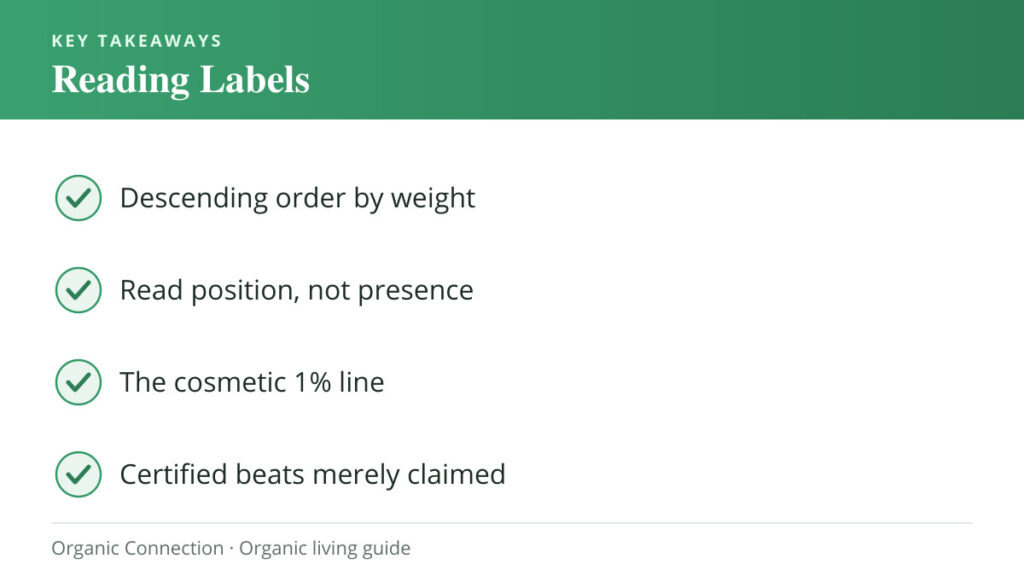
Every label in your shopping basket runs on the same underlying rule: descending order by weight. Once you read position rather than presence, the front of the pack loses most of its power, ingredient splitting becomes visible, hero ingredients reveal themselves as trace amounts, and the difference between a certified claim and an asserted one becomes the obvious question to ask. Food gives you the most information, cosmetics give you less and hide fragrance inside a legal black box, and cleaning products give you least, which is why certification matters most there. Five steps, thirty seconds, and you will make better decisions than any amount of front-of-pack reading can produce.
The rule behind the list: descending order, specific names
Two requirements govern almost everything on an ingredient panel, and once you know them the list becomes a document rather than a wall of text.
Order. Under 21 CFR 101.4(a)(1), ingredients must be listed by common or usual name “in descending order of predominance by weight”. The first three ingredients are most of the product. That is why a granola whose second ingredient is a syrup is a confectionery product wearing a health label, whatever the front of the box says.
Specificity. The same section requires that “the name of an ingredient shall be a specific name and not a collective (generic) name”, with limited exceptions for spices, flavorings and colorings. So “vegetable oil” without qualification is not generally acceptable where a specific oil is meant, while “spices” legitimately is.
The exception worth understanding is the compound ingredient. Where an ingredient is itself made of several things, a manufacturer may either name it and put its components in brackets in descending order, or skip the parent name and list the components directly in the main list. Both are legal, and they read very differently. The first produces the honest-looking “chocolate chips (sugar, cocoa mass, cocoa butter, soy lecithin)”. The second scatters those components through the list, which can leave sugar appearing further down the list than the amount actually present would suggest.
Neither approach is deceptive in itself. Knowing both exist is what lets you read a long list accurately rather than counting positions and stopping.
“Natural flavor” is a defined term, and the definition is broader than you think
This is the phrase that generates the most suspicion and the least understanding, so it is worth quoting the regulation rather than paraphrasing it.
21 CFR 101.22 defines natural flavor as “the essential oil, oleoresin, essence or extractive, protein hydrolysate, distillate, or any product of roasting, heating or enzymolysis, which contains the flavoring constituents derived from a spice, fruit or fruit juice, vegetable or vegetable juice, edible yeast, herb, bark, bud, root, leaf or similar plant material, meat, seafood, poultry, eggs, dairy products, or fermentation products thereof” — where the significant function is flavoring rather than nutrition.
Artificial flavor is defined as the mirror image: a flavoring substance not derived from any of those sources.
Three things follow, and they are the whole of the natural flavor question:
- “Natural” here describes the origin, not the process. A natural flavor can be the product of roasting, heating, enzymolysis or fermentation, and can arrive via distillation and extraction. It is not “the fruit itself”.
- The list can be long and it does not have to be disclosed. A single declaration of “natural flavor” can stand for a complex mixture, which is why it looks like one ingredient and behaves like many.
- It tells you nothing about quantity. Flavors are typically used at very small percentages, which is precisely why they sit at the end of ingredient lists.
The practical reading: “natural flavor” is neither a red flag nor a reassurance. It is a defined, permitted, undisclosed mixture of flavoring substances from biological sources. If you need to avoid a specific allergen or animal-derived material, the phrase is exactly where you have to ask the manufacturer, because the label alone cannot answer you.
Spices, colorings and the things that need not be declared
Two more provisions explain gaps people notice on labels and assume are errors.
Spices may be declared collectively. A product can say “spices” rather than naming each one, which protects recipes and is entirely legal. Where a spice also colors the food — paprika, turmeric and saffron are the usual cases — the declaration should reflect that, as “spice and coloring” or by the specific name.
Flavor declarations must state their nature. The list has to indicate whether flavoring is natural, artificial, or both, which is why you see “natural and artificial flavors” so often; it is a required disclosure rather than hedging.
Incidental additives can be exempt. Substances present at insignificant levels with no technical effect in the finished food — including some arriving via spices or flavors — need not be declared, under the incidental additive provisions. This is the mechanism behind processing aids that never appear on a label, and it is a genuine limit on what an ingredient list can tell you.
This is where certification does work that label-reading cannot. Organic certification audits inputs and processing at the facility rather than relying on what the panel prints, which is the argument we make in detail in understanding organic certifications and in our explainer on organic versus natural versus non-GMO.
Reading a panel in practice
The same method works on any product, and it takes about twenty seconds once it is habit.
- Read the first three ingredients and stop. They are most of what you are buying. Everything after is seasoning, texture and preservation.
- Count the sugars. Syrups, juices from concentrate, malt, dextrose, cane juice and honey are all sugars and each is listed separately, which spreads one ingredient across several positions.
- Check for a compound ingredient in brackets, and re-read the list mentally with its components merged into the main order.
- Treat “natural flavor” as unanswered rather than answered. It is defined but undisclosed.
- Then look at the front of the pack, and ask whether anything there is contradicted by what you just read.
We apply exactly this to the listings behind our guides, which is why pages like organic granola, breakfast cereal, protein bars, ketchup, peanut butter and baby food pouches spend as much time on ingredient panels as on certifications.
Common questions about reading ingredient lists
How are ingredients ordered on a label?
In descending order by weight, heaviest first. This applies to food and cosmetics alike and is the single most useful fact about labels. It means the first three to five ingredients are essentially the product, and anything named on the front that appears near the bottom of the list is present in a trace amount.
What is the 1% rule in cosmetics?
Ingredients present above one percent must be listed in descending order, but anything at or below one percent may be listed in any order. The preservative system, such as phenoxyethanol or sodium benzoate, usually marks roughly where that line falls, so ingredients appearing after it are present in trace amounts regardless of how prominently they feature on the front.
Why does “fragrance” appear instead of actual ingredients?
Because fragrance formulas are treated as trade secrets, a single “fragrance” or “parfum” entry can legally represent dozens of undisclosed compounds. It is the largest transparency gap in personal care and household products, and it is also the most common cause of contact reactions, which is why fragrance-free is a useful default if you are trying to identify a trigger.
Do organic claims mean the same thing on food and skincare?
No. On food, “organic” is legally defined and enforced through USDA-accredited certifiers with tiers at 100%, 95%, and 70% organic content. On cosmetics, the word is largely unregulated in the US and can appear without meeting any standard. On skincare, look for a genuine USDA organic seal, certified organic ingredients named in the list, or a European certification such as Ecocert or COSMOS.
Are long chemical names on labels bad?
Not inherently. Tocopherol is vitamin E, ascorbic acid is vitamin C, and sodium chloride is salt. Unpronounceability reflects naming conventions rather than safety. The useful questions are what an ingredient actually is and how much of it is present, which you determine from its position in the list, not how the name sounds.
Keep reading
- Greenwashing: 12 Label Tricks and How to Spot Fake Organic Claims
- Organic vs Natural vs Non-GMO: What Labels Actually Mean
- What “Organic” Really Means: A Complete Guide to Certifications
- The Non-Toxic Home: Cleaning and Laundry, Room by Room
- our full product index — search by brand, product or certification
Organic Connection is reader-supported. When you buy through links in our reviews we may earn a commission, at no extra cost to you. As an Amazon Associate we earn from qualifying purchases. We are not paid to feature or rank any product. How we research and rate.