
Last updated: September 30, 2026
We may earn a commission when you buy through links on this page, at no extra cost to you. How we research and rate.
The short version
After researching the certifications, extraction methods, and packaging of the most popular organic rosehip oils, our top pick is Pai Skincare Rosehip BioRegenerate Oil. It is certified organic by the Soil Association, CO2-extracted rather than solvent-refined, and sold in a light-blocking bottle, which is why it earned our highest Organic Integrity Score of 93 out of 100. For a straightforward USDA-certified cold-pressed oil, RosehipPLUS is our pick, and for the best value, Handcraft Blends Organic Rosehip Oil is the best choice.
Rosehip oil is one of the few facial oils where processing genuinely changes the product, because the compounds people buy it for are fragile. We flag each product’s certification, extraction method, and bottle type.
Best organic rosehip oil compared
| Best Choice | Best Value | ||||
 |  |  |  |  | |
| Product | Pai BioRegenerate 1 oz | RosehipPLUS 1.01 oz | Handcraft Blends 1 oz | USDA Amber Glass 2 oz | Eden’s Semilla 4 oz |
| Organic Integrity Score | 93/ 100 | 89/ 100 | 85/ 100 | 82/ 100 | 79/ 100 |
| Our rating | 4.7 | 4.5 | 4.3 | 4.1 | 4.0 |
| Extraction | CO2-extracted | Cold-pressed | Cold-pressed | Cold-pressed | Cold-pressed |
| Best for | Best overall | Certified cold-pressed | Best value | Glass dropper bottle | Face and body |
| Certification | Non-GMO, Vegan, Organic | — | — | USDA Organic | Certified Organic |
| Price | $54.00$53.47 / fluid ounce View on Amazon | $29.99$29.69 / fluid ounce View on Amazon | $7.99 View on Amazon | $19.99$10.00 / fluid ounce View on Amazon | $14.95$3.74 / fluid ounce View on Amazon |
Price and availability as of October 11, 2026 7:10 pm EDT. Product prices and availability are accurate as of the date/time indicated and are subject to change. Any price and availability information displayed on Amazon.com at the time of purchase will apply to the purchase of this product.
Scores are ours, based on independent research of certification, extraction method, ingredient purity, packaging, and value, using the same 10-criteria method we apply to every product. See how we research and rate.
What each certification on an organic rosehip oil label actually covers
Each certification below appears on at least one product on this page. They are not ranked against each other, because they measure different things, but knowing which is which changes what you buy.
| Certification | Covers | Key exclusion |
| USDA Organic | Farming and handling: no synthetic pesticides or fertilizers, no GMOs, no sewage sludge or irradiation, audited yearly by an accredited certifier | Three different tiers share the one seal, and it makes no claim about worker pay, food miles, or nutrition |
| COSMOS Organic | Cosmetics: organic content thresholds, permitted processes and ingredients, and packaging rules | Its sister grade, COSMOS Natural, carries the same name and requires no minimum organic content at all |
| Soil Association | The UK organic standard across food, textiles and beauty, in several places stricter than the legal minimum | A UK and EU scheme; it is not USDA Organic and the two are not interchangeable on a US label |
COSMOS is two standards with one name, and the weaker one is easy to miss. COSMOS Organic requires at least 95% of the plant ingredients to be organic. COSMOS Natural, printed in the same typeface by the same body, requires no minimum organic content whatsoever: it governs which ingredients and processes are permitted, not how much of the product is organic. If the word after COSMOS is “Natural”, the organic question is still open.
Key things to look for in organic rosehip oil
Great rosehip oil comes down to certification, extraction, packaging, and freshness. Here is what matters.
1. A real organic certification
Look for a USDA organic seal, Soil Association, COSMOS, or ACO. The word organic on the front of a bottle means nothing on its own in cosmetics.
2. Cold-pressed or CO2-extracted, and unrefined
Heat and solvents strip the carotenoids and fatty acids that make the oil worth buying. Unrefined oil is deep amber to orange, not pale yellow.
3. Dark glass with a dropper
Rosehip is one of the fastest-oxidizing cosmetic oils there is. Amber or violet glass protects it; clear plastic does not.
4. One ingredient
The list should read Rosa canina or Rosa rubiginosa seed oil, and at most a little vitamin E as a natural antioxidant. Anything else is dilution.
Why extraction method matters more here than on most oils
Most facial oils tolerate rough handling. Rosehip does not, and understanding why makes the price differences on this page make sense.
Cold-pressed. The seeds are mechanically crushed without added heat. This is the standard for a good rosehip oil and preserves most of the fatty acid profile and the carotenoids that give the oil its orange color. It is what you should expect at minimum from anything calling itself unrefined.
CO2-extracted. Pressurized carbon dioxide pulls the oil out at low temperature, then evaporates away completely, leaving no solvent residue. It typically yields a higher concentration of carotenoids and a deeper color, and it can also capture compounds from the fruit as well as the seed. It costs more, and it is the reason our top pick sits where it does.
Refined. Cheap rosehip oil is often solvent-extracted and then bleached and deodorized. The result is a pale, nearly odorless oil that is still technically rosehip oil but has lost much of what people buy it for. If an oil is very cheap, pale yellow, and has no smell, it has almost certainly been refined.
On the retinoic acid claims. Rosehip oil does contain trace all-trans-retinoic acid, and this gets stretched in marketing into comparisons with prescription tretinoin. The concentration is orders of magnitude lower. Rosehip is a good, well-tolerated emollient with reasonable evidence behind its use on scars and dry skin, and it is not a retinoid treatment. Buy it as a nourishing oil and you will be happy with it; buy it expecting prescription results and you will not.
What the clinical research actually shows
Rosehip oil has more published research behind it than most botanical oils, and it is worth being precise about what has actually been measured rather than repeating the marketing.
The composition. Rosehip seed oil is over 92% unsaturated fatty acids and over 77% polyunsaturated, dominated by linoleic acid (omega-6), alpha-linolenic acid (omega-3), and oleic acid. That very high polyunsaturated fraction is what makes it a light, fast-absorbing “dry” oil, and it is also precisely why it oxidizes so quickly, since polyunsaturated bonds are the most reactive. The oil also carries tocopherols, carotenoids, phytosterols, and phenolic compounds.
On wrinkles. A randomized trial in 34 participants aged 35 to 65 found a reduction in crow’s feet wrinkle depth of roughly 46% over the study period, an effect comparable to the astaxanthin comparator. This is a single small trial and the result is genuinely notable.
On scars. This is the best-supported use. A human trial using a rosehip seed oil preparation on post-surgical scars found significant reductions in atrophy, discoloration, and dyschromia over six to twelve weeks of twice-daily application. A 2023 review concluded rosehip oil may reduce post-surgical scar size and dampen the inflammatory signalling that drives excessive scarring. Animal and cell work supports the mechanism, showing faster healing, increased fibroblast proliferation, better collagen organization, and reduced inflammatory infiltration.
On pigmentation. Evidence here is weaker and largely preclinical. Animal studies have shown reduced UVB-induced pigmentation and reduced tyrosinase activity, the enzyme that drives melanin production. That is a plausible mechanism rather than a demonstrated result in humans.
On barrier function. Rosehip oil forms a light occlusive layer that slows transepidermal water loss, which is the straightforward, well-accepted part of how it works and does not require any of the more exotic claims.
Where the honest caveats sit. Most of these trials are small, several use rosehip powder or a specific commercial preparation rather than plain oil, and few have been replicated at scale. The retinoic acid question is genuinely contested: some reviews describe meaningful trans-retinoic acid in seed extracts, while dermatologists consistently point out the concentration is orders of magnitude below prescription tretinoin. The sensible reading is that rosehip is a well-evidenced emollient with good scar data and a plausible mild retinoid-adjacent effect, not a substitute for a prescribed retinoid.
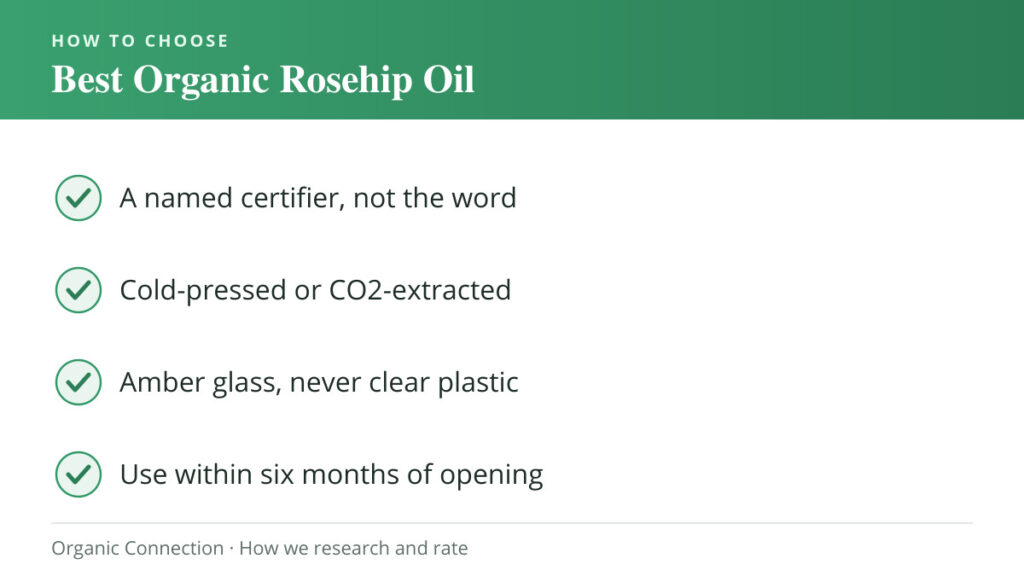
How to choose organic rosehip oil
- Confirm a named certifier. USDA, Soil Association, COSMOS, or ACO on the label, not just the word organic.
- Check it says cold-pressed or CO2-extracted, and unrefined.
- Look at the color. Good rosehip oil is amber to deep orange. Pale yellow suggests refining.
- Insist on dark glass. Amber or violet, with a dropper rather than a pump.
- Buy small. A 1 oz bottle used nightly lasts around three months, which is about how long it stays fresh once opened.
Who should buy organic rosehip oil
The right bottle depends on how you use it. If you want the highest-integrity extraction and will use it as a treatment oil, our top pick fits. If you want a simple certified cold-pressed oil, the best cost per ounce, a glass-dropper bottle, or a large size for face and body, we have a pick for each.
Best overall: Pai Skincare Rosehip BioRegenerate Universal Facial Oil
| Organic Integrity Score | 93 / 100 |
| Extraction | Supercritical CO2, seed and fruit |
| Certification | Non-GMO, Vegan, Organic |
| Best for | Sensitive skin and scar or texture work |
Pai is our top pick because it is the only oil here that uses supercritical CO2 extraction on both the seed and the fruit, which pulls a broader carotenoid profile than pressing the seed alone. The result is a noticeably deep orange oil with a rich, earthy smell. Pai is certified organic by the Soil Association, formulates specifically for sensitive and reactive skin, and adds no fragrance whatsoever, which matters on a product you leave on your face overnight. The bottle is dark glass with a pipette.
The trade-off is price. This is comfortably the most expensive oil per ounce in the guide, several times the cost of the value picks, and the deep color can leave a faint temporary tint on very fair skin if you apply too much. It is a treatment-sized bottle, not something to use on your whole body.
What we liked: Soil Association certified, CO2-extracted from seed and fruit, fragrance-free, dark glass pipette bottle, and a formulation aimed squarely at sensitive skin.
Keep in mind: The highest price per ounce here by some margin, and the deep color can tint fair skin briefly.
What the listing discloses: PAI SKINCARE leaves the basics open, including whether the USDA seal applies and where it was grown or made.
Best certified cold-pressed: RosehipPLUS Certified Organic Rosehip Oil
| Organic Integrity Score | 89 / 100 |
| Extraction | Cold-pressed, unrefined |
| Certification | — |
| Best for | A no-nonsense certified daily facial oil |
RosehipPLUS is Australian Certified Organic, which is a genuinely strict cosmetic standard and a stronger claim than an unnamed organic label. The oil is cold-pressed, unrefined, and a single ingredient, and it carries the deep amber color and characteristic earthy smell you want. It sits at a sensible mid-market price, which makes it the easiest recommendation here for someone who wants a properly certified oil without paying treatment-brand money.
The trade-off is that pressing only extracts the seed, so the carotenoid concentration is lower than a CO2 extract, and the bottle is small at just over an ounce. Australian certification is also less familiar to US buyers than a USDA seal, which makes it harder to verify at a glance even though the standard behind it is robust.
What we liked: A strict named certifier, genuine cold-pressed unrefined oil, one ingredient, and fair mid-market pricing.
Keep in mind: Small bottle, seed-only extraction, and an unfamiliar certifier for US buyers.
What the listing discloses: Little to verify on the RosehipPLUS listing: no word on whether the USDA seal applies and where it was grown or made.
Best value: Handcraft Blends Organic Rosehip Oil, 1 fl oz
| Organic Integrity Score | 85 / 100 |
| Extraction | Cold-pressed |
| Certification | — |
| Best for | First-time buyers and hair use |
Handcraft Blends is the sensible entry point. It is USDA organic, cold-pressed, sold in amber glass with a dropper, and priced well below the specialist brands. If you have never used rosehip oil and want to find out whether it suits your skin before committing, this is the bottle to buy. It also works well as a hair and cuticle oil, where the very highest carotenoid retention matters less.
The trade-off is consistency. Value-priced carrier oils from large-volume brands vary more batch to batch, and some buyers report a lighter color and milder smell than others, which points to variation in the raw material or a lighter filtration. It is a genuine cold-pressed organic oil, but it is not in the same class as the top two on extraction.
What we liked: USDA organic and cold-pressed at an entry-level price, in proper amber glass with a dropper.
Keep in mind: Batch-to-batch variation in color and aroma is more noticeable than on the specialist brands.
What the listing discloses: Handcraft Blends is explicit about a single-ingredient formula, and silent on whether the USDA seal applies and where it was grown or made.
Best glass dropper bottle: USDA Certified Organic Rosehip Seed Oil, 2 fl oz
| Organic Integrity Score | 82 / 100 |
| Extraction | Cold-pressed, unrefined |
| Certification | USDA Organic |
| Best for | Precise dosing and travel |
This one earns its place on packaging discipline: USDA certified organic, cold-pressed and unrefined, in an amber glass bottle with an all-glass dropper rather than a rubber-bulb pipette that degrades over time. For an oil that oxidizes as fast as rosehip does, the packaging is not a detail. Two or three drops is a full face application, and a glass dropper makes that easy to control without waste.
The trade-off is that the brand is less established than the others here, with a shorter track record and less published information about sourcing. The certification is real, but you are getting less transparency about where the seed comes from than you get from Pai or RosehipPLUS.
What we liked: USDA organic, cold-pressed and unrefined, with genuinely good amber glass and glass-dropper packaging.
Keep in mind: Limited sourcing transparency and a shorter brand track record.
What the listing discloses: Fully documented: US Organic states USDA organic certification, a Leaping Bunny mark, an origin of the USA and a single-ingredient formula.
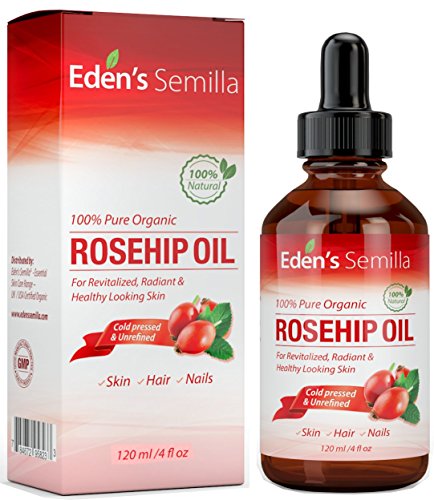
Best for face and body: Eden’s Semilla 100% Pure Rosehip Oil, 4 oz
| Organic Integrity Score | 79 / 100 |
| Extraction | Cold-pressed, unrefined |
| Certification | Certified Organic |
| Best for | Stretch marks, scars, and full-body use |
Four ounces is four times the size of everything else in this guide, and that is the point. If you are using rosehip oil on stretch marks, on a larger scar, or over your arms and décolletage rather than just your face, a 1 oz treatment bottle runs out fast and costs a fortune per use. This is cold-pressed, unrefined, certified organic, and priced so that using it generously is realistic.
It scores lowest here on freshness economics rather than quality. Rosehip oil oxidizes within roughly six months of opening, and most people will not get through four ounces of facial oil in that window, so some of the bottle risks going off before it is used. Buy this size only if you genuinely have a whole-body use for it, and keep it in a cool dark cupboard rather than a warm bathroom.
What we liked: A genuinely large bottle of cold-pressed certified organic oil at a cost per ounce that makes body use practical.
Keep in mind: Four ounces is more than most people can use before the oil starts to oxidize.
What the listing discloses: Eden’s Semilla is explicit about a single-ingredient formula, and silent on whether the USDA seal applies and where it was grown or made.
Other rosehip oils you will come across
A few brands dominate search results for rosehip oil, and it is worth saying where they sit rather than pretending they do not exist.
Trilogy Certified Organic Rosehip Oil is probably the best-known rosehip oil in the world and a genuinely good product: certified organic, cold-pressed, and the brand that did most to popularize the category. It is a solid choice and it did not make our five because it is seed-only cold-pressed at a price close to the CO2-extracted top pick, so on our scoring it is beaten on extraction by Pai and on value by Handcraft. If you already use it, there is no reason to switch. View on Amazon.
The Ordinary 100% Organic Cold-Pressed Rose Hip Seed Oil is the cheapest credible entry point in the category and perfectly decent for the money. Its weakness for our purposes is packaging: it ships in a bottle that offers less light protection than we would want for an oil this prone to oxidation, and users frequently report it turning over faster than expected.
Sky Organics, Radha Beauty, and Pura D’Or all sell USDA organic cold-pressed rosehip at value pricing and sit in broadly the same tier as our value pick. They are reasonable buys; they publish less about sourcing than the specialists.
The general rule across all of them: at the budget end you are choosing between broadly similar cold-pressed oils and should decide on packaging and freshness, and at the premium end you are paying for extraction method and formulation discipline.
Rosehip oil by skin type
Rosehip suits most skin, and the way you use it should change depending on what you are working with.
Dry and mature skin. The most straightforward case. Use it nightly on damp skin and follow with a richer cream to seal it. This is where the wrinkle and elasticity evidence is most relevant, and where people notice the difference fastest.
Oily and acne-prone skin. Counterintuitively, rosehip is one of the better oils here because it is high in linoleic acid, and people with acne-prone skin often have sebum that is relatively low in linoleic acid. It rates low for comedogenicity. Start twice a week, use two drops rather than five, and patch test along the jaw for a fortnight. It is not universally tolerated, and if you break out in the areas you applied it, stop.
Sensitive, rosacea-prone, and eczema-prone skin. Rosehip is anti-inflammatory and fragrance-free versions are among the gentlest things you can apply. Choose an oil with no essential oils added, and if your barrier is actively compromised, introduce it slowly.
Scarring and stretch marks. This is the use with the best evidence, and it requires persistence: the trials that found effects ran twice daily for six to twelve weeks. Massage it in rather than patting, and be realistic that it improves the appearance of scars rather than removing them.
Combination skin. Use it only where you are dry, most often cheeks and around the eyes, and skip the T-zone. Facial oil does not have to be an all-over product.
Rosehip oil versus other facial oils
| Oil | Best for | Feel | Shelf life |
| Rosehip | Scars, fine lines, texture | Dry, fast-absorbing | Short, about 6 months |
| Jojoba | Oily and acne-prone skin, balance | Light, waxy ester | Very long, 2 years plus |
| Argan | Dry skin, hair, nails | Medium, slightly richer | Long, 1 to 2 years |
| Squalane | Sensitive skin, very light finish | Weightless | Very long, extremely stable |
| Coconut | Body, not usually face | Heavy, occlusive | Long |
The practical takeaway is that rosehip is a treatment-leaning oil with the shortest shelf life of the group, jojoba is the most stable and the safest bet on oily skin, and squalane is the one to choose if you react to almost everything. Many people use two: a stable oil for everyday and rosehip at night for texture work.
How to use rosehip oil, and how to store it
Rosehip is a dry oil, so it sinks in fast and does not need much. Two to three drops is a full face. Apply it to skin that is still slightly damp from cleansing or a toner, press rather than rub, and follow with a moisturizer if your skin is dry, since an oil seals moisture in but does not add water itself. Most people get on best using it at night, partly because the smell fades by morning and partly because it is the step that pairs least well with sunscreen.
If you are also using a retinoid or an acid, alternate nights rather than layering everything at once. Rosehip is non-comedogenic for most people, but it is not zero-risk on very acne-prone skin, so patch test along your jaw for a few nights before committing. Anyone with a nut or seed sensitivity should patch test too.
Where it goes in a routine. Oils go last among your leave-on steps, because they are the heaviest and they seal everything underneath. The order that works for most people is cleanse, then any water-based toner or essence, then a water-based serum, then rosehip oil, then moisturizer if your skin is dry, and sunscreen last in the morning. Do not apply rosehip before a water-based serum, because the oil film will block it. Two to three drops warmed between the fingertips and pressed into damp skin is the whole technique.
Sun sensitivity, which most guides skip. Rosehip contains natural vitamin A compounds, and vitamin A derivatives can increase skin’s sensitivity to UV. If you use rosehip in the morning, wear a broad-spectrum sunscreen over it, and if you are using it specifically on scars or pigmentation, daily sun protection is not optional, since UV exposure will undo the thing you are trying to fix. Many people simply use it at night and avoid the question entirely, which is a reasonable choice.
Patch test properly. Apply a small amount to the inner forearm and wait 24 to 48 hours before putting it on your face. Allergic reaction to rosehip is uncommon but real, and reported reactions range from redness and itching through to, very rarely, anaphylaxis. If you experience swelling, difficulty breathing, or a rapid heartbeat, seek emergency care. Anyone with a known rose family allergy should be particularly careful.
Give it time. The scar and wrinkle trials ran six to twelve weeks of consistent twice-daily use. Judging rosehip after a fortnight tells you whether your skin tolerates it, not whether it works.
Storage matters more than with almost any other oil. Keep the bottle closed, cool, and out of direct light, which in practice means a bedroom drawer rather than a bathroom windowsill. Some people refrigerate it, which is not necessary but does extend its life. Use it within six months of opening. If it starts to smell sharp, waxy, or like old crayons rather than earthy, it has oxidized and should be replaced. The natural smell of fresh rosehip oil is earthy and slightly fishy, and that is not a defect.
How we researched this guide
We are a research-based review site. We compared each product against its certification body (USDA organic, Soil Association, ACO), extraction method, refining status, ingredient list length, packaging materials and light protection, bottle size relative to shelf life, and the weight of aggregated customer feedback on color, aroma, and absorption, then scored each with our 10-criteria Organic Integrity Score. No brand paid to be included or ranked. Nothing here is medical advice, and persistent skin concerns should be discussed with a dermatologist. Read the full method on our How We Research and Rate page.
Common questions about organic rosehip oil
What is the best organic rosehip oil?
Our overall pick is Pai Skincare Rosehip BioRegenerate Oil, because it is certified organic by the Soil Association, CO2-extracted from both seed and fruit rather than solvent-refined, fragrance-free, and packaged in dark glass. For a certified cold-pressed oil at a lower price, RosehipPLUS is our pick, and for the best value, Handcraft Blends.
Why does my rosehip oil smell fishy?
That earthy, slightly fishy smell is the natural aroma of unrefined rosehip seed oil and is a sign you have bought the real thing rather than a bleached and deodorized version. It fades within a few minutes on the skin. A sharp, waxy, or crayon-like smell is different, and that does mean the oil has oxidized and should be replaced.
Is rosehip oil the same as a retinol?
No. Rosehip oil contains trace all-trans-retinoic acid, but at concentrations orders of magnitude below a prescription retinoid or even an over-the-counter retinol. It is a well-tolerated emollient oil with reasonable evidence for use on dry skin and scars, and it should be bought on that basis rather than as a retinoid substitute.
Does rosehip oil expire?
Yes, and faster than most oils. It is high in polyunsaturated fatty acids, which oxidize readily on contact with air, light, and heat. Use it within about six months of opening, store it cool and dark, and buy a 1 oz bottle rather than a large one unless you are using it on your whole body.
Will rosehip oil clog my pores?
For most people, no. It is high in linoleic acid and rates low on comedogenicity scales, and many acne-prone people use it without trouble. It is not risk-free though, so patch test along your jawline for several nights before applying it over your whole face.
What is the difference between rosehip oil and rosehip seed oil?
In practice they are usually the same thing. Almost all oil sold as rosehip oil is pressed from the seeds inside the hip, and the two names are used interchangeably. The genuine distinction is with CO2 extracts, which can capture compounds from the fruit flesh as well as the seed, and with rose oil or rose otto, which is a completely different product distilled from rose petals for fragrance.
Can you use rosehip oil with retinol or vitamin C?
Yes, with sensible sequencing. Apply water-based products such as a vitamin C serum first and let them absorb, then rosehip oil on top, since oil blocks anything applied after it. With a prescription retinoid, many people use rosehip on alternate nights, or apply it as a buffer after the retinoid to reduce irritation. Introduce one product at a time so you know what is causing what.
Should you use rosehip oil in the morning or at night?
Night suits most people. The natural earthy smell fades overnight, it is the step that sits least comfortably under sunscreen and make-up, and rosehip contains vitamin A compounds that can increase UV sensitivity. If you do use it in the morning, always apply a broad-spectrum sunscreen over it.
How long does rosehip oil take to work on scars?
Six to twelve weeks of consistent twice-daily use, based on the trials that measured it. Improvements were in the appearance of scars, atrophy, discoloration, and texture, rather than removal. Massage it in rather than patting, and protect the area from sun, since UV exposure works directly against what you are trying to achieve.
- Organic Skincare & Beauty hub
- Best Organic Argan Oil
- Best Organic Jojoba Oil
- Organic Skincare 101: How to Read Labels
- our searchable product database — compare all 800+ picks side by side
Price and availability as of October 11, 2026 7:10 pm EDT. Product prices and availability are accurate as of the date/time indicated and are subject to change. Any price and availability information displayed on Amazon.com at the time of purchase will apply to the purchase of this product.
Looking for other organic products?
We have checked more than 800 products across food, household goods, gardening, personal care and pet, every one against its stated certification. Browse all reviews.
Organic Connection is reader-supported. When you buy through links on this page we may earn a commission, at no extra cost to you. As an Amazon Associate we earn from qualifying purchases. We are not paid to feature or rank any product. This page is informational and is not medical advice. How we research and rate.