Last updated: September 30, 2026
We may earn a commission when you buy through links on this page, at no extra cost to you. How we research and rate.
The short version
After researching the ingredients, certifications, and formulas of the most popular organic and natural body lotions, our top pick is Nourish Organic Body Lotion. It is USDA Certified Organic, built on organic aloe, shea butter, coconut oil, and cocoa butter, and free of parabens, sulfates, and synthetic fragrance, which is why it earned our highest Organic Integrity Score of 94 out of 100. For the best value with fair-trade shea, Alaffia Everyday Shea is our pick, and for a fragrance-free option for sensitive skin, Amara Organics is the best choice.
One honest note up front: a truly USDA Certified Organic body lotion is less common than you would think, because a finished lotion blends water, oils, butters, and preservatives that are hard to certify as a whole. So we rated these on what actually matters here: certified-organic and clean plant ingredients, recognized certifications (USDA Organic, NATRUE), genuine moisturizing performance, and honest labeling, and we flag which are fully USDA organic versus certified-natural.
Best organic body lotion compared
| Best Choice | Best Value | ||||
 |  |  |  |  | |
| Product | Nourish Organic | Alaffia | Amara Organics | Weleda Skin Food | Aura Cacia Shea Butter |
| Organic Integrity Score | 94/ 100 | 92/ 100 | 86/ 100 | 80/ 100 | 75/ 100 |
| Our rating | 4.7 | 4.6 | 4.3 | 4.0 | 3.8 |
| Best for | Best overall | Fair-trade value | Fragrance-free | Very dry skin | Multi-use |
| Certification | — | Fair Trade | USDA Organic | Not stated on the listing | Non-GMO Verified, B Corp, organic herbal blend |
| Scent | Unscented option | Unscented / light | Fragrance-free | Lightly herbal | Essential-oil scents |
| Key ingredients | Organic aloe, shea butter, coconut oil, cocoa butter | Fair-trade shea butter, shea leaf, lemongrass | — | Pansy, chamomile, rosemary, calendula extracts | Coconut oil, aloe, organic calendula and chamomile |
| Price | $24.37 View on Amazon | $22.92$0.72 / ounce View on Amazon | $29.95$3.74 / fluid ounce View on Amazon | $17.49 $18.99 −8%$3.50 / fluid ounce View on Amazon | $11.01$3.39 / ounce View on Amazon |
Price and availability as of October 27, 2026 1:10 am EDT. Product prices and availability are accurate as of the date/time indicated and are subject to change. Any price and availability information displayed on Amazon.com at the time of purchase will apply to the purchase of this product.
Scores are ours, based on independent research of organic content, certification, formulation, and moisturizing performance, using the same 10-criteria method we apply to every product. See how we research and rate.
The certification map for organic body lotion, and what each one actually excludes
A seal is a specific promise about a specific thing. These are the promises behind the marks on this page, in plain terms, along with the question each one leaves unanswered.
| Certification | Covers | Key exclusion |
| USDA Organic | Farming and handling: no synthetic pesticides or fertilizers, no GMOs, no sewage sludge or irradiation, audited yearly by an accredited certifier | Three different tiers share the one seal, and it makes no claim about worker pay, food miles, or nutrition |
| GOTS | Organic fiber from farm to finished textile, plus dyeing, finishing, wastewater and labor criteria | Has a weaker second tier, “made with organic”, that needs only 70% organic fiber and carries the same name |
| COSMOS Organic | Cosmetics: organic content thresholds, permitted processes and ingredients, and packaging rules | Its sister grade, COSMOS Natural, carries the same name and requires no minimum organic content at all |
| Soil Association | The UK organic standard across food, textiles and beauty, in several places stricter than the legal minimum | A UK and EU scheme; it is not USDA Organic and the two are not interchangeable on a US label |
| B Corp | The whole company: social and environmental performance, governance, and transparency | Certifies the company, not the product in your hand |
COSMOS is two standards with one name, and the weaker one is easy to miss. COSMOS Organic requires at least 95% of the plant ingredients to be organic. COSMOS Natural, printed in the same typeface by the same body, requires no minimum organic content whatsoever: it governs which ingredients and processes are permitted, not how much of the product is organic. If the word after COSMOS is “Natural”, the organic question is still open.
The ingredients worth understanding on the label
| Ingredient | What it does | The actual concern |
| SLS and SLES | Sulfate detergents that create lather | SLS is a known irritant at higher concentrations. SLES is milder but can carry trace 1,4-dioxane from manufacturing, a probable carcinogen |
| Fragrance or parfum | Scent | A single word can legally represent a proprietary blend of up to around 300 undisclosed chemicals, and phthalates often hide here |
| Phthalates | Plasticizer, thickener, scent carrier | Frequently not listed at all, because trade secret protection lets them sit inside “fragrance” |
| Parabens | Preservative against bacteria and mold | Some research associates long-term exposure with hormone disruption; the evidence is contested rather than settled |
| Formaldehyde donors | Preservative, released slowly | Known sensitizer. Look for DMDM hydantoin, quaternium-15, imidazolidinyl urea |
Fragrance is the one to act on first. Of everything above, undisclosed fragrance is both the most common cause of contact dermatitis and the ingredient you can least investigate, since the law does not require the components to be named. If you buy on one rule alone, buy fragrance-free. It removes the largest single source of irritation and it closes the loophole that phthalates travel through.
A note on proportion. None of this means conventional products are dangerous. Exposures are generally low, and the regulatory position on most of these ingredients is that they are permitted at the concentrations used. What is fair to say is that disclosure is weak, the fragrance gap is real, and if you would rather not accept undisclosed ingredients on skin you use daily, a certified product with a short readable list is a reasonable preference rather than a paranoid one.
Key things to look for in an organic body lotion
A good organic body lotion hydrates without synthetic fragrance or harsh additives. Here is what matters when you choose one.
1. Certified-organic plant moisturizers
Look for organic shea butter, cocoa butter, coconut oil, and aloe, the plant butters and oils that actually soften and hold moisture in skin.
2. Clean, fragrance-honest formulas
Favor lotions free of parabens, phthalates, sulfates, mineral oil, and synthetic fragrance; scent, if any, should come from essential oils, and fragrance-free options exist for sensitive skin.
3. Recognized certifications
USDA Organic is the gold standard for content; NATRUE and fair-trade seals are useful signals of clean, ethically sourced formulas.
4. The right texture for your skin
Lightweight lotions absorb fast for everyday use, while richer creams suit very dry skin, elbows, and winter.
Why “natural” is not always “certified organic” for lotion
Unlike food, skincare is not required to carry a USDA-organic seal, and a finished body lotion is a water-and-oil emulsion that needs preservatives to stay safe, which makes whole-product organic certification genuinely difficult even when most ingredients are organic. That is why the meaningful signals here are certified-organic key ingredients, clean formulation, and recognized certifications like USDA Organic or NATRUE, rather than assuming every “natural” label means the same thing.
It is also why we are upfront that this is a guide to organic and natural body lotions: some picks are fully USDA Certified Organic, while others are certified natural or fair-trade with organic ingredients. Our scoring rewards genuine organic content, clean and transparent ingredient lists, recognized certification, and real moisturizing performance, because that combination is what delivers a clean lotion that actually works on dry skin.
Why “organic” is barely regulated in personal care
This is the structural fact that makes label reading necessary, and it is very different from how food works.
Food organic is legally enforced. Cosmetic organic mostly is not. A food product cannot say “organic” in the US without USDA certification behind it. A shampoo or lotion can carry the word organic on the front while containing a token amount of an organic botanical in an otherwise conventional formula. The USDA seal does exist for cosmetics that qualify, and most products using the word organic in this category are not carrying it. Where a product is genuinely certified, you will see USDA Organic, COSMOS, Soil Association, or NATRUE named explicitly.
MoCRA changed less than the headlines suggested. The Modernization of Cosmetics Regulation Act of 2022 was the first significant update to US cosmetics law in decades. It expanded FDA powers around facility registration, adverse event reporting, and recalls, which is real progress. What it did not do is ban formaldehyde, parabens, or phthalates, or close the fragrance disclosure gap. Much of the substantive ingredient restriction has fallen to individual states, around twenty of which have now passed their own limits.
How to choose an organic body lotion
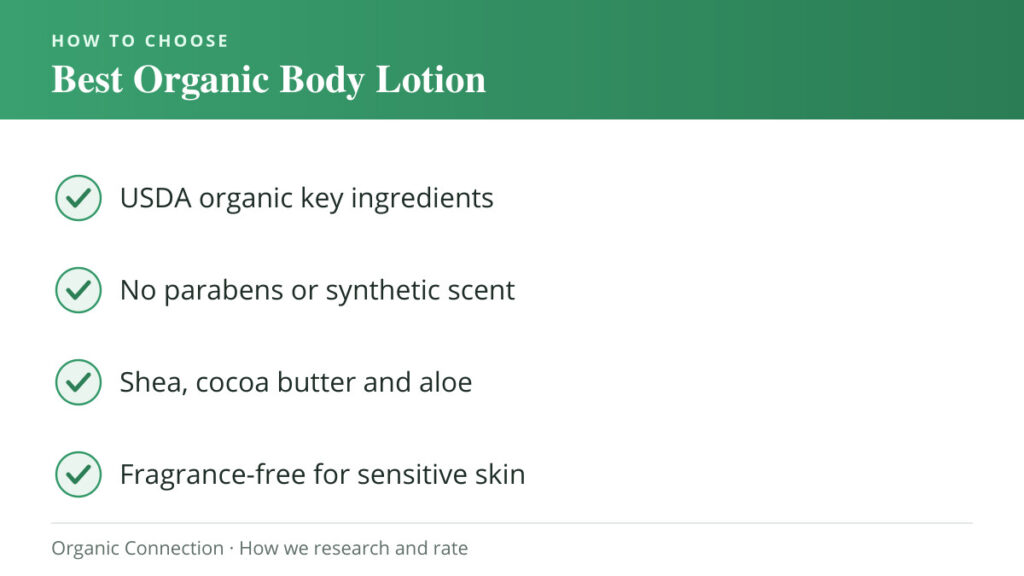
- Read the ingredient list. Favor organic shea, cocoa butter, coconut oil, and aloe near the top, with no parabens, mineral oil, or synthetic fragrance.
- Check the certification. USDA Organic for content, NATRUE for certified-natural, fair-trade for ethical sourcing.
- Pick fragrance-free if you are sensitive. Even essential-oil scents can bother reactive skin, so unscented is safest for sensitivity.
- Match texture to need. Light lotion for daily all-over use, richer cream for very dry skin and rough spots.
- Apply to damp skin. Moisturize within a few minutes of showering to lock in water.
Who should buy organic body lotion
Skin type matters more than marketing here. Our top pick is the USDA-organic lotion for most people. If you want fair-trade value, a fragrance-free option for sensitive skin, a rich treatment for very dry skin, or a multi-use hands-face-body lotion, we have a pick for each.
Best overall: Nourish Organic Body Lotion
| Organic Integrity Score | 94 / 100 |
| Certification | — |
| Key ingredients | Organic aloe, shea butter, coconut oil, cocoa butter |
| Best for | An all-around USDA-organic daily lotion |
Nourish Organic is our top pick because it is genuinely USDA Certified Organic, not just natural-sounding. It is built on organic aloe vera, shea butter, coconut oil, and cocoa butter, is vegan and cruelty-free, and leaves out dyes, parabens, sulfates, and petrochemicals, hydrating dry skin with a clean, quick-absorbing feel, with a fragrance-free option available.
The trade-off is that a preservative-light organic formula has a shorter shelf life than conventional lotions, so use it within a reasonable window. For a trustworthy, genuinely organic everyday body lotion, it is our first choice.
What we liked: USDA Certified Organic, organic shea and cocoa butter, vegan and cruelty-free, clean formula, with an unscented option.
Keep in mind: As a clean organic formula it has a shorter shelf life than conventional lotions, so buy a size you will use.
What the listing discloses: Beyond the organic claim itself, Nourish does not say whether the USDA seal applies and where it was grown or made.
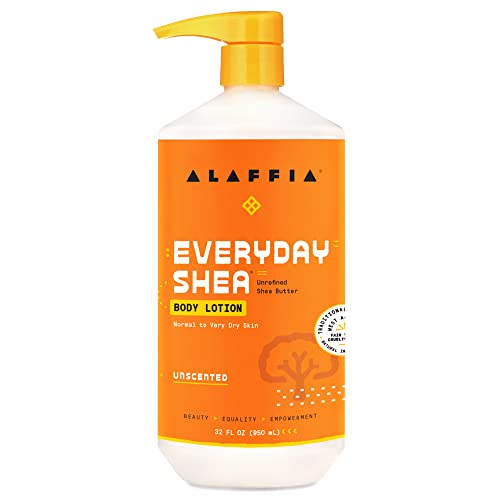
Best value: Alaffia Everyday Shea Body Lotion
| Organic Integrity Score | 92 / 100 |
| Certification | Fair Trade |
| Key ingredients | Fair-trade shea butter, shea leaf, lemongrass |
| Best for | Big-value moisturizing with an ethical story |
Alaffia is our value pick. Its Everyday Shea lotion is built on handcrafted, fair-trade, organic unrefined “raw” shea butter from women-led cooperatives in West Africa, with no sulfates, parabens, phthalates, silicones, mineral oil, or synthetic fragrance, and it comes in a large bottle at a low cost per ounce, with an unscented version for sensitive skin.
It scores just below our top pick because it is fair-trade with organic shea rather than a fully USDA-organic finished product, but on ingredients, ethics, and value it is outstanding.
What we liked: Fair-trade organic unrefined shea, clean formula, a strong social mission, and excellent value in a large bottle.
Keep in mind: It is fair-trade with organic shea rather than a fully USDA-organic certified product, and the scented versions use natural fragrance some sensitive users skip.
What the listing discloses: The word organic does not appear on the Alaffia listing at all.
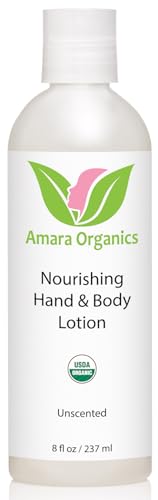
Best fragrance-free: Amara Organics Body Lotion
| Organic Integrity Score | 86 / 100 |
| Certification | USDA Organic |
| Scent | Fragrance-free |
| Best for | Sensitive, reactive skin |
Amara Organics is our pick for sensitive skin. It is a USDA Certified Organic, fragrance-free hand and body lotion, formulated to nourish dry skin without essential oils or added scent, which makes it a safe choice for reactive skin that flares up with fragrance.
It scores in the middle mainly because it is a smaller brand with a shorter track record than the leaders, but as a genuinely USDA-organic, truly fragrance-free lotion, it fills an important niche.
What we liked: USDA Certified Organic, completely fragrance-free, and a simple nourishing formula that suits sensitive skin.
Keep in mind: It is a smaller brand, and being unscented, it will not appeal to those who want a naturally scented lotion.
What the listing discloses: On the Amara Organics label: USDA organic certification. Not stated: where it was grown or made.
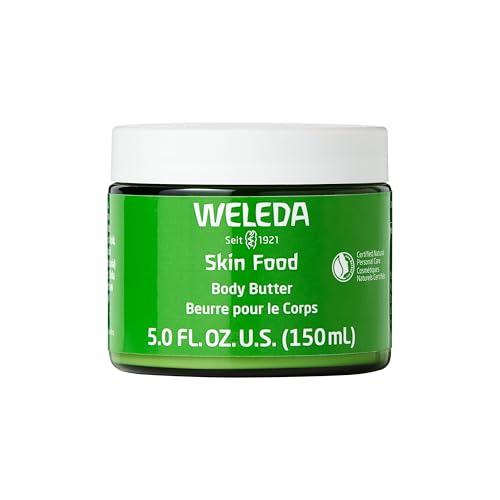
Best for very dry skin: Weleda Skin Food Body Butter, 5 oz
| Organic Integrity Score | 80 / 100 |
| Certification | Certified Natural by NATRUE, stated on the listing |
| Key ingredients | Shea and cocoa seed butter, sunflower oil, pansy extract |
| Best for | Very dry skin that needs rich moisture |
For skin that is genuinely dry rather than merely tight, a butter beats a lotion, and this is the Skin Food formula in its richest form. Shea and cocoa seed butter with sunflower oil and pansy extract, whipped to a texture that melts rather than sits on the surface, in a glass jar rather than plastic.
The listing states Certified Natural by NATRUE, and Weleda commits to no parabens, no phthalates, no synthetic fragrance or preservatives, and no animal testing. That is a specific, checkable standard rather than the usual gesture at being natural.
Why it sits fourth and not higher. NATRUE certifies natural, which is a different and less demanding thing than certified organic. On a page that ranks by organic integrity, a natural certification cannot outrank the USDA-organic picks above it, however good the product is on dry skin. Judge it on what it is: the richest, best-documented moisturizer here, certified against the wrong standard for our purposes.
What we liked: A true whipped butter rather than a lotion, so it actually holds up on very dry skin. NATRUE certified, named on the listing. Shea and cocoa butter, in a glass jar.
Keep in mind: Certified natural, not certified organic, which is why it does not rank higher here. 5 oz is a small jar for whole-body use, and the herbal scent is noticeable.
What the listing discloses: Weleda carries no organic claim, certified or otherwise.
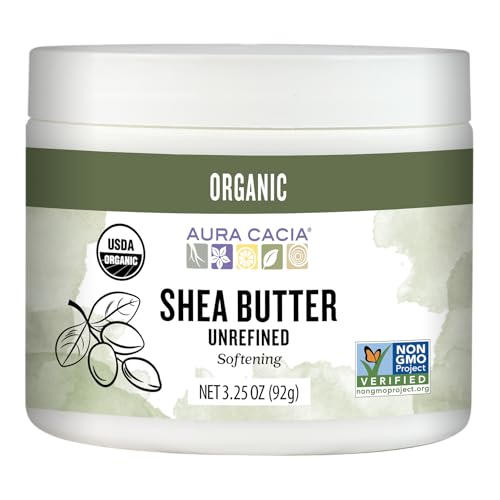
Best multi-use: Aura Cacia Organic Shea Butter, 3.25 oz
| Organic Integrity Score | 75 / 100 |
| Certification | USDA-certified organic, stated on the listing |
| Key ingredients | Unrefined shea butter — one ingredient |
| Best for | Elbows, knees, heels, lips, and DIY blending |
This is the odd one out on the page, deliberately. It is not a lotion at all — it is a jar of unrefined shea butter, one ingredient, USDA-certified organic. Where the picks above blend shea into a formula, this is the raw material itself.
That makes it the most versatile thing here. The listing suggests it for dry elbows, knees and heels, as a lip balm, and as a base to blend with essential oils, and all three are true. A single jar covers jobs that would otherwise take three products, and there is no fragrance, preservative or emulsifier to react to.
Why it sits last despite the strongest certification wording. Shea butter is not a body lotion. It is thick, it needs warming between the palms, and nobody is spreading it over their whole body after a shower. Judged as what it is — a single-ingredient multi-purpose balm — it is excellent. Judged as a lotion, it is the wrong tool, and this page ranks lotions.
What we liked: USDA-certified organic and a single ingredient, so there is nothing to react to. Genuinely multi-use: skin, lips, and a base for DIY blends. Small jar at a low price.
Keep in mind: It is a butter, not a lotion — thick, needs warming, and impractical for whole-body use. At 3.25 oz it is the smallest thing on this page.
What the listing discloses: Aura Cacia states USDA organic certification, and does not say where it was grown or made.
How to get the most from your body lotion
Apply lotion within a few minutes of showering or bathing, while your skin is still slightly damp, so it seals in that surface water, this single habit does more for dry skin than any ingredient. Use a richer cream on stubborn dry spots like elbows, knees, and heels, and a lighter lotion for everyday all-over use. If your skin is sensitive or reactive, choose a fragrance-free formula and patch-test a new product on your inner arm first. Because clean organic lotions use fewer synthetic preservatives, store them away from heat and use them within a reasonable window of opening.
Humectant, emollient, occlusive: a good lotion needs all three
Moisturizers work through three distinct mechanisms, and most disappointment with a lotion comes from buying one that only does one of them.
| Type | What it does | Examples |
| Humectant | Draws water into the outer layer of skin from the layer below | Glycerin, hyaluronic acid, urea, propylene glycol, honey, aloe |
| Emollient | Fills the gaps between skin cells, smoothing and softening | Shea butter, plant oils, squalane, ceramides, fatty alcohols |
| Occlusive | Forms a barrier that stops water evaporating out | Petrolatum, beeswax, dimethicone, lanolin, heavy butters |
Keep in mind: a humectant without an occlusive can make dry skin worse. Glycerin and hyaluronic acid pull water toward the surface — from the air in humid conditions, but from deeper in your own tissue when the air is dry, where it then evaporates. In a heated house in winter, a humectant-heavy lotion with no sealing layer can leave skin tighter than before. The fix is not avoiding humectants but pairing them, which is exactly what a well-built lotion does.
Duration follows the same logic. Most light lotions, creams and gels keep skin moisturized for roughly 1–4 hours. Formulations combining humectants such as glycerin or urea with a genuine occlusive effect can last 6–24 hours. If you are reapplying constantly, the product is not failing — it is a light one.
Where organic lotions are genuinely at a disadvantage
Being straightforward about this matters more than defending the category.
The most effective occlusives available are petrolatum and dimethicone. Petrolatum reduces water loss from skin more effectively than almost anything else, is among the least allergenic substances in dermatology, and is what clinicians reach for on badly compromised skin. Both are petroleum- or silicone-derived and neither is permitted in a certified organic product.
Organic lotions achieve occlusion with beeswax, plant butters and heavier oils. Those work — but on genuinely cracked, fissured or severely eczematous skin, they are not equivalent, and pretending otherwise does readers no favors.
Where organic and natural formulations do compete well:
- Emollience. Shea butter, plant oils and squalane are excellent emollients, and shea in particular brings an unusually high unsaponifiable fraction.
- Ceramides. These are a core component of the skin’s own barrier, and formulations high in ceramides perform well for many people with eczema. They are compatible with clean formulation.
- Fewer irritants — organic rules prohibit formaldehyde-releasing preservatives, synthetic dyes and phthalates.
- Everyday dry skin, which is what most people actually have, is well served by a good organic lotion.
Lotion, cream or ointment
| Format | Water content | Best for |
| Lotion | Highest — thin and pourable | Normal to slightly dry skin, large areas, summer, quick absorption |
| Cream | Moderate | Dry skin, everyday use, the sensible default |
| Ointment | Lowest — mostly oils and waxes | Very dry, cracked or eczematous skin. Greasy, and the most effective. |
A useful consequence: ointments contain less water and therefore need fewer preservatives, which makes them the better option for anyone who reacts to preservative systems. The greasiness is the trade — apply at night, or to hands and feet under cotton gloves or socks.
The general rule for compromised skin is that the greasier the product, the more effective it is. People consistently under-treat because lotions feel nicer.
Preservatives are not optional
Any product containing water will grow bacteria, yeast and mold without a preservative system. There is no exception for organic, natural or artisanal products.
- A water-containing lotion claiming to be “preservative-free” is either mislabeled or unsafe. Some use preservatives that are not legally classified as such — which is a labeling technicality rather than an absence.
- Organic-compatible systems typically use sodium benzoate, potassium sorbate, benzyl alcohol or leucidal. Sodium benzoate and potassium sorbate only work below about pH 5.5, which is why many organic lotions are formulated acidic.
- These systems are milder than synthetic ones, which means shorter shelf life. Check the open-jar symbol — a number followed by M is months after opening.
- Formaldehyde-releasers — DMDM hydantoin, imidazolidinyl urea, quaternium-15 — are prohibited under organic standards, and worth avoiding generally if you react to them.
- Pump bottles beat tubs. Every time fingers enter a jar, bacteria go with them, and that is the main route to a contaminated product.
Fragrance, essential oils and sensitive skin
- Essential oils are fragrance. A lotion scented with lavender, citrus or ylang-ylang is not hypoallergenic — essential oils are among the more common causes of contact dermatitis in natural products, and citrus oils can also be phototoxic on sun-exposed skin.
- EU labeling requires 26 fragrance allergens to be declared individually above threshold, which is why European labels list limonene, linalool, geraniol and citronellol. Those are usually components of the essential oils, not separate synthetic additions.
- “Unscented” may contain masking fragrance to neutralize a base odor. “Fragrance-free” is the stronger claim.
- For eczema or reactive skin, fragrance-free is the single most useful filter — more so than organic. The National Eczema Association’s guidance points toward humectants such as hyaluronic acid, plus niacinamide, glycerin, petrolatum, vitamin E, oat and shea butter, and toward ceramide-containing barrier creams.
- Patch test on the inner forearm for 24–48 hours with any new product if your skin reacts easily.
Application: the part that costs nothing
- Apply within three minutes of a shower or bath, to skin still damp. This is the single highest-return habit in skincare. You are trapping water that is already there; on fully dry skin you are sealing in dryness.
- Pat dry, do not rub, and leave skin slightly moist.
- Lukewarm showers, under ten minutes. Hot water strips barrier lipids efficiently and is the main driver of winter dryness.
- More product, less often beats a thin layer reapplied — particularly with creams and ointments.
- Feet and hands last longest under occlusion — apply thickly, then cotton socks or gloves overnight.
- A humidifier in a heated bedroom does more for winter skin than upgrading your lotion.
- Shelf life: most lotions keep 12 months after opening, less for preservative-light organic formulations. Discard on any change in smell, color, separation that will not re-mix, or a texture change — those indicate the preservative system has failed.
How we researched this guide
We are a research-based review site. We compared each lotion against its organic content and certification, ingredient transparency, formulation and scent, and the weight of aggregated customer feedback on moisturizing and skin feel, then scored each with our 10-criteria Organic Integrity Score. No brand paid to be included or ranked. Read the full method on our How We Research and Rate page.
Common questions about organic body lotion
What is the best organic body lotion?
Our overall pick is Nourish Organic Body Lotion, because it is USDA Certified Organic, built on organic shea, cocoa butter, coconut oil, and aloe, and free of parabens and synthetic fragrance. For fair-trade value, Alaffia is our pick, and for fragrance-free sensitive skin, Amara Organics.
Is there such a thing as a fully organic body lotion?
Some body lotions are USDA Certified Organic, but many clean lotions are certified natural or fair-trade with organic ingredients instead, because a finished water-and-oil lotion needs preservatives and is hard to certify as a whole. Look for a USDA Organic seal for the strictest content standard.
When should I apply body lotion?
Within a few minutes of showering or bathing, while your skin is still slightly damp. Applying to damp skin traps surface water and moisturizes far more effectively than applying to fully dry skin.
Which organic lotion is best for sensitive skin?
A fragrance-free, USDA-organic option like Amara Organics is safest for sensitive or reactive skin, since even natural essential-oil scents can trigger irritation. Always patch-test a new lotion first.
Are natural and organic lotions worth it?
If you want to avoid synthetic fragrance, parabens, and petrochemicals on a large area of skin, yes. Organic and certified-natural lotions use cleaner ingredients, though they often have shorter shelf lives because they rely on fewer synthetic preservatives.
What is the difference between a humectant, emollient and occlusive?
Three different jobs. Humectants — glycerin, hyaluronic acid, urea — draw water into the outer skin layer. Emollients — shea butter, plant oils, squalane, ceramides — fill the gaps between skin cells to smooth and soften. Occlusives — petrolatum, beeswax, dimethicone, lanolin — form a barrier that stops water evaporating. A good moisturizer does all three, and most disappointment comes from buying one that only does one.
Can moisturizer make dry skin worse?
A humectant without an occlusive can. Glycerin and hyaluronic acid pull water toward the surface — from the air when it is humid, but from deeper in your own tissue when the air is dry, where it then evaporates. In a heated house in winter that can leave skin tighter than before. The answer is pairing humectants with a sealing layer, not avoiding them.
Are organic body lotions as effective as conventional ones?
For everyday dry skin, yes. For severely cracked or eczematous skin, honestly no. The most effective occlusives available are petrolatum and dimethicone — petrolatum reduces water loss better than almost anything and is among the least allergenic substances in dermatology — and neither is permitted in a certified organic product. Organic lotions use beeswax, plant butters and heavier oils, which work but are not equivalent on badly compromised skin.
Should you use a lotion, cream or ointment?
By severity. Lotion has the most water and suits normal to slightly dry skin and large areas. Cream is the everyday default for dry skin. Ointment has the least water, is the greasiest and is the most effective for very dry, cracked or eczematous skin. People consistently under-treat because lotions feel nicer. Ointments also need fewer preservatives, which makes them useful for anyone who reacts to preservative systems.
How long should a moisturizer last on your skin?
Light lotions, creams and gels keep skin moisturized roughly 1 to 4 hours. Formulations combining humectants such as glycerin or urea with a genuine occlusive effect can last 6 to 24 hours. If you are reapplying constantly, the product is not failing — it is simply a light one.
Do organic lotions need preservatives?
Yes — anything containing water grows bacteria, yeast and mold without one, and there is no exception for organic or artisanal products. A water-containing lotion claiming to be preservative-free is either mislabeled or unsafe. Organic-compatible systems use sodium benzoate, potassium sorbate or benzyl alcohol, which are milder and therefore give shorter shelf life. Pump bottles beat tubs, since fingers in a jar are the main route to contamination.
Are essential oils better than fragrance in lotion?
Better sourced, not gentler. Essential oils are fragrance, and they are among the more common causes of contact dermatitis in natural products — citrus oils can also be phototoxic on sun-exposed skin. For eczema or reactive skin, fragrance-free is a more useful filter than organic. Note that “unscented” may contain masking fragrance, while “fragrance-free” is the stronger claim.
When should you apply body lotion?
Within three minutes of a shower or bath, on skin still damp — the single highest-return habit in skincare, because you are trapping water already present rather than sealing dry skin. Pat dry rather than rubbing, keep showers lukewarm and under ten minutes, and for hands and feet apply thickly under cotton gloves or socks overnight. A humidifier in a heated bedroom does more for winter skin than upgrading your lotion.
- Organic Skincare and Beauty hub
- Best Organic Body Wash
- Best Organic Jojoba Oil
- How we research and rate products
- every product we have reviewed — filter by USDA Organic, GOTS, Fair Trade and more
Price and availability as of October 27, 2026 1:10 am EDT. Product prices and availability are accurate as of the date/time indicated and are subject to change. Any price and availability information displayed on Amazon.com at the time of purchase will apply to the purchase of this product.
Looking for other organic products?
We have checked more than 800 products across food, household goods, gardening, personal care and pet, every one against its stated certification. Browse all reviews.
Organic Connection is reader-supported. When you buy through links on this page we may earn a commission, at no extra cost to you. As an Amazon Associate we earn from qualifying purchases. We are not paid to feature or rank any product. How we research and rate.