Last updated: September 30, 2026
We may earn a commission when you buy through links on this page, at no extra cost to you. How we research and rate.
The short version
After working through sterilization methods, volatile oil loss and heavy metal testing in the spice trade, our top pick is Starwest Botanicals Organic Whole Cloves. They are USDA certified, sold whole in a one pound bulk bag, and the company tests for heavy metals under cGMP, which is why they earned our highest Organic Integrity Score of 89 out of 100.
Whole and ground cloves are not the same product in any meaningful sense. Ground clove is fundamentally the weaker one, for a reason worth understanding before you buy either.
Best organic cloves compared
| Best Choice | Best Value | ||||
 |  |  |  |  | |
| Product | Starwest Botanicals | Frontier Co-op Organic | True Organic Ceylon 1 lb | True Organic Ceylon Cloves | Simply Organic Ground |
| Organic Integrity Score | 89/ 100 | 86/ 100 | 85/ 100 | 83/ 100 | 78/ 100 |
| Our rating | 4.5 | 4.3 | 4.3 | 4.2 | 3.9 |
| Form | Whole | Whole, hand select | Whole | — | Ground |
| Size | 1 lb bulk | 16 oz bulk | 2.05 oz jar | — | 2.82 oz x3 |
| Testing | Heavy metals, cGMP | Co-op sourced | Non-GMO, non-ETO | — | Certified organic |
| Best for | Heavy users, best value | Bulk, hand-selected | Normal households | — | Baking convenience |
| Certification | USDA Organic, Non-GMO, Kosher | Certified Organic | USDA Organic, Non-GMO, Kosher | Certified Organic, Kosher | Certified Organic |
| Price | $37.44$2.34 / ounce View on Amazon | $26.99 $33.34 −19%$1.69 / ounce View on Amazon | $14.95$0.93 / ounce View on Amazon | $76.65$37.39 / ounce View on Amazon | $5.75$2.04 / ounce View on Amazon |
Scores are ours, based on independent research of form, sterilization method, contaminant testing, sourcing and value, using the same 10-criteria method we apply to every product.
Reading the seals on organic cloves: what each one does and does not cover
A seal is a specific promise about a specific thing. These are the promises behind the marks on this page, in plain terms, along with the question each one leaves unanswered.
| Certification | Covers | Key exclusion |
| USDA Organic | Farming and handling: no synthetic pesticides or fertilizers, no GMOs, no sewage sludge or irradiation, audited yearly by an accredited certifier | Three different tiers share the one seal, and it makes no claim about worker pay, food miles, or nutrition |
| Kosher | Ingredients and production comply with Jewish dietary law, verified by a rabbinic agency that inspects the facility | A dietary-law standard: it makes no claim about pesticides, GMOs or farming practice |
Kosher and organic answer entirely different questions. A kosher mark, OU, OK, Star-K and others, confirms that ingredients and production follow Jewish dietary law, verified by an agency that inspects the facility. It is a rigorous supply-chain audit and it says nothing about pesticides, GMOs or farming. The two seals appear together often precisely because neither substitutes for the other.
Whole versus ground, and why it matters more here than elsewhere
Every ground spice loses aroma faster than its whole form, but cloves are an extreme case because so much of what they are is volatile oil. A clove is an unopened flower bud, dried, and the eugenol is held inside its structure. Intact, it stays put for years. Ground, the surface area increases enormously and the oil starts leaving.
In practice, whole cloves keep their character for around two years stored properly, while ground cloves are noticeably flatter within six months and largely spent by a year. Since most households use cloves a few times a year, mostly around baking and mulling seasons, a jar of ground cloves bought in one December is usually disappointing by the next.
The recommendation follows. Buy whole and grind what you need. A cheap coffee grinder kept for spices, or a mortar and pestle, closes the gap entirely, and whole cloves are also what you want for anything infused: mulled wine, stocks, poaching liquid, biryani, pickling. Keep a small jar of ground for baking convenience if you like, and buy the smallest one you can.
What organic certification changes in the spice trade
More than you might expect, and the reason is sterilization.
Imported spices carry a genuine microbial risk, so they are commonly treated before sale. Conventional spice processing has historically used ethylene oxide (ETO), a fumigant gas which is an effective sterilant and also a recognized carcinogen. It is prohibited in organic production, so certified organic spices use alternatives such as steam sterilization instead. Brands that avoid it often state non-ETO on the label, and it is worth looking for.
Organic certification also covers the growing itself, and cloves are a tropical crop grown largely in Indonesia, Madagascar and Tanzania, where conventional pesticide use is not always well documented.
What certification does not cover is heavy metals. Spices are a known route for lead and cadmium exposure, because they are dried plant material concentrated from soil, and organic farming does not remove metals already present in ground. That is why third-party heavy metal testing is a separate and genuinely valuable thing to look for, exactly as it is with turmeric.
What cloves actually do, honestly
Cloves have a real pharmacological story and a heavily inflated one, and it is worth separating them.
The genuine part is eugenol as a topical analgesic. Clove oil has a long history in dentistry, and eugenol is still used in dental materials today. If you have ever had a temporary filling that smelled strongly of cloves, that is why. For short-term toothache relief it has a legitimate basis, though it is a stopgap rather than treatment, and swallowing clove oil is genuinely dangerous, particularly for children.
The inflated part is the antioxidant marketing. Cloves do score extremely high on antioxidant assays, and you will see this repeated constantly. The catch is dose: those figures are per 100 grams, and nobody eats 100 grams of cloves. A few cloves in a pot of mulled wine contribute a rounding error to your daily antioxidant intake. Buy cloves because they taste extraordinary, not because of an ORAC number.
Key things to look for in organic cloves
1. Whole, not ground, wherever possible
The single biggest quality decision, for the volatile oil reasons above.
2. Non-ETO stated
Certified organic spices should not be ethylene oxide fumigated, and brands that say so explicitly are making the point they should be.
3. Heavy metal testing
Not covered by organic certification. A brand testing under cGMP for lead and cadmium is offering something the seal does not.
4. Appearance and aroma
Good cloves are plump, dark reddish-brown, and slightly oily to the touch. Pale, shrivelled, dusty cloves have lost their oil. If you can smell them through the bag, that is a good sign.
5. A size you will actually use
A pound of cloves is an enormous quantity for a home kitchen. Bulk is superb value only if you cook with them constantly.
Who should buy organic cloves
Buy them if you want to avoid ethylene oxide fumigation, which is the most concrete benefit certification delivers in spices. Buy whole if you mull, pickle, brine, or cook South Asian or Middle Eastern food. Buy from a brand that tests for heavy metals, since that is the risk certification does not address.
Buy small if you use cloves twice a year, because value per ounce is irrelevant if three quarters of the bag goes stale. And treat clove oil as a topical stopgap for toothache rather than a remedy, and keep it away from children entirely.
How to choose organic cloves
Choose whole over ground unless convenience genuinely outweighs flavor for you. Look for non-ETO and for heavy metal testing. Judge the cloves themselves on plumpness, color and smell. Then pick the smallest size that covers your real usage, and store them airtight, dark and away from the cooker, since heat accelerates exactly the oil loss you are trying to avoid.
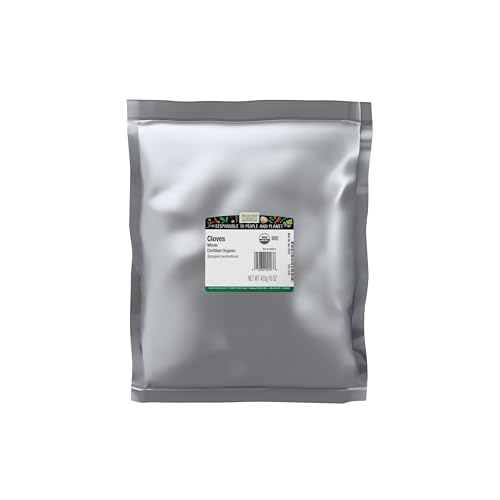
Best overall: Starwest Botanicals Organic Whole Cloves, 1 lb
| Organic Integrity Score | 89 / 100 |
| Form | Whole cloves, 1 lb bulk bag |
| Certification | USDA Organic, Non-GMO, Kosher |
| Best for | Frequent users who want testing beyond certification |
This is the pick because Starwest do the thing organic certification does not: they test for heavy metals under cGMP. In a category where the contaminant risk is metals drawn from soil rather than sprays, that testing is worth more than the seal alone, and very few spice brands publish it.
The catch is quantity. A pound of whole cloves is a great deal of cloves, and unless you cook with them regularly you will not get through it while it is at its best. Whole cloves hold up far better than ground, so this is more forgiving than a pound of ground spice would be, but be honest about your usage before buying it.
What we liked: Heavy metal testing under cGMP, which certification does not cover. USDA organic and kosher. Whole form preserves the eugenol. Outstanding value per ounce.
Keep in mind: One pound is far more than most households need. Decant into airtight jars rather than leaving it in the bulk bag.
What the listing discloses: Starwest Botanicals states USDA organic certification and kosher certification, and does not say where it was grown or made.
Best hand-selected: Frontier Co-op Organic Whole Cloves, 16 oz
| Organic Integrity Score | 86 / 100 |
| Form | Whole cloves, hand select grade, 16 oz |
| Certification | Certified Organic |
| Best for | Bulk buyers who care about sourcing structure |
Hand select is a real grading distinction in the clove trade, meaning buds sorted for size and condition rather than taken as harvested. In practice that means plumper, more uniform cloves with fewer broken or shrivelled ones, which matters because a shrivelled clove has already lost much of its oil.
Frontier is a co-operative, and their sourcing relationships with growers are more transparent than most spice supply chains, which are notoriously opaque. Same bulk quantity caveat as above.
What we liked: Hand-select grading gives visibly better cloves. Co-operative structure with unusually good sourcing transparency. USDA organic. Strong value in bulk.
Keep in mind: Sixteen ounces is a lot. Heavy metal testing is not published the way Starwest publishes theirs.
What the listing discloses: Frontier Co-op leaves the basics open, including whether the USDA seal applies and where it was grown or made.
Best named origin: True Organic Ceylon Whole Cloves, 1 lb
| Organic Integrity Score | 85 / 100 |
| Size | 1 lb |
| Origin | Sourced directly from Sri Lanka |
| Certification | USDA Organic, Non-GMO, Kosher |
| Shelf life | Stated as up to three years stored properly |
| Best for | Cooks who use cloves often and want a named origin |
The only clove listing here that names both an origin and a food safety certification. Cloves are sourced from Sri Lanka directly, and the facility holds FSSC 22000, a GFSI-recognized food safety scheme that covers processing rather than farming.
That pairing is worth having in a spice. Organic certification covers how the crop was grown; FSSC 22000 covers what happened in the plant afterwards, which for a dried imported spice is the half most likely to go wrong.
It also gives a shelf life, stated as up to three years stored properly. Whole cloves keep far better than ground, and putting a figure on it is more useful than the usual silence.
One thing to be aware of before you read the page: the listing is heavily keyword-stuffed. The phrases “cloves whole organic”, “whole cloves bulk” and “premium organic cloves” repeat many times across the bullets in a way that reads as written for a search engine rather than a cook. The underlying claims are specific and checkable; the prose around them is not written for you.
What we liked: Named origin, USDA Organic plus Kosher, an FSSC 22000 facility, and a stated shelf life.
Keep in mind: Aggressively keyword-stuffed copy, and a pound of cloves is a very large quantity for a home kitchen.
What the listing discloses: True Organic is explicit about USDA organic certification and kosher certification, and silent on where it was grown or made.
Best multipack: True Organic Ceylon Cloves Cloves, 2.05 oz (Pack of 6)
| Organic Integrity Score | 83 / 100 |
| Form | Whole cloves, 2.05 oz x 6 jars |
| Certification | Certified Organic, Kosher |
| Best for | Sharing, gifting, or a household that mulls seriously |
Six sealed jars is a sensible middle path between a single jar and a pound of bulk: better value per ounce, while each jar stays sealed until opened. Because these are whole cloves rather than ground, the sealed jars hold their oil well.
Twelve ounces of cloves is still a lot for one kitchen. This works best split with someone, or for a household that genuinely mulls, brines and cooks with whole spices through the winter.
What we liked: Individually sealed jars keep potency far better than one large container. Better per-ounce value than a single jar. Whole form.
Keep in mind: Twelve ounces total is more than most households need. Bulk bags are cheaper still if you do not need the jars.
What the listing discloses: You are told kosher certification for Simply Organic; you are not told whether the USDA seal applies and where it was grown or made.
Best ground: Simply Organic Ground Cloves, 2.82 oz (Pack of 3)
| Organic Integrity Score | 78 / 100 |
| Form | Ground cloves, 2.82 oz x 3 |
| Certification | Certified Organic |
| Best for | Baking, where ground is genuinely more practical |
Ground cloves have a legitimate place. In a spice cake, gingerbread or pumpkin pie you need the clove distributed through the batter, and grinding two whole cloves for a recipe is a genuine nuisance.
We have scored it lowest here for the reason the whole guide is built on: ground cloves lose eugenol continuously and are noticeably weaker within months. Buying three jars compounds that, since the second and third sit losing potency while you use the first. If you want ground cloves, we would rather you bought one jar at a time, and this pack is included because it is the best ground option rather than because we think ground is the right choice.
What we liked: Genuinely convenient for baking. Certified organic. Good value per ounce for ground.
Keep in mind: Ground cloves fade fast, and three jars will not stay potent. Buy singly unless you bake constantly.
What the listing discloses: Beyond the organic claim itself, Simply Organic does not say whether the USDA seal applies and where it was grown or made.
Common questions about organic cloves
Should I buy whole or ground cloves?
Whole, wherever practical. Cloves are essentially a sealed container of eugenol, the volatile oil responsible for both their flavor and their dental reputation, and grinding starts the loss immediately. Whole cloves hold up for around two years stored properly; ground cloves are noticeably flat within six months.
What is ETO and why does it matter in spices?
Ethylene oxide is a fumigant gas historically used to sterilize imported spices. It is effective and it is a recognized carcinogen. It is prohibited in organic production, so certified organic spices use alternatives such as steam sterilization. Brands stating non-ETO are making that explicit, and it is the most concrete benefit of buying organic spices.
Does organic certification cover heavy metals in spices?
No, and this is an important gap. Spices are dried plant material concentrated from soil, and lead and cadmium already present in ground are not removed by organic farming. Look for brands that test independently under cGMP, which is a separate assurance from the organic seal.
Are cloves good for toothache?
Eugenol has a genuine basis as a topical analgesic and is still used in dental materials, which is why temporary fillings often smell of cloves. It is a short-term stopgap rather than treatment, and you should see a dentist. Never swallow clove oil, and keep it away from children, where ingestion has caused serious harm.
Are cloves really high in antioxidants?
They score extremely high in laboratory antioxidant assays, but those figures are per 100 grams and nobody eats anything close to that. A few cloves in a dish contribute a negligible amount to daily intake. Buy cloves for flavor, which is extraordinary, rather than for an antioxidant number.
How can I tell if cloves are fresh?
Good cloves are plump, dark reddish-brown, and slightly oily to the touch, with an aroma strong enough to notice through packaging. Pale, shrivelled, dusty or brittle cloves have lost their volatile oil. A fresh clove pressed with a fingernail should release scent immediately.
How should I store cloves?
Airtight, dark, and away from the cooker. Heat and light accelerate the loss of volatile oil, and the cupboard above the hob is the worst place in most kitchens. Glass jars beat bags; if you buy bulk, decant it.
How long do cloves last?
Whole cloves keep meaningful flavor for around two years properly stored. Ground cloves fade much faster, weakening noticeably within six months and largely spent by a year. They do not become unsafe, they simply stop tasting of anything, which is its own kind of waste.
- Organic Food and Pantry hub
- Best Organic Ceylon Cinnamon
- Third-party testing explained
- our organic food product database — compare brands across every pantry guide
- Lead in cinnamon and ground spices
Price and availability as of October 15, 2026 1:10 pm EDT. Product prices and availability are accurate as of the date/time indicated and are subject to change. Any price and availability information displayed on Amazon.com at the time of purchase will apply to the purchase of this product.
Looking for other organic products?
We have checked more than 800 products across food, household goods, gardening, personal care and pet, every one against its stated certification. Browse all reviews.
Organic Connection is reader-supported. When you buy through links on this page we may earn a commission, at no extra cost to you. As an Amazon Associate we earn from qualifying purchases. We are not paid to feature or rank any product. How we research and rate.