Last updated: September 30, 2026
We may earn a commission when you buy through links on this page, at no extra cost to you. How we research and rate.
The short version
Scoring the listings rather than the labels, our top pick is R.W. Knudsen Organic Pineapple Juice, 32 fl oz. which earned it our highest Organic Integrity Score of 90 out of 100. Lakewood Pure Pineapple, 32 fl oz (Pack of 6) is our pick for value, and Lakewood Organic Pineapple Ginger Juice, 32 oz (Pack of 4) for flavored.
Two honest points first, because they matter more than the brand you pick. Not from concentrate matters more than organic here. And juice, organic or otherwise, behaves very differently from the fruit it came from.
Best organic pineapple juice compared
| Best Choice | Best Value | ||||
 |  |  |  |  | |
| Product | R.W. Knudsen 32 oz | R.W. Knudsen Organic Pineapple Juice Not x6 | Lakewood Pineapple Ginger | Knudsen Just Pineapple | Suja Cold-Pressed |
| Organic Integrity Score | 90/ 100 | 87/ 100 | 86/ 100 | 85/ 100 | 82/ 100 |
| Our rating | 4.5 | 4.4 | 4.3 | 4.3 | 4.1 |
| Best for | Best overall | Best value | Best flavored | Best single serving | Best cold-pressed |
| Size | 32 fl oz | 32 fl oz, pack of 6 | 32 oz, pack of 4 | 12.5 fl oz | 12.5 oz, 12 pack |
| Ingredients | Pineapple only | Pineapple only | Pineapple, ginger | Pineapple only | Pineapple only |
| Certification | USDA Organic, Non-GMO | Not stated on the listing | — | USDA Organic | Vegan, Organic |
| Price | $6.87$0.21 / fluid ounce View on Amazon | $58.99$0.31 / fluid ounce View on Amazon | $47.12$0.37 / fluid ounce View on Amazon | $40.49 $43.99 −8%$0.42 / fluid ounce View on Amazon | $39.99$1.11 / fluid ounce View on Amazon |
Price and availability as of October 15, 2026 1:10 pm EDT. Product prices and availability are accurate as of the date/time indicated and are subject to change. Any price and availability information displayed on Amazon.com at the time of purchase will apply to the purchase of this product.
Nutrition facts side by side
Scores are ours, based on independent research of processing, ingredient purity, packaging, size suitability and value, using the same 10-criteria method we apply to every product.
Reading the seals on organic pineapple juice: what each one does and does not cover
The labels on these products are not interchangeable, and several of them cover things that have nothing to do with each other. Here is what each one actually buys you.
| Certification | Covers | Key exclusion |
| USDA Organic | Farming and handling: no synthetic pesticides or fertilizers, no GMOs, no sewage sludge or irradiation, audited yearly by an accredited certifier | Three different tiers share the one seal, and it makes no claim about worker pay, food miles, or nutrition |
| Non-GMO Project | Testing and supply-chain traceability showing the ingredients are not genetically engineered | Sets no limit on synthetic pesticides or fertilizers, so it is not an organic claim |
The mark most often mistaken for an organic claim is Non-GMO Project Verified. It is a real standard with real testing, and it verifies exactly one thing: that the ingredients are not genetically engineered. It sets no limit on synthetic pesticides, synthetic fertilizers, or anything else about how the crop was grown. USDA Organic already prohibits GMOs outright, so on a certified organic product the butterfly adds independent verification rather than a new promise. On a product carrying only the butterfly, the pesticide question has not been asked.
Not from concentrate versus concentrate
This is the processing distinction that actually separates products on the shelf, and it has more effect on what you are drinking than the organic seal does.
From concentrate means the juice was pressed, then heated to evaporate most of its water, shipped as a syrup, and reconstituted with water later. It is cheaper to transport and store, and the heating drives off aromatic compounds, which is why reconstituted juice tastes flatter and often has “natural flavors” added back to compensate.
Not from concentrate, usually shortened to NFC, means the juice was pressed and bottled without that evaporation step. It keeps more of its aroma and needs nothing added back. It costs more, and it tastes noticeably more like the fruit.
If you are choosing between an organic from-concentrate juice and a conventional NFC one, the NFC will usually be the better drink. Ideally you want both, which is what the picks here are.
Why glass matters in juice
Pineapple juice is acidic, and acidic liquids interact with their packaging over months of storage more than neutral ones do.
Most juice cartons are multilayer laminates with a plastic lining, and most juice cans have an internal polymer coating. Glass is inert: it does not leach, it does not absorb flavor, and it does not impart anything to the juice however long it sits. It is also infinitely recyclable, unlike laminated cartons, which are difficult to process in most curbside systems.
The trade-offs are weight and breakage, which matter for shipping and are why glass is less common. For a product you are buying partly on purity grounds, glass is the packaging that matches the intent, and it is one of the easiest quality signals to check by eye.
Bromelain, and what it does and does not do
Pineapple’s most-marketed property is bromelain, a group of protein-digesting enzymes found in the fruit and concentrated in the stem. The claims around it are a mix of genuine and overstated, so it is worth separating them.
What is real: bromelain genuinely breaks down protein. This is why fresh pineapple tenderizes meat, why it stops gelatine setting, and why eating a lot of fresh pineapple can leave your tongue feeling raw, since the enzyme is briefly acting on the proteins in your mouth. That is not an allergy, and it stops when you stop.
What is overstated: the digestive and anti-inflammatory supplement claims. Bromelain has been studied for those purposes, but at concentrated supplemental doses rather than the amount in a glass of juice, and much of the evidence is limited. More importantly, bromelain is destroyed by heat, so any pasteurized juice, which is nearly all commercially sold juice, contains little to no active enzyme. If bromelain is specifically why you are buying pineapple juice, you are unlikely to be getting it.
What organic certification does cover here
Pineapple is worth buying organic for a specific agricultural reason. It is a heavily managed monoculture crop, grown mainly in Costa Rica, the Philippines and Thailand. Conventional production relies on a substantial pesticide and fungicide program, and there are documented concerns about worker exposure and water contamination near growing regions.
Organic certification prohibits those synthetic inputs. That is a real difference in how the crop was grown, even though, as above, it changes nothing about the sugar or the missing fiber in the finished juice. Buy organic for the farming; do not buy it expecting the juice to behave differently in your body.
Key things to look for in an organic pineapple juice
1. “Not from concentrate” on the label
The processing distinction that most affects flavor and aroma.
2. One ingredient
Pineapple juice. No added sugar, no “natural flavors”, no added ascorbic acid. If flavors have been added back, the juice lost them somewhere.
3. Glass packaging
Inert, non-leaching, and properly recyclable, which matters for an acidic product stored for months.
4. Sensible bottle size
Juice degrades once opened, losing vitamin C to oxidation within days. Smaller bottles suit anyone who drinks it occasionally.
5. Realistic expectations on enzymes
Any shelf-stable juice is pasteurized, so treat bromelain content as effectively nil regardless of the marketing.
Who should buy organic pineapple juice
Buy it if you want a genuinely good-tasting juice from a crop where organic farming makes a real difference, and you drink juice occasionally rather than by the liter. Buy NFC in glass if you care about flavor, which is where the money actually goes in this category. It is also excellent as a cooking ingredient, in marinades and glazes, where quality shows.
Be careful if you are managing blood sugar, since juice without fiber raises it considerably faster than whole fruit does. Standard dietary guidance treats juice as a limited part of fruit intake rather than an equivalent to it, and that applies identically to organic juice. If you want pineapple’s nutrition, eating the fruit is straightforwardly better.
How to choose an organic pineapple juice
Look for not from concentrate first, then a single-ingredient label, then glass packaging. Choose a bottle size you will finish within a few days of opening. Treat bromelain claims as marketing on any pasteurized product. And decide honestly whether you are buying a drink or a health product, because this is a good drink and a mediocre health product.
Best overall: R.W. Knudsen Organic Pineapple Juice, 32 fl oz
| Organic Integrity Score | 90 / 100 |
| Size | 32 fl oz |
| Certification | USDA Organic, Non-GMO |
| Best for | Everyday drinking and cooking, at the lowest price here |
Two things have to be right in this category before anything else matters: certified organic, and not from concentrate. Knudsen puts both in the product name and confirms the organic claim in the listing body, which is more than most of this aisle manages.
It is also, by a wide margin, the best selling pineapple juice we found and the cheapest bottle on this page. That combination is unusual. Organic juice is normally a premium purchase, and here the product with the strongest sales position is also the one asking least of your wallet.
The listing itself is thin. Its entire body claim is two words, “USDA organic”, with no sourcing, no processing detail and no packaging description. We would rather have that than a paragraph of atmosphere, and it does mean the label is doing all the work.
What we liked: Not from concentrate and USDA organic, the two claims that matter, plus the strongest sales rank and the lowest price in the comparison.
Keep in mind: A very sparse listing with no sourcing or processing detail. Still juice: the sugar of several pineapples without the fiber. Finish within a few days of opening.
What the listing discloses: R.W. Knudsen is explicit about a USDA organic claim and Non-GMO Project Verified, and silent on where it was grown or made.
Best value: Lakewood Pure Pineapple, 32 fl oz (Pack of 6)
| Organic Integrity Score | 87 / 100 |
| Size | 32 fl oz x 6, glass |
| Certification | Not stated on the listing |
| Best for | Households that drink pineapple juice regularly |
Six bottles brings the cost per ounce down meaningfully, and since unopened juice is shelf stable, buying ahead is sensible if you actually drink it. The saving on NFC juice in glass is worth having, because this is not a cheap category.
The caution is the one this whole page keeps returning to: buying juice in quantity makes it easier to drink more of it, and juice is the form of fruit it is easiest to overconsume. Buy six because you drink it steadily, not because the unit price looks good.
What we liked: Best cost per ounce here. Shelf stable unopened, so stocking up works. Same NFC, glass-bottled quality.
Keep in mind: Six glass bottles are heavy and need storage. Bulk juice encourages drinking more of it than you meant to.
What the listing discloses: The word organic does not appear on the Lakewood listing at all.
Best flavored: Lakewood Organic Pineapple Ginger Juice, 32 oz (Pack of 4)
| Organic Integrity Score | 86 / 100 |
| Size | 32 fl oz x 4, glass |
| Certification | — |
| Best for | People who find straight pineapple juice too sweet |
Ginger cuts pineapple’s sweetness in a way that makes the juice considerably more drinkable for adults, and it is a genuine ingredient here rather than a flavoring. Two ingredients, both organic, still not from concentrate, still glass.
The four-pack is the sensible format if you know you like it, though four 32 ounce bottles is a real commitment to one flavor. Try the Knudsen plain bottle first if you are new to pineapple juice, then come here for the ginger version.
What we liked: Real ginger rather than flavoring, and it genuinely balances the sweetness. Same NFC, organic, glass standard. Good value in a four-pack.
Keep in mind: Four large bottles is a lot to commit to before tasting. Ginger is assertive and not to everyone’s liking.
What the listing discloses: Lakewood leaves the basics open, including whether the USDA seal applies and where it was grown or made.
Best single serving: R.W. Knudsen Organic Just Pineapple, 8 fl oz (12 Pack)
| Organic Integrity Score | 85 / 100 |
| Size | 8 fl oz, 12 pack |
| Certification | USDA Organic |
| Best for | Portion control, lunchboxes, and juice that does not sit open |
The small bottle solves the problem that spoils juice at home. Vitamin C oxidizes once a bottle is opened, and a 32 oz bottle in a fridge door is losing quality every day it sits there. An 8 oz serving is finished in one go, so every bottle is drunk at its best.
It also does the portion work for you. Juice is easy to over-pour, and 8 oz is a sensible glass rather than a guess.
Knudsen’s Just Pineapple line is a separate product from the 32 oz bottle above rather than the same juice in a smaller container, and it uses the regulated phrasing: USDA-Certified Organic. As with its sibling, the listing says almost nothing beyond that.
What we liked: Every bottle drunk fresh, portion size decided for you, and the certification stated in the regulated form.
Keep in mind: Considerably more expensive per ounce than a large bottle, and twelve small bottles is more packaging than one big one.
What the listing discloses: R.W. Knudsen commits to USDA organic certification but stops short of where it was grown or made.
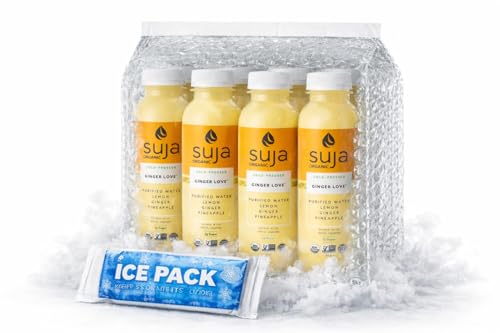
Best cold-pressed: Suja Organic Ginger Lemon Pineapple, 6 Pack
| Organic Integrity Score | 82 / 100 |
| Size | 10.5 oz, 6 pack |
| Certification | Vegan, Organic |
| Blend | Ginger, lemon and pineapple, not pure pineapple |
| Best for | Anyone who wants cold-pressed rather than pasteurized |
The only cold-pressed option on this page, and the reason it earns a slot. Every other juice here is pasteurized, which is why none of them retains active bromelain. Cold pressing uses pressure rather than heat, so more of the heat-sensitive character survives.
Be clear about what this is: a blend, not pure pineapple. Ginger and lemon are in the bottle alongside it, and the listing says so in the product name rather than burying it. If you want pineapple on its own, buy one of the bottles above.
The claims are otherwise well made. No added sugar is stated with the exclusions named: no artificial additives, sweeteners or preservatives. USDA certified and vegan are both stated plainly.
One claim we do not credit. “Organic immunity boost” and “support your immune system naturally” are the kind of structure-function language that sounds like a health claim without being one. Vitamin C in juice is real; an immunity boost is not a measurable thing a bottle can deliver.
What we liked: Genuinely cold-pressed rather than pasteurized, no added sugar with the exclusions named, and the blend declared in the product name.
Keep in mind: A blend rather than pure pineapple, the most expensive option per ounce, and an immunity claim that is marketing rather than measurement.
What the listing discloses: Suja states a USDA organic claim, and does not say where it was grown or made.
Bromelain, sugar, and a claim that does not survive the stomach
Pineapple juice attracts a specific claim about digestion and fat, and it is worth following because it fails at an identifiable point.
Pineapple contains bromelain, a genuine proteolytic enzyme, and it does break down protein. This is why fresh pineapple tenderises meat and why it prevents gelatine from setting. Those are real, observable effects.
The claim built on it is that bromelain aids digestion and therefore assists with weight. The first part has some support: bromelain supplements have been studied for digestive and anti-inflammatory effects, with mixed results. The second does not follow. Bromelain digests protein, not fat, and protein digestion is not a limiting step in weight management for anyone with normal pancreatic function.
Most orally consumed bromelain is also denatured by stomach acid, which is why supplement forms use enteric coating. The bromelain in a glass of juice largely does not reach the intestine intact.
What pineapple juice reliably is, is sweet. A cup carries around 130 calories and 25 grams of sugar, which is at the higher end for fruit juice, with the same liquid-calorie characteristics discussed elsewhere: quick to drink, low in fullness, poorly compensated for later.
Fresh pineapple is the better form by some distance: fiber intact, considerably more volume per calorie, and the same flavor.
Honest summary: a real enzyme with a real function that is unrelated to fat, largely destroyed before it could act anyway, and a juice with a high sugar content that is better eaten as fruit.
Common questions about organic pineapple juice
Is organic pineapple juice healthier than regular?
The farming is meaningfully different, since conventional pineapple is a heavily sprayed monoculture and organic prohibits those synthetic inputs. The juice itself is not nutritionally different: same sugar, same absent fiber. Buy organic for how the crop was grown, not for how the juice behaves.
What does “not from concentrate” actually mean?
That the juice was pressed and bottled without being heated to evaporate its water for shipping and then reconstituted later. That evaporation step drives off aromatic compounds, which is why from-concentrate juice tastes flatter and often has natural flavors added back. NFC keeps more of the fruit’s character.
Does pineapple juice contain bromelain?
Very little in any commercial bottle. Bromelain is destroyed by heat, and essentially all shelf-stable juice is pasteurized. Fresh pineapple contains active bromelain, which is why it tenderizes meat, stops gelatine setting and can make your tongue feel raw. Pasteurized juice does not.
Why does fresh pineapple hurt my tongue?
Bromelain is a protein-digesting enzyme, and it briefly acts on the proteins in your mouth. It is not an allergy and the sensation stops when you stop eating. Cooked or canned pineapple does not do it, because heat has deactivated the enzyme.
Is juice as good as eating fruit?
No. Juicing removes essentially all the fiber while keeping the sugar, so juice raises blood sugar faster than whole fruit and is far easier to overconsume. Dietary guidance generally treats juice as a limited part of fruit intake rather than an equivalent. This applies identically to organic juice.
Why does packaging matter for juice?
Juice is acidic and sits in its container for months. Glass is inert, does not leach, does not absorb flavor, and is genuinely recyclable, unlike multilayer cartons, which most curbside systems struggle with. It is heavier and breakable, which is why it is less common.
How long does pineapple juice last once opened?
Around five to seven days refrigerated, though vitamin C starts oxidizing immediately and flavor flattens after a few days. Keep it sealed and cold, and buy a size you will finish rather than the largest bottle available.
Can I use pineapple juice in cooking?
Yes, and it is excellent for it. It works particularly well in marinades and glazes, where its acidity and sweetness both contribute. Note that fresh, unpasteurized pineapple juice will prevent gelatine setting because of bromelain, so use pasteurized juice or cook it first for any jelly or panna cotta.
- Organic Food and Pantry hub
- Best Organic Apple Juice
- Best Organic Lemon Juice
- browse all our reviewed products — scores and certifications for 800+ products
- Juice labels explained
Price and availability as of October 15, 2026 1:10 pm EDT. Product prices and availability are accurate as of the date/time indicated and are subject to change. Any price and availability information displayed on Amazon.com at the time of purchase will apply to the purchase of this product.
Looking for other organic products?
We have checked more than 800 products across food, household goods, gardening, personal care and pet, every one against its stated certification. Browse all reviews.
Organic Connection is reader-supported. When you buy through links on this page we may earn a commission, at no extra cost to you. As an Amazon Associate we earn from qualifying purchases. We are not paid to feature or rank any product. How we research and rate.