Last updated: September 30, 2026
We may earn a commission when you buy through links on this page, at no extra cost to you. How we research and rate.
The short version
After researching the certifications, sourcing, and processing of the most popular organic quinoa, our top pick is Viva Naturals Organic Quinoa, 4 lb. It is USDA certified organic through QAI, pre-washed to remove saponins, and packed in a dedicated gluten-free facility with lot-level traceability, which is why it earned our highest Organic Integrity Score of 92 out of 100. For the best value, the 26 oz four-pack is our pick, and for a mix of colors, Ancient Harvest Tri-Color Harmony Blend is the best choice.
Quinoa is a category where the brands are less different than the marketing implies, and the two things that actually matter are whether the saponins have been properly removed and whether you are paying for a name. We flag each product’s certification, wash status, and format.
Best organic quinoa compared
| Best Choice | Best Value | ||||
 |  |  |  |  | |
| Product | Viva Naturals 4 lb | Bob’s Red Mill 26 oz x4 | Ancient Harvest Tri-Color | Anthony’s 4 lb | Yupik 2.2 lb |
| Organic Integrity Score | 92/ 100 | 88/ 100 | 86/ 100 | 84/ 100 | 82/ 100 |
| Our rating | 4.6 | 4.4 | 4.3 | 4.2 | 4.1 |
| Variety | White | White | White, red, black | White | White |
| Best for | Best overall | Best value | Salads and color | Bulk | Small bag |
| Certification | USDA Organic, Non-GMO Project Verified, Kosher | Vegan, Organic | USDA Organic, Non-GMO Project Verified, Gluten-free | USDA Organic, Non-GMO, Gluten-free | Certified Organic, Non-GMO, Kosher |
| Price | $24.99$0.39 / ounce View on Amazon | Currently unavailable See buying options | $18.22$1.52 / ounce View on Amazon | $25.19$0.39 / ounce View on Amazon | $12.99$0.37 / ounce View on Amazon |
Price and availability as of October 11, 2026 7:10 pm EDT. Product prices and availability are accurate as of the date/time indicated and are subject to change. Any price and availability information displayed on Amazon.com at the time of purchase will apply to the purchase of this product.
Scores are ours, based on independent research of certification, saponin removal, allergen handling, packaging, traceability, and price per pound, using the same 10-criteria method we apply to every product. See how we research and rate.
The organic quinoa certifications, and the question each one leaves open
A seal is a specific promise about a specific thing. These are the promises behind the marks on this page, in plain terms, along with the question each one leaves unanswered.
| Certification | Covers | Key exclusion |
| USDA Organic | Farming and handling: no synthetic pesticides or fertilizers, no GMOs, no sewage sludge or irradiation, audited yearly by an accredited certifier | Three different tiers share the one seal, and it makes no claim about worker pay, food miles, or nutrition |
| Non-GMO Project | Testing and supply-chain traceability showing the ingredients are not genetically engineered | Sets no limit on synthetic pesticides or fertilizers, so it is not an organic claim |
| Kosher | Ingredients and production comply with Jewish dietary law, verified by a rabbinic agency that inspects the facility | A dietary-law standard: it makes no claim about pesticides, GMOs or farming practice |
| Gluten-Free Certified | Testing to below 10 parts per million of gluten, stricter than the FDA threshold of 20 ppm | A gluten threshold and nothing more; unrelated to organic content or nutrition |
The mark most often mistaken for an organic claim is Non-GMO Project Verified. It is a real standard with real testing, and it verifies exactly one thing: that the ingredients are not genetically engineered. It sets no limit on synthetic pesticides, synthetic fertilizers, or anything else about how the crop was grown. USDA Organic already prohibits GMOs outright, so on a certified organic product the butterfly adds independent verification rather than a new promise. On a product carrying only the butterfly, the pesticide question has not been asked.
Quinoa nutrition, and the “complete protein” claim examined
| Per cooked cup (about 185 g) | Amount |
| Calories | About 222 |
| Protein | About 8 g, complete |
| Fiber | About 5 g |
| Carbohydrate | About 39 g |
| Glycaemic index | Around 53, low |
The complete protein claim is true, and routinely overstated. Quinoa does contain all nine essential amino acids, which genuinely sets it apart from most grains. What makes it unusual is the specific gaps it fills: it is high in lysine, the amino acid typically limiting in cereal grains, and in methionine, which is usually the limiting one in legumes. That is a real nutritional advantage for anyone eating mostly plants.
The honest caveat is quantity. Eight grams of protein per cooked cup makes quinoa a notably better grain than rice or couscous, and it does not make it a protein food in the way beans, lentils, eggs, or tofu are. Treat it as an upgraded carbohydrate rather than a protein source, and it will not disappoint you.
The low glycaemic index is the underrated part. At around 53, quinoa sits in the low-GI band, driven by its combination of fiber, protein, and a resistant starch fraction that slows glucose absorption. That makes it a genuinely useful swap for white rice or pasta if you are managing blood sugar, and it is arguably a stronger practical argument for eating it than the protein content is.
On rinsing and nutrients. A common worry is that rinsing washes away the goodness along with the saponins. It does not. Research has found that saponin removal through standard rinsing and processing does not meaningfully alter quinoa’s amino acid composition, so you keep the full protein benefit. Rinse without hesitation.
Key things to look for in organic quinoa
Good quinoa comes down to certification, washing, packaging, and price per pound. Here is what matters.
1. USDA organic certification
Quinoa is largely imported from Peru and Bolivia. Certification gives you an audited chain of custody that a bag of commodity seed does not.
2. Pre-washed or pre-rinsed
Look for a statement that saponins have been removed. It is not a guarantee you can skip rinsing, but it is a meaningful starting point.
3. Resealable, opaque packaging
Quinoa is high in unsaturated fat for a seed and goes rancid faster than rice. A resealable bag beats a paper sack.
4. Price per pound, not per bag
This is a commodity category with wide packaging variation. The same quinoa can differ by more than double per pound between formats.
White, red, black, tri-color: what actually differs
Color is the main axis of choice in quinoa, and the differences are real but smaller than the price gaps sometimes suggest.
White quinoa is the mildest, fluffiest, and fastest-cooking, and it is what most recipes assume. It cooks to a soft, separate grain in about fifteen minutes and takes on other flavors readily, which makes it the default for pilafs, bowls, and anything where quinoa is a background component.
Red quinoa holds its shape better and has a firmer bite and slightly earthier, nuttier flavor. It is the better choice in cold salads, where white quinoa can turn mushy after dressing, and it looks considerably better on a plate.
Black quinoa is the firmest and sweetest, with the most pronounced crunch, and it takes a few minutes longer to cook. It is a texture ingredient more than a staple.
Tri-color blends mix all three. They look excellent and taste good, with one honest caveat: the three colors cook at slightly different rates, so a blend is always a compromise, with the white slightly overdone by the time the black is right. In practice this is barely noticeable in a salad and more noticeable if you want perfectly uniform fluffy grains.
On nutrition, the differences between colors are minor. Darker varieties have somewhat more antioxidant pigment, and all quinoa is a complete protein at roughly 8 grams per cooked cup, high in magnesium, iron, and fiber, and naturally gluten-free. Choose on texture and appearance rather than expecting a meaningful nutritional gap.
How to choose organic quinoa
- Confirm USDA organic and, if you are celiac, a dedicated gluten-free facility.
- Check for a pre-washed statement, then rinse anyway.
- Pick color on texture: white for fluffy sides, red for salads, black for crunch.
- Compare price per pound across pack sizes, since the spread is large.
- Buy a size you will use in six months, and store it airtight and cool.
Who should buy organic quinoa
The right bag depends on how much quinoa you eat. If you want a reliable everyday white quinoa, our top pick fits. If you want the best price per pound, a colorful blend for salads, a small bag to try, or a bulk sack for a big household, we have a pick for each.
Best overall: Viva Naturals Organic Quinoa, 4 lb
| Organic Integrity Score | 92 / 100 |
| Size | 4 lb |
| Processing | Mechanically de-saponized and pre-washed |
| Per serving | 6 g plant protein, 3 g fiber; rich in magnesium |
| Origin | Southern Highlands of the Andean Plateau |
| Certification | USDA Organic, Non-GMO Project Verified, Kosher |
| Best for | Anyone who wants the saponin question answered |
Quinoa has one processing question that matters more than any other, and this is the only listing here that answers it properly. The seeds carry saponins, a naturally bitter, soapy coating that has to be removed or the cooked grain tastes unpleasant.
Viva Naturals says its quinoa is mechanically de-saponized and pre-washed. Mechanically matters: the alternative is a water wash, which works but uses considerably more water. Either way, pre-washed means you are not required to rinse it yourself, though a quick rinse never hurts.
It is also the only bag here to publish nutrition — 6 g of plant protein and 3 g of fiber per serving — and to name a growing region, the Southern Highlands of the Andean Plateau, which is where quinoa has been farmed for thousands of years.
The certification line names its programs rather than gesturing: Certified USDA Organic and Non-GMO Project Verified, alongside gluten-free, vegan and kosher.
What we liked: The only listing to explain de-saponization, published macros, a named growing region, and programs named rather than implied.
Keep in mind: “Larger, rounder and more flavorful than other varieties” is a comparative with nothing behind it. Rinse before cooking anyway if you are sensitive to bitterness.
What the listing discloses: Viva Naturals is explicit about USDA organic certification, Non-GMO Project Verified and kosher certification, and silent on where it was grown or made.
Best value: Bob’s Red Mill Organic White Quinoa, 26 oz (Pack of 4)
| Organic Integrity Score | 88 / 100 |
| Ingredients | Organic whole grain white quinoa |
| Certification | Vegan, Organic |
| Best for | Households that cook quinoa weekly |
Four bags of the same top-pick quinoa brings the price per pound down substantially without changing anything about the product. If quinoa is a regular part of how you cook rather than an occasional experiment, this is straightforwardly the format to buy. Each bag stays sealed until you open it, which is better for freshness than one enormous sack, and six and a half pounds is a realistic few months for a household.
The trade-off is storage space and upfront cost. Four 26 oz bags take up a fair amount of cupboard, and you are paying for several months at once. Quinoa’s fat content also means it will not keep indefinitely, so this is a good buy for a household that cooks it weekly and a poor one for someone who makes it twice a year.
What we liked: Identical quality to the top pick at a much better price per pound, in four separately sealed bags.
Keep in mind: Meaningful cupboard space and upfront cost, and not worth it for occasional cooks.
What the listing discloses: Beyond the organic claim itself, Bob’s Red Mill does not say whether the USDA seal applies and where it was grown or made.
Best for salads: Ancient Harvest Organic Tri-Color Harmony Blend
| Organic Integrity Score | 86 / 100 |
| Ingredients | Organic white, red, and black quinoa |
| Certification | USDA Organic, Non-GMO Project Verified, Gluten-free |
| Best for | Cold salads, grain bowls, and anything served visibly |
Ancient Harvest was the company that introduced quinoa to the US market in the 1980s, and its tri-color blend remains the best-known version of the format. The mix of white, red, and black gives a genuinely attractive speckled result and a more interesting texture than white alone, and crucially the red and black grains hold their shape after dressing, so a quinoa salad made with this does not collapse into mush in the fridge overnight the way white-only salads can.
The trade-off is the blend problem: three varieties with different cooking times in one pot means a compromise, with the white slightly softer than ideal by the time the black is properly done. It is also priced above plain white quinoa and sold here in a smaller two-pack, so the price per pound is noticeably higher.
What we liked: Excellent appearance and texture, holds its shape in dressed salads, USDA organic, from the company that pioneered the category.
Keep in mind: Mixed varieties cook at different rates, and it costs more per pound than white quinoa.
What the listing discloses: The listing leaves the basics open, including whether the USDA seal applies and where it was grown or made.
Best bulk: Anthony’s Organic White Whole Grain Quinoa, 4 lb
| Organic Integrity Score | 84 / 100 |
| Size | 4 lb |
| Processing | Triple cleaned |
| Certification | USDA Organic, Non-GMO, Gluten-free |
| Best for | Bulk buying without a 25 lb sack |
The sensible bulk option. The previous pick in this slot was a 25 lb sack, which is a catering quantity that most households will not get through before it goes stale.
On processing it says triple cleaned, which is the second-best answer in this comparison to the saponin question. It tells you the grain has been through multiple cleaning passes without saying whether that was mechanical or water, and it is considerably more than most bags offer.
The organic claim is stated as USDA Organic, alongside gluten free and non-GMO in the product name.
Beyond that, two bullets, the second of which lists diets rather than describing the quinoa. No macros, no origin, no certifier named.
What we liked: Triple cleaned is a real processing statement, and 4 lb is bulk that a household can actually finish.
Keep in mind: No origin, no macros, and the second bullet is a list of diets rather than product information.
What the listing discloses: Anthony’s states a USDA organic claim, and does not say where it was grown or made.
Best small bag: Yupik Organic White Quinoa, 2.2 lb
| Organic Integrity Score | 82 / 100 |
| Size | 2.2 lb |
| Variety | Royal quinoa, large seeds |
| Certification | Certified Organic, Non-GMO, Kosher |
| Best for | A modest bag at the lowest price in the comparison |
The cheapest bag here, and it names a variety rather than just a color. Royal quinoa refers to the large-seeded quinoa grown on the Bolivian altiplano, and it is genuinely a different grade from ordinary white quinoa — bigger seeds, and they stay separate rather than collapsing when cooked.
The certification is stated in the certified form, covering organic, gluten-free and kosher.
What is missing is the processing answer. Nothing is said about saponins, so assume you should rinse this one thoroughly before cooking. There are no macros, no origin beyond the variety name, and only two short bullets.
What we liked: Names the royal variety and its large seeds, states its certifications in the certified form, and costs least here.
Keep in mind: No mention of de-saponization or pre-washing, so rinse it. No nutrition figures.
What the listing discloses: Yupik is explicit about kosher certification, and silent on whether the USDA seal applies and where it was grown or made.
How to cook quinoa so it is fluffy, not mushy
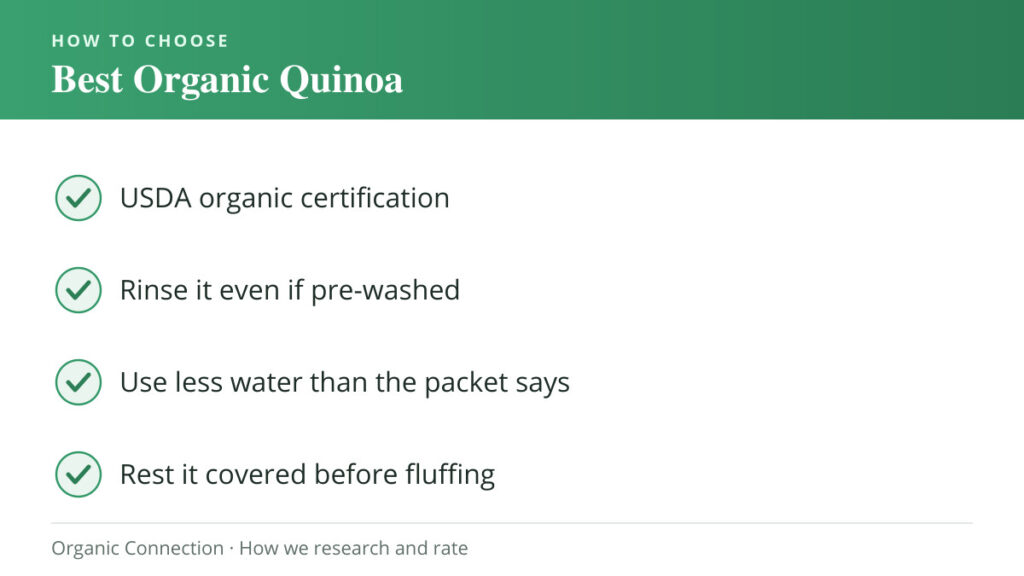
Rinse it, even if the bag says pre-washed. Put the quinoa in a fine mesh sieve and run cold water through it for thirty seconds while rubbing the seeds with your fingers. If the water foams, that is residual saponin, and you have just removed the reason most people say they do not like quinoa. Then drain it well; wet quinoa going into the pan is the main cause of gluey results.
The ratio most packets give is two parts water to one part quinoa, and that is too much. Use one and three-quarter parts liquid, or even one and a half, and you will get separate fluffy grains instead of porridge. Bring it to a boil, cover, reduce to the lowest simmer, and leave it fifteen minutes without lifting the lid. Then take it off the heat and let it stand, still covered, for another five to ten minutes. That resting step matters as much as the cooking. Fluff with a fork, never a spoon. You will see the germ separate into little white spirals, which is the sign it is properly done.
Two upgrades worth the effort: toast the drained quinoa in the dry pan for two or three minutes before adding liquid, which brings out a genuinely nutty flavor, and cook it in stock rather than water. Quinoa is bland by nature and takes salt and fat well. Cooked quinoa keeps four or five days refrigerated and freezes well in portions. Store uncooked quinoa airtight, cool, and dark; it keeps two to three years unopened but noticeably less once open, since its fat content means it goes rancid rather than simply stale.
How we researched this guide
We are a research-based review site. We compared each product against its certification (USDA organic and, where present, certified gluten-free and non-GMO), saponin removal and pre-washing, facility allergen controls, traceability, packaging and resealability, price per pound, and the weight of aggregated customer feedback on texture and cleanliness, then scored each with our 10-criteria Organic Integrity Score. No brand paid to be included or ranked. This page is informational and is not medical advice. Read the full method on our How We Research and Rate page.
The protein claim, and what quinoa is really good for
Quinoa’s reputation rests on being a complete protein, and while that is technically accurate it leads people to expect something the food does not deliver.
Quinoa does contain all nine essential amino acids in reasonable proportion, which is unusual for a plant food and genuinely notable. The quantity is the issue. A cooked cup supplies around 8 grams of protein alongside 39 grams of carbohydrate and 222 calories. That is more protein than rice and considerably less than most people assume from how it is marketed. Treated as your protein source, a bowl of quinoa falls well short.
Where it does better is the combination of fiber and structure. A cup carries about 5 grams of fiber, and the intact seed structure means it digests more slowly than refined grains, producing a flatter glucose curve and longer satiety than an equivalent serving of white rice or pasta. That is a real advantage and it is where the practical benefit sits.
It is not a low-calorie food. Quinoa and rice are close enough per cooked cup that swapping one for the other changes little in energy terms. The difference is in fiber, protein and micronutrients, not in calories saved, and anyone eating quinoa expecting a caloric discount will be disappointed.
One practical note that affects nothing about weight but improves the food considerably: rinse it. The saponin coating is bitter, and unrinsed quinoa is the usual reason people decide they dislike it.
Honest summary: a nutritionally strong grain with more fiber and better protein quality than most, at essentially the same calorie cost. Useful as a base, not as a protein source.
Common questions about organic quinoa
What is the best organic quinoa?
Our overall pick is Viva Naturals Organic Quinoa, which scores highest here at 92, because its listing names USDA organic certification, Non-GMO Project verification and kosher certification. For the best value, the 26 oz four-pack is our pick, and for salads, Ancient Harvest Tri-Color Harmony Blend.
Do you need to rinse pre-washed quinoa?
Yes, and it takes thirty seconds. Commercial de-saponification is mechanical and imperfect, so residue is common even on pre-washed quinoa. Rinse in a fine mesh sieve under cold water while rubbing the seeds. If the water foams, that is saponin, and rinsing it away is what stops quinoa tasting soapy or bitter.
Why is my quinoa mushy?
Usually too much water and not enough resting. Most packets say two parts water to one part quinoa, which is more than needed; use one and a half to one and three-quarter parts instead. Drain the rinsed quinoa well, simmer covered for fifteen minutes without lifting the lid, then rest it off the heat for five to ten minutes before fluffing with a fork.
Is red or white quinoa better?
They suit different jobs. White is milder, fluffier, and faster-cooking, which makes it the default for side dishes and bowls. Red is firmer and earthier and holds its shape after dressing, which makes it better in cold salads and meal prep. Nutritionally the difference is minor, so choose on texture.
Is quinoa gluten-free?
Quinoa is naturally gluten-free, since it is a pseudocereal seed rather than a true grain. The risk is cross-contamination during handling, because much quinoa is processed on lines shared with wheat. If you are celiac, buy quinoa that is certified gluten-free and packed in a dedicated facility rather than relying on the seed being naturally free of gluten.
- Organic Food & Pantry hub
- Best Organic Rice
- Best Organic Oatmeal
- How to Build an Organic Pantry
- browse all our reviewed products — scores and certifications for 800+ products
- Glyphosate in food, explained
Price and availability as of October 11, 2026 7:10 pm EDT. Product prices and availability are accurate as of the date/time indicated and are subject to change. Any price and availability information displayed on Amazon.com at the time of purchase will apply to the purchase of this product.
Looking for other organic products?
We have checked more than 800 products across food, household goods, gardening, personal care and pet, every one against its stated certification. Browse all reviews.
Organic Connection is reader-supported. When you buy through links on this page we may earn a commission, at no extra cost to you. As an Amazon Associate we earn from qualifying purchases. We are not paid to feature or rank any product. This page is informational and is not medical advice. How we research and rate.