
Last updated: September 11, 2026
Some links in this guide point to our product reviews, which may earn us a commission at no extra cost to you. How we research and rate.
The supplement aisle is one of the least regulated corners of the store, which is exactly why “organic” and third-party testing matter so much here. When you take something daily, in concentrated form, you want to know what is actually in the bottle. This guide explains what “organic” means for supplements, why it is not the whole story, which quality signals to look for beyond the organic seal, and how to choose whole-food organic supplements wisely, without falling for hype or wasting money.
What “organic” means for a supplement
A supplement can be USDA certified organic when it is made from agricultural ingredients grown to the organic standard, no synthetic pesticides, no GMOs, clean processing. This is genuinely meaningful for botanical and whole-food supplements: an organic turmeric, ashwagandha, or beet root is made from plants grown without synthetic chemicals, which matters because you take it every day and because roots and herbs can absorb what is in their soil.
Here is the important nuance: not every supplement can be organic, and that is not always a knock against it. Many isolated vitamins and minerals, a synthetic vitamin D or a mineral like zinc, are not agricultural products in the organic sense, so they cannot carry the seal. This is why our guide to the best organic multivitamin is honest that truly organic multivitamins are rare (most are synthetic USP isolates), and the genuinely organic options are whole-food formulas built from organic fruits, vegetables, and herbs. Knowing where organic certification is realistic and where it is not keeps you from chasing a seal that a given product category cannot honestly carry.
Why organic alone is not enough: the testing question
Because dietary supplements are regulated more loosely than food or drugs in the US, manufacturers are largely responsible for their own quality and labeling, and the agency mostly steps in after problems arise. That makes independent verification crucial. A supplement can be certified organic and still, in theory, be under-dosed, contaminated with heavy metals from its growing region, or inaccurately labeled. Organic certification addresses how the plant was grown; it does not, on its own, confirm what is in the finished capsule.
That is why the best supplements add third-party testing on top of organic certification. Look for language like “third-party tested,” “independently tested for purity and potency,” or seals from testing organizations, and for supplements prone to contamination (anything from the sea, or roots grown in heavy-metal-prone soils), testing for heavy metals like lead, arsenic, cadmium, and mercury is especially important. Our reviews of products like sea moss and spirulina emphasize this, because sea vegetables and algae can concentrate contaminants from their environment, so a clean source plus testing is what separates a trustworthy product from a risky one.
Whole-food vs isolated: what the form tells you
Supplements broadly come in two philosophies. Whole-food supplements are made by concentrating actual foods and herbs, an organic beet root powder, a spirulina, a food-based multivitamin, so you get the nutrient alongside its natural cofactors, and these can be certified organic. Isolated supplements deliver a single nutrient in concentrated form, a specific vitamin or an extracted compound, which allows precise, high dosing but is more processed and often cannot be organic.
Neither is universally better; they serve different goals. If your priority is clean, food-based nutrition with organic certification, whole-food supplements are the natural fit, and this is where the organic seal genuinely applies. If you need a specific, clinically studied dose of one nutrient, an isolated form may be more practical, and you should judge it on testing and quality rather than expecting an organic label. Extracts sit in between: a concentrated botanical extract (like a beet root 20:1) trades some whole-food character for potency, which can still be organic but is more processed than plain powder. Matching the form to your goal is half the battle.
Category by category: where organic genuinely shines
Some supplement categories are natural homes for organic, because they are botanical and whole-food by nature:
- Adaptogens and herbs: organic ashwagandha and other herbs are grown crops, so organic certification directly reduces pesticide exposure in something you take daily.
- Superfoods and greens: organic spirulina, sea moss, and beet root are concentrated foods where clean sourcing and testing matter most.
- Spice-based supplements: organic turmeric avoids the irradiation and fumigation common to conventional spices.
- Fiber: organic psyllium husk is a daily, high-volume supplement where 100% organic husk with no additives is the clean standard.
- Immune and wellness: organic elderberry syrup and apple cider vinegar are food-based and well-suited to organic.
- Herbal oils: oil of oregano, where the honest standard is certified organic or verified wild-harvested, plus meaningful potency (carvacrol).
And where organic is harder or rarer, we say so plainly. Comprehensive multivitamins, prenatal vitamins, and protein powders are all categories where genuinely organic options exist but are a minority (most protein powder, for example, is conventional whey; organic tends to mean plant-based). Our reviews steer you to the honestly organic choices in those categories rather than implying the whole shelf qualifies.
How to choose an organic supplement: a checklist
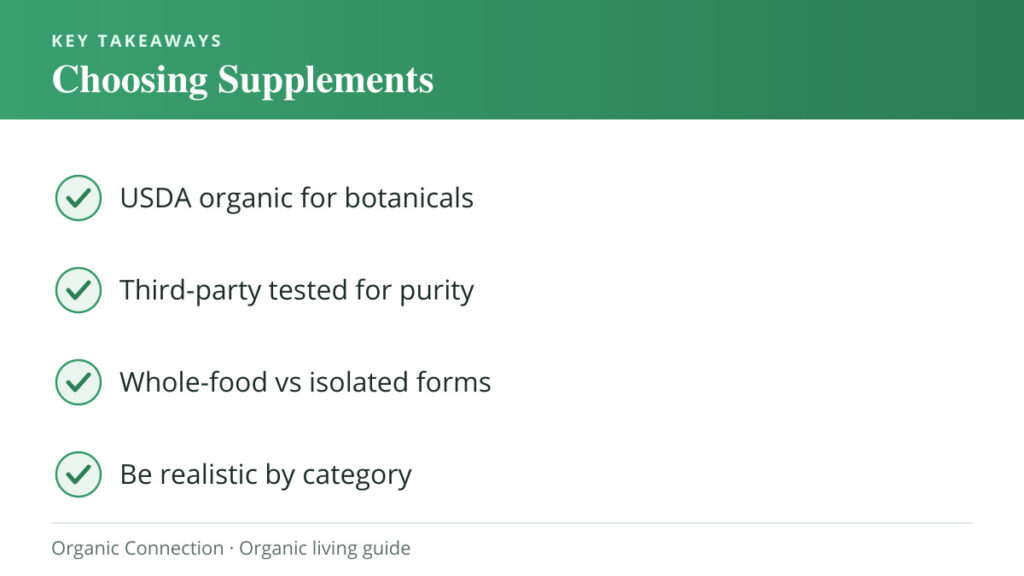
- Confirm the USDA Organic seal where the category realistically supports it (botanicals, superfoods, whole-food formulas).
- Look for third-party testing for potency, purity, and, where relevant, heavy metals and microbes. This is the verification the organic seal does not provide.
- Read the ingredient list. The best products are the active botanical plus minimal, recognizable other ingredients, no unnecessary fillers, artificial colors, or flow agents.
- Match the form to your goal: whole-food powder or capsule for clean food-based nutrition, extract for concentrated potency, isolate only when you need a specific high dose.
- Check the dose and serving size, and compare like with like, some products look cheaper because the serving is smaller.
- Be realistic about the category. Expect organic in herbs and superfoods; do not expect it on isolated synthetic vitamins.
A note on safety and expectations
Organic does not mean risk-free or effective for everyone, and supplements are not medicines. Some botanicals interact with medications (for example, certain herbs with blood thinners), some are not recommended during pregnancy, and potent products like oregano oil should be used sparingly and diluted. Whole-food supplements are generally gentle, but “natural” is not a guarantee of safety at any dose. The sensible approach is to treat supplements as a complement to a good diet rather than a replacement, start with modest amounts, and talk to your doctor before adding something new, especially if you are pregnant, nursing, managing a health condition, or taking medication. This article is general information, not medical advice.
Where organic matters in supplements
For supplements, organic certification is a strong signal that a botanical was grown cleanly, and it genuinely applies to herbs, superfoods, and whole-food formulas. But it is only half the picture: because supplements are loosely regulated, third-party testing for potency and purity is what verifies what is actually in the bottle. Look for organic plus testing, read the ingredient list, match the form to your goal, and be realistic about which categories can honestly be organic. For our specific picks and the honest category framing in each, follow the links above and see our rating method.
Common questions about organic supplements
What does organic mean for a supplement?
It means the supplement is made from agricultural ingredients grown to the USDA organic standard, without synthetic pesticides or GMOs, and cleanly processed. This is meaningful for botanical and whole-food supplements like turmeric, ashwagandha, and beet root, but many isolated synthetic vitamins cannot be organic because they are not agricultural products.
Is organic enough, or do supplements need testing too?
Testing matters too. Organic certification verifies how a plant was grown but not the potency, purity, or label accuracy of the finished product. Because supplements are loosely regulated, the best ones add third-party testing for potency, purity, and, where relevant, heavy metals, so look for both organic and independent testing.
Are there truly organic multivitamins?
They are rare. Most multivitamins are built from synthetic USP-isolated vitamins that cannot carry the organic seal. The genuinely organic options are whole-food multivitamins made from organic fruits, vegetables, and herbs. Our multivitamin review focuses on those honestly organic, whole-food formulas rather than implying the whole category qualifies.
Which supplements are most worth buying organic?
Botanicals and whole-food superfoods, where organic directly reduces pesticide exposure in something you take daily. Examples include ashwagandha, turmeric, spirulina, sea moss, beet root, psyllium husk, and elderberry. For products from the sea or algae, also insist on heavy-metal testing, since they can concentrate contaminants.
Are organic supplements safe to take with medication?
Not always. Organic does not mean risk-free; some botanicals interact with medications like blood thinners, and some are not recommended during pregnancy. Treat supplements as a complement to a good diet, start with modest amounts, and consult your doctor before adding anything new, especially if you are pregnant, nursing, or on medication.
Keep reading
- Organic Skincare 101: Reading Labels and Building a Routine
- What “Organic” Really Means: A Guide to Certifications
- How to Build an Organic Pantry Without Overspending
- How we research and rate products
- every product we have reviewed — filter by USDA Organic, GOTS, Fair Trade and more
- Organic Supplements and Wellness hub
- our organic product database — compare brands across every guide
Organic Connection is reader-supported. When you buy through links in our reviews we may earn a commission, at no extra cost to you. As an Amazon Associate we earn from qualifying purchases. We are not paid to feature or rank any product. This article is general information, not medical advice; consult your doctor before starting any supplement. How we research and rate.