Last updated: September 30, 2026
We may earn a commission when you buy through links on this page, at no extra cost to you. How we research and rate.
The short version
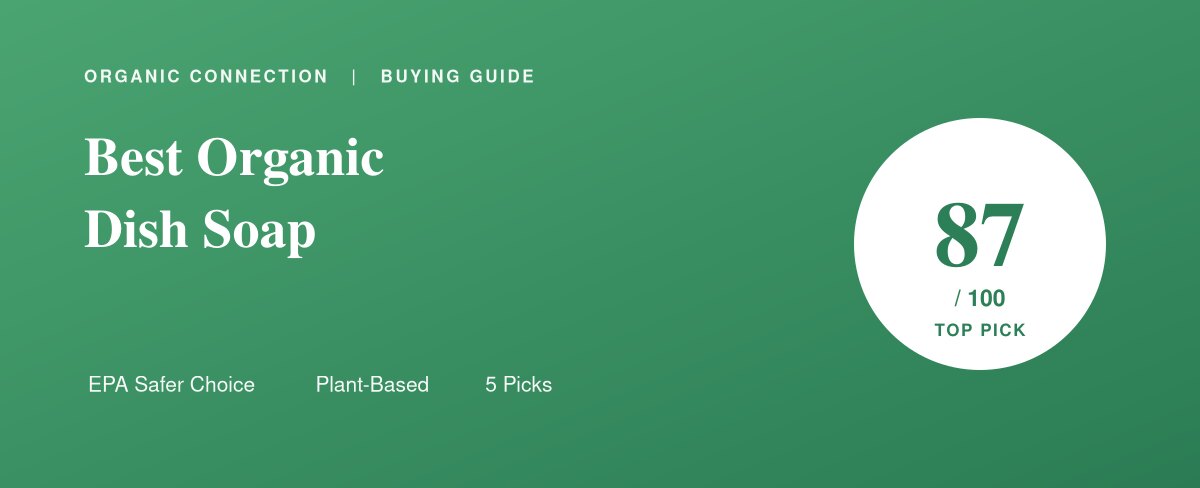
After working through what can and cannot be certified in this category, our top pick is Seventh Generation Free & Clear Dish Liquid. It is EPA Safer Choice certified and 95 percent USDA Certified Biobased, which are the two claims that carry real meaning here, and it is fragrance free, which is why it earned our highest Organic Integrity Score of 87 out of 100.
We have to open with a correction rather than a recommendation. There is no such thing as USDA Organic dish soap, and if you find a bottle implying otherwise, the claim is not what it appears to be.
Best organic dish soap compared
| Best Choice | Best Value | ||||
 |  |  |  |  | |
| Product | Seventh Generation Free | Ginger Lily Farms 128 oz | Dr. Bronner’s Sal Suds | ATTITUDE Dish Soap | Better Life Dish Soap |
| Organic Integrity Score | 87/ 100 | 84/ 100 | 83/ 100 | 82/ 100 | 80/ 100 |
| Our rating | 4.4 | 4.2 | 4.2 | 4.1 | 4.0 |
| Certification | Not stated on the listing | Not stated on the listing | Leaping Bunny | EWG Verified, Vegan | Not stated on the listing |
| Fragrance | Fragrance free | Fir and spruce | — | Citrus zest | Unscented |
| Format | 19 oz liquid | 32 oz concentrate, 2-pack | — | 23.7 oz liquid | 22 oz liquid |
| Best for | Sensitive hands | Whole-house cleaning | — | Verified ingredients | Unscented value |
| Size | 19 fl oz | 128 oz, the largest here | 1 gallon concentrate | 23.7 fl oz | 22 fl oz |
| Price | $21.18$0.19 / fluid ounce View on Amazon | $19.99$0.16 / fluid ounce View on Amazon | $54.99$0.43 / fluid ounce View on Amazon | $5.95 $6.99 −15%$0.25 / fluid ounce View on Amazon | $14.99$0.68 / fluid ounce View on Amazon |
Scores are ours, based on independent research of certification, ingredient disclosure, concentration, packaging and value, using the same 10-criteria method we apply to every product.
What each certification on an organic dish soap label actually covers
The labels on these products are not interchangeable, and several of them cover things that have nothing to do with each other. Here is what each one actually buys you.
| Certification | Covers | Key exclusion |
| USDA Organic | Farming and handling: no synthetic pesticides or fertilizers, no GMOs, no sewage sludge or irradiation, audited yearly by an accredited certifier | Three different tiers share the one seal, and it makes no claim about worker pay, food miles, or nutrition |
| EWG Verified | Full ingredient disclosure and avoidance of the chemicals on the EWG list of concern | Run by an advocacy group rather than a standards body, and not an organic claim |
USDA Organic is three claims wearing one seal. “100% Organic” means every ingredient is certified. Plain “Organic”, the version you will see most often, means at least 95% by weight, with the remainder drawn from an approved national list. “Made with organic ingredients” means 70%, and that wording may not carry the USDA seal at all. The phrase on the front of the pack tells you which of the three you are holding, and the gap between them is not small.
Why dish soap cannot be USDA Organic
The reason is structural rather than a failure of will by manufacturers.
Dish soap works because of surfactants: molecules with a water-loving end and an oil-loving end that lift grease into water. Those molecules have to be manufactured. Even the good ones derived from plants, such as decyl glucoside or sodium cocoyl isethionate, are the product of a chemical reaction on a coconut or corn feedstock. The feedstock may be agricultural; the surfactant is not.
Since USDA organic percentages count agricultural ingredients and exclude water, a product that is mostly water and manufactured surfactants has almost no eligible content to count. This is the same arithmetic that makes certified organic face cream rare, only more severe, because at least a moisturizer contains botanical oils that do count.
So “organic dish soap” as a shelf category is a search term rather than a certification. That does not mean the products are bad or the intent is dishonest. It means you need to know which certifications do apply, because those are the ones telling you something checkable.
The two certifications that actually mean something
EPA Safer Choice is the most useful mark in this aisle. It means every ingredient has been reviewed against the agency’s criteria and is the lowest hazard available in its functional class. Read that carefully, because the wording matters: it does not mean an ingredient is harmless, it means that among the chemicals that do that job, this one carries the least risk. That is a meaningful, honest standard rather than a marketing badge, and it covers the whole formula rather than one hero ingredient.
USDA Certified Biobased is the other one worth knowing, and it is routinely confused with USDA Organic because of the shared name. It quantifies what proportion of the product comes from renewable biological feedstocks rather than petroleum, and it is expressed as a percentage: 95 percent biobased means what it says. It tells you nothing about toxicity or how it was farmed, only about where the carbon came from.
Between them these cover different things. Safer Choice speaks to hazard, Biobased to renewability. A product carrying both is telling you considerably more than one saying “natural”. See how to spot greenwashing for the wider pattern of unregulated claims.
Are plant-based surfactants actually better?
Mostly yes, with a caveat worth stating.
Plant-derived surfactants such as coconut-based sodium cocoyl isethionate and decyl glucoside clean effectively and biodegrade readily, and unlike some petroleum-derived surfactants they do not persist and accumulate in aquatic systems. Since essentially all of your dish soap ends up in the water system, biodegradability is the environmental question that matters most in this category, and it is a genuine advantage.
The caveat is the one that runs through all of natural cleaning: plant-derived does not automatically mean gentle on skin, and it does not mean non-irritating. Some plant surfactants are mild, others less so, and the fragrance added to a natural soap is a more common cause of hand irritation than the surfactant. If dish soap dries or irritates your hands, the fragrance-free version is the change to make first.
Key things to look for in a natural dish soap
1. EPA Safer Choice certification
The single most informative mark available. It reflects a review of the entire formula rather than a claim about one ingredient.
2. A stated biobased percentage
A number such as 95 percent is checkable. “Plant-based” with no figure is not, and the gap between 98 percent and “made with plant-derived ingredients” can be large.
3. Fragrance free if your hands react
Fragrance is the usual culprit in dish soap irritation, including natural fragrance and essential oils. Free and clear versions exist for this reason.
4. Concentration, not just bottle size
A concentrated soap that needs a few drops outlasts a dilute one twice its size. Compare cost per wash rather than per bottle, which is genuinely hard to do from the shelf and worth doing anyway.
5. Refills or concentrates over single-use bottles
If the environmental case is why you are here, packaging is where a large part of the impact sits. A gallon concentrate or a refill system beats repeatedly buying a new plastic bottle of mostly water.
Who should buy a natural dish soap
Buy one if you want a formula reviewed against a real hazard standard, if biodegradability matters to you, or if conventional dish soap irritates your hands. Buy the fragrance-free version if skin reactions are the driver, since that is the variable most likely to be responsible.
Adjust expectations on grease. Natural formulations have improved enormously, but the most aggressive conventional degreasers still have an edge on burnt-on fat, and the honest answer is that you may use slightly more, or soak first. That is a real trade rather than one we will pretend away. If you want one product for dishes, floors and laundry, a concentrate like Sal Suds does that job in a way single-purpose soaps do not.
How to choose a natural dish soap
Look for EPA Safer Choice first, since it does the most work per square centimeter of label. Then check for a stated biobased percentage. Then decide on fragrance based on your hands rather than your nose. Then compare concentration and packaging, because a concentrate in a large container is usually both cheaper per wash and lighter environmentally than repeat bottles. Ignore the word organic here entirely; as above, it cannot mean what it does on food.
Best overall: Seventh Generation Free & Clear Dish Liquid
| Organic Integrity Score | 87 / 100 |
| Size | 19 fl oz |
| Certification | Not stated on the listing |
| Best for | Sensitive skin, and anyone wanting checkable claims |
It carries both certifications that mean anything in this category, and states a number for the one that has a number. EPA Safer Choice means the whole formula was reviewed for hazard, 95 percent USDA Biobased quantifies the renewable content, and Free & Clear means no fragrance, which is the ingredient most likely to bother your hands.
The trade-off is grease performance on the worst jobs. It handles everyday washing well, but on a roasting tin of set fat you will use more of it than a heavy-duty conventional detergent, or soak first. For most people most of the time that is a fair exchange for a formula that has actually been assessed.
What we liked: Both meaningful certifications, with the biobased content stated as a percentage rather than implied. Genuinely fragrance free. Widely available and reasonably priced. Established brand with a long compliance record.
Keep in mind: Not the strongest degreaser on baked-on fat. Nineteen ounces is a modest bottle, and it is not concentrated, so cost per wash is average rather than good.
What the listing discloses: Seventh Generation carries no organic claim, certified or otherwise.
Best fragrance-free value: Dr. Bronner’s Sal Suds All-Purpose Soap, 128 oz
| Organic Integrity Score | 84 / 100 |
| Size | 128 oz, the largest here |
| Formula | Plant-based, biodegradable, with aloe vera extract and glycerin |
| Excludes | Parabens, phthalates, MEA, DEA, dyes, triclosan, fragrance |
| Organic claim | None |
| Best for | Sensitive skin, and the lowest cost per ounce |
The exclusion list is the reason this earns a slot, and it is unusually specific: no parabens, phthalates, MEA, DEA, dyes or triclosan, plus fragrance-free.
Two of those are worth knowing. MEA and DEA are ethanolamines, used as foaming agents and pH adjusters in cleaning products, and they are rarely named in a free-from list because most shoppers have never heard of them. Triclosan is the antibacterial the FDA barred from consumer hand soaps in 2016; naming it excluded is reassurance rather than news, and it is still an explicit statement.
Fragrance-free is the practical one. Fragrance is the most common cause of contact irritation in dish soap, and hands spend more time in dish soap than in almost any other cleaning product.
At 128 oz it is the largest container on this page by a wide margin and the cheapest per ounce.
Be clear about what it is not: there is no organic claim here at all. It is plant-based and biodegradable, which are different things, and on a page about organic dish soap it sits on its exclusions rather than a seal.
What we liked: Six named exclusions including MEA and DEA, genuinely fragrance-free, biodegradable, and the best price per ounce here.
Keep in mind: No organic certification of any kind, and a gallon jug needs decanting into a pump bottle to be usable at the sink.
What the listing discloses: No organic certification appears anywhere on the Ginger Lily Farms listing.
Best bulk: Dr. Bronner’s Sal Suds, 1 Gallon
| Organic Integrity Score | 83 / 100 |
| Size | 1 gallon concentrate |
| Certification | Leaping Bunny |
| Best for | Refilling smaller bottles and cutting packaging |
The same concentrate in a gallon, which is the format that makes the environmental argument properly. One large container refilling a small dispenser for a year or more removes a great many single-use bottles from your kitchen, and the cost per wash drops again.
It only makes sense if you have somewhere to store a gallon and something to decant into. Buy a pump bottle at the same time, because pouring from a gallon jug over a sink is how you end up using far too much.
What we liked: Best cost per wash here by a distance. Dramatically less packaging than repeat bottles. Same multi-purpose concentrate.
Keep in mind: Needs storage space and a dispenser bottle. Scented. A gallon is a serious commitment if you turn out not to like it.
What the listing discloses: The word organic does not appear on the Dr. Bronner’s listing at all.
Best verified ingredients: ATTITUDE Dish Soap, Citrus Zest, 23.7 oz
| Organic Integrity Score | 82 / 100 |
| Size | 23.7 fl oz |
| Certification | EWG Verified, Vegan |
| Best for | Buyers who follow EWG ingredient ratings |
EWG Verified is a stricter ingredient screen than most marks in this aisle, requiring full disclosure and excluding ingredients on the organization’s own concern lists. It is a different philosophy from EPA Safer Choice, which asks what the least-hazardous option in each functional class is, and worth having if EWG ratings are how you already shop.
The citrus zest scent is natural rather than synthetic, which matters to some buyers and is irrelevant to skin reactivity, since natural fragrance is still fragrance. A larger bottle than the Seventh Generation at a comparable price.
What we liked: EWG Verified requires full ingredient disclosure, which is genuinely more than most brands offer. Vegan and plant-based. Good bottle size for the money.
Keep in mind: Scented, so not the pick for reactive hands. EWG Verified is a private standard rather than a government one, which is not a criticism but is worth knowing.
What the listing discloses: The word organic does not appear on the BIO SPECTRA ATTITUDE listing at all.
Best unscented value: Better Life Dish Soap, Unscented, 22 oz
| Organic Integrity Score | 80 / 100 |
| Size | 22 fl oz |
| Certification | Not stated on the listing |
| Best for | Unscented washing at a sensible price |
A plant-derived unscented soap aimed squarely at people whose hands object to dish washing, at a lower price than the certified options. Twenty-two ounces is a good size and it does the everyday job without drama.
We have scored it lowest of the five because it carries neither EPA Safer Choice nor a stated biobased percentage, so you are relying on the brand’s own description rather than an outside check. That is not evidence of a problem, but after everything above about which claims are verifiable, it would be inconsistent to rank it alongside products that have been independently assessed.
What we liked: Genuinely unscented, which is the thing that matters most for irritated hands. Plant-derived. Good value per ounce. Gentle enough to use without gloves.
Keep in mind: No third-party certification, so the claims rest on the manufacturer. Check whether you are buying the single bottle or the two-pack, as both are listed.
What the listing discloses: Better Life makes no organic claim anywhere, so the case rests on the other claims it does make.
Common questions about organic dish soap
Is there such a thing as USDA Organic dish soap?
No, and there effectively cannot be. Organic percentages count agricultural ingredients and exclude water, while dish soap is mostly water plus manufactured surfactants. Even plant-derived surfactants are chemical products made from an agricultural feedstock rather than agricultural products themselves, so there is almost nothing eligible to count.
What does EPA Safer Choice actually certify?
That every ingredient in the formula has been reviewed and is the lowest hazard available in its functional class. It does not mean ingredients are harmless; it means that among the chemicals capable of doing that job, these carry the least risk. It assesses the whole formula, which makes it the most useful mark in this aisle.
Is USDA Biobased the same as USDA Organic?
No, and the shared name causes real confusion. Biobased certifies what proportion of the product comes from renewable biological feedstocks rather than petroleum, expressed as a percentage. It says nothing about farming practice or toxicity, only about the origin of the carbon.
Are plant-based surfactants better for the environment?
Generally yes. Plant-derived surfactants such as decyl glucoside and coconut-based sodium cocoyl isethionate biodegrade readily and do not accumulate in aquatic systems the way some petroleum-derived surfactants can. Since essentially all dish soap ends up in the water system, biodegradability is the environmental property that matters most here.
Does natural dish soap clean as well?
For everyday washing, yes. On heavily baked-on grease the strongest conventional degreasers still have an edge, and you may use more product or need to soak first. That is a genuine trade-off rather than a myth, and worth knowing before you switch.
Why does dish soap irritate my hands?
Most often fragrance, including natural fragrance and essential oils, rather than the surfactant. Switching to a fragrance-free or free-and-clear version is the first change to try. Water temperature and frequency matter too, since hot water strips skin lipids regardless of the soap.
Can I use castile soap for dishes?
You can, but many people find it disappointing. Castile is a true soap and reacts with the minerals in hard water to leave a film on dishes and glassware. Dr. Bronner’s make Sal Suds as a synthetic detergent specifically to avoid that, which is why it is the better choice at the sink.
Is concentrated dish soap better value?
Usually, and by more than the label suggests. A concentrate needing a few drops per sink outlasts a dilute soap several times its volume, and buying a large concentrate to refill a small dispenser also cuts packaging substantially. Compare cost per wash rather than per bottle.
- Organic Household hub
- Best Organic Castile Soap
- Best Natural Laundry Detergent
- our full product index — search by brand, product or certification
Price and availability as of October 15, 2026 1:10 pm EDT. Product prices and availability are accurate as of the date/time indicated and are subject to change. Any price and availability information displayed on Amazon.com at the time of purchase will apply to the purchase of this product.
Looking for other organic products?
We have checked more than 800 products across food, household goods, gardening, personal care and pet, every one against its stated certification. Browse all reviews.
Organic Connection is reader-supported. When you buy through links on this page we may earn a commission, at no extra cost to you. As an Amazon Associate we earn from qualifying purchases. We are not paid to feature or rank any product. How we research and rate.