Last updated: September 30, 2026
We may earn a commission when you buy through links on this page, at no extra cost to you. How we research and rate.
The short version
After researching the certifications, oil sourcing, and formulation of the most popular organic castile soaps, our top pick is WHOLENATURALS Pure Castile Soap, Unscented, 32 oz. It is made with over 70% certified organic and fair trade oils, contains no synthetic preservatives, thickeners, foaming agents, or fragrance, and now uses Regenerative Organic Certified oils, which is why it earned our highest Organic Integrity Score of 92 out of 100. For a scented version, the VERMONT SOAP Castile Soap Unscented is our pick, and for the best value, the Baby Unscented 2-pack is the best choice.
Castile soap is the closest thing to a genuinely universal cleaning product, and it is also the one most people use wrong, because it is three times more concentrated than it looks and it reacts badly with two very common things. We flag each product’s certification, scent, and size.
Best organic castile soap compared
| Best Choice | Best Value | ||||
 |  |  |  |  | |
| Product | WHOLENATURALS 32 oz | Vermont Soap 32 oz | Baby Unscented 2-Pack | Peppermint 2-Pack | Quinn’s Unscented Pure Castile |
| Organic Integrity Score | 92/ 100 | 88/ 100 | 87/ 100 | 84/ 100 | 83/ 100 |
| Our rating | 4.6 | 4.4 | 4.4 | 4.2 | 4.2 |
| Scent | None | Peppermint | None | Peppermint | None |
| Best for | Best overall | Best all-rounder | Best value | Household cleaning | Travel |
| Certification | Certified Organic, EWG Verified, Non-GMO | USDA Organic, Vegan | Regenerative Organic, Fair Trade, Certified Organic | Fair Trade, Certified Organic | Certified Organic, Vegan |
| Price | $28.88$0.45 / fluid ounce View on Amazon | $24.99$0.78 / fluid ounce View on Amazon | $33.23$0.52 / fluid ounce View on Amazon | $32.99$0.52 / fluid ounce View on Amazon | $16.49$0.52 / ounce View on Amazon |
Price and availability as of October 11, 2026 7:10 pm EDT. Product prices and availability are accurate as of the date/time indicated and are subject to change. Any price and availability information displayed on Amazon.com at the time of purchase will apply to the purchase of this product.
Scores are ours, based on independent research of oil certification and sourcing, ingredient purity, absence of synthetic additives, concentration, packaging, and value, using the same 10-criteria method we apply to every product. See how we research and rate.
Reading the seals on organic castile soap: what each one does and does not cover
Most shoppers read a certification as a general signal of quality. Every one of them is narrower than that, and the gaps between them are where the marketing lives.
| Certification | Covers | Key exclusion |
| USDA Organic | Farming and handling: no synthetic pesticides or fertilizers, no GMOs, no sewage sludge or irradiation, audited yearly by an accredited certifier | Three different tiers share the one seal, and it makes no claim about worker pay, food miles, or nutrition |
| Regenerative Organic | Soil health, animal welfare and farmworker fairness, built on top of an existing organic certification | Requires organic certification as its baseline, so it is an addition to the USDA seal and never a replacement for it |
| EWG Verified | Full ingredient disclosure and avoidance of the chemicals on the EWG list of concern | Run by an advocacy group rather than a standards body, and not an organic claim |
The USDA seal is a farming standard, and only a farming standard. It is enforced, it is audited annually, and it genuinely prohibits synthetic pesticides, synthetic fertilizers and GMOs. It says nothing about what the people who grew the crop were paid, how far the product traveled, or whether it is good for you. Organic sugar is organic. It is still sugar.
Key things to look for in organic castile soap
Good castile soap comes down to oil quality, certification, additives, and concentration. Here is what matters.
1. Certified organic and fair trade oils
The oils are the product. Coconut, olive, hemp, and jojoba sourced under organic and fair trade certification is the meaningful claim.
2. No synthetic preservatives, thickeners, or foaming agents
True castile needs none of these. Their presence means you are buying a detergent blend with some soap in it.
3. Unscented if you have sensitive skin or a baby
Even natural essential oils are a common irritant. Unscented is the default for babies, faces, and reactive skin.
4. Concentration, not bottle size
Genuine castile is roughly three times more concentrated than conventional liquid soap, so compare on dilutions, not ounces.
What castile soap is genuinely good at, and what it is not
The “18-in-1” marketing is closer to true than most marketing, and it still has real limits worth knowing before you buy a gallon.
Where it excels. As a body wash and hand soap it is excellent, mild, and effective. Diluted heavily it makes a very good all-purpose surface cleaner and floor wash. It is a good dish soap by hand. It works well for washing pets, for cleaning fruit and vegetables at high dilution, and as a base for a gentle insecticidal soap spray in the garden. For anyone trying to cut the number of plastic bottles under the sink, one bottle genuinely replacing five or six is a real result.
Where it struggles. As a shampoo it is divisive and often disappointing, particularly in hard water. Because it is alkaline, it lifts the hair cuticle, which leaves many people with straw-like, tangled hair. The traditional fix is an acidic rinse afterwards, diluted apple cider vinegar or citric acid, which flattens the cuticle again. If you try castile as shampoo without that step and conclude it is terrible, the missing rinse is usually why. Some hair types never get on with it regardless.
Where it should not be used at all. Never in a dishwasher or washing machine drawer designed for low-foaming detergent, where it will foam catastrophically. Never mixed with vinegar in the same bottle. Never on natural stone like marble or granite, where alkalinity can etch and dull sealed surfaces. And it is a poor choice for laundry in hard water, where soap scum builds up in fabric over time and leaves clothes stiff and dingy.
On the Regenerative Organic Certification. Dr. Bronner’s has moved much of its oil supply to Regenerative Organic Certified sourcing, which is organic certification plus audited soil health, animal welfare, and farmworker fairness. That is a genuinely higher bar than USDA organic alone and is a legitimate reason the brand dominates this category.
Hard water, soap scum, and how to fix it
This is the single most common reason people give up on castile soap, and it is entirely explicable chemistry rather than a fault in the product.
What is happening. Because castile is a true soap rather than a synthetic detergent, it reacts with the calcium and magnesium ions in hard water to form insoluble metallic stearates. Those are the whitish, slightly greasy precipitate you see: soap scum. Unlike detergent residue, it does not rinse away easily, so it builds up on skin, hair, shower walls, and fabric, producing dullness, a filmy feel, and eventually stiff dingy laundry.
| Fix | How it works | Best for |
| Dilute much further | Less soap, less residue to react | Everything, first thing to try |
| Add washing soda or borax | Chelates the minerals before the soap meets them | Cleaning and laundry |
| Use filtered or distilled water | Removes the minerals entirely | Making up spray bottles |
| Acidic rinse afterwards | Dissolves scum already deposited | Hair, shower surfaces |
| Switch to a detergent-based product | Detergents do not react with minerals | Very hard water, laundry |
A quick way to test your water. Put a small amount of castile soap in a jar of your tap water and shake. Soft water gives a good head of suds that persists. Hard water gives poor suds and a cloudy, filmy liquid. That tells you immediately whether castile is going to be straightforward in your house or a running battle.
One thing to be clear about: castile soap cleans, it does not disinfect. It is not an antibacterial sanitiser, and it should not be relied on where actual disinfection is needed, such as after handling raw meat. It lifts and removes soil, which is a different job and the right one for most household cleaning.
How to choose organic castile soap
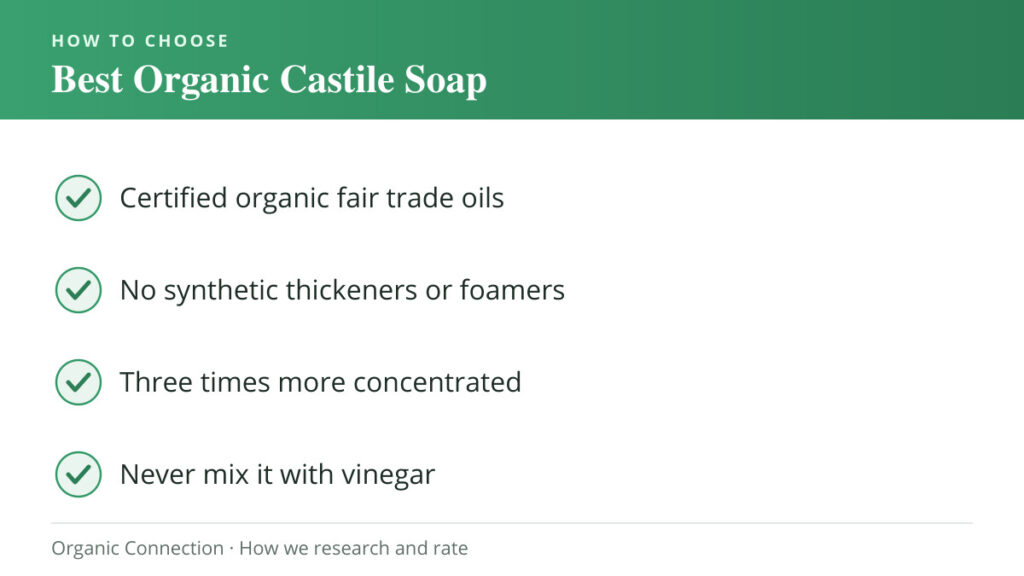
- Check the oils are certified organic and fair trade, since the oils are the whole product.
- Reject anything with synthetic thickeners or foaming agents; true castile needs none.
- Buy unscented for babies, faces, and sensitive skin, scented for general household use.
- Buy concentrate and dilute it yourself. Pre-diluted versions are mostly water at a premium.
- Never store it mixed with vinegar, and expect soap scum if your water is hard.
Who should buy organic castile soap
The right bottle depends on what you are replacing. If you want the gentlest option for babies, faces, and sensitive skin, our top pick fits. If you want a scented all-rounder, the best value in bulk, a household cleaning workhorse, or a travel size, we have a pick for each.
Best overall: WHOLENATURALS Pure Castile Soap, Unscented, 32 oz
| Organic Integrity Score | 92 / 100 |
| Size | 32 oz |
| Certification | Certified Organic, EWG Verified, Non-GMO |
| Concentration | Stated as 2 to 3 times more concentrated than regular soaps |
| Oils | Prickly pear, argan, jojoba, almond and hemp |
| Best for | Anyone avoiding palm oil, and the best selling castile here |
Two claims here are worth more than anything else in the category, and the first is about an ingredient most castile buyers never think about.
Certified palm oil free. Palm is the standard base fat in liquid soap, and it is the ingredient behind the deforestation argument. Most castile soaps contain it. This listing claims to be the only certified palm-oil-free castile on Amazon, which is a first-in-category superlative we cannot verify, but the underlying certification is a real and unusual thing to hold.
EWG Verified is the second. It is a third-party mark covering ingredient disclosure and hazard screening, and it is named as a program rather than gestured at.
The concentration statement is practical: 2 to 3 times more concentrated than regular soaps, which is what makes castile economical, since almost every use involves diluting it. The oil blend is named individually — prickly pear, argan, jojoba, almond and hemp — rather than described as botanical.
It also carries by far the strongest sales rank in this comparison.
What we liked: Certified palm oil free, EWG Verified, a stated concentration, the oils named individually, and the best sales rank here.
Keep in mind: “The only certified palm oil free castile soap on Amazon” is an unverifiable first-in-category claim, and the last bullet is a sales pitch with a free e-book.
What the listing discloses: On the WHOLENATURALS label: EWG Verified. Not stated: whether the USDA seal applies and where it was grown or made.
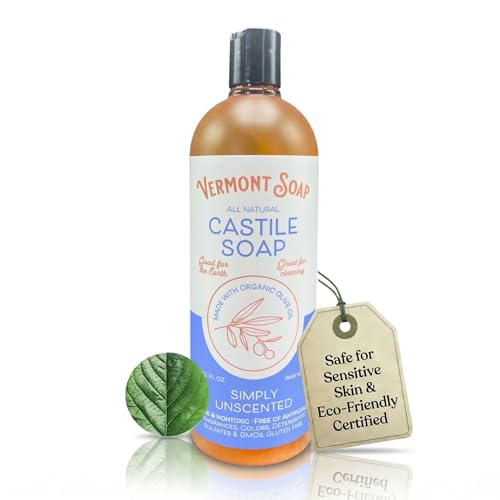
Best audited supply chain: Vermont Soap Organic Castile Soap, Unscented, 32 oz
| Organic Integrity Score | 88 / 100 |
| Size | 32 oz |
| Certification | USDA Organic, Vegan |
| Excludes | Sulfates, chemical detergents, petrochemicals, artificial colors, fragrances, animal by-products |
| History | Making certified organic castile since 1992 |
| Best for | Buyers who want the certification described rather than just claimed |
The phrase that earns this its slot is “USDA Organic: audited natural farm to bottle.” Most organic claims name the seal; this one names the scope, which is the whole supply chain rather than the finished formula.
The exclusions are enumerated rather than summarized: no sulfates, chemical detergents, petrochemicals, artificial colors, fragrances or animal by-products. Six named categories beats any number of uses of the word natural, and it is aimed squarely at what mass-market body wash actually contains.
The company history is unusually specific and checkable — making certified organic castile since 1992 — and the concentrated formula claim is tied to reducing plastic waste rather than left as a virtue on its own.
Unscented here means genuinely unscented, with no essential oils, which matters for sensitive skin.
What we liked: Names the audit scope rather than just the seal, six specific exclusions, and a long documented history of organic certification.
Keep in mind: A typo in the listing (‘Glutan-free’), and no certifying agency named. Unscented will not suit anyone who wants the classic peppermint.
What the listing discloses: On the VERMONT SOAP label: USDA organic certification. Not stated: where it was grown or made.
Best value: Dr. Bronner’s Baby Unscented Pure-Castile Soap, 32 oz 2-Pack
| Organic Integrity Score | 87 / 100 |
| Ingredients | Organic coconut, olive, hemp and jojoba oils |
| Certification | Regenerative Organic, Fair Trade, Certified Organic |
| Best for | Households replacing several products at once |
Two 32 oz bottles of our top pick, which is where the economics of castile soap really land. At 3x concentration, 64 oz of unscented castile diluted properly is an enormous quantity of hand soap, body wash, and surface cleaner, and it works out dramatically cheaper per use than buying separate products for each job. If you have decided to consolidate what is under your sink, this is the buy.
The trade-off is straightforward: it is a lot of soap and a lot of shelf space, and it only makes sense once you know castile suits you. If you have never used it, buy one bottle, work out your dilutions, confirm your water is not so hard that soap scum becomes a nuisance, and then buy the two-pack.
What we liked: The best cost per use here, same Regenerative Organic fragrance-free formula, in two separately sealed bottles.
Keep in mind: A large commitment and considerable storage space; establish that castile works for you first.
What the listing discloses: Dr. Bronner’s states Fair Trade and Regenerative Organic Certified, and does not say whether the USDA seal applies and where it was grown or made.
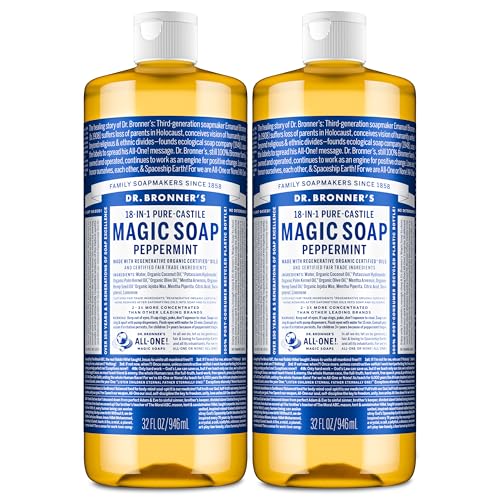
Best for household cleaning: Dr. Bronner’s Peppermint Pure-Castile Soap, 32 oz 2-Pack
| Organic Integrity Score | 84 / 100 |
| Ingredients | Organic coconut, olive, hemp and jojoba oils, organic peppermint oil |
| Certification | Fair Trade, Certified Organic |
| Best for | Mopping, surfaces, dishes, and outdoor cleaning |
If your main interest is replacing household cleaners rather than body wash, peppermint in bulk is the practical choice. A capful in a bucket of hot water is an excellent floor wash, a heavily diluted spray bottle handles most surfaces, and it works well for washing pets and outdoor gear. Two bottles at 3x concentration is a long-term supply of general-purpose cleaner for a fraction of the cost of branded sprays.
It scores lower than the unscented equivalents because peppermint limits its usefulness: it is not suitable for babies, faces, or sensitive skin, so a household buying only this is buying a cleaning product rather than a universal one. It also cannot be mixed with vinegar, which rules out combining it with the other staple of natural cleaning.
What we liked: Excellent value as a bulk household cleaner, organic fair trade oils, and a genuinely pleasant clean scent.
Keep in mind: Peppermint rules out baby and facial use, and castile cannot be combined with vinegar.
What the listing discloses: Dr. Bronner’s is explicit about Fair Trade, and silent on whether the USDA seal applies and where it was grown or made.
Best value unscented: Quinn’s Unscented Pure Castile Organic Liquid Soap, 32 oz
| Organic Integrity Score | 83 / 100 |
| Size | 32 oz |
| Certification | Certified Organic, Vegan |
| Excludes | Synthetic detergents, foaming agents, animal products |
| Best for | The lowest price on a full-size unscented castile |
The cheapest full-size bottle in the comparison, and it is honest about what unscented does and does not mean.
“Good for sensitive skin and babies too (though not tear-free!)” is a small piece of candour that stands out. Castile soap is genuinely not tear-free, plenty of parents assume a baby-labeled soap will be, and this listing says so in a bracket rather than letting the assumption stand.
The exclusions are specific — no synthetic detergents, no foaming agents, no animal products — and the ingredients are described as certified organic and vegan, with the soap base fully biodegradable.
What it does not do is name a certifier, quantify the concentration, or list which oils it uses, all of which the two picks above manage.
What we liked: Cheapest full-size bottle here, three named exclusions, and an unusually honest note that castile is not tear-free.
Keep in mind: No certifier named, no oils listed, and no concentration figure.
What the listing discloses: Little to verify on the Quinn’s listing: no word on whether the USDA seal applies and where it was grown or made.
How to dilute castile soap, and the two things never to mix it with
Almost every complaint about castile soap comes from using it neat. It is roughly three times more concentrated than conventional liquid soap, so undiluted it feels slimy, is hard to rinse, and wastes most of the bottle. The rough guides worth writing on a card: hand soap, one part soap to three parts water in a pump bottle. Body wash, a small squirt on a wet flannel, not on dry skin. Dishes, a couple of teaspoons in a full sink. All-purpose spray, a quarter cup per quart of water. Floors, half a cup in a bucket of hot water. Start weaker than you think; you can always add more.
Two absolute rules. Never mix castile soap with vinegar. The acid reacts with the soap and breaks it back into its constituent oils, leaving a curdled white greasy film that is worse than what you were cleaning. Countless natural cleaning recipes online get this wrong. Use them separately if you want both: soap first, rinse, then vinegar. Never use it in a dishwasher or a washing machine detergent drawer, where the foam will overflow spectacularly.
If your water is hard, expect soap scum, a faint white film on surfaces, in the shower, and eventually in fabric. This is calcium binding to the soap and it is not a fault in the product. A vinegar rinse afterwards, applied separately, removes it. In very hard water areas, castile is a poor choice for laundry specifically.
For hair, dilute heavily and always follow with an acidic rinse: a tablespoon of apple cider vinegar in a cup of water, poured through and rinsed out. Without it, the alkaline soap leaves the cuticle raised and hair feels like straw. Be honest with yourself after a few weeks; some hair types simply never adapt, and that is a reasonable outcome rather than a failure of technique.
How we researched this guide
We are a research-based review site. We compared each product against oil sourcing and certification including USDA organic, Fair Trade, and Regenerative Organic Certification, ingredient purity and the absence of synthetic preservatives, thickeners and foaming agents, fragrance content, concentration, packaging, cost per diluted use, and the weight of aggregated customer feedback on skin tolerance and versatility, then scored each with our 10-criteria Organic Integrity Score. No brand paid to be included or ranked. This page is informational and is not medical advice. Read the full method on our How We Research and Rate page.
Common questions about organic castile soap
What is the best organic castile soap?
Our overall pick is Dr. Bronner’s Baby Unscented Pure-Castile Liquid Soap, because it is made with over 70% certified organic and fair trade oils, now including Regenerative Organic Certified sourcing, and contains no fragrance, synthetic preservatives, thickeners, or foaming agents. For a scented all-rounder, the VERMONT SOAP Castile Soap Unscented, and for the best value, the unscented 2-pack.
Why can’t you mix castile soap and vinegar?
Because castile is a true soap and vinegar is an acid. The acid reacts with the soap and breaks it back into its constituent oils, producing a curdled white greasy film that is worse than whatever you were cleaning. Many natural cleaning recipes online get this wrong. Use them separately: soap first, rinse, then vinegar.
How much should you dilute castile soap?
It is roughly three times more concentrated than conventional liquid soap. As a rough guide: one part soap to three parts water for hand soap, a couple of teaspoons in a sink of dishes, a quarter cup per quart of water for an all-purpose spray, and half a cup in a bucket for floors. Start weaker than you think.
Can you use castile soap as shampoo?
You can, and results vary considerably. Because castile is alkaline it lifts the hair cuticle, which leaves many people with straw-like hair, especially in hard water. Always follow with an acidic rinse, such as a tablespoon of apple cider vinegar in a cup of water. Even then, some hair types never adapt to it.
Is castile soap safe for babies?
The unscented version is widely used for babies and is the one to choose, since it contains no fragrance or essential oils, which are the most common irritants. Dilute it well, keep it out of eyes, and patch test first. Avoid the scented versions, particularly peppermint, on infants entirely.
- Organic Household & Cleaning hub
- Best Organic Bar Soap
- Best Natural Laundry Detergent
- The Non-Toxic Home: Cleaning Room by Room
- our full product index — search by brand, product or certification
Price and availability as of October 11, 2026 7:10 pm EDT. Product prices and availability are accurate as of the date/time indicated and are subject to change. Any price and availability information displayed on Amazon.com at the time of purchase will apply to the purchase of this product.
Looking for other organic products?
We have checked more than 800 products across food, household goods, gardening, personal care and pet, every one against its stated certification. Browse all reviews.
Organic Connection is reader-supported. When you buy through links on this page we may earn a commission, at no extra cost to you. As an Amazon Associate we earn from qualifying purchases. We are not paid to feature or rank any product. This page is informational and is not medical advice. How we research and rate.