Last updated: September 23, 2026
We may earn a commission when you buy through links on this page, at no extra cost to you. How we research and rate.
The short version
Our top pick is the Stargazer 12-inch, with an Organic Integrity Score of 94 out of 100. It is machined smooth, made in the USA, and carries the only warranty in this comparison that states what it excludes as well as what it covers.
There is exactly one manufacturing difference that separates a $35 skillet from a $175 one, and four of the five listings we read tell you about it in the first bullet.
They say the cooking surface has been machined, milled or polished after casting, so the iron itself is flat. The fifth, the bestselling pan in the category, never mentions its surface at all. It describes a “naturally nonstick finish” from seasoning, which is a layer of baked oil sitting on a surface that is still sand-textured underneath.
Both pans are good, and the difference is invisible in a photograph. But it is the whole reason the price gap exists, and a buyer who does not know the vocabulary has no way to see it.
Best cast iron skillets compared
 |  |  |  |  | |
| Skillet | Stargazer 12″ | Greater Goods 12″ | TECOR 12″ | Backcountry Wasatch 12″ | Lodge 12″ |
| Organic Integrity Score | 94/ 100 | 90/ 100 | 86/ 100 | 84/ 100 | 78/ 100 |
| Our rating | 4.7 | 4.5 | 4.3 | 4.2 | 3.9 |
| Surface | Machined smooth | Precision milled | Precision polished | Machined smooth | Sand-cast, seasoned |
| Seasoning oil named | No | Organic flaxseed, Canada | Vegetable oil | Vegetable and grape seed, 4 coats | Vegetable oil |
| Made in | USA | Not stated | “German-Engineered” | Not stated | USA |
| Third-party testing | No | No | Intertek named | No | No |
| Warranty | Lifetime, exclusions stated | Not stated | 20-year refund | Not stated | Not stated |
| Stated weight | Not stated | Not stated | 7.2 lbs | Not stated | Not stated |
| Best for | Buy-once skillet | Getting the machined | Budget buyers who want | Anyone chasing the feel | Searing, roasting |
| Price | $175.00 View on Amazon | $64.99 View on Amazon | Currently unavailable See buying options | $130.00 View on Amazon | $34.90 View on Amazon |
- Organic Household hub
- Best Enameled Cast Iron Dutch Ovens
- our organic product database — compare brands across every guide
- Best Wood Cutting Boards
- Best Carbon Steel Woks
- How to season and care for cast iron, carbon steel and wood
- Best Wooden Cooking Utensils
- Best Oven Mitts
Price and availability as of October 27, 2026 7:10 am EDT. Product prices and availability are accurate as of the date/time indicated and are subject to change. Any price and availability information displayed on Amazon.com at the time of purchase will apply to the purchase of this product.
Why old pans are smooth and new ones mostly are not
Cast iron is made by pouring molten iron into a sand mold. Sand is granular, so the surface of every pan that comes out is granular too. That is true of a Lodge skillet and it was true of a Griswold skillet in 1935.
The difference is what the foundry did next. Until roughly the middle of the twentieth century, manufacturers machined the cooking surface flat after casting, because that was simply how cookware was finished. Griswold, Wagner and their contemporaries all did it. Then labor costs rose, the milling step was dropped as an economy, and the modern rough-cast pan became the norm.
That is the whole explanation for a phenomenon people find mysterious: why a beaten-up skillet from an antique shop often cooks better than a new one. It is not that the iron was better. It is that somebody spent a minute grinding the surface flat, and nobody does that on a $25 pan today.
A handful of modern makers reintroduced the step, and they charge for it. Stargazer, Backcountry Iron, Greater Goods and TECOR all describe machining, milling or polishing in their listings. That is the feature you are buying at the top of this category, and it is worth understanding before deciding whether to pay for it.
Does a polished surface actually cook better?
Partly yes, and less than the price difference implies. Being honest about which is which matters here, because this is a category where enthusiasm outruns evidence.
Where it genuinely helps: a flat surface holds a more even seasoning layer, because oil pools in the valleys of a pebbled surface and thins on the peaks. That means release improves faster on a milled pan and is more consistent across the face. Delicate items, eggs, fish and pancakes, are where you notice it, and every polished pan in this comparison names exactly those foods.
Where it does not matter at all: heat retention and searing. Those are functions of mass and iron, not surface finish. A rough Lodge sears a steak identically to a Stargazer, and anyone telling you otherwise is selling something.
Where it evens out: over years. A rough pan builds seasoning into its texture and gradually fills in, which is why a well-used Lodge from a decade of frying is genuinely slick. The milled pan starts where the rough pan finishes. You are buying time, not a different ceiling.
So the honest framing: if you cook eggs and fish often and want that to work in month one, pay for machining. If you sear and roast and are patient, the cheap pan gets there.
The seasoning oil is worth reading
Almost every pan here arrives pre-seasoned, and two listings say precisely what they seasoned it with, which is rarer than it should be.
Greater Goods names “100% organic flaxseed oil from Canada.” Flaxseed is the oil cast iron enthusiasts argue for, because it is highly unsaturated and polymerizes into a notably hard layer. It is also more expensive than the vegetable oil most factories use, and naming both the oil and its origin is a level of specificity nobody else in this comparison offers.
Backcountry Iron states its pans are “quadruple seasoned with vegetable and grape seed oil”, giving both the oils and the number of coats. Four coats is a genuine factory investment and explains the bronze color it describes.
TECOR and Lodge both say “100% natural vegetable oil”, which names a category rather than a specific oil. Stargazer says seasoned without specifying at all.
This matters less than the surface finish, and it is a good tell. A manufacturer that tells you the oil and the number of coats is one that has decided the seasoning is a feature rather than a step to get through.
Named testing, and one claim that needs a caveat
Cast iron is the simplest material we audit. It is iron and oil, with no coating, so the safety conversation that dominates ceramic and non-stick barely applies. Two listings still do something worth crediting.
TECOR states: “No PFAS, no PTFE, no PFOA, no coatings. Pure cast iron seasoned with natural vegetable oil… Independently tested by Intertek.” Intertek is a genuine accredited testing organization, and naming it puts this ahead of the vague “lab tested” language common across cookware. It is a step short of the strongest version, because the listing does not say what Intertek tested for or what the result was, but naming the body at all is uncommon.
Stargazer’s phrasing is the most elegant: “Crafted with no toxic chemicals or space-age materials, just pure iron.” A complete positive statement of what the pan is, which forecloses everything it is not.
The caveat belongs on TECOR’s title, which reads “German-Engineered” and states no country of manufacture anywhere in the listing. Engineered and made are different claims, and a listing that specifies one while omitting the other has made a choice. Two competitors here say plainly that they are made in the USA.
What we looked for
We read every feature bullet on every listing in full and scored on what each manufacturer put in writing.
Whether the listing says the metal was machined. The central distinction in this category, and the one most often left out entirely.
The seasoning oil and coat count, where stated.
Country of manufacture, stated rather than implied by an engineering claim.
Warranty terms including exclusions. A warranty that says what it will not cover is more informative than one that promises everything.
Honest care instructions, since cast iron rusts and a listing that says so is doing the buyer a favor.
The trade-offs of cast iron
Cast iron is the cheapest cookware that can outlive you, and the list of things it is bad at is short but real.
| In its favor | Against it | |
| Heat | Thick walls hold heat, so the pan barely drops temperature when cold food hits it. That is what makes a crust | Slow to heat and slow to respond. It is the wrong pan for anything needing quick temperature changes |
| Lifespan | No coating to fail, so there is nothing to wear out. A neglected pan is restorable with a wire brush | Seasoning is a maintained surface, not a permanent one, and acid strips a young one |
| Cost | The cheapest pick here is under $35 and will cook as well as the $157 one once seasoned | Machined pans command a real premium for a head start you could build yourself |
| Safety claims | Bare iron has no coating, so PFAS questions do not arise — the shortest honest answer in cookware | It does leach small amounts of iron, which is usually beneficial and occasionally not |
| Practicality | Oven, grill, induction and campfire safe with no temperature ceiling worth worrying about | Weight. A 12-inch skillet is six to nine pounds, and it must be dried immediately or it rusts |
If you want a pan that responds instantly instead, carbon steel is the same idea at half the weight. Our cookware materials guide sets the four materials against each other properly.
What actually separates these five
Every pan here is 12 inches of bare cast iron. The price runs from $35 to $157, and the difference is almost entirely surface finish.
| Pick | What only this one does |
| Stargazer 12-Inch | A fully machined cooking surface, made in the USA, plus a drip-free flared rim that lets you pour from any point rather than from two spouts |
| Greater Goods 12-Inch | Precision-milled and pitched explicitly at cooks leaving nonstick behind, with the clearest statement of the argument: there is no coating to wear away |
| TECOR 12-Inch | The most explicit food-safety disclosure of any pick here — no PFAS, no PTFE, no PFOA, no coatings, seasoned with natural oil — at the second-lowest price |
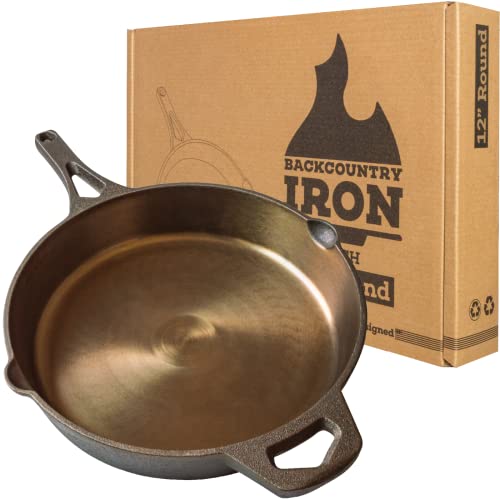
| Backcountry Iron Wasatch | Quadruple-seasoned with vegetable and grape seed oil for a glossy bronze surface, and the closest thing here to a vintage hand-me-down pan |
| Lodge 12-Inch | A quarter the price of the machined pans, pre-seasoned with natural vegetable oil, and it ships with a silicone handle holder — the practical answer for most kitchens |
Best overall: Stargazer 12-Inch
| Organic Integrity Score | 94 / 100 |
| Surface | Flawlessly machined smooth cooking surface, preseasoned and polished |
| Made in | USA, individually crafted |
| Warranty | Lifetime, with exclusions stated explicitly |
| Best for | A buy-once skillet, where the milled surface is the point |
The most complete listing in the category and the pan we would keep.
The surface claim is unambiguous: “a flawlessly machined smooth cooking surface”, and separately “preseasoned and meticulously polished”. Machined and polished are manufacturing operations, not descriptions of a coating, and that is the distinction this whole guide turns on.
The warranty is the reason it tops the table. Most cookware warranties are a sentence promising a lifetime. Stargazer’s states the term, the remedy, and then the exclusions: coverage is “for manufacturer defects only and does not include damage due to improper use or user error, such as warping due to excessive heat.” Naming warping from overheating as excluded is telling you the one thing most likely to void your claim. A warranty that describes its own limits is worth more than one that does not.
Two design details are more than cosmetic. The flared rim pours from any angle without spouts, which on a heavy pan you are lifting one-handed genuinely matters. And the extended handle is shaped to stay cooler for longer, which on cast iron is the difference between a cloth and a burn.
The materials statement is the cleanest here: “no toxic chemicals or space-age materials, just pure iron.” That is a complete positive disclosure, and on cast iron it is trivially true, which is exactly why it is the right way to say it.
What is missing: no seasoning oil is named, no weight is given, and no oven temperature is stated, though cast iron’s oven tolerance exceeds any domestic oven. And it is by a wide margin the most expensive skillet here, which is a real consideration when a rough-cast pan will sear identically.
- Genuinely machined smooth surface, described without ambiguity.
- Lifetime warranty that states its exclusions, which almost none do.
- Made in the USA, stated plainly.
- Flared rim pours from any angle; stay-cool extended handle.
- Complete positive materials statement: just pure iron.
- Most expensive skillet in this comparison by a wide margin.
- Seasoning oil not named.
- No stated weight, which matters on a 12-inch cast iron pan.
- Searing performance is no better than a pan costing a fifth as much.
What we liked: A fully machined cooking surface, made in the USA, and a flared rim that pours cleanly from any point on the pan rather than from two spouts.
Keep in mind: By a wide margin the most expensive pan here, and the milling is a head start you could build yourself on a $35 pan with a year of cooking.
Best for: A buy-once, keep-forever skillet where the milled surface and the warranty justify the price.
Best value polished: Greater Goods 12-Inch
| Organic Integrity Score | 90 / 100 |
| Surface | Precision milled cast iron, not a coating |
| Seasoning | 100% organic flaxseed oil from Canada |
| Positioning | Aimed at cooks switching from non-stick and ceramic |
| Best for | Getting the machined surface at roughly a third of the premium price |
The polished surface at a price that makes the whole argument affordable, and the most precise seasoning disclosure in the category.
“We precision mill the cast iron itself for a smoother cooking surface.” The phrase “the cast iron itself” is doing deliberate work, distinguishing a manufacturing operation from a coating, and the bullet is headed “Nothing To Wear Away”. That is the correct argument for cast iron over ceramic, made correctly: there is no layer to fail because the smoothness is the metal.
The seasoning claim goes further than anyone else’s. “Pre-seasoned with 100% organic flaxseed oil from Canada” names the oil, the grade and the origin. Flaxseed is what cast iron enthusiasts season with by choice, because it polymerizes into a harder layer than ordinary vegetable oil, and it costs more. A factory using it and saying so has made a real decision.
The positioning is honest too. The listing is explicitly aimed at “cooks who love the convenience of nonstick and ceramic cookware but want a pan they’ll keep for years”, and it promises “easy food release from the very first meal” rather than the instant miracle a coated pan delivers. That is close to the right expectation.
What it does not tell you is where it is made, which both Stargazer and Lodge state. There is no warranty in the listing, no weight, and no seasoning coat count. For a pan whose case rests on lasting forever, the absence of a warranty is the notable gap.
- Genuinely milled surface at roughly a third of the premium price.
- Names the seasoning oil, its grade and its country of origin.
- Explains that smoothness is the metal, not a coating that can fail.
- Sets an honest expectation about release from the first meal.
- No country of manufacture stated.
- No warranty mentioned anywhere in the listing.
- No weight or seasoning coat count given.
- “Nonstick-Like Release” in the title oversells what any cast iron does on day one.
What we liked: Precision-milled for easy release from the first meal, room for four to six eggs or four burgers, at under half the price of the premium machined pan.
Keep in mind: Still a heavy bare-iron pan that has to be dried immediately, and the comparison its marketing draws with nonstick sets an expectation bare iron never quite meets.
Best for: Anyone who wants the machined surface without the premium, especially cooks moving away from coated pans.
Best documented budget option: TECOR 12-Inch
| Organic Integrity Score | 86 / 100 |
| Surface | Precision-polished, smoother than standard cast iron |
| Testing | Independently tested by Intertek; scope and result not stated |
| Weight | 7.2 lbs, the only stated weight in this comparison |
| Best for | Budget buyers who want the polished surface and a long guarantee |
The cheapest polished pan here, and the only one that names a testing body.
“Independently tested by Intertek” is a step above the unnamed “lab tested” language that litters cookware listings. Intertek is a real accredited organization, and naming it means the claim could in principle be checked. It stops short of the strongest form, since the listing does not say what was tested or what the result was, but it is more than any competitor here offers.
The safety statement is otherwise the most thorough in the comparison: “No PFAS, no PTFE, no PFOA, no coatings. Pure cast iron seasoned with natural vegetable oil.” Naming the compounds and then stating what the pan actually is covers both directions.
The 7.2 lb weight is the only one published anywhere in this comparison, and it deserves credit. Weight is the single most common complaint about 12-inch cast iron, it varies meaningfully between makers, and it is the specification a buyer with wrist trouble most needs. Everyone else leaves you to find out on delivery.
The 20-year full refund is unusual and generous in stated terms, though the listing gives no detail about what would void it, which is where Stargazer’s warranty is better despite being less headline-grabbing.
Now the caveat. The title says “German-Engineered” and the listing states no country of manufacture. Engineering and manufacturing are different things, and a listing that specifies one while omitting the other is telling you which fact it prefers you to notice. It is not a defect and it is not dishonest; it is a choice, and we score published facts rather than implications.
- Names Intertek as an independent testing body, unique here.
- Publishes the pan’s weight, which nobody else does.
- Thorough safety statement naming PFAS, PTFE, PFOA and no coatings.
- Cheapest polished pan in this comparison, with leather handle covers included.
- 20-year refund guarantee.
- “German-Engineered” with no country of manufacture stated.
- Intertek testing named without a scope or a result.
- Seasoning oil given only as “natural vegetable oil”.
- Refund terms give no exclusions.
What we liked: The most explicit materials disclosure of any pick here — no PFAS, no PTFE, no PFOA, no coatings, seasoned with natural oil — on a polished surface at close to budget price.
Keep in mind: The least established brand of the five, and “polished” describes a range of finishes rather than a specification you can compare.
Best for: The polished surface on a budget, from the listing that publishes the most facts.
The closest to a vintage pan: Backcountry Iron Wasatch 12-Inch
| Organic Integrity Score | 84 / 100 |
| Surface | Machined cooking surface and sides |
| Seasoning | Quadruple seasoned with vegetable and grape seed oil |
| Dimensions | 12 inch diameter, 12.50 spout to spout, 4.75 inch handle |
| Best for | Anyone chasing the feel of a Griswold or Wagner pan |
The listing that explains the entire category, and the pan aimed squarely at people who have handled an old one.
It names the reference directly: inspiration from “the legendary polished cast iron pans made by Wagner and Griswold”, seeking “to recapture the former glory of vintage cast iron in the modern day.” That is the honest statement of what every polished skillet on this page is doing, and Backcountry Iron is the only maker to say it out loud.
It also machines the sides, not just the cooking face, which none of the other listings claim. On a vintage pan the whole interior is smooth, and matching that is a genuine manufacturing difference rather than a talking point.
The seasoning disclosure is the most detailed here: “quadruple seasoned with vegetable and grape seed oil, giving it that signature bronze coloring.” Four coats, two named oils, and an explanation of the resulting color so buyers do not mistake it for a defect.
Then it does something we always credit: it tells you plainly that the pan can rust. “Cast iron can rust so keep it out of the dishwasher, do not soak overnight, or air dry.” Followed by actual instructions, including the chainmail scrubber trick that cast iron owners otherwise learn from forums. That is a manufacturer treating the buyer as someone who will still own the pan in a year.
Published dimensions down to the handle length are another rarity. The reservations are commercial rather than technical: this is a low-volume product with a sales rank far below the others here, which affects how easily you will find it in stock and what a return looks like. No warranty is stated, no country of manufacture, and no weight, on a pan the listing itself calls heavyweight.
- Machines the sides as well as the cooking surface, matching vintage pans.
- Names both seasoning oils and the number of coats.
- States plainly that cast iron rusts, with real care instructions.
- Publishes full dimensions including handle length.
- Explains the category’s vintage reference honestly.
- Far lower sales volume than the rest, so availability is less certain.
- No warranty, country of manufacture or weight stated.
- Expensive for a pan without a stated guarantee.
- Comparison to enameled cast iron in the copy is a stretch.
What we liked: Quadruple-seasoned with vegetable and grape seed oil for a glossy bronze surface, and the closest thing here to a vintage hand-me-down pan.
Keep in mind: Stock is intermittent, and it costs nearly as much as the Stargazer without making the same machining claim.
Best for: Cooks who have used an old Griswold and want that surface again, sides included.
The bestseller, and what “smooth” means here: Lodge 12-Inch
| Organic Integrity Score | 78 / 100 |
| Surface | Sand-cast, not machined; the listing does not mention surface finish |
| Made in | USA |
| Claim | PFAS-free, stated in the title |
| Best for | Searing, roasting, camping, and anyone unbothered by surface texture |
By an enormous margin the best selling skillet in this comparison, and the pan the rest of this page is implicitly measured against.
Almost everything about it is right. It is made in the USA and says so. It is PFAS-free, which on bare iron is trivially true and worth stating anyway. It arrives pre-seasoned, it is oven safe, it works on a campfire, and it costs a fraction of every other pan here. For searing steaks and roasting, it performs identically to skillets costing five times more, because heat retention is a function of iron and mass, not surface finish.
Our reservation is about what the listing leaves out. It promises a “naturally nonstick finish” from seasoning and never mentions the surface of the metal underneath at all. Lodge skillets are sand-cast and not machined, which is why a whole segment of this market exists selling milled alternatives, and why the other four listings on this page lead with machining language in their first bullet.
Nothing here is false. The seasoning is genuinely nonstick and improves with use, and Lodge is describing the finish rather than the substrate. But a buyer comparing this listing against a polished pan sees “nonstick finish” on one and “machined smooth surface” on the other, with no way to tell that only one of those describes the iron. The omission costs Lodge points on disclosure rather than on quality.
What it does say is unusually clean. “Made with 100% natural vegetable oil” names the seasoning oil, which only two other listings here do, and the PFAS-free claim is trivially true on bare iron and correctly stated rather than dressed up.
The listing is thin elsewhere: no oven temperature, no weight, no warranty stated, and a final bullet headed “About Lodge Cast Iron” that repeats the brand rather than adding a fact.
- Sears and retains heat identically to skillets costing five times more.
- Made in the USA, stated plainly.
- Pre-seasoned, oven safe, campfire capable, and by far the cheapest here.
- PFAS-free stated in the title, trivially true and correctly claimed.
- Universally available, so replacement and sizing are easy.
- Listing never mentions the surface of the metal, only the seasoning finish.
- Textured surface holds seasoning less evenly, so eggs and fish take longer to behave.
- No weight, oven temperature or warranty stated.
- Heavier than several competitors, none of which publish weights either.
What we liked: A quarter the price of the machined pans, pre-seasoned with natural vegetable oil, PFAS-free, and it ships with a silicone handle holder.
Keep in mind: Sand-cast rather than machined, so early food release is poorer and the smooth surface is something you build over months of cooking.
Best for: Searing, roasting and camping, at a price that makes the polished debate optional.
What we left out and why
We left out enameled cast iron, which is a genuinely different product. The enamel coating means no seasoning, no rust risk and safe use with acidic ingredients, and it also means a surface that can chip and cannot be repaired. It belongs in its own comparison rather than being scored against bare iron.
We left out vintage Griswold and Wagner pans, despite them being the reference every polished maker cites. They are wonderful and they are not a product we can responsibly recommend, since condition varies enormously, reproductions are common, and there is no warranty on a ninety-year-old skillet.
We left out lightweight cast iron, which thins the walls to reduce weight and gives up the heat retention that is the entire reason to choose the material.
And we left out carbon steel, which is seasoned like cast iron but lighter and faster to respond, and stainless steel, which is not seasoned at all. Both have their own guides. Our guide to cookware materials compared sets the four side by side.
How to season and keep a cast iron skillet
Cast iron is the most forgiving cookware there is, on one condition: it must be dry.
- Every pan here arrives pre-seasoned, so wash in warm water, dry on the hob, and cook something fatty. Bacon is the traditional answer and it is the right one.
- Do not strip a factory seasoning to redo it. It is several baked layers and you are not improving on it.
- Expect uneven color and some mottling. Cast iron does not look uniform and a patchy pan is not a faulty one.
- If it is a machined pan, notice how it behaves in week one. That early release is what the milling premium bought.
- Cook fat-forward food often at the start. Frying does more in a week than deliberate seasoning cycles do in a month.
- If you do season deliberately, use a thin coat of a high smoke point oil, wipe it back off, and heat past the smoke point. Flaxseed gives the hardest layer; ordinary vegetable oil works fine.
- Thin coats only. A thick coat bakes into a sticky, patchy varnish that flakes.
- Go easy on tomatoes, wine and vinegar until the surface is established. Acid strips young seasoning.
- Clean while warm with hot water and a brush or a chainmail scrubber, which Backcountry Iron rightly recommends.
- Soap is fine. Modern detergent does not dissolve polymerized seasoning; the folklore predates modern soap.
- Never the dishwasher, never soak overnight, never air dry. All three cause rust, and all three are named in one listing here.
- Dry on the hob until steam stops, then wipe a trace of oil over the surface.
- If it rusts, scrub back to bare metal and re-season. Cast iron is fully recoverable, which is why the pans your grandparents used still work.
What it costs to own
Nothing, more or less, which is the point. There is no coating to replace and no service interval, so the purchase price is the whole cost and the only real variable is what the milling step is worth to you.
Two things follow. The first is that weight deserves to be published and almost never is. A 12-inch cast iron skillet is heavy enough that it is a genuine accessibility question, and only one listing in five treats it as a specification worth stating.
The second is that the sensible purchase for most kitchens is not the most expensive pan. It is a cheap rough-cast skillet for searing and roasting, plus one machined pan if you cook eggs and fish often. Those two jobs want different surfaces, and buying one pan to do both is what leads people to conclude cast iron does not work for eggs.
Living with cast iron
Dry is the whole discipline. Everything else about cast iron is forgiving. Water left on it is not.
Soap is not the enemy. This is the most persistent piece of kitchen misinformation there is. Scouring and soaking are the problems.
The handle is as hot as the pan. Every time. A leather cover or a folded cloth lives next to the hob for a reason.
Preheat slowly. Cast iron is slow to warm and holds heat once there. Blasting it on high warps pans, which is the failure mode one warranty here explicitly excludes.
It gets better for years. A pan you use weekly at year five outperforms the same pan new, whatever it cost. That is not true of any coated cookware.
Questions about cast iron skillets
What is the difference between polished and regular cast iron?
All cast iron comes out of a sand mold with a pebbled surface. Polished, machined or milled pans have had that surface ground flat after casting, which is an extra manufacturing step most makers dropped decades ago as an economy. It is the difference vintage Griswold and Wagner collectors are chasing, and it is what the price premium buys.
Does a smooth cast iron skillet actually cook better?
For eggs, fish and pancakes, yes, because a flat surface holds a more even seasoning layer and releases sooner. For searing and roasting, no: heat retention comes from iron and mass, not surface finish, so a cheap rough-cast pan sears identically. A rough pan also gradually fills in with use and closes much of the gap over years.
Why are old cast iron pans smoother than new ones?
Because manufacturers used to machine the cooking surface flat after casting as standard practice. The step was dropped in the mid twentieth century to reduce cost. Nothing about the iron itself was better; the finishing was.
How can I tell if a cast iron skillet is machined?
Look for “milled”, “machined” or “polished” applied to the iron itself, usually in the first bullet, because makers who pay for that step always say so. A listing that only describes a “nonstick finish” or “seasoned surface” is describing the oil layer, not the metal, and is almost certainly sand-cast underneath.
Can you use soap on cast iron?
Yes. Modern dish soap does not strip polymerized seasoning. The advice not to use it dates from when soap contained lye. What actually damages seasoning is abrasive scouring, soaking, and the dishwasher.
How do I stop cast iron rusting?
Dry it completely, preferably on the hob until steam stops, and wipe a trace of oil over it before storing. Never air dry, never soak overnight, never put it in a dishwasher. One listing in this comparison states all three, which is more than most manage.
Which oil is best for seasoning cast iron?
Flaxseed polymerizes into the hardest layer and is what one manufacturer here uses at the factory, naming it as organic flaxseed oil from Canada. Grape seed and ordinary vegetable oil also work and are cheaper. The technique matters more than the oil: thin coats, wiped back, heated past the smoke point.
Is cast iron safe to cook with?
It is iron and polymerized oil, with no coating, so the chemistry questions that apply to ceramic and non-stick do not arise. Listings that say PFAS-free or PFOA-free are stating something trivially true of the material. One pan here goes further and names an independent testing body.
How heavy is a 12-inch cast iron skillet?
Around seven pounds, though only one listing in this comparison publishes a figure at all, at 7.2 lbs. Weight is the most common regret with 12-inch cast iron, and it is worth checking before buying if lifting a loaded pan one-handed would be a problem.
Is an expensive cast iron skillet worth it?
Only for the machined surface. The premium buys a milling step, usually a better warranty, and sometimes a named seasoning oil. It does not buy better searing or heat retention. If you mainly sear and roast, the cheapest pan here is genuinely as good.
Organic Connection is reader supported. We read every product listing in full and say plainly when a claim cannot be verified. How we research and rate.