Last updated: September 22, 2026
We may earn a commission when you buy through links on this page, at no extra cost to you. How we research and rate.
The short version
Our top pick is the Nuwave Duralon Blue, with an Organic Integrity Score of 96 out of 100, and it earns that score for one sentence no competitor comes close to matching.
People buy ceramic cookware for one reason: to avoid the chemistry in conventional non-stick. So the safety claim is the product. Which makes it worth knowing that those claims are written at five very different levels of rigor, and the gap between the top and the bottom is enormous.
At the top, Nuwave states: “Tested by TÜV Rheinland for 106 known PFAS elements and none were detected.” That names the testing body, the scope of the test and the result. It is the only claim in this category we could describe as verifiable.
At the bottom, a bestselling CAROTE set says its coating is “food-safe coating without harmful chemicals.” It names no compound, no test and no standard. Not PFOA, not PTFE, not PFAS, not lead, not cadmium.
And in the middle sits the qualifier that does the most quiet work in this entire category.
Best ceramic cookware compared
 |  |  |  |  | |
| Set | Nuwave Duralon Blue | GreenPan Chatham | SENSARTE 13-pc | Umite Chef 21-pc | CAROTE 21-pc |
| Organic Integrity Score | 96/ 100 | 86/ 100 | 80/ 100 | 74/ 100 | 58/ 100 |
| Our rating | 4.8 | 4.3 | 4.0 | 3.7 | 2.9 |
| Claim rung | Lab, scope, result | Unqualified list | Hedged list | Unqualified list | Nothing named |
| Test named | TÜV Rheinland, 106 PFAS | No | No | No | No |
| PTFE named as absent | Yes | No, says PFAS | Yes, hedged | Yes | No |
| Hedging language | None | None | “Intentionally added” | None | “Harmful chemicals” |
| Oven safe | Not stated | 425°F lids | 550°F | 500°F, handle off | Not stated |
| Induction | Yes | No | Yes | Yes | Not stated |
| Best for | Anyone buying ceramic | Gas or electric kitchens | Oven-heavy cooking | RVs, dorms, boats | Not our recommendation |
| Price | $239.99 $259.99 −8% View on Amazon | $159.99 $199.99 −20% View on Amazon | $109.95 View on Amazon | $57.99 $69.99 −17% View on Amazon | $79.99 $135.99 −41% View on Amazon |
- Organic Household hub
- Best Enameled Cast Iron Dutch Ovens
- Best Glass Food Storage Containers
- our organic product database — compare brands across every guide
- Best Non-Toxic Bakeware
- Best Dinnerware Sets
- Lead and cadmium in dishes, explained
- Best Steamer Baskets
Price and availability as of September 21, 2026 7:10 pm EDT. Product prices and availability are accurate as of the date/time indicated and are subject to change. Any price and availability information displayed on Amazon.com at the time of purchase will apply to the purchase of this product.
The claim ladder, from strongest to weakest
Once you read enough of these listings, the language sorts itself into rungs. Here is the ladder we found, using the exact wording from the five sets in this comparison.
1. A named lab, a named scope, a stated result. Nuwave: “Tested by TÜV Rheinland for 106 known PFAS elements and none were detected.” TÜV Rheinland is a large accredited testing organization, 106 is a defined scope, and “none were detected” is a result. Every part of that can be questioned, which is what makes it a real claim.
2. An unqualified list of named compounds. GreenPan: “free of PFAS, PFOA, lead, and cadmium.” No hedge, no asterisk. No test named either, so you are trusting the brand, but the sentence commits to something.
3. A hedged list of named compounds. SENSARTE: “free of intentionally added PFOA, PTFE, PFAS, lead, and cadmium.” Same compounds, materially weaker commitment.
4. A partial list with a catch-all. CAROTE’s larger set: “free of PFOA, PFOS, and the other harmful chemicals.” Two named, the rest gestured at. Notably PTFE is not among them.
5. No compounds at all. CAROTE’s 21-piece set: “food-safe coating without harmful chemicals.” Nothing named, nothing testable.
This ladder is the single most useful thing to carry into a product page. The rung a listing sits on tells you more than the price does, and in this comparison the cheapest set and one of the dearest sit on rungs five and one respectively.
“PFOA-free” is not a feature
Half the listings in this category lead with PFOA. It is the most recognizable of the compounds and the least meaningful thing to advertise.
PFOA was phased out of US cookware manufacturing years ago, under an EPA stewardship program that major manufacturers completed by around 2015. Non-stick pans made since then, including conventional PTFE pans, are made without it.
So “PFOA-free” on a pan sold in 2026 describes an industry-wide baseline rather than a distinguishing property. It is true, and it separates the product from nothing currently on the shelf.
The compounds that actually differentiate a ceramic pan from a conventional non-stick one are PTFE, the fluoropolymer that makes Teflon-style coatings work, and PFAS as a broader class. Those are the words to look for.
Which is why one omission in this comparison stands out. CAROTE’s larger set says it is “free of PFOA, PFOS, and the other harmful chemicals” and never says PTFE. For a product sold as ceramic, on a page where competitors name PTFE explicitly, that is a conspicuous gap. We are not asserting the coating contains PTFE, and we have no evidence that it does. We are saying the listing does not rule it out, while others do.
Ceramic is not ceramic, and the names are interchangeable marketing
Worth knowing before you compare anything: “ceramic” cookware is not ceramic in the pottery sense. These are aluminum or die-cast aluminum pans sprayed with a silica-based coating, applied as a liquid and cured. The chemistry is a sol-gel process, and the result is a thin glass-like layer, not a fired ceramic body.
That matters because the same coating family is sold under several names. Umite Chef sells a “Ceramic Cookware Set” whose own bullets describe “an advanced mineral-reinforced granite coating”. Granite, marble, diamond and ceramic in this aisle are largely marketing names for closely related sol-gel coatings, sometimes with a particulate mixed in for hardness. GreenPan says “diamond-infused”; Nuwave calls its version Duralon Blue and rates it at 9H hardness.
None of that is dishonest, exactly. It does mean brand coating names tell you very little, and that comparing “ceramic” against “granite” against “diamond” is mostly comparing adjectives.
The one specification in that group that is actually a measurement is Nuwave’s 9H hardness rating, which is the pencil hardness scale where diamond sits at 10H. Whether it delivers is a separate question, but it is a number rather than an adjective.
The honest problem with ceramic: it wears out
This is the part the category does not talk about, and no listing in this comparison mentions it, so we will.
Ceramic non-stick coatings lose their release properties much faster than PTFE coatings do. The sol-gel layer is thin and hard rather than thick and slippery, and it degrades through ordinary use: thermal cycling causes micro-cracking, cooking oils polymerize into a varnish that fills the surface, and abrasion wears it. Depending on use and heat, the useful non-stick life is commonly one to three years.
That is a shorter life than a well-treated conventional non-stick pan, which is itself a consumable, and dramatically shorter than the stainless steel sets we reviewed separately, which do not degrade at all.
So the honest trade is this. Ceramic gives you a genuinely non-stick surface without fluoropolymer chemistry, at the cost of a pan you will replace several times over the life of one stainless pan. If your reason for buying is chemistry, that trade is worth making. If your reason is durability, ceramic is the wrong category, and the warranties reflect it: CAROTE offers 12 months, which is a reasonable indication of expected service life.
You can extend it substantially. Keep the heat at medium or below, since high heat is what cracks the coating. Use wooden or silicone utensils. Avoid the dishwasher regardless of what the listing permits, because detergent is abrasive and alkaline. And never heat one empty.
What we looked for
We read every feature bullet on every listing in full and scored on what each manufacturer put in writing.
Named compounds rather than categories. “Without harmful chemicals” is unfalsifiable. PFOA, PTFE, PFAS, lead and cadmium are specific, and a listing that names them has committed to something.
A named test, body or scope. The thing that separates rung one from rung two. Almost nobody offers it.
Absence of hedging. “Intentionally added” is the qualifier to watch for, and it is not the only one.
Oven temperature and induction compatibility, both of which vary far more in this category than in stainless.
Honesty about limits. We gave credit for admitting what a pan cannot do, which one manufacturer here does unusually well.
The trade-offs of ceramic nonstick
Ceramic is the only material in this cluster with a coating, and every one of its trade-offs follows from that single fact.
| In its favor | Against it | |
| Release | Genuinely excellent from day one, with far less oil needed, and no seasoning to build | It wears out. This is the honest limit of the category: a ceramic pan is a consumable with a life of a few years |
| Chemistry | A real alternative to PTFE for buyers avoiding fluoropolymers entirely | Claim wording varies enormously, and “free of intentionally added PFAS” is not the same promise as “free of PFAS” |
| Weight and heat | Light, quick to heat, and usually induction-compatible via a steel base | High heat destroys ceramic coatings faster than anything else. Medium is the ceiling if you want it to last |
| Value | Large sets are inexpensive, so the cost per piece is the lowest here | You are buying the set again in a few years, which changes the ten-year arithmetic considerably |
| Care | Nothing to season, and most sets tolerate the dishwasher | Metal utensils, aerosol sprays and thermal shock all shorten its life. Hand wash if you want the upper end of that life |
The useful way to buy ceramic is as a dedicated egg-and-fish pan you expect to replace, alongside something permanent. See the cookware materials guide for that pairing.
What actually separates these five
The wording of the safety claim is the specification in this category, and these five sit at visibly different points on it.
| Pick | What only this one does |
| Nuwave Duralon Blue | Forged rather than cast or stamped construction, and the only maker here naming a specific coating generation — Gen10 — which implies a documented lineage |
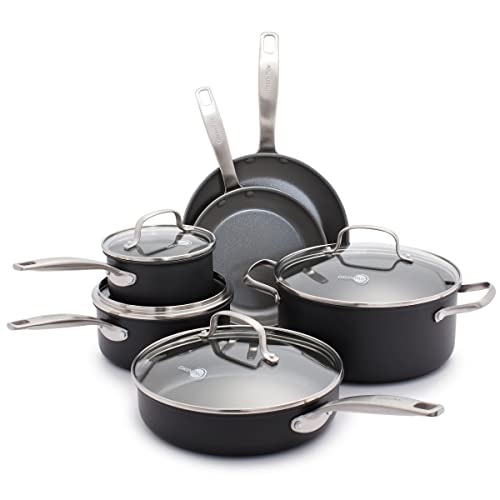
| GreenPan Chatham | The strongest claim on the page because it is unhedged: free of PFAS, PFOA, lead and cadmium, with no “intentionally added” qualifier. Diamond-infused coating over hard-anodized bodies |
| SENSARTE 13-Piece | The best oven rating and the largest set for the money — and the clearest illustration of the hedge, promising freedom from intentionally added PFOA, PTFE and PFAS |
| Umite Chef 21-Piece | Removable handles, which no other set here offers, so the pans stack and go from hob to oven to fridge in small kitchens |
| CAROTE 21-Piece | The bestseller, and the listing names no compound at all — “food-safe coating without harmful chemicals” is the entire chemistry disclosure |
Best overall: Nuwave Duralon Blue
| Organic Integrity Score | 96 / 100 |
| Safety claim | Free of PFAS, PTFE, PFOA, lead and cadmium; tested by TÜV Rheinland for 106 PFAS elements, none detected |
| Coating | Gen10 Duralon Blue, rated 9H hardness |
| Compatibility | Induction ready, anti-warp stainless plate bonded to base |
| Best for | Anyone buying ceramic specifically for the chemistry, who wants it evidenced |
This is the highest score we have given any cookware, and it comes down to one footnote most buyers will scroll past.
“Tested by TÜV Rheinland for 106 known PFAS elements and none were detected.” Every element of that is checkable. TÜV Rheinland is a large accredited testing organization rather than an unnamed “independent lab”. 106 elements is a stated scope, which matters because PFAS is a class of thousands of compounds and any test covers a defined subset. And “none were detected” is a result rather than an adjective.
Compare that with the phrasing everywhere else in this category and the distance is obvious. This is the cookware equivalent of a water filter naming NSF/ANSI 53 instead of saying “advanced filtration”, and it is the reason this set tops the table despite being the most expensive.
Two more things we credit. The 9H hardness rating is a real measurement on the pencil hardness scale, offered alongside the explanation that diamond sits at 10H, which is a fair and checkable framing. And the coating is bonded to an anti-warp stainless plate for induction, so unlike our second pick it works on every hob.
Then there is a sentence we did not expect to find in any listing in this aisle: “The ceramic coating is not chemically nonstick but gets pretty darn close.” That is a manufacturer voluntarily conceding its product is less slippery than the fluoropolymer alternative. It is accurate, it is the single most common complaint about ceramic, and admitting it is worth more to a buyer than another paragraph of superlatives.
The reservations are real. It is the most expensive set here by some distance. No oven temperature is stated anywhere in the bullets we read, which is a genuine omission given how much that number varies. And the durability claim that it “won’t chip or discolor and will retain its non-stick properties longer” is a comparative with nothing to compare against; ceramic coatings degrade, and no hardness rating changes that.
- The only listing in the category naming a testing body, a scope and a result.
- Names PFAS, PTFE, PFOA, lead and cadmium with no hedging language.
- 9H hardness is a real measurement rather than an adjective.
- Induction ready with a bonded anti-warp base.
- Concedes openly that ceramic is not as slippery as chemical non-stick.
- Most expensive set in this comparison.
- No oven safe temperature stated anywhere in the listing.
- “Won’t chip or discolor” overstates what any ceramic coating achieves.
- 106 elements is a defined subset of a class containing thousands.
What we liked: Forged rather than stamped, and the only maker here naming a specific coating generation, which implies a documented lineage rather than a marketing word.
Keep in mind: Like every ceramic pan it is a consumable with a life measured in years, and “all-natural ceramic” is not a defined term.
Best for: The buyer whose whole reason for choosing ceramic is the chemistry, and who wants that backed by something more than a promise.
Best unqualified claim: GreenPan Chatham
| Organic Integrity Score | 86 / 100 |
| Safety claim | Free of PFAS, PFOA, lead and cadmium, stated without qualification |
| Coating | Diamond-infused ceramic non-stick, metal utensil safe |
| Compatibility | All stovetops except induction; lids oven safe to 425°F |
| Best for | Gas or electric kitchens wanting an established ceramic brand |
GreenPan effectively created this category, and its claim is the second strongest here for a simple reason: there is no hedge in it.
“GreenPan’s healthy ceramic nonstick coating is free of PFAS, PFOA, lead, and cadmium for worry-free meals.” No “intentionally added”, no asterisk, no catch-all. Four named compounds and a flat statement. It names no test, which is what separates it from our top pick, but the sentence commits to something a regulator could hold them to.
The metal utensil safe rating is the practical standout. Almost every ceramic pan warns you off metal, and the diamond-infused coating here is rated to take it. In a category whose main failure mode is surface wear, that is a meaningful durability advantage rather than a marketing line.
Now the limitation that decides whether this set is even an option: “Suitable for all stovetops, except induction.” That is stated plainly, to the listing’s credit, and it rules the set out entirely for a growing share of kitchens. Every other set in this comparison is induction compatible. If you have an induction hob, stop here.
The oven rating also needs care. The listing gives 425°F for the glass lids, which is the lowest figure in this comparison and well under the 550°F SENSARTE claims. Hard anodized bodies generally tolerate more than their lids, but the number published is the lid number.
It was also showing limited availability when we looked, which is worth checking before you commit.
- Unqualified free-of claim naming four compounds, with no hedging.
- Metal utensil safe, rare and genuinely useful in this category.
- Diamond-infused coating from the brand that established the category.
- Riveted stainless handles and dishwasher safe.
- Not induction compatible, unlike every other set here.
- 425°F lid rating is the lowest in this comparison.
- No test, body or scope named to support the free-of claim.
- Does not name PTFE specifically, though PFAS covers the class.
- Limited availability when we checked.
What we liked: The only unhedged safety claim on the page: free of PFAS, PFOA, lead and cadmium, with no “intentionally added” qualifier. Diamond-reinforced and metal-utensil safe over hard-anodized bodies.
Keep in mind: The smallest set here for the money, and metal-utensil safe still shortens coating life in practice.
Best for: Gas or electric kitchens that want metal-utensil durability from an established name.
Best oven rating, weakest wording: SENSARTE 13-Piece
| Organic Integrity Score | 80 / 100 |
| Safety claim | Free of intentionally added PFOA, PTFE, PFAS, lead and cadmium |
| Oven safe | 550°F, the highest in this comparison |
| Construction | Cast aluminum body, stainless base, rivet-free interior |
| Best for | Oven-heavy cooking, if you accept the hedged wording |
The best specification sheet here attached to the most carefully lawyered sentence.
On specification it is genuinely strong. 550°F oven safe is the highest rating in this comparison, 125°F above the GreenPan lids and comfortably enough for roasting and finishing. It is induction compatible. And the rivet-free interior is a real design advantage in a coated pan, because rivets are where coatings chip first and where food traps.
The listing also makes a claim worth taking seriously: the cookware “does not produce toxic fumes even when overheated.” That is the substantive difference between ceramic and conventional non-stick. PTFE coatings can off-gas when taken far above normal cooking temperatures, which is the origin of the polymer-fume concern, and a silica coating does not behave that way. Naming the failure mode is more useful than a generic safety promise.
Which makes the hedge the more disappointing. “Free of intentionally added PFOA, PTFE, PFAS, lead, and cadmium” names all five compounds, more than GreenPan does, and then qualifies the whole list. The distinction is not pedantry: “intentionally added” describes what the manufacturer put in, and leaves room for what arrives via raw materials, processing aids or shared equipment. It is the standard phrasing when a company is unwilling to warrant the finished product.
We do not read it as evidence of anything being present. We read it as a company declining to make the stronger claim two of its competitors make on the same page, and we score the wording as written.
One further note: the 80% less oil figure is a marketing comparison against no stated baseline.
- 550°F oven rating, the highest here by a clear margin.
- Names all five compounds, more than any competitor except our top pick.
- Rivet-free interior, which is where coated pans usually fail first.
- Explains the overheating and fumes issue rather than gesturing at safety.
- Induction compatible and among the cheaper sets here.
- “Intentionally added” qualifies the entire free-of list.
- No test, body or scope named.
- “Up to 80% less oil” has no stated baseline.
- Cast aluminum body, so heavier handling than the thin budget sets.
What we liked: The best oven rating and the largest set for the money, on an induction-ready stainless base, with a stated 80% reduction in oil needed.
Keep in mind: The claim is hedged to intentionally added PFOA, PTFE and PFAS, which is a materially weaker promise than the unqualified version above it.
Best for: Oven-heavy cooking on induction, for buyers who read the qualifier and accept it.
Best for small spaces: Umite Chef 21-Piece
| Organic Integrity Score | 74 / 100 |
| Safety claim | 100% PFOA-free, PTFE-free and PFOS-free, unqualified |
| Coating | Described as “mineral-reinforced granite coating” despite ceramic in the title |
| Oven safe | 500°F with the handle removed; handle is not oven safe |
| Best for | RVs, dorms, boats and small kitchens where storage is the constraint |
The cheapest set here, and the one with a genuine design reason to exist rather than just a low price.
Detachable handles let the pots nest, which the listing claims saves up to 90% of storage space. For an RV, a boat, a dorm or a very small kitchen that is a real functional advantage that no amount of coating quality substitutes for. The listing is also specific about the mechanism, describing a dual-layer safety lock rather than just asserting it stays put.
On chemistry it does better than its price suggests, naming PFOA, PTFE and PFOS explicitly and without hedging. Naming PTFE matters, since that is the compound that actually distinguishes ceramic from conventional non-stick, and two more expensive sets here do not name it.
We also credit an unusually honest operational detail: oven safe to 500°F, “simply remove the handle (not oven-safe) before transferring to oven”. Most listings would have printed 500°F and left you to discover the handle limitation yourself.
What holds it at 74 is the terminology. The product is sold as a Ceramic Cookware Set and its own bullets describe “an advanced mineral-reinforced granite coating”. Granite and ceramic are both marketing names in this aisle, frequently for closely related sol-gel coatings, but a set whose title and body disagree on what the coating is called leaves you unsure what you are buying. No test is named either.
The 21-piece count is also heavily inflated: it includes five silicone utensils, a silicone mat, pot protectors and storage lids. Count the pans.
- Detachable handles and nesting pots, a genuine advantage in small spaces.
- Names PFOA, PTFE and PFOS without hedging, at the lowest price here.
- States plainly that the handle is not oven safe.
- 500°F oven rating and induction compatible.
- Cheapest set in this comparison.
- Sold as ceramic, described in its own bullets as a granite coating.
- No test, body or scope named.
- 21-piece count padded with utensils, mats and storage lids.
- “Meals cook 50% faster” has no stated baseline.
What we liked: Removable handles, which nothing else here offers, so the pans stack and move from hob to oven to refrigerator in a small kitchen.
Keep in mind: A dual-lock removable handle adds a failure point, and the “advanced mineral” coating names no compound at all.
Best for: RVs, dorms and small kitchens where nesting storage matters more than coating pedigree.
The bestseller that names nothing: CAROTE 21-Piece
| Organic Integrity Score | 58 / 100 |
| Safety claim | “Food-safe coating without harmful chemicals”; no compound named |
| Oven safe | Not stated |
| Warranty | 12 months |
| Best for | Not our recommendation where the safety claim is the reason for buying |
CAROTE is among the best selling cookware brands on Amazon, and this listing is the clearest example on this page of a claim that cannot be checked.
“Constructed with food-safe coating without harmful chemicals.” That is the entire safety statement. No PFOA, no PTFE, no PFAS, no lead, no cadmium. No test, no standard, no body. “Harmful chemicals” is a category with no definition, which makes the sentence impossible to falsify and therefore impossible to rely on.
It is worth noting that CAROTE’s other ceramic sets do better, naming PFOA and PFOS, though even those add “and the other harmful chemicals” rather than naming PTFE. So the company can write a more specific claim and on this listing has not.
The rest is thin in the same way. No oven safe temperature. No induction statement. No coating description beyond “ceramic”. The one concrete commitment is a 12 month warranty, which is honest in its way: it is roughly the service life you should expect from a budget ceramic coating, and it is a quarter of what the stainless sets we reviewed offer.
To be fair to the product: plenty of people buy these, and a cheap ceramic set that lasts a year of light cooking is a reasonable purchase at this price. Our objection is specific. If you are buying ceramic because of what is not in the coating, this listing tells you nothing about what is not in the coating. That is the one job the copy needed to do.
- Inexpensive and very widely bought.
- Dishwasher safe and easy to clean.
- 12 month warranty, honestly matched to expected coating life.
- Large piece count for the money.
- Names no compound at all: no PFOA, PTFE, PFAS, lead or cadmium.
- “Without harmful chemicals” is unfalsifiable.
- No oven temperature and no induction statement.
- 12 month warranty is the shortest here.
- Company’s own other listings are more specific than this one.
What we liked: The lowest cost per piece here, with a built-in pour spout, silicone-sealed glass lids and dishwasher tolerance.
Keep in mind: The entire chemistry disclosure is “food-safe coating without harmful chemicals” — no compound named, no standard cited.
Best for: Budget buyers who want a cheap set and are not relying on the safety claim.
What we left out and why
We left out a higher-ranked CAROTE ceramic set that names PFOA and PFOS, because it was showing a future availability date rather than being in stock when we checked, and a comparison should point at things you can buy. Its wording is worth noting anyway: “free of PFOA, PFOS, and the other harmful chemicals” names two compounds and never mentions PTFE, which for a ceramic pan is the omission that matters.
We left out conventional PTFE non-stick sets, which are a different category with a different conversation. Modern PTFE cookware is made without PFOA and is considered safe within normal cooking temperatures; the concerns are about overheating and coating wear. Anyone shopping ceramic specifically to avoid fluoropolymers is answering a different question.
We left out sets whose only safety language was “healthy”, “eco-friendly” or “non-toxic” with no compound named, which is a large share of this category.
And we left out bare stainless steel and cast iron, which have no coating to fail and belong in their own guides. Our guide to cookware materials compared sets the four side by side.
How to make a ceramic pan last
Ceramic rewards technique more than any other coated surface, and mistreatment shortens its life from years to months.
- Wash by hand in warm soapy water and dry thoroughly. Skip any advice to “season” it; sol-gel coatings do not season the way cast iron does, and baked-on oil is what eventually ruins them.
- Check the oven rating for the pans and, separately, for the lids and handles. In this comparison they differ on three of the five sets.
- If the handles detach, confirm the locking mechanism before putting weight on it.
- Cook on medium or lower. High heat is the single biggest cause of ceramic failure, and the coating loses release long before it looks damaged.
- Never heat the pan empty. Thermal shock micro-cracks the coating.
- Add a little oil even though the pan is non-stick. A thin film protects the surface; cooking bone dry accelerates wear.
- Avoid aerosol cooking sprays. The propellants and emulsifiers leave a varnish that builds up and destroys release, and it is the most common reason a ceramic pan “stops working” within months.
- Use wood or silicone utensils unless the set is explicitly metal utensil safe, which only one here is.
- Let the pan cool before washing. Cold water into a hot ceramic pan is thermal shock.
- Suspect polymerized oil before assuming the coating has failed. A haze of baked-on residue mimics coating failure exactly.
- Simmer water with a spoonful of baking soda for ten minutes, then wipe with a soft cloth. This restores a surprising number of pans.
- Do not use abrasive pads or oven cleaner. Both will finish off what residue started.
- If food still sticks after cleaning, the coating is genuinely worn. Ceramic cannot be recoated, and a worn pan is a replacement rather than a repair.
What it costs to own
Ceramic is cheap to buy and the most expensive coated cookware to keep, because the coating is the product and the coating is consumable.
The practical consequence is that a ceramic set should be costed over about three years rather than a decade. A $65 set replaced every two years costs more across ten years than a single mid-range clad stainless set that never wears out, and rather less than the premium ceramic option replaced on the same cycle.
Which points at the sensible compromise most experienced cooks land on: one or two ceramic pans for eggs, fish and anything delicate, treated as consumables, alongside stainless or cast iron for everything else. Buying a 21-piece ceramic set means putting the coating on stockpots and saucepans that never needed a non-stick surface in the first place.
Living with ceramic cookware
Medium heat is not a suggestion. It is the difference between three years and six months. Ceramic conducts heat well enough that medium does what high does on a thinner pan.
The first failure is invisible. Release degrades gradually, and most people conclude the pan was badly made when it was simply used hot.
Cooking spray is the silent killer. If you take one thing from this guide beyond the claim ladder, it is that aerosol sprays leave residue no dishwasher removes.
Buy pans, not sets. Non-stick belongs on a frying pan. A non-stick stockpot is a coating waiting to be scratched for no benefit.
Check induction before ordering. One of the best-regarded sets in this category does not work on induction hobs at all, and it says so only in the fifth bullet.
Questions about ceramic cookware
Is ceramic cookware actually safe?
The coating is a silica-based sol-gel layer rather than a fluoropolymer, so it does not contain PTFE and does not off-gas the way an overheated conventional non-stick pan can. The important question is what a specific manufacturer will state in writing. In this comparison one set named a testing body, a scope and a result, three named compounds with varying degrees of hedging, and one named nothing at all.
What does “free of intentionally added PFAS” mean?
It means the manufacturer did not deliberately add those compounds. It is a weaker statement than “PFAS-free”, because it leaves room for compounds arriving through raw materials, processing aids or shared equipment, and it does not warrant the finished product. When one listing uses the qualifier and the listing beside it does not, that difference is deliberate.
Is “PFOA-free” worth looking for?
No. PFOA was phased out of US cookware manufacturing years ago, so essentially every pan on sale is PFOA-free, including conventional PTFE pans. A listing leading with PFOA-free is advertising an industry baseline. PTFE and PFAS are the words that actually distinguish products.
Is ceramic cookware the same as ceramic?
No. It is aluminum or die-cast aluminum sprayed with a silica-based coating and cured, not fired pottery. The same coating family is also sold as granite, marble and diamond, sometimes within a single listing, so the coating name tells you very little.
How long does ceramic non-stick last?
Commonly one to three years of regular use, which is shorter than conventional non-stick and far shorter than uncoated stainless or cast iron. Heat is the main variable: cooking on medium or below, avoiding empty preheating and skipping aerosol sprays extends it substantially.
Why did my ceramic pan stop being non-stick?
Usually polymerized oil rather than a failed coating, especially if you have used cooking spray. Simmer water with a spoonful of baking soda for ten minutes and wipe gently before concluding the pan is finished. If it still sticks after that, the coating has genuinely worn and cannot be restored.
Can I use metal utensils on ceramic cookware?
Only if the listing explicitly says metal utensil safe, which one set in this comparison does and the others do not. The coating is hard but thin, and a scratch that breaks the surface will spread.
Is ceramic or stainless steel better?
They solve different problems. Ceramic gives you a genuinely non-stick surface with no fluoropolymer chemistry and wears out in a few years. Stainless never degrades, takes any heat and requires technique to stop food sticking. Most experienced cooks keep one or two ceramic pans for eggs and fish and use stainless for everything else.
Does ceramic cookware work on induction?
Usually, but check. Induction needs a magnetic base, and manufacturers bond a stainless plate to the bottom to provide it. One well-known set in this comparison is explicitly not induction compatible, and that appears well down its bullet list.
Is expensive ceramic cookware better?
On evidence, sometimes. The best documented listing here is also the most expensive, and the least documented is mid-priced. What the money buys is a testing claim and a harder coating, not exemption from wear. Every ceramic pan is a consumable.
Organic Connection is reader supported. We read every product listing in full and say plainly when a claim cannot be verified. How we research and rate.