Last updated: August 31, 2026
We may earn a commission when you buy through links on this page, at no extra cost to you. How we research and rate.
The short version
Salt cannot be certified organic, and the two best listings in this comparison are the two that do not claim it is.
Our top pick is 365 by Whole Foods Market Sea Salt, with an Organic Integrity Score of 86 out of 100. It makes no organic claim, which is the accurate position, and it costs a fraction of everything else here.
The reason is the same one that applies to creatine, and it is structural rather than a loophole. USDA organic certification covers agricultural products. Salt is a mineral, extracted from seawater or mined from rock. Nothing about it is grown, so there is no farming practice for the standard to govern.
The organic regulations are explicit about this in an unusual way: when calculating what percentage of a product is organic, salt and water are excluded from the calculation entirely, precisely because they are not agricultural ingredients.
What “organic salt” claims usually mean
We should be fair about this, because most of it is loose rather than dishonest.
When a salt listing says organic, it is generally reaching for one of three ideas, none of which is USDA organic certification.
Unrefined. Most table salt is refined: washed, recrystallized, and stripped of trace minerals, often with anti-caking agents added. Unrefined salts skip that, which is a real processing difference and a legitimate thing to advertise. It is not organic certification.
No additives. Conventional table salt commonly contains anti-caking agents such as sodium ferrocyanide or silicon dioxide, and iodized salt contains added potassium iodide or iodate. A salt with none of those is a real distinction, again unrelated to organic status.
Clean sourcing. Harvested from a protected area, or by traditional methods, without industrial contamination. Also real, also not certification.
All three are worth knowing and all three have names of their own. Using “organic” as shorthand for them borrows credibility from a standard that does not apply, and on a product that is chemically about 98% sodium chloride, it is the least informative word available.
The related case worth mentioning: a seasoned salt containing organic herbs can legitimately carry an organic claim, because the herbs are agricultural. The salt still is not the organic part.
The “trace minerals” claim, and what it is worth
Every unrefined salt on this page sells itself on minerals. Le Marinier claims “over 82 vital minerals and micronutrients”. Himalayan pink salt is routinely advertised with 84.
The counts are broadly accurate and almost entirely irrelevant, for a reason of arithmetic rather than chemistry.
Unrefined sea salt is roughly 97 to 98% sodium chloride. Everything else, magnesium, calcium, potassium, iron and the long tail of trace elements, shares the remaining two or three percent. A daily intake of salt is a few grams, so the trace minerals in it arrive in quantities measured in milligrams or less.
Put concretely: you would need to eat an implausible and dangerous quantity of salt for its magnesium or potassium content to matter nutritionally. A handful of nuts or a banana delivers more of either than a month of salt does.
What the minerals genuinely affect is taste and texture. That is not a small thing, and it is the honest case for buying unrefined salt: grey Celtic salt is damp and mineral-tasting, flaky finishing salts dissolve differently on the tongue, and cooks choose them for good reasons. Buy them for flavor rather than for nutrition, and the purchase makes sense.
“Naturally lower sodium” is not true in the way it sounds
One listing here makes a health claim we want to address directly, because it is widespread and it is misleading.
The Himalayan pink salt listing states: “Naturally Lower Sodium: Enjoy real salt flavor with a healthier option. This organic salt is naturally lower in sodium, making it a healthier choice.”
Pink Himalayan salt is approximately 98% sodium chloride. Refined table salt is around 99% or higher. By weight, the difference is one or two percent, which has no meaningful effect on sodium intake and no bearing on blood pressure.
Where a real difference exists is by volume, and only for coarse crystals. Large irregular crystals pack less densely, so a teaspoon of coarse salt contains less salt than a teaspoon of fine table salt. That is a genuine effect and it is about crystal size, not about the salt being pink or Himalayan. Grind the same salt fine and the effect disappears.
So the claim is technically defensible on a coarse product and it is presented as a property of the salt itself, which it is not. Describing it as “a healthier choice” on that basis overstates a packing difference into a health benefit, and anyone reducing sodium for medical reasons should not rely on it.
The iodine question, which nobody mentions
This is the genuinely important consideration in this category and only one listing here addresses it.
Table salt in most of the developed world is iodized, meaning potassium iodide or iodate has been added. That program exists because iodine deficiency causes thyroid disease and developmental harm, and iodized salt has been one of the most effective public health interventions of the last century.
Unrefined sea salts and rock salts are generally not iodized. The trace iodine naturally present is small and variable. So switching from iodized table salt to Celtic or Himalayan salt removes an iodine source without replacing it.
For most people eating a varied diet that includes dairy, eggs, fish or seaweed, this is unlikely to matter. It matters more if you are pregnant, breastfeeding, or eating a plant-based diet with little seaweed, where iodine intake is a known gap.
One product in this comparison, Purelife, is iodized while remaining unrefined, which is an unusual and genuinely useful combination. Its listing is the only one to explain why iodine is there at all. That same listing also contains a contradiction we cover below.
None of this is an argument against unrefined salt. It is an argument for knowing what you gave up when you switched, and for getting iodine from somewhere.
What we looked for
We read every feature bullet on every listing in full and scored on what each manufacturer put in writing.
Whether an organic claim is made at all. In this category, not making one is the accurate position, and we score it as such.
Whether the real distinctions are named: unrefined, additive-free, iodized or not, and the harvest location.
Internal consistency. One listing here says it is enriched with an additive and headlines another bullet “no additives”.
Health claims. “Lower sodium” on a salt product gets checked rather than repeated.
Keyword stuffing, since a listing that repeats “organic” in three grammatical arrangements is writing for a search engine rather than a reader.
Best sea salt compared
 |  |  |  |  | |
| Product | 365 Sea Salt Fine | Celtic Sea Salt Fine Grind | Le Marinier Celtic | Purelife Iodized | Himalayan Pink Coarse |
| Organic Integrity Score | 86 / 100 | 84 / 100 | 70 / 100 | 62 / 100 | 52 / 100 |
| Organic claim | None, correctly | None, correctly | Twice in title, none in body | In title and body | Repeated throughout |
| Iodized | Not stated | No | No | Yes, potassium iodate | No |
| Origin stated | No | Implied Celtic/French | French | Aegean Sea | Implied Himalayan |
| Contested health claim | No | No | 82 minerals | No additives vs iodate | “Lower sodium” |
| Price | $2.96$0.11 / ounce View on Amazon | $13.45$0.84 / ounce View on Amazon | $14.99$0.83 / ounce View on Amazon | $35.99$1.28 / ounce View on Amazon | $13.50$1.93 / ounce View on Amazon |
Price and availability as of September 4, 2026 1:10 am EDT. Product prices and availability are accurate as of the date/time indicated and are subject to change. Any price and availability information displayed on Amazon.com at the time of purchase will apply to the purchase of this product.
Best overall: 365 by Whole Foods Market Sea Salt Fine
| Organic Integrity Score | 86 / 100 |
| Organic claim | None, which is the accurate position for salt |
| Size | 26.5 oz |
| Listing content | Minimal; a packaging transition note |
| Best for | Everyday cooking salt at the lowest price, with no claim to check |
The cheapest salt here by a wide margin, from the retailer most associated with organic food, and it makes no organic claim at all.
That combination is the point. Whole Foods sells this as sea salt, because that is what it is. A company with every commercial incentive to put “organic” on the label has not done so, on a product where the certification does not apply, and that restraint is worth more than a paragraph of claims.
It scores 86 rather than higher because there is nothing else in the listing. The only feature bullet is a note about a packaging redesign. No origin, no processing description, no statement about additives or iodization. If you want to know whether it is refined or where it came from, the page does not say.
What you are buying is a large, inexpensive box of fine sea salt for cooking, which for most kitchen uses is the correct purchase. Salt for boiling pasta, seasoning while cooking and general use does not need to be special, and the money saved against the premium options here is substantial.
For finishing, where texture and mineral taste actually register on the tongue, one of the unrefined salts below is a better tool. Most cooks are best served owning both: a cheap box for cooking and a small bag of something coarse for the table.
- Makes no organic claim, which is the accurate position for a mineral.
- Cheapest product in this comparison by a wide margin.
- 26.5 oz, a genuine everyday cooking quantity.
- Sold by a retailer with strong incentive to overclaim, which it has not done.
- Almost no product information published at all.
- No statement on refining, additives or iodization.
- No origin given.
- Fine grain only, so not a finishing salt.
Best for: Everyday cooking, and anyone who would rather pay for salt than for adjectives.
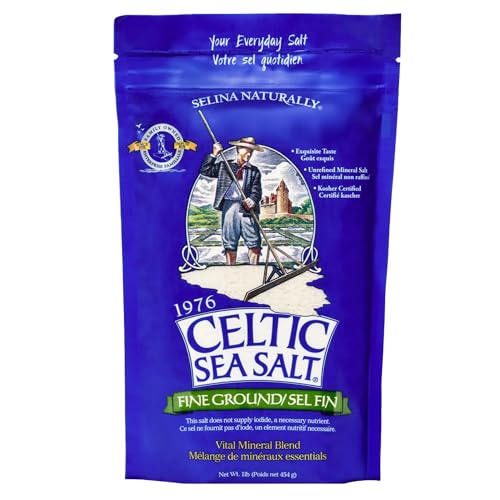
The category benchmark: Celtic Sea Salt Fine Grind
| Organic Integrity Score | 84 / 100 |
| Organic claim | None |
| Size | 16 oz |
| Listing content | No feature bullets returned |
| Best for | Cooks who want the reference Celtic salt without marketing language |
The brand most people mean when they say Celtic salt, sold with a listing that says nothing at all.
Like our top pick, it makes no organic claim, and on a mineral product that is the correct and honest position. Unlike our top pick it is a genuinely distinctive salt: grey, moist, harvested by traditional methods from Atlantic coastal marshes, with a mineral character that cooks buy it for.
The absence of feature bullets cuts both ways. There is no overclaiming, no invented health benefit and no keyword stuffing. There is also no origin statement, no processing description, no note on iodine and no explanation of what distinguishes it from a competitor selling ground Celtic salt at a similar price.
We score it just below the 365 box on price and quantity rather than on honesty. Both listings are equally clean; this one costs considerably more per ounce for a smaller package.
Worth knowing: fine-grind Celtic salt loses some of what makes coarse Celtic salt interesting. The damp, clumping texture and the slow dissolve are properties of the crystal, and grinding it fine produces something closer to ordinary sea salt with a grey tint. If the mineral character is why you are buying, the coarse version is the one to get.
- No organic claim, no health claims, no keyword stuffing.
- The reference brand for Celtic salt, widely available.
- Genuine mineral character that cooks choose deliberately.
- Established supply chain and consistent product.
- No feature bullets at all, so nothing is disclosed.
- Considerably more per ounce than the 365 box.
- Fine grind loses much of what distinguishes Celtic salt.
- Not iodized, and the listing does not mention it.
Best for: Cooks who want the benchmark Celtic salt and do not need the page to explain it.
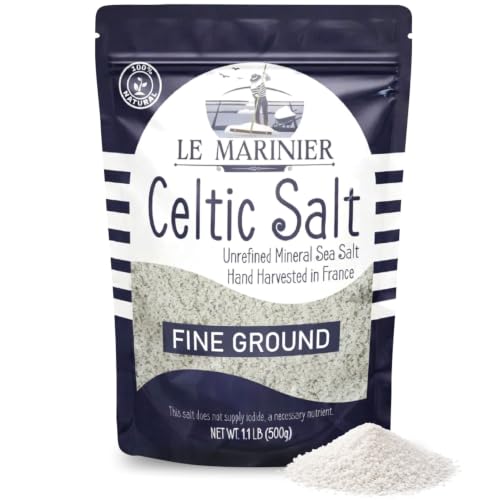
Organic twice in the title, never in the body: Le Marinier Celtic Salt
| Organic Integrity Score | 70 / 100 |
| Organic claim | Appears twice in the title; not once in the feature bullets |
| Mineral claim | “Over 82 vital minerals and micronutrients” |
| Origin | French, unrefined |
| Best for | Cooks who want ground Celtic salt and can read past the title |
A well-selling French Celtic salt whose title uses the word organic twice and whose body copy never mentions it.
The title reads “Celtic Salt Organic Fine Ground” and later “Celtic Salt Organic 80+ Minerals”. Neither feature bullet contains the word organic at all. They describe mineral content and grinding process, which is what the product actually offers.
That split is the pattern this guide exists to describe. The claim sits in the title, where it captures searches, and disappears from the body, where a claim would have to be supported. We are not suggesting anything false is being asserted: no certification is claimed, no certifier is named, and there is nothing to disprove. There is simply a word doing search work rather than describing the product.
On the product itself the listing is reasonable. It states French origin, describes the salt as unrefined, and explains that the fine grind is produced by grinding its own grey coarse salt, which is a useful and specific piece of information.
The mineral claim needs the caveat from earlier: “over 82 vital minerals and micronutrients crucial to our health” is broadly accurate as a count and misleading as a nutritional argument. Those minerals occupy two or three percent of the product, consumed in gram quantities, so their contribution to intake is negligible. The claim that it is “packed with electrolytes to improve hydration” is the same overreach; salt does contain sodium, and the hydration framing implies more than a few grams of salt can deliver.
- States French origin and describes the grinding process specifically.
- Genuinely unrefined Celtic salt at a mid-range price.
- Strong sales rank, so turnover and freshness are good.
- Makes no certification claim it would have to support.
- “Organic” appears twice in the title and zero times in the body.
- 82 minerals is accurate as a count and negligible as nutrition.
- “Electrolytes to improve hydration” overstates what salt provides.
- Not iodized, and the listing does not say so.
Best for: Ground Celtic salt for cooking, bought for flavor rather than the mineral claims.
No additives, plus an additive: Purelife Iodized Sea Salt
| Organic Integrity Score | 62 / 100 |
| Iodine | Enriched with potassium iodate, explained in the listing |
| Contradiction | A separate bullet is headlined “NO ADDITIVES” |
| Origin | Aegean Sea, stated |
| Best for | People who want unrefined salt without losing dietary iodine |
The most genuinely useful product concept here, wrapped in a listing that argues with itself.
Start with what is good, because it is real. This is an unrefined sea salt that has been iodized, which addresses the one substantive nutritional drawback of switching away from table salt. The listing is also the only one in this comparison to explain why iodine matters, noting its role in thyroid function. For someone who wants unrefined salt and does not want to think about iodine intake separately, that is a well-designed product.
It states its origin plainly, the Aegean Sea, and claims freedom from microplastics, which is a topical concern in sea salt and a fair thing to raise.
Then the contradiction. One bullet says the salt is “enriched with potassium iodate”. Another is headlined “UNREFINED FROM THE AEGEAN – NO ADDITIVES”. Potassium iodate is an additive. Both statements sit in the same listing, a few lines apart.
Read charitably, the second bullet means no anti-caking agents and no chemical refining treatments, which is a legitimate distinction and probably what was intended. Read as written, the listing says the product both has and does not have additives. We score published wording rather than intent, and a buyer avoiding additives who reads only the headline gets the wrong impression.
The microplastics claim has the same problem in a smaller way: “free from microplastics” is a testable assertion and no test, laboratory or method is named.
It is also by a wide margin the most expensive product here.
- Unrefined and iodized, an unusual and genuinely useful combination.
- The only listing to explain why dietary iodine matters.
- States origin specifically as the Aegean Sea.
- Raises the microplastics question, which is a real one in sea salt.
- Headlines “NO ADDITIVES” while stating it is enriched with potassium iodate.
- “Free from microplastics” names no test, lab or method.
- Most expensive product in this comparison by a wide margin.
- Uses “organic” in the title on a product that cannot be certified.
Best for: Unrefined salt users who want to keep their iodine intake, and will read past the contradiction.
Keyword stuffing and a sodium claim that does not hold: Himalayan Pink Salt
| Organic Integrity Score | 52 / 100 |
| Health claim | “Naturally lower in sodium, making it a healthier choice” |
| Reality | Pink Himalayan salt is roughly 98% sodium chloride |
| Organic claim | Repeated in several grammatical arrangements |
| Best for | Not our recommendation on published claims |
The lowest score in this comparison, and it is about the claims rather than the salt.
The sodium claim is the serious one. “This organic salt is naturally lower in sodium, making it a healthier choice for your organic food lifestyle.” Pink Himalayan salt is approximately 98% sodium chloride against roughly 99% for refined table salt, a difference with no meaningful effect on sodium intake.
There is a real effect hiding behind the claim, and it is not what the listing describes. Coarse crystals pack less densely, so a teaspoon of coarse salt holds less salt than a teaspoon of fine salt. That is a property of grain size, not of the salt being pink, and grinding this product fine would eliminate it. Presenting it as an inherent health benefit is the part we mark down, and anyone reducing sodium on medical advice should not act on it.
The organic language is the other issue. Across three bullets the listing uses “himalayan pink salt organic”, “pink salt himalayan organic” and “your organic food lifestyle”. Those are the same words rearranged, which is a search-engine pattern rather than a description, on a product category where the certification does not exist.
What is defensible: the salt is genuinely unrefined, coarse grain is a legitimate format for a grinder or finishing, and “free from harmful additives and preservatives” is true of essentially all rock salt.
Pink Himalayan salt is a perfectly good salt with an attractive color and a mild mineral taste. Nothing here argues against using it. The listing simply makes claims the product cannot support.
- Genuinely unrefined rock salt with no additives.
- Coarse grain suits a grinder or finishing use.
- Attractive color and mild mineral flavor.
- Small pouch is a low-commitment way to try it.
- “Naturally lower in sodium” does not hold; the salt is around 98% sodium chloride.
- Presents a grain-size packing effect as a health benefit.
- Repeats “organic” in rearranged phrases across several bullets.
- Smallest quantity here at 7 oz, and not cheap for it.
Best for: Buyers who like pink salt and disregard the health claims on the pouch.
What we left out and why
We left out salt marketed with therapeutic claims, including products sold for detox, alkalinity or mineral supplementation. Salt does not detoxify anything, dietary salt does not meaningfully alter body pH, and the mineral content is nutritionally negligible for the reasons set out above.
We left out flavored and seasoned salts, which can legitimately carry an organic claim because the herbs and spices in them are agricultural. That is a genuinely different product and the organic part is the seasoning rather than the salt.
We left out bath and spa salts, which are not food and are not covered by food labeling rules at all.
We also left out bulk food-service quantities, which distort price comparisons and which almost nobody needs at home.
How to choose and store salt
Salt is one of the few kitchen purchases where the cheap option is genuinely correct most of the time, and the expensive one has a narrow, real use.
- Cooking, boiling and seasoning as you go: buy the cheapest plain sea salt in a large box. It dissolves, it seasons, and nothing about it is wasted in a pot of water.
- Finishing, on top of a dish just before serving: buy a coarse or flaky salt. This is where crystal texture and mineral taste actually register.
- Baking: use fine grain and weigh it if the recipe is precise, because coarse and fine salts differ substantially by volume.
- If you are cutting sodium, reduce the amount rather than switching type. No salt is meaningfully lower in sodium than another by weight.
- If you have switched from iodized table salt to sea or rock salt, you have removed an iodine source unless you chose an iodized unrefined salt.
- Dairy, eggs, fish and seaweed are the common dietary sources. If you eat none of them regularly, this is worth a thought.
- Pregnancy and breastfeeding raise iodine requirements, which is the situation where this matters most.
- An iodized unrefined salt, or keeping a box of iodized table salt for everyday cooking, both solve it.
- Keep it dry and sealed. Salt does not spoil, but it absorbs moisture and clumps, and unrefined salts clump more because they are naturally damp.
- A few grains of rice in a shaker is the traditional fix for humidity and it works.
- Do not refrigerate. Condensation is the problem you are trying to avoid.
- Iodized salt loses iodine slowly over time, particularly with heat and light, so a box kept for years is weaker than a fresh one.
What the numbers actually are
Collecting the figures in one place, because most of the marketing in this category rests on numbers that sound larger than they are.
The 2 to 3% figure is the one to hold on to. Every mineral claim in this category, every count of 82 or 84 elements, and every argument about electrolytes and hydration is describing that fraction, divided across dozens of elements, in a food eaten by the gram.
It is enough to change how salt tastes, which is a real and sufficient reason to buy an unrefined one. It is not enough to change your nutrition, and no listing here should be read as though it were.
Questions about organic salt
Can salt be certified organic?
No. USDA organic certification applies to agricultural products, and salt is a mineral extracted from seawater or mined from rock, so nothing about it is grown. The organic regulations make this explicit in an unusual way: salt and water are excluded from the calculation used to work out a product’s organic percentage.
So why do salt products say organic on the label?
Usually as shorthand for unrefined, additive-free or cleanly sourced, all of which are real distinctions with their own names. In this comparison, three of five listings used the word in the title, and one of those never used it again in the body copy.
Is Himalayan pink salt lower in sodium?
Not meaningfully. It is roughly 98% sodium chloride against about 99% for refined table salt. There is a real effect with coarse crystals, which pack less densely so a teaspoon holds less salt, but that is about grain size rather than the salt itself, and grinding it fine removes the difference.
Are the trace minerals in sea salt worth anything?
For taste, yes. For nutrition, no. Minerals make up two to three percent of unrefined salt, spread across dozens of elements, in a food consumed by the gram. A single portion of most vegetables delivers more magnesium or potassium than a month of salt does.
Do I still need iodized salt?
It depends on the rest of your diet. Unrefined sea and rock salts are generally not iodized, so switching removes an iodine source. Dairy, eggs, fish and seaweed supply it otherwise. Iodine requirements rise in pregnancy and breastfeeding, which is where this matters most.
What is the difference between refined and unrefined salt?
Refined salt is washed and recrystallized, removing trace minerals, and often has anti-caking agents added. Unrefined salt skips that, keeping trace minerals and a distinctive texture and flavor. It is a genuine processing difference and it is unrelated to organic certification.
Is sea salt healthier than table salt?
Not in any way that shows up in intake. Both are overwhelmingly sodium chloride. Sea salt tastes different and often has a better texture, which is a good reason to prefer it, and neither is a low-sodium food.
What about microplastics in sea salt?
It is a documented concern, since microplastics have been found in sea salts from various regions, and it is one reason some buyers prefer rock salt. One listing here claims to be free of them but names no test, laboratory or method, so the claim cannot be checked.
Which salt should I actually buy?
For most cooking, the cheapest plain sea salt in a large box. Keep a small bag of something coarse or flaky for finishing, where texture and mineral flavor are noticeable. Owning both costs less than buying one expensive salt for every purpose.
Does salt expire?
Pure salt does not spoil. It absorbs moisture and clumps, which is cosmetic. Iodized salt is the exception in a small way, since iodine degrades slowly with heat, light and time, so an old box is weaker than a fresh one.
Organic Connection is reader supported. We read every product listing in full and say plainly when a claim cannot be verified. How we research and rate.