Last updated: September 11, 2026
We may earn a commission when you buy through links on this page, at no extra cost to you. How we research and rate.
The short version
Our top pick is Made In Nature Fig ‘n’ Oat Bars, with an Organic Integrity Score of 92 out of 100, because it names four certification programs and states its sugar position without hedging: no added sugar, sweetened with fruit, and the three things it does not contain named individually.
But the best-constructed claim in this comparison is not on an organic bar. It is on a KIND Chewy bar, and it looks like this:
“25% less sugar than the leading competitor; (The leading granola bar contains 7g sugar per 24g bar; KIND Chewy granola bar contains 5g sugar per 23g bar).”
The claim, the reference product’s figure, its serving weight, its own figure, and its own serving weight. Everything needed to check the arithmetic, published in the bullet. We have read hundreds of comparative claims for this site and this is the first that showed its work.
Best organic granola bars compared
 |  |  |  |  | |
| Product | Made In Nature Fig ‘n’ Oat | KIND Chewy Variety | Cascadian Farm Chewy | Annie’s Organic Chewy | Quaker Chewy |
| Organic Integrity Score | 92/ 100 | 86/ 100 | 84/ 100 | 76/ 100 | 48/ 100 |
| Our rating | 4.6 | 4.3 | 4.2 | 3.8 | 2.4 |
| Organic wording | Certified Organic | None | Certified USDA organic | “Made with organic ingredients” | None |
| Programs named | Non-GMO Project, Kosher | None | Non-GMO | None | None |
| Sugar addressed | 0 g added, 3 exclusions | 5 g vs 7 g, both weights | No | No | No |
| Grain claim | Whole-grain oats | 100% whole grain oats | No | No | No |
| Ingredients named | Figs, fruit, oats | Oats | No | No | No |
| Best for | Anyone who wants | Buyers who want | Buyers who want | Lunchboxes at the lowest | Price per bar, at scale |
| Organic claim | — | None | “Certified USDA organic”, product level | “Made with certified organic ingredients” — ingredient level | None |
| Price | Currently unavailable View on Amazon | $9.48$0.47 / count View on Amazon | $8.31$0.68 / ounce View on Amazon | $4.39$0.82 / ounce View on Amazon | $14.01$0.24 / count View on Amazon |
Related reading
- Organic Food and Pantry hub
- our organic product database — compare brands across every guide
Price and availability as of September 16, 2026 7:10 am EDT. Product prices and availability are accurate as of the date/time indicated and are subject to change. Any price and availability information displayed on Amazon.com at the time of purchase will apply to the purchase of this product.
A granola bar is a confection with an ingredient list
Worth saying plainly before anything else, because it frames every claim on this page.
A chewy granola bar is oats bound together with a syrup. The syrup is what makes it a bar rather than loose oats, and the syrup is sugar — cane syrup, brown rice syrup, honey, tapioca syrup, glucose. Add chocolate chips and there is more.
That is not a scandal. It is what the product is. The useful question is not whether a granola bar contains sugar but how much, and whether the listing tells you.
Three approaches appear here.
Eliminate it. Made In Nature’s bars are sweetened with fruit and state no added sugar, naming the three categories excluded: artificial sweeteners, syrups and cane sugar. Naming what is excluded is stronger than the phrase alone.
Reduce it and show the numbers. KIND’s substantiated comparative, above.
Say nothing. Three listings here, including both certified organic ones and the category best seller, publish no sugar figure of any kind.
Note also what organic certification does and does not do here. Organic cane syrup is still sugar. The seal governs how the sugarcane was farmed. It has nothing to say about how much of it is in the bar, which makes the sugar figure the one number the certification cannot substitute for.
“Made with certified organic ingredients” again
Two organic bars here, two different constructions, and the difference is one we have now found in five categories.
Cascadian Farm says its bars are “Non-GMO and certified USDA organic.” That is the regulated phrasing, applied to the product.
Annie’s says “Made with certified organic ingredients for the goodness you’d expect from Annie’s snacks”, on a box whose product name is Annie’s Organic Chewy Granola Bars.
As always: we are not asserting a tier. We are pointing out that “made with organic ingredients” is the phrasing of the 70 percent labeling tier, that a multi-ingredient bar containing oats, syrup, chocolate and stabilizers is exactly the kind of product where that tier is common, and that the wording is the only signal a listing gives.
The three USDA tiers, for reference: 100% Organic means every ingredient. Organic, which carries the seal, means at least 95 percent. Made with organic ingredients means at least 70 percent and cannot carry the seal. We set the structure out in our guide to the USDA organic database.
Whole grain, and the word that qualifies it
Two listings make a grain claim and one of them uses the strong form.
KIND says its bars are “made with 100% whole grain oats.” All of the oats, whole. Made In Nature says “whole-grain oats” and names them as an ingredient alongside figs and fruit.
The two certified organic bars and the best seller make no grain claim in their bullets at all, which is notable in a product category built on oats.
The distinction matters the same way it did in our comparison of organic crackers: look for the word 100%. Without it, whole grain is a presence claim rather than a proportion claim.
What we looked for
We read every feature bullet on every listing in full and scored on what each manufacturer put in writing.
Whether any sugar figure or comparison is published, and whether a comparative claim shows both sides.
Whether the organic claim describes the product or its ingredients.
Whether certification programs are named individually.
Whether the ingredients are listed rather than described.
Whether the bullets describe the bar or the box. Three restate the box.
The certification map for organic granola bars, and what each one actually excludes
Most shoppers read a certification as a general signal of quality. Every one of them is narrower than that, and the gaps between them are where the marketing lives.
| Certification | Covers | Key exclusion |
| USDA Organic | Farming and handling: no synthetic pesticides or fertilizers, no GMOs, no sewage sludge or irradiation, audited yearly by an accredited certifier | Three different tiers share the one seal, and it makes no claim about worker pay, food miles, or nutrition |
| Non-GMO Project | Testing and supply-chain traceability showing the ingredients are not genetically engineered | Sets no limit on synthetic pesticides or fertilizers, so it is not an organic claim |
| Kosher | Ingredients and production comply with Jewish dietary law, verified by a rabbinic agency that inspects the facility | A dietary-law standard: it makes no claim about pesticides, GMOs or farming practice |
The mark most often mistaken for an organic claim is Non-GMO Project Verified. It is a real standard with real testing, and it verifies exactly one thing: that the ingredients are not genetically engineered. It sets no limit on synthetic pesticides, synthetic fertilizers, or anything else about how the crop was grown. USDA Organic already prohibits GMOs outright, so on a certified organic product the butterfly adds independent verification rather than a new promise. On a product carrying only the butterfly, the pesticide question has not been asked.
Best overall: Made In Nature Fig ‘n’ Oat Bars
| Organic Integrity Score | 92 / 100 |
| Certifications claimed | Certified Organic, Non-GMO Project Verified, Certified Kosher, gluten free, vegan |
| Sugar | No added sugar; no artificial sweeteners, no syrups, no cane sugar |
| Ingredients named | Ripe figs, real fruit, whole-grain oats |
| Process | No-bake soft crust |
| Best for | Anyone who wants a bar without added sugar and the certifications named |
Four certification programs, three named ingredients, and the clearest sugar statement in the comparison.
The certifications are enumerated rather than summarized: “Certified Organic, Gluten Free and Vegan, Non-GMO Project Verified, Certified Kosher.” Non-GMO Project is named as a program rather than claimed generically, and kosher is stated as certified rather than as an adjective.
The sugar statement is the part we rate highest, because it names what is excluded rather than relying on a phrase: “Sweetened with only real fruit. No artificial sweeteners, no syrups, no cane sugar.”
Those three exclusions are exactly the three things a granola bar usually uses to bind and sweeten itself. Ruling out syrups specifically is the meaningful one — brown rice syrup and tapioca syrup are the standard workarounds for a bar that wants to avoid the words cane sugar.
The ingredients are named plainly: ripe figs, real fruit, whole-grain oats. For a fruit-and-grain bar that is close to the complete recipe, and it explains where the sweetness comes from without a claim needing to.
The no-bake construction is also a genuine process description rather than a slogan, and it accounts for the softer texture.
Three deductions. The listing contains a typo where the zero in “0g added sugar” is rendered as a letter — “Og ADDED SUGAR” — in the sentence carrying the product’s most important claim. The fourth bullet is pure slogan: “ALL NATURE. NO JUNK.” and “we’re snackers to the core”. And no certifying agency is named for the organic or kosher certifications.
It is also the most expensive product here by a wide margin, and its sales rank is modest. Fruit-sweetened bars cost more to make than syrup-bound ones, and this one is priced accordingly.
- Four certification programs, two named individually.
- Names the three sweetener categories it excludes, not just “no added sugar”.
- Lists its actual ingredients: figs, fruit, oats.
- No-bake process described rather than implied.
- The only bar here sweetened without added sugar.
- Typo in the bullet carrying the headline sugar claim.
- Fourth bullet is a slogan.
- No certifying agency named.
- Most expensive product here, with a modest sales rank.
What the listing discloses: Made In Nature commits to Non-GMO Project Verified and kosher certification but stops short of whether the USDA seal applies and where it was grown or made.
Best-written claim, no certification: KIND Chewy Granola Bars
| Organic Integrity Score | 86 / 100 |
| Sugar claim | 5 g per 23 g bar, against 7 g per 24 g for the reference product |
| Grain | 100% whole grain oats |
| Excludes | Artificial flavors, colors and preservatives |
| Organic claim | None |
| Best for | Buyers who want the numbers, and are not choosing on certification |
The best-constructed comparative claim we have found on any product listing, on a bar with no organic certification.
“Made with 25% less sugar than the leading competitor; (The leading granola bar contains 7g sugar per 24g bar; KIND Chewy granola bar contains 5g sugar per 23g bar).”
Read what that parenthesis contains. The reference product’s sugar. The reference product’s weight. Its own sugar. Its own weight. A reader can confirm the 25 percent themselves, and can also notice that the bars are almost the same size, so the comparison is not being flattered by a smaller serving.
Set that against the relative claims we have documented elsewhere on this site: “50% less sodium than our regular soup” in organic soup, “25% Less Sodium” with no reference in organic soy sauce, “light in sodium” with no figure. All legal. None checkable. This is what the same claim looks like when a company decides to be verifiable.
The grain claim uses the strong form too: “100% whole grain oats”, not made with whole grains. And the exclusions are specific: artificial flavors, colors and preservatives, named individually.
Now the reason it is second on a page about organic granola bars. There is no organic claim anywhere — not in the title, not in the body. It is gluten free and low calorie and made with whole grain oats, and it is not certified organic.
So this is a bar that answers the sugar question better than any competitor and does not answer the farming question at all. Which of those matters more is a decision only you can make, and the listing is admirably clear about which one it is offering.
No ingredient list beyond the oats, no sourcing, no certification of any kind.
- Publishes both sides of its comparative sugar claim, with serving weights.
- “100% whole grain oats”, the strong form of the grain claim.
- Names three specific exclusions.
- Strong sales rank at a reasonable price per bar.
- No organic certification of any kind.
- The reference competitor is described rather than named.
- No ingredient list beyond the oats.
- “Low calorie” and “healthy snacks” in the title are undefined.
What the listing discloses: KIND makes no organic claim anywhere, so the case rests on the other claims it does make.
Best organic wording: Cascadian Farm Organic Chewy Granola Bars
| Organic Integrity Score | 84 / 100 |
| Organic claim | “Certified USDA organic”, product level |
| Also claims | Non-GMO |
| Pack | 10 bars, 12.3 oz |
| Feature bullets | Two; one restates the box |
| Best for | Buyers who want the regulated organic phrasing in a value pack |
The only certified organic bar here that uses the regulated phrasing, in a listing that then stops.
“QUALITY INGREDIENTS: Non-GMO and certified USDA organic granola bars.” Seven words, and they do the job — the certification tied to the product rather than to its ingredients, plus a non-GMO claim which on a certified organic product is redundant but harmless.
That distinction matters more than it might appear, because the other organic bar in this comparison uses the softer construction. Two organic granola bars on the same search results page, one saying certified USDA organic and one saying made with certified organic ingredients, at similar prices.
The second bullet is “One big cardboard box of Cascadian Farm Organic Chewy Granola Bars, Dark Chocolate Chip, 10 Bars, Value Size, 12.3 oz; Perfect for instant snacking.” That is packaging, quantity and a serving suggestion, which is to say it is the box rather than the bar.
So of two available bullets, one is well-written and one describes a cardboard box.
Nothing else is disclosed: no sugar figure, no grain claim, no ingredient list, no certifier, no sourcing. In a category where sugar is the central question, a certified organic bar with chocolate chips that publishes no sugar information is leaving out the number that matters most.
At 10 bars it is decent value per bar and cheaper than the pick above it by a wide margin.
- “Certified USDA organic” in the regulated, product-level form.
- Non-GMO claim alongside it.
- Good value per bar in a 10-count box.
- Long-established organic brand.
- No sugar figure, on a chocolate chip bar.
- Second of two bullets describes the cardboard box.
- No ingredient list, grain claim or certifier.
- Non-GMO is redundant alongside organic certification.
What the listing discloses: Cascadian Farm states USDA organic certification, and does not say where it was grown or made.
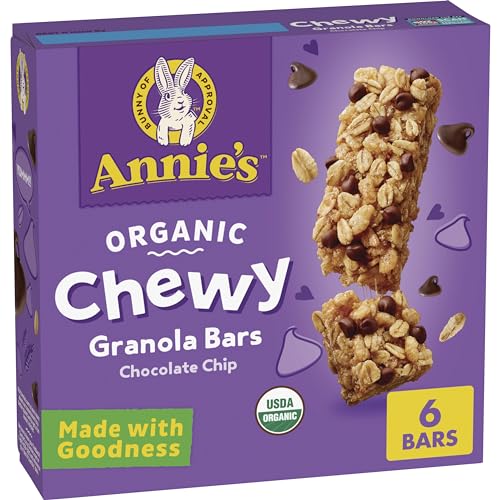
Cheapest organic, softer wording: Annie’s Organic Chewy Granola Bars
| Organic Integrity Score | 76 / 100 |
| Organic claim | “Made with certified organic ingredients” — ingredient level |
| Pack | 6 bars, 5.34 oz |
| Feature bullets | Two; one restates the box |
| Best for | Lunchboxes at the lowest organic price |
The cheapest organic box here with a strong sales rank, and a claim written the softer way.
“ORGANIC: Made with certified organic ingredients for the goodness you’d expect from Annie’s snacks.”
The bullet is headed ORGANIC and the sentence describes ingredients. On a box named Annie’s Organic Chewy Granola Bars, that is a gap between the product name and the claim in the body — and it is the phrasing of the 70 percent labeling tier.
We have now flagged this construction in taco seasoning, canned tomatoes, dog food and soup. It is not evidence of a tier, and it is the only signal a listing gives, and in a multi-ingredient bar with chocolate chips and a binding syrup it is exactly the product type where the tiers can differ.
The remainder of the sentence — “for the goodness you’d expect” — is brand reassurance rather than product information.
The second bullet is the box again: one 5.34 oz box, six bars.
So two bullets, one softly-worded certification and one package restatement, with no sugar figure, no grain claim, no ingredient list, no certifier and no other programs named.
What it has is price and availability. It is the cheapest organic option here, it sells well, and for a lunchbox it is a reasonable purchase. On a comparison scored by what the manufacturer published, it sits below the bar using the regulated phrasing.
- Cheapest organic box in the comparison.
- Strong sales rank and wide availability.
- Well-known brand with a following among parents.
- Claims nothing beyond what it can support.
- “Made with certified organic ingredients” on a box titled Organic.
- Second of two bullets restates the box.
- No sugar figure, grain claim or ingredient list.
- Smallest pack here at six bars.
What the listing discloses: Beyond the organic claim itself, Annie’s Homegrown does not say whether the USDA seal applies and where it was grown or made.
Best selling, one bullet: Quaker Chewy Granola Bars
| Organic Integrity Score | 48 / 100 |
| Organic claim | None |
| Feature bullets | One: the count and the flavor |
| Pack | 58 individually wrapped bars |
| Sales rank | Best selling granola bar in our search results |
| Best for | Price per bar, at scale |
The best selling granola bar in our search results, in the largest pack, with one bullet.
“Includes 58 individually wrapped Chewy Granola Bars, Chocolate Chip flavor.” That is the entire listing body: a count, a wrapping method and a flavor.
There is no organic claim, no sugar figure, no grain claim, no certification, no ingredient list and no exclusion of anything. Our scanner found no claims in the title either beyond the count.
At 58 bars it is comfortably the cheapest per bar on this page — a fraction of the organic options — and it is what the category actually sells in volume. That is worth stating plainly: the reference point for the organic premium in this aisle is a bar whose listing tells you nothing at all.
It is also the clearest illustration of a pattern we have now found in oats, jerky, whey protein, mascara, canned tomatoes and here: the highest-selling product in a category is routinely the one whose listing says the least, because brand recognition and price do the persuading and the bullets stop working.
- Best selling granola bar in our search results.
- Cheapest per bar here by a wide margin, at 58 count.
- Individually wrapped, which suits lunchboxes and bulk buying.
- Claims nothing it cannot support.
- No organic certification, on a page about organic granola bars.
- A single bullet giving a count and a flavor.
- No sugar, grain, ingredient or certification information.
- Nothing for a buyer to evaluate beyond price.
What the listing discloses: Quaker carries no organic claim, certified or otherwise.
What we left out and why
Protein bars. A different product judged on protein content and source, where the interesting certifications are the finished-product ones we covered in organic whey protein.
Loose granola and cereal. Same ingredients, different format, different purchase decision.
Soft-baked and fruit-filled bars aimed at toddlers. A distinct category where the questions are about portion size and added sugar for young children rather than about certification.
Products with no price or availability at the time of our scan.
Reading a granola bar box
- Find grams of total sugar and grams of added sugar on the panel. Added sugar is the line that matters and it is separately listed.
- Treat any relative claim as unverifiable unless both sides are published. One listing here publishes both; the rest publish none.
- Check where a syrup appears in the ingredient list. Second position after oats means the bar is mostly oats and syrup.
- “No added sugar” means sweetened by fruit or nothing. It does not mean low in sugar, since dried fruit is concentrated sugar.
- Organic cane syrup is still sugar. The seal governs the farming, not the quantity.
- Prefer “certified USDA organic” applied to the bars over “made with certified organic ingredients”, which is the wording of the 70 percent tier.
- Look for named programs — Non-GMO Project Verified, a named kosher agency — rather than bare adjectives.
- Look for 100% in front of any whole grain claim.
- Non-GMO on a certified organic product is redundant, since organic rules already prohibit engineered inputs.
- Convert to price per bar, not price per box. Packs here range from 6 to 58.
- Check bar weight as well as bar count. A 23 g bar and a 40 g bar are different products at the same unit price.
- Individually wrapped suits lunchboxes and creates more packaging per bar than a bulk box.
- Chewy bars stale quickly once a box is opened, because the syrup dries. Reseal or use a container.
What the field adds up to
Two listings in five say anything about sugar, in a category whose main nutritional question is sugar. One uses the regulated organic wording. One publishes a checkable comparison — and it is the one with no organic claim.
The rule for granola bars is short and slightly deflating. The certification tells you how the oats were farmed. The panel tells you how much sugar is in the bar. Only one of those is the reason most people are standing in this aisle, and the certification cannot answer it.
Questions about organic granola bars
Does organic mean less sugar?
No. Organic certification governs how ingredients were farmed, not how much of them a recipe contains. Organic cane syrup is sugar. The two certified organic bars in this comparison publish no sugar figure at all.
What makes a comparative claim trustworthy?
Both sides being published. A claim of “25% less sugar” means nothing without the reference product’s figure and both serving sizes, because a smaller bar can produce the same percentage without containing less sugar per gram. One listing here publishes all four numbers.
Is “made with organic ingredients” the same as organic?
Not in labeling terms. “Made with organic ingredients” is the wording of the 70 percent tier, which cannot carry the USDA seal. “Certified USDA organic” applies to the finished product at 95 percent or above. A brand may use loose wording on a fully certified product, and the wording is the only signal a listing gives.
Does “no added sugar” mean low sugar?
No. It means no sweetener was added during production. A bar sweetened entirely with dried fruit can still contain a great deal of sugar, because drying concentrates it. It is a claim about what was added, not about the total.
What binds a granola bar together?
A syrup, almost always. Cane syrup, brown rice syrup, tapioca syrup, honey or glucose. It is what turns loose oats into a bar, which is why a genuinely syrup-free bar has to be built differently, usually around fruit paste.
What is the difference between 100% whole grain oats and whole grain oats?
The 100% means all of the oats are whole grain. Without it, whole grain is a presence claim that can be true when whole grain is a minority of the flour or oat content.
Is non-GMO meaningful on an organic granola bar?
Not much. Organic certification already prohibits genetically engineered inputs, so a non-GMO badge on a certified organic product is redundant. It is not misleading and it should not add to your confidence.
Why do granola bars go stale so fast once opened?
Because the syrup that binds them loses moisture to the air, and the oats absorb it unevenly. Individually wrapped bars avoid this; an opened bulk box needs an airtight container.
How should I compare prices across pack sizes?
By price per bar and then by bar weight. Packs in this comparison range from 6 to 58 bars, and bar weights range widely, so neither box price nor bar count alone is comparable.
Organic Connection is reader supported. We read every product listing in full and say plainly when a claim cannot be verified. How we research and rate.