Last updated: September 30, 2026
We may earn a commission when you buy through links on this page, at no extra cost to you. How we research and rate.
Safety note: Toxic shock syndrome (TSS) is a rare but serious risk with any tampon, organic or not. Always use the lowest absorbency for your flow, change tampons every 4 to 8 hours, never leave one in overnight beyond the recommended time, and consider alternating with pads. Seek medical care immediately for sudden high fever, rash, vomiting, or dizziness while using a tampon.
The short version
After researching the materials, certifications, and options of the most popular organic tampons, our top pick is Natracare Non-Applicator Organic Cotton Tampons. They are 100% certified organic cotton, totally chlorine-free, contain no rayon or plastic, and are biodegradable, which is why they earned our highest Organic Integrity Score of 89 out of 100. For a modern applicator, Rael is our pick, and for an eco cardboard applicator, Organyc is the best choice.
The most important thing with tampons is that they are 100% organic cotton with no rayon, since rayon and conventional materials are what many people want to avoid. After that, it is about the applicator: none (most eco), cardboard, plant-based, or plastic. We flag each pick’s material and applicator.
Best organic tampons compared
| Best Choice | Best Value | ||||
 |  |  |  |  | |
| Product | Natracare | Organyc Non-App | Organyc Cardboard | Natracare Applicator | Rael |
| Organic Integrity Score | 89/ 100 | 88/ 100 | 87/ 100 | 83/ 100 | 81/ 100 |
| Our rating | 4.5 | 4.4 | 4.4 | 4.2 | 4.1 |
| Best for | Best overall | Heavy flow | Eco applicator | Value applicator | Modern applicator |
| Applicator | None | None | Cardboard | Cardboard | Compact BPA-free |
| Cotton | 100% organic cotton | 100% organic cotton | 100% organic cotton | 100% organic cotton | Organic cotton core |
| Price | $9.56$0.48 / count View on Amazon | $9.79$0.61 / count View on Amazon | $8.99$0.56 / count View on Amazon | $23.80 $26.39 −10%$0.50 / count View on Amazon | $18.99$0.47 / count View on Amazon |
Price and availability as of October 12, 2026 1:10 am EDT. Product prices and availability are accurate as of the date/time indicated and are subject to change. Any price and availability information displayed on Amazon.com at the time of purchase will apply to the purchase of this product.
Scores are ours, based on independent research of materials, certification, applicator eco-friendliness, and value, using the same 10-criteria method we apply to every product. See how we research and rate.
The certification map for organic tampons, and what each one actually excludes
Seals accumulate on a package faster than meaning does. This is what each of the marks you will see here certifies, and what it leaves out.
| Certification | Covers | Key exclusion |
| USDA Organic | Farming and handling: no synthetic pesticides or fertilizers, no GMOs, no sewage sludge or irradiation, audited yearly by an accredited certifier | Three different tiers share the one seal, and it makes no claim about worker pay, food miles, or nutrition |
| GOTS | Organic fiber from farm to finished textile, plus dyeing, finishing, wastewater and labor criteria | Has a weaker second tier, “made with organic”, that needs only 70% organic fiber and carries the same name |
What makes GOTS unusual is how far past the farm it reaches. Most organic marks certify how a crop was grown and stop there. GOTS carries the requirement through spinning, weaving, dyeing and finishing, bans a long list of processing chemicals, sets wastewater limits, and adds labor criteria at every stage. That is why a GOTS textile costs more than a fabric merely woven from organic cotton, and why the two are not the same claim.
Key things to look for in organic tampons
Good organic tampons are about pure materials and the right applicator. Here is what matters.
1. 100% organic cotton, no rayon
The whole point is pure organic cotton with no rayon, plastics, chlorine, or fragrance.
2. The applicator you prefer
None (most eco and compact), cardboard or plant-based (biodegradable), or a smooth BPA-free plastic applicator for ease.
3. The right absorbency
Use the lowest absorbency that works for your flow, and match regular, super, or super plus to the day.
4. Certification and biodegradability
Look for certified organic cotton; non-applicator and cardboard options are typically biodegradable.
Applicator options, explained
With organic tampons, the tampon itself is 100% organic cotton across the good brands, so the main choice is the applicator. Non-applicator tampons (like Natracare) are the most eco and compact, with the least waste and often biodegradable, inserted with a clean finger. Cardboard and plant-based applicators (like Organyc) are easy to use and biodegradable, a nice middle ground. Smooth BPA-free plastic applicators (like Rael’s compact) are the easiest and most familiar for many people, though they are not biodegradable.
None of these changes the purity of the cotton; it is about convenience versus waste. Our scoring rewards 100% organic cotton, chlorine- and rayon-free materials, honest labeling, and the applicator’s eco-friendliness, so you can pick the format that suits you.
Are organic menstrual products actually safer? An honest look
This category is marketed hard on health fear, and the evidence does not really support the strong version of the claim. We would rather tell you that than sell you something on a scare.
Dioxin: largely a historical issue. The dioxin concern dates from when rayon was made using elemental chlorine bleaching. That practice ended. The FDA states tampons are no longer bleached with elemental chlorine and that dioxin levels are negligible in every type of tampon, organic or not. One analysis put dioxin concentrations in tampons at somewhere between 13,000 and 240,000 times lower than ordinary dietary exposure. Whatever dioxin you encounter, it is coming from food, not from menstrual products.
Glyphosate: detectable, and in context. Trace glyphosate has been found in non-organic cotton products. The EPA’s position is that glyphosate is not likely to be carcinogenic at relevant exposures, and the dominant route of human exposure is food and drinking water rather than textile contact. Organic cotton avoids it, and the exposure it avoids is small.
Toxic shock syndrome: genuinely unresolved. This is where you might expect organic cotton to win clearly, and the literature is contradictory. One study comparing toxin production across eleven tampon types found higher toxin levels in cotton-only tampons than in rayon or viscose blends. Other work has found the opposite, with all-cotton tampons not producing the TSS toxin while rayon varieties amplified it. When two bodies of evidence point in opposite directions, the honest summary is that no material has demonstrated a clear TSS advantage.
What actually reduces TSS risk is unchanged regardless of what your product is made from: use the lowest absorbency that works for your flow, change every four to eight hours, never leave one in overnight beyond eight hours, and alternate with pads where practical. Absorbency and duration drive the risk, not fiber type.
So why buy organic, then?
There are good reasons. None of them require a health scare.
- Ingredient transparency. Menstrual products are regulated as medical devices in the US and have historically not required full ingredient disclosure. Organic and certified brands generally disclose everything, which is a legitimate reason to prefer them.
- No fragrance. This is the most defensible health reason. Added fragrance in menstrual products is a genuine and common cause of vulval irritation and contact dermatitis. Unscented is worth insisting on, and organic lines are reliably unscented.
- Farming impact. Cotton is roughly 6% of global pesticide use on about 2.4% of cultivated land. If you use these products for decades, that is a real cumulative purchasing decision even if the personal exposure is negligible.
- Fewer processing chemicals. GOTS-certified cotton excludes chlorine bleaching, toxic azo dyes, and formaldehyde finishing, which is a reasonable preference for something worn against mucous membrane.
- Biodegradability. Conventional products often contain plastic layers and take centuries to break down. Cotton-based ones do considerably better.
Buy them for transparency, for the absence of fragrance, and for the farming and waste footprint. Do not buy them believing conventional products are poisoning you, because the evidence does not show that, and see a doctor rather than switching brands if you have persistent irritation.
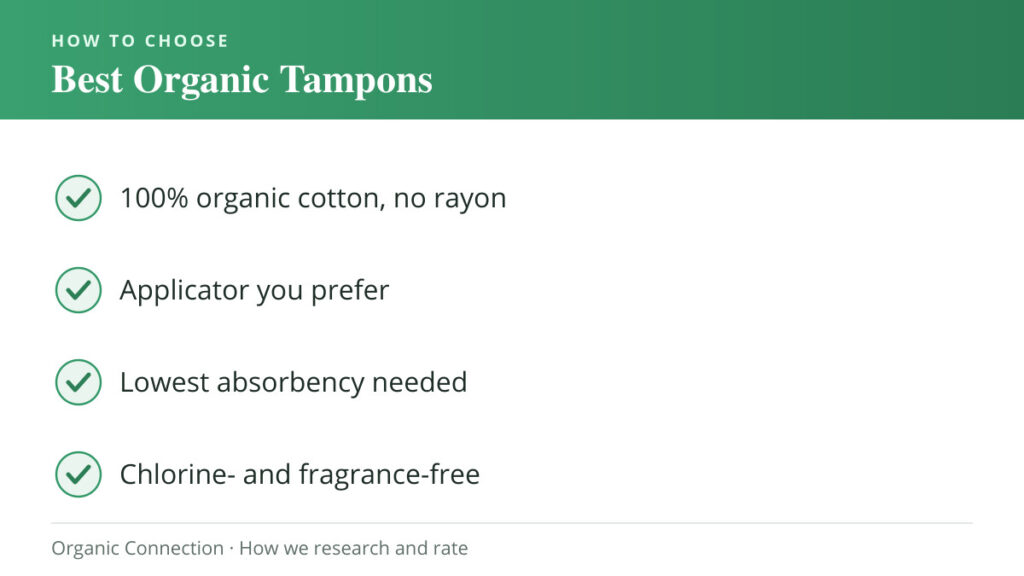
How to choose organic tampons
- Confirm 100% organic cotton, no rayon. That is the core reason to switch.
- Pick your applicator. None for least waste, cardboard or plant-based for eco ease, plastic for familiarity.
- Use the lowest absorbency needed. Match your flow, and change every 4 to 8 hours for TSS safety.
- Look for chlorine-free and fragrance-free. Gentler and cleaner.
- Consider biodegradability. Non-applicator and cardboard-applicator options break down; plastic applicators do not.
Who should buy organic tampons
The best tampon depends on your preference. If you want the purest, most eco non-applicator tampon, our top pick fits. If you want an easy modern applicator, an eco cardboard applicator, a non-applicator for heavier flow, or the best value, we have a pick for each.
Best overall: Natracare Non-Applicator Organic Cotton Tampons
| Organic Integrity Score | 89 / 100 |
| Applicator | None (digital/finger insertion) |
| Cotton | 100% organic cotton, no rayon or plastic |
| Best for | The purest, most eco tampon |
Natracare is our top pick because it is the cleanest, most eco option. These non-applicator tampons are 100% certified organic cotton with no rayon, plastics, or dyes, totally chlorine-free, and fully biodegradable and compostable, with zero applicator waste, from the brand that pioneered organic period care in 1989.
The trade-off is that non-applicator tampons take a little practice to insert with a clean finger. For the purest materials and least waste, they are our first choice, and they come in regular, super, and super plus.
What we liked: 100% organic cotton, no rayon or plastic, chlorine-free, biodegradable, and zero applicator waste.
Keep in mind: Non-applicator insertion takes some practice and clean hands, which not everyone prefers.
What the listing discloses: natracare commits to GOTS but stops short of whether the USDA seal applies and where it was grown or made.
Best for heavy flow: Organyc Non-Applicator Super
| Organic Integrity Score | 88 / 100 |
| Applicator | None |
| Cotton | 100% certified organic cotton, super |
| Best for | Heavier-flow days |
Organyc Non-Applicator Super is our pick for heavier days. It is 100% certified organic cotton in a super absorbency, no applicator, free of chlorine, rayon, perfumes, and chemicals, textured for extra absorbency and fiber strength, and tested to absorb as well as mainstream brands, all while staying fully cotton and biodegradable.
It scores in the value range because super absorbency should be used only when your flow needs it (for TSS safety), and non-applicator takes practice, but for pure, high-absorbency organic cotton, it is a strong pick.
What we liked: 100% organic cotton in super absorbency, no applicator waste, chlorine- and rayon-free, and strong absorbency.
Keep in mind: Use super absorbency only when needed for your flow, and non-applicator insertion takes practice.
What the listing discloses: Beyond the organic claim itself, Organyc does not say whether the USDA seal applies and where it was grown or made.
Best eco applicator: Organyc Cardboard Applicator Tampons
| Organic Integrity Score | 87 / 100 |
| Applicator | Biodegradable cardboard |
| Cotton | 100% certified organic cotton |
| Best for | An easy but eco applicator |
Organyc is our pick for an eco applicator. These tampons are 100% certified organic cotton in a biodegradable cardboard applicator, free of chlorine, perfumes, rayon, and chemicals, textured for absorbency, from a 70-year-old Italian company whose products are clinically shown to respect sensitive skin.
It scores in the middle because a cardboard applicator is slightly less smooth than plastic, but it gives you the ease of an applicator with the eco benefit of biodegradability and 100% organic cotton, and a plant-based eco-applicator version is also available.
What we liked: 100% organic cotton, a biodegradable cardboard applicator, chlorine- and rayon-free, and gentle on sensitive skin.
Keep in mind: Cardboard applicators are a little less smooth than plastic, which takes minor getting used to.
What the listing discloses: Sparse documentation from Organyc — nothing on whether the USDA seal applies and where it was grown or made.
Best value applicator: Natracare Applicator Tampons
| Organic Integrity Score | 83 / 100 |
| Applicator | Biodegradable cardboard |
| Cotton | 100% certified organic cotton |
| Best for | Affordable applicator tampons |
Natracare’s applicator tampons are our value pick. They bring the same 100% organic cotton, chlorine-free, rayon- and plastic-free materials as our top pick, in a convenient biodegradable cardboard applicator, at a friendly price and widely available, so you get the ease of an applicator with fully organic, compostable materials.
It scores at the value end here only because it overlaps with our top pick and Organyc’s cardboard option, but for affordable, genuinely organic applicator tampons, it is a reliable choice.
What we liked: 100% organic cotton, biodegradable cardboard applicator, chlorine- and rayon-free, and good value.
Keep in mind: Cardboard is less smooth than plastic, and it overlaps with our other cardboard pick, so choose on price and pack size.
What the listing discloses: Beyond the organic claim itself, natracare does not say whether the USDA seal applies and where it was grown or made.
Best modern applicator: Rael Organic Cotton Tampons
| Organic Integrity Score | 81 / 100 |
| Applicator | Compact BPA-free plastic, smooth tip |
| Cotton | Organic cotton core, chlorine-free |
| Best for | Easy, familiar insertion |
Rael is our pick for a modern applicator. Its tampons have an organic cotton core in a smooth, compact BPA-free applicator with a comfort-fit rounded tip, chlorine-free, unscented, and with Leak Locker technology for security, wrapped in a sustainable paper wrapper and easy to slip in a pocket or purse.
It scores just below our top pick because the plastic applicator is not biodegradable, but for a familiar, comfortable, discreet applicator with an organic cotton core, it is excellent.
What we liked: Organic cotton core, smooth compact BPA-free applicator, chlorine-free and unscented, and easy, comfortable insertion.
Keep in mind: The plastic applicator is not biodegradable, so it creates more waste than cardboard or non-applicator options.
What the listing discloses: Rael is thin on detail, and does not say whether the USDA seal applies and where it was grown or made.
Using organic tampons safely
Choose the lowest absorbency that handles your flow, since higher absorbency than you need raises TSS risk. Change your tampon every 4 to 8 hours, do not exceed 8 hours, and consider using a pad overnight or alternating tampons with pads. Wash your hands before and after insertion, especially with non-applicator tampons. Dispose of tampons in the trash (never flush them, even biodegradable ones, to protect plumbing); non-applicator and cardboard-applicator organic tampons can be composted where facilities accept them. Seek medical help right away for sudden fever, rash, vomiting, or dizziness.
How we researched this guide
We are a research-based review site. We compared each tampon against its materials and certification, applicator eco-friendliness, absorbency options, and the weight of aggregated customer feedback, then scored each with our 10-criteria Organic Integrity Score. No brand paid to be included or ranked. Read the full method on our How We Research and Rate page.
Common questions about organic tampons
What are the best organic tampons?
Our overall pick is Natracare Non-Applicator Organic Cotton Tampons, because they are 100% organic cotton, chlorine-free, rayon- and plastic-free, and biodegradable. For a modern applicator, Rael is our pick, and for an eco cardboard applicator, Organyc.
Are organic tampons safer for TSS?
TSS risk exists with all tampons, organic or not, and is driven mainly by absorbency and how long a tampon is left in, not the material. Organic cotton avoids rayon and chemicals, but you should still use the lowest absorbency needed and change every 4 to 8 hours.
What is the difference between organic and regular tampons?
Organic tampons are 100% certified organic cotton with no rayon, plastics, chlorine bleaching, or fragrance, and the cotton is grown without synthetic pesticides. Many conventional tampons blend rayon with cotton and are chlorine-bleached.
Which applicator is best?
It is a personal trade-off: non-applicator is the most eco and compact, cardboard and plant-based applicators are easy and biodegradable, and BPA-free plastic applicators are the smoothest but not biodegradable. The cotton is the same across the good brands.
Are organic tampons biodegradable?
The tampon itself, being 100% organic cotton, is biodegradable in all our picks, and non-applicator and cardboard-applicator versions are fully compostable where accepted. Plastic applicators are not. Never flush tampons regardless.
- Organic Household hub
- Best Organic Pads
- Best Organic Cotton Underwear
- How we research and rate products
- every product we have reviewed — filter by USDA Organic, GOTS, Fair Trade and more
- Best Organic Period Underwear
Price and availability as of October 12, 2026 1:10 am EDT. Product prices and availability are accurate as of the date/time indicated and are subject to change. Any price and availability information displayed on Amazon.com at the time of purchase will apply to the purchase of this product.
Looking for other organic products?
We have checked more than 800 products across food, household goods, gardening, personal care and pet, every one against its stated certification. Browse all reviews.
Organic Connection is reader-supported. When you buy through links on this page we may earn a commission, at no extra cost to you. As an Amazon Associate we earn from qualifying purchases. We are not paid to feature or rank any product. How we research and rate.