Last updated: September 30, 2026
We may earn a commission when you buy through links on this page, at no extra cost to you. How we research and rate.
The short version
Judged on what each listing will actually stand behind, our top pick is Delilah Home 100% Organic Hemp Sheets, with our highest Organic Integrity Score of 87 out of 100. Hemp and flax are both bast fibers and both sleep cool, so the question on this page is less which plant and more which brand will name the certification behind it.
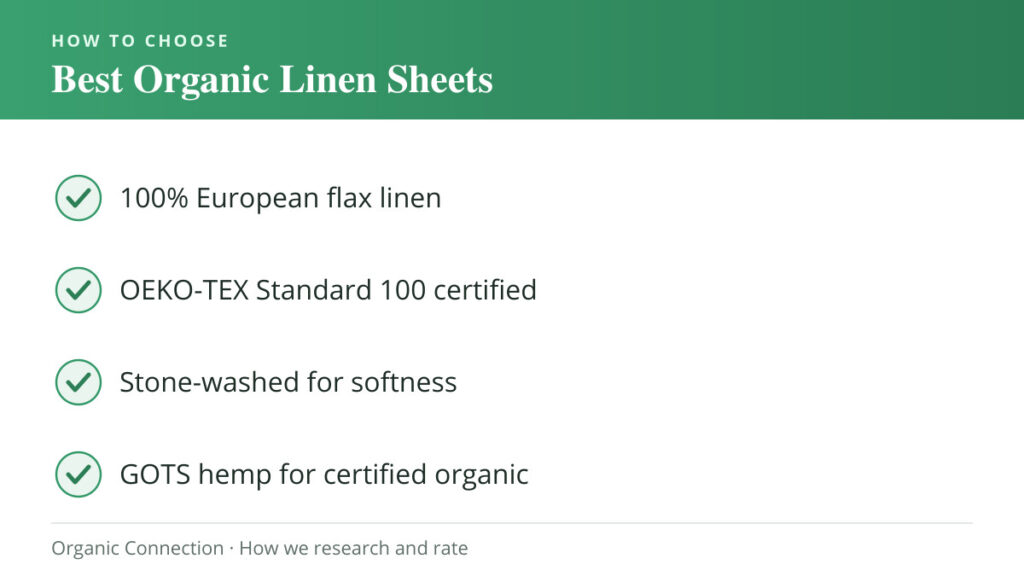
An honest note up front: true GOTS-certified organic linen is rare, because most flax is grown with minimal inputs but not certified organic. For clean linen, the meaningful standard is 100% European flax with OEKO-TEX certification (no harmful chemicals), and where you want certified-organic fiber, GOTS hemp or cotton is the genuine alternative. We flag exactly what each set is.
Best organic linen sheets compared
| Best Choice | Best Value | ||||
 |  |  |  | ||
| Product | Delilah Home Hemp | DAPU French Flax | Simple&Opulence Hemstitch | Simple&Opulence Flax | Sijo Organic Linen |
| Organic Integrity Score | 87/ 100 | 86/ 100 | 85/ 100 | 84/ 100 | 83/ 100 |
| Our rating | 4.4 | 4.3 | 4.3 | 4.2 | 4.2 |
| Fiber | 100% organic hemp | 100% French flax | 100% flax, hemstitch | 100% French flax | 100% French flax, stone washed, 175 gsm |
| Best for | Best overall | Clean, natural linen set | Decorative finish | Value flax | Certified organic linen |
| Certification | GOTS, Organic | OEKO-TEX | OEKO-TEX | OEKO-TEX | OEKO-TEX |
| Price | $399.99$100.00 / set View on Amazon | $122.39 $143.99 −15% View on Amazon | $122.99 $137.99 −11% View on Amazon | View on Amazon | $250.75 $295.00 −15% View on Amazon |
Price and availability as of October 11, 2026 7:10 pm EDT. Product prices and availability are accurate as of the date/time indicated and are subject to change. Any price and availability information displayed on Amazon.com at the time of purchase will apply to the purchase of this product.
Scores are ours, based on independent research of fiber, certification, finish, and value, using the same 10-criteria method we apply to every product. See how we research and rate.
The certification map for organic linen sheets, and what each one actually excludes
Seals accumulate on a package faster than meaning does. This is what each of the marks you will see here certifies, and what it leaves out.
| Certification | Covers | Key exclusion |
| GOTS | Organic fiber from farm to finished textile, plus dyeing, finishing, wastewater and labor criteria | Has a weaker second tier, “made with organic”, that needs only 70% organic fiber and carries the same name |
| OEKO-TEX Standard 100 | Laboratory testing of the finished textile against limits for more than 1,000 harmful substances | Says nothing at all about whether the fiber was organically grown |
| Certified Vegan | No animal ingredients or animal-derived processing aids, and no animal testing | Not an organic, safety or nutritional claim |
Standard 100 answers “what is in this fabric”, not “how was it grown”. That is a useful question and the testing behind it is rigorous, covering formaldehyde, heavy metals, azo dyes and a long list besides. But a product can pass it while having been grown with every pesticide the organic standards prohibit, because those residues do not survive to the finished textile. Treat it as a floor for chemical safety and look elsewhere for the farming claim.
Key things to look for in natural linen sheets
Genuinely clean linen is about fiber, certification, and finish. Here is what matters.
1. 100% pure flax linen
Look for 100% European flax (French or Belgian), not linen-cotton blends, for the true breathable, durable feel.
2. OEKO-TEX certification
OEKO-TEX Standard 100 verifies the finished fabric is free of harmful substances, the key clean-textile mark for linen.
3. A softened finish
Stone-washed or garment-washed linen feels soft from day one; all quality linen softens further with use.
4. Certified-organic alternatives
Because organic linen is rare, GOTS-certified organic hemp or cotton is the genuine certified-organic option.
Is there such a thing as organic linen sheets?
Yes — but far less of it reaches the marketplace most people shop, and the reason is worth understanding before you pay the premium.
Flax is already one of the lowest-input textile crops there is. It grows in the cool, rain-fed climates of Normandy, Hauts-de-France, Belgium and the Netherlands with essentially no irrigation, and it needs far less pesticide and fertilizer than cotton does. Because the conventional crop is already close to what certification would require, many growers never pursue organic status — the certificate would change the farming very little while adding real cost. That is a genuinely different situation from cotton, where organic certification eliminates a large and well-documented chemical load.
GOTS-certified organic linen does nonetheless exist. Sijo’s LuxeWeave uses GOTS-certified organic flax from Normandy; Boll & Branch sells sheets made from certified organic flax; Coyuchi’s linen is MadeSafe certified and woven in Portugal from French flax; Avocado and Rawganique both offer organic French linen. What these have in common is that they are direct-to-consumer brands at premium prices, which is why they are largely absent from the marketplace listings most shoppers browse.
So the practical position is this. If certified-organic fiber is your priority and budget allows, buy from one of those brands directly. If you are shopping the wider market, the meaningful marks are OEKO-TEX Standard 100, which tests the finished fabric for harmful substances, and Masters of FLAX FIBER (formerly European Flax), which certifies European origin and traceability. Both are real, audited claims. Our scoring rewards 100% flax content, OEKO-TEX certification, honest fiber labeling, and genuine GOTS certification where a product carries it.
How to choose natural linen sheets
- Insist on 100% flax. European French or Belgian flax, not a linen-cotton blend, for true linen.
- Look for OEKO-TEX certification. Standard 100 verifies the fabric is free of harmful substances.
- Choose a softened finish. Stone-washed or garment-washed linen is soft immediately.
- Consider GOTS hemp or cotton for certified organic. The genuine certified-organic alternative to linen.
- Pick your color and fit. Confirm deep-pocket fit for your mattress and choose OEKO-TEX-dyed colors.
Who should buy organic linen sheets
One priority usually dominates: price, weight or origin. For 100% French flax linen, our top pick leads. If you want value flax, a certified-organic hemp alternative, stone-washed softness, or a decorative hemstitch finish, we have a pick for each.
Best overall: Delilah Home 100% Organic Hemp Sheets
| Organic Integrity Score | 87 / 100 |
| Fiber | 100% organic hemp |
| Certification | GOTS, Organic |
| Best for | A genuinely certified-organic linen alternative |
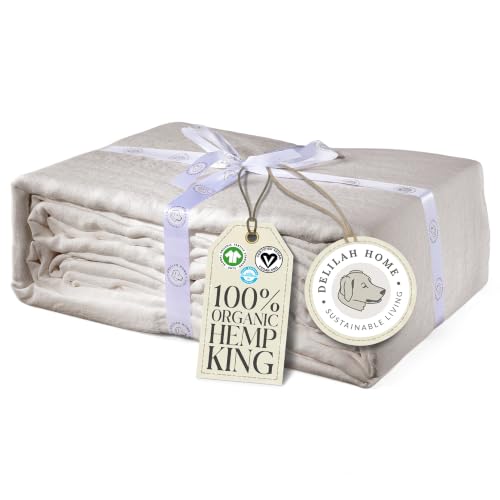
Delilah Home is our pick when you specifically want a certified-organic fiber. Since organic linen barely exists, this GOTS and Vegan.org certified 100% organic hemp set is the genuine certified-organic alternative: hemp shares linen’s breathable, moisture-wicking, temperature-regulating, textured feel, is exceptionally durable and gets softer over time, and comes with the GOTS certification that real organic linen almost never carries.
It scores in the middle because hemp is a different fiber from linen (similar feel, but its own texture) and starts crisper before softening, but for a certified-organic, natural, breathable sheet, it is the honest choice.
What we liked: GOTS-certified 100% organic hemp, breathable and temperature-regulating like linen, extremely durable, and genuinely certified organic.
Keep in mind: Hemp is not linen; it feels similar but starts crisper and softens with use, and it is premium-priced.
What the listing discloses: Delilah Home documents GOTS, and leaves whether the USDA seal applies and where it was grown or made unsaid.
Clean, natural linen set: DAPU 100% French Flax Linen Sheet Set
| Organic Integrity Score | 86 / 100 |
| Fiber | 100% pure French flax linen |
| Certification | OEKO-TEX |
| Best for | An all-around clean, natural linen set |
DAPU earns its place here because it delivers genuine, clean linen at a fair price. It is woven from 100% high-quality French flax (not a blend), certified to OEKO-TEX Standard 100 for no harmful substances, breathable and temperature-regulating (cool in summer, warm in winter), moisture-wicking, and it starts pleasantly soft and gets softer with every wash, in a full set with deep-pocket fitted sheet and pillowcases.
The honest caveat is that it is OEKO-TEX certified pure flax rather than GOTS-certified organic, which, as noted, barely exists for linen. For a verifiably clean, breathable, durable natural linen set, it is a dependable option.
What we liked: 100% French flax, OEKO-TEX Standard 100 certified, breathable and temperature-regulating, and softens beautifully with washing.
Keep in mind: It is OEKO-TEX-certified pure flax rather than GOTS organic, and linen wrinkles naturally as part of its relaxed look.
What the listing discloses: No organic certification appears anywhere on the DAPU listing.
Best decorative: Simple&Opulence Hemstitch Linen Set
| Organic Integrity Score | 85 / 100 |
| Fiber | 100% flax linen with hemstitch trim |
| Certification | OEKO-TEX |
| Best for | A refined, decorative linen look |
The Simple&Opulence hemstitch set is our decorative pick. It is 100% flax linen, OEKO-TEX Standard 100 certified, and finished with a classic hemstitch border on the top sheet and pillowcases, giving a refined, tailored, farmhouse-elegant look with the same breathable, softening-with-use linen feel, for people who want their bedding to look a little more finished.
It scores at the value end here because the decorative hemstitch is a style choice rather than a material upgrade and adds a little to the price, but for a refined, certified 100% linen set with a tailored detail, it is a lovely choice.
What we liked: 100% flax, OEKO-TEX certified, an elegant hemstitch border, breathable, and softens with use.
Keep in mind: The hemstitch is decorative rather than a material upgrade and adds slightly to the price; linen still wrinkles naturally.
What the listing discloses: Simple&Opulence carries no organic claim, certified or otherwise.
Best value: Simple&Opulence 100% French Flax Linen Set
| Organic Integrity Score | 84 / 100 |
| Fiber | 100% French flax linen |
| Certification | OEKO-TEX |
| Best for | Real French linen at the best price |
Simple&Opulence is our value pick. It is 100% French flax linen certified to OEKO-TEX Standard 100, breathable and temperature-regulating, and garment-washed so it feels soft out of the package, offered in a wide range of colors and sizes at one of the most accessible prices for genuine 100% linen, a great way to try linen without the premium.
It scores just below our top pick on the fine consistency of the weave and finish rather than any material shortfall, but for real, certified, 100% French flax linen at an excellent price, it is hard to beat.
What we liked: 100% French flax, OEKO-TEX certified, soft garment-washed finish, lots of colors, and a very accessible price.
Keep in mind: Weave and finish are a touch less refined than premium sets, and like all linen it wrinkles naturally.
What the listing discloses: No organic certification appears anywhere on the Simple&Opulence listing.
Best certified organic linen: Sijo Stone Washed Organic French Linen Sheet Set
| Organic Integrity Score | 83 / 100 |
| Fiber | 100% French flax linen, preshrunk and stone washed, 175 gsm |
| Certification | GOTS certified organic, certificate GOTS-24366 named on the listing |
| Best for | The one certified-organic linen set you can buy here |
Further down this page we note that certified-organic linen does exist — from Sijo, Boll and Branch, Coyuchi, Avocado and Rawganique — but that it is mostly sold direct at premium prices. This is the exception: the one certified-organic linen set we found that you can actually buy here.
It is 100% French flax, stone washed and preshrunk so it arrives soft rather than crisp, and it is GOTS certified organic. Unusually, the listing names the certificate itself — GOTS-24366 — rather than only the scheme. Across the textile listings we have read for this site, naming the certificate number is close to unheard of, and it makes this the most checkable certification claim on this page.
At 175 gsm it is also a heavier, more durable weight than the lighter flax sets above, which is what you want if you are buying linen to keep for a decade rather than for one hot summer.
It scores 83 rather than higher for three specific reasons. It carries one certification where our top pick carries two, GOTS alongside Certified Vegan. Far fewer people are buying it than the flax sets above. And it is both the most expensive set here and frequently low on stock, which is a real obstacle rather than a footnote.
What we liked: Genuinely GOTS certified organic linen, with the certificate number named on the listing. Stone washed, so it is soft from the first night. A durable 175 gsm weight.
Keep in mind: One certification rather than two. The most expensive set on this page, often low on stock, and far less widely bought than the flax sets above.
What the listing discloses: Sijo commits to GOTS but stops short of whether the USDA seal applies and where it was grown or made.
Living with linen sheets
Linen loves a gentle routine. Machine wash in cool or warm water on a gentle cycle with mild detergent, skip bleach and fabric softener, and tumble dry low or line dry; linen gets softer with every wash. Embrace the natural wrinkles, they are part of linen’s relaxed character, or remove the sheets slightly damp and smooth them if you prefer a neater look. Real linen is remarkably durable and can last for many years, often outlasting cotton. For certified-organic hemp, follow the same care; it too softens and lasts. Buy the deep-pocket size that matches your mattress for a secure fit.
GSM: the spec that actually decides how linen feels
Linen is not measured in thread count, and any linen sheet advertising one is borrowing a cotton metric that does not apply — linen yarns are thicker and irregular, so counting them tells you nothing. The number that matters is GSM (grams per square meter), sometimes given in ounces. Almost no organic linen roundup states it, and it is the single most useful figure on the spec sheet.
| Weight | Feel | Best for |
| Under 130 gsm (~4 oz) | Light, airy, semi-sheer; softens fastest | Hot sleepers and hot climates. Wears out sooner. |
| 150–170 gsm (~5 oz) | The commercial standard for bedding; good drape | Year-round use for most people |
| 170–190 gsm (~6 oz) | Substantial, heavier drape, longest-lived | Cool sleepers, and anyone who wants sheets to last decades |
| Over 200 gsm | Upholstery weight | Not bedding. Stiff, slow to break in. |
Heavier is not better; it is a different product. A 190 gsm sheet takes noticeably longer to break in and sleeps warmer, which is exactly right if you are cold at night and exactly wrong if you bought linen to stop overheating. If a listing does not state GSM at all, that is usually a sign the fabric is at the light end.
Retting: the processing step that defines linen quality
Between the flax field and the yarn sits retting — controlled decomposition that breaks down the pectin binding the fiber to the woody stalk. How it is done affects the fiber, the environment, and the price, and it is the part of linen production that goes almost entirely undiscussed in shopping guides.
| Method | How | Result |
| Dew retting | Flax left in swaths in the field, 3–6 weeks; rain, dew and soil microbes do the work | The European standard. Environmentally benign, no wastewater. Fiber quality varies with the weather, and color is grayer. |
| Water retting | Submerged in still or slow water for 6–20 days | Finer, whiter, more consistent fiber — but the wastewater deoxygenates waterways and killed fish stocks historically, which is why it has been largely abandoned in Europe. |
| Chemical retting | Caustic soda or organic acids accelerate separation | Fast, but costly and environmentally poor. Rarely used commercially. |
| Enzyme retting | Targeted enzymes replace microbes | Promising — high-quality, whiter fiber without water retting’s pollution. Not yet widespread at commercial scale. |
In practice, European flax sold today is overwhelmingly dew retted, which is the environmentally sound choice and part of why French and Belgian linen carries the reputation it does. The slight grayish cast of undyed European linen is a signature of dew retting, not a defect. If a very white linen is advertised as undyed and unbleached, be mildly skeptical.
Origin marks: Masters of FLAX FIBER and Masters of LINEN
“French flax linen” appears on a great many listings and means nothing on its own. Two certifications run by the Alliance for European Flax-Linen and Hemp make it an auditable claim, and they were restructured recently, so the naming on packaging is currently in transition.
- Masters of FLAX FIBER (formerly European Flax) — certifies that the flax was grown in France, Belgium or the Netherlands, with traceability verified by an independent body, Bureau Veritas Certification. It applies to products containing a minimum of 50% linen, and only linen of certified European origin.
- Masters of LINEN — the stricter mark, requiring that spinning, weaving and finishing also take place in Europe, not only the growing. Full farm-to-finished-product traceability.
- Both now use fiber-forward digital traceability through the TextileGenesis platform, which means the chain of custody can be followed rather than asserted.
The combination worth looking for on a mid-market sheet set is Masters of FLAX FIBER (or European Flax on older stock) for origin, plus OEKO-TEX Standard 100 for chemical safety in the finished fabric. Together they cover where the fiber came from and what was done to it — which, absent GOTS, is most of what you would want to know.
How linen is softened, and what each method costs you
Unsoftened linen out of the loom is stiff. Every brand does something about it, and the method affects both the initial feel and how long the sheets last.
- Stone washing — tumbled with volcanic stones. Immediate softness and the relaxed, crumpled look linen is known for. Slight fiber loss, but modest.
- Garment washing — a pre-wash that relaxes and pre-shrinks the fabric. The gentlest option, and the one that most reduces later shrinkage surprises.
- Enzyme washing — cellulase enzymes digest surface fibers. Very soft very fast, and the most aggressive: over-processed enzyme-washed linen thins and pills sooner. Softness on day one at the expense of years at the end.
- Unprocessed — softens naturally over 10–20 washes and lasts longest of all. Genuinely uncomfortable for the first fortnight, and the reason some people conclude they dislike linen.
If a listing promises “buttery soft from the first night” at a low price, enzyme washing is the usual explanation. That is not automatically a bad buy, but it means you are trading some of linen’s headline durability for immediate comfort.
Linen vs cotton vs hemp
| Linen (flax) | Organic cotton | Hemp | |
| Breathability | Highest; hollow fiber moves air | Good, depends on weave | High, similar to linen |
| Moisture | Absorbs ~20% of its weight before feeling damp | Absorbs well, dries slower | Comparable to linen |
| Durability | 2–3× cotton; gets stronger when wet | Good; sateen weaves wear fastest | The most durable of the three |
| Initial feel | Textured, stiff until broken in | Soft immediately | Coarsest at first, softens well |
| Wrinkling | Wrinkles freely; that is the look | Moderate | Wrinkles like linen |
| Water to grow | Mostly rain-fed | High, even organic | Low |
| Certified organic supply | Limited, DTC brands | Wide GOTS availability | Growing GOTS availability |
The short version: buy linen for temperature regulation and longevity, organic cotton for immediate softness and the widest certified choice, hemp if you want maximum durability with a certification behind it and do not mind a rougher start.
Shrinkage, care and the break-in period
Linen behaves differently from cotton in ways that catch people out in the first month.
- Shrinkage. Linen that has not been pre-washed can shrink up to about 10% on the first wash, mostly in length. Buy pre-washed or garment-washed sets, or size up on the flat sheet. A fitted sheet that shrinks off the mattress corners cannot be recovered.
- Wash cool, wash gently. 30–40°C, mild detergent, machine no more than two-thirds full so the fibers can move. Hot water accelerates wear without cleaning better.
- No fabric softener, ever. It coats the fiber, destroys linen’s absorbency, and prevents the natural softening that is the entire point of owning linen. If you want softness, add half a cup of white vinegar to the rinse instead.
- Do not over-dry. Tumble on low and remove while slightly damp, then line dry or lay flat. Fully drying in a hot machine is what makes linen feel scratchy and brittle.
- Break-in is real. Expect 10 to 20 washes before linen reaches the softness people describe. It does not plateau either — well-kept linen sheets continue improving for years, which is why they are handed down.
- Pilling is a red flag. Good linen does not pill. If it does, the fiber was short-staple or over-processed, and no amount of care will fix it.
How we researched this guide
We are a research-based review site. We compared each set against its fiber (100% flax or certified organic hemp), certification (OEKO-TEX, GOTS), finish, honest labeling, and the weight of aggregated customer feedback on softness and durability, then scored each with our 10-criteria Organic Integrity Score. No brand paid to be included or ranked. Read the full method on our How We Research and Rate page.
Common questions about organic linen sheets
Are there truly organic linen sheets?
Genuinely GOTS-certified organic linen is very rare, because flax is a naturally low-input crop that most growers never certify. For clean linen, the practical standard is 100% European flax with OEKO-TEX certification. For a certified-organic fiber, GOTS-certified organic hemp or cotton is the real alternative.
What is the best natural linen sheet set?
Our overall pick is the DAPU 100% French Flax Linen Sheet Set, because it is pure French flax, OEKO-TEX Standard 100 certified, breathable, and softens with every wash. For value, Simple&Opulence is our pick, and for certified organic, Delilah Home organic hemp.
What does OEKO-TEX certification mean for linen?
OEKO-TEX Standard 100 certifies that the finished fabric has been tested and found free of harmful substances. Since organic linen is rare, OEKO-TEX on 100% flax is the main assurance that your linen is clean and safe against skin.
Why is linen considered sustainable?
Linen is made from flax, which grows in cool climates with little irrigation and minimal pesticide, and the whole plant is used with little waste. This makes linen one of the most sustainable bedding fibers even when it is not certified organic.
Do linen sheets get softer over time?
Yes. Quality 100% flax linen starts pleasantly textured and becomes noticeably softer with every wash, developing a relaxed, lived-in feel over months and years. Stone-washed linen is pre-softened so it feels soft from the first night.
What GSM should linen sheets be?
Between 150 and 190 gsm for most people. Under 130 gsm is light and semi-sheer, softens fastest and wears out soonest, which suits hot climates. Around 150 to 170 gsm is the commercial standard for bedding. At 170 to 190 gsm the fabric has a heavier drape and the longest life, but sleeps warmer and takes longer to break in. Anything over 200 gsm is upholstery weight, not bedding. Linen is not measured in thread count — any linen sheet advertising one is borrowing a cotton metric that does not apply.
What is retting and does it matter?
Retting is the controlled decomposition that separates flax fiber from the woody stalk, and it shapes both quality and environmental impact. European flax is overwhelmingly dew retted, left in the field for three to six weeks so rain, dew and soil microbes do the work — no wastewater, but grayer fiber and weather-dependent consistency. Water retting gives finer, whiter fiber but its wastewater deoxygenates rivers, which is why Europe largely abandoned it. The slight gray cast of undyed European linen is a signature of dew retting, not a flaw.
What does Masters of FLAX FIBER certification mean?
It certifies that the flax was grown in France, Belgium or the Netherlands, with traceability verified independently by Bureau Veritas, for products containing at least 50% linen of certified European origin. It was previously called European Flax, so both names appear on shelves during the transition. The stricter Masters of LINEN mark additionally requires spinning, weaving and finishing to happen in Europe. Paired with OEKO-TEX Standard 100, these cover where the fiber came from and what was done to it.
Do linen sheets shrink?
Yes, up to about 10% on the first wash if they have not been pre-washed, mostly in length. Buy pre-washed or garment-washed sets where possible. A flat sheet that shrinks is an inconvenience; a fitted sheet that shrinks off the mattress corners cannot be recovered, so check the finish before buying rather than sizing up and hoping.
Why should you never use fabric softener on linen?
It coats the fiber, destroys the absorbency that makes linen comfortable, and blocks the natural softening that happens with washing — which is the main reason to own linen at all. Half a cup of white vinegar in the rinse gives softness without the coating.
How long does it take linen sheets to soften?
Ten to twenty washes for unprocessed linen, and it keeps improving for years after that. Stone-washed and garment-washed sets start softer. Enzyme-washed linen feels soft almost immediately because cellulase enzymes have digested the surface fibers, which is why very cheap “buttery soft” linen tends to thin and pill sooner.
Is organic linen worth paying more for than regular linen?
Less than the equivalent decision in cotton. Flax is grown mostly rain-fed in northern Europe with far lower pesticide and fertilizer use than cotton, so conventional flax is already close to what certification requires — the organic premium buys a smaller improvement than it does on a cotton crop. Certified organic linen does exist from brands like Sijo, Boll & Branch, Coyuchi, Avocado and Rawganique, mostly sold direct at premium prices. For the wider market, OEKO-TEX Standard 100 plus a European origin mark covers most of what matters.
Do good linen sheets pill?
No. Pilling on linen indicates short-staple fiber or over-processing, usually aggressive enzyme washing, and no amount of careful laundering will reverse it. Genuine long-staple European flax gets smoother with age rather than bobbling.
- Organic Household hub
- Best Organic Cotton Sheets
- Best Organic Cotton Duvet Cover
- How we research and rate products
- browse all our reviewed products — scores and certifications for 800+ products
- Percale vs sateen, explained
Price and availability as of October 11, 2026 7:10 pm EDT. Product prices and availability are accurate as of the date/time indicated and are subject to change. Any price and availability information displayed on Amazon.com at the time of purchase will apply to the purchase of this product.
Looking for other organic products?
We have checked more than 800 products across food, household goods, gardening, personal care and pet, every one against its stated certification. Browse all reviews.
Organic Connection is reader-supported. When you buy through links on this page we may earn a commission, at no extra cost to you. As an Amazon Associate we earn from qualifying purchases. We are not paid to feature or rank any product. How we research and rate.