Last updated: September 30, 2026
We may earn a commission when you buy through links on this page, at no extra cost to you. How we research and rate.
The short version
On the evidence each listing gives you, our top pick is Dr. Bronner's Pure-Castile Bar Soap, Baby Unscented. which earned it our highest Organic Integrity Score of 93 out of 100. Dr. Bronner's Pure-Castile Bar Soap, Peppermint is our pick for scented, and Dr. Bronner's Organic Castile Bar Soap, Eucalyptus for mild scent.
With bar soap, the thing that matters most is whether it is true soap made from saponified oils or a synthetic detergent bar sold as “beauty bar.” We flag each product’s certification and base oils.
Best organic bar soap compared
| Best Choice | Best Value | ||||
 |  |  |  |  | |
| Product | Dr. Bronner’s Baby Unscented | Dr. Bronner’s Peppermint | Dr. Bronner’s Eucalyptus | Nubian Heritage Black Soap | Alaffia Black Soap |
| Organic Integrity Score | 93/ 100 | 89/ 100 | 85/ 100 | 80/ 100 | 76/ 100 |
| Our rating | 4.7 | 4.5 | 4.3 | 4.0 | 3.8 |
| Base | Castile, saponified oils | Castile, saponified oils | Castile, saponified oils | African black soap | African black soap |
| Best for | Sensitive skin and babies | Invigorating daily bar | Milder scented option | Oily and acne-prone skin | Traditional unscented |
| Certification | Fair Trade, Vegan, Organic | Fair Trade, Vegan, Organic | USDA Organic, Certified Vegan | Not stated on the listing | — |
| Price | $28.99$0.97 / ounce View on Amazon | $24.99 $28.99 −14%$0.83 / ounce View on Amazon | Currently unavailable See buying options | $9.99$2.00 / ounce View on Amazon | $8.99$1.80 / ounce View on Amazon |
Price and availability as of October 11, 2026 7:10 pm EDT. Product prices and availability are accurate as of the date/time indicated and are subject to change. Any price and availability information displayed on Amazon.com at the time of purchase will apply to the purchase of this product.
Scores are ours, based on independent research of certification, base oils, ingredient purity, sourcing ethics, and value, using the same 10-criteria method we apply to every product. See how we research and rate.
The organic bar soap certifications, and the question each one leaves open
The labels on these products are not interchangeable, and several of them cover things that have nothing to do with each other. Here is what each one actually buys you.
| Certification | Covers | Key exclusion |
| USDA Organic | Farming and handling: no synthetic pesticides or fertilizers, no GMOs, no sewage sludge or irradiation, audited yearly by an accredited certifier | Three different tiers share the one seal, and it makes no claim about worker pay, food miles, or nutrition |
| Fair Trade Certified | A price floor for producers, a community premium, and labor standards on the farms and in the facilities | An economic and labor standard; it is not an organic or pesticide claim |
| Regenerative Organic | Soil health, animal welfare and farmworker fairness, built on top of an existing organic certification | Requires organic certification as its baseline, so it is an addition to the USDA seal and never a replacement for it |
USDA Organic is three claims wearing one seal. “100% Organic” means every ingredient is certified. Plain “Organic”, the version you will see most often, means at least 95% by weight, with the remainder drawn from an approved national list. “Made with organic ingredients” means 70%, and that wording may not carry the USDA seal at all. The phrase on the front of the pack tells you which of the three you are holding, and the gap between them is not small.
Key things to look for in organic bar soap
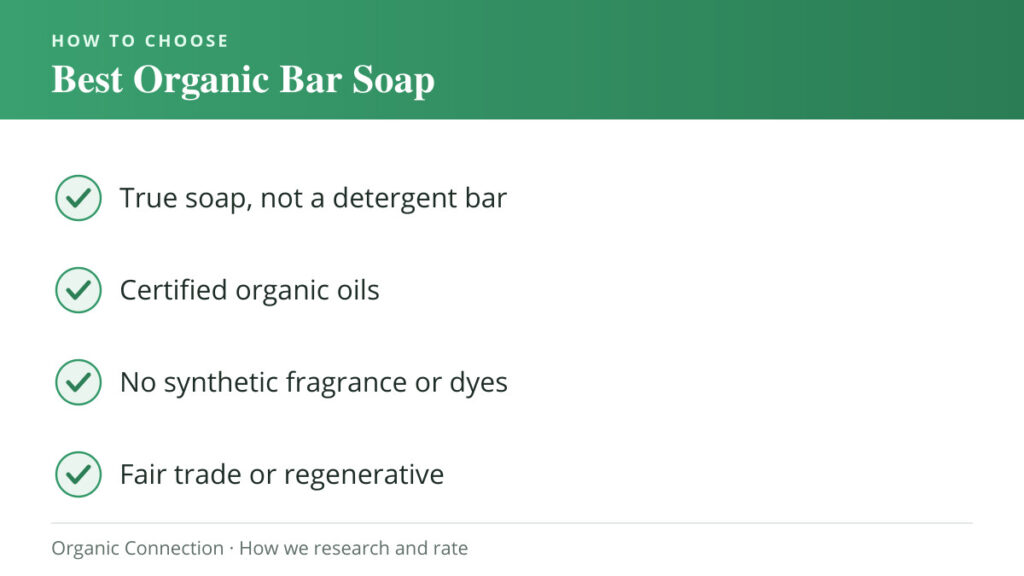
Great organic soap is about the base, the oils, the additives, and the sourcing. Here is what matters.
1. True saponified soap
The ingredient list should read like “organic coconut oil, organic olive oil, sodium hydroxide,” not “sodium lauryl sulfate” or “sodium cocoyl isethionate.”
2. Certified organic oils
Because “organic” is unregulated in cosmetics, the meaningful signal is certified organic oils named in the ingredient list or a seal on the pack.
3. No synthetic fragrance or dyes
“Fragrance” is a legal catch-all that can hide dozens of undisclosed compounds. Essential oils or nothing at all is the cleaner route.
4. Fair trade or regenerative sourcing
Coconut, olive, and shea supply chains have real labor issues. Fair Trade and Regenerative Organic Certified address them.
Castile, African black soap, or shea-based?
Castile soap in the classical sense is made from olive oil alone; in modern usage it means a vegetable-oil soap, typically coconut and olive with a few others, and no animal tallow. It lathers cleanly, rinses without residue, and is the most versatile format, working on face, body, and hair, and in a pinch on dishes. Because it is a simple, high-pH soap, it can feel drying on very dry or eczema-prone skin, which is worth knowing before you switch your whole routine to it.
African black soap is a different tradition entirely, made in West Africa from plantain skin ash, cocoa pod ash, shea butter, and palm or coconut oil. It is notably effective on oily and acne-prone skin, and the ash gives it a gentle exfoliating character. Authentic versions are soft, crumbly, and dark brown rather than jet black, and they can be drying if overused, so once a day is usually plenty. Shea-based and superfatted bars sit at the other end: extra oil is left unsaponified so the bar cleanses more gently and leaves skin softer, which suits dry skin and winter but can feel less “squeaky clean.” None of the three is universally best. Match the bar to your skin, and if you have eczema or genuinely sensitive skin, start with an unscented superfatted or castile bar and patch test before committing.
How to choose organic bar soap
- Read the ingredient list, not the front of the box. “Organic” on soap packaging is unregulated; certified organic oils in the list are the real signal.
- Confirm it is true soap. Saponified oils, not synthetic detergents.
- Skip “fragrance.” Choose unscented or bars scented with named essential oils.
- Match the bar to your skin. Castile for normal to oily, black soap for oily and acne-prone, superfatted for dry.
- Let bars dry between uses. A draining dish doubles or triples how long a bar lasts.
Who should buy organic bar soap
The right bar depends on your skin and your preferences. If you want the cleanest unscented soap for sensitive skin or babies, our top pick fits. If you want an invigorating scented everyday bar, a milder scented option, or a traditional African black soap for oily skin, we have a pick for each.
Best overall: Dr. Bronner’s Pure-Castile Bar Soap, Baby Unscented
| Organic Integrity Score | 93 / 100 |
| Base | Saponified organic coconut, palm, olive, hemp, and jojoba oils |
| Certification | Fair Trade, Vegan, Organic |
| Best for | Sensitive skin, babies, and face, body, or hair |
This is our top pick because it is the cleanest ingredient list in a mainstream bar soap. It is genuine castile soap made from saponified certified organic oils, including Regenerative Organic Certified coconut and olive oil, with organic hemp and jojoba oil for a milder feel. The unscented version adds no essential oils, no fragrance, no dyes, and no preservatives, which makes it the right starting point for babies, eczema-prone skin, or anyone reacting to scented products. Dr. Bronner’s Fair Trade sourcing and long-standing transparency about their supply chain put them well ahead of most of the category.
The trade-off is that castile soap has a high natural pH and can feel drying on very dry skin, particularly in winter or hard water, where it may also leave a slight film. Follow with a moisturizer if your skin is on the dry side, and expect to use less soap than you think: a small amount lathers a long way.
What we liked: Certified organic and Regenerative Organic Certified oils, Fair Trade, no fragrance or dyes, genuinely multi-purpose, and excellent value per bar.
Keep in mind: High-pH castile soap can feel drying on very dry skin and in hard water.
What the listing discloses: Dr. Bronner’s states Fair Trade, and does not say where it was grown or made.
Best scented everyday bar: Dr. Bronner’s Pure-Castile Bar Soap, Peppermint
| Organic Integrity Score | 89 / 100 |
| Base | Saponified organic coconut, palm, olive, hemp, and jojoba oils |
| Certification | Fair Trade, Vegan, Organic |
| Best for | An invigorating morning shower bar |
Same base as our top pick, scented with organic peppermint essential oil rather than synthetic fragrance. The peppermint gives a genuine cooling tingle on the skin, which people either love as a wake-up or find too intense; it is the brand’s best-selling scent for a reason. Everything that makes the unscented bar good, the certified organic oils, the Fair Trade sourcing, the true-soap base, applies equally here.
The trade-off is the tingle itself. Peppermint oil is a genuine skin stimulant, and it is emphatically not the bar for sensitive areas, small children, or anyone with reactive skin. If you want scent without the intensity, the eucalyptus or lavender versions are gentler.
What we liked: Certified organic oils and Fair Trade sourcing with a real essential-oil scent rather than synthetic fragrance.
Keep in mind: The peppermint tingle is strong and unsuitable for sensitive areas or young children.
What the listing discloses: On the Dr. Bronner’s label: Fair Trade. Not stated: where it was grown or made.
Best milder scent: Dr. Bronner’s Organic Castile Bar Soap, Eucalyptus
| Organic Integrity Score | 85 / 100 |
| Base | Saponified organic coconut, palm, olive, hemp, and jojoba oils |
| Certification | USDA Organic, Certified Vegan |
| Best for | Scent without the peppermint intensity |
Eucalyptus is the middle path: a clear, clean, slightly medicinal scent from organic eucalyptus essential oil, with none of the cooling tingle peppermint delivers. It is a good choice if you want a bar that smells like something in the shower but do not want your skin to react to it, and it is particularly pleasant in a steamy bathroom.
The trade-off is availability and format. This variant is more often sold as a single bar than in the six-packs that make Dr. Bronner’s such good value, so the per-bar price tends to be higher. Eucalyptus oil is also not recommended for use on or around young children.
What we liked: Certified organic oils and Fair Trade sourcing with a clean essential-oil scent and no skin tingle.
Keep in mind: Usually sold in smaller counts, so per-bar cost is higher; not for young children.
What the listing discloses: Dr. Bronner’s states USDA organic certification, and does not say where it was grown or made.
Best for oily and acne-prone skin: Nubian Heritage African Black Soap
| Organic Integrity Score | 80 / 100 |
| Base | African black soap with oats, aloe vera, shea butter, and vitamin E |
| Certification | Not stated on the listing |
| Best for | Oily, congested, and acne-prone skin |
African black soap has a genuine following among people with oily and acne-prone skin, and this is the most widely available version. The plantain and cocoa pod ash gives a mild exfoliating action and a deep clean, and Nubian Heritage adds oats, aloe, shea butter, and vitamin E to soften the effect, which makes it more forgiving than a raw traditional bar. It also works well as a body bar for back and chest congestion.
It scores lower than the castile bars for a specific reason: the ingredient list is longer and only partly certified organic, and it includes added fragrance rather than essential oils alone. It is a good soap for its purpose, but it is a less clean formulation than the top picks. Black soap can also be drying, so once daily is usually enough, and follow with a moisturizer.
What we liked: Genuinely effective on oily and congested skin, softened with oats, aloe, and shea, and widely available at a fair price.
Keep in mind: Contains added fragrance and only some certified organic ingredients; can be drying with twice-daily use.
What the listing discloses: Nubian Heritage makes no organic claim anywhere, so the case rests on the other claims it does make.
Best traditional black soap: Alaffia Unscented Authentic African Black Soap
| Organic Integrity Score | 76 / 100 |
| Base | Traditional West African black soap with fair trade unrefined shea butter |
| Certification | — |
| Best for | Authentic black soap without added scent |
Alaffia makes its black soap to a traditional West African recipe using fair trade, certified organic unrefined shea butter, and the unscented version keeps the ingredient list about as short as black soap gets. The company’s fair trade model with women’s cooperatives in Togo is one of the more substantive social sourcing programs in personal care, which is worth something in a category full of vague claims.
It scores lowest here on our certification-weighted method because, while individual ingredients like the shea are certified organic, the finished bar does not carry an organic certification, and traditional black soap includes palm oil, which is a legitimate sourcing concern even when the producer states it is sustainably obtained. As a soap it is excellent; as a certified organic product it is the least verified in this guide.
What we liked: Authentic traditional recipe, fair trade certified organic shea butter, unscented, and a genuinely meaningful social sourcing program.
Keep in mind: The finished bar is not organic certified, and it contains palm oil; the soft texture also melts quickly if it stays wet.
What the listing discloses: Alaffia is thin on detail, and does not say where it was grown or made.
Making a bar last
The single biggest factor in how long a bar of soap lasts is drainage. A bar sitting in a puddle dissolves several times faster than one on a slatted or draining dish, and moving it out of the direct spray of the shower helps as much again. Cutting a large bar in half and keeping the second piece dry in a cupboard extends it further, and the unused half continues to cure and harden, which makes it last longer still. For travel, a tin or a cotton soap bag beats plastic, which traps moisture. If you are switching from liquid body wash, expect an adjustment period: true soap has a higher pH than a syndet body wash, so skin can feel tight for a week or two before it settles. Follow with a moisturizer while that happens, and if your water is hard, a squeeze of the bar between the hands rather than direct rubbing on skin gives a better lather with less product.
There is no such thing as lye-free soap
This is the most persistent myth in the category, and it is worth settling because it drives a lot of confused buying.
All true soap is made with lye. Soap is, by definition, the salt of a fatty acid, and producing it requires an alkali — sodium hydroxide for bars, potassium hydroxide for liquid soap. That reaction is called saponification, and it splits the oils into two things: soap, which does the cleaning, and glycerin, which is a humectant.
Products marketed as “lye-free” fall into two categories. Either they are melt-and-pour bars made from a pre-made soap base — which was itself produced with lye, just not by that maker — or they are syndet bars, which are not soap at all but synthetic detergents pressed into a bar shape, built around surfactants such as sodium cocoyl isethionate.
Keep in mind: there is no lye left in a finished bar. In a correctly formulated recipe with sufficient superfat, analytical testing confirms no free sodium hydroxide remains — what you have is fatty acid salts and glycerin. The related belief that young cold-process soap will burn your skin is also false; saponification completes within a day or two, and curing is about water evaporation rather than remaining lye.
Superfat and cure: the two numbers that decide how a bar feels
Superfat is the proportion of oil deliberately left unsaponified. If a recipe uses 500 g of oils at 5% superfat, the maker adds only enough sodium hydroxide to saponify 475 g, leaving 25 g as free oil in the finished bar. Typical superfat runs 3–8%.
| Superfat | Result |
| 1–3% | Very cleansing, harder bar, can feel stripping |
| 5% | The standard balance — cleansing with a conditioning margin |
| 7–8% | Noticeably more moisturizing, softer bar, shorter shelf life as free oils can go rancid |
| Above 10% | Greasy, soft, poor lather, and rancidity becomes likely |
Cure time is the other variable. After unmolding, cold-process bars need four to six weeks for water to evaporate. A cured bar is harder, milder and lasts substantially longer in the shower — an undercured bar dissolves fast and feels harsh. This is the main practical difference between a well-made artisan soap and a rushed one, and it is why good handmade soap is not cheap: the maker is holding stock for six weeks before selling it.
Handmade soap keeps its glycerin — commercial soap often does not
Glycerin is produced by saponification and accounts for roughly 20–25% of the weight of a finished cold-process bar. It is a humectant, drawing moisture toward skin, and it is a large part of why handmade soap feels less drying than a supermarket bar.
Large-scale commercial soap manufacture frequently removes the glycerin and sells it separately, because it is a valuable ingredient in its own right — it then goes into lotions and other products. The resulting bar is harder and lasts longer on a shelf, and it is more drying.
This is a genuine, structural advantage of small-batch and organic soap, and it is more concrete than most claims made for the category. It also explains why handmade bars soften and dissolve faster in a wet dish: glycerin attracts water.
Soap is alkaline, and for some skin that matters
Healthy skin sits at roughly pH 4.7–5.5. True soap — including castile and African black soap — is alkaline at around pH 9–10, because soap cannot exist otherwise.
- Normal, resilient skin handles this without difficulty. Skin pH recovers within hours.
- Dry, sensitive or eczema-prone skin often does not. Repeated alkaline washing leaves it tight and can aggravate flares — which is why dermatologists tend to recommend syndet bars, formulated to skin pH, for compromised skin.
- Hard water makes it worse, because soap reacts with calcium to form the film known as soap scum, which deposits on skin as well as on tiles.
- Face use: soap is generally too alkaline for facial skin used daily, particularly if you use actives such as retinoids or acids.
- Superfatted bars mitigate it but do not change the pH.
None of this makes organic bar soap a bad product — it is excellent for most people, has the shortest ingredient list in the aisle and avoids plastic packaging entirely. It is a question of matching it to your skin rather than assuming natural means gentle.
Palm oil, and reading a soap label
- Palm oil is extremely common in bar soap because it produces a hard, long-lasting bar with stable lather at low cost. It appears as sodium palmate, palm kernelate, or simply palm oil.
- Organic certification permits organic palm oil, so an organic bar can still contain it. If deforestation matters to you, look for RSPO certification or a palm-free formulation.
- Palm-free bars typically use higher proportions of coconut, olive and shea, and are often softer as a result.
- Saponified oil names — sodium olivate is saponified olive oil, sodium cocoate is coconut, sodium shea butterate is shea. A label listing these is describing a true soap.
- Coconut oil percentage drives lather and cleansing. High-coconut bars lather impressively and can be drying; olive-heavy castile lathers modestly and is far milder.
- “Fragrance” or “parfum” covers undisclosed components; essential oils are declared by name. Essential oils are still fragrance and still a common cause of contact dermatitis.
Making a bar last, and the hygiene question
- A draining soap dish is the single biggest factor. A bar sitting in a puddle can dissolve several times faster than one that dries between uses. Slatted, ridged or magnetic holders all work.
- Keep it out of the direct shower stream. A shelf at the back of the cubicle, or outside it entirely.
- Cut large bars in half and store the unused portion dry. It also continues curing, getting harder.
- Let new soap air for a week or two before use if it feels soft — even shop-bought bars benefit.
- Save the slivers and press them onto a new bar, or collect them in a mesh pouch.
- On sharing a bar: research on this question has consistently found that transfer of bacteria from a used soap bar to the next user is negligible in practice. Rinsing the bar before use removes any residual concern. It is a reasonable thing to worry about and not a real hygiene risk in a household.
- Shelf life: 1–3 years wrapped and stored dry. High-superfat bars go rancid sooner — the tell is orange or brown spots, sometimes called dreaded orange spots, and a sharp crayon-like smell. Discard those.
How we researched this guide
We are a research-based review site. We compared each product against its certification (certified organic oils, Regenerative Organic Certified and Fair Trade where present), whether it is true saponified soap or a synthetic detergent bar, ingredient purity and fragrance policy, sourcing ethics, and the weight of aggregated customer feedback on skin feel and longevity, then scored each with our 10-criteria Organic Integrity Score. No brand paid to be included or ranked. Read the full method on our How We Research and Rate page.
Common questions about organic bar soap
What is the best organic bar soap?
Our overall pick is Dr. Bronner’s Pure-Castile Bar Soap in Baby Unscented, because it is true castile soap made from certified organic and Regenerative Organic Certified oils, it is Fair Trade, and it contains no fragrance, dyes, or preservatives. For a scented daily bar, the peppermint version is our pick, and for oily skin, Nubian Heritage African Black Soap.
Does “organic” mean anything on soap?
On its own, very little. Personal care products are only lightly regulated in the US, so a brand can put “organic” on the front of a soap box without meeting any standard. What counts is certified organic oils named in the ingredient list, or a USDA organic or Regenerative Organic Certified seal on the product itself.
Is bar soap better than body wash?
For packaging and cost, usually yes: a bar has minimal or no plastic and costs far less per wash. For skin, it depends. True soap has a higher pH than most body washes, which suits normal and oily skin but can feel drying on very dry or eczema-prone skin. A superfatted or shea-based bar bridges the gap.
What is African black soap good for?
It is traditionally used on oily, congested, and acne-prone skin. The plantain and cocoa pod ash gives it a gentle exfoliating action and a deep clean that many people find effective on body acne as well as the face. It can be drying, so once a day is usually enough, and it pairs well with a moisturizer.
How do I make a bar of soap last longer?
Keep it dry between uses. A draining or slatted dish, positioned out of the direct shower spray, makes the biggest difference by far. Cutting a large bar in half and storing the unused piece dry extends it further, since the reserved half continues to harden as it cures.
Is there such a thing as lye-free soap?
No. All true soap is made with lye — soap is by definition the salt of a fatty acid, and producing it requires an alkali. Products marketed as lye-free are either melt-and-pour bars made from a pre-made base that was itself produced with lye, or syndet bars, which are not soap at all but synthetic detergents pressed into a bar shape. There is no lye left in a finished bar: in a correctly formulated recipe with sufficient superfat, testing confirms no free sodium hydroxide remains.
What does superfat mean in soap?
The proportion of oil deliberately left unsaponified. At 5% superfat, a maker using 500 g of oils adds only enough lye to saponify 475 g, leaving 25 g as free oil in the bar. Typical superfat runs 3 to 8%. Around 5% is the standard balance; 7 to 8% is noticeably more moisturizing but softer and shorter-lived; above 10% the bar goes greasy, lathers poorly and turns rancid.
Why does handmade soap need to cure?
To let water evaporate, not to remove lye — saponification completes within a day or two. Four to six weeks of curing makes a bar harder, milder and substantially longer-lasting in the shower, where an undercured bar dissolves fast and feels harsh. It is the main practical difference between well-made artisan soap and a rushed one, and it is why good handmade soap is not cheap.
Does handmade soap contain glycerin?
Yes, and it is a real advantage. Glycerin is produced by saponification and accounts for roughly 20 to 25% of a finished cold-process bar, acting as a humectant that draws moisture toward skin. Large-scale commercial manufacture frequently removes it to sell separately for use in lotions, which makes the resulting bar harder, longer-lasting on the shelf and more drying.
Is bar soap too alkaline for skin?
Sometimes. Healthy skin sits at pH 4.7 to 5.5, and true soap including castile and African black soap is alkaline at around pH 9 to 10, because soap cannot exist otherwise. Normal resilient skin handles it and recovers within hours. Dry, sensitive or eczema-prone skin often does not, which is why dermatologists tend to recommend pH-balanced syndet bars for compromised skin. Hard water makes it worse.
Does organic bar soap contain palm oil?
Often, since organic certification permits organic palm oil. Palm is extremely common in soap because it produces a hard, long-lasting bar with stable lather at low cost, and appears as sodium palmate or palm kernelate. If deforestation matters to you, look for RSPO certification or a palm-free formulation, which typically uses more coconut, olive and shea and gives a softer bar.
How do you make a bar of soap last longer?
A draining soap dish, which is the single biggest factor — a bar sitting in a puddle can dissolve several times faster than one that dries between uses. Keep it out of the direct shower stream, cut large bars in half and store the unused portion dry, where it continues curing and hardening. Let new soap air for a week or two if it feels soft.
Is it hygienic to share a bar of soap?
Yes. Research on this question has consistently found that transfer of bacteria from a used soap bar to the next user is negligible in practice, and rinsing the bar before use removes any residual concern. It is a reasonable thing to wonder about and not a real hygiene risk in a household.
- Organic Skincare & Beauty hub
- Best Organic Body Wash
- Organic Skincare 101
- How we research and rate products
- browse all our reviewed products — scores and certifications for 800+ products
Price and availability as of October 11, 2026 7:10 pm EDT. Product prices and availability are accurate as of the date/time indicated and are subject to change. Any price and availability information displayed on Amazon.com at the time of purchase will apply to the purchase of this product.
Looking for other organic products?
We have checked more than 800 products across food, household goods, gardening, personal care and pet, every one against its stated certification. Browse all reviews.
Organic Connection is reader-supported. When you buy through links on this page we may earn a commission, at no extra cost to you. As an Amazon Associate we earn from qualifying purchases. We are not paid to feature or rank any product. How we research and rate.