Last updated: September 22, 2026
We may earn a commission when you buy through links on this page, at no extra cost to you. How we research and rate.
The short version
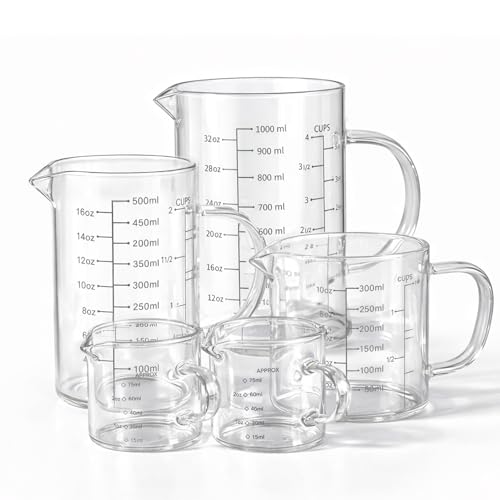
Judged on what each maker will put in writing, our top pick is the Ackers BORO3.3 3-Piece Glass Measuring Cup Set. It cites 3.3 borosilicate — the actual ISO designation, not just the word — claims Class A measuring accuracy, and states that the volumes were physically verified. That earned it our highest Organic Integrity Score of 93 out of 100, on the second-cheapest product here.
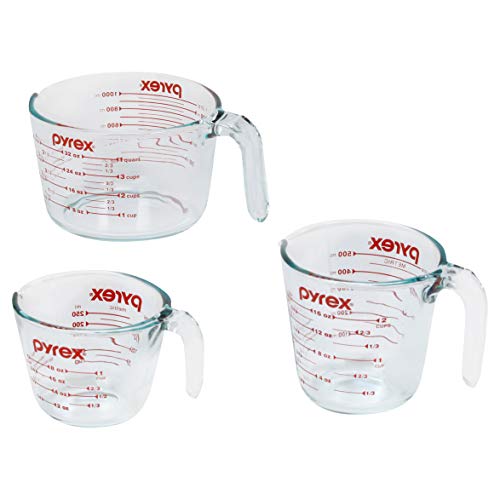
The thing most people do not know about this category: Pyrex sold in the United States has not been borosilicate glass since 1998, when the brand was sold and production moved to tempered soda-lime. The listing on this page says so, in its own words — it calls the material “high-quality tempered glass” and never claims borosilicate.
That is not a scandal and it is not a defect. It is a genuine engineering trade, and it runs in both directions.
What the listings leave out
| Best Choice | Best Value | ||||
 |
 |
 |
 |
 |
|
| Product | Ackers BORO3.3 | 77L 5-Pack | M MCIRCO 6-Piece | Pyrex Essentials | Le’raze Set of 4 |
| Organic Integrity Score | 93/ 100 | 89/ 100 | 85/ 100 | 83/ 100 | 78/ 100 |
| Our rating | 4.7 | 4.5 | 4.3 | 4.2 | 3.9 |
| Best for | Best overall | Temperature range stated | Lids and stacking | Impact resistance, the classic | Largest size, least detail |
| Glass stated | 3.3 borosilicate, ISO spec cited | High borosilicate | Borosilicate | Tempered glass (soda-lime) | Borosilicate, unqualified |
| Temperature range | Oven, stovetop, microwave listed | −4°F to 302°F | Microwave, oven, freezer | Microwave stated | “Extreme temperatures”, no figure |
| Accuracy claim | Class A; actual volume verified | Three units marked | Cups, oz and ml | Ounces and milliliters | Easy-read markings |
| Chemical resistance | Acids and bases, stated | Acid and alkali resistant scales | Not stated | Not stated | Not stated |
| Sizes | 1/2, 1, 2 cup | 5 pieces | 1, 2, 4 cup with lids | 1, 2, 4 cup | 1 cup to 8 cup |
| Price | $15.99 View on Amazon |
$40.84 $42.99 −5% View on Amazon |
$25.99 View on Amazon |
$25.99$8.66 / count View on Amazon |
$39.99 View on Amazon |
Scores are ours, based on independent research of materials disclosure, published specifications, measurement accuracy and value, using the same ten-criteria method we apply to every product.
What happened to Pyrex, and why it matters here
This is the most useful thing we can tell you about buying a glass measuring cup, and almost nobody explains it at the point of sale.
Pyrex was originally borosilicate glass. That is the formulation that made the name famous, and it is still what laboratory Pyrex is made from. In 1998 Corning sold the consumer Pyrex brand, and US production moved to tempered soda-lime glass. European PYREX, made by a different company, remained borosilicate. Same name, two different materials, depending which side of the Atlantic you shop on.
The two glasses fail in opposite ways, and this is the part that actually affects you.
Borosilicate contains at least five percent boric oxide, which gives it a much lower coefficient of thermal expansion. It shrugs off sudden temperature change — boiling water into a cold cup, a hot cup onto a cool counter. It is comparatively easier to chip or break on impact.
Tempered soda-lime is heat-treated to put its surface under compression, which makes it more resistant to knocks and drops than borosilicate. The tempering does not confer borosilicate’s thermal shock resistance, though, so rapid temperature change is where it is vulnerable. When tempered glass does fail it tends to fail suddenly and completely rather than cracking.
So which is better depends on how you break things. If your measuring cups get knocked around, dropped and stacked carelessly, tempered soda-lime is genuinely the tougher choice. If you pour boiling stock into a cup that just came out of the fridge, borosilicate is the one you want.
We are not scoring Pyrex down for using soda-lime. We are noting that four competitors name a glass type that resists thermal shock and this one does not — and that the listing, to its credit, says “tempered glass” rather than borrowing a word it is not entitled to.
“3.3 borosilicate” is a specification, not an adjective
Three listings here say borosilicate. One says 3.3 borosilicate, and that number is doing real work.
The 3.3 refers to the glass’s coefficient of thermal expansion — 3.3 parts per million per degree Kelvin — which is the internationally standardized designation for laboratory-grade borosilicate under ISO 3585. Ordinary soda-lime glass sits around 9. That single figure is the physical reason borosilicate survives thermal shock, and citing it is the difference between naming a family and naming a grade.
This is exactly the pattern we keep finding across kitchen categories: the listing that cites 304 rather than “stainless”, or 18/8 rather than “premium steel”, is nearly always the one that turns out to have thought about the rest of the product too.
The same listing goes further and makes two claims we have not seen anywhere else in this project.
Class A, which in laboratory glassware denotes the tighter of the two standard accuracy tolerances for volumetric measurement.
And a statement that the actual volume was measured so the printed scale matches reality. That sounds like a strange thing to boast about until you consider that cheap measuring cups are routinely inaccurate, and that nobody ever checks.
What each claim on a measuring cup listing covers
| Claim | Covers | Key exclusion |
| 3.3 borosilicate | A standardized glass with a 3.3 coefficient of thermal expansion | The most precise glass claim available; one listing cites it |
| High borosilicate | Boron-containing glass with low thermal expansion | No number, so no way to compare grades |
| Tempered glass | Heat-treated soda-lime, stronger against impact | Does not resist thermal shock the way borosilicate does |
| Class A | The tighter laboratory tolerance for volumetric accuracy | An accuracy claim rather than a materials one; one listing makes it |
| −4°F to 302°F | The stated service range of the glass | A credible figure for consumer borosilicate; one listing gives it |
| Acid and alkali resistant | The glass and the printed scale survive chemical contact | Relevant because vinegar and lemon juice erase cheap printed markings |
| Microwave safe | The cup can be heated in a microwave | True of all five; says nothing about oven or stovetop |
| Easy-read measurements | The markings are legible | Says nothing about whether they are accurate or permanent |
Best overall: Ackers BORO3.3 3-Piece Glass Measuring Cup Set
| Organic Integrity Score | 93 / 100 |
| Glass | High-quality 3.3 borosilicate, ISO designation cited |
| Accuracy | Class A; actual volume physically measured, stated |
| Sizes | 1/2 cup, 1 cup, 2 cup |
| Use | Induction, gas, microwave, electric ceramic, oven and refrigerator |
| Best for | Laboratory-grade specification at supermarket prices |
This is the most technically specified product we have audited in any kitchen category, and it costs about sixteen dollars.
It cites 3.3 borosilicate, which is the ISO designation rather than the marketing word, and describes the cups as glass science measuring beakers. That is not puffery — the shape, the wide mouth and the V-shaped spout are beaker design, and beaker design pours better than the traditional jug shape.
It claims Class A accuracy, the tighter volumetric tolerance used in laboratory glassware, and then does something we have never seen a kitchen listing do: it states that the maker measured the actual volume of the cups so the printed scale reflects reality. Inaccurate measuring cups are a real and invisible problem, and this is the only seller on the page to address it.
The compatibility list is the widest here. Induction, gas, electric ceramic, microwave, oven and refrigerator — this is a cup you can heat milk in directly on the hob, which none of the others claim.
Acid and base resistance is stated, which matters more than it sounds: printed scales on cheap cups fade after repeated contact with vinegar, lemon juice and dishwasher detergent, and a measuring cup you cannot read is finished. Three measurement scales — fluid ounces, milliliters and cups — and a wide mouth that actually cleans.
The limitation is size. The largest cup is 2 cups, so this is a set for everyday measuring rather than for mixing a batter or holding a liter of stock. Pair it with a larger jug.
What we liked: The ISO 3.3 borosilicate designation cited, Class A accuracy claimed, verified actual volumes, stovetop and oven use, acid and base resistance, three scales, and a beaker spout that pours cleanly.
Keep in mind: Nothing larger than 2 cups. No stated temperature range in degrees. Borosilicate chips more easily than tempered glass if you knock it.
Temperature range stated: 77L 5-Pack Glass Measuring Cups
| Organic Integrity Score | 89 / 100 |
| Glass | High borosilicate, rated −4°F to 302°F |
| Scales | Acid and alkali resistant, in cups, ml and oz |
| Spout | Improved V-shape for flow control |
| Set | 5 pieces |
| Best for | Knowing exactly what the glass tolerates |
The only listing here that puts a number on its glass, and it is the same credible figure — −4°F to 302°F — that we found on the better-specified glass pantry jars. Two independent sellers converging on the same range for named borosilicate is a reasonable sign that the number is real rather than invented.
That range covers everything a measuring cup does: straight from the freezer, and hot enough for boiling water and melted butter, with headroom.
The acid and alkali resistant scales are the underrated feature. The markings are the part of a measuring cup that dies first — vinegar, citrus and dishwasher detergent lift printed scales off cheap glass within a couple of years, leaving a cup you can no longer measure with. A listing that specifically addresses the durability of the printing understands what actually wears out.
The V-shaped spout is explained in terms of flow control rather than just mentioned, and three units are marked.
It sits second because there is no accuracy claim, the five pieces are not individually sized in the listing, and at around forty dollars it is the second most expensive set here. The listing also candidly notes that dishwasher use will degrade the markings over time, which is honest and slightly undercuts the acid-resistance claim.
What we liked: A stated temperature range that matches independent figures, acid and alkali resistant markings, three units, a properly explained spout, lightweight, and five pieces.
Keep in mind: Individual sizes are not listed. No accuracy or tolerance claim. Second highest price, and the listing admits dishwasher cycles wear the scales.
Lids and stacking: M MCIRCO 6-Piece Glass Measuring Cups with Lids
| Organic Integrity Score | 85 / 100 |
| Set | 3 cups with 3 lids — 1 cup/250ml, 2 cup/500ml, 4 cup/1000ml |
| Glass | Borosilicate |
| Use | Microwave, oven, freezer and top-rack dishwasher |
| Storage | Nest without lids, stack with lids on |
| Best for | Measuring in it, then keeping the leftovers in it |
The most practical set here, because the lids turn three measuring cups into three storage containers and remove a washing-up step.
That sounds minor until you have measured stock into a jug, used half, and had to decant the rest. With lids, the jug goes in the fridge as it is. The listing also thinks about storage properly: the cups nest inside each other without lids and stack when the lids are on, which are two different problems and it solves both.
Every capacity is given in cups and milliliters — 1/250, 2/500, 4/1000 — and the glass is named as borosilicate with microwave, oven, freezer and top-rack dishwasher use all stated. Freezer plus oven is a genuinely wide range and only borosilicate makes it comfortable.
The point about lids preventing smells transferring in the fridge is a small, real observation.
It scores third because “borosilicate” arrives without a grade or a temperature figure, there is no accuracy claim, and the lid material is never named — the same gap we found across the stainless container and mixing bowl categories. Assume plastic.
What we liked: Lids that make these storage containers too, capacities in two units, sensible nesting and stacking, borosilicate named, and microwave through freezer use stated.
Keep in mind: Lid material never stated. No glass grade, temperature figure or accuracy claim. Six pieces means three cups and three lids.
Impact resistance, the classic: Pyrex Essentials 3-Pack
| Organic Integrity Score | 83 / 100 |
| Set | 1 cup, 2 cup and 4 cup |
| Glass | High-quality tempered glass — soda-lime, not borosilicate |
| Markings | Bold and large, in ounces and milliliters |
| Dimensions | Stated, e.g. 1 cup is 6 in diameter x 4.5 in high |
| Best for | A kitchen where things get knocked over |
The default choice, the fourth best-selling set here, and a genuinely good product that we want to place accurately rather than either praise or dismiss.
Its glass is tempered soda-lime, and the listing says so. It describes “high-quality tempered glass” and never claims borosilicate, which is honest. Since 1998 that is what US Pyrex has been.
And tempering is a real advantage in one direction. Surface compression makes tempered glass markedly more resistant to chips and knocks than borosilicate. In a busy kitchen where a measuring cup gets shoved into a crowded cupboard and clipped by a pan handle, this is the more survivable glass.
The trade is thermal shock. Do not take this cup from the fridge and pour boiling liquid into it, do not set it hot onto a wet or cold surface, and warm it gradually if you are melting butter in the microwave. Those precautions matter less with borosilicate.
The listing is strong on the things it does cover: exact dimensions for each cup, so you know whether they fit your shelf, bold markings in both ounces and milliliters, a curved spout, easy-grip handles, and microwave and dishwasher use.
It scores where it does because on a page where three rivals name a thermal-shock-resistant glass and one cites its ISO grade, “tempered glass” plus a claim to be the number one brand of glass prepware is thinner specification — and because the listing never explains what tempered means or what it trades away.
What we liked: Honest about being tempered glass, genuinely more impact resistant, exact dimensions given, bold dual-unit markings, a proven design and an enormous track record.
Keep in mind: Soda-lime, so vulnerable to thermal shock — no boiling liquid into a cold cup. The listing never explains the trade. No temperature range or accuracy claim.
Largest size, least detail: Le’raze Glass Measuring Cups, Set of 4
| Organic Integrity Score | 78 / 100 |
| Set | 4 sizes — 1 cup (8 oz) up to 8 cups (64 oz) |
| Glass | Premium borosilicate, no grade or figure |
| Handle | Ergonomic, slip resistant |
| Best for | Needing a genuinely large measuring jug |
The size range is the reason to consider this set. Up to 8 cups, 64 ounces — twice the largest cup anyone else here offers, and enough to mix a full batch of pancake batter or hold a large quantity of stock. Most measuring cup sets top out at 4 cups and leave you reaching for a mixing bowl.
Borosilicate is named, the sizes are given in cups and ounces, and the slip-resistant handle is a fair thing to mention on a jug that will sometimes hold four pounds of liquid.
It scores lowest because almost everything else is adjectives. “Withstands extreme temperatures” with no figure, “crystal-clear accuracy” with no tolerance, “high-quality glass” with no grade. On a page where one competitor cites an ISO designation and another publishes a temperature range, superlatives do not compete.
At around forty-five dollars it is also the most expensive set here, and it has the weakest sales record of the five.
What we liked: A genuinely large 8-cup jug that nothing else here matches, four graduated sizes given in two units, borosilicate named, and a slip-resistant handle.
Keep in mind: No temperature figure, no glass grade, no accuracy tolerance. The most expensive set here with the least specification and the thinnest sales history.
Liquid and dry cups are not the same tool
This trips up more home bakers than any glass question, and no listing here explains it.
A liquid measuring cup — everything on this page — is a jug with a spout and headroom above the top marking, so you can carry it without spilling. You fill it to a line and read at eye level.
A dry measuring cup is filled to the brim and leveled off with a straight edge. That is the only way to measure flour and sugar consistently by volume.
Using one for the other introduces real error. Flour scooped into a liquid jug and eyeballed against a line can be out by a significant margin, because flour compacts. If a recipe is not working and you are measuring by volume, this is a likely culprit.
The genuine fix is a scale. Weighing flour removes the whole problem, and it is why serious baking recipes give grams. A measuring jug is still the right tool for liquids, where volume is unambiguous.
Reading, using and keeping them
Read at eye level, on a flat surface. Looking down into a jug on a counter overstates the volume, sometimes considerably. Put it down, crouch, and read the meniscus — the bottom of the curve the liquid makes.
Warm the glass gradually if it is soda-lime. With tempered Pyrex-style glass, avoid pouring boiling liquid into a cold cup and never put a hot cup on a wet counter. Borosilicate is far more forgiving of both.
Protect the markings. They are the first thing to fail. Two listings here address acid resistance for exactly this reason, and one admits dishwasher cycles wear them. If you want a cup to stay readable for a decade, wash it by hand.
Retire a chipped cup. A chip on a rim is both a cut risk and a stress concentration where a crack will start, particularly with tempered glass, which fails suddenly rather than gradually.
Do not use a measuring cup as a mixing bowl. The handle and the spout make it unstable under a whisk, and a chipped jug is worse than a scratched bowl — our mixing bowl guide covers the right tool.
How we researched this guide
We read all five listings in full, title and description, and recorded every materials and performance claim. Because thermal shock resistance is the property that distinguishes glass types in this category, we scored first on whether the glass is named specifically — and whether a listing citing a standardized grade, a temperature range, or an accuracy tolerance goes beyond simply using the word borosilicate. We treated a listing that honestly describes tempered soda-lime glass as making a truthful materials statement rather than a deficient one, and scored the absence of thermal-shock resistance as a functional trade rather than a fault. We noted claims about scale durability, since printed markings are what fails first on a measuring cup. Sales position was used as a check on whether claims have been tested by use.
Common questions about glass measuring cups
Is Pyrex borosilicate glass?
Not in the United States, and not since 1998, when the brand changed hands and production moved to tempered soda-lime glass. European PYREX, made by a different company, is still borosilicate. The US listing accurately says “tempered glass”.
Is tempered soda-lime glass worse than borosilicate?
Not worse, different. Tempered soda-lime resists impact and chipping better; borosilicate resists thermal shock far better. Which matters depends on whether you drop things or pour boiling liquid into cold glass.
What does 3.3 borosilicate mean?
It refers to a coefficient of thermal expansion of 3.3, the internationally standardized designation for laboratory-grade borosilicate. Ordinary soda-lime glass is around 9. Lower means better resistance to sudden temperature change.
Can I pour boiling water into a glass measuring cup?
Into borosilicate, yes. Into tempered soda-lime, warm the glass first and never pour boiling liquid into a cup straight from the fridge. Thermal shock is how these cups break.
What is Class A accuracy?
The tighter of the two standard tolerances used for laboratory volumetric glassware. One listing here claims it, along with a statement that actual volumes were measured against the printed scale.
Why do the markings wear off my measuring cup?
Acid from vinegar and citrus, plus dishwasher detergent, lifts printed scales over time. Two listings here specifically claim acid and alkali resistant markings; hand washing extends the life of any of them.
Can I use a liquid measuring cup for flour?
You can, but you will be less accurate. Liquid cups are read against a line with headroom; dry cups are filled to the brim and leveled. For flour, a scale is better than either.
How should I read a measuring cup?
On a flat surface, at eye level, reading the bottom of the curved surface of the liquid. Reading from above while holding it consistently overstates the amount.
Can glass measuring cups go in the oven?
Borosilicate ones generally can, and two listings here state oven use. Check before assuming, and never put any glass under a broiler.
Are glass measuring cups microwave safe?
All five here are. Heat in short bursts and avoid superheating water, which can boil over violently when disturbed.
What size measuring cups do I need?
A 1-cup and a 4-cup covers most cooking. A 2-cup is the one you will reach for most. An 8-cup jug is useful only if you batch cook or bake in quantity.
Should I replace a chipped measuring cup?
Yes. A chip is a cut hazard and a stress point where a crack will begin, and tempered glass in particular tends to fail suddenly rather than gradually.
- Best Stainless Steel Mixing Bowls
- Best Glass Pantry Jars
- Best Stainless Steel Food Containers
- Best Silicone Baking Mats
- Organic Product Database — search all 800+ products we have reviewed