Last updated: September 22, 2026
We may earn a commission when you buy through links on this page, at no extra cost to you. How we research and rate.
The short version
Judged on what each maker will put in writing, our top pick is the Oster Classic Series Heritage Blender. It prints both power figures in its own title — 1000 peak watts and 600 rated watts — names an all-metal drive, and backs that drive with a ten-year warranty. That earned it our highest Organic Integrity Score of 93 out of 100.
The wattage number blenders are sold on is close to meaningless, and it is worth understanding exactly why.
Peak watts is the maximum current the motor draws for a fraction of a second — and it occurs at the moment the motor approaches stall. That is the instant just before the blades stop turning entirely. At peak wattage, your blender is doing no blending at all.
Rated watts is what the motor sustains continuously with the blades actually spinning. That is the number that blends.
What the listings leave out
| Best Choice | Best Value | ||||
 |
 |
 |
 |
 |
|
| Product | Oster Heritage | Amazon Basics 700W | BLACK+DECKER PowerCrush | Hamilton Beach Power Elite | GDOR 1200W |
| Organic Integrity Score | 93/ 100 | 89/ 100 | 86/ 100 | 82/ 100 | 78/ 100 |
| Our rating | 4.7 | 4.5 | 4.3 | 4.1 | 3.9 |
| Best for | Best overall | Best power ratio, cheapest | Honest about a poor ratio | Best seller, peak only | Biggest number, least clarity |
| Peak watts | 1000, in the title | 700 | 700 | 700 | 1200, unqualified |
| Rated watts | 600, in the title | 500 | 350 | Not stated | Not stated |
| Rated as % of peak | 60% | 71% | 50% | Unknown | Unknown |
| Drive coupling | All-metal, stated | Not stated | Not stated | Not stated | Not stated |
| Warranty | 10-year drive, 3-year satisfaction | Not stated | Not stated | Not stated | Not stated |
| Price | $80.21 $84.99 −6% View on Amazon |
$25.62 View on Amazon |
$46.99 View on Amazon |
$39.95 View on Amazon |
$42.99 View on Amazon |
Scores are ours, based on independent research of specification disclosure, construction, published warranty terms and value, using the same ten-criteria method we apply to every product.
Peak watts is measured when nothing is blending
This is the most useful thing in this guide, so it is worth stating precisely.
An electric motor draws the most current when it is working hardest against resistance — and the point of maximum resistance is the point of stall, when the load is heavy enough that the shaft is about to stop rotating. That instant, for a fraction of a second, is when the motor pulls its peak wattage.
At that moment the blades are barely turning. No smoothie is being made. Peak wattage is a measurement of the machine at the edge of failure, and it is the number printed on the box.
Rated watts — sometimes called continuous or running watts — is what the motor sustains indefinitely without overheating, with the blades spinning at their designed speed. That is the figure that corresponds to actually crushing ice.
The gap between them is large and it varies enormously. On this page:
- One blender delivers 71% of its peak as rated power
- One delivers 60%
- One delivers 50% — half the advertised number
- Two do not say
Which produces the finding that matters. The blender on this page with the largest headline figure — 1200W — is the only one that does not qualify the number at all. It does not say peak, it does not say rated. A 1200W peak motor with a 50% ratio delivers 600W of actual blending, which is less than the 600W rated Oster whose box says 1000.
How to shop: find the rated or continuous figure. If a listing gives only one number and does not label it, assume it is peak, and assume the working figure is somewhere between half and three-quarters of it. Three listings here save you the guesswork.
The drive coupling is what actually breaks
Blenders rarely die because the motor burns out. They die because of a small part almost no listing mentions.
Between the motor shaft and the blade assembly sits a drive coupling — a splined gear that transmits rotation from the base into the jar. On most blenders in this price range it is plastic, and it is deliberately the weakest link: when you jam the blades with a frozen strawberry, the coupling shears rather than the motor burning out.
That is sensible engineering and a genuinely cheap part to replace. It is also why a blender that “stopped working” often spins freely with no blending happening at all — the motor is fine, the teeth are gone.
One listing here names an all-metal drive and puts a ten-year warranty specifically on it. A metal coupling does not strip the way a plastic one does, and warranting it for a decade is a meaningful commitment rather than a slogan — it is the manufacturer betting on the exact component most likely to fail.
Nobody else on this page mentions the drive at all. If you are choosing between two similar blenders, this is the specification worth hunting for.
Why a glass jar
Every blender on this page has a glass jar, which is why they are here. It is worth setting out what that buys you.
Glass does not scratch. Plastic jars cloud and micro-scratch from ice and hard ingredients, and those scratches hold residue and odor. A glass jar looks the same in year five.
Glass does not stain or hold smell. Turmeric, tomato and garlic all mark plastic permanently. Glass is inert.
Glass has no plastic in contact with hot food. If you blend hot soup, that is the whole argument — and it is the same reasoning behind our glass storage container recommendations.
Glass is heavier, which helps. A heavy jar damps vibration and stops the blender walking across the counter.
The trade-offs are real and worth knowing. Glass breaks if you drop it. It is heavier to lift and pour when full. And it is not the right choice for a personal blender you throw in a bag.
One caution that applies to every jar here: do not pour boiling liquid straight into a cold glass jar, and never seal a hot blend under a fixed lid — steam pressure will force the lid off. Let soup cool a few minutes, fill the jar no more than half, and vent the lid.
What each claim on a blender listing covers
| Claim | Covers | Key exclusion |
| Rated / continuous watts | Sustained power with the blades turning | The figure that predicts blending; two listings omit it |
| Peak watts | Momentary draw as the motor approaches stall | Measured when no blending is occurring |
| An unlabeled wattage | Almost certainly the peak figure | Assume the working number is 50–75% of it |
| All-metal drive | The coupling between motor and blades | The component that actually fails; one listing names it |
| Glass jar | No scratching, staining, odor retention or plastic contact | Breakable and heavy; not for hot liquid poured in cold |
| Stainless steel blades | The blade material | Universal at this price; blade geometry matters more |
| Number of speeds | How many preset settings the dial offers | Most blending uses two: low and pulse |
| Dishwasher safe | Named parts survive a cycle | Check whether the blade and collar are included |
Best overall: Oster Classic Series Heritage Blender
| Organic Integrity Score | 93 / 100 |
| Power | 1000 peak watts, 600 rated watts — both in the product title |
| Drive | All-metal, 10-year DURALAST limited warranty |
| Jar | 6-cup Boroclass glass, dishwasher safe |
| Controls | 2 speeds, high/low toggle |
| Best for | The only blender that tells you what it can sustain, and warrants the part that breaks |
This wins on the two disclosures that matter, and both are unusually prominent.
Both power figures are in the product title. Not buried in a bullet, not in a specification table — in the name of the product, where a competitor would put the biggest number available. Putting “600 Rated Watts” next to “1000 Peak Watts” is a manufacturer volunteering the smaller, truer number at the exact point where the industry inflates.
The all-metal drive with a ten-year warranty addresses the single most common blender failure. Metal couplings do not strip; plastic ones do. Warranting that specific component for a decade — and naming it in the warranty rather than offering a vague whole-product guarantee — is a company being specific about where its confidence lies.
There is a three-year satisfaction guarantee on top of the drive warranty.
The rest is sensibly plain. Two speeds, high and low, on a toggle — and honestly, two is what most people use. A four-point stainless blade. A glass jar described as Boroclass with a two-ounce filler cap that has measurement markings, so you can add liquid while it runs without taking the lid off.
It is the most expensive blender here at around eighty-five dollars, and it is the plainest looking. There are no pre-programmed modes and no travel cup. What you are buying is a motor, a metal drive and a glass jar, warranted for ten years.
What we liked: Peak and rated wattage both in the title, an all-metal drive named and warranted for ten years, a Boroclass glass jar, a measured filler cap, and a three-year satisfaction guarantee.
Keep in mind: The most expensive here. Only two speeds and no preset programs. The lowest rated wattage as a percentage of peak among the three that disclose both, at 60%.
Best power ratio, cheapest: Amazon Basics 700W Countertop Blender
| Organic Integrity Score | 89 / 100 |
| Power | 700W peak, 500W rated — the best ratio here at 71% |
| Jar | 50 fl oz / 6-cup glass |
| Controls | 6 pre-programmed function settings |
| Dimensions | 8.35 x 6.65 x 14.9 in, stated |
| Best for | The most usable power per dollar on this page |
The value pick, and on the metric that actually matters it is arguably the best blender here.
500 rated watts from a 700W peak is a 71% ratio — the highest on this page, and comfortably better than the 50% of the BLACK+DECKER below. In practical terms this blender sustains 500W of real work for around a quarter of the price of the Oster, which sustains 600W.
Putting “(500W rated)” in parentheses immediately after the peak figure, in the first bullet, is exactly the right way to publish this. It is not hidden and it is not spun.
The dimensions are stated to two decimal places, which matters more on a blender than on most appliances — at 14.9 inches tall it needs to clear the underside of a wall cabinet, and that is the measurement people discover after unboxing.
Fifty ounces of glass, six pre-programmed settings, and stainless blades described specifically as ice blades.
It sits second because nothing is said about the drive coupling and no warranty terms appear at all — where the pick above warrants its most failure-prone part for ten years. On an appliance with a moving mechanical joint, that is the gap.
What we liked: Peak and rated both published in the first bullet, the best power ratio here, exact dimensions including height, a 50 oz glass jar, six presets, and by far the lowest price.
Keep in mind: No warranty stated and no mention of the drive coupling. The lowest rated wattage in absolute terms among the disclosers, at 500W.
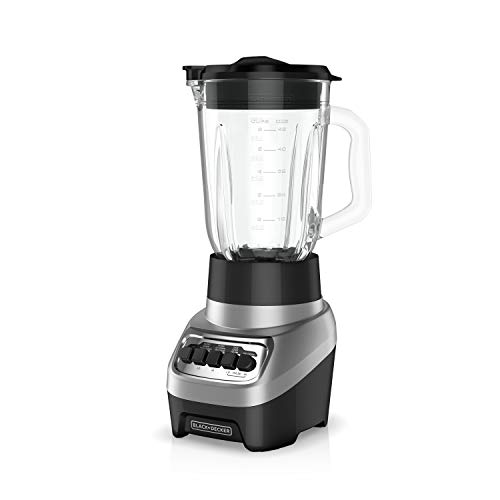
Honest about a poor ratio: BLACK+DECKER PowerCrush Blender
| Organic Integrity Score | 86 / 100 |
| Power | 700W peak, 350W for continuous use — a 50% ratio, stated |
| Blade | 4-tip QuadPro stainless, shaped to work with the jar |
| Jar | 6-cup thick glass with a molded pouring spout |
| Controls | 4 speeds — low, high, low pulse, high pulse |
| Best for | A seller publishing a number that does not flatter it |
We are placing this third for a reason that runs against its own specification, and it is worth explaining.
Its power ratio is the worst on this page. 700W peak, 350W continuous — exactly half. On raw capability it is behind both blenders above.
But it published the number. The listing states, in plain text, “for continuous use, the blender uses 350W” — a figure that halves its own headline claim and that no competitor would be required to disclose. Two blenders on this page simply did not mention it, and one of those advertises 1200W.
On a site that scores what makers put in writing, volunteering an unflattering figure is exactly the behavior the method exists to reward. A seller that tells you the disappointing truth about wattage is a seller whose other claims are worth more.
The product itself is well thought through. The 4-tip blade is described in terms of what it does — working with the jar shape to create a vortex that pulls ingredients down — rather than just being counted. The four speeds sensibly include both a low and a high pulse. The glass jar is called thick and has a molded spout, and the jar, blade and lid are all dishwasher safe.
No drive coupling information and no warranty terms.
What we liked: Continuous wattage published even though it halves the headline, a blade explained by function, four genuinely useful speeds, a thick glass jar with a molded spout, and dishwasher-safe parts named individually.
Keep in mind: 350W continuous is the least real power here. No warranty or drive information. The asterisk on the peak claim is not explained in the listing.
Best seller, peak only: Hamilton Beach Power Elite Blender
| Organic Integrity Score | 82 / 100 |
| Power | 700 peak watts — no rated figure given |
| Design | Wave Action system, forcing ingredients down into the blades |
| Jar | Glass with a patented pour spout |
| Cleaning | Jar, lid, blades and collar all removable and dishwasher safe |
| Best for | Smoothies, with the most thoroughly dismantlable jar here |
The best-selling blender on this page and a genuinely good design, held back by a single omission.
The Wave Action system is a real mechanism rather than a name. The jar is shaped to continuously circulate ingredients back down into the blades instead of letting them ride up the sides, which is the standard failure of a cheap blender making a thick smoothie — you end up stopping it and stirring. This addresses it through jar geometry, and it is explained in the listing rather than merely branded.
Everything comes apart. Jar, lid, blades and jar collar are all removable and dishwasher safe, which matters more than it sounds: the collar and the underside of the blade assembly are where smoothie residue collects and sours, and a blender you cannot fully dismantle eventually smells.
The patented pour spout addresses the other everyday irritation, which is dribbling smoothie down the side of the jar.
What costs it is the wattage. “700 watts of peak blending power” and nothing else. Given a typical ratio the working figure is somewhere between 350 and 500 watts — a spread wide enough to matter — and three competitors on this page simply tell you.
No warranty terms, no drive information, and the first bullet is about an Amazon merchandising collection rather than the product.
What we liked: A jar geometry that solves a real blending problem and is explained, every part removable and dishwasher safe, a proper pour spout, and the strongest sales record here.
Keep in mind: Peak wattage only, so real power is unknown. No warranty or drive detail. One bullet is spent on a merchandising collection.
Biggest number, least clarity: GDOR 1200W Glass Blender
| Organic Integrity Score | 78 / 100 |
| Power | 1200W — not labelled peak or rated |
| Jars | 52 oz glass jar plus a 22 oz travel cup |
| Controls | 2 speeds plus pulse |
| Cleaning | Self-cleaning cycle with warm soapy water |
| Best for | The largest jar here, plus a to-go cup |
The biggest headline figure on the page, and the only one with no qualifier attached to it.
1200W, stated as a “powerful motor” and nothing more. Not peak, not rated. Applying the range we see from the three blenders that do disclose both — 50% to 71% — a 1200W peak motor would deliver somewhere between 600 and 850 rated watts. That could genuinely be the most powerful blender here, or it could be roughly equal to the Oster whose box says 1000.
The listing does not let you work it out, and on a page where three competitors publish the figure, that silence is the score.
Two things here are genuinely good. The 52 oz glass jar is the largest on this page, and the included 22 oz travel cup is a real convenience — blend and take it, no decanting, no extra washing up. Two vessels covering two different uses is more useful than a sixth preset.
The self-cleaning function is described properly: warm soapy water in the jar, turn to the pulse position, done. That is exactly how to clean a blender and it is nice to see it in the instructions rather than left for the buyer to work out.
Beyond that, no rated power, no warranty, no drive information, and no dimensions.
What we liked: The largest glass jar here at 52 oz, a genuinely useful travel cup included, a properly described self-cleaning routine, and pulse alongside two speeds.
Keep in mind: The headline 1200W is unqualified, so real blending power is unknown. No warranty, drive detail or dimensions. The newest and least proven product on the page.
How much power do you actually need?
Less than the marketing suggests, and the answer depends entirely on what you blend.
Around 300–500 rated watts handles soft fruit smoothies, soups, batters, sauces, dressings and milkshakes. That is the great majority of home blending, and every blender on this page clears it.
500–700 rated watts is where ice crushing and frozen fruit become comfortable rather than laborious, and where a blender stops bogging down on a thick nut-butter smoothie.
Beyond about 1000 rated watts you are into nut butters, hot soup made by friction, and grinding grain — genuinely different machines at genuinely different prices, and none of them here.
Technique beats wattage for most problems. Liquid goes in first, then soft ingredients, then hard, then ice on top. Start on low and build up. Use pulse rather than holding high. A 500W blender loaded correctly outperforms a 1000W blender loaded upside down.
Care, and what actually kills a blender
Clean it immediately with the jar in place. Warm water, a drop of dish soap, run it for ten seconds, rinse. Every blender here supports this and one lists it as a feature. Doing it before the smoothie dries saves dismantling anything.
Dismantle the collar weekly. The gasket and the underside of the blade assembly are where residue collects and sours. If your blender smells, that is where the smell lives.
Do not run it continuously for minutes on end. Rated wattage is a thermal limit, not a suggestion. Most domestic blenders want a rest after a minute or two of continuous load, and overheating is the second most common way they die.
Never put boiling liquid into a cold glass jar, do not fill past half with anything hot, and vent the lid. Steam pressure in a sealed jar is a genuine hazard, not a theoretical one.
Keep the base dry. Wipe it; never immerse it. Liquid tracking down the drive shaft into the motor housing is the third common failure.
If the motor runs but nothing blends, the drive coupling has stripped — which is why the one blender here that names an all-metal drive and warrants it for ten years is worth the premium if you blend daily.
How we researched this guide
We read all five listings in full, title and description, and recorded every power, materials and construction claim. Because wattage is the specification this category is sold on and the one most commonly inflated, we scored first on whether both peak and rated figures are published, and calculated the ratio between them where both appear. We then scored disclosure of the drive coupling — the component that most often fails — along with jar material and capacity, published warranty terms, and dimensional information. We treated the publication of an unflattering figure as a positive, and an unlabeled headline wattage as a material omission. Sales position was used as a check on whether claims have been tested by use.
Common questions about blenders with glass jars
What is the difference between peak and rated watts?
Peak is the momentary maximum draw as the motor approaches stall, when the blades are barely turning and no blending is happening. Rated, or continuous, is what the motor sustains with the blades spinning. Rated is the number that predicts performance.
Why do blenders advertise peak watts?
Because it is the larger number. Three of these five publish the rated figure alongside it; two publish only a peak figure, and one gives an unlabeled 1200W.
How much of the peak figure is usable?
On this page, between 50% and 71%. If a listing gives one unlabeled number, assume it is peak and that real power is roughly half to three-quarters of it.
How many watts do I actually need?
Around 300 to 500 rated watts covers smoothies, soups and sauces. 500 to 700 makes ice and frozen fruit comfortable. Beyond 1000 rated is a different class of machine.
Why did my blender stop blending while the motor still runs?
The drive coupling between motor and blades has stripped. It is usually plastic and deliberately the weakest link. One blender here uses an all-metal drive and warrants it for ten years.
Is a glass jar better than plastic?
For a countertop blender, generally yes. Glass does not scratch, cloud, stain or hold odors, and no plastic touches hot food. It is heavier and it breaks, which is why personal blenders use plastic.
Can I blend hot soup in a glass jar?
With care. Let it cool a few minutes, fill no more than half, and vent the lid. Never pour boiling liquid into a cold jar, and never seal a hot blend completely.
Does the number of speeds matter?
Not much. Most blending uses low, high and pulse. One blender here has two speeds and scores highest; presets are convenience rather than capability.
In what order should ingredients go in?
Liquid first, then soft ingredients, then hard, then ice on top. This lets the blades create a vortex instead of cavitating against a solid mass.
How do I clean a blender properly?
Warm water and a drop of dish soap in the jar, run it briefly, rinse. Dismantle the collar and gasket weekly, because that is where residue collects and smells develop.
Why does my blender smell?
Residue trapped under the blade assembly or in the gasket. Take the collar apart and wash the parts separately. If the smell is burning rather than sour, stop using it.
Can I run a blender continuously?
Not for long. Rated wattage is a thermal limit. Most domestic blenders want a pause after a minute or two under load, and overheating is a common cause of failure.
- Best Glass Food Storage Containers
- Best Glass Measuring Cups
- Best Burr Coffee Grinders
- Best Stainless Steel Mixing Bowls
- Organic Product Database — search all 800+ products we have reviewed