Last updated: September 11, 2026
We may earn a commission when you buy through links on this page, at no extra cost to you. How we research and rate.
The short version
After researching the certifications, fabric composition, and construction of the organic cotton bras available in the US, our top pick is the Felina GOTS Certified Organic Cotton Bralette. It is GOTS-certified organic cotton with a third-party audited supply chain, wireless and tagless with a racerback cut that gives genuine medium support, which is why it earned our highest Organic Integrity Score of 91 out of 100. For nursing, the Pact Organic Cotton Maternity Nursing Bralette is our pick, and for a seamless GOTS nursing option, Cache Coeur is the best choice.
The honest framing here: organic cotton bras are excellent for low-impact and everyday wear and are not high-impact sports bras.
Best organic cotton sports bra compared
| Best Choice | Best Value | ||||
 |  |  |  |  | |
| Product | Felina Organic Bralette | Pact Nursing Bralette | Cache Coeur Seamless | In Touch Wireless Bralette | ORGANICKID Crop Bralette |
| Organic Integrity Score | 91/ 100 | 88/ 100 | 84/ 100 | 80/ 100 | 76/ 100 |
| Our rating | 4.6 | 4.4 | 4.2 | 4.0 | 3.8 |
| Support | Medium | Light, nursing | Light, nursing | Light | Light |
| Best for | Best overall | Breastfeeding | Seamless maternity | Everyday bralette | Crop-top style |
| Certification | GOTS, Certified Organic | Fair Trade, Organic | GOTS, Certified Organic | Non-GMO, Organic | GOTS, OEKO-TEX, Organic |
| Fabric | Organic cotton with elastane | 95% organic cotton, 5% elastane | GOTS certified organic cotton, seamless knit | Organic cotton stretch knit | Organic cotton |
| Price | $30.00 View on Amazon | Currently unavailable See buying options | $59.95 View on Amazon | See buying options | $19.99 View on Amazon |
Price and availability as of October 12, 2026 1:10 am EDT. Product prices and availability are accurate as of the date/time indicated and are subject to change. Any price and availability information displayed on Amazon.com at the time of purchase will apply to the purchase of this product.
Scores are ours, based on independent research of certification, fabric composition, construction, supply chain transparency, and value, using the same 10-criteria method we apply to every product. See how we research and rate.
Key things to look for in an organic cotton bra
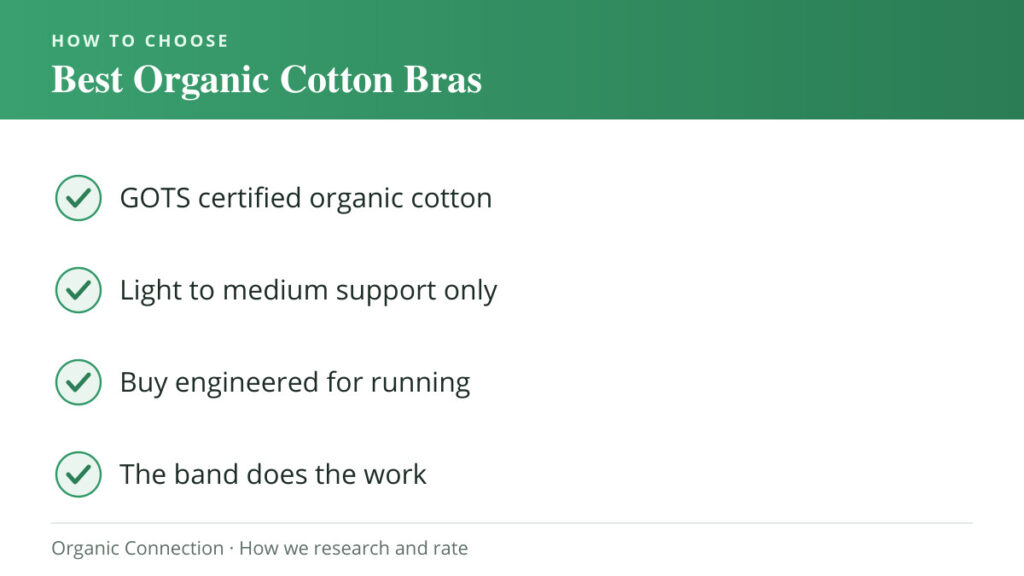
Great organic bras are about certification, fabric, support level, and construction. Here is what matters.
1. GOTS certification
It covers organic fiber plus dyeing, finishing, restricted chemicals, wastewater, and labor, not just the crop.
2. Around 92 to 95 percent cotton
Enough elastane to give recovery and shape retention without becoming a synthetic garment.
3. An honest support level
Match the garment to the activity. Cotton is light to medium support; running needs an engineered high-impact bra.
4. Wireless, tagless, flat seams
The details that determine whether you notice it all day. Tags and raised seams at the band are the usual irritants.
Cotton, sensitivity, and when to choose something else
The strongest case for an organic cotton bra is skin. This is a garment worn for twelve or more hours against the chest, underbust, and back, often under a band with steady pressure and in a spot that gets warm and slightly damp. That combination is a common site for contact irritation, heat rash, and eczema flares, and cotton breathes considerably better than polyester while holding less odor over a long day. GOTS certification adds the part people often miss: the restriction on dyes and finishing chemistry. If you have reacted to a bra before, the dye and finish are at least as likely a culprit as the fiber, and GOTS is the standard that addresses both.
Where to choose something else, stated plainly. For running, HIIT, or any high-impact activity, buy a proper engineered high-impact sports bra; cotton will be uncomfortable and will not give the support breast tissue needs during repetitive vertical movement, and no environmental argument outweighs that. For hot-weather endurance activity, synthetic wicking fabric genuinely performs better. And for anyone needing a larger cup size with real structure, the organic cotton category is thin, since most GOTS-certified options are bralette-style and sized S to XL rather than by band and cup, which is a real limitation of the category rather than of any single product. If that describes you, a conventional well-fitting bra you actually wear beats an organic one that does not fit.
How to choose an organic cotton bra
- Look for GOTS certification, not just “organic cotton” on the label.
- Check the composition. Around 92 to 95 percent cotton with elastane for recovery.
- Match support to activity. Cotton for yoga, walking, and everyday; engineered synthetic for running.
- Prefer wireless, tagless, flatlock seams if the reason you are here is skin comfort.
- Wash cool and air dry. Heat destroys the elastane that holds the band.
Who should buy organic cotton sports bra
The right bra depends on what you need it to do. If you want a GOTS-certified racerback for yoga and everyday wear, our top pick fits. If you need a nursing bralette, a seamless maternity option, a soft everyday bralette, or a simple crop-top style, we have a pick for each.
Best overall: Felina GOTS Certified Organic Cotton Bralette
| Organic Integrity Score | 91 / 100 |
| Fabric | Organic cotton with elastane |
| Certification | GOTS, Certified Organic |
| Best for | Yoga, pilates, walking, and everyday wear |
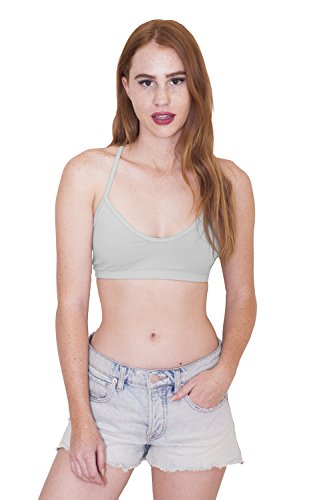
The Pact racerback is our top pick because it combines the strongest certification in the category with the most useful construction. GOTS certification covers dyeing, finishing, restricted chemicals, wastewater, and labor, and Pact states its whole supply chain is third-party audited against it. The racerback cut is what makes this more than a bralette: pulling the straps toward the center of the back distributes load better and stops the shoulder-slip that plagues straight-strap styles, which is what earns it a genuine medium support rating. It is wireless, pre-washed, and tagless.
The trade-off is honest: medium support means yoga, walking, and everyday, not running. Pact sizes S to XL rather than by band and cup, which limits fit precision for larger sizes, and cotton absorbs sweat rather than wicking it, so it stays damp after a hot session.
What we liked: Full GOTS certification with an audited supply chain, a racerback that genuinely improves support, wireless and tagless construction, and soft breathable cotton.
Keep in mind: Medium support only, alpha sizing rather than band-and-cup, and it holds sweat rather than wicking it.
What the listing discloses: Felina is explicit about GOTS, and silent on whether the USDA seal applies and where it was grown or made.
Best for nursing: Pact Organic Cotton Maternity Nursing Bralette
| Organic Integrity Score | 88 / 100 |
| Fabric | 95% organic cotton, 5% elastane |
| Certification | Fair Trade, Organic |
| Best for | Breastfeeding, pregnancy, and sleeping |
At 95 percent organic cotton with 5 percent elastane, this has the highest cotton content of any pick here, which matters for nursing specifically: this is a garment worn nearly around the clock, against skin that is often sore and sometimes broken, on a body producing more heat and moisture than usual. Wireless and seamless construction avoids pressure points that can contribute to blocked ducts, and the adjustable straps accommodate the substantial size changes across pregnancy and feeding.
The trade-off is support, which is light by design, and durability: a bra worn and washed daily through months of feeding wears out faster than one in rotation, so buying two or three is realistic. Pact’s alpha sizing is also less precise than a fitted nursing bra during a period when fit changes constantly.
What we liked: 95% organic cotton, wireless and seamless to avoid pressure points, adjustable for changing size, and comfortable for round-the-clock wear.
Keep in mind: Light support only, and daily wear and washing means you will want more than one.
What the listing discloses: On the Pact label: Fair Trade. Not stated: whether the USDA seal applies and where it was grown or made.
Best seamless maternity: Cache Coeur Seamless Maternity & Nursing Bra
| Organic Integrity Score | 84 / 100 |
| Fabric | GOTS certified organic cotton, seamless knit |
| Certification | GOTS, Certified Organic |
| Best for | Maternity and nursing with no seams at all |
Cache Coeur is a French maternity specialist, and this bra is genuinely seamless, knitted as a single piece rather than sewn from panels, which eliminates the seam lines that show under fitted clothes and the raised edges that irritate sensitive skin. It is GOTS certified organic cotton with nursing clips, and the construction quality reflects a brand that does only this category.
It scores below the Pact picks on value and availability rather than quality: it is priced as an imported specialist product, sizing runs to European conventions which causes confusion, and stock on specific colors and sizes is intermittent. As a garment it is arguably the most refined here.
What we liked: GOTS certified and genuinely seamless, from a maternity specialist, with no seam lines under clothing.
Keep in mind: Priced as an imported specialist item, European sizing confusion, and patchy stock.
What the listing discloses: Cache Coeur documents GOTS, and leaves whether the USDA seal applies and where it was grown or made unsaid.
Best everyday bralette: In Touch Women’s Organic Cotton Wireless Bralette
| Organic Integrity Score | 80 / 100 |
| Fabric | Organic cotton stretch knit |
| Certification | Non-GMO, Organic |
| Best for | Lounging, sleeping, and wearing under loose clothing |
This is the softest, least structured option here, and that is the point: a GOTS-certified organic cotton bralette made in the USA, designed for comfort rather than support. For sleeping, working from home, recovering from surgery, or anyone who wants something between a bra and nothing, it does a job the more structured picks do not. Domestic manufacturing also shortens the supply chain considerably.
It scores lower because support is minimal, there is no adjustability, and the stretch knit relaxes over time faster than a firmer construction. It is a comfort garment rather than a functional bra, which is worth knowing before buying.
What we liked: GOTS certified and made in the USA, exceptionally soft, ideal for sleeping and loungewear.
Keep in mind: Minimal support, no adjustability, and the knit relaxes with wear.
What the listing discloses: In Touch states an origin of the USA, and does not say whether the USDA seal applies.
Best crop-top style: ORGANICKID Organic Cotton Crop Bralette
| Organic Integrity Score | 76 / 100 |
| Fabric | Organic cotton |
| Certification | GOTS, OEKO-TEX, Organic |
| Best for | Crop-top layering and light everyday wear |
A GOTS-certified crop-top bralette, cut longer than a standard bralette so it works as a visible layer under an open shirt or with high-waisted trousers as well as underwear. For anyone who finds standard bralettes sit awkwardly short, the longer cut is a genuine improvement, and the GOTS certification is the same standard as the larger brands.
It scores lowest here on brand track record rather than the garment: ORGANICKID is a smaller seller with fewer accumulated reviews, less published detail about its supply chain beyond the GOTS mark itself, and less consistent size and color availability. The certification is real; the surrounding transparency is thinner than Pact’s.
What we liked: GOTS certified with a longer crop cut that works as a visible layer, at an accessible price.
Keep in mind: Smaller brand with fewer reviews, thinner supply chain disclosure, and patchy availability.
What the listing discloses: ORGANICKID commits to GOTS and OEKO-TEX but stops short of whether the USDA seal applies and where it was grown or made.
Fit, care, and getting the support right
Fit first: the band does most of the work in any bra, including a bralette, so it should be snug enough that two fingers slide under it with resistance but no more. If the band rides up your back, it is too loose, and no amount of strap adjustment fixes that. With alpha sizing (S to XL), which most organic cotton bras use, size by underbust measurement rather than by the size you wear in fitted bras, and be aware that cotton relaxes through a day of wear and recovers in the wash, so a bra that feels slightly firm when new is usually correct.
Care is straightforward and matters more than people think. Elastane dies from heat, so wash cool and air dry; a single hot dryer cycle does more damage to a band than months of wear. Wash in a mesh bag to stop straps tangling, skip fabric softener, which coats cotton and degrades elastic, and rotate between two or three bras rather than wearing one repeatedly, since fibers recover between wears and all of them last longer. Replace a bra when the band no longer springs back after washing; at that point the elastane has gone and the garment cannot support anything regardless of how the cotton looks. And if your main activity is running, buy a proper high-impact bra for that and keep the organic cotton one for everything else, which is the honest recommendation rather than a compromise.
What breast support is actually doing
The case for a proper sports bra is anatomical rather than aesthetic, and the numbers make it concrete.
Breasts have no muscle in them. They are held by skin and by Cooper’s ligaments, which are not especially strong and which can stretch by up to about 2 cm during high-intensity activity. Unsupported breasts can move as much as 15 cm — around 6 inches — during exercise, and the movement is not simply up and down: it combines vertical, lateral and forward-backward motion into a figure-of-eight that stretches tissue in every direction.
Repeated high-impact loading stretches those ligaments, and the stretching is not reversible. The consequences people actually notice are pain and tenderness during and after exercise, alongside accelerated sagging over years.
| Design | How it works | Movement reduction | Best for |
| Compression | Flattens breasts against the torso as one unit | ~51% in research | Smaller cup sizes; low to medium impact. Often rated more comfortable at speed. |
| Encapsulation | Molded cups support each breast separately | ~59% in research | Larger cup sizes; better shape under clothing |
| Combination | Both — cups plus a compressive outer layer | Highest | High impact at any size. What most serious running bras are. |
Worth noting that encapsulation measured slightly better on movement reduction while participants in some studies reported less perceived discomfort and movement in compression bras at high walking and running speeds. Measured movement and felt comfort are not the same thing, so trying both is more useful than following a rule.
Where organic cotton is the wrong fabric — and where it is right
Keep in mind: we should be straight about this, because it cuts against the premise of an organic guide. Cotton absorbs sweat and holds it. It does not wick, it stays wet, and a soaked cotton bra gets heavy, loses its shape, chafes and stays cold. For genuinely high-sweat, high-impact exercise — distance running, HIIT, hot yoga — a 100% organic cotton bra is a poor performance garment, and no amount of certification changes that. Synthetic technical fabrics exist because they solve a real problem.
Where organic cotton genuinely wins:
- Everyday wear, low-impact movement, walking, gentle yoga, pilates — cotton is comfortable, breathable and softer against skin than most technical fabric.
- Sensitive skin, eczema and contact dermatitis. Synthetics plus trapped sweat is a common trigger, and cotton against skin is often the fix.
- Sleep and nursing bras, where breathability matters more than moisture management.
- Anyone reacting to elastane, dyes or finishes — GOTS prohibits formaldehyde resins, restricted azo dyes and optical brighteners.
- Odor — cotton actually holds odor less stubbornly than polyester, which harbors the bacteria responsible.
The practical answer for most people is to own both: organic cotton for daily wear and light activity, a technical bra for hard training. A cotton-dominant blend with elastane is a reasonable middle ground, and note that every stretch bra contains some synthetic — GOTS permits a small percentage precisely because cotton alone cannot recover its shape.
Fit: the band does most of the work
Around 80% of a bra’s support comes from the band, not the straps. Almost every common fit complaint traces back to a band that is too loose.
- The band should sit level and firm all the way round, not riding up at the back. Two fingers should slide underneath with resistance — no more.
- If you are tightening the straps to get support, the band is too big. Go down a band size and up a cup size to keep the same volume.
- Straps should not dig in. Grooves in the shoulders mean the straps are carrying weight the band should be.
- The center gore or front panel should sit flat against the sternum. If it lifts away, the cup is too small.
- Do the jump test. Jump ten times in the changing room — movement should be minimal and nothing should spill, ride up or shift.
- Fasten a new bra on the loosest hook. Bands stretch with wear, and the tighter hooks are there to extend its useful life.
- Sizing changes. Weight shifts, pregnancy, breastfeeding and hormonal cycles all change breast volume, and most people are wearing a size that was right some years ago.
When to replace it
- Every 6 to 12 months for a bra in regular rotation. Six months if you wear it several times a week; high-impact use wears bras faster than low-impact.
- The elastic dies before the fabric does. A bra that looks fine can have stopped supporting entirely — this is the failure mode people miss.
- Signs it is finished: the band rides up, you are on the tightest hook, straps will not stay adjusted, cups have lost shape or wrinkle, or you notice more movement than you used to.
- Rotate three or four bras rather than wearing one constantly. Elastane needs 24 hours to recover its shape between wears, and rotation extends the life of all of them substantially.
Care: heat is what kills bras
- Never tumble dry. This is the single biggest cause of premature bra death — heat destroys elastane far faster than wear does.
- Wash cool, 30°C, on a delicate cycle in a mesh bag, with hooks fastened so they do not snag.
- Hand washing is better still for anything molded or structured.
- No fabric softener. It coats fibers, kills absorbency and degrades elastane.
- Reshape cups while damp and dry flat or hang by the band — never by the straps, which stretches them permanently.
- Wash sports bras after every workout. Sweat degrades elastane, and leaving a damp bra in a bag is how people end up with skin irritation and fungal rashes under the bust.
- Do not store cups folded inside each other — it creases molded foam permanently.
- Expect 3–5% shrinkage on cotton bras in the first wash if they are not pre-shrunk, which affects band fit more than anything else.
How we researched this guide
We are a research-based review site. We compared each product against its certification (GOTS), fabric composition and cotton percentage, construction including support level, seams, and wire-free design, supply chain transparency, and the weight of aggregated customer feedback on fit, comfort, and durability, then scored each with our 10-criteria Organic Integrity Score. No brand paid to be included or ranked. Read the full method on our How We Research and Rate page.
Common questions about organic cotton sports bra
What is the best organic cotton sports bra?
Our overall pick is the Felina GOTS Certified Organic Cotton Bralette, because it uses GOTS-certified organic cotton with a third-party audited supply chain and the racerback cut gives genuine medium support while staying wireless and tagless. For nursing, the Pact Organic Cotton Maternity Nursing Bralette is our pick.
Can you run in an organic cotton sports bra?
Not comfortably or safely for high-impact activity. Breast tissue has no muscle and needs real mechanical support during repetitive vertical movement, which requires engineered high-compression synthetic fabric and structured bands. Cotton also absorbs sweat and stretches when wet. Use organic cotton for yoga, pilates, walking, and everyday, and a proper high-impact bra for running.
Why does GOTS matter for a bra?
Because a bra sits against skin for twelve or more hours a day under steady band pressure, in a warm area prone to irritation. GOTS goes beyond organic farming to restrict the azo dyes and formaldehyde-based finishes permitted in conventional textile processing, and dyes and finishes are at least as likely as fiber to cause a reaction.
Are organic cotton bras good for sensitive skin?
Generally yes, and this is the strongest reason to buy one. Cotton breathes better than polyester and holds less odor over a long day, and GOTS-certified processing restricts the chemistry most associated with contact irritation. Wireless, tagless, flatlock-seam construction removes the other common irritants.
How should an organic cotton bralette fit?
The band does the work, so it should be snug with two fingers sliding underneath against resistance. If it rides up your back it is too loose. Size by underbust measurement with alpha sizing, and expect cotton to relax slightly through a day and recover in the wash, so slightly firm when new is usually correct.
How much do breasts move without support?
Up to about 15 cm — roughly 6 inches — during exercise, and not simply up and down: the motion combines vertical, lateral and forward-backward movement into a figure-of-eight. Breasts contain no muscle and are held by skin and Cooper’s ligaments, which can stretch up to about 2 cm during high-intensity activity. That stretching is not reversible, which is why support matters beyond comfort.
Compression or encapsulation sports bra?
Compression flattens the breasts against the torso and reduced movement by around 51% in research; encapsulation uses molded cups supporting each breast separately and reduced it by around 59%. Compression suits smaller cup sizes and lower impact; encapsulation suits larger cups and gives better shape under clothing. Interestingly, some studies found participants perceived less discomfort in compression bras at high speeds, so measured movement and felt comfort are not the same thing — try both.
Is organic cotton good for a sports bra?
Honestly, not for hard training. Cotton absorbs sweat and holds it — it does not wick, so a soaked cotton bra gets heavy, loses shape, chafes and stays cold. For distance running, HIIT or hot yoga, a technical fabric is the better garment and certification does not change that. Organic cotton wins for everyday wear, walking, gentle yoga and pilates, for sensitive or eczema-prone skin, and for sleep and nursing bras. Owning both is the practical answer.
Why does my bra band ride up?
It is too big. About 80% of a bra’s support comes from the band, and almost every fit complaint traces back to a loose one. The band should sit level and firm all the way round with two fingers sliding underneath against resistance. If you are tightening the straps to get support, go down a band size and up a cup size to keep the same volume.
How do you check a sports bra fits?
Jump ten times in the changing room — movement should be minimal and nothing should spill, ride up or shift. The center panel should sit flat against the sternum; if it lifts away, the cup is too small. Straps should not leave grooves in your shoulders, which means they are carrying weight the band should. Always fasten a new bra on the loosest hook, since bands stretch with wear.
How often should you replace a sports bra?
Every 6 to 12 months in regular rotation — closer to six months if you wear it several times a week, and high-impact use wears bras faster. The elastic dies before the fabric looks worn, which is the failure people miss. Replace it when the band rides up, you are on the tightest hook, straps will not stay adjusted, or you notice more movement than before.
Why should you rotate bras?
Elastane needs around 24 hours to recover its shape between wears, so rotating three or four bras extends the life of all of them substantially compared with wearing one constantly. Wash sports bras after every workout too — sweat degrades elastane, and a damp bra left in a bag is how people end up with irritation and fungal rashes under the bust.
What ruins bras fastest?
Heat. Tumble drying is the single biggest cause of premature bra death, because heat destroys elastane far faster than wear does. Wash at 30°C on a delicate cycle in a mesh bag with the hooks fastened, skip fabric softener entirely, reshape cups while damp, and dry flat or hang by the band — never by the straps, which stretches them permanently.
- Organic Household hub
- Best Organic Cotton Underwear
- Best Organic Cotton Leggings
- The Complete Guide to Organic Cotton and Textiles
- Organic Product Database — search every product we have reviewed, by certification
Price and availability as of October 12, 2026 1:10 am EDT. Product prices and availability are accurate as of the date/time indicated and are subject to change. Any price and availability information displayed on Amazon.com at the time of purchase will apply to the purchase of this product.
Looking for other organic products?
We have checked more than 800 products across food, household goods, gardening, personal care and pet, every one against its stated certification. Browse all reviews.
Organic Connection is reader-supported. When you buy through links on this page we may earn a commission, at no extra cost to you. As an Amazon Associate we earn from qualifying purchases. We are not paid to feature or rank any product. How we research and rate.