Last updated: September 30, 2026
We may earn a commission when you buy through links on this page, at no extra cost to you. How we research and rate.
The short version
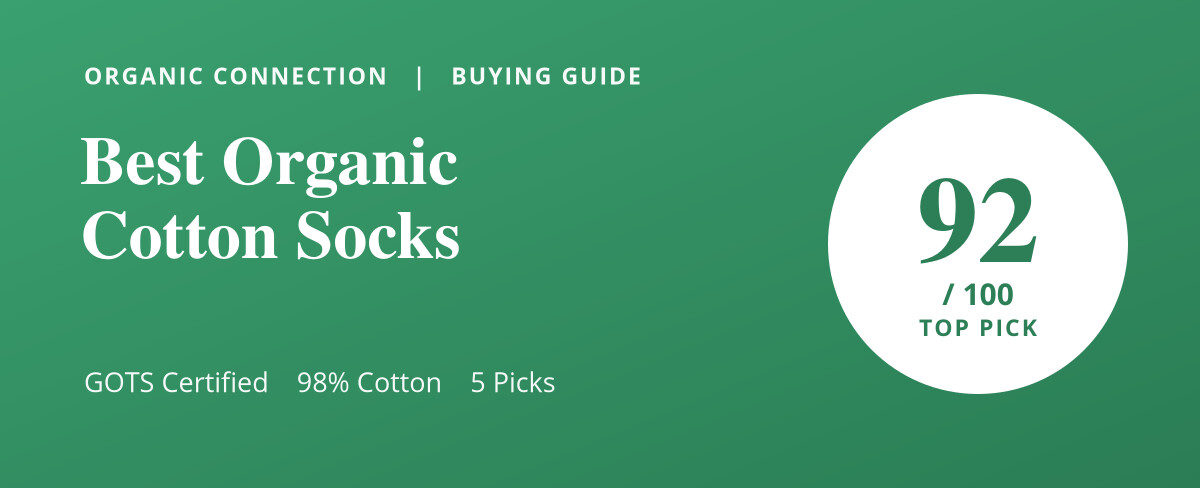
After researching the certifications, fiber content, and manufacturing of the organic cotton socks available in the US, our top pick is Bulusorganic GOTS Certified Organic Cotton Crew Socks, 3 Pairs. They are made from certified organic cotton, knit and dyed in the USA with a genuinely transparent fair trade supply chain, and they use a high organic cotton percentage with minimal synthetic, which is why they earned our highest Organic Integrity Score of 92 out of 100. For GOTS certification specifically, Pact Men’s Crew Socks and Pact Women’s Crew Socks are our picks, and for cushioning, Maggie’s Cushion Crew is the best choice.
With socks, the thing to understand before you shop is that no sock is 100 percent organic cotton, because a sock with no elastic falls down. What matters is how much synthetic there is and whether the cotton is certified.
Best organic cotton socks compared
| Best Choice | Best Value | ||||
 | 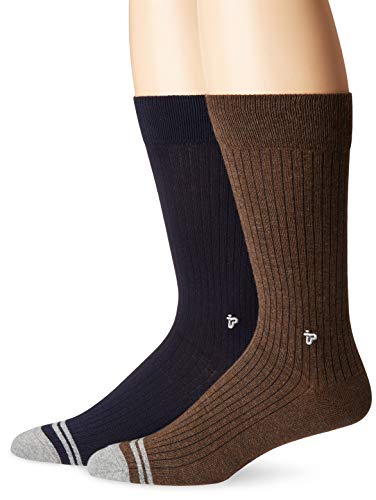 |  | 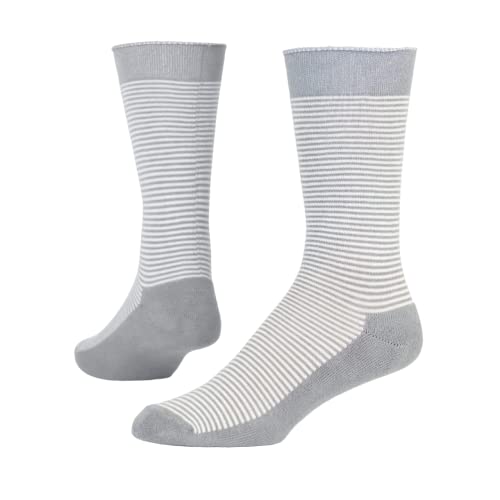 |  | |
| Product | Bulusorganic 3 Pairs | Pact Men’s Crew 2-Pack | Pact Women’s Crew 2-Pack | Maggie’s Cushion Crew | Maggie’s Crew 1 Pair |
| Organic Integrity Score | 92/ 100 | 89/ 100 | 86/ 100 | 81/ 100 | 76/ 100 |
| Our rating | 4.6 | 4.5 | 4.3 | 4.1 | 3.8 |
| Fiber | 98% organic cotton | Organic cotton blend | Organic cotton blend | Organic cotton, cushioned | 98% organic cotton |
| Best for | Best overall | Men, GOTS certified | Women, GOTS certified | Cushioned comfort | Trying the fit |
| Certification | GOTS, Organic | GOTS, Fair Trade, Organic | — | Certified Organic | — |
| Price | $28.90 View on Amazon | Currently unavailable See buying options | See buying options | $13.00 View on Amazon | $13.00 View on Amazon |
Price and availability as of October 11, 2026 7:10 pm EDT. Product prices and availability are accurate as of the date/time indicated and are subject to change. Any price and availability information displayed on Amazon.com at the time of purchase will apply to the purchase of this product.
Scores are ours, based on independent research of certification, fiber content, construction, manufacturing transparency, and value, using the same 10-criteria method we apply to every product. See how we research and rate.
The organic cotton socks certifications, and the question each one leaves open
Seals accumulate on a package faster than meaning does. This is what each of the marks you will see here certifies, and what it leaves out.
| Certification | Covers | Key exclusion |
| USDA Organic | Farming and handling: no synthetic pesticides or fertilizers, no GMOs, no sewage sludge or irradiation, audited yearly by an accredited certifier | Three different tiers share the one seal, and it makes no claim about worker pay, food miles, or nutrition |
| GOTS | Organic fiber from farm to finished textile, plus dyeing, finishing, wastewater and labor criteria | Has a weaker second tier, “made with organic”, that needs only 70% organic fiber and carries the same name |
What makes GOTS unusual is how far past the farm it reaches. Most organic marks certify how a crop was grown and stop there. GOTS carries the requirement through spinning, weaving, dyeing and finishing, bans a long list of processing chemicals, sets wastewater limits, and adds labor criteria at every stage. That is why a GOTS textile costs more than a fabric merely woven from organic cotton, and why the two are not the same claim.
Key things to look for in organic cotton socks
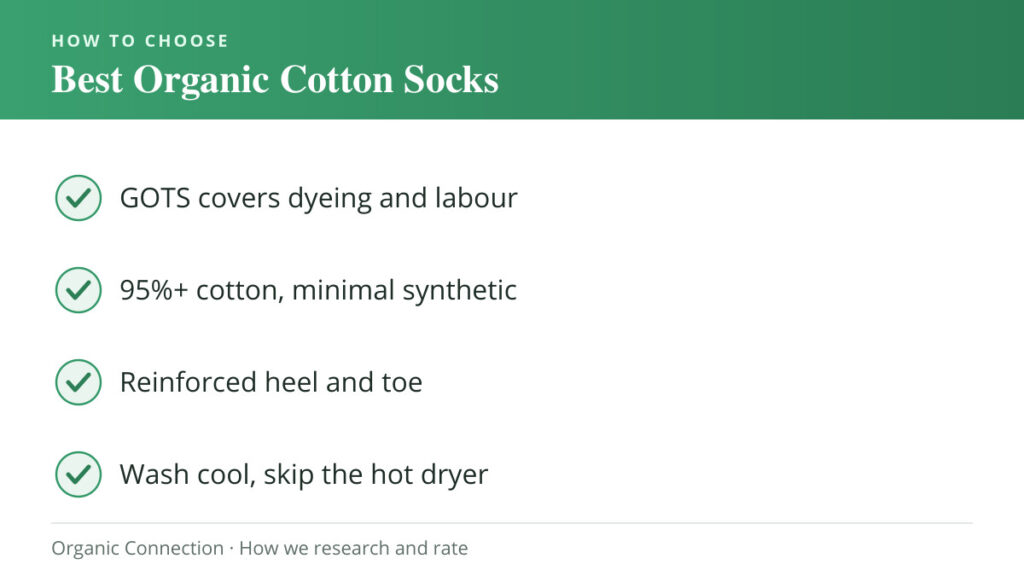
Great organic socks are about certification, fiber percentage, construction, and manufacturing transparency. Here is what matters.
1. GOTS certification or certified organic cotton
GOTS covers organic fiber content plus dyeing, finishing, restricted chemicals, wastewater, and labor standards, not just the crop.
2. A high organic cotton percentage
Look for 95 percent or more cotton with 1 to 5 percent nylon and spandex. Anything below 80 percent cotton is a synthetic sock.
3. Reinforced heel and toe
The nylon in a good sock is concentrated where it wears. Socks without reinforcement develop holes within months.
4. Transparent manufacturing
Named factories, domestic knitting, or fair trade certification tell you more than “ethically made” on a hangtag.
Why organic cotton socks are worth it, and where the limits are
Socks are a reasonable place to prioritize organic cotton for two reasons. First, cotton is genuinely one of the most chemically intensive crops in world agriculture, so the fiber choice has a real agricultural footprint even in a small garment. Second, socks are in continuous contact with skin, they trap heat and moisture, and feet are one of the more common places for contact irritation, so the dyes and finishes matter. GOTS-certified socks restrict the azo dyes and formaldehyde-based wrinkle finishes permitted in conventional textile processing, which is why people with sensitive skin or eczema often notice a difference here specifically.
Where the limits are worth stating honestly: organic cotton socks are not performance socks. Cotton absorbs moisture and holds it against the skin rather than wicking it away, which is why running and hiking socks are made from merino wool or synthetic blends. For a long run, a hot hike, or a day on your feet in boots, cotton socks will leave you damp and are a recognized contributor to blisters. Organic cotton socks are excellent for everyday wear, office days, lounging, and sleeping; they are the wrong tool for endurance sport. If you want a natural fiber that manages moisture, that is wool, not cotton. Buying the right sock for the job matters more than the certification on either one.
How to choose organic cotton socks
- Look for GOTS or certified organic cotton. The word “organic” alone on apparel is not regulated the way it is on food.
- Check the fiber percentages. 95 percent or more cotton, with a small amount of nylon and spandex, is the target.
- Confirm reinforcement. Nylon at heel and toe is what determines whether socks last a year or three months.
- Match the sock to the activity. Cotton for everyday, wool or synthetic for running and hiking.
- Wash cool and skip the dryer. Heat is what kills the elastic in a cuff.
Who should buy organic cotton socks
The right sock depends on the wearer and the day. If you want the best-made organic cotton crew sock with genuine supply chain transparency, our top pick fits. If you want GOTS-certified socks for men or women specifically, extra cushioning underfoot, or a single pair to try the fit, we have a pick for each.
Best overall: Bulusorganic GOTS Certified Organic Cotton Crew Socks, 3 Pairs
| Organic Integrity Score | 92 / 100 |
| Fiber | 98% organic cotton, 1% nylon, 1% spandex |
| Certification | GOTS, Organic |
| Best for | Everyday wear and sensitive skin |
Maggie’s is our top pick because the fiber percentage and the supply chain are both about as good as socks get. At 98 percent organic cotton with just 1 percent nylon and 1 percent spandex, there is essentially no synthetic content beyond what is structurally necessary, which is unusual; most “organic cotton” socks sit well below that. They are knit and dyed in the USA, and Maggie’s has built its business around genuine transparency and real fair trade rather than a hangtag claim, which is rare enough in apparel to count for a lot.
The trade-off is that a 98 percent cotton sock is a soft, everyday sock rather than a hard-wearing one. With so little nylon, they are less abrasion-resistant than a sport sock and will not survive being worn in heavy boots daily. They also run slightly thin, and cotton stretches with wear, so buy true to size rather than up.
What we liked: 98% organic cotton with minimal synthetic, genuine fair trade sourcing, knit and dyed in the USA, and soft enough for sensitive skin.
Keep in mind: Minimal nylon means less durability under heavy use, and they run on the thin side.
What the listing discloses: buluş organic lists GOTS. The gap is whether the USDA seal applies and where it was grown or made.
Best GOTS-certified for men: Pact Men’s Crew Socks, 2-Pack
| Organic Integrity Score | 89 / 100 |
| Fiber | Organic cotton with nylon and spandex |
| Certification | GOTS, Fair Trade, Organic |
| Best for | Men who want the full GOTS standard |
Pact is the pick when you want GOTS specifically rather than “certified organic cotton” more loosely. GOTS is the stricter standard because it does not stop at the fiber: it covers dyeing, finishing, restricted chemical inputs, wastewater treatment, and labor conditions across the whole chain, and Pact states its entire supply chain is third-party audited against it. For anyone whose concern is the chemistry of textile processing rather than only the farming, that distinction is the whole point.
The trade-off is fiber percentage and pack size. Pact’s blend carries more synthetic than Maggie’s 98 percent, which makes for a more durable and stretchier sock but a less purely cotton one, and two pairs per pack means a higher cost per pair than a three-pack.
What we liked: Full GOTS certification covering processing and labor, third-party audited supply chain, and a comfortable everyday fit.
Keep in mind: More synthetic content than the pick above it, and two-pair packs cost more per pair.
What the listing discloses: You are told GOTS and Fair Trade for Pact; you are not told whether the USDA seal applies and where it was grown or made.
Best GOTS-certified for women: Pact Women’s Crew Socks, 2-Pack
| Organic Integrity Score | 86 / 100 |
| Fiber | Organic cotton with nylon and spandex |
| Certification | — |
| Best for | Women who want the full GOTS standard |
The women’s version of the same product, cut for a narrower foot and a shorter cuff. Same GOTS certification, same audited supply chain, same soft everyday hand. If you have found unisex or men’s-cut socks bunch at the heel, a sock actually cut for the foot shape makes a genuine difference to how it sits under a shoe.
The trade-offs mirror the men’s version: more synthetic content than a 98 percent cotton sock, and two-pair packs are less economical than larger multipacks. Color availability also fluctuates more than the men’s line.
What we liked: GOTS certified with an audited supply chain, cut properly for a narrower foot, soft everyday feel.
Keep in mind: Two pairs per pack, more synthetic than the top pick, and colors come and go.
What the listing discloses: Little to verify on the Pact listing: no word on whether the USDA seal applies and where it was grown or made.
Best cushioned: Maggie’s Organics Organic Cotton Cushion Crew Socks
| Organic Integrity Score | 81 / 100 |
| Fiber | Organic cotton with cushioned terry sole |
| Certification | Certified Organic |
| Best for | Long days standing, boots, and cold floors |
The cushioned version adds a terry loop pile on the sole, which makes a real difference if you are on your feet all day, wear boots, or have hard floors at home. It is warmer, more padded underfoot, and more forgiving in a shoe with minimal insole, while keeping Maggie’s certified organic cotton and US knitting.
It scores below the plain crew for two honest reasons: the thicker terry construction requires a somewhat lower organic cotton percentage and more structural synthetic to hold its shape, and the extra bulk means they do not fit in close-fitting shoes. They are also warmer, which is a benefit in winter and a drawback in July.
What we liked: Genuine cushioning underfoot with certified organic cotton and US manufacturing, good for long days and cold floors.
Keep in mind: Bulkier, warmer, and a lower cotton percentage than the plain crew.
What the listing discloses: Maggie’s leaves the basics open, including whether the USDA seal applies and where it was grown or made.
Best single pair: Maggie’s Organic Cotton Crew Socks, 1 Pair Unisex
| Organic Integrity Score | 76 / 100 |
| Fiber | 98% organic cotton, 1% nylon, 1% spandex |
| Certification | — |
| Best for | Checking the fit before buying multipacks |
Sock sizing is genuinely inconsistent between brands, and a sock that bunches at the heel or cuts at the calf is unwearable regardless of what it is made of. Buying one pair first is the cheap way to find out whether Maggie’s unisex sizing works for your foot before committing to three or six pairs. The sock itself is identical to our top pick.
It scores lowest here on economics alone: single pairs are always the worst value per pair in socks, and the difference against the three-pack is substantial. Treat it as a fitting purchase.
What we liked: Identical 98% organic cotton quality in a single pair, so you can check sizing cheaply.
Keep in mind: The worst value per pair here; buy the multipack once you know the size works.
What the listing discloses: Beyond the organic claim itself, Maggie’s does not say whether the USDA seal applies and where it was grown or made.
Making socks last
Socks fail in two places, and both are avoidable. The elastic in the cuff dies from heat, so washing warm and tumble drying hot is what turns a good sock into one that slides down within six months. Wash cool, and air dry if you can; if you must use a dryer, use low heat. The heel and toe fail from abrasion, which is why the nylon content is concentrated there, and why rotating between several pairs rather than wearing the same one repeatedly extends the life of all of them, since fibers recover between wears.
Turn socks inside out before washing, which puts the abrasion of the wash on the outside surface rather than the sole, and wash them in a mesh bag if your machine eats them. Skip fabric softener entirely: it deposits a waxy coating that reduces cotton’s absorbency and degrades elastic, which is the opposite of what you want in a sock, and that applies across your laundry generally, as we cover in our non-toxic home guide. Finally, buy true to size. Cotton relaxes with wear, so a sock bought a size up will be loose in a month, and a loose sock rubs, which is how blisters start.
Where cotton socks are the wrong choice
Every organic sock roundup recommends “breathable materials” and stops there. The honest version is more specific, and it runs against the premise of the category for one particular use.
Keep in mind: cotton absorbs sweat and holds it rather than wicking it away, and wet cotton loses much of its loft and cushioning. That combination — a damp, flattened layer moving against skin — is precisely the mechanism that produces blisters. It is why running and hiking guidance has advised against cotton socks for decades, and no certification changes the physics. For running, hiking, long days on your feet or anything that makes you sweat, merino wool or a technical synthetic is genuinely the better garment.
Where organic cotton socks are the right answer:
- Everyday wear, office, school, low-activity days. Most socks live here, and cotton is comfortable and breathable in ordinary conditions.
- Eczema, dermatitis and sensitive skin. Synthetics plus trapped sweat is a common irritant, and cotton against skin is frequently the fix.
- Anyone reacting to dyes or finishes. GOTS prohibits formaldehyde resins, restricted azo dyes, optical brighteners and antimicrobial treatments.
- Children, where softness and low chemical load matter more than moisture management.
- Odor — cotton actually holds odor less stubbornly than polyester, which harbors the bacteria responsible.
The practical answer for most people is to own both: organic cotton for daily wear, wool or technical socks for exercise.
Why “100% organic cotton” socks disappoint
Socks have to stretch over a heel, grip a calf and return to shape every day, and cotton does none of that well. A genuinely 100% cotton sock bags at the ankle, slides down and develops a permanent heel bulge within weeks.
| Composition | Behavior |
| 100% cotton | Softest and most breathable; loses shape fastest, slips down. Suits chemical sensitivity above all else. |
| ~80% cotton, nylon, 2–5% elastane | The practical standard. Nylon adds abrasion resistance at heel and toe; elastane provides recovery. |
| Cotton with reinforced heel and toe | Where socks actually wear through. Worth seeking out. |
GOTS permits a small percentage of synthetic precisely because natural fibers alone cannot recover their shape. A sock listing 75–85% organic cotton with nylon and elastane is not a compromised product — it is a functional one, and it will outlast the pure-cotton alternative several times over. Truly 100% cotton socks exist for people with genuine elastane sensitivity, and the trade is real.
Sock anatomy: what to actually look at
- Seamless or hand-linked toe. The toe seam is the most common source of irritation and pressure, particularly for people with sensitive feet, bunions or neuropathy. Flat-linked seams sit almost imperceptibly; cheap overlocked seams form a ridge.
- Ribbed cuff, not a tight elastic band. A wide ribbed cuff holds without constricting. A narrow band that leaves a deep mark is too tight.
- Y-heel or shaped heel pocket. Tube socks with no shaped heel bunch under the arch and wear through fast.
- Terry loop cushioning underfoot adds comfort and absorbency; full terry adds warmth, which may or may not be wanted.
- Arch support band — a light elasticated band across the midfoot stops the sock rotating.
- Gauge. Higher needle count means a finer, denser knit, which is smoother and lasts longer.
| Height | Sits |
| No-show | Below the shoe line. Prone to slipping without a silicone heel grip. |
| Ankle / quarter | Just above the ankle bone |
| Crew | Mid-calf. The everyday default. |
| Over-the-calf | Below the knee; stays up best, traditional with tailoring |
Diabetic and neuropathic foot care
This is a use case where sock choice genuinely matters medically, and it is worth setting out because organic cotton socks are often bought for exactly this reason.
- Non-binding tops. Anything that constricts restricts circulation where circulation is already compromised. The cuff should leave no mark.
- Seamless toes. A seam creates a pressure point, and a pressure point on a foot with reduced sensation can become an ulcer without being felt.
- No compression unless it has been specifically prescribed. Graduated compression socks are a medical device and are not automatically appropriate.
- Light colors. Standard podiatry advice — pale socks let you see blood or drainage from a wound you may not be able to feel.
- Smooth, wrinkle-free fit. A sock that bunches creates the same pressure problem as a seam, which is an argument for a blend that holds its shape rather than pure cotton that bags.
- Change daily and inspect feet daily. The sock is one part of a routine, not a substitute for it.
- Moisture management matters more here, not less — damp skin between toes is where fungal infection and skin breakdown start. This is the one case where we would suggest a wool or wool-blend sock over pure cotton even for everyday wear, and it is worth raising with your podiatrist.
Fit and sizing
- Sock size is not shoe size, though it is usually expressed as a shoe size range. A sock that is too big wrinkles and blisters; too small and it pulls the toes and wears through at the ball.
- Buy for the larger foot if yours differ, which most people’s do.
- Expect 3–5% shrinkage on the first wash unless pre-shrunk. If you are between sizes, size up.
- The toe seam should sit past your toes, not across them, when the sock is on.
Care: why socks wear out
- Heat kills the elastane, not the cotton. Socks that have gone baggy have almost always been tumble dried hot. Wash at 30–40°C and air dry, or tumble low.
- Turn them inside out to wash. Most of the dead skin, sweat and lint is on the inside, and washing inside out cleans it better and reduces pilling.
- Skip fabric softener. It coats fibers and reduces the absorbency you bought cotton for.
- Use a mesh bag. It solves the disappearing sock problem, which is genuinely a machine-drum issue, and prevents snagging on zips and hooks.
- Rotate a larger number of pairs. Elastane needs time to recover between wears, and a drawer of twenty pairs outlasts two drawers’ worth of wear on ten.
- Trim toenails. The most common cause of a hole at the toe is not fabric quality.
- Darn or repurpose rather than binning. Cotton socks make excellent cleaning cloths, and a worn heel takes ten minutes to darn.
How we researched this guide
We are a research-based review site. We compared each product against its certification (GOTS or certified organic cotton), fiber percentages, construction and reinforcement, manufacturing and supply chain transparency, and the weight of aggregated customer feedback on fit, comfort, and durability, then scored each with our 10-criteria Organic Integrity Score. No brand paid to be included or ranked. Read the full method on our How We Research and Rate page.
Common questions about organic cotton socks
What are the best organic cotton socks?
Our overall pick is Bulusorganic GOTS Certified Organic Cotton Crew Socks, which scores highest here at 92, because its listing names GOTS certification. For full GOTS certification, Pact’s men’s and women’s crew socks are our picks, and for cushioning, Maggie’s Cushion Crew.
Why are organic cotton socks not 100% cotton?
Because cotton has no elastic recovery, so a sock made entirely of it stretches out and slides down within an hour. Every wearable sock contains a small percentage of nylon for abrasion resistance at heel and toe and spandex for the cuff. The good ones keep this to 1 to 5 percent; cheap “cotton” socks are often 60 percent cotton or less.
Is GOTS better than “made with organic cotton”?
Yes, meaningfully. “Made with organic cotton” refers only to the fiber. GOTS additionally covers dyeing, finishing, restricted chemical inputs, wastewater treatment, and labor conditions across the whole supply chain, which is what matters if your concern is the chemistry a finished garment carries against your skin.
Are cotton socks good for running or hiking?
No. Cotton absorbs moisture and holds it against the skin rather than wicking it away, which is a recognized contributor to blisters on long runs and hikes. Use merino wool or a synthetic blend for endurance activity, and keep organic cotton socks for everyday wear, office days, and lounging.
How do I make socks last longer?
Wash cool and skip the hot dryer, since heat is what destroys the elastic in the cuff. Turn them inside out before washing, rotate between several pairs so fibers recover between wears, avoid fabric softener, which coats cotton and degrades elastic, and buy true to size rather than a size up.
Why do runners avoid cotton socks?
Because cotton absorbs sweat and holds it rather than wicking it away, and wet cotton loses much of its loft and cushioning. A damp, flattened layer moving against skin is exactly the mechanism that produces blisters. For running, hiking or long days on your feet, merino wool or a technical synthetic is genuinely the better garment, and no certification changes that. Organic cotton socks are for everyday wear, sensitive skin and low-activity days.
Are 100% organic cotton socks better?
Softer, and shorter-lived. Cotton has no recovery, so a genuinely 100% cotton sock bags at the ankle, slides down and develops a permanent heel bulge within weeks. A blend of roughly 75 to 85% organic cotton with nylon for abrasion resistance and 2 to 5% elastane for recovery will outlast it several times over. GOTS permits that small synthetic percentage precisely because natural fibers alone cannot hold shape.
What should you look for in a well-made sock?
A seamless or hand-linked toe, since the toe seam is the most common source of irritation; a wide ribbed cuff rather than a narrow elastic band that leaves a deep mark; a shaped heel pocket rather than a tube, which bunches under the arch; reinforced heel and toe, which is where socks actually wear through; and a light arch band to stop the sock rotating.
What features matter in socks for diabetes?
Non-binding tops that leave no mark, since constriction restricts circulation where it may already be compromised. Seamless toes, because a seam creates a pressure point and a pressure point on a foot with reduced sensation can become an ulcer without being felt. No compression unless specifically prescribed. Light colors, so blood or drainage from an unfelt wound is visible. And a smooth wrinkle-free fit, which argues for a blend that holds shape rather than pure cotton that bags.
Is cotton or wool better for diabetic feet?
This is the one everyday case where we would lean to wool or a wool blend over pure cotton. Damp skin between toes is where fungal infection and skin breakdown begin, so moisture management matters more here rather than less. It is worth raising with your podiatrist rather than deciding from a product page.
Why do my socks go baggy?
Heat destroys the elastane, not wear. Socks that have gone loose have almost always been tumble dried hot. Wash at 30 to 40°C and air dry or tumble low, skip fabric softener, and rotate a larger number of pairs — elastane needs time to recover between wears, so twenty pairs in rotation outlast ten worn twice as often.
Do organic cotton socks shrink?
By about 3 to 5% on the first wash unless pre-shrunk, so size up if you are between sizes. Sock sizing is expressed as a shoe size range but is not the same thing — a sock that is too big wrinkles and blisters, and one that is too small pulls the toes and wears through at the ball. Buy for your larger foot, since most people’s differ.
Should you wash socks inside out?
Yes. Most of the dead skin, sweat and lint is on the inside, so washing inside out cleans them properly and reduces surface pilling. Use a mesh bag, which solves the disappearing sock problem and stops snagging on zips and hooks. And trim your toenails — the most common cause of a hole at the toe is not fabric quality.
- Organic Household hub
- Best Organic Cotton Underwear
- Best Organic Cotton Pajamas
- The Complete Guide to Organic Cotton and Textiles
- every product we have reviewed — filter by USDA Organic, GOTS, Fair Trade and more
- Best Organic Cotton Boxer Briefs
Price and availability as of October 11, 2026 7:10 pm EDT. Product prices and availability are accurate as of the date/time indicated and are subject to change. Any price and availability information displayed on Amazon.com at the time of purchase will apply to the purchase of this product.
Looking for other organic products?
We have checked more than 800 products across food, household goods, gardening, personal care and pet, every one against its stated certification. Browse all reviews.
Organic Connection is reader-supported. When you buy through links on this page we may earn a commission, at no extra cost to you. As an Amazon Associate we earn from qualifying purchases. We are not paid to feature or rank any product. How we research and rate.