
Last updated: September 30, 2026
We may earn a commission when you buy through links on this page, at no extra cost to you. How we research and rate.
The short version
After researching the certifications, composition, and drainage of the most popular organic seed starting mixes, our top pick is Espoma Organic Seed Starter Premium Potting Mix. It is OMRI Listed for organic production, milled fine enough for small seeds to push through, and includes mycorrhizae to support early root development, which is why it earned our highest Organic Integrity Score of 91 out of 100. For nutrient-rich germination, Coast of Maine Sprout Island Seed Starter is our pick, and for the lowest cost per quart, the Burpee Organic Coir Compressed Brick is the best choice.
Seed starting mix is not potting soil, and using the wrong one is the most common reason seedlings fail. We flag each product’s certification and volume.
Best organic seed starting mix compared
| Best Choice | Best Value | ||||
 |  |  |  | | |
| Product | Espoma Seed Starter 8 qt | Back to the Roots 6 qt | Coast of Maine Sprout Island | Burpee Coir Brick | Espoma 8 qt 2-Pack |
| Organic Integrity Score | 91/ 100 | 90/ 100 | 88/ 100 | 84/ 100 | 76/ 100 |
| Our rating | 4.6 | 4.5 | 4.4 | 4.2 | 3.8 |
| Base | Peat with perlite | Peat with perlite | Peat, compost, kelp | Coconut coir | Peat with perlite |
| Best for | Best overall | Larger sowings | Nutrient-rich start | Best value, peat-free | Full season supply |
| Certification | — | — | OMRI Listed, Organic | OMRI Listed | — |
| Composition | Sphagnum peat moss, perlite, with mycorrhizae | — | Peat, composted manure, worm castings, kelp, mycorrhizae, perlite | Compressed coconut coir | Sphagnum peat moss, perlite, with mycorrhizae |
| Price | Currently unavailable See buying options | $6.97$0.04 / ounce View on Amazon | $13.99 $15.49 −10%$1.75 / Dry Quarts View on Amazon | $12.99$0.03 / fluid ounce View on Amazon | $20.93$0.08 / fluid ounce View on Amazon |
Price and availability as of October 11, 2026 7:10 pm EDT. Product prices and availability are accurate as of the date/time indicated and are subject to change. Any price and availability information displayed on Amazon.com at the time of purchase will apply to the purchase of this product.
Scores are ours, based on independent research of certification, texture and composition, drainage, value, and the weight of aggregated gardener feedback on germination results, using the same 10-criteria method we apply to every product. See how we research and rate.
Reading the seals on organic seed starting mix: what each one does and does not cover
The labels on these products are not interchangeable, and several of them cover things that have nothing to do with each other. Here is what each one actually buys you.
| Certification | Covers | Key exclusion |
| USDA Organic | Farming and handling: no synthetic pesticides or fertilizers, no GMOs, no sewage sludge or irradiation, audited yearly by an accredited certifier | Three different tiers share the one seal, and it makes no claim about worker pay, food miles, or nutrition |
| GOTS | Organic fiber from farm to finished textile, plus dyeing, finishing, wastewater and labor criteria | Has a weaker second tier, “made with organic”, that needs only 70% organic fiber and carries the same name |
| OMRI Listed | Review of an input, a fertilizer, pesticide or soil amendment, as allowed in certified organic production | Reviews the product, not the farm: it cannot make your garden or your crop organic |
OMRI Listed is about the input, not the farm. The Organic Materials Review Institute reviews a fertilizer, pesticide or amendment and confirms it is permitted in certified organic production. That is genuinely useful when you are deciding what to put on your own soil. What it does not do is certify the manufacturer, the crop you grow with it, or your garden, and only an accredited certifier can do the last of those.
Key things to look for in an organic seed starting mix
Great seed starting mix is about certification, texture, drainage, and moisture behavior. Here is what matters.
1. OMRI Listed or certified organic
OMRI listing means an independent body reviewed the input against the USDA organic standard, which is the clearest signal on a garden product.
2. A fine, uniform texture
Small seeds cannot push through bark chips or coarse compost. The mix should feel light and evenly milled.
3. Perlite or vermiculite for air space
Drainage and air around roots is what prevents damping off, the fungal problem that flattens seedlings overnight.
4. Low nutrients, not high
Seeds do not need feeding for the first couple of weeks. Heavy compost or added fertilizer can burn new roots.
Peat, coir, and what actually matters
Most seed starting mixes are built on one of two bases. Sphagnum peat moss has been the standard for decades: it holds water beautifully, has a fine consistent texture, and is naturally low in nutrients and largely sterile, which is exactly what germination wants. Its problem is environmental. Peat bogs are enormous long-term carbon stores and slow-forming ecosystems, and harvesting them releases stored carbon and destroys habitat, which is why peat use has become genuinely contentious and is being phased out for amateur gardeners in some countries.
Coconut coir is the main alternative, made from the husk fiber left over from coconut processing. It is a byproduct rather than an extracted resource, it rehydrates from a compressed brick which cuts shipping weight dramatically, and it performs comparably for germination. Its complications are that it is shipped long distances, some coir is washed in salt water and needs thorough rinsing, and it holds slightly less water than peat while draining faster, which can mean more frequent watering. Neither base is perfect, and for most home gardeners either works. If the peat question matters to you, coir is the straightforward answer; if it does not, peat-based mixes remain the easier medium to get consistent results from.
What matters more than the base is what you do with it. The single biggest cause of seedling failure is damping off, a fungal disease that rots stems at soil level and flattens a whole tray overnight. It is driven by overwatering, poor air circulation, and dirty containers, not by the brand of mix, which is why sterile medium, clean trays, bottom watering, and a fan matter more than which bag you buy.
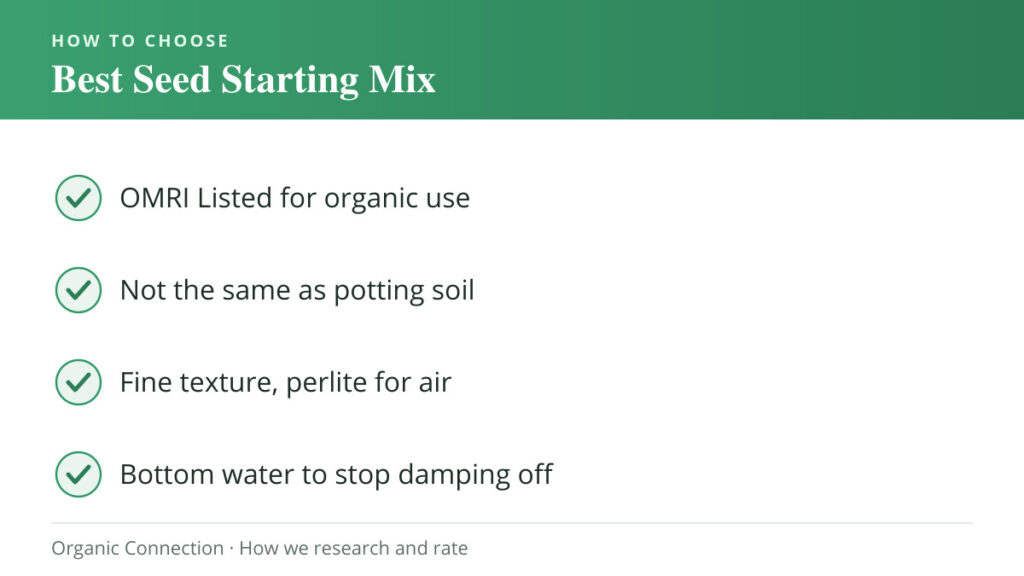
How to choose an organic seed starting mix
- Look for OMRI Listed or a genuine organic certification, not just “natural” on the bag.
- Check the texture. Fine and uniform, without bark chips or coarse compost lumps.
- Confirm there is perlite or vermiculite for the air space that prevents damping off.
- Do not buy a high-nutrient mix. Seeds carry their own food for the first weeks; fertilizer burns new roots.
- Buy the volume you need. A standard 72-cell tray takes roughly 4 to 6 quarts.
Who should buy organic seed starting mix
The right mix depends on scale. If you want the best all-round OMRI-listed mix for trays and pots, our top pick fits. If you want a nutrient-rich germination blend, the lowest cost per quart, a larger bag for a big sowing, or a two-pack for a full season, we have a pick for each.
Best overall: Espoma Organic Seed Starter Premium Potting Mix, 8 qt
| Organic Integrity Score | 91 / 100 |
| Composition | Sphagnum peat moss, perlite, with mycorrhizae |
| Certification | — |
| Best for | Seed trays, plugs, and cuttings |
Espoma is our top pick because it is the mix that most reliably does the specific job. It is OMRI Listed, which means independent review against the USDA organic standard rather than a marketing claim, and the texture is milled fine and uniform so even tiny seeds like lettuce and basil push through without struggling. Perlite provides the air space that keeps damping off at bay, and the added mycorrhizal fungi colonize roots early, which genuinely helps nutrient uptake once seedlings transplant out. The 8 quart bag covers a couple of standard trays.
The trade-off is that it is peat-based, so if avoiding peat matters to you this is not your mix. It is also very low in nutrients by design, which means seedlings will need feeding with a dilute liquid fertilizer once true leaves appear, and bagged mix bought online costs more per quart than a garden center bale.
What we liked: OMRI Listed, finely milled for small seeds, good perlite content for drainage, and mycorrhizae that help at transplant.
Keep in mind: Peat-based, deliberately low in nutrients so seedlings need feeding after true leaves, and pricier per quart bought online.
What the listing discloses: Espoma is thin on detail, and does not say whether the USDA seal applies and where it was grown or made.
Best peat-free: Back to the Roots 3-in-1 Seed Starting Mix, 6 qt
| Organic Integrity Score | 90 / 100 |
| Size | 6 quarts |
| Base | Peat-free, coconut coir |
| Additives | Mycorrhizae, yucca extract, worm castings, dolomitic limestone |
| Origin | USA made, stated |
| Best for | Seed starting without peat, at the lowest price here |
Peat-free is the claim that earns this its place. Peat is harvested from bogs that store enormous amounts of carbon and take millennia to form, and it is the default base for most seed-starting mixes. A mix built on coconut coir instead sidesteps that entirely, and this listing says so plainly.
The additives are named individually rather than described as enriched. Mycorrhizae are the root-associating fungi that extend a seedling’s effective root system; yucca extract acts as a wetting agent, which matters because coir can be difficult to re-wet once it dries; and worm castings supply gentle nutrition.
Dolomitic limestone is the one most listings leave out. Coir and peat are both acidic, and dolomitic lime raises pH while adding calcium and magnesium. Naming it tells you the mix has actually been pH-corrected rather than left where the coir landed.
It is also by a very wide margin the best selling product in this comparison, and the cheapest.
What we liked: Genuinely peat-free, four amendments named individually with dolomitic lime among them, USA made, and the strongest sales rank here by far.
Keep in mind: Only 6 quarts, the smallest bag on this page. Coir mixes need careful watering, since they shed water when they dry out completely.
What the listing discloses: You are told an origin of the USA for Back to the Roots; you are not told whether the USDA seal applies.
Best nutrient-rich start: Coast of Maine Sprout Island Seed Starter, 8 qt
| Organic Integrity Score | 88 / 100 |
| Composition | Peat, composted manure, worm castings, kelp, mycorrhizae, perlite |
| Certification | OMRI Listed, Organic |
| Best for | Longer germination periods and rooting cuttings |
Coast of Maine takes a different approach: rather than a nearly inert medium, Sprout Island blends in composted manure, worm castings, kelp, and mycorrhizae, so there is genuine nutrition available once seedlings exhaust their seed reserves. That makes it particularly good for slow germinators like peppers and for rooting cuttings, where a plant sits in the medium for weeks before transplanting and would otherwise need feeding. Drainage is enhanced and the OMRI listing is genuine.
The trade-off is that the added nutrition cuts both ways. A richer mix is slightly more prone to algae and fungus gnats on the surface, and very delicate seedlings can find it stronger than they need in the first days. It is also priced above the plain mixes and, like Espoma, is peat-based.
What we liked: OMRI Listed with genuine nutrition from castings and kelp, ideal for slow germinators and cuttings, with good drainage.
Keep in mind: Richer mixes attract more surface algae and fungus gnats, it costs more, and it is peat-based.
What the listing discloses: Little to verify on the Coast of Maine listing: no word on whether the USDA seal applies and where it was grown or made.
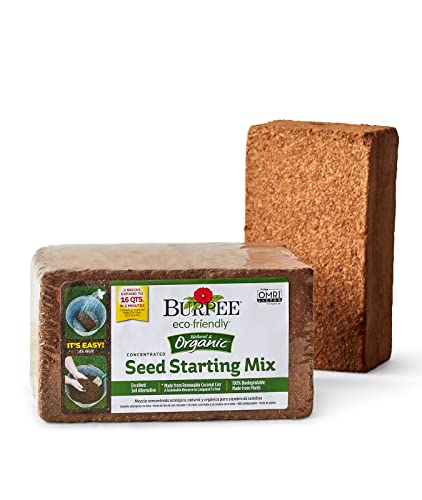
Best value and peat-free: Burpee Organic Coir Compressed Seed Starting Mix, 8 qt Brick
| Organic Integrity Score | 84 / 100 |
| Composition | Compressed coconut coir |
| Certification | OMRI Listed |
| Best for | Peat-free growing and cheap bulk starting medium |
The compressed coir brick is the clever format in this category. A brick weighing a couple of pounds expands to 8 quarts of medium when you add water, which means shipping costs and storage space are a fraction of a bagged mix, and the cost per quart is the lowest here by a clear margin. It is peat-free, made from a coconut processing byproduct, and coir germinates seeds perfectly well.
The trade-offs are real. Straight coir contains no perlite, so drainage and air space are lower than a blended mix and you should mix in a couple of handfuls of perlite yourself for best results. It also contains essentially no nutrients, so feeding after true leaves is mandatory rather than optional, and some coir needs rinsing if it was salt-water processed. It is a component more than a finished mix.
What we liked: Peat-free from a byproduct source, by far the lowest cost per quart, and compact to ship and store.
Keep in mind: No perlite so add your own, no nutrients at all, and rehydrating a brick is a messy job.
What the listing discloses: Burpee is thin on detail, and does not say whether the USDA seal applies and where it was grown or made.
Best full-season supply: Espoma Organic Seed Starter, 8 qt, 2-Pack
| Organic Integrity Score | 76 / 100 |
| Composition | Sphagnum peat moss, perlite, with mycorrhizae |
| Certification | — |
| Best for | Spreading sowings across spring and autumn |
Two sealed 8 quart bags solve the storage problem the single 16 quart bag creates: you open one for spring sowing and the second stays factory-sealed and dry until autumn, which preserves the sterility that matters for germination. Same OMRI-listed mix, same mycorrhizae, same fine texture.
It scores lowest here on straightforward economics: two-pack pricing frequently comes out above the single 16 quart bag for the identical total volume, and it uses more packaging. Compare the per-quart price at the time you buy, and choose this only when it is genuinely competitive or when the sealed-bag advantage matters to you.
What we liked: Two sealed bags keep the second half sterile and dry until you need it, with the same OMRI-listed quality.
Keep in mind: Often prices above the single 16 qt bag for the same volume, and uses more packaging.
What the listing discloses: Sparse documentation from Espoma — nothing on whether the USDA seal applies and where it was grown or made.
How to actually start seeds successfully
Pre-moisten the mix before you fill anything. Tip it into a bucket, add warm water gradually, and work it through until it holds together when squeezed but does not drip; dry mix in a tray repels water and you end up with dry pockets where seeds never germinate. Fill cells and tap them down lightly rather than compacting them, since compressed medium loses the air space roots need.
Sow at the depth on the packet, roughly twice the seed’s diameter, and remember that some seeds, including lettuce and snapdragons, need light and should sit on the surface. Water from the bottom by standing trays in a shallow tray of water until the surface darkens, then remove them: bottom watering keeps the surface drier, which is the single most effective thing you can do against damping off. Cover with a humidity dome until germination, then remove it immediately, because trapped humid air after sprouting is what invites fungal collapse. Give seedlings strong light as soon as they emerge, a windowsill is usually not enough and produces the long pale stems called legginess, and run a small fan for a few hours a day, which both strengthens stems and dramatically reduces damping off.
Feed with a half-strength organic liquid fertilizer once true leaves appear, since seed starting mix carries almost no nutrition by design. Use clean containers, washed and rinsed if reused, because carried-over fungal spores are a common cause of failure. When seedlings outgrow their cells, pot on into proper organic potting soil rather than more starting mix, and harden them off over a week before planting out. More on the wider setup in our beginner’s gardening guide.
Damping off: the thing seed starting mix exists to prevent
Almost every design decision in a seed starting mix — the fineness, the lack of nutrients, the sterility — exists to fight one problem. It is worth understanding, because it explains why using potting mix for seeds fails.
Damping off is caused by soilborne organisms including Pythium, Fusarium, Rhizoctonia and Phytophthora, which thrive in cool, damp conditions. Seedlings either fail to emerge or topple over with a pinched, water-soaked stem right at soil level. It is fast, and it is not treatable — once a seedling collapses, it is gone.
Keep in mind: the single biggest risk factor is a persistently wet surface at the soil line, because that is exactly where the stem gets pinched. The surface of the mix should dry between waterings even while the lower portion stays moist — which is precisely what bottom watering achieves and what watering from above does not. Most damping off is a watering-habit problem rather than a mix problem.
The full prevention checklist:
- Use a sterile or pasteurized seed starting mix, not garden soil and not last year’s leftovers.
- Clean trays and pots properly. Wash with soap and warm water to remove old soil and visible debris, then soak in a 10% bleach solution for 30 minutes and rinse. Reusing dirty trays reintroduces the pathogens you avoided by buying fresh mix.
- Bottom water, and remove any standing water after about half an hour — sitting in a reservoir raises the risk of rot rather than lowering it.
- Air movement. A small fan on low for a few hours a day dries the surface, strengthens stems and is one of the highest-return things you can do.
- Do not sow too densely. Crowded seedlings hold humidity between them.
- Remove humidity domes as soon as germination happens. They are for germination, not for seedlings, and leaving them on is a common cause of collapse.
- Strong light, which keeps growth stocky and the surface drier.
The organic trade-off: sterile versus biologically active
Here is a tension worth naming, because it cuts against the usual organic recommendation.
Conventional seed starting mixes are typically steam-sterilized or pasteurized, which kills damping-off pathogens along with everything else. Many organic mixes contain compost, worm castings and mycorrhizal inoculants — deliberately biologically active, which is good for growing plants on and is, by definition, not sterile.
- A well-made compost-containing mix is not automatically risky. Mature compost carries beneficial organisms that compete with pathogens, and there is a reasonable argument that biological competition suppresses damping off.
- A poorly made one is a real hazard. Immature compost, or compost that never reached thermophilic temperatures, can carry pathogens directly.
- Nutrients are the other half of the problem. Compost-rich mixes are not lean, and rich, wet, warm conditions are exactly what damping off wants.
- The practical answer: buy a mix specifically labeled for seed starting rather than a general organic potting mix, from a manufacturer with a reputation to protect, and be more disciplined about watering and airflow than you would be with a sterile mix.
Seeds contain their own food supply and need no added nutrition until the first true leaves appear, which is why starting mixes are deliberately lean. Nutrients at germination do nothing useful and encourage exactly the soft, fast growth that collapses.
Pre-moisten the mix before you sow
This step gets skipped constantly and causes more failed trays than almost anything else.
Dry peat and coir are hydrophobic — water runs off rather than in. If you fill cells with dry mix, sow, then water, the water channels down the sides and out of the drainage holes while the center of each cell stays bone dry. The seed never gets consistent moisture and germination is patchy.
- Moisten the mix in a bucket or tub first, working the water in with your hands until it holds together when squeezed but does not drip. Aim for the texture of a wrung-out sponge.
- Use warm water, which penetrates dry peat considerably faster than cold.
- Let it sit 15–30 minutes and check again — coir bricks in particular keep absorbing.
- Then fill your cells, firm gently, and sow. The seed now sits in evenly damp medium from the start.
- Do not compact it hard. Firming removes air pockets; compressing kills drainage.
Light, not warmth, is what stops leggy seedlings
Warmth drives germination. Light drives what happens next, and this is where most windowsill seed starting goes wrong.
Etiolation — long, pale, floppy stems reaching for a light source — happens when light is insufficient or coming from one side. A windowsill in late winter is far dimmer than it looks to human eyes, and seedlings stretch toward it and fall over.
- 16–18 hours daily of full-spectrum light, on a timer.
- Keep the light 2–4 inches above the foliage and raise it as the seedlings grow. Distance is the variable people get wrong — lights hung high produce leggy plants regardless of how many hours they run.
- Light from directly above, not from the side, so growth is even rather than leaning.
- Drop the heat after germination. Heat mats are for germinating; leaving them on afterwards accelerates stretching. Cooler and brighter produces stocky seedlings.
- Brush the seedlings with your hand daily, or run that fan. Mechanical stimulation thickens stems — it is the same signal wind gives outdoors.
- If they are already leggy, you can pot tomatoes and other Solanaceae deeper, burying the stem, which will root along its length. Most other seedlings cannot be rescued this way.
When to feed, and when to pot on
- No feeding until the first true leaves. The first pair to appear are seed leaves (cotyledons), which are food storage; true leaves are the next set and look like miniature versions of the adult leaf.
- Then feed at quarter to half strength, every 1–2 weeks. Full-strength feed will burn young roots in a lean mix.
- Pot on into potting mix once true leaves are established and roots reach the edges of the cell. Seed starting mix has neither the nutrition nor the structure to carry a plant further.
- Harden off over 7–10 days before planting out — an hour or two outside in shade on day one, building gradually. Skipping this undoes weeks of work in an afternoon of wind and UV.
Storage
- Keep opened bags sealed and off damp ground. An open bag in a shed absorbs moisture and grows fungi — which reintroduces exactly what you paid to avoid.
- Unopened bags keep 1–2 years, though mixes containing mycorrhizal inoculants lose viability over that time.
- Do not reuse mix from a tray that had damping off. Discard it away from the garden, and sterilize the trays before reuse.
- Coir bricks store indefinitely if kept dry, and take far less space than bagged mix — a genuine practical advantage for anyone starting seeds once a year.
- Wear a mask when handling dry mix, and dampen it before working with it. Peat, coir and perlite all produce fine dust, and potting media can carry Legionella longbeachae.
How we researched this guide
We are a research-based review site. We compared each product against its certification (OMRI listing where present), composition and texture, drainage and aeration, nutrient content appropriate to germination, value per quart, and the weight of aggregated gardener feedback on germination rates, then scored each with our 10-criteria Organic Integrity Score. No brand paid to be included or ranked. Read the full method on our How We Research and Rate page.
Common questions about organic seed starting mix
What is the best organic seed starting mix?
Our overall pick is Espoma Organic Seed Starter, because it is OMRI Listed for organic production, milled fine and uniform so small seeds germinate reliably, contains perlite for the drainage that prevents damping off, and includes mycorrhizae that help at transplant. For a nutrient-rich blend, Coast of Maine Sprout Island is our pick.
Can I use potting soil to start seeds?
You can, but results are worse. Potting soil is coarser and heavier, so tiny roots struggle to penetrate it, it holds more water which encourages damping off, and it often contains compost or fertilizer strong enough to burn delicate new roots. Seed starting mix is finer, lighter, better draining, and deliberately low in nutrients.
What is damping off and how do I prevent it?
It is a fungal disease that rots seedling stems at soil level and can flatten a whole tray overnight. It is driven by overwatering, poor air circulation, and dirty containers rather than by the brand of mix. Water from the bottom, remove humidity domes as soon as seeds sprout, run a small fan, and use clean containers.
Is coir better than peat for seed starting?
Environmentally, coir has the stronger case, since it is a coconut processing byproduct while peat harvesting releases stored carbon and destroys slow-forming bog habitat. For results, peat is slightly easier to work with because it holds water more evenly. Coir germinates seeds well but usually benefits from added perlite and needs feeding sooner.
Do seedlings need fertilizer?
Not at first. Seeds carry their own food supply for roughly the first two weeks, which is why seed starting mix is deliberately low in nutrients. Once true leaves appear, the second set that looks like miniature adult leaves, begin feeding with a half-strength organic liquid fertilizer.
What causes damping off in seedlings?
Soilborne organisms including Pythium, Fusarium, Rhizoctonia and Phytophthora, which thrive in cool damp conditions and pinch the stem at soil level. The single biggest risk factor is a persistently wet surface at the soil line, because that is exactly where the stem gets attacked. It is fast and untreatable — once a seedling topples it is gone — so prevention is everything.
How do you prevent damping off?
Use a sterile or pasteurized seed starting mix rather than garden soil. Clean trays with soap and warm water, then soak in a 10% bleach solution for 30 minutes. Bottom water and remove standing water after about half an hour. Run a small fan on low for a few hours daily to dry the surface. Do not sow densely, remove humidity domes as soon as germination happens, and give strong light.
Can you use potting soil to start seeds?
Not well. Potting mix is nutrient-rich and coarser, and rich, wet, warm conditions are exactly what damping off wants. Seeds contain their own food supply and need no added nutrition until the first true leaves appear, which is why starting mixes are deliberately lean — nutrients at germination encourage the soft fast growth that collapses.
Are organic seed starting mixes sterile?
Usually not, and this is a genuine trade-off. Many organic mixes contain compost, worm castings and mycorrhizal inoculants — deliberately biologically active, which by definition is not sterile. Mature compost carries beneficial organisms that compete with pathogens, so a well-made mix is not automatically risky, but a poorly made one carrying immature compost is a real hazard. Buy a mix labeled specifically for seed starting, and be more disciplined about watering and airflow.
Why should you pre-moisten seed starting mix?
Because dry peat and coir are hydrophobic — water runs off rather than in. Fill cells with dry mix and water afterwards, and the water channels down the sides and out the drainage holes while the center stays bone dry, giving patchy germination. Moisten the mix in a tub first with warm water until it holds together when squeezed but does not drip, let it sit 15 to 30 minutes, then fill your cells.
Why are my seedlings tall and floppy?
Etiolation from insufficient or one-sided light. A late-winter windowsill is far dimmer than it looks. Give 16 to 18 hours of full-spectrum light on a timer, keep it 2 to 4 inches above the foliage and raise it as they grow — distance is the variable people get wrong. Light from directly above, not the side. And turn heat mats off after germination, since heat accelerates stretching while cooler and brighter produces stocky seedlings.
When should you start feeding seedlings?
After the first true leaves appear — the first pair are seed leaves, which are food storage, and true leaves are the next set that look like miniature adult leaves. Then feed at quarter to half strength every one to two weeks, since full-strength feed burns young roots in a lean mix. Pot on into potting mix once roots reach the edges of the cell.
Can you reuse seed starting mix?
Not from a tray that had damping off — discard it away from the garden and sterilize the trays before reuse. Otherwise keep opened bags sealed and off damp ground, since an open bag in a shed absorbs moisture and grows fungi. Unopened bags keep 1 to 2 years, though mycorrhizal inoculants lose viability over that time. Coir bricks store indefinitely if kept dry.
- Organic Gardening hub
- Best Organic Potting Soil
- Best Organic Vegetable Seeds
- Organic Gardening for Beginners
- every product we have reviewed — filter by USDA Organic, GOTS, Fair Trade and more
Price and availability as of October 11, 2026 7:10 pm EDT. Product prices and availability are accurate as of the date/time indicated and are subject to change. Any price and availability information displayed on Amazon.com at the time of purchase will apply to the purchase of this product.
Looking for other organic products?
We have checked more than 800 products across food, household goods, gardening, personal care and pet, every one against its stated certification. Browse all reviews.
Organic Connection is reader-supported. When you buy through links on this page we may earn a commission, at no extra cost to you. As an Amazon Associate we earn from qualifying purchases. We are not paid to feature or rank any product. How we research and rate.