
Last updated: September 30, 2026
We may earn a commission when you buy through links on this page, at no extra cost to you. How we research and rate.
The short version
After researching the ingredients, certifications, and NPK of the most popular organic liquid fertilizers, our top pick is Neptune’s Harvest Fish & Seaweed Fertilizer. It is OMRI listed, made from hydrolyzed fish and seaweed, and it feeds plants and soil life fast without burning, which is why it earned our highest Organic Integrity Score of 93 out of 100. For vegetables, Neptune’s Harvest Tomato & Veg is our pick, and for an all-purpose everyday feed, Espoma Organic Grow! is the best choice.
Liquid organic fertilizers work fast, because nutrients are already dissolved and plant-ready, and they feed the soil microbes that keep plants healthy. We flag each pick’s NPK, form, and organic credential (OMRI, CDFA, or organic input).
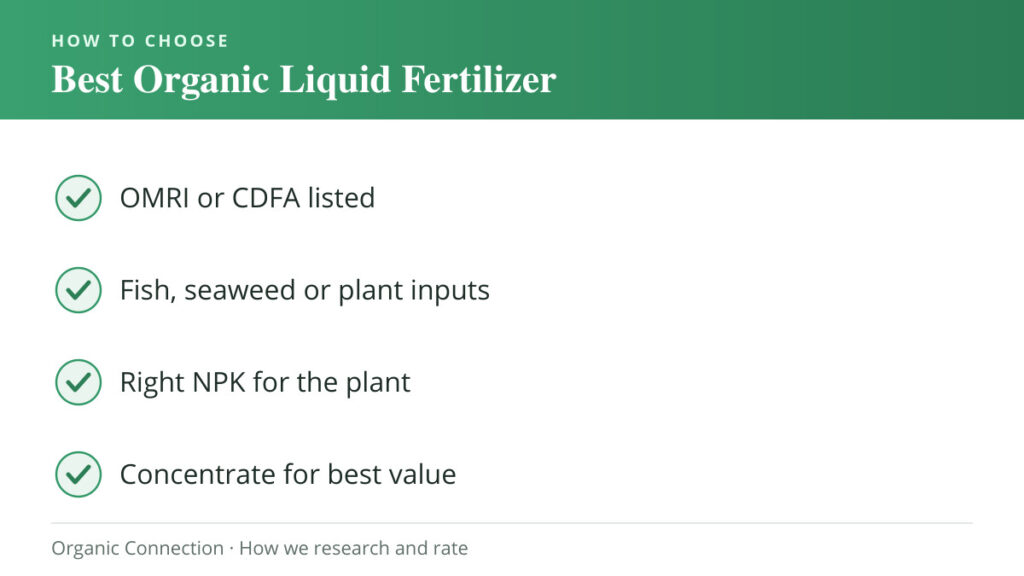
Best organic liquid fertilizer compared
| Best Choice | Best Value | ||||
 |  |  |  |  | |
| Product | Neptune’s Fish & Seaweed | Espoma Indoor | Espoma Grow! | Dr. Earth Pure Gold | Neptune’s Tomato & Veg |
| Organic Integrity Score | 93/ 100 | 80/ 100 | 79/ 100 | 77/ 100 | 73/ 100 |
| Our rating | 4.7 | 4.0 | 4.0 | 3.9 | 3.7 |
| Best for | Best overall | Houseplants | All-purpose | Potent concentrate | Vegetables |
| NPK | 2-3-1 | 2-2-2 | 2-2-2 | 4-4-4 | 2-4-2 |
| Credential | OMRI Listed | CDFA approved | CDFA approved | OMRI, CCOF | Organic (fish/seaweed) |
| Price | $22.49$0.62 / fluid ounce View on Amazon | See buying options | Currently unavailable See buying options | $13.10 $17.99 −27%$0.55 / fluid ounce View on Amazon | $49.99$0.69 / ounce View on Amazon |
Price and availability as of October 11, 2026 7:10 pm EDT. Product prices and availability are accurate as of the date/time indicated and are subject to change. Any price and availability information displayed on Amazon.com at the time of purchase will apply to the purchase of this product.
Scores are ours, based on independent research of organic credentials, ingredients, NPK, and value, using the same 10-criteria method we apply to every product. See how we research and rate.
The organic liquid fertilizer certifications, and the question each one leaves open
The labels on these products are not interchangeable, and several of them cover things that have nothing to do with each other. Here is what each one actually buys you.
| Certification | Covers | Key exclusion |
| USDA Organic | Farming and handling: no synthetic pesticides or fertilizers, no GMOs, no sewage sludge or irradiation, audited yearly by an accredited certifier | Three different tiers share the one seal, and it makes no claim about worker pay, food miles, or nutrition |
| OMRI Listed | Review of an input, a fertilizer, pesticide or soil amendment, as allowed in certified organic production | Reviews the product, not the farm: it cannot make your garden or your crop organic |
OMRI Listed is about the input, not the farm. The Organic Materials Review Institute reviews a fertilizer, pesticide or amendment and confirms it is permitted in certified organic production. That is genuinely useful when you are deciding what to put on your own soil. What it does not do is certify the manufacturer, the crop you grow with it, or your garden, and only an accredited certifier can do the last of those.
Key things to look for in an organic liquid fertilizer
Good organic liquid feed is about clean inputs and the right nutrients. Here is what matters.
1. Organic certification or listing
Look for OMRI Listed, CDFA, or a registered organic input, which verify the ingredients meet organic standards.
2. Natural inputs
Fish hydrolysate, seaweed and kelp, and plant proteins feed both plants and soil biology, unlike synthetic salts.
3. The right NPK for the job
Balanced blends for all-purpose feeding, higher-phosphorus formulas for flowers and fruit, gentle formulas for houseplants.
4. Concentrate vs ready-to-use
Concentrates you dilute are the best value; ready-to-spray or easy-dose bottles are the most convenient.
Are organic liquid fertilizers worth it?
Liquid organic fertilizers give you the best of both worlds: fast feeding and soil health. Because the nutrients are already dissolved, plants take them up quickly, which makes liquids perfect for a mid-season boost, transplants, seedlings, and container gardens that need regular feeding. And because they are made from natural inputs like fish, seaweed, and plant proteins rather than synthetic salts, they also feed the soil microbes that improve structure and long-term fertility, without the burn risk or chemical re-entry period of synthetic feeds.
Because “organic” on a fertilizer bottle is not regulated like food, we look for OMRI, CDFA, or a registered organic input. Our scoring rewards those credentials, clean natural ingredients, appropriate NPK, and value, so you get a liquid feed that is both genuinely organic and effective.
OMRI listed versus USDA organic: the distinction that matters for inputs
This trips up almost every gardener, and it explains why you will rarely see a USDA organic seal on a bag of fertilizer or soil.
USDA Organic certifies outputs. It applies to food and fiber products, the things a farm sells. It is not designed to certify the inputs a grower uses to produce them, so a bag of fertilizer is generally not the sort of thing that carries the USDA organic seal.
OMRI certifies inputs. The Organic Materials Review Institute is an independent non-profit that reviews products against the USDA National Organic Program standards and determines whether they are allowed in certified organic production. When you see “OMRI Listed” on a soil amendment, fertilizer, or pest control product, it means an accredited third party has verified the product is permitted for organic growing.
So for garden inputs, OMRI Listed is the seal to look for, not USDA Organic. A product claiming to be “organic” with neither OMRI listing nor a stated certifier is making an unverified claim, and the word organic is not legally protected on garden products the way it is on food.
You may also see “USDA Certified Biobased”, which is a different thing again: it certifies the proportion of the product derived from renewable biological material, not whether it meets organic standards.
Reading NPK, and why organic numbers look disappointingly low
Every fertilizer carries three numbers. They are percentages by weight, always in the same order.
| Letter | Nutrient | What it drives |
| N | Nitrogen | Leafy vegetative growth, green color |
| P | Phosphorus | Roots, flowers, fruit, and seed |
| K | Potassium | Root and stem strength, disease resistance, protein synthesis |
Why organic products show low numbers. A typical OMRI-listed organic fertilizer might read 4-4-4, while a synthetic product sits at 20-20-20. That looks like a fivefold difference in value, and it is not, because the two work in fundamentally different ways.
Synthetic fertilizer delivers nutrients in immediately plant-available mineral form. The plant takes up what it can and the rest is prone to leaching away, which is where nutrient runoff into waterways comes from. Organic fertilizer delivers nutrients bound up in organic matter that soil microbes must break down first. That makes it slower, steadier, far harder to burn plants with, and it feeds soil biology rather than bypassing it. The nutrients release over weeks to months rather than days.
The practical implication. Do not compare an organic fertilizer to a synthetic one on the NPK numbers alone; you are comparing a slow-release biological system with a fast-release chemical one. Apply organic fertilizer earlier than you think you need it, since it takes time to become available, and judge it over a season rather than over a fortnight. The goal with organic growing is a living soil that holds and cycles nutrients, at which point you need less input each year rather than more.
How to choose an organic liquid fertilizer
- Look for OMRI or CDFA. These verify the organic claim on a fertilizer.
- Match the NPK to the plant. Balanced for all-purpose, higher phosphorus for flowers and fruit, gentle for houseplants.
- Pick concentrate or ready-to-use. Concentrate for value, easy-dose or hose-end for convenience.
- Mind the smell. Fish-based feeds are effective but smell strong; use outdoors or choose a plant-based feed for indoors.
- Feed on schedule. Liquids act fast but for a shorter window, so reapply every 1 to 4 weeks as directed.
Who should buy organic liquid fertilizer
Your garden decides the feed. Most beds are covered by our top pick. If you want a vegetable-specific formula, an easy all-purpose everyday feed, a potent concentrate, or a gentle houseplant food, we have a pick for each.
Best overall: Neptune’s Harvest Fish & Seaweed Fertilizer
| Organic Integrity Score | 93 / 100 |
| Credential | OMRI Listed |
| NPK | 2-3-1, hydrolyzed fish and seaweed |
| Best for | An all-around organic liquid feed |
Neptune’s Harvest Fish & Seaweed is our top pick because it is a proven, OMRI-listed all-purpose liquid feed. It blends 75% hydrolyzed fish and 25% seaweed (2-3-1) into a plant-ready liquid that feeds vegetables, flowers, trees, lawns, and houseplants, builds soil biology and organic matter, and is safe for kids and pets, all at a strong value in concentrate form.
The trade-off is the strong fish smell, which fades outdoors but is noticeable indoors. For an effective, genuinely organic, do-everything liquid fertilizer, it is our first choice.
What we liked: OMRI listed, fish and seaweed inputs that feed plants and soil, all-purpose use, and excellent value as a concentrate.
Keep in mind: It has a strong fish odor, so it is best used outdoors or well-ventilated for indoor plants.
What the listing discloses: Sparse documentation from Neptune’s Harvest — nothing on whether the USDA seal applies and where it was grown or made.
Best for houseplants: Espoma Organic Indoor Plant Food
| Organic Integrity Score | 80 / 100 |
| Credential | Approved for organic use (CDFA) |
| NPK | Gentle balanced formula for indoor plants |
| Best for | Pothos, monstera, and other houseplants |
Espoma Indoor is our houseplant pick. This gentle, low-odor liquid concentrate is made for indoor plants like pothos, fiddle leaf fig, monstera, snake plants, and palms, approved for organic use, safe around kids and pets, and dispensed with a simple half-cap-per-quart easy-dose system, so it is hard to over-apply.
It scores at the value end because it is a mild, indoor-specific feed rather than a potent garden fertilizer, but for feeding houseplants cleanly and easily without a fishy smell, it is the right choice.
What we liked: Gentle and low-odor, approved for organic use, safe for pets and kids, and a foolproof easy-dose system.
Keep in mind: It is a mild houseplant feed, not a heavy-duty garden fertilizer.
What the listing discloses: Espoma leaves the basics open, including whether the USDA seal applies and where it was grown or made.
Best all-purpose: Espoma Organic Grow!
| Organic Integrity Score | 79 / 100 |
| Credential | Approved for organic use (CDFA) |
| NPK | 2-2-2 balanced, with kelp and microbes |
| Best for | Easy, balanced everyday feeding |
Espoma Grow! is our all-purpose pick. This balanced 2-2-2 liquid concentrate combines natural proteins with kelp extracts, humic acids, and beneficial microbes, is approved for organic use, and pours from an easy-dose bottle for indoor and outdoor plants, a simple, low-odor, do-everything feed from a trusted organic-fertilizer brand.
It scores in the middle because it is a gentle, balanced feed rather than a potent or targeted one, but for easy, reliable, all-purpose organic feeding, it is a great choice.
What we liked: Balanced 2-2-2, kelp and microbes, approved for organic use, low odor, and a mess-free easy-dose bottle.
Keep in mind: As a gentle balanced feed, it is less potent than a concentrated 4-4-4 or a targeted fruiting formula.
What the listing discloses: Espoma documents an origin of the USA, and leaves whether the USDA seal applies unsaid.
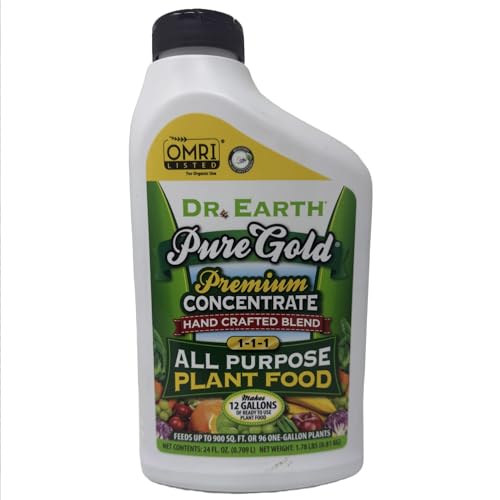
Best concentrate: Dr. Earth Pure Gold All-Purpose Liquid
| Organic Integrity Score | 77 / 100 |
| Credential | OMRI, CCOF certified |
| NPK | 4-4-4 concentrated, all-purpose |
| Best for | A potent, well-certified concentrate |
Dr. Earth Pure Gold is our concentrate pick. Its 4-4-4 all-purpose liquid is more concentrated than most, OMRI and CCOF certified, made from whole-food ingredients, and can feed flowers, vegetables, trees, and shrubs throughout the season, even up to the day of harvest, giving a stronger feed per bottle.
It scores in the value range mainly because a stronger feed needs careful dilution and the whole-food inputs have a smell, but for a potent, well-certified organic concentrate, it is excellent.
What we liked: Concentrated 4-4-4, OMRI and CCOF certified, whole-food ingredients, and usable right up to harvest.
Keep in mind: Being concentrated, it must be diluted correctly, and it has a noticeable smell.
What the listing discloses: The word organic does not appear on the Dr. Earth listing at all.
Best for vegetables: Neptune’s Harvest Tomato & Veg
| Organic Integrity Score | 73 / 100 |
| Credential | Organic (fish, seaweed, molasses, yucca) |
| NPK | 2-4-2, higher phosphorus for fruiting |
| Best for | Tomatoes, vegetables, and fruiting plants |
Neptune’s Harvest Tomato & Veg is our pick for the vegetable garden. Its 2-4-2 formula adds extra phosphorus for flowering and fruiting, blending fresh fish and seaweed with molasses, yucca extract, and humic acids to strengthen roots, boost soil biology, and increase yields on tomatoes, peppers, and other vegetables.
It scores just below our top pick because it is purpose-built for fruiting crops rather than every plant, but for a productive vegetable garden, it is the better-targeted feed.
What we liked: Higher-phosphorus 2-4-2 for fruiting, added yucca and humic acids, and reported higher vegetable yields.
Keep in mind: It is targeted at fruiting crops, and like other fish feeds it has a strong smell.
What the listing discloses: Neptune’s Harvest is thin on detail, and does not say whether the USDA seal applies and where it was grown or made.
How to use organic liquid fertilizer
Most liquid organic fertilizers are concentrates you dilute with water, so follow the label’s ratio (often around 1 tablespoon to a few ounces per gallon) and apply with a watering can, hose-end sprayer, or drip line. Feed every one to four weeks during the growing season, more often for fast-growing vegetables and containers. You can water it into the soil or, for some products, spray it on leaves as a foliar feed. Fish-based feeds smell strong, so use them outdoors or ventilate well indoors, and since organic feeds won’t burn, there is no chemical re-entry period for kids or pets.
Fish emulsion versus fish hydrolysate
These sit side by side on the shelf, cost similar money and are made completely differently. It is the most useful distinction in liquid organic feeding and virtually no product page explains it.
| Fish emulsion | Fish hydrolysate | |
| Process | Heat-processed by-product of fish meal production | Cold enzymatic digestion — never heated enough to break down amino acid chains |
| Typical NPK | ~5-1-1 | ~2-4-1 |
| Oils and fats | Largely removed during cooking | Retained |
| Proteins | Denatured by heat | Intact amino acids |
| Smell | Strong | Milder |
| Best for | Delivering nitrogen quickly | Feeding soil biology, particularly fungi, which use the retained oils |
The practical choice: emulsion if you want a nitrogen hit — it has more than double the nitrogen and acts fast, which is what a hungry plant in cool soil needs. Hydrolysate if you are building soil biology, since the retained fats and oils are what fungi feed on, and intact amino acids are more useful to microbes than denatured protein.
Most gardeners do better with hydrolysate over a season and emulsion as a rescue feed. Labels are not always clear, so look for “hydrolysate”, “cold processed” or “enzymatically digested” — if it says only “fish fertilizer” and smells overwhelming, it is almost certainly emulsion.
Foliar feeding: when it works and when it is theatre
Spraying leaves is widely recommended and frequently done at the worst possible time of day.
- Timing is the whole thing. Spray in the early morning, roughly 6–9am, or in the late afternoon and early evening. Stomata are open, temperatures are mild, and humidity is high enough that the spray stays liquid long enough to be absorbed.
- Evening applications often outperform morning ones, because humidity rises after sunset and residues can stay liquid for eight to ten hours, greatly extending the absorption window.
- Never spray in midday sun. The droplets evaporate before anything is absorbed, and can scorch leaves.
- Stop above about 27°C (80°F). Stomata close in heat and the plant simply is not taking anything in.
- Dilute more than you would for a soil drench — typically half strength. Leaves burn far more readily than roots.
- Cover leaf undersides, where stomatal density is highest.
- Manage expectations. Foliar feeding is genuinely useful for micronutrients — iron, zinc, manganese — where a soil problem is blocking uptake, and for a quick corrective. It cannot supply a plant’s bulk nitrogen, phosphorus and potassium needs; leaves simply cannot absorb that much. Anyone selling foliar feeding as a replacement for soil feeding is overstating it.
Compost tea, assessed honestly
Compost tea has an enthusiastic following and a thinner evidence base than that following suggests, and there is a food safety point worth stating plainly.
- The efficacy evidence is weak. Reviews have found little scientific evidence that either aerated or non-aerated compost tea reliably suppresses plant pathogens. It may add some nutrients and microbes; it is not the transformative input it is often presented as.
- Nutritionally it is dilute. Compost tea is cheap per gallon but delivers far less nitrogen per application than fish products. If your plant needs feeding, tea is not the tool.
- The safety point: compost tea is unregulated, and brewing — particularly aerated brewing with added molasses — can multiply whatever bacteria were in the starting compost, including human pathogens if manure was involved. Restrict it to ornamentals rather than edibles, and if you do use it on food crops, observe the standard 90 to 120 day pre-harvest interval that applies to raw manure. Spraying it on leafy greens a week before eating them is a genuinely bad idea.
- If you brew it, use finished plant-based compost or worm castings rather than manure, keep the brew under 24–36 hours, and use it the same day. A tea that smells sour or sulfurous has gone anaerobic — pour it away rather than onto plants.
Dilution, frequency and burn
| Use | Typical dilution | Frequency |
| Established outdoor plants | As labeled | Every 2–3 weeks in active growth |
| Seedlings and young transplants | Quarter to half strength | Every 2–3 weeks |
| Houseplants | Half strength | Monthly in growing season, not at all in winter |
| Foliar spray | Half strength or less | Every 2–4 weeks |
| Containers outdoors | As labeled | Every 1–2 weeks — nutrients leach out with every watering |
- Water first, feed second. Liquid feed into dry soil concentrates salts against roots and is the usual cause of “fertilizer burn” from products that are otherwise gentle.
- Containers need feeding far more often than beds, because every watering flushes nutrients out of the bottom. This is the most common reason container plants stall in midsummer.
- Stop feeding houseplants in winter. Low light means low growth, and unused nutrients accumulate as salts — the white crust on pot rims and soil surface.
- Flush containers occasionally with plain water, several times the pot volume, to clear that build-up.
Storage: the bottle that explodes
- Fish products continue to ferment in the bottle. Pressure builds, and a tightly capped bottle left in a warm shed can leak or burst. Open it slowly, outdoors, over a sink or the ground — this is not hypothetical, and the smell is memorable.
- Store cool, dark and upright, and never in a greenhouse or a car.
- Concentrates keep 1–3 years unopened; once opened, use within a year.
- Diluted feed does not store. Mix what you need and use it the same day — dilution removes the concentration that was keeping microbes in check.
- Separation is normal in fish and seaweed products. Shake thoroughly; the solids are where much of the value sits.
- Do not use organic liquid feeds in a hydroponic reservoir unless the product is specifically formulated for it. The organic matter clogs emitters, goes anaerobic, and produces exactly the sulfurous root problems you are trying to avoid.
- Keep them away from pets. Fish-based feeds are extremely attractive to dogs and cats, both in the bottle and freshly applied.
How we researched this guide
We are a research-based review site. We compared each fertilizer against its organic credentials (OMRI, CDFA, CCOF), ingredients, NPK, and the weight of aggregated customer feedback, then scored each with our 10-criteria Organic Integrity Score. No brand paid to be included or ranked. Read the full method on our How We Research and Rate page.
Common questions about organic liquid fertilizer
What is the best organic liquid fertilizer?
Our overall pick is Neptune’s Harvest Fish & Seaweed Fertilizer, because it is OMRI listed, feeds plants and soil life fast, and works on almost everything. For vegetables, Neptune’s Harvest Tomato & Veg is our pick, and for all-purpose feeding, Espoma Organic Grow!.
Are liquid or granular organic fertilizers better?
They complement each other. Liquids act fast and are great for a mid-season boost, seedlings, and containers, while granular feeds release slowly over weeks. Many gardeners use granular as a base and liquid for a quick boost.
Do organic liquid fertilizers smell?
Fish-based feeds like Neptune’s Harvest have a strong smell that fades outdoors within a day. If you want to feed indoor plants without odor, choose a gentle plant-based formula like Espoma’s indoor plant food.
How often should I use liquid fertilizer?
Because liquids act fast but for a shorter time, feed every one to four weeks during the growing season, following the product label. Fast-growing vegetables and container plants benefit from more frequent feeding than established shrubs.
Is organic liquid fertilizer safe for pets and kids?
Organic feeds made from natural inputs generally have no synthetic-chemical re-entry restriction, so kids and pets can usually be around treated plants soon after application. Always follow the specific product label, and store bottles out of reach.
What is the difference between fish emulsion and fish hydrolysate?
Processing. Fish emulsion is a heat-processed by-product of fish meal production, typically around 5-1-1, with the oils cooked out and the proteins denatured. Fish hydrolysate is cold enzymatically digested, typically around 2-4-1, retaining fats, oils and intact amino acids. Emulsion delivers more nitrogen faster; hydrolysate feeds soil biology better, since fungi use the retained oils. Look for “hydrolysate”, “cold processed” or “enzymatically digested” on the label.
When is the best time to foliar feed?
Early morning, roughly 6 to 9am, or late afternoon and early evening. Stomata are open, temperatures are mild, and humidity keeps the spray liquid long enough to absorb. Evening applications often outperform morning ones, because humidity rises after sunset and residues can stay liquid for eight to ten hours. Never spray in midday sun, and stop above about 27°C, when stomata close and nothing is being absorbed.
Can foliar feeding replace soil fertilizer?
No. It is genuinely useful for micronutrients such as iron, zinc and manganese, especially where a soil problem is blocking uptake, and for a quick corrective. But leaves cannot absorb the bulk nitrogen, phosphorus and potassium a plant needs across a season. Anyone presenting foliar feeding as a replacement for soil feeding is overstating it.
Does compost tea actually work?
Less than its reputation suggests. Reviews have found little scientific evidence that either aerated or non-aerated compost tea reliably suppresses plant pathogens, and it is nutritionally dilute — far less nitrogen per application than fish products. It may add some nutrients and microbes, but if a plant needs feeding, tea is not the tool.
Is compost tea safe on vegetables?
Use caution. Compost tea is unregulated, and brewing — especially aerated brewing with added molasses — multiplies whatever bacteria were in the starting compost, including human pathogens if manure was involved. Restrict it to ornamentals where possible, and if you use it on food crops, observe the 90 to 120 day pre-harvest interval that applies to raw manure. Spraying it on leafy greens a week before eating them is a bad idea.
How often should you use liquid fertilizer?
Every 2 to 3 weeks for established outdoor plants in active growth, but every 1 to 2 weeks for outdoor containers, because every watering flushes nutrients out of the bottom — that is the usual reason container plants stall in midsummer. Houseplants take half strength monthly in the growing season and nothing at all in winter, when low light means unused nutrients accumulate as salts.
Why did my liquid fertilizer burn my plants?
Almost always because it went onto dry soil. Liquid feed into dry ground concentrates salts against roots, and it is the usual cause of burn from products that are otherwise gentle. Water first, then feed. Use quarter to half strength on seedlings and young transplants, and half strength or less for any foliar spray, since leaves burn far more readily than roots.
Why did my bottle of fish fertilizer leak or burst?
Fish products keep fermenting in the bottle and build pressure, so a tightly capped bottle in a warm shed can leak or burst. Open it slowly, outdoors, over a sink or the ground. Store cool, dark and upright — never in a greenhouse or a car. Concentrates keep 1 to 3 years unopened and about a year after opening, but diluted feed does not store at all; mix what you need and use it the same day.
- Organic Gardening hub
- Best Organic Lawn Fertilizer
- Best Organic Fertilizer (all purpose)
- How we research and rate products
- all our reviewed products in one place — sortable by Organic Integrity Score
Price and availability as of October 11, 2026 7:10 pm EDT. Product prices and availability are accurate as of the date/time indicated and are subject to change. Any price and availability information displayed on Amazon.com at the time of purchase will apply to the purchase of this product.
Looking for other organic products?
We have checked more than 800 products across food, household goods, gardening, personal care and pet, every one against its stated certification. Browse all reviews.
Organic Connection is reader-supported. When you buy through links on this page we may earn a commission, at no extra cost to you. As an Amazon Associate we earn from qualifying purchases. We are not paid to feature or rank any product. How we research and rate.