Last updated: September 23, 2026
We may earn a commission when you buy through links on this page, at no extra cost to you. How we research and rate.
The short version
On what each listing will actually stand behind, our top pick is Levoit Vital 100, with our highest Organic Integrity Score of 94 out of 100. HEAPETS P358 is the runner-up at 88.
Our top pick is the Levoit Vital 100, with an Organic Integrity Score of 94 out of 100. It is not the largest machine here and it is not marketed at pet owners. It wins because it publishes a CADR of 105 CFM, states coverage of 788 sq ft, and those two numbers reconcile to the square foot.
Which brings us to the finding. There is now a whole product category of purifiers branded specifically for pets, at a modest premium, with pet-shaped intakes and a “Pet Mode” button. We read six listings in full to see what was different inside.
The genuinely pet-specific engineering is real, and it is the pre-filter. Fur mats across an intake grille in a way no other household particle does, and a washable pre-filter designed to shed it is a legitimate answer to a legitimate problem. Every pet-branded unit here has one, and they are right to.
What mostly went missing was the airflow figure. Of the six listings, only two publish a CADR at all, and one of those two is the general purpose Levoit that never mentions pets in its title.
Best air purifiers for pets compared
 |  |  |  |  | |
| Model | Levoit Vital 100 | HEAPETS P358 | Meowant Dual-Sided | uahpet Slim | MOOKA PR1 |
| Organic Integrity Score | 94/ 100 | 88/ 100 | 76/ 100 | 72/ 100 | 66/ 100 |
| Our rating | 4.7 | 4.4 | 3.8 | 3.6 | 3.3 |
| CADR published | 105 CFM | 176 CFM (295 m³/h) | No | No | No |
| Coverage claimed | 788 sq ft hourly | 2,500 sq ft hourly | Not stated | 2,100 sq ft | 2,200 sq ft |
| Does it reconcile? | Yes, exactly | No: 176 CFM supports 1,320 | Nothing to check | Nothing to check | Nothing to check |
| Coverage at 4.8 changes | Approx. 164 sq ft | Approx. 275 sq ft | Not calculable | Not calculable | Not calculable |
| Independent verification | AHAM Verifide | ETL, EPA, FCC, CE, CARB | ETL, EPA, FCC, CARB | ETL, EPA, FCC, CE, CARB | CARB, ETL, DOE, FCC |
| Washable pre-filter | Pre-filter stage | Electrostatic pads | Electrostatic, washable | Washable | Washable |
| Anti-matting intake | Conventional | Dual-sided U-shape | Multi U-shape | Conventional | Wide side inlet |
| Fragrance function | No | No | No | No | Yes, aroma pad |
| Best for | One room | Heavy shedding, multiple | Litter box odor | Buyers prioritizing low | Budget buyers who will |
| Filtration | — | H13 HEPA, activated carbon, electrostatic washable pre-filter pads | Six layers including two H13 HEPA filters and granular activated carbon | H13 HEPA, activated carbon, washable pre-filter | 4-stage with washable pre-filter; Pet Mode; PM2.5 sensor |
| Price | $119.99 View on Amazon | $89.99 View on Amazon | $75.99 $99.99 −24% View on Amazon | $89.99 View on Amazon | $79.99 $99.99 −20% View on Amazon |
- Clean Air and Water hub
- our organic product database — compare brands across every guide
Price and availability as of October 12, 2026 1:10 am EDT. Product prices and availability are accurate as of the date/time indicated and are subject to change. Any price and availability information displayed on Amazon.com at the time of purchase will apply to the purchase of this product.
What a purifier does about pets, and what it does not
The thing people are usually reacting to is not hair, and it is not quite dander either. Cat allergy is largely a response to a protein called Fel d 1, and dog allergy to Can f 1, and those proteins ride on skin flakes and dried saliva that the animal deposits everywhere it goes.
The important physical fact is that these particles are relatively large and heavy, and they settle. Within a few hours of being shed, most of the allergen load in a room is not in the air at all. It is on the sofa, in the rug, on the bedding, and in the fabric of the curtains, where a purifier cannot reach it.
An air purifier captures the fraction that is airborne at any moment, and it captures it efficiently. It also captures the load that gets kicked back into the air every time someone sits down heavily or the dog shakes itself, which is a genuinely useful thing to be doing continuously in the background.
But it does not decontaminate a sofa. To the credit of one manufacturer here, the HEAPETS listing says so outright: “For hair that has already settled on floors, sofas, or bedding, regular vacuuming is recommended.” That is an unusually honest sentence to find in an Amazon bullet, and it is correct.
So the sequence that actually works is vacuuming and washing soft furnishings for the settled load, and a purifier running continuously for the airborne fraction. A purifier on its own, in a house with a shedding animal and an unwashed rug, is working on the smaller half of the problem.
Fur is a mechanical problem before it is a filtration problem
Here is what genuinely separates a pet household from any other, and it has nothing to do with filter grade.
Hair does not behave like dust. Dust loads a filter gradually and evenly across its surface. Fur mats. It bridges across the openings of an intake grille and forms a felt layer that blocks airflow to the filter behind it, and it does this in weeks rather than months. A purifier whose intake has matted over is still running, still drawing power, and still showing a green filter light while moving a fraction of its rated air.
This is why the pre-filter is the one component where “designed for pets” means something concrete, and why two design choices in this comparison are worth paying for.
Intake geometry. Both HEAPETS and Meowant have moved away from a conventional grille to a U-shaped or dual-sided intake, and both explain the reasoning in almost identical terms: a perforated or grilled inlet clogs with fur and is hard to clean, while a wider open intake resists matting and wipes clear. That is a real engineering response to a real failure mode, not a marketing flourish.
A washable, electrostatic pre-filter. Every pet-branded unit here has one, and several quantify the benefit: uahpet claims the washable pre-filter extends HEPA life “by over 50%”, Meowant claims it extends the main filter from three months to six, and HEAPETS makes the same three-to-six month claim and prices it as a 50% reduction in filter cost. Those claims are consistent with each other, which is mild corroboration that the effect is real.
The practical consequence is that in a pet household, running cost is dominated by how often the main filter has to be replaced, and the pre-filter is what controls that. A cheap machine with a disposable pre-filter can cost more over two years than a dearer one you can rinse.
Odor is the other half, and it is not a particle
Litter box, wet dog, and urine are gas phase compounds. A HEPA filter, which is a mechanical trap for particles, does nothing to any of them. Only activated carbon does.
The distinction that matters is how much carbon, and in what form. Meowant makes the point more precisely than anyone else in this comparison, describing “an activated carbon filter instead of carbon cotton”. Carbon cotton is a fabric with carbon dusted onto it, and it holds a small fraction of what a genuine granular or pelletized carbon layer holds. It is what most budget purifiers use, and it saturates in weeks in a house with a litter tray.
HEAPETS is the other listing to handle this carefully, and it does so by limiting its own claim: the carbon layer “helps adsorb some airborne litter box odors”, with actual improvement varying by “odor concentration, room size, ventilation, and filter condition”. Hedged, yes, but accurate, and considerably more useful than a promise to eliminate pet smells.
The rule to take away: if the odor comes back while the filter indicator still reads healthy, the carbon has saturated and the HEPA has not. That is normal, and it means the carbon is the component setting your replacement schedule.
Two of these purifiers also emit fragrance
This deserves its own section because it cuts against the purpose of the appliance.
Both the MOOKA PR1 and the EVALIT ET066 include a slot for essential oils, described respectively as an aroma function that “can bring a pleasant aroma to the room or cover up an unpleasant smell”, and an aromatherapy feature for a “cozy home atmosphere”.
Essential oils are volatile organic compounds. They are, chemically, the same class of thing the carbon stage exists to remove, and a purifier running an aroma pad is adding VOCs at one end while adsorbing them at the other. It also consumes carbon capacity that you are paying for and would rather spend on the litter tray.
The phrase “cover up an unpleasant smell” is the honest description of what is happening, and covering an odor is the opposite of removing it. If you buy either of these machines, our advice is to leave the aroma pad dry.
What we looked for
We read every feature bullet in full and scored on what each manufacturer put in writing.
A published CADR, with its units. This is the number that lets you size a machine and compare it with another brand, and it is the single strongest predictor of a carefully written listing. Where a listing gives both a CADR and a coverage figure, we checked whether they agree.
A washable pre-filter, and an intake that resists matting. The pet-specific requirement, and the one that governs long term running cost.
Real activated carbon rather than carbon cotton, because odor is half the reason anyone buys one of these.
Honesty about scope. We gave credit for saying that settled hair needs vacuuming and that odor results vary, and we marked down features that work against the machine’s purpose.
CARB compliance and an absence of ozone-generating stages. Animals are in these rooms continuously and at floor level, which is where ozone concentrates.
The trade-offs of an air purifier for pets
A pet household asks two different things of one machine. Fur is a mechanical problem and odor is a chemical one, and a purifier that is good at one can be poor at the other.
| In its favor | Against it | |
| Fur and dander | A pre-filter designed for hair keeps the expensive cartridge alive, and dander is squarely within HEPA range | Fur loads a pre-filter faster than any other domestic particle. Neglect it and you starve the filter behind it |
| Odor | Activated carbon genuinely adsorbs litter box and animal odor | Odor is a gas. HEPA does nothing to it, and thin carbon layers saturate within weeks |
| Running cost | A washable pre-filter can roughly double main filter life, and three makers here claim exactly that | Pet households replace filters more often than any other, so cartridge price matters more than purchase price |
| Placement | Near where the animal sleeps does most of the work | The machine is not the cleaning plan — vacuuming and washing bedding remove far more allergen |
| Fragrance | Nothing here needs it | Some purifiers add scent. Masking odor with fragrance adds VOCs to air you bought a machine to clean |
Run it continuously on a low speed rather than in bursts. Shedding is constant, so the load is constant, and intermittent high-speed runs let concentration climb back between them.
What actually separates these five
Four of these five are built around the same insight — that the air intake is what fur clogs first — and they solve it in visibly different ways.
| Pick | What only this one does |
| Levoit Vital 100 | The only pick here that is AHAM Verifide, with a published 105 CFM CADR and a 24 dB sleep mode |
| HEAPETS P358 | Dual-sided U-shaped inlets plus a pet-specific pre-filter, in a footprint about the size of a sheet of A4 |
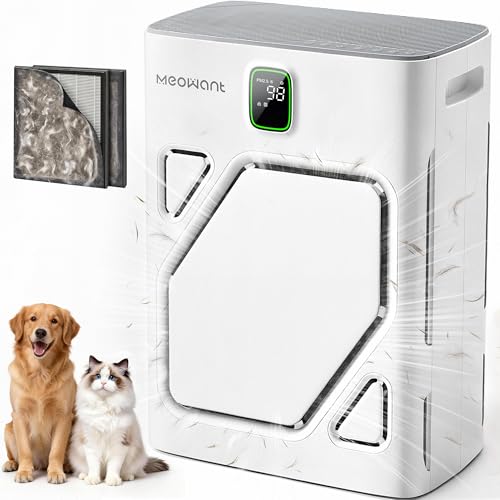
| Meowant Dual-Sided | Two separate H13 HEPA filters rather than one, giving six filtration layers and twice the intake area |
| uahpet Slim | The washable pre-filter aimed specifically at secondary floating fur, plus app control — but no CADR anywhere |
| MOOKA PR1 | The most popular machine here and the one with a dedicated Pet Mode. It also perfumes the air, which is the one feature in this group we would rather it did not have |
Best overall: Levoit Vital 100
| Organic Integrity Score | 94 / 100 |
| CADR | 105 CFM |
| Coverage | 788 sq ft once an hour; approximately 164 sq ft at 4.8 changes |
| Verification | AHAM Verifide, CARB compliant |
| Best for | One room with an animal in it, where you want figures that hold up |
There is something instructive about the fact that the highest scoring machine in a pet purifier comparison does not have the word “pet” in its title.
The Vital 100 publishes a CADR of 105 CFM and states coverage of 788 sq ft once an hour. Multiply 105 by sixty minutes and divide by an eight foot ceiling and you get 787.5. The claims reconcile to within half a square foot, which across every air purifier listing we have audited has happened three times in total.
It carries AHAM Verifide, and the listing explains what that means, including that AHAM is ANSI-accredited and the testing is independent. That is the only third-party performance verification present anywhere in this comparison. The pet-branded machines carry ETL, EPA, FCC, CE and CARB, which between them cover electrical safety, ozone emission and radio interference, and none of which says anything at all about how well the unit cleans air.
On the pet-specific side it is less specialized than the purpose-built units, and honest about it: a three-stage arrangement where “the pre-filter traps hair and large debris”, then the main filter, then carbon for odors and VOCs. There is a pre-filter and it does the pet job; there is no U-shaped intake and no Pet Mode.
The real limitation is size, and it is the reason this is a one-room recommendation. 788 sq ft is the one-air-change figure. At the 4.8 air changes AHAM tests against, this is a 164 sq ft machine, which is a bedroom or a home office, not a living room with two dogs in it. If your pet problem is spread across an open floor, the HEAPETS below has 68% more airflow for less money.
One further caution: the listing warns against off-brand filters, saying they “are unreliable and may damage the air purifier”. Treat that as a running cost note. Levoit filters are widely available but they are the only ones the manufacturer endorses.
- CADR published, and the coverage figure reconciles with it exactly.
- The only AHAM Verifide unit in this comparison.
- Three-stage filtration with a genuine carbon layer for odors.
- By far the most popular machine here, so filters are easy to source.
- Smallest real coverage here at roughly 164 sq ft.
- No anti-matting intake design, so the pre-filter needs more frequent attention in a shedding household.
- Most expensive machine in this comparison despite being the smallest.
- Manufacturer discourages third-party filters.
What we liked: The only AHAM Verifide machine here, with a published 105 CFM CADR, a 24 dB sleep mode and a three-stage filter that starts with a hair pre-filter.
Keep in mind: The pre-filter needs checking every couple of weeks in a shedding household, and there is no dedicated odor bed beyond the carbon layer.
Best for: A bedroom or office shared with an animal, and anyone who wants verified numbers over pet-shaped features.
Best for multiple pets: HEAPETS P358
| Organic Integrity Score | 88 / 100 |
| CADR | 176 CFM, published as “176 CFM (295 m³/h)” |
| Coverage | 2,500 sq ft claimed; 176 CFM supports about 1,320 at one change, 275 at 4.8 |
| Filtration | H13 HEPA, activated carbon, electrostatic washable pre-filter pads |
| Best for | Heavy shedding, multiple animals, and larger rooms |
This is the most transparent listing in the comparison on almost every axis except one, and the exception is a significant one.
Start with what it does better than anyone. It publishes its CADR in both units: “a CADR of up to 176 CFM (295 m³/h)”. We have now audited air purifier listings across mold, smoke and pet use, and this is the only one that has done that. It matters because the two units are routinely confused, and a metric CADR quoted bare looks roughly 1.7 times larger than an imperial one from the same machine. HEAPETS simply removes the ambiguity, and every manufacturer should copy it.
It also names the replacement filter ASINs directly in the bullets, along with the exact filter dimensions, which makes it possible to price the consumables before buying rather than after. It quantifies the pre-filter benefit, extending main filter life from three months to six. And it hedges its odor claim accurately rather than promising elimination, noting results vary with concentration, room size and ventilation.
The intake is the other reason to buy it. The dual-sided U-shaped inlets are a direct answer to fur matting, and the listing explains the mechanism rather than just asserting a benefit. For a heavy shedding household this is the design difference that will still matter in a year.
Now the problem. The 2,500 sq ft coverage claim does not follow from the published CADR. At 176 CFM, one air change an hour supports about 1,320 sq ft with eight foot ceilings, and 2,500 sq ft would require roughly 333 CFM, nearly double what the listing states. Both figures appear in the same bullet. At the 4.8 air changes AHAM tests against, real coverage is closer to 275 sq ft.
We have scored it at 88 rather than lower because the company published the number that exposes the discrepancy. A listing that gives you a CADR and an over-optimistic room size is more useful than one that gives you only the room size, because the first can be checked and the second cannot. But buy it for 275 sq ft, not 2,500.
- Publishes CADR in both CFM and metric, which no other listing we have audited does.
- Dual-sided U-shaped intake genuinely resists fur matting, with the reasoning explained.
- Names replacement filter ASINs and filter dimensions in the listing.
- States plainly that settled hair needs vacuuming, and hedges its odor claim accurately.
- 68% more airflow than the pick above it, at a lower price.
- The 2,500 sq ft claim needs about 333 CFM; the listing publishes 176.
- Real coverage is nearer 275 sq ft at 4.8 air changes.
- No AHAM Verifide or other third-party performance verification.
- Certifications listed cover safety and ozone, not cleaning performance.
What we liked: Dual-sided U-shaped inlets and a pet-specific pre-filter, in a footprint about the size of a sheet of A4, at 25 dB on sleep mode.
Keep in mind: Publishes no CADR, so its coverage claim cannot be checked, and the carbon layer only “helps adsorb some” litter odor by its own wording.
Best for: A multi-pet household or a larger room, sized honestly at around 275 sq ft.
Best filter architecture: Meowant Dual-Sided Intake
| Organic Integrity Score | 76 / 100 |
| Filtration | Six layers including two H13 HEPA filters and granular activated carbon |
| CADR | Not published |
| Coverage | Not stated anywhere in the listing |
| Best for | Litter box odor, if you can accept an unstated room size |
On filter design this is the most thoughtful listing here, and one sentence explains why we rate it. Meowant specifies “an activated carbon filter instead of carbon cotton“.
That distinction is the single most useful thing a purifier listing can tell an owner of a litter tray. Carbon cotton is a fabric with carbon dust bonded to it and it holds very little; granular activated carbon is a bed with real capacity. Most budget purifiers use the former and describe it simply as “activated carbon”, which is technically true and practically misleading. Meowant is the only manufacturer here to draw the line explicitly, and it is drawing it against its own competitors in this comparison.
The rest of the architecture follows the same logic. Two H13 HEPA filters rather than one, multi U-shaped inlets for the same anti-matting reason HEAPETS gives, and washable electrostatic pre-filters that can be vacuumed or rinsed, extending main filter life to six months.
It also gives the practical warning that matters most on first use, which is to remove the plastic packaging from the filters before running it. A purifier that appears to do nothing on day one has usually been run with the wrappers on, and few listings mention it.
What holds it at 76 is that there is no CADR and no coverage figure at all. Not an optimistic one, not a vague one. The listing describes a six-stage system that “rapidly refreshes the air in minutes” without ever saying how much air or in what size room. Everything we can praise here is architecture, and architecture without airflow does not tell you whether the machine suits your space.
Like the AZEUS unit in our smoke comparison, this listing is also filed on Amazon under kitchen rather than home, which is a small sign of a listing that has not been closely tended.
- The only listing to distinguish real activated carbon from carbon cotton.
- Two H13 HEPA filters and multi U-shaped anti-matting inlets.
- Washable electrostatic pre-filters extending main filter life to six months.
- Warns you to unwrap the filters before first use.
- No CADR and no coverage figure of any kind.
- “Refreshes the air in minutes” is not a quantity.
- No third-party performance verification.
- Filed under the wrong Amazon category, suggesting a loosely maintained listing.
What we liked: Two separate H13 HEPA filters rather than one, giving six filtration layers and twice the intake area, with a real-time PM2.5 display.
Keep in mind: Two filters means two filters to replace, and no CADR is published for the doubled airflow claim.
Best for: A litter box room, where carbon quality matters more than a stated square footage.
Good pre-filter, no numbers: uahpet Slim
| Organic Integrity Score | 72 / 100 |
| Coverage claimed | 2,100 sq ft, with no CADR to check it against |
| Filtration | H13 HEPA, activated carbon, washable pre-filter |
| Verification | ETL, EPA, FCC, CE, CARB, CA65; no performance certification |
| Best for | Buyers prioritizing low filter cost over a stated airflow |
The pre-filter argument here is well made and, we think, correct. uahpet describes the pre-filter as capturing hair and dander “before air reaches the HEPA filter, reducing repeated dispersal of fur indoors”, and claims it extends HEPA life “by over 50%”. That is consistent with what Meowant and HEAPETS claim independently, and the underlying mechanism is sound.
The carbon and H13 stages are appropriate, and the placement advice is genuinely useful: put it near the litter box or the pet’s resting area rather than in the middle of the room, because the source is localized.
The difficulty is that this machine costs the same as the HEAPETS while publishing considerably less. There is a 2,100 sq ft coverage claim and no CADR anywhere, so unlike the HEAPETS figure, this one cannot even be checked and found optimistic. It has to be taken on trust.
The certification list is long and worth reading carefully, because its length is doing some work. ETL is electrical safety, FCC is radio interference, CE is European market conformity, CARB is the California ozone limit and CA65 is a chemical disclosure requirement. Every one is worth holding. Not one of them is a test of how well the unit cleans air. In a category where AHAM Verifide exists and one competitor carries it, a long list of safety marks is not a substitute.
- Washable pre-filter with a quantified benefit, consistent with rival claims.
- H13 HEPA with a genuine activated carbon stage.
- Sensible, specific placement advice near the litter box or resting area.
- One year full-unit replacement plan.
- No CADR, so the 2,100 sq ft claim cannot be checked at all.
- Same price as the HEAPETS while publishing far less information.
- Long certification list, none of which covers cleaning performance.
- Conventional intake rather than an anti-matting design.
What we liked: A washable pre-filter aimed specifically at secondary floating fur, plus app control and genuinely quiet running.
Keep in mind: No CADR and no coverage verification anywhere, which is why it sits below the machines that publish numbers.
Best for: Multi-pet households focused on filter running cost, who accept an unverifiable coverage figure.
Most popular, and it perfumes the air: MOOKA PR1
| Organic Integrity Score | 66 / 100 |
| Coverage claimed | 2,200 sq ft, with no CADR to check it against |
| Filtration | 4-stage with washable pre-filter; Pet Mode; PM2.5 sensor |
| Verification | CARB, ETL, DOE, FCC; explicitly no ozone and no UV |
| Best for | Budget buyers who will leave the aroma pad dry |
This is by a wide margin the best selling machine in the comparison, and it does several things we like. The washable pre-filter is there, the PM2.5 sensor and auto mode are there, sleep mode runs at 26dB, and there is a child lock.
Most notably, MOOKA states outright: “No ozone release, No UV light.” In a category where ionizers and germicidal lamps are routinely added as premium-sounding features that mainly create ozone, saying plainly that the machine does neither is a genuine mark in its favor, and it is the reason this listing scores as well as it does despite publishing no airflow figure.
The Pet Mode is a fan speed profile rather than a filtration change, which is fine and is more or less what the listing says.
Two things pull the score down. The first is the familiar one: a 2,200 sq ft claim with no CADR, so nothing can be checked.
The second is the aroma function. The listing suggests moistening an essential oil pad so the unit can “bring a pleasant aroma to the room or cover up an unpleasant smell”. Essential oils are volatile organic compounds, which is precisely the class of thing the carbon stage is there to remove. Running the aroma pad means the machine is emitting VOCs from one part of itself and adsorbing them in another, consuming carbon capacity you would rather spend on the litter tray. And covering an odor is not removing it. The feature is easy to ignore, and we would ignore it.
One smaller note in the listing’s favor: it explains that the indicator light flashes for a minute at power-on during preheating, which will save some owners an unnecessary return.
- States explicitly that it releases no ozone and has no UV lamp.
- Washable pre-filter, PM2.5 sensor, auto mode and child lock.
- 26dB sleep mode, genuinely quiet for a bedroom.
- Cheapest machine here and the best selling by a wide margin.
- 2,200 sq ft claimed with no CADR published to support it.
- Aroma pad adds VOCs to air the carbon stage is trying to clean.
- “Cover up an unpleasant smell” is masking, not filtration.
- No third-party performance verification.
What we liked: The most popular machine here, with a dedicated Pet Mode, six fan speeds and a PM2.5 sensor at the lowest price in the group.
Keep in mind: It perfumes the air. Adding fragrance to a machine bought to remove airborne compounds is the one feature we would rather it did not have.
Best for: A budget bedroom purifier for a pet household, with the aroma pad left empty.
What we left out and why
We left out the EVALIT ET066, which claims 2,200 sq ft coverage with no CADR, names no certifications at all in its feature bullets, and includes the same essential oil diffuser feature. In a comparison where several units at the same price publish more, an absence of any named certification was decisive.
We excluded units whose odor claim rested on an ionizer. Charging particles so they clump and fall out of the air removes them from your measurement rather than from your room, and they land on the surfaces where a pet household already has an allergen problem.
We left out purifiers advertising “HEPA-type” or “HEPA-style” filters, which are not HEPA, and any unit where the pre-filter was not user-removable, because in a shedding household that turns a cleanable component into a disposable one.
We also left out several duplicate listings. The pet purifier category has an unusual number of near-identical products sold under different brand names, occasionally with identical feature text and identical sales rank, and there is no value in reviewing the same machine twice.
How to set one up in a pet household
Placement matters more here than in most categories, because the source is mobile, localized, and close to the floor.
- Put it where the animal actually spends its time, not in the middle of the room. A bed, a favorite chair, or the litter tray is the source, and capture falls off quickly with distance.
- Keep it off the floor if the unit draws from the sides, but low enough to catch dander before it settles. A low table is usually the compromise.
- Leave clearance on every intake face. A dual-sided unit pushed against a wall has lost half its intake, which is the whole feature you paid for.
- If the litter tray is in a bathroom or utility room, treat that as its own room and give it its own machine rather than hoping one unit serves both.
- Unwrap the filters. Nearly every unit ships with the filter sealed in plastic inside the housing, and this is the most common reason a new purifier seems to do nothing.
- Vacuum the room thoroughly first, including soft furnishings. The purifier handles the airborne fraction; the settled load is yours.
- Run it on high for the first few hours, then settle to a continuous lower speed.
- Note the date on the filter itself with a marker. Filter indicators count hours, not fur.
- Check the pre-filter every two weeks in a shedding household. This is the single highest-value habit in this guide.
- Vacuum or rinse it depending on type. If you rinse, let it dry completely before refitting, because a damp pre-filter in a warm machine grows exactly what you are trying to remove.
- Replace the main filter when the odor returns, not when the light says so. Carbon saturates before HEPA clogs.
- Wipe the intake surfaces themselves. Fur mats across the openings, not just on the filter behind them.
What it costs to run
In a pet household the filter schedule, not the purchase price, decides what the machine costs you. Fur loads a pre-filter faster than any other domestic particle, and a saturated pre-filter starves the expensive cartridge behind it.
Two conclusions follow. The first is that a washable pre-filter is worth more in a pet household than anywhere else, and it is worth paying a premium for one that is genuinely removable and rinseable rather than a mesh you are expected to vacuum in place.
The second is that HEAPETS’ approach of naming the replacement filter ASINs directly in the listing deserves to become standard. Consumable cost is a large fraction of the total cost of ownership in this category, and it is almost always invisible until after purchase.
Living with a purifier and an animal
The machine is not the cleaning plan. Most of the allergen in a pet household is settled on fabric within a few hours of being shed. Vacuuming and washing bedding does the larger share; the purifier handles what is in the air right now and what gets stirred back up.
Expect the pre-filter to be the maintenance item. In a house without animals it is an afterthought. With a shedding dog it is the component that decides whether the machine is working.
Run it continuously on a low speed. Shedding is constant, so the load is constant. Intermittent bursts on high let the concentration climb back between runs.
Don’t chase the odor with fragrance. Masking a litter tray smell means you stop noticing the signal that tells you the carbon is spent.
One room, properly. Purifiers do not work through doorways. A machine in the hallway is serving neither the bedroom nor the living room.
Ceiling height quietly reduces every figure on this page. All the coverage arithmetic assumes eight feet. A room with a vaulted ceiling is a larger volume than its floor area suggests.
Questions about air purifiers for pets
Do air purifiers actually help with pet allergies?
They help with the airborne fraction, which is real but is the smaller share. Cat and dog allergens are proteins carried on dander that settles onto fabric within hours, so most of the load in a room is on the sofa and the bedding rather than in the air. A purifier plus regular vacuuming and washing works; a purifier alone is doing part of the job.
Is a “pet air purifier” different from a normal one?
In one respect, genuinely yes. Fur mats across a conventional intake grille and blocks airflow in a way ordinary dust does not, so a washable pre-filter and an intake shaped to resist matting are real engineering answers to a real problem. Beyond that, a Pet Mode is usually a fan speed profile, and the filtration is the same HEPA and carbon arrangement as any other purifier.
Why do so few pet purifiers publish a CADR?
We do not know, but the pattern was consistent: of six listings we read in full, only two published an airflow figure, and one of those was a general purpose machine not marketed at pet owners. Without a CADR a coverage claim cannot be checked, which makes it the first thing to look for.
Does a HEPA filter remove litter box smell?
No. HEPA traps particles, and odor is gas phase, so it passes straight through. Only activated carbon removes it. Look for a listing that specifies genuine granular activated carbon rather than carbon cotton, which is a fabric with carbon dust on it and holds far less.
How often should I clean the pre-filter?
Every two weeks in a shedding household, which is considerably more often than the manuals suggest. This is the highest-value maintenance habit in the category, because a matted pre-filter starves the main filter of airflow while the indicator light still reads healthy.
What size air purifier do I need for a room with pets?
Take the CADR in CFM and multiply by 1.56 for genuine coverage at 4.8 air changes an hour. So 105 CFM covers about 164 sq ft and 176 CFM covers about 275 sq ft, whatever the larger figures in the titles say. If no CADR is published, you have nothing to size with.
Should I use the aroma or essential oil function?
We would leave it empty. Essential oils are volatile organic compounds, the same class of thing the carbon stage exists to remove, so the machine ends up emitting and adsorbing at the same time and consuming carbon capacity you need for the litter tray. Masking an odor also removes the signal that tells you the carbon is spent.
Will an air purifier stop pet hair collecting on the floor?
No, and one manufacturer here says so directly. A purifier captures hair while it is airborne. Hair that has already landed on floors, sofas and bedding needs vacuuming, and that settled load is the larger part of the problem in most homes.
Do I need one purifier per room?
If you have pets in more than one room, effectively yes. Purifiers do not work through doorways, and coverage figures assume a closed space. One machine in a hallway serves neither adjoining room properly.
Is an ionizer useful for pet dander?
We would avoid it. Ionizers charge particles so they clump and drop out of the air, which removes them from a sensor reading but deposits them on the surfaces where a pet household already has its allergen problem. They can also generate ozone, in rooms where animals sit at floor level.
Organic Connection is reader supported. We read every product listing in full, check the arithmetic in it, and say plainly when a claim cannot be verified. How we research and rate.