Last updated: September 30, 2026
We may earn a commission when you buy through links on this page, at no extra cost to you. How we research and rate.
The short version
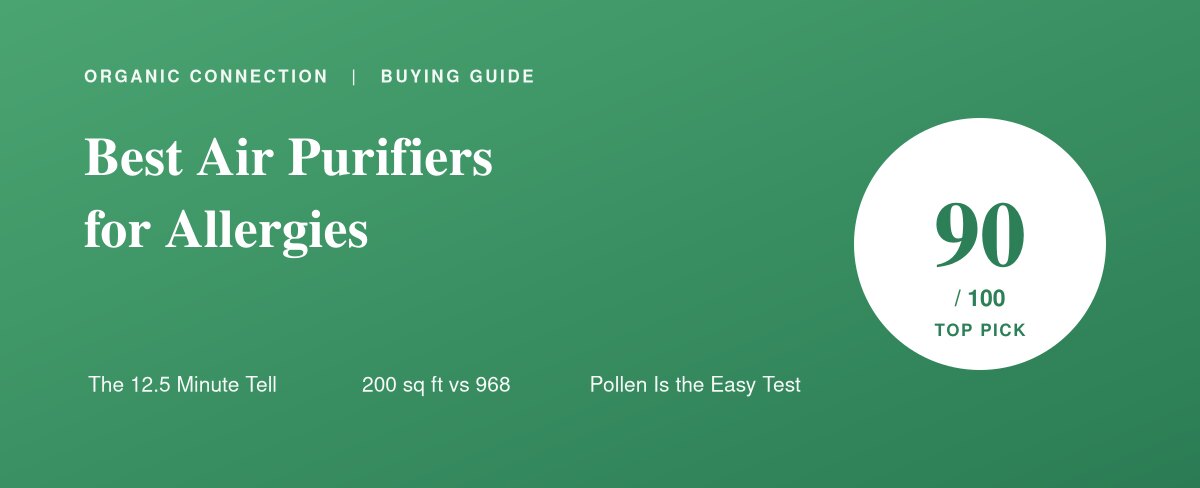
Scoring the listings rather than the labels, our top pick is Honeywell PowerPlus HPA3100, with our highest Organic Integrity Score of 90 out of 100. Blueair Blue Pure 511 is the runner-up at 88.
Our top pick is the Honeywell PowerPlus HPA3100, with an Organic Integrity Score of 90 out of 100, and it is a peculiar recommendation because the thing that makes it the best listing here also makes it the most self-contradictory.
Honeywell’s own feature bullet says the unit “circulates air 4.8 times/hr (115 times a day) for 200 sq ft of true room cleaning coverage”, and then adds, unprompted: “other brands may inflate room size claims with only 1-2 air changes per hour.”
That is a manufacturer publicly accusing its competitors of the exact practice we documented across this category. It is also, word for word, correct. The awkward part is what Honeywell put in its own product title: 968 Ft² Rooms. Which is 200 sq ft multiplied by 4.8.
Best air purifiers for allergies compared
 |  |  |  |  | |
| Model | Honeywell PowerPlus HPA3100 | Blueair Blue Pure 511 | GermGuardian AC4825 | Airtok AP3001 | ECOSELF |
| Organic Integrity Score | 90/ 100 | 88/ 100 | 82/ 100 | 68/ 100 | 50/ 100 |
| Our rating | 4.5 | 4.4 | 4.1 | 3.4 | 2.5 |
| Coverage at 4.8 changes | 200 sq ft, stated | 180 sq ft, stated | 153 sq ft, stated | 385 sq ft, stated | Not stated |
| Coverage in title | 968 sq ft | 432 sq ft | Not in title | 1,848 sq ft | 1,800 sq ft |
| Publishes the 12.5 min figure | Yes, as 4.8×/hr | Yes | Yes | States 4.8x | No |
| CADR published | No | No | No | 280 m³/h, does not reconcile | No |
| Independent verification | AHAM Verified | Energy Star Most Efficient | CARB, ETL, Zero Ozone Verified | CARB; lab unnamed | None named |
| Ozone-generating stage | No | No | Optional UV-C | No | Not stated |
| Fragrance function | No | No | No | Yes, diffuser | No |
| Best for | Bedroom, and anyone | Bedroom or nursery | Small bedroom | Budget buyers who size | Not our recommendation |
| Price | $69.99 View on Amazon | $99.99 View on Amazon | $80.74 $99.99 −19% View on Amazon | $59.99 View on Amazon | $99.99 View on Amazon |
- Clean Air and Water hub
- our organic product database — compare brands across every guide
- Air purifier vs humidifier, explained
Price and availability as of October 12, 2026 1:10 am EDT. Product prices and availability are accurate as of the date/time indicated and are subject to change. Any price and availability information displayed on Amazon.com at the time of purchase will apply to the purchase of this product.
Reading the seals on air purifiers for allergies: what each one does and does not cover
Seals accumulate on a package faster than meaning does. This is what each of the marks you will see here certifies, and what it leaves out.
| Certification | Covers | Key exclusion |
| AHAM Verifide | Independently verifies an air purifier CADR figure and its stated room coverage | Verifies the performance numbers, not the filter chemistry or the materials |
| Energy Star | Energy efficiency measured against EPA thresholds for the product class | Efficiency only; no bearing on materials, filtration or air quality |
The 12.5 minute tell
Once you know to look for it, the honest listings identify themselves.
Independent testing rates a purifier’s suggested room size at 4.8 air changes per hour, which works out to one complete change every twelve and a half minutes. Manufacturers are free to quote coverage at one air change per hour instead, which produces a number 4.8 times larger for exactly the same machine. Nothing requires them to say which they used.
But the ones that use the honest figure tend to say so, and they say it the same way. Three separate manufacturers in this comparison, with no reason to coordinate, publish the identical interval:
Honeywell: “circulates air 4.8 times/hr (115 times a day) for 200 sq ft of true room cleaning coverage”.
Blueair: “cleans up to 432 sq ft spaces in 30 minutes or 180 sq ft small rooms in 12.5 minutes”, and separately, “delivering 4.8 air changes per hour”.
GermGuardian: “circulates and filters air in a small bedroom (153 sq. ft.) every 12.5 minutes and large spaces (743 sq. ft.) every hour”.
In each case the smaller figure is the one with testing behind it. GermGuardian’s two numbers sit in a ratio of 4.86. Honeywell’s sit at 4.84. Blueair’s title figure of 432 sq ft turns out to be its thirty minute number, roughly 2.4 times its 180 sq ft honest figure, which makes Blueair the most conservative of the three in how far it stretches.
So the shopping heuristic is: find the smallest square footage in the listing, and buy for that one. If the listing contains only one square footage and no interval, no air change rate, and no CADR, you are looking at the flattering number with nothing to check it against.
Pollen is the flattering CADR, and allergy marketing knows it
There is a second place where allergy buyers get the optimistic figure, and it is more specific to this category than to any other.
Clean Air Delivery Rate is published as three separate numbers, for smoke, dust and pollen, and they always come in the same order. Levoit’s Core 300-P: 143 smoke, 153 dust, 167 pollen. Its Core 400S-P: 231, 240, 259. Coway’s Airmega Mighty2: 240 smoke, 242 dust, 249 pollen.
Pollen is normally the highest of the three, because pollen grains are large, from about 10 to 100 microns, and a filter catches them almost trivially. Smoke is normally the lowest, because smoke particles are near the size at which mechanical filtration works hardest. The pattern held in every listing above, and we have found one exception: Coway’s largest model publishes dust 580, smoke 567 and pollen 450, which makes pollen its lowest figure rather than its highest. We discuss that oddity in our guide to the best air purifiers for large rooms.
The consequence for anyone shopping for allergies: a product marketed at allergy sufferers, quoting a single unlabeled CADR, is almost certainly quoting the pollen figure. That is the number that makes the machine look strongest, and it is a real measurement, and it is the least demanding of the three tests.
This matters because most allergy sufferers are not only reacting to pollen. Dust mite allergen and pet allergen are both smaller and behave differently, and if you want a single figure that tells you whether a machine is capable, the smoke CADR is the conservative one to compare on. We cover how that number gets misreported in our guide to the best air purifiers for smoke.
What a purifier does about allergies, and what it does not
Pollen is genuinely an air problem, and this is the allergen a purifier handles best. Grains enter on clothing, hair and open windows, circulate, and a HEPA filter removes them efficiently. During a high pollen week a purifier in a closed bedroom does measurable good.
Dust mites are a different matter, and the distinction is worth understanding before you spend anything.
Dust mites live in your mattress, your pillow and your carpet, and the allergen is in their droppings, which are heavy particles that settle within minutes of being disturbed. They do not float around waiting to be filtered. They become airborne when you turn over in bed, sit down on the sofa, or vacuum, and then they fall back out of the air quickly.
A purifier captures that fraction while it is up, which is worth something, especially overnight. But the reservoir is in the bedding, and the interventions that actually reduce a dust mite problem are washing bedding weekly at high temperature, allergen-proof mattress and pillow covers, and keeping bedroom humidity below about 50%, because mites cannot survive dry air.
We say this plainly because several listings in this category imply that a purifier addresses dust mites, and what it addresses is the airborne fraction of their droppings during the minutes after disturbance.
The same logic applies to pet allergen, which settles onto fabric within hours; we go into that in our guide to the best air purifiers for pets.
Where to put it, and why it is the bedroom
If you are buying one purifier for allergies, put it in the bedroom, and the reason is arithmetic rather than preference.
You spend roughly a third of your life in that room, continuously, with the door shut and your face close to the surfaces holding the most allergen. No other room in the house gives a single machine that much contact time with one person’s breathing.
It also happens to be the room where a purifier’s coverage figure is most likely to be adequate. A bedroom is small, and 180 to 200 sq ft of genuine coverage, which is what the honest machines in this comparison deliver, is a bedroom-sized number. The same machine in an open plan living area is being asked to do something it cannot.
Noise consequently matters more here than in any other use case. Every coverage figure on this page is measured at maximum fan speed, and a purifier you turn down to sleep is no longer covering the room it was rated for. This is the one category where a genuinely quiet high setting is worth paying for, and it is why the Blueair and the Levoit-style 24dB sleep modes keep appearing in allergy recommendations.
What we looked for
We read every feature bullet in full and scored on what each manufacturer put in writing.
A stated air change rate, or the 12.5 minute interval. The single best indicator that a listing is quoting a tested figure rather than a marketing one.
A CADR with its units. Metric and imperial CADR figures differ by a factor of 1.699 and are routinely quoted bare, which makes an unlabeled number in the high hundreds look far stronger than it is.
Internal consistency. Where a listing gives both a CADR and a coverage figure, the two should agree. We checked all of them.
No ozone. More important here than anywhere else, because an ionizer or UV lamp in a bedroom is adding a respiratory irritant to a room occupied by someone with irritated airways for eight hours a night.
Honesty about dust mites, since the reservoir is in the bedding rather than the air.
The trade-offs of an air purifier for allergies
A HEPA purifier is genuinely effective against airborne allergens and genuinely powerless against most of the allergen in your house. Both halves matter when you set expectations.
| In its favor | Against it | |
| What it does | Mechanical HEPA filtration removes pollen, dust mite debris and dander from the air it processes, with no byproducts | Most allergen in a home is settled in carpet, bedding and upholstery. A purifier never touches it until it is disturbed |
| Evidence | CADR and AHAM Verifide give you a third-party number for exactly this job | Coverage claims are often calculated at one air change per hour, where allergy guidance assumes four or more |
| Running it | Continuous operation on a low speed beats bursts on high, and is quieter | It has to run continuously, which means filter cost and a machine you hear |
| Bedroom effect | The single highest-value placement, because you spend eight uninterrupted hours there | Only helps the room it is in. A whole-house effect needs a machine per room |
| Safety | A pure mechanical filter emits nothing at all | Purifiers that add ionization can generate ozone, an irritant that is the last thing an inflamed airway needs |
The honest framing: a purifier is one part of an allergen plan, alongside washing bedding hot, vacuuming with a sealed machine and reducing soft furnishings. It is the part that handles what is airborne right now.
What actually separates these five
All five are HEPA machines in the same price band. The differences are in what each one is willing to have measured.
| Pick | What only this one does |
| Honeywell HPA3100 | States its air changes explicitly — 4.8 per hour, 115 a day — which is the AHAM convention rather than the flattering one, and it is AHAM Verified |
| Blueair Blue Pure 511 | Claims 99.97% down to 0.1 micron, a finer threshold than the 0.3 micron figure everyone else quotes, and is certified Energy Star Most Efficient |
| GermGuardian AC4825 | The most complete certification list in this cluster: CARB Certified, ETL Certified and Zero Ozone Verified, all named. It also gives room times for two room sizes rather than one |
| Airtok AP3001 | States both coverage conventions, which is unusually transparent — then publishes a CADR that does not reconcile with either |
| ECOSELF | 360-degree intake and a real-time PM2.5 sensor, and the largest coverage claim here with the least published to support it |
Best overall: Honeywell PowerPlus HPA3100
| Organic Integrity Score | 90 / 100 |
| True coverage | 200 sq ft at 4.8 air changes per hour, stated |
| Coverage in title | 968 sq ft |
| Verification | AHAM Verified performance |
| Best for | A bedroom, and anyone who wants the honest number stated outright |
The first feature bullet on this listing does something we have not seen any other manufacturer do. It gives the honest figure, explains the standard behind it, and then names the practice it is competing against: “Circulates air 4.8 times/hr (115 times a day) for 200 sq ft of true room cleaning coverage; other brands may inflate room size claims with only 1-2 air changes per hour.”
Every part of that is accurate. The 4.8 rate is the tested one. The 115 changes a day is simply 4.8 times 24. “True room cleaning coverage” is a fair description of 200 sq ft. And the accusation about competitors is, on the evidence of this comparison and the three that preceded it, entirely justified.
Honeywell also states plainly that its purifiers are “AHAM Verified performance”, which is the only genuine third-party performance verification present in this comparison. The carbon pre-filter arrangement handles odors alongside the HEPA stage.
Now the contradiction, which we cannot ignore and which costs it the points that would otherwise have made this the highest scoring air purifier we have reviewed. The product title says “968 Ft² Rooms”. That is 200 multiplied by 4.8 and rounded, which is to say it is exactly the kind of number the bullet warns you about, on the same page, from the same company.
We have scored it at 90 because both numbers are published and the honest one is given first, with its methodology attached. A buyer who reads the bullets gets the truth. A buyer who reads only the title, which is what appears in search results, gets 968. Honeywell is criticizing a practice it is participating in, and the criticism is still useful.
Two further limits. No CADR is published anywhere, so this machine cannot be compared against a brand using a different convention. And the “over 99.99%” filtration claim carries a double asterisk whose footnote is not in the bullets we read, so we treat it as unverified.
- States true coverage at 4.8 air changes and explains the arithmetic.
- The only listing anywhere in our air audits to name room size inflation as a practice.
- AHAM Verified performance, the only third-party performance mark here.
- Carbon pre-filter for odors alongside the HEPA stage.
- Cheapest of our three recommended picks.
- Its own title uses the inflated 968 sq ft figure it criticizes.
- No CADR published, so it cannot be compared across brands.
- The 99.99% claim carries an unresolvable asterisk.
- 200 sq ft is a bedroom, not a living room.
What we liked: States its air changes the conservative way — 4.8 per hour, the AHAM convention — carries AHAM Verified performance, and pairs HEPA with a carbon pre-filter.
Keep in mind: The carbon layer is a pre-filter rather than a substantial bed, so it handles light odor rather than persistent smells.
Best for: A bedroom, bought at its stated 200 sq ft rather than its titled 968.
Most conservative claims: Blueair Blue Pure 511
| Organic Integrity Score | 88 / 100 |
| True coverage | 180 sq ft in 12.5 minutes, at 4.8 air changes per hour, stated |
| Coverage in title | 432 sq ft, which is its 30 minute figure |
| Verification | Energy Star Most Efficient |
| Best for | A bedroom or nursery where noise and running cost matter |
Blueair stretches its numbers less than anyone else here, and that is the main reason to buy it.
The listing gives 432 sq ft in thirty minutes and 180 sq ft in twelve and a half, and separately confirms “4.8 air changes per hour”. The title figure of 432 is therefore its two-air-change number, not its one-air-change number. The gap between Blueair’s headline and its honest figure is about 2.4 times, against roughly 4.8 for most of this category. Where other manufacturers reach for the largest defensible number, Blueair reached for a middling one.
The Energy Star Most Efficient designation is meaningful in this category in a way it is not in most. An allergy purifier runs continuously, all night, for months, so the difference between an efficient and an inefficient machine is a genuine line on a bill rather than a rounding error. Blueair’s claim to use “less energy than a light bulb” while delivering 4.8 air changes an hour is the sort of claim that Energy Star certification actually backs.
For a bedroom the 24dB low speed matters, and the washable pre-filter, which Blueair sells in several colors as a design feature, is also the component that extends the life of the main filter. Two-stage HEPASilent filtration is claimed at 99.97% down to 0.1 microns.
The limits are size and information. At 180 sq ft this is the smallest genuine coverage in the comparison, which is fine for a bedroom or nursery and inadequate for anything larger. No CADR is published. And the 0.1 micron figure, like several in this category, is not the 0.3 micron point at which HEPA filters are conventionally rated, so it is not directly comparable with a competitor quoting the standard figure.
- Smallest gap between headline and honest coverage of any listing here.
- States both the 12.5 minute interval and the 4.8 air change rate explicitly.
- Energy Star Most Efficient, which matters for a machine that runs continuously.
- 24 dB on low, genuinely quiet for a bedroom or nursery.
- Washable pre-filter that extends main filter life.
- 180 sq ft is the smallest real coverage in this comparison.
- No CADR published.
- The 0.1 micron claim is not the standard 0.3 micron rating point.
- Most expensive machine here despite being the smallest.
What we liked: Claims 99.97% down to 0.1 micron, a finer threshold than the 0.3 micron everyone else quotes, and it is certified Energy Star Most Efficient.
Keep in mind: One of the smaller machines here, so it suits a bedroom rather than an open floor, and the filter is a proprietary Blueair part.
Best for: A bedroom or nursery, where quiet operation and running cost outweigh raw coverage.
Best certification detail: GermGuardian AC4825
| Organic Integrity Score | 82 / 100 |
| True coverage | 153 sq ft every 12.5 minutes; 743 sq ft every hour, both stated |
| Verification | CARB Certified, ETL Certified, Zero Ozone Verified |
| Filtration | HEPA PURE filter, activated carbon, optional UV-C |
| Best for | A small bedroom, with the UV-C lamp switched off |
This listing states both of its coverage figures in a single sentence, which is the disclosure standard we have been arguing for throughout: 153 sq ft every twelve and a half minutes, and 743 sq ft every hour. The ratio is 4.86, and the smaller number is the one to buy on.
Its certification line is the most precise in the comparison. “CARB Certified, ETL Certified, and Zero Ozone Verified” names three distinct things, and Zero Ozone Verified is a specific designation rather than a general reassurance. In a category where ionizers and UV lamps are routinely added and ozone is the quiet cost of both, a manufacturer explicitly holding a zero ozone verification is telling you something worth knowing.
Which makes the UV-C lamp an odd inclusion, and it is the main reason this sits below the two above it. The listing describes it as optional, and it should be treated as exactly that. Germicidal light in a fast-moving airstream has very little contact time, allergens such as pollen and dust mite droppings are not alive and cannot be killed, and the replacement bulbs are an ongoing cost. The Zero Ozone verification means the lamp is not creating an ozone problem, which is genuinely reassuring; it does not mean the lamp is doing much.
The activated carbon stage is credited for cooking and pet scents, which is honest scoping, and the filtration claim of 99.97% of allergens is asterisked twice with footnotes we could not resolve from the bullets, so we treat the specifics as unverified.
At 153 sq ft this is the smallest genuine coverage figure in the comparison and it is an old, long-established model, which cuts both ways: filters are cheap and universally stocked, and the design predates most of its rivals.
- States both the 12.5 minute and the hourly coverage figures in one sentence.
- Zero Ozone Verified, a specific designation rather than a vague reassurance.
- CARB and ETL certified, and independently tested in the USA.
- Long-established model, so filters are cheap and easy to find.
- UV-C lamp adds a consumable that does little against pollen or mite allergen.
- 153 sq ft is the smallest true coverage here.
- No CADR published.
- Filtration percentages carry asterisks we could not resolve.
What we liked: The most complete certification list in this cluster: CARB Certified, ETL Certified and Zero Ozone Verified, all named, with room times given for two room sizes.
Keep in mind: An older design that is taller and louder than the newer machines, and the UV-C stage adds little for allergens specifically.
Best for: A small bedroom on a budget, with the UV-C left off and the savings spent on filters.
States both conventions, then contradicts its own CADR: Airtok AP3001
| Organic Integrity Score | 68 / 100 |
| Coverage claimed | 1,848 sq ft hourly, or 385 sq ft at 4.8 changes |
| CADR | 280 m³/h ±10%, which is about 165 CFM |
| The problem | 165 CFM supports about 1,236 sq ft hourly, not 1,848 |
| Best for | Budget buyers who size it at roughly 260 sq ft rather than 385 |
This listing gets the hard part right and then undoes it, which is frustrating because it was most of the way to a good score.
The good part: Airtok states both conventions explicitly, and states them correctly relative to each other. “Rooms up to 1848 sq. ft once per hour, means purify the air with 4.8x per hour in the rooms up to 385 sq. ft.” Divide 1,848 by 4.8 and you get 385. The internal logic is sound and the disclosure is better than most machines costing three times as much.
It also publishes a CADR, with a tolerance band, which almost nobody at this price does: “CADR: 280m3/H ±10%”.
The trouble is that the CADR does not support the coverage figures. 280 cubic meters per hour converts to about 165 CFM. At 165 CFM, one air change an hour covers roughly 1,236 sq ft with eight foot ceilings, not 1,848, and 4.8 changes covers roughly 257 sq ft, not 385. Reaching 1,848 sq ft would need about 246 CFM, or 418 m³/h, half as much again as the published figure.
So all three numbers are in the listing, two of them agree with each other, and the third contradicts both. Our reading is that the coverage figures were calculated from a more optimistic airflow than the one published. Size this machine at around 260 sq ft.
Two further marks against. The CADR is given in metric with no unit clarification beyond “m3/H”, which invites exactly the confusion we documented elsewhere, where a bare metric figure looks about 1.7 times stronger than an imperial one. And there is a built-in aromatherapy diffuser, which adds volatile organic compounds to air the carbon stage is meant to be removing them from. Leave it dry.
The washable pre-filter and three-stage design are sound, the 20 to 24dB sleep mode is genuinely quiet, and “Disclaimer: Independently lab-tested” names no laboratory, no standard and no result.
- States both coverage conventions explicitly and consistently with each other.
- Publishes a CADR with a tolerance band, which is rare at this price.
- Washable pre-filter and a genuine activated carbon stage.
- 20 to 24 dB sleep mode and cheapest machine in the comparison.
- The published CADR supports about 1,236 sq ft hourly, not the 1,848 claimed.
- Real coverage at 4.8 changes is nearer 257 sq ft than the stated 385.
- CADR quoted in metric without clarification.
- Aromatherapy diffuser works against the carbon stage.
- “Independently lab-tested” names no lab, standard or result.
What we liked: Unusually transparent in stating both coverage conventions rather than only the flattering one, with a 3-stage filter and a real air quality sensor.
Keep in mind: The CADR it publishes does not reconcile with either coverage figure, which is the reason it sits mid-table rather than higher.
Best for: Budget buyers willing to size it from its CADR rather than its coverage claim.
A large claim and nothing else: ECOSELF
| Organic Integrity Score | 50 / 100 |
| Coverage claimed | 1,800 sq ft, with no air change rate and no CADR |
| Filtration described | Nothing in the feature bullets we read |
| Certifications named | None |
| Best for | Not our recommendation for an allergy problem |
This is a well-ranked, reasonably priced purifier whose feature bullets are almost entirely about its display.
They describe the PM2.5 sensor, the automatic fan response, the real-time readings and a color ring that shifts from green to blue to amber to red. All of that is fine, and a sensor with a clear readout is a useful thing to have.
What the bullets never describe is the filter. There is a claim of 1,800 sq ft in the title and, in the text we read, no HEPA grade, no filter stages, no micron rating, no carbon description, no CADR, no air change rate, and no named certification of any kind. Not CARB, which is close to universal on Amazon and whose absence from a listing is conspicuous.
We want to be careful about what that does and does not establish. It does not prove the machine performs badly, and we do not test. It means that on the evidence of its own listing, there is nothing here to evaluate. Every other product on this page told us something we could check, and several of them failed those checks in interesting ways. This one offers no surface at all.
For allergies specifically, where the whole question is whether the machine turns over your bedroom’s air often enough, a coverage claim with no air change rate attached is the one number that cannot be interpreted.
- PM2.5 sensor with a clear color-coded readout.
- Auto mode that responds to measured particle levels.
- Competitively priced and well ranked.
- No filter description of any kind in the feature bullets.
- 1,800 sq ft claimed with no air change rate and no CADR.
- No certifications named, not even CARB.
- Nothing in the listing can be independently checked.
What we liked: 360-degree intake, a real-time PM2.5 sensor and a genuinely dark, quiet sleep mode.
Keep in mind: The largest coverage claim here with the least published behind it — no CADR, no AHAM verification, no test standard named.
Best for: Buyers who want an air quality display and are not relying on the coverage figure.
What we left out and why
We left out the Levoit Core 300-P, despite it being among the best documented listings in this category, because it is the top pick in our guide to the best air purifiers for mold and we do not want the same machine heading two comparisons. It is worth noting that it appears on Amazon under more than one ASIN at different prices, which is worth checking before you buy any purifier: the same unit is frequently listed several times.
We left out the Purivortex PX500, which is an interesting near-miss. It is the only listing we found that names both the accreditation standard its testing was done under, ISO 17025, and the laboratory that did it, SGS. That is more specific than “independently lab-tested” and considerably more useful. What it never publishes is the result: no CADR, no air change rate, and an 880 sq ft coverage claim with nothing attached. Naming the lab but not the number is a strange place to stop.
We excluded ozone generators and any unit whose primary claim rested on an ionizer. Charging particles so they clump and fall out of the air deposits them on the bedding and carpet, which in an allergy household is where the reservoir already is.
We left out “HEPA-type” and “HEPA-style” units, which are not HEPA, and units where the only quantified claim carried an asterisk with no resolvable footnote.
How to set one up for allergies
The bedroom setup is different from every other use case in this cluster, because you are trying to protect one person for eight uninterrupted hours rather than clean a whole house.
- Unwrap the filter. Purifiers ship with the filter sealed in plastic inside the housing, and this is the most common reason a new machine appears to do nothing.
- Place it near the bed but not pointing at your face, with clearance on every intake surface. Two to three feet away is enough.
- Keep the bedroom door shut. Every coverage figure assumes a sealed room, and an open door roughly doubles the volume.
- Close the windows during pollen season, which is the opposite of most people’s instinct on a warm night, and is the single change that makes the purifier’s job possible.
- Run it on high for an hour before bed, then drop to the sleep setting overnight.
- Wash bedding weekly at 130°F or above. Dust mite allergen lives in the mattress and pillow, not in the air, and this is the intervention that actually reduces it.
- Fit allergen-proof covers on the mattress and pillows. They are inexpensive and they address the reservoir directly.
- Keep bedroom humidity below about 50%. Dust mites cannot survive in dry air, so a hygrometer is a worthwhile few dollars.
- Vacuum with the purifier running on high, and for an hour afterward. Vacuuming is the single largest disturbance event in a bedroom’s week.
- Shower and change before getting into bed during pollen season, since pollen arrives on hair and clothing.
- Check the pre-filter monthly and vacuum or rinse it depending on type. A clogged pre-filter starves the HEPA layer of airflow while the indicator light still reads healthy.
- Let a rinsed pre-filter dry completely before refitting.
- Replace the main filter on schedule during pollen season and expect to do it sooner than the rating suggests.
- If the machine has a UV lamp, remember the bulb is a consumable with its own replacement cost, and that it does nothing to pollen or mite allergen.
What it costs to run
An allergy purifier is the one that runs the most hours, because it runs every night for months, so efficiency and filter schedule matter more here than in any other use case.
Two practical consequences. The first is that Energy Star certification is worth more in this category than in any other on the site, because the machine is running eight hours a night for a season rather than being switched on during an event.
The second is that the quiet setting is not free. Every coverage figure here is measured at maximum fan speed, so a machine set to its 24dB sleep mode is covering considerably less than its rated room. The honest way to buy is to assume you will run it low overnight and size up accordingly, which is another argument for treating the smallest published figure as the real one.
Living with an allergy purifier
Judge it over weeks, not nights. Allergy symptoms have too many inputs for a single night to tell you anything. Give a new machine a fortnight before deciding.
The bedroom door is part of the appliance. Coverage assumes a closed room, and an open door is the most common reason a correctly sized purifier underperforms.
Windows closed during pollen season. A purifier cannot outrun an open window on a high pollen day, and this is the trade nobody wants to make on a warm night.
The mattress is not the machine’s problem. If symptoms are worst on waking, the reservoir is in the bedding, and covers and hot washes will do more than any upgrade in purifier.
Run it continuously rather than in bursts. Pollen infiltrates steadily and mite allergen is re-disturbed every time you move, so a low constant speed beats intermittent blasts on high.
Watch the pre-filter, not the calendar. Filter intervals assume ordinary air and ordinary hours. A purifier running every night through a pollen season is not ordinary use.
Questions about air purifiers for allergies
What does the 12.5 minute figure mean on an air purifier listing?
It is how long the machine takes to complete one air change when doing 4.8 of them an hour, which is the rate independent testing uses to rate a suggested room size. A listing that publishes the 12.5 minute interval is showing you its tested figure. A listing that shows only a large square footage with no interval is usually quoting coverage at one air change per hour, which produces a number about 4.8 times larger for the same machine.
Do air purifiers help with dust mite allergy?
Partly. Dust mites live in mattresses, pillows and carpet, and the allergen is in their droppings, which are heavy and settle within minutes of being disturbed. A purifier captures the airborne fraction, which is worth having overnight. It does not reach the reservoir. Washing bedding weekly at 130°F, using allergen-proof covers, and keeping humidity below 50% do considerably more.
Why is the pollen CADR usually the highest number?
Because pollen grains are large, roughly 10 to 100 microns, and easy for a filter to capture. Smoke particles are near the size at which mechanical filtration is least efficient, so the smoke CADR is usually the lowest. There are exceptions, and we found one in a flagship model whose pollen figure is its lowest rather than its highest. A purifier marketed for allergies that quotes a single unlabeled CADR is still, in most cases, quoting the pollen figure.
Where should I put an air purifier for allergies?
The bedroom, with the door closed. You spend about a third of your life there continuously, close to the surfaces holding the most allergen, which gives one machine more useful contact time than any other room in the house.
Should I sleep with the air purifier on?
Yes, that is the main point of owning one for allergies. Bear in mind that coverage figures are measured at maximum fan speed, so a quiet sleep setting covers a smaller room than the box says. Size the machine assuming you will run it low.
Do I need to close the windows?
During pollen season, yes. A purifier cannot keep up with an open window on a high pollen day, since the source is effectively unlimited and outdoors. This is the trade-off most people resist and it is the one that decides whether the machine works.
Is UV-C light useful for allergies?
Very little. Pollen grains and dust mite droppings are not alive, so there is nothing for germicidal light to kill, and contact time in a moving airstream is short in any case. The bulb is also a consumable with a replacement cost. If a machine has one, it does no harm switched off.
How long before I notice a difference?
Give it two weeks. Allergy symptoms respond to weather, pollen counts, sleep and a dozen other variables, so a single night tells you nothing either way. Judge it on a trend across a fortnight with the door shut and the windows closed.
What size air purifier do I need for a bedroom?
Take the smallest square footage published in the listing, which will be the figure at 4.8 air changes an hour, and check it against your room. The honest machines in this comparison sit between 153 and 200 sq ft, which is a bedroom. If only a CADR is given, multiply the CFM figure by 1.56.
Are expensive air purifiers better for allergies?
Not reliably. The best-documented listing in this comparison is also among the cheapest, and the most expensive machine here has the smallest genuine coverage. What correlates with a good purchase is whether the manufacturer publishes a figure you can check, not what it charges.
Organic Connection is reader supported. We read every product listing in full, check the arithmetic in it, and say plainly when a claim cannot be verified. How we research and rate.