Last updated: September 30, 2026
We may earn a commission when you buy through links on this page, at no extra cost to you. How we research and rate.
The short version
Judged on the evidence each listing gives you, our top pick is Woolino Premium Australian Wool Duvet Insert, with our highest Organic Integrity Score of 90 out of 100. Whisper Organics 100% Organic Cotton Comforter, Queen/Full is the runner-up at 89.
Read the fill, not the shell. Most “organic cotton” comforters are organic only on the outside, and the fill is the majority of what you are paying for.
Best organic cotton comforter compared
| Best Choice | Best Value | ||||
 |  |  | |||
| Product | Woolino Wool | Whisper Organics | WENERSI Down | Delara Down Alt | KUSNUG Wool Hybrid |
| Organic Integrity Score | 90/ 100 | 89/ 100 | 84/ 100 | 83/ 100 | 82/ 100 |
| Our rating | 4.5 | 4.5 | 4.2 | 4.2 | 4.1 |
| Fill | 100% Australian wool | Organic cotton | Goose feather down | Polyester microfiber | 50% Merino wool |
| Shell | Organic cotton sateen | GOTS organic cotton | GOTS organic cotton | GOTS organic cotton | OCS organic cotton |
| Certification | OEKO-TEX, Organic | GOTS, Fair Trade, Organic | GOTS, Certified Organic | GOTS, OEKO-TEX, Certified Organic | OEKO-TEX, Organic |
| Best for | Checkable certificate | Organic fill throughout | Down warmth | Loft and easy care | Wool on a budget |
| Price | View on Amazon | Currently unavailable See buying options | $109.99 View on Amazon | $111.02 $224.00 −50% View on Amazon | View on Amazon |
Scores are ours, based on independent research of fill material, certification scope, warmth specification, construction, care practicality and value, using the same 10-criteria method we apply to every product.
The certification map for organic cotton comforter, and what each one actually excludes
A seal is a specific promise about a specific thing. These are the promises behind the marks on this page, in plain terms, along with the question each one leaves unanswered.
| Certification | Covers | Key exclusion |
| GOTS | Organic fiber from farm to finished textile, plus dyeing, finishing, wastewater and labor criteria | Has a weaker second tier, “made with organic”, that needs only 70% organic fiber and carries the same name |
| OEKO-TEX Standard 100 | Laboratory testing of the finished textile against limits for more than 1,000 harmful substances | Says nothing at all about whether the fiber was organically grown |
| Fair Trade Certified | A price floor for producers, a community premium, and labor standards on the farms and in the facilities | An economic and labor standard; it is not an organic or pesticide claim |
Standard 100 answers “what is in this fabric”, not “how was it grown”. That is a useful question and the testing behind it is rigorous, covering formaldehyde, heavy metals, azo dyes and a long list besides. But a product can pass it while having been grown with every pesticide the organic standards prohibit, because those residues do not survive to the finished textile. Treat it as a floor for chemical safety and look elsewhere for the farming claim.
Comforter, duvet insert or duvet cover
The words are used loosely and getting them straight saves money and laundry.
A duvet insert is the filled item that goes inside a cover. A duvet cover is the washable envelope that goes around it. A comforter, in common American usage, is a quilted filled item designed to be used on its own, often with a decorative face, and washed as a whole.
In practice most of the products here work either way, and the way you use them matters more than the label. Our strong recommendation is to use a cover, even on something sold as a comforter, for one straightforward reason: you can wash a cover weekly in a normal machine, and you cannot easily wash a comforter at all. A covered insert stays clean for years; an uncovered comforter absorbs skin oils and sweat directly and has no practical way to shed them.
That single decision does more for the life of the product than any certification on the label. We cover the covers themselves in our organic duvet cover guide.
GSM is the warmth spec, and nobody explains it
Comforters are sold with words like “all season” and “lightweight” that mean nothing consistent between brands. GSM does mean something.
GSM stands for grams per square meter and describes the density of the fill. Roughly: 200 to 250 GSM is a summer or lightweight comforter, suited to warm rooms and hot sleepers. 300 to 350 GSM is genuinely all season and what most people want in a temperate climate. 400 GSM and above is a winter weight, and in a heated bedroom it will be too hot for most people.
The number is only comparable within a fill type, which is the catch. Wool at 300 GSM feels different from polyester at 300 GSM, because wool regulates moisture and buffers temperature swings in a way synthetic fill does not. Cotton fill at the same GSM feels heavier and less lofty than either.
If a product does not state GSM, that is worth noticing. It usually means the brand would rather you judged by adjectives.
Cotton fill, down alternative and wool
Three genuinely different products with different strengths, and the choice matters more than the certification.
Cotton fill is breathable, natural and the only option that lets a comforter be organic throughout. It is also heavier for its warmth, compresses over time, and takes a long time to dry if it does get wet. People who like a weighty, blanket-like feel tend to love it; people who want loft do not.
Down alternative means polyester microfiber. It is light, lofty, cheap, hypoallergenic and easy to care for, and it is plastic — it sheds microfibers in the wash and will not biodegrade. It is genuinely the most practical fill and the least defensible one environmentally.
Wool is the best performer and the most expensive. It buffers both temperature and moisture, so it feels right across a wider range of conditions than anything else, and it is naturally flame resistant without treatment. Organic wool fill exists and costs accordingly.
There is no correct answer. If organic integrity throughout is the priority, cotton or wool fill is the only honest choice. If practicality and price dominate, down alternative in a certified organic shell is a reasonable compromise, provided you know that is what you are buying.
Construction: baffle box versus sewn through
A detail that determines whether your comforter has cold spots.
Sewn-through construction stitches the top and bottom fabric directly together, creating pockets that hold the fill in place. It is simpler and cheaper, and at every seam the two layers meet with no fill between them, which is a thin line where heat escapes. Diamond and box stitching are variants of this.
Baffle box construction uses fabric walls between the layers, so the fill sits in three-dimensional chambers and maintains loft right across the seams. It is more expensive to make and gives more even warmth with no cold lines.
For a lightweight summer comforter, sewn-through is fine and the cold spots are barely noticeable. For a winter-weight item you want baffle box. Either way, some form of stitching is essential — an unquilted comforter lets the fill migrate to one end within weeks, which is the most common way these products fail.
Key things to look for in an organic comforter
1. What the fill actually is
The single most important specification, and the one most often obscured. Organic cotton, organic wool, or polyester described as down alternative — read past the shell.
2. GSM stated clearly
The only meaningful warmth figure. Around 300 to 350 GSM suits most people year round; a brand that does not publish it is asking you to guess.
3. GOTS certification, and what it covers
Check whether certification applies to the shell only or to the fill as well. Both are legitimate claims and they are not the same claim.
4. Quilting construction
Baffle box for even warmth in heavier weights, sewn-through or diamond stitching for lighter ones. Unquilted means the fill will migrate.
5. Care instructions and your machine
Most queen comforters will not fit a domestic washing machine. Check before buying, and plan to use a duvet cover so you rarely need to wash the insert.
Who should buy an organic cotton comforter
Buy one if you want to reduce the synthetic content of the thing you spend a third of your life under, in which case the fill matters far more than the shell. Buy cotton or wool fill if organic integrity throughout is the point.
Buy a down alternative in a certified shell if practicality and cost dominate, and buy it knowingly rather than under the impression it is organic throughout. Buy the right GSM for your bedroom rather than for the season you happen to be in when you shop. And buy a duvet cover to go with it, because that is what determines whether it lasts three years or fifteen.
How to choose an organic comforter
Start with the fill, since it is the majority of the product and the part most claims skip. Then pick a GSM appropriate to how warm you sleep and how heated your bedroom is, erring lighter rather than heavier, since an extra blanket is easy and an overheated night is not.
Check the quilting construction, confirm the size against your bed rather than your old comforter, and check whether it will fit your washing machine before you need to know. Then use a cover, wash the cover, and air the insert outside occasionally instead of washing it.
Best overall: Woolino Premium Australian Wool Duvet Insert
| Organic Integrity Score | 90 / 100 |
| Fill | 100% Australian wool, 400 gsm stated |
| Shell | 300 thread count sateen organic cotton |
| Certification | OEKO-TEX, Organic |
| Care | Washable wool fill |
| Best for | Anyone who wants the certificate to be checkable |
One line in this listing separates it from everything else in the category. It does not just say OEKO-TEX certified — it prints the certificate number: 15.HCN.66088, issued by Hohenstein HTTI.
That number is the difference between a claim and a claim you can verify. OEKO-TEX runs a public certificate lookup, so a number turns a marketing line into something a buyer can confirm in thirty seconds. Across every textile listing we have audited, almost nobody publishes it.
The construction is stated with the same precision: 400 gsm of Australian wool in a 300 thread count sateen organic cotton shell, with the fill weight given as an actual number rather than as “all season”. Wool regulates temperature better than any synthetic fill and, unusually for wool, this one is washable.
It is the most expensive comforter here by a considerable margin, and that is the honest trade-off. What you are buying is a natural fill and a verifiable certificate rather than a thicker one.
What we liked: A published certificate number, a stated fill weight in gsm, an organic cotton shell with a thread count, and washable wool. Everything material is a number rather than an adjective.
Keep in mind: The highest price in this comparison. The shell is organic cotton but the listing does not name GOTS or OCS for it specifically, and wool is warmer than cotton fill for hot sleepers.
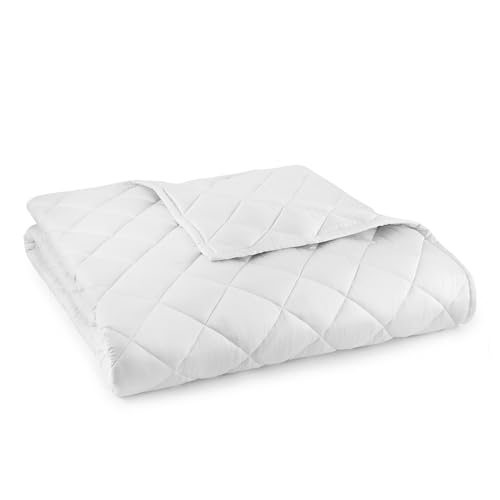
Best organic cotton fill: Whisper Organics 100% Organic Cotton Comforter, Queen/Full
| Organic Integrity Score | 89 / 100 |
| Contents | 100% organic cotton shell and fill, diamond stitched, Queen/Full |
| Certification | GOTS, Fair Trade, Organic |
| Best for | Anyone who wants organic cotton throughout, not just the cover |
It is organic where it actually counts, which almost nothing else in this category manages. The fill is cotton rather than polyester, which is what separates a genuinely organic comforter from an organic wrapper around plastic — and given that fill is most of the product, that distinction is the whole reason this guide exists.
GOTS certification alongside Fairtrade covers both the processing chemistry and the conditions of the people making it, which is a fuller answer than most bedding offers. The diamond stitching keeps the fill distributed rather than letting it migrate to one end, which is the standard failure mode of cheaper comforters.
Two honest points about cotton fill. It is heavier for its warmth than down alternative, so this feels substantial and blanket-like rather than lofty and cloud-like — a preference, not a fault, but a real difference from what many people expect. And it compresses over time and takes a long time to dry, so use a duvet cover and air it rather than washing it.
What we liked: Organic cotton fill, not just an organic shell. GOTS and Fairtrade certified. Diamond stitching prevents fill migration. Breathable in a way polyester is not.
Keep in mind: Heavier and less lofty than down alternative. Slow to dry if washed. Cotton fill compresses gradually over years.
What the listing discloses: Whisper Organics lists GOTS and Fair Trade. The gap is whether the USDA seal applies and where it was grown or made.
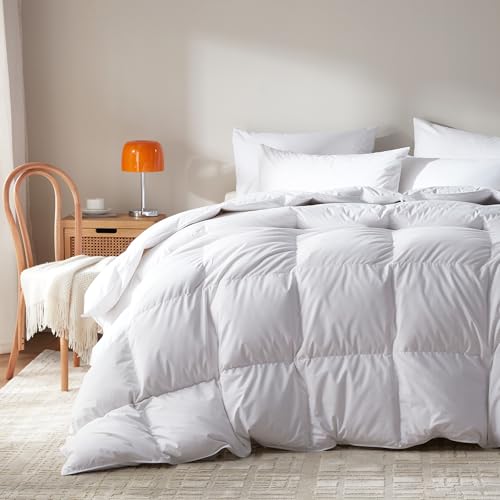
Best down fill: WENERSI Goose Feather Down Comforter, Queen
| Organic Integrity Score | 84 / 100 |
| Fill | Goose feather down, described as ethically sourced and responsibly harvested |
| Shell | GOTS-Certified Organic Cotton, stated |
| Best for | Down warmth with a certified organic shell |
This is the only down comforter in the comparison that names GOTS for its shell rather than saying “organic cotton” and leaving it there. GOTS is the stricter of the two textile schemes and it covers processing as well as fiber, so naming it is a meaningfully stronger statement.
The down side of the listing is weaker. It describes the fill as “ethically sourced” and “responsibly harvested” with “no harmful chemicals”, but it does not name the Responsible Down Standard or Downpass, which are the two schemes that actually audit down sourcing. Other comforters in this price band do name them.
So the shell is certified and checkable; the fill is a promise. If down is what you want and an organic shell is why you are here, that is a reasonable trade.
What we liked: GOTS named specifically for the shell, a breathability argument made against polyester rather than in the abstract, and corner tabs for a duvet cover.
Keep in mind: No RDS or Downpass certification named for the down itself. Down is not suitable for anyone with a feather allergy, and it needs dry cleaning rather than a wash.
Best down alternative: Delara Down Alternative Duvet Insert, Queen 350 GSM
| Organic Integrity Score | 83 / 100 |
| Contents | GOTS organic cotton shell, hypoallergenic microfiber fill, 350 GSM, Queen |
| Certification | GOTS, OEKO-TEX, Certified Organic |
| Best for | Loft, easy care and allergy-friendly bedding |
This is the honest compromise, and it earns its place because it is what a lot of people actually want. Down alternative fill is light, lofty and easy to live with — it has the cloud-like quality cotton fill does not, it dries quickly, and it is genuinely hypoallergenic, which matters for people with dust mite sensitivity.
The shell is GOTS certified organic cotton, so the fabric against you is properly certified, and at 350 GSM with snap tabs to hold a cover in place it is a well-judged all-season insert.
We have scored it lowest here for the reason this guide opens with. The fill is polyester — plastic — and it constitutes most of the product by volume. It will shed microfibers when washed and will not biodegrade. That is a real trade-off against genuine practical advantages, and we would rather set it out plainly than let the organic shell imply something about the whole product.
What we liked: Light and lofty in a way cotton fill is not. GOTS certified shell. Genuinely hypoallergenic. Snap tabs to secure a cover. Dries quickly.
Keep in mind: The fill is polyester and it is most of the product. Sheds microfibers in the wash. Organic claim applies to the shell only.
What the listing discloses: Delara commits to GOTS and OEKO-TEX but stops short of whether the USDA seal applies and where it was grown or made.
Best value wool: KUSNUG Hybrid Australian Wool Comforter
| Organic Integrity Score | 82 / 100 |
| Fill | 50% Australian Merino wool, stated |
| Shell | 100% organic cotton, OEKO-TEX and OCS approved |
| Care | Machine washable, box-stitch construction |
| Best for | Wool at less than half the price of the top pick |
The same idea as our top pick at well under half the price, and the listing is specific about why it costs less: the fill is 50 percent wool rather than 100. That is disclosed rather than buried, which is worth crediting.
The shell is named as OEKO-TEX and OCS-approved 100% organic cotton. OCS, the Organic Content Standard, verifies how much organic fiber is in a product and tracks it through the supply chain. It is a weaker claim than GOTS, which also governs processing chemistry, but it is a real third-party scheme and it is named.
One claim to discount. The listing says the wool offers “36% better breathability than normal fiber”. No baseline is given for “normal fiber” and no test method is cited, so that number is not checkable and we would not weight it.
What we liked: The wool percentage stated plainly, two named certifications on the shell, machine washable, and box-stitch construction to stop the fill shifting.
Keep in mind: Half wool, so it will not regulate temperature as well as a full-wool fill. Stock has been intermittent. The breathability percentage is unsupported.
Common questions about organic cotton comforters
Is an organic cotton comforter organic all the way through?
Usually not. Most products sold as organic cotton comforters have a GOTS-certified cotton shell around polyester microfiber fill, and fill is the majority of the product by volume. The claim is legitimate but describes the smaller part. Look for the fill to be specified as organic cotton or organic wool rather than “down alternative”.
What does GSM mean on a comforter?
Grams per square meter, the density of the fill and the only meaningful warmth figure. Roughly 200 to 250 GSM is summer weight, 300 to 350 is all season, and 400 and above is winter weight. It is only comparable within a fill type, since wool at 300 GSM feels different from polyester at 300 GSM.
What is the difference between a comforter and a duvet insert?
A duvet insert goes inside a washable cover; a comforter in American usage is designed to be used on its own. In practice most products work either way, and using a cover is strongly preferable — you can wash a cover weekly and you cannot easily wash a comforter at all.
Is cotton fill better than down alternative?
Better in different ways. Cotton fill breathes, is natural and biodegradable, and is the only way to have a fully organic comforter. Down alternative is lighter, loftier, cheaper, hypoallergenic and easier to care for, and it is polyester, so it sheds microfibers and does not biodegrade. Neither is simply superior.
What is baffle box construction?
Fabric walls between the top and bottom layers, creating three-dimensional chambers that hold fill loft right across the seams. Sewn-through construction stitches the layers directly together, leaving thin cold lines at every seam. Baffle box matters most in heavier winter comforters and less in lightweight ones.
Can I wash an organic comforter at home?
Often not, at queen size or larger — most domestic machines cannot take one without cramming it, which damages both the machine and the fill distribution. Twin sizes usually fit. The practical answer is to use a duvet cover, wash the cover regularly, and air the insert outdoors occasionally instead.
Do cotton-filled comforters flatten over time?
They compress gradually, yes, more than synthetic fill does. Quilting or baffle box construction keeps the fill distributed so it compresses evenly rather than migrating to one end. Airing it outside and giving it a good shake restores a fair amount of the loft.
Is organic wool fill worth considering?
It is the best performer if the budget allows. Wool buffers both temperature and moisture, so it feels comfortable across a wider range of conditions than cotton or polyester, and it is naturally flame resistant without chemical treatment. It is also the most expensive fill by a clear margin.
- Best Organic Cotton Duvet Cover
- Best Organic Cotton Sheets
- Best Organic Mattress Topper
- our full product index — search by brand, product or certification
Price and availability as of October 15, 2026 1:10 pm EDT. Product prices and availability are accurate as of the date/time indicated and are subject to change. Any price and availability information displayed on Amazon.com at the time of purchase will apply to the purchase of this product.
Looking for other organic products?
We have checked more than 800 products across food, household goods, gardening, personal care and pet, every one against its stated certification. Browse all reviews.
Organic Connection is reader-supported. When you buy through links on this page we may earn a commission, at no extra cost to you. As an Amazon Associate we earn from qualifying purchases. We are not paid to feature or rank any product. How we research and rate.
Does the fill or the shell need to be organic?
They are separate claims and most listings only make one of them. A GOTS or OCS certified shell tells you about the fabric touching your skin. An organic fill tells you about the material inside. A comforter with a certified organic cotton shell and a polyester or down fill is a common and legitimate product, but it is not an organic comforter throughout, and the listings rarely draw that distinction for you.
What is the difference between GOTS, OCS and OEKO-TEX?
OCS, the Organic Content Standard, verifies how much organic fiber is in a product and tracks it through the supply chain. GOTS does that and also governs processing chemistry, water treatment and labor conditions, which makes it the strictest of the three. OEKO-TEX STANDARD 100 is different in kind: it tests the finished item for harmful substances and says nothing about whether the fiber was organically grown. GOTS plus OEKO-TEX is the strongest pair a comforter can carry.
How do I check that a certification is real?
Look for a certificate number. GOTS, OCS and OEKO-TEX all run public lookups where a number can be checked against the issuing body. A listing that names a scheme without a number is asking to be taken on trust. One that prints the number, as our top pick does with its OEKO-TEX certificate, can be verified in under a minute.
Is wool or cotton fill better for hot sleepers?
Wool, generally. It moves moisture away from the skin and buffers temperature swings rather than simply insulating, which suits people who overheat and then wake up cold. Cotton fill is breathable but flatter and heavier for the same warmth. Down is the warmest and the least breathable of the three, which is why it is the wrong choice if you sleep hot.
How often should a comforter be washed?
Two or three times a year if you use a duvet cover, which is the main argument for using one: wash the cover often and the comforter rarely. Check the care label first, because many wool and down fills require dry cleaning, and the ones that can be washed usually specify a gentle cycle and thorough drying to stop the fill clumping.