Last updated: September 30, 2026
We may earn a commission when you buy through links on this page, at no extra cost to you. How we research and rate.
The short version
Our top pick is the Salt Earth GOTS 100% Organic Cotton Swaddle Blanket 4-Pack, with an Organic Integrity Score of 92 out of 100. It names GOTS in the product title, it is 100 percent organic cotton with nothing blended in, and at 47 by 47 inches it is large enough to actually swaddle a newborn.
The reason it wins is less about what it contains than about what several of its competitors contain instead. Two of the best-selling blankets marketed as organic are mostly bamboo viscose, with organic cotton as the minority ingredient. Neither says so in the title. Both say so in the feature bullets, if you read them.
Best organic swaddle blankets compared
| Best Choice | Best Value | ||||
 |  |  |  |  | |
| Product | Salt Earth GOTS Organic | infancie Organic Cotton | aden and anais Boutique | mushie Muslin Swaddle | Burt’s Bees Baby Receiving |
| Organic Integrity Score | 92/ 100 | 86/ 100 | 84/ 100 | 83/ 100 | 79/ 100 |
| Our rating | 4.6 | 4.3 | 4.2 | 4.2 | 4.0 |
| Certification named | GOTS | OEKO-TEX 100 | — | — | — |
| Fiber content | 100% organic cotton | 100% organic cotton | 100% organic cotton | 100% organic cotton | Made with organic cotton |
| Size | 47 x 47 in | 38 x 40 in | 47 x 47 in | 47 x 47 in | 29 x 29 in |
| Pack size | 4 | 3 | 4 | 1 | 2 |
| Best for | Checkable certification | Lowest cost per blanket | Premium muslin | Pre-washed softness | Receiving, not swaddling |
| Certification | GOTS, Organic | OEKO-TEX, Organic | — | — | — |
| Contents | Four 100% organic cotton double-gauze swaddles, 47 x 47 inches | Three 100% organic cotton muslin blankets, 38 x 40 inches | Four large 100% organic cotton muslin swaddles | One 100% organic cotton muslin swaddle blanket, pre-washed | Stretchy knit receiving blankets, 29 x 29 inches |
| Price | $35.99$9.00 / count View on Amazon | $23.99 View on Amazon | $59.95$14.99 / count View on Amazon | $19.99 View on Amazon | $21.21 $24.95 −15%$10.61 / count View on Amazon |
- Organic Baby Essentials hub
- our organic product database — compare brands across every guide
Price and availability as of October 27, 2026 1:10 am EDT. Product prices and availability are accurate as of the date/time indicated and are subject to change. Any price and availability information displayed on Amazon.com at the time of purchase will apply to the purchase of this product.
Reading the seals on organic swaddle blankets: what each one does and does not cover
Certification names are easy to confuse and easy to trade on. Below is what each of these marks covers, and the part of the picture it says nothing about.
| Certification | Covers | Key exclusion |
| GOTS | Organic fiber from farm to finished textile, plus dyeing, finishing, wastewater and labor criteria | Has a weaker second tier, “made with organic”, that needs only 70% organic fiber and carries the same name |
| OEKO-TEX Standard 100 | Laboratory testing of the finished textile against limits for more than 1,000 harmful substances | Says nothing at all about whether the fiber was organically grown |
Standard 100 answers “what is in this fabric”, not “how was it grown”. That is a useful question and the testing behind it is rigorous, covering formaldehyde, heavy metals, azo dyes and a long list besides. But a product can pass it while having been grown with every pesticide the organic standards prohibit, because those residues do not survive to the finished textile. Treat it as a floor for chemical safety and look elsewhere for the farming claim.
Bamboo viscose is the biggest problem in this category
This is the finding that matters most, so it goes before the picks.
Several swaddle blankets sold under organic branding are not primarily cotton. They are viscose rayon made from bamboo pulp, often with a minority of organic cotton blended in so the word can appear on the packaging.
Two examples from our search, both of which sell well. One is titled “Muslin Swaddle Blankets, Organic Baby Blankets” and its first feature bullet states the composition: 70 percent rayon from bamboo, 30 percent organic cotton. Another describes itself as an “Organic Baby Swaddle Blanket” and explains further down that the fabric is “a proprietary viscose derived from bamboo and cotton blend”. Neither is hiding anything. Both are relying on the fact that almost nobody reads the fifth bullet.
Here is why it matters beyond the labeling. Viscose is not a natural fiber in the way the word bamboo suggests. Bamboo is a plant, and viscose is what happens after that plant is dissolved in sodium hydroxide and carbon disulfide, extruded and regenerated as filament. The finished fiber is chemically processed cellulose. It can be lovely to touch, and it is genuinely breathable and temperature regulating, which is why manufacturers use it.
What it cannot be is certified organic cotton, because it is neither organic nor cotton. The US Federal Trade Commission has taken repeated action over textiles marketed as bamboo when the product is rayon, and its guidance for sellers is direct about the distinction.
If you specifically want bamboo viscose, buy it deliberately. Plenty of parents prefer how it feels. Just do not buy it thinking you bought organic cotton.
What GOTS certification actually covers
Only one blanket in this comparison names a certifying standard in its own listing, so it is worth being clear about what that standard does.
The Global Organic Textile Standard covers the whole production chain and not only the farm. The fiber must be certified organic, and then GOTS governs what happens to it afterwards: which dyes and processing chemicals are permitted, how mill wastewater is handled, and the working conditions of the people involved. It prohibits chlorine bleaching, formaldehyde-based finishes and a list of heavy metals used in conventional dyeing.
For a swaddle the processing rules carry most of the weight. This is a large piece of fabric wrapped directly around a newborn for hours at a time, frequently against the face. What the mill applied to the cloth is nearer the point than what the farm did to the cotton.
GOTS has two label grades and they are not interchangeable. “Organic” requires at least 95 percent certified organic fiber. “Made with organic materials” requires 70 percent. Both are real GOTS labels. When a listing uses the phrase “made with 100% organic cotton”, that wording is ambiguous in a way worth noticing, because “made with” is the softer of the two constructions.
OEKO-TEX Standard 100 is the other seal you will meet here, and it answers a different question. It tests the finished article for harmful substances and sets limits on what may be present in the fabric that reaches you. It says nothing about organic farming. Conventionally grown cotton carries Standard 100 all the time. Seeing it alongside an organic claim is a good sign. Seeing it alone does not make a product organic.
Size is the specification most people get wrong
A swaddle blanket has one job that an ordinary receiving blanket does not, which is to wrap a baby securely enough that the wrap does not come undone. Size decides whether it can.
47 by 47 inches is the working standard. That is large enough to wrap a newborn with a proper overlap and enough length to tuck, and it stays usable as the baby grows through the swaddling window. Most dedicated swaddle blankets are cut to roughly this size for exactly that reason.
Anything meaningfully smaller becomes a receiving blanket. A 29 by 29 inch square is a genuinely useful object for covering a lap, wiping a chin or lining a bassinet, and it will not hold a swaddle on an active newborn past the first few weeks. Several products sold in swaddle search results are this size, and the listings do not always make the distinction clear.
There is a safety dimension too. A wrap that comes loose puts loose fabric in the sleep space, which safe sleep guidance is consistent in advising against. Swaddling itself should stop once a baby shows any sign of rolling. Buying a blanket large enough to hold its wrap is part of doing it properly.
Muslin matters here as well. A single layer of open-weave muslin at 47 by 47 gives you enough fabric for a secure wrap without the bulk that would make it too warm, which is why nearly every dedicated swaddle in this category is muslin rather than jersey or flannel.
Pre-washed is worth more than it sounds
Organic cotton muslin shrinks, and on a swaddle blanket the consequence is specific.
GOTS prohibits most of the synthetic finishes conventional textiles use to control shrinkage, which is a large part of the point of the standard. The side effect is that certified organic cotton typically shrinks more in the first few washes than a treated conventional fabric would.
On a towel that is an inconvenience. On a swaddle it can move the blanket across the line described above. A 47 inch square that loses three inches in the first two hot washes is a 44 inch square, and a wrap that was secure at purchase becomes marginal.
Some manufacturers pre-wash the fabric before cutting, which takes most of the shrinkage out before you ever see it and has the additional benefit of delivering the blanket already soft. Where a listing says pre-washed, we have counted it in the product’s favor.
Whether or not yours is pre-washed, wash warm rather than hot and tumble dry low. That single habit limits shrinkage considerably in untreated cotton.
The hips matter more than the fabric
No certification on any blanket in this guide affects the thing most likely to go wrong with swaddling, so it deserves a section of its own.
A swaddle should be firm across the chest and loose around the legs. Wrapping the legs straight and pressed together, which is what most people do instinctively when trying to make a wrap secure, holds the hip joint in an extended position it is not designed to occupy. Done consistently in the newborn weeks, that position is associated with developmental dysplasia of the hip, where the joint does not form correctly in the socket.
The International Hip Dysplasia Institute publishes guidance on hip-healthy swaddling, and the practical version is short. The baby’s legs should be able to bend up and out at the hips inside the wrap. Firm around the arms and chest, roomy from the waist down.
Blanket size feeds into this directly, which is why it belongs here and not in a footnote. A blanket too small to wrap securely tempts you to pull it tight to compensate, and the leg end is where that tension goes. A properly sized 47 inch square lets you get a firm upper wrap while leaving the lower half genuinely loose, so you are not trading one against the other.
Two other points that no fabric will fix. Swaddling stops at the first sign of rolling. And a swaddled baby always sleeps on the back, on a firm flat surface, with nothing else in the sleep space.
Best overall: Salt Earth GOTS 100% Organic Cotton Swaddle Blanket 4-Pack
| Organic Integrity Score | 92 / 100 |
| Contents | Four 100% organic cotton double-gauze swaddles, 47 x 47 inches |
| Certification | GOTS, Organic |
| Best for | Parents who want the certification claim to be checkable |
It is the only blanket in this comparison that names GOTS, and it puts the word in the title rather than burying it in a bullet. Combined with a plain 100 percent organic cotton composition and no blended fiber, that is the strongest certification position in the category.
The construction is double gauze, which is two layers of open-weave cotton bonded at intervals so they behave as one fabric. It gives more substance than single-layer muslin without the density that would make a wrapped baby too warm, and it drapes well enough to hold a fold. For swaddling specifically this is the better of the two constructions.
At 47 by 47 inches it is properly sized for a newborn wrap with room to tuck, and four blankets is a realistic supply rather than a starter set. Given how often a swaddle needs washing, that pack size is a large part of the value.
Two honest points. It is untreated organic cotton and the listing does not say it is pre-washed, so expect some shrinkage in the first few cycles and wash warm rather than hot. And the brand is much smaller than aden and anais or Burt’s Bees, which some buyers weigh and some do not.
What we liked: Names GOTS in the title, not in a footnote. Double gauze holds a wrap better than single-layer muslin. Correct 47 inch size and four to a pack.
Keep in mind: No pre-wash stated, so expect first-wash shrinkage. Smaller brand with a shorter track record.
What the listing discloses: On the Salt Earth label: GOTS. Not stated: whether the USDA seal applies and where it was grown or made.
Best value: infancie 100% Organic Cotton Muslin Blankets, 3-Pack
| Organic Integrity Score | 86 / 100 |
| Contents | Three 100% organic cotton muslin blankets, 38 x 40 inches |
| Certification | OEKO-TEX, Organic |
| Best for | Cost per blanket, and anyone who wants a tested-safe fabric |
This is the second of only two products here that names any standard at all, and the combination it offers is a sensible one: 100 percent organic cotton for the fiber question, OEKO-TEX Standard 100 for the finished-fabric question.
Those two claims answer different things and that is why the pairing is worth having. Organic cotton describes the farming. Standard 100 means the finished cloth has been tested against limits for harmful substances. Neither replaces GOTS, which covers processing chemistry in a way Standard 100 does not, and together they are a stronger position than an unaccompanied organic claim.
It is the cheapest per blanket of anything here, by a clear margin, which is what earns it the value badge.
The size is the real caveat and we want to be direct about it. At 38 by 40 inches these are noticeably smaller than the 47 inch standard. That is enough to swaddle a small newborn and it will run out of fabric sooner than a full-size blanket, particularly on a larger or more active baby. As multipurpose muslin blankets they are excellent. As dedicated swaddles they have a shorter useful window.
What we liked: OEKO-TEX Standard 100 named explicitly. 100 percent organic cotton with no blend. Lowest cost per blanket in the comparison.
Keep in mind: 38 by 40 inches is under the swaddling standard. Shorter useful life as a swaddle than the 47 inch options.
What the listing discloses: On the infancie label: OEKO-TEX. Not stated: whether the USDA seal applies and where it was grown or made.
Best premium muslin: aden and anais Boutique Organic Swaddle Blanket 4-Pack
| Organic Integrity Score | 84 / 100 |
| Contents | Four large 100% organic cotton muslin swaddles |
| Certification | — |
| Best for | Parents who want the reference muslin swaddle |
aden and anais largely created the muslin swaddle category as it exists now, and this is the organic cotton version of the blanket everything else is compared against. If you have handled a friend’s swaddle and liked it, there is a good chance this is what it was.
The muslin is the reason. It is woven open enough to be genuinely breathable, it gets softer with every wash for a remarkably long time, and it drapes in a way cheaper muslin does not quite manage. Properly large at the full swaddling size, four to a pack.
No certifying body is named anywhere in the listing, which is what holds it at 84 rather than into the nineties. The composition claim is unambiguous, 100 percent organic cotton muslin with no blend, and the brand is large enough that a false claim would be a serious liability. That is a reason for confidence, and it is not the same as a certificate.
It is also comfortably the most expensive option here per blanket. You are paying for the fabric and for the brand, and how you weigh that is a personal matter.
What we liked: The reference muslin in this category. Full 47 inch size, four per pack. Softens beautifully over months.
Keep in mind: No certifier named. Most expensive per blanket of any pick here.
What the listing discloses: Little to verify on the aden + anais listing: no word on whether the USDA seal applies and where it was grown or made.
Best pre-washed: mushie Muslin Baby Swaddle Blanket
| Organic Integrity Score | 83 / 100 |
| Contents | One 100% organic cotton muslin swaddle blanket, pre-washed |
| Certification | — |
| Best for | A gift, or a single blanket that is soft immediately |
The specification that earns this a place is pre-washing, which the listing states explicitly and most competitors do not mention at all.
It solves two problems in one step. The blanket arrives soft instead of needing four cycles to get there, and most of the shrinkage has already happened, so the 47 inch square you unwrap stays close to 47 inches. On untreated organic cotton, where GOTS-compliant processing rules out the finishes that would otherwise control shrinkage, that is worth real money.
The prints are the other reason people buy mushie, and they are better than the category norm. As a shower gift this is an easy choice.
It is a single blanket, which is the obvious limitation. As a working supply it is not one, and per blanket it costs more than the four-packs. Buy it as a gift or as an addition to a rotation, not as the whole rotation.
What we liked: Pre-washed, so it is soft on arrival and holds its size. Correct 47 inch dimensions. Genuinely nice prints.
Keep in mind: One blanket per purchase. Expensive per blanket. No certifier named.
What the listing discloses: mushie is thin on detail, and does not say whether the USDA seal applies and where it was grown or made.
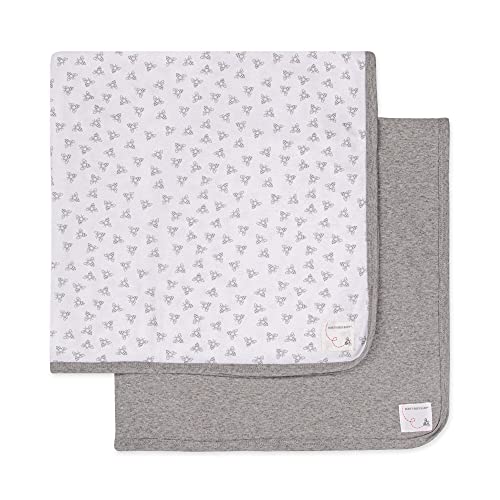
Best small receiving blanket: Burt’s Bees Baby Infant Receiving Blankets
| Organic Integrity Score | 79 / 100 |
| Contents | Stretchy knit receiving blankets, 29 x 29 inches |
| Certification | — |
| Best for | Everything except swaddling a newborn securely |
We have included this deliberately, and partly as a correction, because it appears throughout swaddle search results and it is not really a swaddle blanket.
At 29 by 29 inches there is not enough fabric to wrap a newborn with a secure overlap and a tuck. It is a receiving blanket, and as one it is very good: soft stretchy knit rather than woven muslin, useful for covering, lining a bassinet, tummy time and the hundred other things a small blanket gets used for.
The certification language is worth noticing too. It says “made with 100% organic cotton”, and elsewhere on the same brand’s products we found an explicit GOTS claim. Here there is no certifier named. Burt’s Bees Baby is a serious brand with real certifications across its range, and this particular listing does not state one.
Buy it knowing what it is. If you want it for swaddling, one of the 47 inch options above will do the job this one cannot.
What we liked: Soft stretchy knit that is pleasant to handle. Established brand. Genuinely useful as a small blanket.
Keep in mind: Too small to swaddle securely at 29 inches. Made with wording rather than a named certification.
What the listing discloses: Sparse documentation from Burt’s Bees Baby — nothing on whether the USDA seal applies and where it was grown or made.
What we left out and why
Three products from our search did not make the list, and the reasons are the useful part.
Yoofoss Muslin Swaddle Blankets. Sold as “Organic Baby Blankets”, and its own first feature bullet states the composition as 70 percent rayon from bamboo and 30 percent organic cotton. The organic cotton is the minority fiber. It is a comfortable blanket and it is not what the title implies, so it does not belong in a guide about organic cotton swaddles.
KeaBabies Lumi Muslin Swaddle Blankets. Described as organic muslin receiving blankets, with the fabric explained further down as “a proprietary viscose derived from bamboo and cotton blend”. Same category of problem: viscose is regenerated cellulose, not cotton, and the proportion is not disclosed.
Konssy 3-Pack Muslin Swaddle Blankets. Excluded for the opposite reason. It is one of the best-selling blankets in the search results and it makes no organic claim anywhere, in the title or the bullets. Nothing is wrong with it. It simply is not an organic product.
One limit of this method is worth stating plainly. Reading listing copy tells you what a brand is prepared to claim in public. It cannot tell you what is in the box. A brand could name GOTS and be lying, and a brand could hold a full certificate and never mention it. What a named standard establishes is accountability, since it is something somebody can be held to.
How to wash a swaddle blanket so it lasts
Swaddles get washed more than almost any other baby textile, and a few habits decide whether they survive it.
Skip fabric softener. Softener coats fibers with a thin water-repellent film, which is where the softness and the scent come from. On muslin that coating reduces breathability, which is the entire reason to use muslin around a sleeping baby. Dryer sheets work the same way. Neither belongs near a swaddle.
Wash before first use. New muslin carries sizing from manufacturing and reaches its proper softness and breathability only after a few cycles. If a blanket feels stiff out of the packet, it is not faulty.
Warm, not hot, and tumble low. Untreated organic cotton shrinks, and on a swaddle a lost three inches is a wrap that no longer holds. Warm water and a low dryer setting limit that considerably. Pre-washed blankets are more forgiving but not immune.
Cold rinse milk stains first. Milk protein sets when heated, so a hot wash on a fresh stain cooks it into the fiber. Rinse cold, then wash warm.
Expect muslin to improve. Unlike most fabrics, open-weave cotton muslin genuinely gets better for months. A blanket that seems merely acceptable at week one is often the favorite by month three.
Questions parents ask about organic swaddle blankets
Is bamboo the same as organic cotton?
No. Almost all bamboo fabric is viscose rayon, made by dissolving bamboo pulp in a chemical bath and regenerating it as fiber. It is neither cotton nor organic, whatever the plant it started as. If a listing says rayon from bamboo, that is what you are buying.
What size swaddle blanket do I need?
47 by 47 inches is the working standard, and it is large enough to wrap a newborn with an overlap and a tuck. Anything around 29 inches is a receiving blanket and will not hold a swaddle on an active baby.
Is GOTS better than OEKO-TEX Standard 100?
They answer different questions. GOTS certifies organic fiber content plus processing chemistry, wastewater and labor conditions. Standard 100 tests the finished fabric for harmful substances and says nothing about organic farming. GOTS is the stronger organic claim. Standard 100 alongside it is better still.
How many swaddle blankets do I need?
Four is a sensible working number. Swaddles get soaked, spat on and washed constantly in the first months, and a blanket in the machine is not available to you. Three is workable if you wash daily.
Do organic cotton swaddles shrink?
More than conventional ones, because GOTS prohibits most of the synthetic finishes that control shrinkage. Buying pre-washed avoids most of it. Otherwise wash warm rather than hot and tumble dry low.
When should I stop swaddling?
At the first sign a baby is trying to roll, which for many babies is somewhere around two to four months. Once rolling starts a swaddle stops being safe, and a wearable blanket or sleep sack is the usual next step.
Is muslin or double gauze better for swaddling?
Double gauze is two bonded layers of open-weave cotton, so it has more substance and holds a fold more securely, which suits swaddling. Single-layer muslin is lighter, cooler and more versatile. For a secure wrap, double gauze. For a warm room or general use, muslin.
Does “made with organic cotton” mean the same as “organic”?
Not under GOTS labeling. The “organic” grade requires at least 95 percent certified organic fiber, while “made with organic materials” requires 70 percent. Outside GOTS, the phrase is not defined at all and can describe any proportion.
Looking for other organic products?
We have checked more than 800 products across food, household goods, gardening, personal care and pet, every one against its stated certification. Browse all reviews.
Organic Connection is reader supported. We check every product against its stated certification and say plainly when a claim cannot be verified. How we research and rate.