Last updated: September 30, 2026
We may earn a commission when you buy through links on this page, at no extra cost to you. How we research and rate.
The short version
We pulled every burp cloth Amazon surfaces for organic searches and read the certification claim in the listing body instead of the title. Our top pick is Burt’s Bees Baby 100% Organic Cotton Burp Cloths, which earned an Organic Integrity Score of 91 out of 100. It is the only burp cloth in the category that names its certifying standard, GOTS, in the product copy itself.
That sentence is doing more work than it looks. Of the ten burp cloths we examined, exactly one named a certification body. Three of the four best-selling ones make no organic claim whatsoever.
Best organic burp cloths compared
| Best Choice | Best Value | |||||
 |  |  |  |  |  | |
| Product | Burt’s Bees Baby Organic | Green Sprouts Muslin | KeaBabies Shea Organic | KeaBabies Urban Organic | HonestBaby Organic Cotton | Yoofoss Muslin Burp |
| Organic Integrity Score | 91/ 100 | 84/ 100 | 82/ 100 | 79/ 100 | 78/ 100 | 77/ 100 |
| Our rating | 4.6 | 4.2 | 4.1 | 4.0 | 3.9 | 3.9 |
| Construction | Terry, woven | Muslin, 4 layer | Muslin, 2 layer | Cotton and fleece | Multi-layer cotton | Muslin, 6 layer |
| Pack size | 5 | 3 | 6 | 5 | 5 | 10 |
| Size | 17 x 11.75 in | Standard | 20 x 12 in | 21 x 10 in | Standard | 20 x 10 in |
| Best for | Verifiable certification | Fast-drying muslin | Largest coverage | Shirt protection | Plain undyed white | Volume and rotation |
| Certification | GOTS, Certified Organic | — | — | — | — | — |
| Contents | Five 100% organic cotton burp cloths, 17 x 11.75 inches | 100% organic cotton muslin burp cloths, four layers | Six double-layered organic cotton burp cloths, 20 x 12 inches | Five figure-8 burp cloths, organic cotton with fleece layers, 21 x 10 inches | Five multi-layer 100% organic cotton cloths, bright white | Ten 100% organic muslin cotton cloths, 20 x 10 inches |
| Price | $29.95 View on Amazon | $22.99 $26.99 −15%$7.66 / count View on Amazon | $18.96$3.16 / count View on Amazon | $19.96$3.99 / count View on Amazon | $13.06 $15.67 −17%$2.61 / count View on Amazon | $15.29 $16.99 −10%$1.53 / count View on Amazon |
Price and availability as of October 27, 2026 1:10 am EDT. Product prices and availability are accurate as of the date/time indicated and are subject to change. Any price and availability information displayed on Amazon.com at the time of purchase will apply to the purchase of this product.
The organic burp cloths certifications, and the question each one leaves open
A seal is a specific promise about a specific thing. These are the promises behind the marks on this page, in plain terms, along with the question each one leaves unanswered.
| Certification | Covers | Key exclusion |
| USDA Organic | Farming and handling: no synthetic pesticides or fertilizers, no GMOs, no sewage sludge or irradiation, audited yearly by an accredited certifier | Three different tiers share the one seal, and it makes no claim about worker pay, food miles, or nutrition |
| GOTS | Organic fiber from farm to finished textile, plus dyeing, finishing, wastewater and labor criteria | Has a weaker second tier, “made with organic”, that needs only 70% organic fiber and carries the same name |
| OEKO-TEX Standard 100 | Laboratory testing of the finished textile against limits for more than 1,000 harmful substances | Says nothing at all about whether the fiber was organically grown |
OEKO-TEX Standard 100 is a chemical test, not an organic one. It screens the finished textile against limits for over a thousand substances, which is a real assurance about what will sit against your skin. It makes no claim whatsoever about how the fiber was farmed. Conventionally grown, heavily sprayed cotton can carry Standard 100 without difficulty. On a page about organic textiles it belongs beside GOTS, never instead of it.
The bestsellers in this category are not organic
This is the finding that shaped the rest of the guide, so it goes first.
When you search for organic burp cloths, the products that come back are sorted by what sells, not by what is certified. The top result by sales rank is the Comfy Cubs 10-pack. It is a perfectly good burp cloth: six layers of muslin, 20 by 10 inches, well made. Read its five feature bullets and you will find “100% breathable muslin cotton” and nothing else. No organic claim, no certification, no seal. The brand is not doing anything wrong, because it is not claiming anything.
The same is true of the Lovely Care 12-pack at rank 190 and the HIPHOP PANDA set at rank 215. Both are described as 100 percent cotton muslin. Neither says organic anywhere.
What that means in practice is that a shopper who types “organic burp cloths”, scans the first row of results and buys the one with the most reviews has a good chance of buying conventional cotton. Nothing on the page corrected them, because nothing on the page made a claim in the first place.
So the first useful thing this guide can do is narrow the field to products that actually claim what you are searching for. That took the list from ten down to seven.
What GOTS certification actually covers
Textiles are the one category where the certification is broader than most people expect, and it is worth understanding why before comparing products.
The Global Organic Textile Standard governs the entire chain, not only the farm. It requires the fiber to be certified organic, and then sets rules for everything that happens to that fiber afterwards. Which dyes and processing chemicals may be used. How mill wastewater is treated. Social criteria covering the conditions of the people doing the work. It prohibits chlorine bleaching, formaldehyde-based finishes and several classes of heavy metal used in conventional dyeing.
For a burp cloth, the processing half matters more than the farming half. This is a piece of fabric that spends its working life against a newborn’s cheek and mouth, absorbing milk that the baby will then have its face pressed into. What was applied to the cloth at the mill is closer to the point than what was sprayed on the cotton plant.
GOTS also has two label grades, and the distinction is easy to miss on packaging. A product labeled “organic” under GOTS contains at least 95 percent certified organic fiber. A product labeled “made with organic materials” needs only 70 percent. Both are legitimate GOTS labels. They are not the same product.
One more standard turns up on baby textiles and is regularly mistaken for an organic seal. OEKO-TEX Standard 100 tests the finished item for harmful substances and sets limits on what may be present in the fabric you receive. It is a genuinely useful thing to see. It says nothing at all about organic farming, because that is not what it measures. A conventionally grown cotton cloth can carry Standard 100 and often does.
Why “organic cotton” without a named certifier means less than it looks
Six of our seven remaining candidates say organic cotton in the listing. One of them says who certified it.
The phrase “100% organic cotton” on an Amazon listing is a manufacturer’s statement. It is not a lie in most cases, and we have no reason to think these particular brands are misrepresenting their fabric. It is simply unverifiable from where you are standing. There is no certificate number, no certifying body, no scope statement. You are being asked to take the seller’s word for it.
Compare that with the Burt’s Bees Baby listing, which says “GOTS-certified organic burp cloths” in the first feature bullet. That is a checkable claim. GOTS maintains a public database of certified operations, and the standard has an accreditation structure behind it with third-party auditors. If it is not true, someone can be held to it.
This is the same pattern we found when we checked brands against the USDA Organic INTEGRITY Database for our other guides. The USDA database will not help you here, because it certifies agricultural operations and a textile manufacturer that buys certified fiber from a certified supplier does not need its own entry. Textiles have their own standard, and GOTS is it.
None of this makes the unverified products bad. It is the reason the top pick scores 91 and the rest sit in the high seventies and low eighties.
Muslin, terry and fleece each behave differently
Fabric construction changes how a burp cloth performs more than the fiber source does, and the three constructions on sale are not interchangeable.
Muslin is a loose, open plain weave, usually stacked four to six layers deep to get enough absorbency. It starts slightly stiff and softens with every wash, which is why parents who like muslin tend to like it more after a month than on day one. It dries fast, which matters when you are running the washing machine constantly. Per layer it absorbs less than terry, which is why the layer count is always in the product name.
Terry has a looped pile, the same construction as a bath towel. It holds substantially more liquid per square inch, and it holds it away from the surface so the cloth feels dry longer against your shoulder. The trade-offs are bulk and drying time. A terry burp cloth takes up more space in a bag and comes out of the dryer damp more often.
Fleece backing is worth a specific warning. Several burp cloths pair an organic cotton face with a fleece layer behind it, to slow liquid soaking through to your shirt. Fleece is almost always polyester. A cloth built this way can be honestly described as made with organic cotton while a meaningful part of it is synthetic. That is not a scandal, and the barrier genuinely works. It is simply not the same product as an all-cotton cloth, and the listing rarely spells it out. We have flagged it in the individual pick below where it applies.
How many burp cloths you actually need
Every pack in this category is sold in fives, sixes, tens or twelves, and the pack size is the main thing separating the prices.
Five is not enough. In the first three months, a baby with ordinary posseting will go through three or four cloths a day, and a baby with reflux will go through eight. Cloths in the wash are not cloths you have. The practical floor is around ten in circulation, and parents dealing with reflux routinely keep twice that.
This changes the value calculation in a way the sticker price hides. A five-pack at $29.95 costs $5.99 per cloth. A ten-pack at $16.99 costs $1.70. If you need ten cloths, those two options are $59.90 and $16.99 for the same shoulder coverage. Certification is worth paying for, and it is worth knowing what you are paying.
A reasonable strategy, and the one we would suggest for most people, is to buy one certified pack for the cloths that touch the baby’s face most and a larger unverified pack for volume. That is a compromise, and we would rather say so than pretend the budget question does not exist.
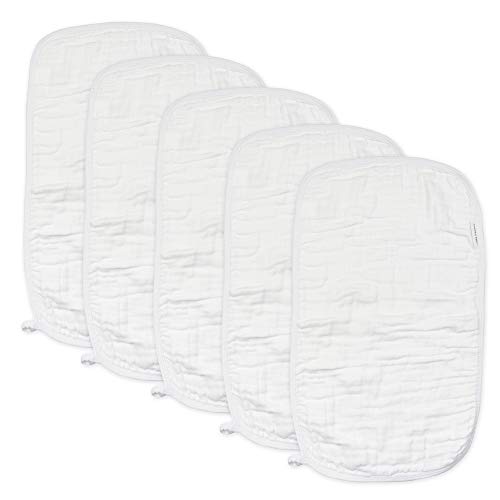
Best overall: Burt’s Bees Baby 100% Organic Cotton Burp Cloths
| Organic Integrity Score | 91 / 100 |
| Contents | Five 100% organic cotton burp cloths, 17 x 11.75 inches |
| Certification | GOTS, Certified Organic |
| Best for | Parents who want the certification claim to be checkable |
This is the only product in the category that tells you which standard certified it. The first feature bullet says GOTS-certified, and that single sentence is why it takes the top score while products with identical fabric descriptions sit fourteen points lower.
The fabric is combed ring-spun cotton, which is a meaningful specification and not marketing language. Combing removes the short fibers before spinning, and ring spinning twists what is left into a smoother, stronger yarn. The practical result is a cloth that pills less and stays soft through the volume of washing a burp cloth gets. Woven terry rather than muslin, so it takes more liquid per square inch and keeps your shoulder dry longer.
At 17 by 11.75 inches it is the smallest cloth in this comparison, and that is a genuine trade-off. It covers a shoulder well and is easy to fold into a bag. It does not have the reach of the 20 by 12 inch options if you want one cloth spread across a shoulder and down a chest.
The cost is the honest objection. Five cloths is not a working supply, and at this price two packs is a real amount of money. Our own suggestion is above: use these as the cloths that touch the baby’s face, and pad the rotation with something cheaper.
What we liked: The only listing in the category that names its certifying standard. Combed ring-spun terry that resists pilling. Genuinely soft from the first wash.
Keep in mind: The smallest cloth here at 17 inches. Five per pack, and you need around ten. Costs roughly three times per cloth what the muslin packs do.
What the listing discloses: Burt’s Bees Baby states GOTS, and does not say whether the USDA seal applies and where it was grown or made.
Best fast-drying muslin: Green Sprouts Muslin Burp Cloths
| Organic Integrity Score | 84 / 100 |
| Contents | 100% organic cotton muslin burp cloths, four layers |
| Certification | — |
| Best for | Households running constant laundry cycles |
Green Sprouts has been making baby goods for long enough to have a reputation worth protecting, and that counts for something when a claim cannot be independently verified. The listing states 100 percent organic cotton muslin without naming a certifier, which is why it scores 84 and not into the nineties.
Four layers is the sweet spot for muslin. Six layers absorbs more and takes noticeably longer to dry. Two layers dries in no time and soaks through. Four holds a normal posset without reaching your shirt and comes out of a dryer cycle actually dry, which is the difference between a cloth you can put back into rotation tonight and one you cannot.
Like all muslin it arrives with a slight crispness and softens over the first several washes. If you judge it on day one you will underrate it.
The pack is small, which is the main practical objection. As a supplement to a larger rotation it works well. As your only purchase it will not cover a day.
What we liked: Four-layer muslin dries fast enough to keep up with daily washing. Long-established brand. Softens well with use.
Keep in mind: No certifying body named. Small pack for the price. Slightly stiff until it has been washed a few times.
What the listing discloses: Sparse documentation from Green Sprouts — nothing on whether the USDA seal applies and where it was grown or made.
Best coverage: KeaBabies Shea Organic Burp Cloths
| Organic Integrity Score | 82 / 100 |
| Contents | Six double-layered organic cotton burp cloths, 20 x 12 inches |
| Certification | — |
| Best for | Reflux, and anyone tired of missing the cloth entirely |
At 20 by 12 inches this is the largest cloth in the comparison, and if you have ever had a baby posset just past the edge of a cloth you will understand why that is worth a section of its own. The extra two inches of width is the difference between catching it and changing your shirt.
The listing describes organic cotton in four separate feature bullets, which at least means the claim is consistent rather than dropped into the title and abandoned. No certifier is named, so it scores in the low eighties along with the rest of the unverified field.
Double-layered rather than four or six, which makes it thinner and quicker to dry than most muslin here while the larger surface area compensates for the reduced layer count. It is a sensible piece of design. Six per pack is closer to a workable rotation than the five-packs.
Thin is thin, though. For a heavy reflux spit-up, two layers over a large area will wet through where six layers over a small area would not. This is a cloth for catching, not for soaking.
What we liked: The largest cloth here by a clear margin. Six per pack. Dries quickly for its size. Organic claim repeated consistently.
Keep in mind: Only two layers, so it wets through faster than six-layer muslin. Certifier not named anywhere.
What the listing discloses: Little to verify on the KeaBabies listing: no word on whether the USDA seal applies and where it was grown or made.
Best shirt protection: KeaBabies Urban Organic Burp Cloths
| Organic Integrity Score | 79 / 100 |
| Contents | Five figure-8 burp cloths, organic cotton with fleece layers, 21 x 10 inches |
| Certification | — |
| Best for | Keeping spit-up off your clothes rather than off the baby |
Two features distinguish this one, and we scored it down for a third.
The figure-8 cut is genuinely clever. Narrowed at the middle, it sits over the curve of a shoulder and stays where you put it, which a flat rectangle does not. Anyone who has bent to pick up a baby and watched a burp cloth slide off behind them will appreciate the difference.
The fleece backing works as intended. It slows liquid moving through the cloth to your shirt, and for a parent going straight from a feed to leaving the house it is a real advantage. It is also the reason for the score. Fleece is a synthetic in almost every application, and the listing does not say what this fleece is made of. A product described as organic cotton where an unspecified proportion of the construction is likely polyester is a weaker organic claim than an all-cotton cloth, and we are not going to score it as though it were the same thing.
Take it for what it is and it is a good product. The cotton face is what touches the baby. The synthetic layer is what touches you. If that arrangement suits you, the figure-8 shape alone makes it worth considering.
What we liked: Figure-8 shape that actually stays on a shoulder. Fleece barrier keeps shirts clean. Thicker than muslin.
Keep in mind: Fleece content is not specified and is very likely synthetic. Slower to dry than muslin. Five per pack.
What the listing discloses: KeaBabies is thin on detail, and does not say whether the USDA seal applies and where it was grown or made.
Best plain white: HonestBaby Organic Cotton Multi-layer Burp Cloths
| Organic Integrity Score | 78 / 100 |
| Contents | Five multi-layer 100% organic cotton cloths, bright white |
| Certification | — |
| Best for | Anyone who would rather have no dye at all |
The case for plain white in this category is better than it sounds. Dye is the part of textile manufacturing that GOTS spends most of its rules on, and a cloth with no print has less of that chemistry applied to it whatever the standard. For a fabric that spends its time next to a baby’s mouth, no pattern is a defensible preference and not merely an aesthetic one.
It also means you can see when a cloth is actually clean, which on a burp cloth is more useful than it is on most textiles. Set-in milk stains hide well on a print.
The listing says 100 percent organic cotton and names no certifier, placing it with the rest of the unverified group. Multi-layer construction without a stated count, which is less informative than we would like. Its Amazon sales rank is the weakest of our picks, which usually reflects a quieter listing rather than a worse product.
Bright white shows every stain, which is the flip side of showing every stain. Some people find that reassuring and some find it dispiriting. Worth knowing which you are before buying.
What we liked: No print means less dye chemistry. Easy to see when they are genuinely clean. Straightforward and inexpensive.
Keep in mind: White shows everything. Layer count not stated. Certifier not named.
What the listing discloses: HonestBaby is thin on detail, and does not say whether the USDA seal applies and where it was grown or made.
Best value: Yoofoss Muslin Burp Cloths, 10-Pack
| Organic Integrity Score | 77 / 100 |
| Contents | Ten 100% organic muslin cotton cloths, 20 x 10 inches |
| Certification | — |
| Best for | Building a rotation that survives a week |
Ten cloths at this price is what makes the rest of the guide practical. It is the only pack here that gets you to a working supply in a single purchase, and it costs less than the five-pack of our top choice.
The organic claim is the thinnest of the group. One bullet, “100% Organic Muslin Cotton: Soft and breathable fabric ideal for delicate skin,” and no further mention. No certifier, no elaboration. That is the reason it scores 77 while sitting at the bottom of our list despite being the most useful pack to actually own.
The cloths themselves are ordinary muslin done competently. Standard 20 by 10 inches, softens with washing, dries quickly. Nothing about them is remarkable and nothing about them is wrong.
We would buy this alongside a certified pack instead of in place of one. Use the verified cloths for the baby’s face and these for shoulders, changing tables, high chairs and the floor, which is where most burp cloths actually end up.
What we liked: Ten per pack, which no other option here manages. Cheapest per cloth by a wide margin. Standard size, quick drying.
Keep in mind: The weakest organic claim of any pick here. Single mention, no certifier. Unremarkable muslin.
What the listing discloses: Yoofoss is thin on detail, and does not say whether the USDA seal applies and where it was grown or made.
What we left out and why
Four products came back in our search and did not make the list. Naming them is more useful than quietly dropping them.
Comfy Cubs Muslin Burp Cloths, Lovely Care 12-Pack and HIPHOP PANDA Muslin Burp Cloths. All three are excluded for the same reason: they make no organic claim. They are the three best-selling products the search returns, they are reasonably made, and they are conventional cotton. If certification is not what you are shopping for, any of them is a sensible buy. They do not belong in a guide about organic burp cloths.
KeaBabies Organic Muslin Burp Cloths, 10-pack. Excluded on brand concentration and not on quality. Two KeaBabies products already appear above, and a third from the same manufacturer would make this a list of one company’s catalogue. It is a reasonable product if the two we picked do not suit you.
We also want to be straightforward about a limit of this method. Reading certification claims from listing copy tells you what a brand is willing to state publicly. It does not tell you what is in the box. A brand could name GOTS and be lying, and a brand could be fully certified and never mention it. What the claim does establish is accountability: a named standard is one somebody can be held to, and an unnamed one is not.
How to wash burp cloths without ruining them
One laundry habit destroys burp cloths faster than anything else, and most people do it deliberately.
Do not use fabric softener. Softener works by depositing a thin waxy coating on the fibers, which is what produces the soft handle and the smell. That coating is water-repellent. On a towel or a burp cloth, the item you have just softened is now measurably worse at absorbing liquid, which is its entire function. Cloths that seem to have stopped working after a few months usually have not worn out. They are coated.
Dryer sheets do the same thing by the same mechanism, so skip those too.
Four other things that help:
Wash new cloths before first use. Muslin in particular arrives with sizing on it and does not reach full absorbency until it has been through the machine two or three times. A new cloth that seems to repel liquid is usually not defective.
Warm rather than hot. GOTS prohibits most of the synthetic finishes that control shrinkage in conventional cotton, so certified organic cloths shrink more in early washes. Warm water and a low tumble dry limit that considerably.
Treat milk stains cold first. Milk protein sets when heated. Rinsing in cold water before a warm wash lifts far more than going straight in hot, which cooks the stain into the fiber.
Half the detergent you think. Small light loads washed constantly do not need a full dose, and detergent residue stiffens fabric and reduces absorbency in much the same way softener does.
Questions parents ask about organic burp cloths
Is organic cotton actually safer against a baby’s skin?
Not on its own, and the honest answer is more interesting than the marketing one. Residue on finished conventional cotton textiles is generally low, since fiber goes through heavy processing before it becomes cloth. The stronger argument is what GOTS prohibits during that processing: chlorine bleaching, formaldehyde-based finishes and certain dye chemistry. The certification does the work, not the word organic.
What is the difference between GOTS and OEKO-TEX?
GOTS certifies organic fiber content plus processing chemistry, wastewater treatment and labor conditions. OEKO-TEX Standard 100 tests the finished product for harmful substances and says nothing about organic farming. A cloth can carry Standard 100 and be conventionally grown. Seeing both is ideal. Seeing only Standard 100 does not make something organic.
How many burp cloths do I need?
Around ten in circulation for an ordinary baby, and closer to twenty if there is reflux. Three or four a day is normal in the first months, and cloths sitting in the washing machine are not available to you. Nearly every pack sold is smaller than a working supply.
Why do my burp cloths not absorb anything anymore?
Almost always fabric softener or dryer sheets. Both leave a water-repellent coating that builds up over time. Wash several times with no softener, adding half a cup of white vinegar to the rinse, and most of the absorbency comes back.
Muslin or terry?
Muslin is lighter, dries much faster and softens with age, and needs four to six layers to absorb well. Terry holds more liquid per square inch and keeps the surface feeling drier, at the cost of bulk and drying time. For constant washing, muslin. For heavy spit-up, terry.
Are burp cloths and washcloths interchangeable?
Partly. Plenty of parents use burp cloths as washcloths and several listings market them for both. The reverse works less well, since washcloths are usually smaller than the shoulder coverage you want. Buy for the burping job and you will find they cover the other one.
Does “made with organic cotton” mean the same as “organic”?
No, and under GOTS labeling the gap is specific. The “organic” grade requires at least 95 percent certified organic fiber. “Made with organic materials” requires 70 percent. Both are real GOTS labels and they describe different products. Outside GOTS, “made with organic cotton” is not defined at all and can mean any proportion.
Should I buy the certified pack or the cheap pack?
Both, in our view. Certification is worth paying for on the cloths that touch a baby’s face, and it is hard to justify at five times the price for the cloth you are using to wipe a high chair. A certified five-pack plus a ten-pack for volume costs less than two certified packs and gets you a rotation that lasts the week.
Looking for other organic products?
We have checked more than 800 products across food, household goods, gardening, personal care and pet, every one against its stated certification. Browse all reviews.
Organic Connection is reader supported. We check every product against its stated certification and say plainly when a claim cannot be verified. How we research and rate.