Last updated: September 30, 2026
We may earn a commission when you buy through links on this page, at no extra cost to you. How we research and rate.
The short version
Judged on what each maker will put in writing, our top pick is the Organic Cotton Mart 8-Pack Mesh Produce Bags. It is the only set here that points at an actual certification scheme rather than just using the word organic, and it gives four sizes with exact dimensions. That earned it our highest Organic Integrity Score of 91 out of 100.
Two things separate a good produce bag from a decorative one, and neither is the fabric.
The first is the closure. Most cotton mesh bags are cinched with a plastic toggle on a plastic cord — which means the object you bought to stop using plastic bags contains plastic. One listing here removes them entirely. One replaces them with stainless steel.
The second is a tare weight tag: the empty weight of the bag, printed on it, so the cashier can subtract it. Without one you pay for the weight of your own bag, every time, forever.
What the listings leave out
| Best Choice | Best Value | ||||
 |
 |
 |
 |
 |
|
| Product | Organic Cotton Mart | ECO ROOTS 9-Pack | Cottify 12+1 | MAQIHAN 6-Pack | KerKoor 9-Pack |
| Organic Integrity Score | 91/ 100 | 88/ 100 | 86/ 100 | 79/ 100 | 76/ 100 |
| Our rating | 4.6 | 4.4 | 4.3 | 4.0 | 3.8 |
| Best for | Best overall | Tare weight tags | No plastic or metal at all | Cheapest, no organic claim | Sizes stated, claims unbacked |
| Certification referenced | Ecology and social responsibility scheme | None named | None named | None claimed | None named |
| Tare weight tag | Not stated on this set | Yes, stated | Not stated | Not stated | Not stated |
| Closure hardware | Drawstring, material not stated | Stainless steel cord locks | No plastic or metal toggle | Drawstring, not stated | Drawstring, not stated |
| Sizes given | 4 sizes, XL to S, dimensioned | 3 sizes, mesh and solid | Various, color coded | 3 sizes, dimensioned | 3 sizes, dimensioned |
| Bags in set | 8 | 9 | 13 | 6 | 9 |
| Price | $24.99 View on Amazon |
$27.97$3.11 / count View on Amazon |
$22.49 View on Amazon |
$8.69 View on Amazon |
$16.99$1.89 / count View on Amazon |
Scores are ours, based on independent research of certification claims, construction, published specifications and value, using the same ten-criteria method we apply to every product.
What each claim on a produce bag listing covers
| Claim | Covers | Key exclusion |
| Certified for ecology and social responsibility | An audited scheme covering farming, processing and labor | Points at GOTS without printing the acronym or a license number |
| 100% organic cotton | The seller’s description of the fiber | No certifier, no threshold, nothing to verify |
| No plastic or metal closure bead | The whole bag, including the hardware | The only fully plastic-free statement here |
| Stainless steel cord locks | A named, durable closure material | Not compostable, but not polymer either |
| Tare weight tag | The empty weight, so the cashier can deduct it | Saves money on every bulk purchase; one listing has it |
| Biodegradable | The bag breaks down at end of life | Only true if the hardware and thread are also natural fiber |
| Double-stitched seams | Reinforced construction at the stress points | The seam is where a loaded mesh bag fails |
| Eco friendly / zero waste | Nothing defined | References no standard and excludes no material |
The toggle is the plastic you were trying to avoid
The whole point of a reusable produce bag is to stop taking a thin plastic bag off a roll in the vegetable aisle. So it is worth looking at what the bag you replaced it with is actually made of.
The mesh is cotton. The drawstring is often a woven synthetic cord, and the toggle that holds it closed — the little spring-loaded barrel — is almost always plastic. On most bags, that is the only plastic in the product, and it is present on the majority of what is sold as a plastic-free swap.
It is not a large amount of plastic and nobody is being defrauded. But it does mean the bag is not compostable at the end of its life, and if the reason you bought it was to keep polymers out of the loop, the toggle is the part that undercuts it.
Three approaches appear on this page.
Remove it. Cottify states explicitly that there is no plastic or metal closure bead and that the bags are fully biodegradable. That is the complete answer, and it is the only listing here that gives it.
Replace it with metal. ECO ROOTS uses stainless steel cord locks. Not compostable, but durable, nameable, and far better than an unspecified polymer — and a steel lock will outlast the cotton.
Say nothing. Three listings describe a drawstring closure and never name the hardware. Assume plastic, because that is the default at this price.
Wooden drawstring beads are a fourth option that appears elsewhere in this category and on none of these five.
The tare weight tag, and why you are overpaying without one
This is the feature that separates listings written by people who use the product from listings written by people who sell it.
When you fill a mesh bag with loose apples and put it on the scale, the scale weighs the bag too. A cotton mesh bag weighs somewhere between 15 and 40 grams. At the price of loose produce that is small per shop and relentless over years — and on expensive bulk goods like nuts, dried fruit or coffee beans it is not trivial at all.
The fix is a tare weight tag: the empty weight printed on a tag sewn to the bag, ideally in grams, ounces and pounds, so a cashier can subtract it. Some stores will do this automatically if the tag is visible; some need asking.
One listing here states tare-weight tags: ECO ROOTS, which sews them onto every bag alongside its stainless cord locks. Independent testing of this category treats a printed tare tag as a headline feature for exactly this reason.
The other four do not mention it. If you buy one of those and shop bulk bins regularly, weigh a bag at home on a kitchen scale and write the number on the label with a laundry marker. It takes two minutes and it is the difference between the bag saving you money and quietly costing you some.
“Organic cotton” and who checked
Four of these five listings use the word organic. One of them points at something behind it.
Organic Cotton Mart describes its fabric as 100% organic cotton knit with a certification for ecology and social responsibility. That phrasing is not decorative — covering ecological and social criteria across the whole production process is the specific framing of GOTS, the Global Organic Textile Standard, which is the certification that exists for organic textiles.
We would prefer it simply printed the four letters and a license number. But pointing at a scheme with an auditor and a social standard is meaningfully more than the alternative, which on this page is the bare adjective.
As we set out in our organic cotton kitchen towel guide, GOTS requires at least 95% certified organic fiber for the “organic” grade, audits the full chain of custody, restricts dyes and finishing chemicals, prohibits formaldehyde and chlorine bleaching, and carries social criteria for the facilities. That is a great deal more than “grown without pesticides”.
Two listings say organic cotton and name nobody. That is a description, not a credential.
And one makes no organic claim at all. MAQIHAN says “coarse cotton” and leaves it there. As with the plain cotton dish towels we looked at, that is more honest than an unbacked organic claim, and it scores accordingly — below the certified option, above the one that gestures.
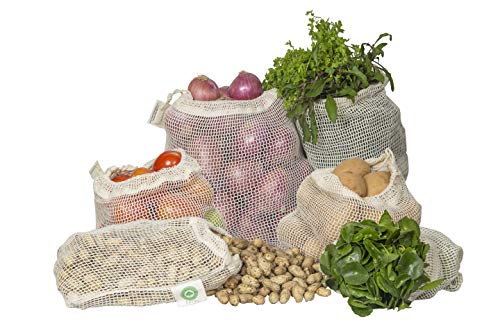
Best overall: Organic Cotton Mart 8-Pack Mesh Produce Bags
| Organic Integrity Score | 91 / 100 |
| Fabric | 100% organic cotton knit, certified for ecology and social responsibility |
| Sizes | XL 14×18, L 12×15, M 10×12, S 8×10 inches |
| Construction | Drawstring closure, reinforced double stitching on all sides |
| Packaging | Recycled paper only, stated |
| Best for | The only set here that points at an actual certification |
This wins on the one thing that separates an organic claim from an organic credential: it names a scheme rather than an adjective.
The listing describes 100% organic cotton knit fabric carrying a certification covering ecology and social responsibility across the production process — which is the language of GOTS, the standard that actually governs organic textiles. It is not as good as printing “GOTS certified” with a license number, and we would say so to the brand. It is considerably better than the bare word organic, which is what three competitors offer.
The sizing is the other strength. Four sizes with exact dimensions — extra large at 14 by 18 inches down to small at 8 by 10 — which matters more than it sounds. A bag sized for a butternut squash is useless for six lemons, and a set with only one or two sizes ends up half unused. Four covers loose leaves, root vegetables, citrus and bulk bin goods.
Reinforced double stitching on all sides is the right construction detail to mention, since the seam is where a mesh bag full of potatoes gives way.
And the recycled paper packaging is a small consistency that we credit. A plastic-free product shipped in a poly bag is a familiar irony, and this listing states it avoided that.
What it lacks is a tare weight tag on this set, and any statement about what the drawstring hardware is made of.
What we liked: A referenced certification covering ecology and social criteria, four dimensioned sizes, reinforced double stitching, breathable mesh that stores produce for around a week, and plastic-free packaging.
Keep in mind: The certification is described rather than named as GOTS, with no license number. No tare weight tag stated. Drawstring hardware material not given.
Tare weight tags: ECO ROOTS Reusable Produce Bags, 9-Pack
| Organic Integrity Score | 88 / 100 |
| Set | 6 mesh bags and 3 solid bulk bags, three sizes |
| Closure | Drawstring with stainless steel cord locks |
| Tags | Tare-weight tags on every bag |
| Construction | Double-stitched seams |
| Best for | Bulk bin shopping, where the tare weight actually costs you |
The most practically equipped set here, and the only one that solves the checkout problem.
Tare-weight tags on every bag means the cashier can deduct the bag’s weight instead of charging you for it. On loose fruit that is pennies; on cashews, dried mango or coffee beans from a bulk bin it is real money, repeated every shop for the life of the bag.
Stainless steel cord locks is the other named material on this page. Steel is not compostable, so this is not the choice if you want a bag you can eventually put on a compost heap — but it is durable, it will outlast the fabric, and naming the material at all puts it ahead of three competitors who leave you to guess.
The mix of six mesh bags and three solid bulk bags is well judged. Mesh is right for anything you want the cashier to see and anything that needs air. Solid cotton is right for flour, grains, rice and anything that would pour straight through mesh — and it also keeps light off produce that does not want it.
Double-stitched seams, and the listing sensibly frames the bags as shopping bags first and fridge or pantry storage second.
It sits second because the fabric claim is unbacked. “Organic cotton produce bags” with no certifier, on the most expensive set here, is the gap that keeps it off the top spot.
What we liked: Tare-weight tags on every bag, stainless steel cord locks named, a genuinely useful mix of mesh and solid bags, double-stitched seams, and three sizes.
Keep in mind: “Organic cotton” with no certifier named. The most expensive set here. Steel locks mean it is not fully compostable.
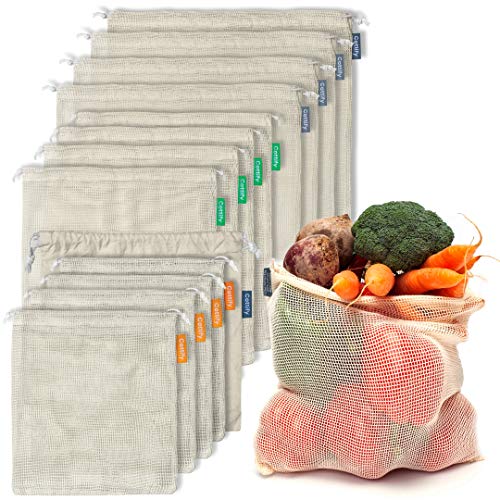
No plastic or metal at all: Cottify 12+1 Cotton Mesh Produce Bags
| Organic Integrity Score | 86 / 100 |
| Set | 13 bags in a range of sizes, color coded |
| Closure | No plastic or metal closure bead, stated |
| End of life | Fully biodegradable, stated |
| Weight | Described as among the lightest available |
| Best for | Actually eliminating plastic rather than relocating it |
The strongest seller of the five, the largest set, and the only one that closes the loop on the plastic question.
No plastic or metal closure bead. The listing says it twice, and pairs it with a claim that the bags are fully biodegradable — which only holds if the hardware is absent, exactly as described. If your reason for buying reusable produce bags is to stop introducing polymers, this is the only set here that does not hand one back to you on the drawstring.
Low weight follows from the same decision, and it has a practical benefit at the till: a lighter bag is a smaller tare, so even without a printed tag you are paying for less of it.
Thirteen bags is a genuine quantity — enough to leave some in the car, some by the door and some in the fridge without ever being caught short, which is the actual reason people fall back on the plastic roll. And color coding is a small, sensible touch that lets you keep the bag you use for onions separate from the one you use for salad leaves.
It falls just short of the top two because the fabric claim has nothing behind it. The listing says organic cotton, names no certifier, and there is no tare weight tag or dimensional table — sizes are described as various rather than listed.
What we liked: Genuinely plastic-free including the closure, biodegradable, thirteen bags, color coded, very light, and the best sales record here.
Keep in mind: “Organic” with no certifier. No tare weight tags. Sizes are not individually dimensioned. A drawstring without a toggle needs tying rather than cinching.
Cheapest, and it claims nothing: MAQIHAN 6-Pack Cotton Mesh Bags
| Organic Integrity Score | 79 / 100 |
| Set | 6 bags — two small 7.9×9.8, two medium 9.8×11.8, two large 11.8×13.8 in |
| Fabric | Coarse cotton — no organic claim made |
| Construction | Tight stitching on both sides, drawstring |
| Best for | Replacing plastic bags at the lowest possible cost |
Under eight dollars for six bags with every size dimensioned, and it is a strong seller.
It makes no organic claim at all. The fabric is described as coarse cotton, tough and breathable, with tight stitching on both sides. That is it — no certification language, no eco vocabulary, no zero-waste framing.
As with the plain cotton dish towels in our kitchen towel guide, we want to be clear about how that is scored. It sits below the certified set because this is an Organic Integrity Score and there is no organic credential to measure. It sits above the listing at the bottom of this page because a seller who tells you plainly what you are getting has done nothing wrong, while one that uses the word organic and names nobody has invited a belief it cannot support.
If your goal is simply to stop taking plastic bags off the roll — and for most people that is the goal — these do the job for the price of a sandwich.
Coarse cotton is also genuinely more durable than fine mesh under load, though it is less see-through, which slows down the cashier.
What we liked: The lowest price here, all three sizes dimensioned, tight stitching on both sides, tough coarse weave, and no claims it cannot back.
Keep in mind: Not organic and not certified. No tare weight tag, no hardware material, and the coarse weave is harder to see through at checkout.
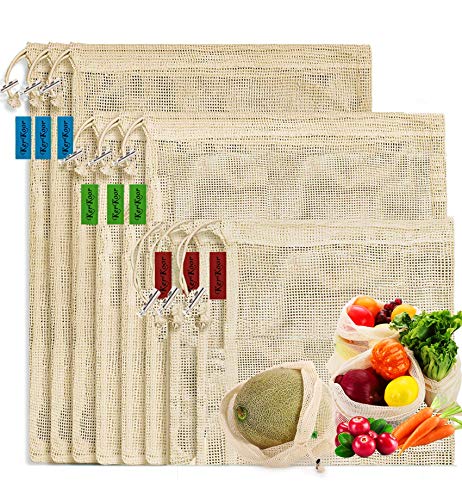
Sizes stated, claims unbacked: KerKoor 9-Pack Cotton Mesh Bags
| Organic Integrity Score | 76 / 100 |
| Set | 9 bags — 3 large 16.9×12.2, 3 medium 13.3×12.2, 3 small 8.2×12.2 in |
| Fabric | Organic cotton, no certifier named |
| Design | See-through mesh so contents are visible at checkout |
| Best for | Nine dimensioned bags, if the claims do not concern you |
Nine bags in three sizes, all dimensioned, and a sensible argument for the see-through weave: an opaque bag means the cashier opens it, or you do, and a mesh you can read through speeds up checkout.
The point about a reusable bag displacing a large number of single-use ones over its life is also fair, and the sizes are usefully spread.
Two things put it last.
The first is familiar: organic cotton with no certifier, alongside “eco friendly” and “zero-waste lifestyle” language that references no standard.
The second is a detail we look for. The listing writes fo-od-sa-fe and WORRY-FR-EE with hyphens inserted mid-word. That is a technique for slipping words past automated listing filters, and while it is not evidence of a bad product, it tells you something about how the listing was written and how much of it to take at face value. On a page where we are grading exactly that, it counts.
What we liked: Nine bags across three dimensioned sizes, a genuinely see-through weave that speeds up checkout, and a fair account of how many single-use bags one replaces.
Keep in mind: Organic claimed with no certifier. “Eco friendly” carries no content. Hyphen-broken words suggest a listing written to evade filters. No tare tag or hardware detail.
Mesh or solid, and what size to buy
Mesh is the default. It lets the cashier see and scan the contents, it lets produce breathe so it does not sweat and rot, and it weighs less. It is wrong for anything small enough to fall through — rice, lentils, flour, coffee, most nuts.
Solid cotton handles all of those, and it keeps light off things that stale in it. One set here includes three.
On sizes: small bags around 8 by 10 inches suit citrus, garlic, chiles and mushrooms. Medium around 10 by 12 handles apples, onions and peppers. Large from 12 by 15 upward takes leafy greens, broccoli and a squash. Buy a spread rather than a stack of one size — every set here that gives four sizes is more useful in practice than one that gives two.
Buy more than you think. The reason people default back to the plastic roll is that the good bags are in the wash, or at home, or in the other car. Thirteen bags is not excessive.
Using and washing them
Weigh a bag at home if it has no tare tag, and write the weight on the label in laundry marker. Grams and ounces both, since scales vary.
Wash cold and line dry. Cotton mesh shrinks in a hot wash and a hot dryer, and a shrunk bag loses capacity permanently. Cold water, and let them dry naturally.
Wash them more often than feels necessary. These bags carry unwashed produce that has been handled by many people, then go back in a cupboard. Once a two weeks in normal use, and immediately after anything leaked.
Dry them fully before storing. A damp cotton bag folded in a drawer will mildew, and the smell does not come out easily.
Do not use them for wet produce long term. Mesh is for transport and short storage. For anything you want to keep crisp for a week, our produce storage guide covers what actually works, and our steamer basket guide covers what to do with the vegetables once they are home.
How we researched this guide
We read all five listings in full, title and description, and recorded every fiber, construction and certification claim. Because the fabric is cotton in every case, we scored on whether an organic claim is backed by a named certification scheme, what the closure hardware is made of, whether a tare weight tag is provided, and whether sizes are given as dimensions rather than adjectives. We treated a listing that makes no organic claim as more honest than one that uses the word without a certifier, and scored accordingly. We also noted listing-writing practices, including hyphen-broken words used to evade automated filters. Sales position was used as a check on whether claims have been tested by use.
Common questions about reusable produce bags
Do reusable produce bags contain plastic?
Often yes — in the drawstring cord and the toggle, even when the mesh is cotton. One set here states it uses no plastic or metal closure bead; one uses stainless steel cord locks; three do not say.
What is a tare weight tag and why does it matter?
It is the empty weight of the bag printed on a sewn tag so the cashier can deduct it. Without one you pay for the weight of your own bag, which adds up on bulk items like nuts and coffee.
How much does a produce bag weigh?
Roughly 15 to 40 grams depending on size and weave. Weigh yours on a kitchen scale and write it on the label if the bag came without a tag.
Does “organic cotton” on a produce bag mean it is certified?
Not unless a certifier is named. GOTS is the standard for organic textiles, requiring at least 95% certified organic fiber and auditing the full supply chain plus social criteria. One listing here points at such a scheme; two use the word with nothing behind it.
Mesh or solid cotton bags?
Mesh for fruit and vegetables, so contents are visible and produce breathes. Solid for flour, grains, rice, nuts and anything that would fall through. One set here includes both.
Will the cashier know how to handle them?
Usually. A visible tare tag makes it easy; a see-through mesh makes scanning easy. If neither, expect to be asked to tip the contents out.
How do I wash produce bags?
Cold water and line dry. Hot washing and tumble drying shrink cotton mesh permanently. Wash every couple of weeks and immediately after any leak.
Are these bags compostable at end of life?
Only if the whole bag is natural fiber, including cord and hardware. A plastic toggle or a steel cord lock means the bag has to be dismantled first, and most listings do not tell you which you have.
How many bags do I actually need?
More than a typical shop needs, because the reason people fall back on plastic is that the good bags are in the wash. Eight to thirteen is a realistic working number.
Can I store vegetables in them in the fridge?
For a few days, yes — mesh lets produce breathe, which beats a sealed plastic bag for most things. For longer storage, method matters more than the bag.
What sizes should I buy?
A spread. Around 8×10 inches for citrus and mushrooms, 10×12 for apples and onions, and 12×15 or larger for greens and squash. Sets with four sizes get used more fully than sets with one.
Why is one bag stiffer than another?
Coarse cotton weaves are tougher and hold more weight; fine mesh is lighter and easier to see through. Neither is better, they are different trades.
- Best Organic Cotton Kitchen Towels
- How to Store Organic Produce So It Actually Lasts
- Best Steamer Baskets
- Best Glass Pantry Jars
- Organic Product Database — search all 800+ products we have reviewed