
Last updated: September 30, 2026
We may earn a commission when you buy through links on this page, at no extra cost to you. How we research and rate.
The short version
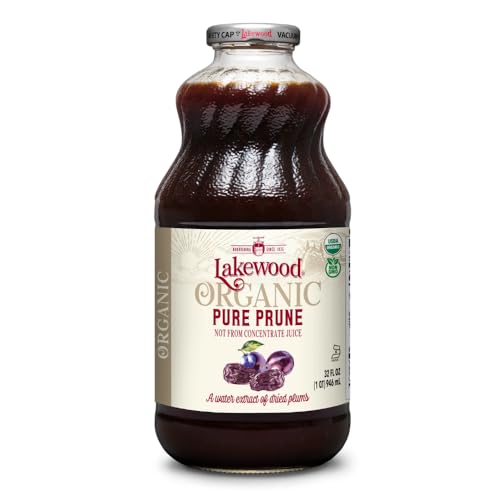
After researching the certifications, ingredients, and sourcing of the organic prune juices you can actually buy, our top pick is Lakewood Organic Pure Prune Juice. It is USDA Organic, 100% juice with nothing added, and made from whole organic prunes (dried plums), which is why it earned our highest Organic Integrity Score of 92 out of 100. The other genuinely organic option worth buying is R.W. Knudsen Organic Just Prune Juice, our value pick.
A quick, honest note: certified organic prune juice is a smaller category than most juice aisles suggest. Plenty of familiar names, Sunsweet among them, sell 100% juice that is not certified organic. The genuinely organic options are fewer, and there are more of them than this guide originally listed, so we have expanded it. All five below are both USDA organic and 100% juice.
Best organic prune juice compared
| Best Choice | Best Value | ||||
 |  |  |  |  | |
| Product | Lakewood Organic | R.W. Knudsen Organic | Lucy’s Family Owned | 365 Whole Foods | Lucy’s 2-Pack |
| Organic Integrity Score | 92/ 100 | 88/ 100 | 86/ 100 | 82/ 100 | 80/ 100 |
| Our rating | 4.6 | 4.4 | 4.3 | 4.1 | 4.0 |
| Best for | Best overall | Widely available | Best glass bottle | Best value | Bulk buying |
| Type | Not from concentrate, glass | Not from concentrate | Not from concentrate, glass | From concentrate | Not from concentrate, glass |
| Certification | — | USDA Organic, Non-GMO Project Verified | Certified Organic, Non-GMO | — | Certified Organic, Non-GMO |
| Price | $10.99$0.34 / fluid ounce View on Amazon | $6.07 $7.59 −20%$0.19 / fluid ounce View on Amazon | Currently unavailable See buying options | $6.99$0.22 / fluid ounce View on Amazon | $29.99$0.44 / fluid ounce View on Amazon |
Price and availability as of October 17, 2026 1:10 pm EDT. Product prices and availability are accurate as of the date/time indicated and are subject to change. Any price and availability information displayed on Amazon.com at the time of purchase will apply to the purchase of this product.
Nutrition facts side by side
| Per 100 ml | Lakewood Organic Pure | R.W. Knudsen Organic | 365 by Whole Foods |
| Calories | 75 kcal | 75 kcal | 75 kcal |
| Carbs | 17.5 g | 19.2 g | 17.5 g |
| Sugars | 10.4 g | 14.6 g | 11.2 g |
| Fiber | 1.2 g | 1.2 g | 0.8 g |
| Protein | 1.3 g | 0.4 g | 0.4 g |
| Fat | 0 g | 0 g | 0 g |
| Sodium | 12 mg | 6 mg | 21 mg |
Source: USDA FoodData Central, matched by UPC. Figures are per 100 ml, not per serving, and reflect the panel USDA published for each product.
Scores are ours, based on independent research of certification, ingredient purity, sourcing, and value, using the same 10-criteria method we apply to every product.
What each certification on an organic prune juice label actually covers
Each certification below appears on at least one product on this page. They are not ranked against each other, because they measure different things, but knowing which is which changes what you buy.
| Certification | Covers | Key exclusion |
| USDA Organic | Farming and handling: no synthetic pesticides or fertilizers, no GMOs, no sewage sludge or irradiation, audited yearly by an accredited certifier | Three different tiers share the one seal, and it makes no claim about worker pay, food miles, or nutrition |
| Non-GMO Project | Testing and supply-chain traceability showing the ingredients are not genetically engineered | Sets no limit on synthetic pesticides or fertilizers, so it is not an organic claim |
Non-GMO and organic are not two grades of the same thing. The butterfly certifies an absence of genetic engineering and stops there; the USDA seal prohibits genetic engineering as one clause among many, alongside synthetic pesticides, synthetic fertilizers, sewage sludge and irradiation. That makes organic the broader claim by some distance. Where both appear together, the butterfly is adding batch testing on top of a standard that had already banned GMOs.
How much prune juice to drink, and when
| Situation | Amount | Notes |
| Adult, occasional constipation | 4 to 8 oz (120 to 240 ml) once daily | Start at 4 oz |
| Adult, chronic constipation | 8 oz, sometimes split morning and evening | Give it several days |
| Whole prunes as an alternative | 80 to 120 g daily (about 10 to 14 prunes) | The dose used in trials |
| Children | Ask a pediatrician first | Doses are much smaller |
| Infants under 12 months | Not without medical advice | Juice generally not recommended |
Start low. The most common mistake is drinking a large glass on day one, which frequently produces cramping, gas, and bloating, because the same sorbitol that softens stool ferments in the colon. Begin with 4 oz, ideally in the morning or about half an hour before bed, and increase only if needed.
Give it time. Effects usually appear within 6 to 12 hours, though for chronic constipation the trials ran over weeks rather than days. It is not an overnight fix comparable to a stimulant laxative, and that gentleness is precisely the advantage.
Drink water alongside it. Every mechanism here depends on drawing water into the colon, so prune juice taken by someone who is dehydrated works considerably less well.
When to stop and see a doctor. Constipation that persists beyond a couple of weeks, or that comes with blood in the stool, unexplained weight loss, severe pain, or a sudden change in bowel habit, needs medical assessment rather than more juice. Nothing here is medical advice.
Key things to look for in organic prune juice
Prune juice is both a pantry staple and a gentle digestive helper, so purity matters. Here is what separates a good bottle from a sugary one.
1. USDA Organic prunes
Organic sourcing means the plums were grown without synthetic pesticides, worth it for a concentrated fruit juice.
2. 100% juice, no added sugar
Prunes are naturally sweet, so the best juices need nothing added, no sugar, syrups, or synthetic preservatives.
3. Natural sorbitol and fiber
Prune juice’s gentle digestive effect comes from its natural sorbitol and fiber, not additives, so pure juice is what you want.
4. Glass packaging
Glass protects the flavor of this rich, dark juice and avoids storing acidic liquid in plastic.
Organic vs conventional prune juice: does it matter?
Most conventional prune juice is 100% juice already (it rarely needs added sugar), but organic sourcing ensures the plums were grown without synthetic pesticides, and the best organic bottles avoid added preservatives. Since prune juice is concentrated from dried plums, starting with clean, organic fruit is meaningful.
The gentle regularity benefit is well recognized: the NIH notes that prunes and prune juice are a common dietary approach to occasional constipation. Our scoring weights organic certification and clean, 100%-juice ingredients alongside flavor and value, with the honest reminder that prune juice is high in natural sugar and best enjoyed in sensible servings.
Why prune juice works: the three mechanisms
Prune juice is one of the few traditional remedies with genuinely solid clinical backing, and it works through three separate mechanisms rather than one.
Sorbitol, the main driver. Sorbitol is a sugar alcohol that the small intestine absorbs poorly. What is not absorbed travels into the colon and draws water in with it by osmosis, softening stool and increasing its volume. Prunes are unusually high in it. This osmotic effect is the primary reason prune juice works, and it is why prune juice is effective despite having far less fiber than whole prunes.
Fiber, mostly pectin. Whole prunes carry meaningful soluble fiber, principally pectin, which adds bulk and supports transit. Juice retains only a fraction of this, which is the key difference between drinking prune juice and eating prunes.
Polyphenols. Prunes contain phenolic compounds, chiefly chlorogenic acids, that appear to stimulate gut motility and may act on colonic function independently of the other two mechanisms.
The evidence. A randomized placebo-controlled trial found prune juice containing sorbitol, pectin, and polyphenols reduced hard and lumpy stools, normalized stool form, and improved subjective constipation complaints. More strikingly, a well-known randomized crossover trial compared 50 g of prunes twice daily against psyllium in 40 adults with chronic constipation, and even when fiber intake was matched between the two groups, prunes produced more complete spontaneous bowel movements per week and better stool consistency than psyllium. That fiber-matched design is what makes the result interesting: it indicates the advantage comes from sorbitol and polyphenols rather than fiber alone. A broader systematic review of foods and drinks for chronic constipation lists prunes among the interventions with supporting evidence.
How to choose an organic prune juice
- USDA Organic seal. Confirms pesticide-free plums, and, as noted, this narrows the field to just a couple of bottles.
- “100% juice, no sugar added.” Prunes are sweet enough; avoid added sugar or preservatives.
- Glass bottle where possible, for flavor and to avoid acidic juice in plastic.
- Serving size. Start with a small serving (4 ounces) for the digestive effect, since more is not always better.
- Moderation. It is naturally high in sugar, so treat it as a functional drink, not an all-day beverage.
Best overall: Lakewood Organic Pure Prune Juice
| Organic Integrity Score | 92 / 100 |
| Certification | — |
| Type | 100% juice from whole organic prunes, in glass |
| Best for | A pure, all-purpose organic prune juice |
Lakewood is our top pick because it is about as pure as prune juice gets: USDA Organic, 100% juice made from whole organic prunes, bottled in glass, with no added sugar or synthetic preservatives. The juice from more than three pounds of prunes goes into every bottle, so it delivers the gentle, natural benefits of prunes without anything extra.
The trade-off is a premium price and, like all pure juice, a shorter fridge life once opened. For a clean, effective organic prune juice, it is our first choice.
What we liked: USDA Organic, 100% juice from whole prunes, glass bottle, no additives, with the natural sorbitol and fiber that make prune juice useful.
Keep in mind: It is premium-priced and, like all prune juice, naturally high in sugar, so stick to sensible servings.
What the listing discloses: Lakewood leaves the basics open, including whether the USDA seal applies and where it was grown or made.
Most widely available: R.W. Knudsen Organic Just Prune Juice
| Organic Integrity Score | 88 / 100 |
| Certification | USDA Organic, Non-GMO Project Verified |
| Type | 100% juice, no sugar added |
| Best for | A trusted, more affordable organic option |
R.W. Knudsen Organic Just Prune Juice is our value pick, and the other prune juice we can recommend without reservation. It is USDA Organic and Non-GMO Project Verified, 100% juice with no added sugar, made as a single-fruit extract from organic dried prunes, from a juice brand that has specialized in pure fruit juices since 1961.
It scores just below our top pick mainly on the premium glass packaging and richness of Lakewood, but on the fundamentals, organic and 100% juice, it delivers at a friendlier price and is widely available.
What we liked: USDA Organic, Non-GMO, 100% juice with no added sugar, from a long-trusted juice brand, at a more affordable price.
Keep in mind: It is a straightforward everyday bottle rather than a premium glass-bottled juice, and, like all prune juice, high in natural sugar.
What the listing discloses: R.W. Knudsen states a USDA organic claim and Non-GMO Project Verified, and does not say where it was grown or made.
Best glass bottle: Lucy’s Family Owned Organic 100% Prune Juice, 34 oz
| Organic Integrity Score | 86 / 100 |
| Ingredients | Organic prune juice, not from concentrate |
| Certification | Certified Organic, Non-GMO |
| Best for | Buyers who want American-grown prunes in glass |
Lucy’s is a family-owned producer using American-grown prunes, bottled in glass rather than plastic. Glass matters more than people assume for an acidic, dark, sugar-rich juice: it is inert, does not leach, and does not pick up flavor over the weeks a 34 oz bottle takes to finish. The juice is single-ingredient, not from concentrate, with no added sugar, and it tastes noticeably fresher and less cooked than concentrate-based prune juice.
The trade-off is availability and price. It is harder to find than the supermarket names and costs more per ounce than concentrate-based options, and a 34 oz glass bottle is heavy to ship and awkward to store in a fridge door.
What we liked: American-grown organic prunes, not from concentrate, single ingredient, and inert glass packaging.
Keep in mind: Costs more per ounce, less widely stocked, and heavy in glass.
What the listing discloses: Little to verify on the Lucy’s listing: no word on whether the USDA seal applies and where it was grown or made.
Best value: 365 by Whole Foods Market Organic 100% Prune Juice, 32 oz
| Organic Integrity Score | 82 / 100 |
| Ingredients | Filtered water, organic prune juice concentrate |
| Certification | — |
| Best for | Regular daily use at the lowest cost |
The cheapest genuinely certified organic prune juice most people can actually buy, and widely stocked. It is USDA organic with no added sugar, and for anyone drinking a glass every morning for regularity, the per-serving cost matters more than provenance. It does the job the sorbitol is there to do just as well as the premium bottles.
The trade-off is that this one is reconstituted from concentrate rather than pressed and bottled directly, which is why it scores below the others here. The label is explicit about it: filtered water and organic prune juice concentrate. That is an honest, legitimate product and it is a step down in flavor and freshness from a not-from-concentrate juice, and it arrives in plastic rather than glass.
What we liked: Genuinely USDA organic at the lowest price per serving, no added sugar, and easy to find.
Keep in mind: From concentrate rather than freshly pressed, and packaged in plastic.
What the listing discloses: Beyond the organic claim itself, 365 by Whole Foods Market does not say whether the USDA seal applies and where it was grown or made.
Best for bulk: Lucy’s Family Owned Organic Prune Juice, 2-Pack
| Organic Integrity Score | 80 / 100 |
| Ingredients | Organic prune juice, not from concentrate |
| Certification | Certified Organic, Non-GMO |
| Best for | Households using it daily and long term |
Two 34 oz glass bottles of the same not-from-concentrate Lucy’s juice, at a better rate per ounce. If prune juice is a standing part of someone’s routine, which it often is in older households and care settings, buying two at a time is simply the sensible arrangement, and the second bottle stays sealed while the first is in use.
It scores lowest here purely on practicality rather than quality. Sixty-eight ounces of glass is heavy and takes real fridge space, and once opened a bottle keeps only seven to ten days refrigerated, so the second bottle is a stock item rather than an open one. Buy it if you genuinely get through a bottle a week.
What we liked: Same not-from-concentrate organic juice in glass at a better price per ounce.
Keep in mind: Heavy, bulky to store, and opened juice keeps only a week or so.
What the listing discloses: Beyond the organic claim itself, Lucy’s does not say whether the USDA seal applies and where it was grown or made.
How to use prune juice
For gentle digestive support, start with a small serving (about 4 ounces) and increase only if needed, ideally in the morning or evening with water alongside. Because prune juice is naturally high in sugar, treat it as a functional drink rather than an all-day beverage, and pair it with a fiber-rich diet and plenty of water. If constipation is persistent or severe, talk to your doctor rather than relying on juice alone. Prune juice also works in marinades and baking, where its rich sweetness shines.
Prune juice versus whole prunes
Worth being clear about, because the trials that produced the strongest results mostly used whole prunes rather than juice.
| Factor | Prune juice | Whole prunes |
| Sorbitol | High | High |
| Fiber | Low, mostly filtered out | Substantial, pectin intact |
| Polyphenols | Present | Higher |
| Sugar per serving | Concentrated, drunk quickly | Slower to eat, more filling |
| Best for | Ease, swallowing difficulty, speed | Strongest evidence, better satiety |
If you can eat them, whole prunes are the better intervention: more fiber, more polyphenols, better satiety, and they are what the psyllium comparison trial actually tested. Juice earns its place where chewing or swallowing is difficult, in older adults and in care settings, where a glass is simply easier to get down than a dozen prunes, and where a faster osmotic effect is wanted. Many people do best combining them, prunes during the day and juice in the morning.
Potassium, sugar, and who should be cautious
Potassium. Prune juice is notably high in potassium, which is a genuine benefit for most people and a real consideration for anyone with chronic kidney disease or taking potassium-sparing diuretics, ACE inhibitors, or ARBs. If you have been told to watch your potassium intake, prune juice is one to raise with your doctor rather than adopt as a daily habit.
Sugar. Prune juice is concentrated fruit sugar with very little fiber to slow it down, at roughly 180 calories per 8 oz serving. That is a meaningful load if you are managing blood glucose, and it is worth pairing with food rather than drinking alone if you are diabetic. Whole prunes are the better choice in that situation, since the fiber blunts the glycaemic response.
Sorbitol sensitivity. People with IBS, particularly those following a low-FODMAP approach, often react badly to sorbitol with bloating, cramping, and wind. Prune juice is high-FODMAP and is one of the drinks most likely to trigger symptoms in that group.
A note on bone health. There is a separate and reasonably interesting body of research on dried plums and bone mineral density in postmenopausal women, generally using whole prunes at around 50 to 100 g daily rather than juice. It is promising and outside what a glass of juice has been shown to do.
Prunes beat psyllium head to head — the trial that matters
Our mechanisms section explains why prune juice works. What is worth adding is that it has been tested directly against the standard fiber supplement, and won.
A randomized, single-blind crossover trial ran for eight weeks, with participants taking either dried plums (50 g twice daily, 6 g fiber per day) or psyllium (11 g twice daily, also 6 g fiber per day) for three weeks each. The fiber doses were deliberately matched, so the comparison isolates everything other than fiber.
Dried plums performed significantly better on both the number of complete spontaneous bowel movements per week and stool consistency scores. The authors concluded that dried plums are safe, palatable and more effective than psyllium for mild to moderate constipation, and should be considered as first-line therapy.
Keep in mind: because the fiber was matched, the advantage cannot be fiber. It points to the other components — principally sorbitol, of which prunes carry around 15 g per 100 g, plus pectin and polyphenols, working together. That is the strongest evidence in this guide, and it is unusually good evidence for a food remedy: a randomized trial in which the whole food outperformed the pharmacy product on a matched active ingredient.
A separate randomized, placebo-controlled trial on prune juice specifically — rather than whole prunes — found it improved subjective complaints and hard stools while normalizing stool consistency in chronic constipation, attributing the effect to the same sorbitol, pectin and polyphenol combination. So the finding does carry across from fruit to juice, which is not always safe to assume.
Where juice and whole fruit genuinely differ
Our comparison section covers this. One clarification worth making explicit, given the trial above used whole prunes:
- The sorbitol survives juicing. It is water-soluble, so it comes across into the juice — which is why prune juice works at all and why the juice trial found what it found.
- Most of the insoluble fiber does not. Whole prunes carry considerably more, which is why they were the form that beat psyllium.
- For occasional relief, juice is the faster and easier option. For ongoing management, whole prunes deliver both mechanisms and less sugar per effective dose.
- The practical compromise many people land on: whole prunes daily as the routine, juice held back for when things are actually stuck.
Potassium, and the group that needs to know
Prunes are potassium-dense — roughly 280 mg from four or five prunes, around 12% of daily needs, and juice concentrates it further.
For most people that is a benefit, since potassium intake is commonly below recommendation. For a specific group it is not:
- Chronic kidney disease or anyone on a potassium-restricted diet — prune juice is a high-potassium food, not a health drink, and impaired kidneys cannot clear the load.
- ACE inhibitors, ARBs and potassium-sparing diuretics all raise serum potassium themselves, and a daily glass of prune juice adds to it.
- This is the same caution we give on coconut water, and for the same reason.
Acrylamide: a small honest footnote
Drying plums involves heat, and heat processing of fruit produces small amounts of acrylamide. Measurements in prunes have ranged from roughly 27 to 164 µg/kg, with plum products generally at the low end of the thermal-processing spectrum.
We mention it for completeness rather than alarm. These are very low concentrations relative to the dietary sources that actually dominate acrylamide exposure — fried potato products, coffee and baked goods — and nothing here suggests avoiding prunes. It is simply true, and a guide that lists every benefit while omitting every trade-off is not being straight with you.
Practical notes
- Start with a small glass — around 120 ml — and wait. Sorbitol is fermented, so too much at once produces gas, bloating and cramping rather than a better result.
- Give it 6–12 hours. This is not a fast-acting laxative, and taking more because nothing has happened in an hour is how people overshoot.
- Warm it slightly and drink it in the morning — a common and reasonable approach, since the gastrocolic reflex is strongest after the first meal.
- Water matters. Sorbitol works osmotically by drawing water into the bowel, so being underhydrated blunts the effect.
- Not for infants without pediatric advice, and not as a routine daily laxative for children.
- If constipation is persistent, new, or accompanied by weight loss, bleeding or severe pain, that needs a doctor rather than a juice.
How we researched this guide
We are a research-based review site. We did not lab-test these juices ourselves, and this is general information, not medical advice. We compared each against its certification, ingredient list, processing, packaging, and the weight of aggregated customer feedback, then scored each with our 10-criteria Organic Integrity Score. We deliberately left out prune juices that are not certified organic rather than pad the list. No brand paid to be included or ranked. Read more about our method on the How We Research and Rate page.
Prune juice, regularity, and why the scale moves without fat changing
Prune juice is often noticed to “work” quickly, and it is worth being clear about what is happening, because the mechanism is real and it is not fat loss.
Prunes and prune juice contain sorbitol, a sugar alcohol that is poorly absorbed in the small intestine. It draws water into the bowel osmotically and speeds transit. That effect is genuine, well documented, and the reason prune juice has been a standard remedy for constipation for generations. Whole prunes add insoluble fiber on top, which is why they outperform the juice for regularity in head-to-head trials.
What that produces on a scale is the relief of retained stool and water, and neither is body fat. The number can move by a kilogram or more and it reflects what has left the bowel, not a change in stored energy. It also returns as normal transit resumes. Any product marketed on rapid visible results through this route is selling the same effect a laxative provides.
The other half of the arithmetic is that prune juice is a sweet drink. A cup carries roughly 180 calories and around 40 grams of sugar, which is more than most soft drinks. Drunk daily for regularity, it is a meaningful and easily overlooked contribution to daily intake.
For that reason whole prunes usually make more sense: more fiber, more chewing, better satiety and fewer calories for the same effect. Four or five prunes is a common effective serving.
Honest summary: a genuine and useful effect on regularity, no effect on fat, and a calorie cost worth counting if it becomes a daily habit.
Common questions about organic prune juice
What is the best organic prune juice?
Our overall pick is Lakewood Organic Pure Prune Juice, because it is USDA Organic, 100% juice from whole organic prunes, bottled in glass with no additives. The best value organic option is R.W. Knudsen Organic Just Prune Juice.
How many prune juices are actually certified organic?
Fewer than the juice aisle suggests, and more than two. Several familiar brands, Sunsweet included, sell 100% prune juice that is not certified organic. The genuinely certified options include Lakewood, R.W. Knudsen, Lucy’s Family Owned, and 365 by Whole Foods. Check for the USDA organic seal specifically rather than assuming 100% juice means organic.
Does prune juice help with constipation?
Prune juice is a widely used, gentle dietary approach to occasional constipation, thanks to its natural sorbitol and fiber. Start with a small serving. If constipation is persistent or severe, talk to your doctor.
How much prune juice should I drink?
A typical serving is 4 to 8 ounces. Because prune juice is high in natural sugar, start small, drink water alongside, and treat it as a functional drink rather than an all-day beverage.
Is prune juice high in sugar?
Yes. Prune juice is concentrated from dried plums and is naturally high in sugar even with no sugar added, so it is best enjoyed in sensible servings.
Are prunes better than psyllium for constipation?
In a head-to-head trial, yes. An eight-week randomized single-blind crossover study gave participants either dried plums (50 g twice daily) or psyllium (11 g twice daily), with fiber matched at 6 g per day in both arms. Dried plums performed significantly better on complete spontaneous bowel movements and stool consistency, and the authors concluded they should be considered first-line therapy for mild to moderate constipation. Because fiber was matched, the advantage cannot be fiber.
Why do prunes work better than fiber alone?
Sorbitol, principally — prunes carry around 15 g per 100 g — working alongside pectin and polyphenols. Sorbitol is an osmotic agent that draws water into the bowel, which is a different mechanism from bulking fiber and is why the matched-fiber comparison still favored prunes.
Does prune juice work as well as whole prunes?
Nearly, and for different reasons. The sorbitol is water-soluble so it carries into the juice, and a separate randomized placebo-controlled trial on prune juice specifically found it improved subjective complaints and hard stools while normalizing consistency. But most of the insoluble fiber stays behind in juicing, so whole prunes deliver both mechanisms. Juice is the faster option for occasional relief; whole prunes suit ongoing management with less sugar per effective dose.
How much prune juice should you drink?
Start with a small glass, around 120 ml, and wait. Sorbitol is fermented in the gut, so too much at once produces gas, bloating and cramping rather than a better result. Give it 6 to 12 hours — this is not fast-acting, and taking more because nothing happened in an hour is how people overshoot. Drink water alongside, since sorbitol works by drawing water into the bowel.
Who should avoid prune juice?
Anyone with chronic kidney disease or on a potassium-restricted diet — prune juice is potassium-dense, with roughly 280 mg from four or five prunes and juice concentrating it further, and impaired kidneys cannot clear that load. Also anyone on ACE inhibitors, ARBs or potassium-sparing diuretics, which raise serum potassium themselves. Not for infants without pediatric advice.
Does prune juice contain acrylamide?
Small amounts. Drying plums involves heat, and heat processing of fruit produces acrylamide — measurements in prunes have ranged from roughly 27 to 164 µg/kg, at the low end of the thermal-processing spectrum. These are very low concentrations relative to the sources that dominate dietary exposure, such as fried potato products and coffee. It is worth stating for completeness rather than as a reason to avoid prunes.
When is the best time to drink prune juice?
Morning, slightly warmed, is a common and reasonable approach — the gastrocolic reflex is strongest after the first meal of the day. Combined with the 6 to 12 hour onset, a morning glass tends to work with your body’s timing rather than against it.
When should constipation be checked by a doctor?
If it is persistent, newly developed, or accompanied by weight loss, bleeding or severe pain. Those warrant medical assessment rather than a dietary remedy, however well evidenced the remedy is.
- Organic Food and Pantry hub
- Best Organic Apple Juice
- Best Organic Lemon Juice
- our searchable product database — compare all 800+ picks side by side
- Juice labels explained
Price and availability as of October 17, 2026 1:10 pm EDT. Product prices and availability are accurate as of the date/time indicated and are subject to change. Any price and availability information displayed on Amazon.com at the time of purchase will apply to the purchase of this product.
Looking for other organic products?
We have checked more than 800 products across food, household goods, gardening, personal care and pet, every one against its stated certification. Browse all reviews.
Organic Connection is reader-supported. When you buy through links on this page we may earn a commission, at no extra cost to you. As an Amazon Associate we earn from qualifying purchases. We are not paid to feature or rank any product. How we research and rate.