Last updated: September 11, 2026
We may earn a commission when you buy through links on this page, at no extra cost to you. How we research and rate.
The short version
After researching the certifications, germination rates, and pathogen testing of the most popular organic sprouting seeds, our top pick is Handy Pantry Organic Broccoli Sprouting Seeds, 1 lb. It is certified organic by Oregon Tilth, sold by a specialist that has focused on sprouting seed for over 50 years, and broccoli sprouts are the one variety with genuinely strong published research behind them, which is why it earned our highest Organic Integrity Score of 90 out of 100. For the best value, Handy Pantry Organic Alfalfa, 1 lb is our pick, and for variety, the Salad Sprouting Mix is the best choice.
Sprouting is the cheapest fresh food you can produce at home and the one with the most real food-safety considerations, so this guide covers both honestly.
Best organic sprouting seeds compared
| Best Choice | Best Value | ||||
 |  |  |  |  | |
| Product | Alfalfa 1 lb | Alfalfa 4 oz | Broccoli 1 lb | Salad Mix 16 oz | Variety 12-Pack |
| Organic Integrity Score | 90/ 100 | 89/ 100 | 88/ 100 | 87/ 100 | 86/ 100 |
| Our rating | 4.5 | 4.5 | 4.4 | 4.4 | 4.3 |
| Variety | Alfalfa | Alfalfa | Broccoli | Five-seed blend | Twelve varieties |
| Best for | Best overall | Trying it first | Anyone sprouting | Best blend | Beginners sampler |
| Certification | USDA Organic, Oregon Tilth, Non-GMO | USDA Organic, Oregon Tilth, Non-GMO | Certified Organic, Non-GMO | USDA Organic, Non-GMO | Certified Organic, Non-GMO |
| Seed | Organic alfalfa sprouting seed | Organic alfalfa sprouting seed | Organic broccoli sprouting seed | Organic alfalfa, broccoli, lentil, mung bean, radish | Twelve organic varieties including alfalfa, broccoli, mung, radish |
| Price | $17.43$1.09 / ounce View on Amazon | $13.63$3.41 / ounce View on Amazon | $34.00$2.13 / ounce View on Amazon | $18.37$1.15 / ounce View on Amazon | $139.23$0.73 / ounce View on Amazon |
Price and availability as of October 11, 2026 7:10 pm EDT. Product prices and availability are accurate as of the date/time indicated and are subject to change. Any price and availability information displayed on Amazon.com at the time of purchase will apply to the purchase of this product.
Scores are ours, based on independent research of certification, suitability for sprouting rather than planting, germination rate, supplier specialization, variety, and value, using the same 10-criteria method we apply to every product. See how we research and rate.
Key things to look for in organic sprouting seeds
Good sprouting seed comes down to intended use, certification, testing, and germination rate. Here is what matters.
1. Sold specifically for sprouting
Untreated, pathogen-tested, and food-grade. Garden seed is often fungicide-treated and is not suitable.
2. Certified organic
You eat the entire plant raw, seed included, days after it germinates. There is no washing or cooking step to fall back on.
3. A stated germination rate
Good sprouting seed germinates at 85% or above. Ungerminated seed sits wet in the jar and is where spoilage starts.
4. A specialist supplier with turnover
Seed viability declines with age. A supplier who sells sprouting seed constantly has fresher stock than a general retailer.
Which sprouts are actually worth growing
The nutritional claims around sprouts range from well-evidenced to entirely invented, and it is worth knowing which is which before you buy a pound of anything.
Broccoli sprouts are the standout. This is the one variety with genuinely strong research behind it. Broccoli sprouts contain glucoraphanin, which converts to sulforaphane, a compound studied extensively for its effects on cellular detoxification pathways. Crucially, young broccoli sprouts contain substantially more glucoraphanin by weight than mature broccoli, by a large multiple in the frequently cited Johns Hopkins work. If you are going to sprout one thing for a specific reason, this is the evidence-backed choice.
Alfalfa is the classic all-rounder. Mild, crunchy, fast, and reliable, it is what most people picture when they think of sprouts and the easiest to eat in quantity. Nutritionally it is a decent source of vitamin K and folate without being remarkable. One caution worth stating: alfalfa contains L-canavanine, and there is limited evidence associating large regular intakes with lupus-like symptoms in susceptible people, so anyone with lupus or an autoimmune condition should raise it with a clinician.
Mung beans and lentils are the substantial ones, thicker and starchier, and they are what goes into stir-fries. They are also more forgiving for beginners because the seeds are large and easy to rinse.
Radish sprouts are peppery and add real flavor rather than bulk, and they grow fast.
The general claim to be skeptical about. “Sprouting multiplies nutrients by 1,000%” and similar figures are largely marketing artefacts, often comparing dry seed weight to hydrated sprout weight, which is mostly measuring added water. Sprouting genuinely does increase some vitamins, reduce phytic acid, and improve digestibility. Those are real, modest benefits. The dramatic multipliers are not.
Sulforaphane, myrosinase, and why cooking ruins it
Broccoli sprouts are the one variety with a serious research base, and understanding the chemistry changes how you handle them.
What the sprout actually contains. Broccoli sprouts do not contain sulforaphane. They contain glucoraphanin, its inert precursor, and they contain it in exceptionally high concentration. The Johns Hopkins work that made this category famous identified broccoli sprouts as an exceptionally rich source of compounds that induce the body’s protective detoxification enzymes, with young sprouts carrying far more glucoraphanin by weight than mature broccoli.
The enzyme that does the conversion. Glucoraphanin only becomes sulforaphane when it meets myrosinase, an enzyme stored separately within the plant. Chewing, chopping, or crushing ruptures the cells and brings the two together. This is why the standard advice is to chew sprouts thoroughly rather than swallowing them whole.
Why this matters practically. Myrosinase is heat-sensitive and is denatured by cooking. Cook broccoli sprouts and you still have the glucoraphanin, and you have destroyed the enzyme needed to convert it, so you get far less sulforaphane. This is the single most important handling fact in the category, and it sits in direct tension with the food safety guidance that vulnerable groups should cook sprouts rather than eat them raw. That is a genuine trade-off rather than something we can resolve for you: cooking removes the microbial risk and removes most of the benefit that made you interested.
One practical workaround if you are cooking a broccoli dish: adding a small amount of raw mustard seed, mustard powder, or raw rocket provides exogenous myrosinase, which can restore some conversion. The same principle explains why some commercial sulforaphane supplements underperform, since many extracts contain glucoraphanin with no active myrosinase. Research has found that supplements formulated to address this can achieve bioavailability comparable to fresh sprouts.
How to choose organic sprouting seeds
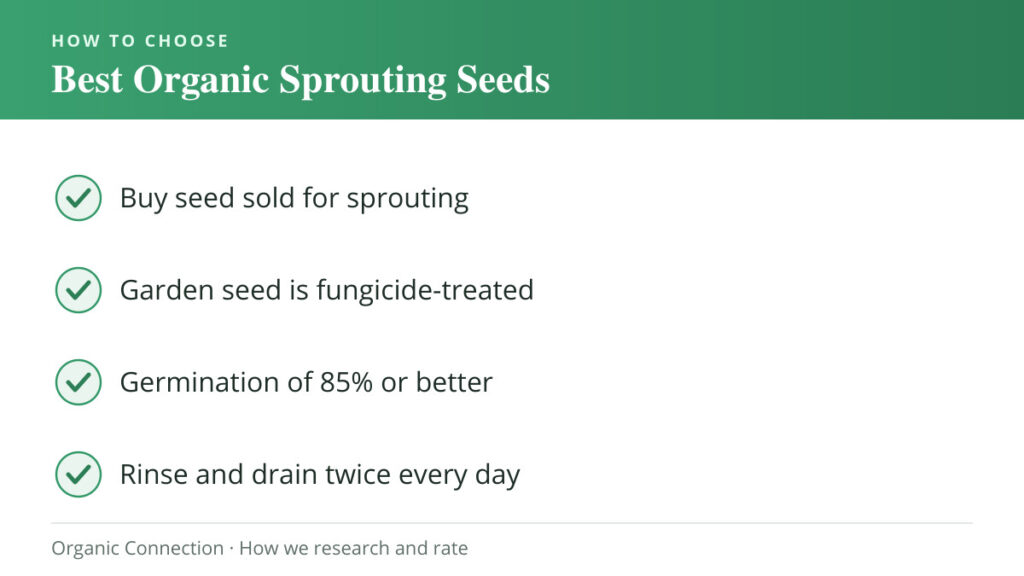
- Buy seed labeled for sprouting, never garden or planting seed.
- Confirm organic certification, since you eat the whole thing raw.
- Check for a stated germination rate of 85% or higher.
- Start with mung, lentil, or alfalfa, which are the most forgiving.
- Buy from a sprouting specialist with high turnover and fresh stock.
Who should buy organic sprouting seeds
The right seed depends on why you are sprouting. If you want the variety with real research behind it, our top pick fits. If you want the classic salad sprout, a ready-made mix, a smaller trial pack, or a wide sampler, we have a pick for each.
Best overall: Handy Pantry Organic Alfalfa Sprouting Seeds, 1 lb
| Organic Integrity Score | 90 / 100 |
| Seed | Organic alfalfa sprouting seed |
| Certification | USDA Organic, Oregon Tilth, Non-GMO |
| Best for | Everyday salad and sandwich sprouts |
Alfalfa is the classic sprout and the best value here by a wide margin. A pound of seed produces an extraordinary volume of sprouts, they are ready in four to five days, and the flavor is mild and grassy enough that a whole household will eat them on sandwiches and in salads without complaint. Certified organic by Oregon Tilth, non-GMO, sold in a resealable pouch by a sprouting specialist. If you are building a sprouting habit, this is the seed to buy in quantity.
The trade-off is the L-canavanine caution: alfalfa contains this amino acid analogue, and limited evidence associates high regular intakes with lupus-like symptoms in susceptible people. That is not a reason for most people to avoid it, and it is a reason for anyone with lupus or an autoimmune condition to ask their doctor first. Alfalfa sprouts also have a shorter fridge life than sturdier sprouts, around five days.
What we liked: Oregon Tilth certified organic, excellent germination, huge yield per pound, and a mild flavor everyone eats.
Keep in mind: The L-canavanine question for anyone with an autoimmune condition, and a short fridge life once harvested.
What the listing discloses: Handy Pantry lists Oregon Tilth as the certifying agent and an origin of the USA. The gap is whether the USDA seal applies.
Best starter size: Handy Pantry Certified Organic Alfalfa Sprouting Seed, 4 oz
| Organic Integrity Score | 89 / 100 |
| Seed | Organic alfalfa sprouting seed |
| Certification | USDA Organic, Oregon Tilth, Non-GMO |
| Best for | First-time sprouters |
Four ounces is enough for several batches, which is exactly what you want when learning. Sprouting has a technique element, rinse frequency, drainage angle, airflow, and most people produce one slimy failed jar before they get it right. Finding that out with four ounces rather than a pound is the sensible way round, and alfalfa is the most forgiving variety to learn on.
It scores lower purely on economics: the cost per ounce is much higher than the 1 lb bag of identical seed, and once you know what you are doing there is no reason to keep buying this size. Buy it once, get two good batches under your belt, then buy in bulk.
What we liked: Same certified organic seed in a size that makes learning to sprout a low-risk exercise.
Keep in mind: Much higher cost per ounce than the pound bag of the same seed.
What the listing discloses: On the Handy Pantry label: Oregon Tilth as the certifying agent and an origin of the USA. Not stated: whether the USDA seal applies.
Anyone sprouting for a specific: Handy Pantry Organic Broccoli Sprouting Seeds, 1 lb
| Organic Integrity Score | 88 / 100 |
| Seed | Organic broccoli sprouting seed |
| Certification | Certified Organic, Non-GMO |
| Best for | Anyone sprouting for a specific nutritional reason |
Broccoli is one we still rate because it is the variety where the science is real rather than assumed. Young broccoli sprouts are far higher in glucoraphanin, the precursor to sulforaphane, than mature broccoli, and that compound has been studied more seriously than anything else in the sprouting world. Handy Pantry has specialized in sprouting seed for over 50 years, the seed is certified organic and non-GMO, and a pound produces an enormous quantity of sprouts, roughly six pounds of finished sprouts from a pound of seed, which makes the cost per serving trivial.
The trade-off is flavor and technique. Broccoli sprouts are noticeably peppery, closer to radish than to mild alfalfa, and not everyone enjoys them in quantity. The seeds are also small, which makes thorough rinsing more important, and small seed is less forgiving of poor drainage than mung or lentil. Start with a smaller batch until your routine is reliable.
What we liked: Certified organic sprouting-grade seed from a 50-year specialist, the best-evidenced variety, and outstanding yield per pound.
Keep in mind: Distinctly peppery flavor, and small seed needs careful rinsing and drainage.
What the listing discloses: Beyond the organic claim itself, Handy Pantry does not say whether the USDA seal applies and where it was grown or made.
Best blend: Handy Pantry Organic Salad Sprouting & Microgreens Mix, 16 oz
| Organic Integrity Score | 87 / 100 |
| Seed | Organic alfalfa, broccoli, lentil, mung bean, radish |
| Certification | USDA Organic, Non-GMO |
| Best for | Mixed salad sprouts with varied texture and flavor |
A ready-blended five-seed mix of alfalfa, broccoli, lentil, mung bean, and radish, which gives a far more interesting result than any single variety: the alfalfa provides bulk, radish and broccoli bring pepper, and lentil and mung add substance and crunch. It saves you buying and storing five separate bags, and it is genuinely good in a sandwich or on top of a bowl.
The trade-off is the standard problem with any seed blend: the varieties germinate and mature at slightly different rates, so the batch is always a compromise, with the fast seeds slightly over and the slow ones slightly under at harvest. The larger mung and lentil seeds also need more rinsing volume than the small seeds, so drainage matters more. It is excellent for eating and less suitable if you are sprouting broccoli for sulforaphane specifically, where a single variety is better.
What we liked: A well-judged five-variety organic blend with genuinely better flavor and texture than single-seed sprouts.
Keep in mind: Mixed varieties mature at different rates, so every batch is a slight compromise.
What the listing discloses: Handy Pantry lists USDA organic certification. The gap is where it was grown or made.
Best sampler: Handy Pantry Organic Sprouting Seed Variety Pack, 12-Pack
| Organic Integrity Score | 86 / 100 |
| Seed | Twelve organic varieties including alfalfa, broccoli, mung, radish |
| Certification | Certified Organic, Non-GMO |
| Best for | Working out which sprouts you actually like |
Twelve separate packets covering alfalfa, broccoli, mung bean, daikon radish, salad mix, and a protein blend among others. Sprout flavors vary far more than people expect, from mild alfalfa to fiercely peppery radish to substantial starchy mung, and the only way to find out which you will actually eat regularly is to try them. As a gift for someone curious about sprouting, it is also a genuinely good one.
It scores lowest here on economics and practicality. The cost per ounce is high, the individual packets are small enough that some produce only one batch, and having twelve part-used packets in a cupboard is a storage nuisance that works against seed freshness. Treat it as a tasting exercise, then buy a pound of whichever two you liked.
What we liked: A genuinely broad USDA organic selection, and the best way to find out which sprouts suit your household.
Keep in mind: High cost per ounce, small packets, and twelve part-used bags to store.
What the listing discloses: Handy Pantry is thin on detail, and does not say whether the USDA seal applies and where it was grown or made.
How to sprout safely, step by step
Sprouting is simple, and the food safety element deserves respect rather than alarm. Warm, humid, dark conditions grow sprouts well and grow bacteria well too, so the process is built around limiting that.
Start clean. Wash the jar, lid, and your hands thoroughly. Use a wide-mouth jar with a mesh lid or a purpose-made sprouting lid; the mesh is what makes rinsing and draining practical.
Soak. One to two tablespoons of small seed such as alfalfa or broccoli per quart jar, or a quarter cup for larger seeds like mung and lentil. Cover with cool water and soak eight to twelve hours, or overnight. Do not overfill; sprouts expand enormously and a crowded jar is the main cause of failure.
Rinse and drain, twice a day, without fail. Drain the soak water, fill with fresh cool water, swirl, and drain thoroughly. Draining is the important half: leave the jar tilted at roughly 45 degrees, mouth down, in a bowl or dish rack so water keeps running out and air can circulate. Standing water at the bottom of a jar is what produces slime and off smells.
Harvest at three to six days, depending on variety. Give them a few hours in indirect light at the end if you want them to green up. Rinse well, spin or pat dry, and refrigerate in a container lined with kitchen paper. Properly dried sprouts keep about five days.
Know when to throw them out. A musty or sour smell, visible slime, or a slimy texture means bin the batch, no exceptions. Do not confuse the fine white root hairs on broccoli and radish sprouts with mold; root hairs are evenly distributed along the root and disappear when rinsed, whereas mold is patchy, cobweb-like, and often grayish. When genuinely unsure, throw it away.
One honest caveat. Because of the outbreak history, health authorities generally advise that pregnant people, young children, older adults, and anyone immunocompromised avoid raw sprouts entirely, and cook them if eating them at all. Cooking removes the risk and also removes the sulforaphane benefit in broccoli sprouts. That is a genuine trade-off worth knowing rather than glossing over.
How we researched this guide
We are a research-based review site. We compared each product against its organic certification and certifying body, whether the seed is sold and tested specifically for sprouting rather than planting, stated germination rate, supplier specialization and stock turnover, variety and its evidence base, yield per pound, packaging, and the weight of aggregated customer feedback on germination consistency, then scored each with our 10-criteria Organic Integrity Score. No brand paid to be included or ranked. This page is informational and is not medical advice; health authorities advise that pregnant people, young children, older adults, and immunocompromised people avoid raw sprouts. Read the full method on our How We Research and Rate page.
Common questions about organic sprouting seeds
What are the best organic sprouting seeds?
Our overall pick is Handy Pantry Organic Broccoli Sprouting Seeds, because broccoli is the variety with genuinely strong published research behind it through glucoraphanin and sulforaphane, and the seed is certified organic from a specialist with over 50 years in sprouting seed. For the best value, organic alfalfa, and for variety, the Salad Sprouting Mix.
Can you use garden seeds for sprouting?
No, and this is the most important safety point in the category. Garden and planting seed is frequently treated with fungicides to protect it in soil, and it is not screened for E. coli or Salmonella. Seed sold specifically for sprouting is untreated, pathogen-tested, and selected for high germination.
Are sprouts safe to eat raw?
For most healthy adults, yes, with good practice: buy sprouting-grade seed, keep everything clean, rinse and drain twice daily, and refrigerate promptly. Sprouts have been linked to foodborne illness outbreaks, almost always traced to contaminated seed. Health authorities advise pregnant people, young children, older adults, and immunocompromised people to avoid raw sprouts or cook them.
Why did my sprouts go slimy?
Almost always poor drainage, overcrowding, or missed rinses. Standing water at the bottom of the jar is what causes slime and off smells. Drain thoroughly after every rinse and store the jar tilted mouth-down so water keeps running out and air circulates. Use less seed than you think; sprouts expand dramatically.
What is the white fuzz on my broccoli sprouts?
Usually root hairs rather than mold. Root hairs are fine, white, evenly distributed along the root, and vanish when you rinse the sprouts. Mold is patchy, cobweb-like, often grayish, and comes with a musty smell. If you are genuinely unsure, throw the batch out; the cost of seed is far lower than the cost of being wrong.
- Organic Gardening hub
- Best Organic Vegetable Seeds
- Best Organic Seed Starting Mix
- Organic Gardening for Beginners
- our full product index — search by brand, product or certification
Price and availability as of October 11, 2026 7:10 pm EDT. Product prices and availability are accurate as of the date/time indicated and are subject to change. Any price and availability information displayed on Amazon.com at the time of purchase will apply to the purchase of this product.
Looking for other organic products?
We have checked more than 800 products across food, household goods, gardening, personal care and pet, every one against its stated certification. Browse all reviews.
Organic Connection is reader-supported. When you buy through links on this page we may earn a commission, at no extra cost to you. As an Amazon Associate we earn from qualifying purchases. We are not paid to feature or rank any product. This page is informational and is not medical advice. How we research and rate.