Last updated: September 30, 2026
We may earn a commission when you buy through links on this page, at no extra cost to you. How we research and rate.
The short version
After working through calcium requirements, feed waste, corn and soy claims and what organic certification does and does not entitle you to say about your eggs, our top pick is Mile Four Organic Layer Pellet. They are USDA certified organic and Non-GMO Project Verified, 16 percent protein, corn and soy free, and milled in North America from whole grains. They earned our highest Organic Integrity Score of 92 out of 100.
A warning before any product comparison, because it matters more than which bag you choose: layer feed can seriously harm birds that are not laying, and plenty of backyard keepers do not know it.
Best organic chicken feed compared
| Best Choice | Best Value | ||||
 |  |  |  |  | |
| Product | Mile Four 2 lb | Scratch and Peck Pellets | New Country Corn-Free | Scratch and Peck Mash | New Country Pastured |
| Organic Integrity Score | 92/ 100 | 90/ 100 | 89/ 100 | 87/ 100 | 85/ 100 |
| Our rating | 4.6 | 4.5 | 4.5 | 4.4 | 4.3 |
| Form | — | Pellets | Pellets | Mash | Pellets |
| Protein | — | 16% | 17% | 16% | 17% |
| Corn / soy | — | Neither | Neither, caveat stated | Neither | Neither |
| Best for | — | Least waste, cleanest spec | Corn-free, highest protein | Best price per pound | Large corn-free flocks |
| Certification | Certified Organic, Non-GMO | USDA Organic, Non-GMO Project Verified | Certified Organic, Non-GMO | — | Certified Organic, Non-GMO |
| Price | $19.99$0.62 / ounce View on Amazon | $44.99$0.11 / ounce View on Amazon | $49.98$2.00 / lb View on Amazon | $88.99$0.11 / ounce View on Amazon | $69.98$1.75 / lb View on Amazon |
Scores are ours, based on independent research of certification, ingredient quality, protein specification, form, milling transparency and value, using the same 10-criteria method we apply to every product.
What each certification on an organic chicken feed label actually covers
Most shoppers read a certification as a general signal of quality. Every one of them is narrower than that, and the gaps between them are where the marketing lives.
| Certification | Covers | Key exclusion |
| USDA Organic | Farming and handling: no synthetic pesticides or fertilizers, no GMOs, no sewage sludge or irradiation, audited yearly by an accredited certifier | Three different tiers share the one seal, and it makes no claim about worker pay, food miles, or nutrition |
| Non-GMO Project | Testing and supply-chain traceability showing the ingredients are not genetically engineered | Sets no limit on synthetic pesticides or fertilizers, so it is not an organic claim |
Non-GMO and organic are not two grades of the same thing. The butterfly certifies an absence of genetic engineering and stops there; the USDA seal prohibits genetic engineering as one clause among many, alongside synthetic pesticides, synthetic fertilizers, sewage sludge and irradiation. That makes organic the broader claim by some distance. Where both appear together, the butterfly is adding batch testing on top of a standard that had already banned GMOs.
What organic feed does and does not let you claim
This is the point most often misunderstood, and it is worth being precise about because it has legal edges.
Feeding your hens certified organic feed gives you organic-fed eggs. It does not give you certified organic eggs. Those are different claims with different requirements: certified organic eggs require the whole operation to be certified, covering housing, outdoor access, healthcare practices, record keeping and inspection, not just what goes in the feeder.
For a backyard keeper eating their own eggs, this distinction is academic. If you sell eggs at a farm gate or a market, it matters. Describing eggs as organic when the operation is not certified is a claim you are not entitled to make. “Organic-fed” or “fed certified organic feed” is accurate and honest, and most customers who care will understand the difference.
What the feed genuinely gives you is real: grain grown without synthetic pesticides or fertilizers, no genetically modified ingredients, and no animal by-products or synthetic amino acids of the kind permitted in conventional feed. That is a substantive change to what your birds eat, and it is worth paying for on its own terms.
The economics, stated honestly
Organic feed costs roughly twice conventional feed, and it is worth being straightforward about what that means.
A laying hen eats somewhere in the region of a quarter pound of feed a day. Across a small flock over a year that is a substantial quantity, and doubling the feed cost is the single largest change to the economics of keeping chickens. Backyard eggs are already, in almost every case, more expensive than supermarket eggs once feed, housing, bedding and time are counted. Organic feed widens that gap considerably.
None of which is an argument against it. People keep chickens for the eggs, for the birds, for control over what goes into their food, and for the pleasure of it — and if you are keeping hens partly to avoid industrial food systems, feeding them industrial grain is a strange place to stop. Just do it with clear eyes. Nobody saves money on eggs by buying organic feed, and anyone telling you otherwise is selling something.
Pellets, mash and crumble
The physical form of the feed affects waste, digestion and what else you can do with it, and it is a more consequential choice than most people expect.
Pellets are compressed and uniform. Their main advantage is waste: chickens feed by sweeping their beaks sideways, which flings loose feed out of the trough, and a pellet is too large to scatter easily. Since organic feed is expensive, reducing waste is a direct saving. Their disadvantage is that birds cannot selectively eat parts of it, which is also an advantage — no picking out the corn and leaving the rest.
Mash is loose and ground. It wastes more in a standard feeder, and it has one significant advantage: it can be fermented. Soaking mash in water for a couple of days produces a sour, porridge-like feed that many keepers find reduces total consumption while improving digestibility, and birds generally take to it enthusiastically. If you intend to ferment, buy mash, because pellets simply disintegrate into sludge.
Crumble is pellets broken into smaller pieces, intended for younger birds or those that struggle with full-size pellets. It waste-scatters more than pellets and less than mash.
For most keepers with adult hens and a standard feeder, pellets are the sensible default. Choose mash if you want to ferment, and consider a feeder with a lip or a treadle design either way, since that saves more feed than any choice of form.
Corn free and soy free, examined
These appear prominently on premium organic feeds and are worth thinking about rather than assuming.
Chickens are omnivores and digest corn and soy perfectly well. Corn is an efficient energy source and soy is a useful protein source with a good amino acid profile, which is precisely why they dominate poultry feed. There is no evidence that a hen fed organic corn and soy is less healthy than one fed neither.
There are two legitimate reasons to want them excluded. The first is human allergy: some people with severe soy allergies report reacting to eggs from soy-fed hens. Whether meaningful soy protein transfers into eggs is debated and the quantities are likely very small, but for someone with a genuine severe allergy, soy-free feed is a reasonable precaution to try. The second is principle — corn and soy are the two crops most associated with industrial monoculture, and some keepers prefer to opt out of them entirely.
What corn-free and soy-free feed is not is automatically better for the birds. It also tends to cost more, because the protein has to come from more expensive sources such as peas and fish meal. Buy it for a reason you can articulate.
Key things to look for in organic chicken feed
1. The right feed for the birds you have
Layer feed only for hens in lay. Starter or grower for chicks and pullets. All-flock plus free-choice oyster shell for mixed flocks including roosters.
2. Protein percentage
Around 16 percent is standard for laying hens. Chicks need more, typically 18 to 20 percent. Higher is not automatically better for adult layers.
3. Mill date and freshness
Feed vitamins degrade over months and fats can go rancid. Aim to use feed within about three months of milling, and buy a bag size your flock will get through in that time.
4. Form, matched to your feeder and plans
Pellets for minimum waste, mash if you intend to ferment. This choice affects cost more than most people realize.
5. Both certifications where possible
USDA Organic already excludes GM ingredients. Non-GMO Project Verification on top is belt and braces, and signals a supplier taking supply chain testing seriously.
Who should buy organic chicken feed
Buy it if you keep hens partly to control what goes into your food, since the feed is where most of that control actually lives. Buy it if you sell eggs to customers who value it, being careful to describe them as organic-fed rather than organic unless your operation is certified.
Buy corn and soy free only if you have a specific reason, such as a severe soy allergy in the household. Buy pellets unless you plan to ferment. And be realistic about cost: this roughly doubles your feed bill, and it is a choice about values rather than economics.
How to choose organic chicken feed
Start with the composition of your flock, because feeding layer ration to chicks or roosters is the one genuinely harmful mistake available here. Then pick the form: pellets to minimize waste, mash if you want to ferment.
Buy a bag size your birds will finish within about three months, and store it sealed in a metal container — rodents chew through plastic and paper without difficulty, and spilled organic feed is an expensive way to feed mice. Offer oyster shell free choice in a separate dish rather than mixing it in, so each hen takes what she needs. And transition between feeds over about a week, since abrupt changes upset digestion and can knock laying off temporarily.
Best overall: Mile Four Organic Layer Pellet, 2 lb
| Organic Integrity Score | 92 / 100 |
| Size | 2 lb sample bag |
| Grains | 100% certified organic, certified non-GMO, USA grown, milled fresh |
| Excludes | Corn, soy, medication |
| Protein | 16 percent |
| Best for | Trying a feed type before committing to a sack |
The only feed here that is corn-free and soy-free, and the only one that explains why that matters: the listing says corn and soy fillers “can lead to vitamin and mineral deficiencies.” Those two grains are the cheap bulk of most layer feed, so excluding them is a formulation decision with a cost attached.
It is also non-medicated, which is a real distinction in poultry feed. Medicated starter feeds contain a coccidiostat; layer feed generally should not, and saying so removes the doubt.
The certification is doubled and specific: 100% of grains certified organic and certified non-GMO, USA grown on family farms, and milled fresh. Protein is stated at 16 percent, which is the standard target for laying hens.
The most practical thing here is the size. A 2 lb sample bag lets you test whether your flock will actually eat a pellet before buying a 25 or 50 lb sack, and the listing is candid that chickens are picky and that the three formats behave differently — whole grain for visual eaters, pellet to reduce waste, mash for chicks and fermenting.
What we liked: Corn and soy free with the reason given, non-medicated, doubled organic and non-GMO certification, a stated protein figure, and a sample size that lets you test first.
Keep in mind: At 2 lb this is a trial bag, not a supply. Claims about deeper yolks and shinier plumage are the usual feed marketing.
What the listing discloses: Sparse documentation from Mile Four — nothing on whether the USDA seal applies and where it was grown or made.
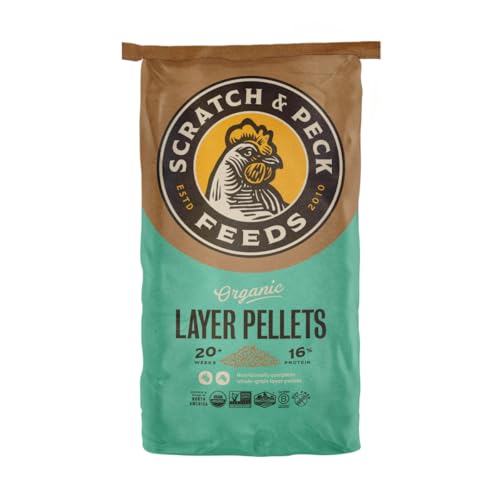
Keepers who want the cleanest: Scratch and Peck Feeds Whole Grain Layer Pellets, 25 lb
| Organic Integrity Score | 90 / 100 |
| Contents | Whole grain layer pellets, 16% protein, corn and soy free, 25 lb |
| Certification | USDA Organic, Non-GMO Project Verified |
| Best for | Keepers who want the cleanest specification with least waste |
Two things matter most here: a genuinely rigorous specification, and a form that stops your money ending up in the bedding. This has both. USDA Organic already excludes GM ingredients, and Non-GMO Project Verification on top means the supply chain is separately tested — belt and braces, and a signal of a supplier taking it seriously.
Pelleted form means far less waste than mash, which matters when the feed costs what organic feed costs. At 16 percent protein it is correctly specified for laying hens, and Scratch and Peck are unusually transparent about milling in North America from whole grains rather than by-products.
Two honest points. Corn and soy free is a premium you are paying for whether or not you need it, and for most flocks it delivers no benefit — buy this for the certification and the pellet form, and treat the exclusions as a bonus. And a 25 lb bag is not much for a larger flock, so check how long it will actually last you.
What we liked: Both USDA Organic and Non-GMO Project Verified. Pellets minimize waste, which is a real saving here. Correct 16% protein. Transparent North American milling.
Keep in mind: Corn and soy free is a premium most flocks do not need. 25 lb goes quickly with more than a few birds. Layer feed only — not for chicks or roosters.
What the listing discloses: Fully documented: Scratch and Peck Feeds states a USDA organic claim, Non-GMO Project Verified and an origin of the USA.
Best corn-free and soy-free: New Country Organics Corn-Free Classic Layer, 25 lb
| Organic Integrity Score | 89 / 100 |
| Protein | 17% guaranteed minimum, the highest here |
| Certification | Certified Organic, Non-GMO |
| Grains | North American certified organic |
| Corn and soy | Formulated without both, with a shared-equipment caveat stated |
| Best for | Flocks where corn and soy are being deliberately avoided |
At 17 percent protein this is the richest formula in the comparison, against 16 percent for most layer feeds. For hens in heavy lay, or a flock that free-ranges and needs the feed to do less of the work, that difference is real.
But the reason it scores where it does is a single line most brands would have left out. The listing says: “Because our feeds are milled on the same equipment, we do not guarantee that the finished product will be 100% free of corn.”
Read that against the section above. “Corn-free” on a feed bag is a formulation claim, not a purity guarantee, because almost every mill runs corn through the same lines. Nearly every corn-free feed on the market has the same exposure. This is the only listing we read that tells you so, and it tells you unprompted, in a bullet a shopper will actually see.
If you are avoiding corn as a preference, that caveat changes nothing. If you are avoiding it because a bird has a diagnosed sensitivity, it is the most useful sentence on the page, and its absence from competing listings does not mean those feeds are cleaner.
What we liked: The highest protein figure here, certification named in both title and body, North American organic grains stated, and a shared-equipment disclosure that no competitor volunteers.
Keep in mind: More expensive per pound than the large Scratch and Peck bags. The corn-free claim carries the caveat above, which is honest but is still a caveat.
Best price per pound: Scratch and Peck Feeds Layer Mash, 50 lb
| Organic Integrity Score | 87 / 100 |
| Contents | Whole grain layer mash, 16% protein, corn and soy free, 50 lb |
| Certification | — |
| Best for | Larger flocks and households avoiding soy entirely |
Fifty pounds brings the price per pound down meaningfully, which matters when feeding more than a handful of birds. This is the same corn-free and soy-free whole grain formulation as our top pick, in mash form and at scale.
The corn and soy exclusion earns its place for one specific group: households where someone has a severe soy allergy and wants to remove even the possibility of transfer through eggs. The evidence for meaningful transfer is limited, but as a precaution it is reasonable and this is the feed to use.
The size cuts both ways. A 50 lb bag only makes sense if your flock will finish it within about three months, since feed vitamins degrade and fats can go rancid. It also needs proper storage — a sealed metal container, because rodents get through plastic and paper easily and spilled organic feed is an expensive way to feed mice.
What we liked: Best price per pound for a fully certified feed. Genuinely corn and soy free. Both organic certifications.
Keep in mind: Only sensible if finished within about three months. Mash wastes more than pellets. Needs rodent-proof storage.
What the listing discloses: On the Scratch and Peck Feeds label: an origin of the USA. Not stated: whether the USDA seal applies.
Best for larger corn-free flocks: New Country Organics Pastured Perfect Layer, 40 lb
| Organic Integrity Score | 85 / 100 |
| Size | 40 lb |
| Protein | 17% |
| Certification | Certified Organic, Non-GMO |
| Best for | A corn-free flock large enough to move a 40 lb bag before it stales |
The same certification and the same 17 percent protein as the pick above, in a 40 lb bag rather than 25. If you have settled on corn-free and soy-free and you have the birds to justify the volume, this is the cheaper way to buy it per pound.
It scores lower for one reason: the listing is much thinner. Where the Corn-Free Classic explains its grains, its protein floor and its shared-equipment limitation, this one offers a single bullet describing “a carefully balanced mix of high-quality ingredients”. The certification is named and the corn and soy exclusions are named, and beyond that there is little to check.
Because both feeds come from the same mill, the shared-equipment caveat stated on the Corn-Free Classic listing should be assumed to apply here too, even though this listing does not repeat it.
What we liked: Certified organic and non-GMO, corn-free and soy-free, 17 percent protein, in the largest corn-free bag in this comparison.
Keep in mind: A thin listing next to its own stablemate. Forty pounds is a lot of feed to keep fresh for a small flock, and feed loses vitamin potency in storage.
Common questions about organic chicken feed
Does organic feed make my eggs organic?
No. It makes them organic-fed. Certified organic eggs require the whole operation to be certified, covering housing, outdoor access, healthcare and record keeping, not just the feed. For eating your own eggs the distinction does not matter. If you sell them, describe them as organic-fed rather than organic unless you are certified.
Can I feed layer feed to chicks or roosters?
No, and this is the one genuinely harmful mistake in this area. Layer feed contains around four percent calcium for eggshell production, roughly four times what a non-laying bird needs. Sustained excess calcium damages the kidneys and can cause visceral gout. Feed chicks starter or grower, and use an all-flock ration with free-choice oyster shell for mixed flocks.
Should I buy pellets or mash?
Pellets for most people, because chickens sweep their beaks sideways and fling loose feed out of the trough, which wastes expensive organic feed. Choose mash only if you intend to ferment it, since pellets disintegrate into sludge when soaked.
Is fermenting chicken feed worth it?
Many keepers find it is. Soaking mash in water for a couple of days produces a sour, porridge-like feed, and birds generally eat less of it while appearing to do well on it. On a feed bill doubled by organic pricing, that reduction matters. It requires daily attention, and forgotten buckets spoil quickly in warm weather.
Do I need corn-free and soy-free feed?
Usually not. Chickens digest corn and soy well, and there is no evidence a hen fed organic corn and soy is less healthy. The two legitimate reasons are a severe soy allergy in the household, where some people report reacting to eggs from soy-fed hens, and a preference to avoid those crops on principle. It costs more, so buy it for a reason.
How long does chicken feed stay good?
About three months from milling before vitamins degrade meaningfully and fats begin to go rancid. Buy a bag size your flock will finish within that window, and store it sealed in a metal container — rodents chew through plastic and paper easily, and spilled organic feed is an expensive way to feed mice.
Should I mix oyster shell into the feed?
No, offer it free choice in a separate dish. Calcium needs vary between individual hens depending on where they are in their laying cycle, and a bird that needs it will take it. Mixing it in forces the same dose on every bird, including any that should not be getting it.
How much does organic feed cost compared with conventional?
Roughly double. A laying hen eats around a quarter pound a day, so across a flock over a year that is a substantial difference and it is the largest single factor in the cost of keeping chickens. Backyard eggs are rarely cheaper than shop eggs to begin with, and organic feed widens that gap. It is a choice about values, not economy.
- Organic Gardening hub
- Best Organic Fertilizer
- Organic gardening for beginners
- all our reviewed products in one place — sortable by Organic Integrity Score
- What OMRI Listed actually checks
Price and availability as of October 15, 2026 7:10 pm EDT. Product prices and availability are accurate as of the date/time indicated and are subject to change. Any price and availability information displayed on Amazon.com at the time of purchase will apply to the purchase of this product.
Looking for other organic products?
We have checked more than 800 products across food, household goods, gardening, personal care and pet, every one against its stated certification. Browse all reviews.
Organic Connection is reader-supported. When you buy through links on this page we may earn a commission, at no extra cost to you. As an Amazon Associate we earn from qualifying purchases. We are not paid to feature or rank any product. How we research and rate.
Does organic feed actually change the eggs?
It changes what the hen ate, which is what organic certification covers. It does not reliably change yolk color, shell strength or taste, all of which track forage, breed and age far more than feed certification. Listings that promise deeper yolks from organic feed are describing pasture access, not the certificate.
Is mash or pellets better?
Pellets waste less, because birds cannot sort out the bits they like and flick the rest onto the floor. Mash suits fermenting and lets you see each individual grain, which is its own kind of transparency. Crumble sits between the two and is usual for younger birds. This is a preference rather than a quality difference.
Can I feed layer feed to chicks?
No. Layer feed carries much more calcium, sized for shell formation, and that calcium load is hard on the kidneys of birds that are not laying. Chicks need a starter or grower formula until point of lay, which is usually around eighteen weeks.
Why is organic feed so much more expensive?
Because organic grain costs substantially more than conventional, and feed is mostly grain by weight. Expect to pay roughly two to three times conventional prices. Whether that is worth it depends on why you keep birds: it is a meaningful cost per dozen eggs, and it is the only route to eggs you can honestly describe as organic.