
Last updated: August 28, 2026
We may earn a commission when you buy through links on this page, at no extra cost to you. How we research and rate.
The short version
This guide covers point-of-entry systems, which treat every tap in the house. If you only want better drinking water at one sink, that is a different and much cheaper purchase: see under-sink reverse osmosis or countertop filters.
Our top pick is the Express Water Whole House 3-Stage, with an Organic Integrity Score of 86 out of 100. It earns that on a sentence almost no manufacturer writes: it tells you plainly what the product does not do.
The finding that shapes this guide is an absence, and it is worth stating precisely. Of the seven whole house systems we examined on Amazon, not one names NSF/ANSI 42 or 53 performance certification. The best of them name NSF/ANSI 372, which covers lead-free materials. Most name nothing.
Performance-certified whole house systems do exist. They are mostly not sold on Amazon, which is the more useful version of the finding and the reason for the section below.
What a whole house filter is actually for
This is the decision most people get wrong, and getting it right saves a lot of money.
A whole house filter sits where the water main enters the building, before it branches to the taps. Everything downstream benefits: showers, washing machine, dishwasher, outside tap, and the kitchen sink along with them.
That breadth is the point, and it is also the limit. A point-of-entry system is optimised for volume and flow, not for the last few percent of purity. It has to pass eight to fifteen gallons a minute without dropping your shower pressure, and the physics of that rule out the slow, fine filtration that a drinking water system uses.
So the jobs it does well are the whole-house ones: sediment and rust that would otherwise reach every appliance, chlorine and the taste and smell that come with it, scale that shortens the life of a water heater, and iron staining on fixtures and laundry.
The job it does not do is produce laboratory-grade drinking water. Our top pick says so in its own listing, which is why it is our top pick.
The sensible architecture for most homes is both: a whole house filter to protect the plumbing and improve every tap, and a small point-of-use filter at the kitchen sink for what you actually drink. That combination costs less than trying to make one system do everything, and each part is doing what it is good at.
The certified systems exist, and they are sold direct
This is the most useful thing we can tell you about the category, and we only found it by checking what ranks for the search term rather than what Amazon returns.
Performance-certified point-of-entry systems are real. Multipure’s Aquasource line is certified by IAPMO R&T. Several other established water treatment brands hold certifications on whole house equipment. What they have in common is that they are sold through the manufacturer or a dealer network, not through Amazon.
There are sound reasons for that. A certified point-of-entry system is usually sized to the household, sometimes after a water test, and often installed by the dealer. That is a consultative sale, and it does not fit a marketplace listing where a single SKU has to suit every house.
So the honest framing of this guide is narrower than “here are the best whole house filters”. It is: here is what is available on Amazon, and here is how to judge it, given that none of it carries a performance certificate.
If a certificate is your requirement rather than your preference, this is the one water category where we would tell you to shop somewhere else. Expect a higher price, a conversation about your water report, and a system specified for your flow rate. For everyone else, the products below are judged on what they document about their mechanism, and that is a weaker basis we would rather name than paper over.
Why almost nothing on Amazon is performance certified
Worth explaining rather than treating as a red flag, because the gap is structural.
NSF/ANSI 42 and 53 certify a filter’s contaminant reduction under a defined test: a specified challenge water, a specified flow rate, run to the end of the filter’s rated life. That is a practical test for a drinking water filter passing half a gallon a minute through a small cartridge.
At point of entry the same test becomes far harder. The system has to be evaluated at ten gallons a minute or more, across a filter life measured in hundreds of thousands of gallons, and the contaminant profile varies by municipality in a way a single challenge water does not capture.
The result is that most point-of-entry systems are sold on component quality and stated mechanism rather than on a performance certificate. What you will see instead is NSF/ANSI 372, the lead-free materials standard, which is a genuine certification that the housings and fittings do not leach lead. It says nothing about what the system removes.
So the useful questions shift. Not “what is it certified to reduce”, because on Amazon the answer is nothing, but: what media is in each stage, what micron rating, what flow rate, and does the manufacturer describe its limits as clearly as its strengths.
For the drinking water standards and what each number actually covers, we set that out in our under-sink reverse osmosis guide.
The three stages, and what each medium does
Almost every system here is a three-stage cartridge design, and the stages are more standardised than the marketing suggests.
Stage one is sediment. A spun or pleated polypropylene cartridge, usually 5 micron, catching sand, rust, silt and scale fragments. Its real job is protecting the two stages behind it, which are far more expensive. A neglected sediment filter is how a good carbon block dies early.
Stage two is usually KDF. A copper-zinc alloy that works by electrochemical exchange rather than adsorption. It handles chlorine well, has some effect on heavy metals, and importantly it inhibits bacterial growth inside the housing, which matters in a filter that sits wet for months.
Stage three is carbon. Either granular activated carbon, which flows freely, or a carbon block, which is denser and filters finer but restricts flow more. This is the stage doing the work on chlorine, taste, odor and organic compounds.
Two variations worth recognizing. Some systems substitute an iron and manganese reduction cartridge for one stage, which is aimed at well water and does little for treated municipal supply. And some add a scale inhibitor stage, which does not remove hardness minerals but conditions them so they are less inclined to deposit in a water heater.
Nothing in a standard three-stage system softens water. If you have genuine hardness, a filter and a softener are two different appliances doing two different jobs, and a combined claim is worth reading twice.
Housing size, flow rate and the specification that decides your shower
Get this wrong and you will notice it every day.
Cartridge size. The two common formats are 10 by 2.5 inch, the standard small cartridge, and 4.5 by 20 inch, usually called Big Blue. The larger format holds several times the media, which means longer intervals between changes and, critically, less pressure drop at high flow.
Flow rate. A typical home needs six to twelve gallons per minute at peak, which is a shower plus a dishwasher plus somebody running a tap. A system rated below your peak demand will not stop working; it will quietly reduce your pressure whenever two things run at once.
The small 10-inch format is generally fine for one or two bathrooms. Big Blue housings are the answer for larger homes, and for anyone whose water is dirty enough to load a sediment filter quickly.
Pressure drop is the number to look for and the one least often published. A new system will cost you a few PSI. A loaded sediment cartridge can cost fifteen or twenty, which is the point at which the shower feels wrong. That sensation is the most reliable filter-change reminder most people get.
Bypass valves are worth having and are sometimes an accessory rather than included. A bypass lets you isolate the system to change cartridges without shutting off water to the whole house, which turns a disruptive job into a ten minute one.
Best whole house water filters compared
| Best Choice | Best Value | ||||
 |  |  |  |  | |
| Product | Express Water 3-Stage | Waterdrop WHF3T-PG | HQUA WF3-01 | VEVOR 3-Stage | Max Water 3 Stage |
| Organic Integrity Score | 86/ 100 | 82/ 100 | 76/ 100 | 72/ 100 | 70/ 100 |
| Our rating | 4.3 | 4.1 | 3.8 | 3.6 | 3.5 |
| Certification named | — | NSF/ANSI 372 | — | — | — |
| States its limits | Yes, explicitly | No | No | No | No |
| Stage two media | Carbon and KDF | KDF composite | GAC plus KDF | Iron and manganese | GAC |
| Best for | Municipal water, honestly sold | A named certification | Heavy metals focus | Iron and well water | Lowest entry price |
| Price | $493.19 $547.99 −10% View on Amazon | $254.99 $369.99 −31% View on Amazon | $349.99 View on Amazon | $257.50 View on Amazon | $108.95 View on Amazon |
Price and availability as of August 28, 2026 1:29 pm EDT. Product prices and availability are accurate as of the date/time indicated and are subject to change. Any price and availability information displayed on Amazon.com at the time of purchase will apply to the purchase of this product.
Best overall: Express Water Whole House 3-Stage
| Organic Integrity Score | 86 / 100 |
| Configuration | 3-stage point-of-entry: sediment, carbon, heavy metal reduction |
| Certification | None named; the listing states the system’s limits explicitly |
| Best for | Municipal supply, from a manufacturer that tells you what it cannot do |
We have read several hundred product listings for this site and this is the first one that actively talks a reader out of the purchase.
Its own description carries this: “PLEASE NOTE: This 3-stage whole house water filtration system does NOT reduce TDS. If that is one of your desires, please consider one of our reverse osmosis systems.” A manufacturer naming a limitation, in capitals, and pointing to a different product for the job this one will not do.
That single paragraph is worth more than a page of adjectives. It signals a company describing a mechanism rather than selling a feeling, and everything else in the listing reads consistently with it: named heavy metals rather than “1000+ contaminants”, scale prevention framed as protecting appliances rather than as health.
The hardware is a conventional three stage arrangement with sediment first, then carbon, then a dedicated heavy metal stage, in large housings sized for household flow.
Two honest points. It is the most expensive system in this comparison by a wide margin, and it names no certification at all, which is the norm in this category but still means the reduction claims are the manufacturer’s own.
- States plainly what the system does not do, which nothing else here does.
- Named contaminants rather than vague totals.
- Dedicated heavy metal stage.
- Sized for real household flow.
- Most expensive here by some distance.
- No certification named.
- Does not reduce TDS, and does not soften water.
Best for: Municipal water, where chlorine, sediment and heavy metals are the concern.
Only certification here: Waterdrop WHF3T-PG 3-Stage
| Organic Integrity Score | 82 / 100 |
| Configuration | 3-stage point-of-entry, KDF composite plus GAC, 5 micron |
| Certification | NSF/ANSI 372 for lead-free materials; no performance standard |
| Best for | Chlorine reduction with a number attached to it |
The only one of our five picks naming any certification, and one of just two Amazon systems we read that publishes a specific reduction figure rather than a range.
The figure is 97.72 percent chlorine reduction. Two decimal places is an oddly precise number to publish, and precision of that kind usually comes from an actual test rather than a marketing meeting. It is not tied to a named performance standard, so we cannot tell you which test produced it, and it is still more useful than “removes up to 99% of impurities”.
The certification is NSF/ANSI 372, lead-free materials. Real, verifiable, and about the housings rather than the filtration. Worth having, and not a performance claim, and the listing does not pretend otherwise.
Mechanically it is a KDF composite plus carbon fiber GAC arrangement at 5 micron, which is a sensible municipal-water specification.
It is also the mid-priced option here and considerably cheaper than our top pick, which for a system doing the same job on the same water makes it the pragmatic choice for many households.
- The only named certification in the category.
- Publishes a specific chlorine figure rather than a vague range.
- Sensible KDF and carbon combination.
- Well priced.
- NSF/ANSI 372 is materials, not performance.
- The 97.72 percent figure has no named standard behind it.
- Does not state its limits.
Best for: Municipal supply where chlorine and taste are the main complaint.
Heavy metal focus: HQUA WF3-01 3-Stage
| Organic Integrity Score | 76 / 100 |
| Configuration | 3-stage point-of-entry with a compound GAC and KDF cartridge |
| Certification | None named; specific metals listed |
| Best for | Supplies where heavy metals are the documented concern |
Where most listings say “heavy metals”, this one names them: lead, mercury, arsenic, cadmium, chromium. Naming the specific metals is a better signal than the category, because it is a claim that can be checked against a water report and, in principle, be wrong.
The mechanism is a compound GAC plus KDF cartridge, which is the right pairing for metals. KDF’s electrochemical exchange handles dissolved metals in a way plain carbon does not, and combining the two in one cartridge saves a housing.
No certifying body is named anywhere, which is normal here and is what holds the score in the mid seventies.
It sits between the Waterdrop and the Express Water on price, and its sales rank is well behind both, which usually reflects a quieter listing rather than a worse product.
- Names the specific metals rather than the category.
- GAC and KDF compound cartridge is the right mechanism for metals.
- Reasonable price for the specification.
- No certifier named.
- Compound cartridge means replacing both media together.
- Much lower sales rank than the leaders.
Best for: Households with a water report showing metals rather than just chlorine.
Best for iron and well water: VEVOR 3-Stage
| Organic Integrity Score | 72 / 100 |
| Configuration | 3-stage Big Blue: sediment, iron and manganese reduction, carbon block |
| Certification | None named |
| Best for | Well water with iron staining and rusty discolouration |
The only system here configured for a specific water problem rather than for general municipal supply, and that focus is the reason to buy it.
Iron and manganese are well water problems. They cause the orange staining on baths and laundry, the metallic taste, and the black specks that appear when manganese oxidises. A dedicated reduction cartridge addresses them in a way a general carbon system does not.
It uses the 4.5 by 20 inch Big Blue format, which holds far more media than the small cartridges and keeps pressure drop manageable at household flow. On well water, where sediment loading is often heavy, that larger format is close to essential.
No certification is named, and the listing is thinner on specification than the leaders.
One important caveat if you are on a well: filtration is not disinfection. If bacteria are a concern, a filter of this type does not address it, and UV treatment is a separate stage. We cover the full well water sequence in a dedicated guide.
- Purpose-built for iron and manganese, which general systems ignore.
- Big Blue housings hold plenty of media.
- Well priced for the format.
- No certifier named.
- Does not disinfect, so bacteria need separate treatment.
- Overkill on treated municipal supply.
Best for: Private wells with visible iron staining.
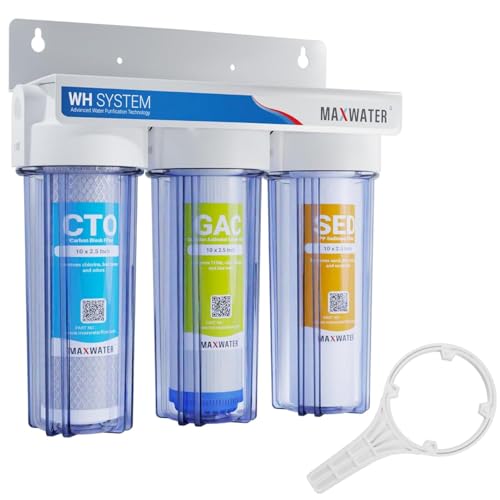
Best value: Max Water 3 Stage 10 inch
| Organic Integrity Score | 70 / 100 |
| Configuration | 3-stage 10 x 2.5 inch: PP sediment 5 micron, GAC, carbon block 5 micron |
| Certification | None named |
| Best for | Smaller homes on municipal water, at the lowest entry cost |
Roughly a fifth the price of our top pick, and for a small home on treated municipal water it does the same three jobs.
The specification is described more precisely than the price suggests: PP sediment at 5 micron, then GAC, then a carbon block also at 5 micron. Naming both the media and the micron rating at each stage is more than several dearer systems bother with.
It uses standard 10 by 2.5 inch cartridges, which is the format’s real advantage. Replacements are commodity items from any supplier, so the running cost stays low and you are never locked to one manufacturer.
The limits follow from the size. The small format holds much less media than Big Blue, so intervals are shorter and pressure drop arrives sooner. The stated 1 to 10 GPM range is optimistic at the top end with loaded cartridges, and for a house with two or more bathrooms we would size up.
- By far the cheapest way into whole house filtration.
- Names media and micron rating at every stage.
- Standard cartridges keep running costs down.
- Small cartridges mean shorter intervals and earlier pressure drop.
- No certifier named.
- Undersized for larger homes.
Best for: One or two bathroom homes on municipal supply.
What we left out and why
Water softeners. They appear constantly in whole house searches and they are a different appliance. A softener exchanges calcium and magnesium for sodium to address hardness; a filter removes particles and chemicals. Neither does the other’s job, and a system claiming both in one cartridge is worth reading very carefully.
Whole house reverse osmosis. Search results include point-of-entry RO systems costing several thousand dollars and requiring a storage tank and repressurisation pump. For almost every household this is the wrong purchase: it wastes enormous volumes of water treating the supply to your toilet and garden tap to drinking standard. Put RO at the kitchen sink instead.
UV disinfection. A necessary stage on some private wells and not a filter. It kills organisms and removes nothing, so it complements a sediment and carbon system rather than replacing one.
A. O. Smith AO-WH-Filter and iSpring WGB32B-PF. Two further Amazon systems we read and did not include, because neither changes the certification picture and both duplicate what our picks already cover. Each is worth a word, though, because both do the thing we keep rewarding. A. O. Smith publishes a specific figure, 96.9 percent chlorine taste and odor reduction, and states in capitals that it is “NOT a water softening system”. iSpring’s PFAS model says its media is SGS-tested, notes that the system “does not reduce TDS”, and points readers to its own reverse osmosis range for that. Neither names a performance standard.
Multipure, SpringWell and similar. Certified systems sold direct rather than on Amazon, covered in the section above. We link to Amazon, so they are outside what this guide can recommend, and pretending they do not exist would be the more misleading choice.
The limit of this method applies with particular force in this category. Reading listing copy tells you what a manufacturer will claim publicly. Here almost none of them claims a certification, so what we are really scoring is how specifically each one describes its mechanism and its limits. That is a weaker basis than a certificate, and it is the basis the category offers.
How to install a whole house filter
This is the one guide in our water series where we would not encourage most people to do it themselves. It involves cutting into the main supply, and a mistake floods the building rather than the cabinet.
- Find the main shutoff and the right side of it. The system goes after the main shutoff and after the pressure regulator, before the water heater. Fitting it before the regulator exposes the housings to street pressure.
- Shut off, then drain down. Close the main, open the lowest tap in the house and let the system drain. Skipping this soaks whatever is below the cut.
- Fit a bypass loop. Three valves, so the filter can be isolated without shutting off the house. Not always included, always worth adding, and far easier to fit now than later.
- Cut and fit. Copper needs soldering or press fittings, PEX needs a crimp or expansion tool, CPVC needs solvent weld. This is where a plumber earns the fee if the pipe is not something you have worked with.
- Support the weight. A filled three-stage Big Blue system is heavy. Mount the bracket into studs or masonry, never into plasterboard alone.
- Fit cartridges and lubricate the O-rings. Use silicone grease, never petroleum jelly, which degrades the seals. Hand tight plus the housing wrench, no more.
- Open slowly and purge air. Crack the inlet, let the housings fill gradually, then open a downstream tap to purge. Opening the main fast can split a housing.
- Run to drain for ten minutes. New carbon sheds fines and the first water through will be gray.
Budget two to four hours if you are confident with the pipe material, and expect a plumber to charge for two hours plus parts if you are not.
What it costs to run
Two things make whole house cheaper to run than any drinking water system: no electricity and no wastewater. Nothing is pumped and nothing goes to drain.
The cost is cartridges, three at a time. Standard 10 inch cartridges are commodity items and cheap; Big Blue cartridges cost more each but last considerably longer, and on dirty water they usually work out cheaper per month.
Change the sediment stage on pressure, not on the calendar. When the shower noticeably weakens, the first stage is loaded. Changing it on time is what protects the carbon behind it.
Questions about whole house water filters
Does a whole house filter make water safe to drink?
It improves it everywhere, and it is not a drinking water purifier. Point-of-entry systems are built for flow rather than for fine filtration. The usual arrangement is a whole house filter for the plumbing and every tap, plus a point-of-use filter at the kitchen sink for drinking.
Why is nothing certified to NSF 42 or 53?
Because certifying a point-of-entry system means testing at household flow rates over a filter life measured in hundreds of thousands of gallons, against a challenge water that varies by municipality. Most manufacturers sell on component specification instead. NSF/ANSI 372, which some carry, covers lead-free materials rather than performance.
Does a whole house filter soften water?
No. Softening is ion exchange and needs a separate appliance with a brine tank. Some filters include a scale inhibitor stage, which conditions minerals so they deposit less but does not remove hardness.
What size cartridges should I buy?
10 by 2.5 inch for one or two bathrooms on clean municipal water. 4.5 by 20 inch, called Big Blue, for larger homes, well water, or anywhere sediment loading is heavy. The larger format means longer intervals and less pressure drop.
How often do the cartridges need changing?
Six to twelve months on municipal supply, and much sooner on well water. The reliable signal is pressure: when the shower weakens, the sediment stage is loaded.
Will it reduce my water pressure?
A new system costs a few PSI. A loaded sediment cartridge can cost fifteen or twenty, which is when you notice. Sizing the system to your peak demand and changing the first stage on time keeps this manageable.
Do I need a plumber?
For most people, yes. The job means cutting into the main supply, and the failure mode is flooding the building rather than a cabinet. If you are comfortable with your pipe material and fitting a bypass loop, it is a two to four hour job.
Does it remove bacteria?
No. Sediment and carbon filtration is not disinfection. On a private well where bacteria are a concern, UV treatment is a separate stage that kills organisms without removing anything.
Organic Connection is reader supported. We check every product against its stated certification and say plainly when a claim cannot be verified. How we research and rate.