Last updated: August 28, 2026
We may earn a commission when you buy through links on this page, at no extra cost to you. How we research and rate.
The short version
Smoke is the hardest thing a purifier is asked to do, and the number that describes how well it does it is the one manufacturers are least consistent about publishing. We read five listings in full, did the arithmetic on every figure, and found five different ways of describing coverage, two of which do not agree with themselves.
Our top pick is the Coway Airmega Mighty2, with an Organic Integrity Score of 96 out of 100. It publishes all three of its CADR ratings, names the actual test standard its filter is certified to, and its stated room coverage matches its stated airflow to within a rounding error. That last part sounds like a low bar. It is not.
Here is the finding that organized the rest of the page. The Medify MA-40 advertises “CADR 406”. The Coway Airmega Mighty2 advertises a smoke CADR of 240. A buyer comparing those two numbers would reasonably conclude the Medify moves about 70% more air.
It does not. They are within half a percent of each other. Medify’s 406 is in cubic meters per hour; Coway’s 240 is in cubic feet per minute. The listing never says so.
Why smoke is the hardest test
Air purifier performance is published as CADR, Clean Air Delivery Rate, and it is not one number. It is three: smoke, dust, and pollen. Manufacturers who publish all three normally publish them in the same order of size, with smoke the smallest.
Coway’s Airmega Mighty2: dust 242, smoke 240, pollen 249. Levoit’s Core 300-P: 143 smoke, 153 dust, 167 pollen. Levoit’s Core 400S-P: 231 smoke, 240 dust, 259 pollen. The pattern holds across almost every unit we have scanned; the one exception we have found is Coway’s largest model, which publishes dust 580, smoke 567 and pollen 450.
The reason is particle size. Pollen is large, 10 to 100 microns, and a filter catches it almost trivially. Dust spans a wide range. Smoke particles are tiny, commonly 0.1 to 1 micron, which puts them near the size at which mechanical filtration is least efficient. A filter that flies through the pollen test works measurably harder on smoke.
Which means that if a listing publishes only one CADR figure without labeling it, you should assume it is the pollen number, because that is the flattering one. And if you are buying for smoke, the pollen number is the least relevant of the three.
There is a second reason smoke is hard, and it is the one filters cannot solve with airflow. Smoke is not only particles. It is also gases, and the smell of a fire is largely volatile organic compounds in the gas phase, which pass through a HEPA filter without touching it. Only carbon removes those, and carbon capacity is finite in a way HEPA capacity is not.
Every listing uses a different coverage convention
Room coverage depends on how many times an hour you want the room’s air replaced, and there is no requirement to say which rate you used. Across five listings we found five answers.
Coway states one air change per hour, and the arithmetic proves it. Smoke CADR 240 CFM, multiplied by 60 minutes, is 14,400 cubic feet an hour. Divided by an eight foot ceiling, that is 1,800 sq ft. Coway claims 1,800 sq ft in 60 minutes. Exact.
Honeywell states both conventions in a single sentence, which is the clearest disclosure we have seen anywhere in this category. Its listing says the unit “filters and circulates air hourly in 1700 sq ft spaces or 4.8x in 360 sq ft rooms every 12.5 min”. That is the one air change figure and the 4.8 air change figure, side by side, with the interval spelled out. Nobody has to do any arithmetic at all.
Medify uses roughly 1.7 air changes per hour, and does not say so. At 239 CFM its one-air-change coverage would be about 3,045 sq ft, and its 4.8-air-change coverage about 634 sq ft. It claims 1,793 sq ft, which sits between them at approximately 1.7 changes an hour. That is a defensible engineering choice and an undocumented one.
AZEUS uses a ninety minute base. Its listing offers “2,160 sq ft in 90 minutes or 1,080 sq ft in just 45 minutes”, which is a fourth time base and makes cross-shopping against an hourly figure needlessly difficult.
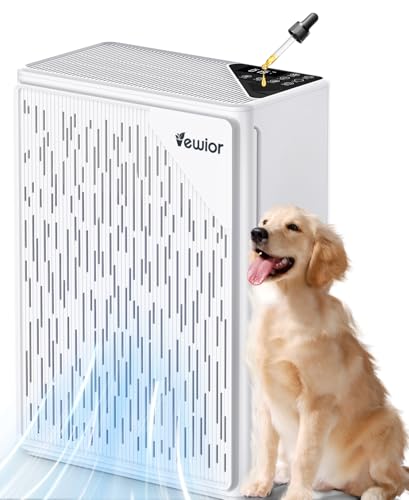
VEWIOR’s two figures do not agree with each other. Its listing states, in one sentence, that the unit “provides 5X air circulation per hour, covers up to 2,535 square feet.” Taken together those imply 101,400 cubic feet of filtered air an hour, or about 1,690 CFM, which is roughly seven times the rated smoke delivery of the Coway from a 68W motor. Read the other way, 2,535 sq ft at a single air change implies about 338 CFM, which is plausible but is then not a 5X figure. No CADR is published to settle it.
How to compare two purifiers in thirty seconds
Because of everything above, the square footage on the box is close to useless for cross-shopping. Here is what we do instead, and it takes very little effort.
Find the smoke CADR, and check its units. A figure in the low hundreds is CFM. A figure in the high hundreds is almost certainly cubic meters per hour. To convert, divide the m³/h figure by 1.699. If a listing publishes one unlabeled CADR, treat it as the pollen figure and discount it.
Convert CADR to the room you actually have. Multiply CFM by 7.5 to get the square footage it covers at one air change per hour with eight foot ceilings, or by 1.56 for coverage at 4.8 air changes. So 240 CFM is 1,800 sq ft at one change, and about 375 sq ft at 4.8.
Decide which rate you want. For an occasional cooking smell, one change an hour is fine. For wildfire season with the windows shut, or a household smoker, you want the 4.8 figure, because the source keeps producing.
Then look at the carbon. Airflow handles particles. Only carbon handles the smell, and the two wear out on completely different schedules.
Carbon is what actually removes the smell
This is the part that separates a smoke purifier from a general purpose one, and it is the part least often quantified.
The particulate half of smoke is easy to describe and easy to test: a HEPA filter captures 99.97% at 0.3 microns and the CADR figure tells you how fast. The gas half has no equivalent number on any listing we read. Nobody publishes carbon weight, and nobody publishes a gas-phase capacity.
What you can compare is architecture. A carbon coating bonded to the surface of a HEPA sheet holds a small fraction of what a separate carbon stage holds, and it saturates far sooner. Once saturated it does not merely stop working, it can begin releasing what it captured back into the room as conditions change, which is why an old carbon filter in a smoky house sometimes seems to make things worse.
Coway is the only listing here that quantifies gas removal at all, claiming reduction of “more than 99.5% of volatile organic compounds and fumes such as NH3 and CH3CHO”. Naming ammonia and acetaldehyde specifically, with a percentage attached, is far more than the rest of this category offers, and it is the sort of claim that could in principle be checked.
The practical rule: replace the carbon on the smell, not on the calendar. The same rule applies to a damp room, where the smell is microbial rather than combustion related; we cover that in our guide to the best air purifiers for mold. If the smoke odor returns while the filter light is still green, the carbon is finished even though the HEPA layer is not.
What we looked for
We read every feature bullet in full and scored on what each manufacturer put in writing.
A CADR figure, in stated units, ideally all three. This is the only number that lets you compare across brands, and units matter as much as magnitude.
Internal consistency. If a listing gives both a CADR and a coverage figure, the two should agree. Two of the five here do. One is silently in different units, and one contradicts itself.
A named filtration standard. “H13” and “True HEPA” describe a grade. A named test standard, with a document number, is a stronger claim because it can be looked up.
A real carbon stage, separate from the HEPA layer where possible.
CARB compliance, California’s ozone limit. It matters more here than in most categories, because several smoke purifiers include ionizers, and adding ozone to a room that already has smoke in it is the wrong direction.
Best air purifiers for smoke compared
 |  |  |  |  | |
| Model | Coway Airmega Mighty2 | Honeywell Large Room | Medify MA-40 | AZEUS Wildfire Smoke | VEWIOR H13 |
| Organic Integrity Score | 96 / 100 | 92 / 100 | 74 / 100 | 64 / 100 | 56 / 100 |
| Smoke CADR | 240 CFM, labeled | Not published | 406 m³/h, units not stated | Not published | Not published |
| All three CADR figures | Yes: 242 / 240 / 249 | No | One unlabeled figure | No | No |
| Coverage claimed | 1,800 sq ft in 60 min | 1,700 sq ft hourly | 1,793 sq ft in 1 hr | 2,160 sq ft in 90 min | 2,535 sq ft |
| Air change convention | 1 per hour, verified | Both 1 and 4.8, stated | Approx. 1.7, not stated | 90 minute base | Self-contradictory |
| Coverage at 4.8 changes | Approx. 375 sq ft | 360 sq ft, stated | Approx. 634 sq ft | Not calculable | Not calculable |
| Named filter standard | IEST-RP-CC007 | None named | H13 grade only | None named | H13 grade only |
| Ionizer | No | No | No | Yes | No |
| Price | $269.99$269.99 / count View on Amazon | $192.79 $219.07 −12%$192.79 / count View on Amazon | $249.99 View on Amazon | $159.99$159.99 / count View on Amazon | $66.49 $99.99 −34% View on Amazon |
Price and availability as of September 1, 2026 2:12 am EDT. Product prices and availability are accurate as of the date/time indicated and are subject to change. Any price and availability information displayed on Amazon.com at the time of purchase will apply to the purchase of this product.
Best overall: Coway Airmega Mighty2
| Organic Integrity Score | 96 / 100 |
| CADR | Dust 242, smoke 240, pollen 249 CFM |
| Coverage | 1,800 sq ft in 60 minutes; 900 sq ft in 30; approximately 375 sq ft at 4.8 changes |
| Filter standard | IEST-RP-CC007 certified HEPA, plus 2-in-1 carbon |
| Best for | Wildfire season, and anyone who wants numbers that check out |
This is the highest score we have given an air purifier, and it is not because the machine is exotic. It is because everything in the listing agrees with everything else in the listing.
Coway publishes all three CADR figures, labeled: dust 242, smoke 240, pollen 249. It publishes coverage as 1,800 sq ft in sixty minutes and 900 sq ft in thirty. Multiply 240 CFM by sixty minutes and divide by an eight foot ceiling and you get 1,800 sq ft. The claims reconcile exactly, which across this whole category happened twice.
It also names a standard rather than a grade. IEST-RP-CC007 is a published test document from the Institute of Environmental Sciences and Technology, and citing it is a materially stronger claim than writing “H13” or “True HEPA”, because a document number can be looked up and a marketing adjective cannot. This is the air purifier equivalent of a water filter naming NSF/ANSI 53 instead of saying “advanced filtration”.
On gases, it is the only listing here that attaches a number to VOC removal, claiming more than 99.5% reduction of volatile organic compounds “such as NH3 and CH3CHO”. Naming ammonia and acetaldehyde is specific in a way the rest of this category never is.
Two practical features matter for smoke in particular. The pre-filter is washable and slides out without opening the front cover, which is what you want during a wildfire week when it clogs in days rather than months. And the filter life indicator shows an actual percentage remaining for both the pre-filter and the main filter, rather than a light that comes on at a fixed hour count regardless of how hard the machine has worked.
The limits. It is the most expensive unit here, and at roughly 375 sq ft at 4.8 air changes it is a large-room machine rather than a whole-home one, whatever the 1,800 sq ft headline suggests. The carbon is combined with the HEPA in a single Max2 cartridge, so a saturated carbon layer means replacing the HEPA too, which is a real running cost in a smoky season. And the three-stage design has no separately replaceable carbon.
- All three CADR figures published and labeled in CFM.
- Coverage claim reconciles exactly with the CADR.
- Names IEST-RP-CC007, an actual test standard, not just a grade.
- Quantifies VOC reduction and names the compounds.
- Washable pre-filter with a percentage life indicator.
- Three year warranty.
- Most expensive unit in this comparison.
- Carbon and HEPA share one cartridge, so saturated carbon means replacing both.
- Real coverage is nearer 375 sq ft than the 1,800 in the headline.
Best for: Wildfire smoke, and anyone who would rather buy from the manufacturer whose arithmetic survives checking.
Best disclosure: Honeywell HEPA Large Room
| Organic Integrity Score | 92 / 100 |
| Coverage | 1,700 sq ft hourly, or 360 sq ft at 4.8 changes every 12.5 minutes, both stated |
| Filtration | HEPA plus activated carbon pre-filter, 4 cleaning levels including Turbo |
| CADR | Not published in the listing |
| Best for | Buyers who want the coverage question answered without arithmetic |
One sentence in this listing does something no other manufacturer here manages. Honeywell writes that the unit “filters and circulates air hourly in 1700 sq ft spaces or 4.8x in 360 sq ft rooms every 12.5 min.”
That is the entire coverage problem, solved in a single line. Both conventions, both numbers, and the interval in minutes so you can see what 4.8 air changes actually means. Every other listing on this page makes you either do the division yourself or accept a number you cannot interpret. Honeywell simply tells you.
It matters that the two figures are consistent: 1,700 divided by 4.8 is 354, and Honeywell rounds to 360. The arithmetic holds.
The filtration is a HEPA stage with an activated carbon pre-filter, which is the sensible order for smoke, since the carbon sits where it meets the air first and the pre-filter role means it also catches the coarse particles that would otherwise load the HEPA. Four cleaning levels including a Turbo mode gives you a genuine high setting for an acute event.
What keeps it below the Coway is that no CADR is published anywhere in the listing. The coverage figures are honest and complete, but without a CADR you cannot compare this machine against one from a brand that uses a different convention, which is the exact problem the rest of this page describes. Honeywell has solved the disclosure problem for its own product without giving you the number that travels between products.
Two smaller notes. The listing says “Exceeds HEPA standards” and claims “over 99.99%”, both marked with asterisks whose footnotes are not in the bullets we read, so we would treat those as unverified. And no filter standard document is named, only the HEPA term itself.
- States both coverage conventions in one sentence, with the interval in minutes.
- The two stated figures reconcile with each other.
- Activated carbon in the pre-filter position, which suits smoke.
- Turbo setting for acute events, and a lower price than the Coway.
- No CADR published, so it cannot be compared across brands.
- “Exceeds HEPA standards” and “99.99%” carry asterisks we could not resolve.
- No named filter test standard.
- Carbon is a pre-filter layer rather than a deep dedicated stage.
Best for: Anyone who wants to know what room the machine actually covers without reaching for a calculator.
Published a number, but not its units: Medify MA-40
| Organic Integrity Score | 74 / 100 |
| CADR | 406, units not stated; equals approximately 239 CFM |
| Coverage | 1,793 sq ft in one hour, 896 sq ft in 30 minutes |
| Filtration | H13 HEPA, CARB and ETL, filter rated 3,000 hours |
| Best for | Buyers who want the lifetime warranty and can read past the specs |
The MA-40 is a capable machine and a popular one, and our reservations are entirely about how its listing is written rather than what the unit does.
Start with the headline number. “CADR 406” appears with no unit attached. Converted at 1.699 m³/h per CFM, 406 becomes 239 CFM, and that figure reconciles precisely with Medify’s own stated coverage of 1,793 sq ft. So the number is correct and the machine performs as claimed. The problem is purely that an unlabeled 406 sits next to a competitor’s labeled 240 and looks like a different league. It is not. The two machines move the same air.
The coverage figure has its own quiet issue. At 239 CFM, one air change an hour would be about 3,045 sq ft and 4.8 changes would be about 634 sq ft. Medify claims 1,793, which corresponds to roughly 1.7 air changes an hour, a convention the listing never states and which we have not seen any other manufacturer use.
Then there is a filtration claim that is simply not right. The listing says the H13 filter removes particles “down to 0.1 microns in size” and “Captures finer particles than HEPA H11 (0.3 microns)”. H11 and H13 are not defined by different particle sizes. Both are graded at the most penetrating particle size, around 0.3 microns, and they differ in efficiency at that size: roughly 95% for H11 against 99.95% for H13. Describing them as though H13 addresses a smaller particle misstates how the grading works. The machine is genuinely the better grade; the explanation of why is wrong.
What we do credit: the filter part number is published in the listing, the service life is given concretely as 3,000 hours or about six months, CARB and ETL are both named, and the warranty is a registered lifetime warranty, which is unusual and worth real money in a category where units are run continuously.
- Publishes a CADR at all, which most of this category does not.
- Coverage and CADR reconcile once you convert the units.
- Filter part number and a concrete 3,000 hour service life.
- Registered lifetime warranty; CARB and ETL named.
- CADR published without units, which makes it look 70% stronger than it is.
- Coverage uses an unstated convention of roughly 1.7 air changes an hour.
- The H11 versus H13 micron explanation misstates how HEPA grades are defined.
- Only one CADR figure, and it is not labeled smoke, dust or pollen.
Best for: Buyers who want the lifetime warranty, and now know that 406 and 240 are the same airflow.
Adds an ionizer to a smoky room: AZEUS Wildfire Smoke
| Organic Integrity Score | 64 / 100 |
| Coverage | 2,160 sq ft in 90 minutes, or 1,080 sq ft in 45 minutes |
| CADR | Not published |
| Filtration | 5-in-1: pre-filter, HEPA, activated carbon, UV-C, ionizer |
| Best for | Not our recommendation where an ionizer-free option exists |
The particulate claim here is properly worded: 99.97% down to 0.3 microns, naming ash, PM2.5 and wildfire smoke specifically. The filter stack includes a genuine activated carbon stage, which smoke needs.
Two things hold the score down. The first is the coverage convention. “2,160 sq ft in 90 minutes or 1,080 sq ft in just 45 minutes” is a ninety minute base, which appears nowhere else in this comparison and cannot be compared with an hourly figure without converting. With no CADR published, there is no way to translate it into anything else.
The second is the ionizer, and for smoke specifically we think it is the wrong feature. Ionizers work by charging particles so they clump and fall out of the air, and the process can generate ozone. AZEUS is CARB compliant, so emission is within California’s limit, and we are not suggesting it is unsafe. But ozone is a respiratory irritant, the people buying a smoke purifier are frequently buying it because their airways are already irritated, and the ionizer contributes nothing the HEPA and carbon stages are not already doing better. Where a unit offers the ionizer as a switchable extra, our advice is to leave it off.
The UV-C stage draws a similar comment. Contact time in a moving airstream is short, and smoke particles are not alive, so there is nothing for germicidal light to do about them.
Worth noting too that this listing is classified on Amazon under kitchen rather than home, which is a small thing, and a sign of a listing that has not been closely tended.
- Correctly worded 99.97% at 0.3 micron claim.
- Names ash and PM2.5 explicitly, which suits wildfire use.
- Genuine activated carbon stage rather than a coating.
- CARB compliant despite including an ionizer.
- Ninety minute coverage base, comparable to nothing else here.
- No CADR published, so the coverage claim cannot be converted.
- Ionizer adds ozone risk with no benefit for smoke.
- UV-C does nothing to smoke particles, which are not alive.
Best for: Few situations we can identify, given the alternatives at this price.
Two figures that contradict each other: VEWIOR H13
| Organic Integrity Score | 56 / 100 |
| Coverage claim | 2,535 sq ft with “5X air circulation per hour” |
| Implied airflow | Approximately 1,690 CFM, if both figures are taken together |
| Motor | 68W brushless |
| Best for | Not our recommendation for a smoke problem |
This is the cheapest machine in the comparison and it may well be a perfectly serviceable purifier. Our objection is to one sentence.
The listing states that the unit “provides 5X air circulation per hour, covers up to 2,535 square feet.” Read together, those two figures describe a machine moving 101,400 cubic feet of air an hour, which is about 1,690 CFM.
For scale, the Coway in this comparison is rated at 240 CFM. The claim as written would put a $75 unit with a 68W brushless motor at roughly seven times the rated delivery of a $270 machine from an established manufacturer. Read the other way, if 2,535 sq ft is a single-air-change figure, the implied airflow is about 338 CFM, which is entirely plausible, but then it is not a 5X figure and the sentence contradicts itself.
No CADR is published, so there is nothing in the listing that resolves which reading is intended. That is the whole basis of the score. We are not saying the machine underperforms; we have not tested it and we do not test. We are saying its two published figures cannot both be true, and no third figure is offered to settle the matter.
Elsewhere the listing is unremarkable in the ordinary way: a three-stage pre-filter, H13 and carbon arrangement, auto mode with air quality monitoring, and a 99.97% claim at “0.1-0.3 microns”, which is a wider range than the standard 0.3 micron rating point and slightly flatters the filter.
- Cheapest unit in this comparison by a wide margin.
- Three-stage design with a genuine activated carbon layer.
- Auto mode with air quality sensing at this price.
- H13 grade filter and CARB compliant.
- The 5X and 2,535 sq ft figures imply about 1,690 CFM, which is not credible from a 68W motor.
- No CADR published to resolve the contradiction.
- The 99.97% claim spans 0.1 to 0.3 microns rather than the standard rating point.
- No named test standard.
Best for: Buyers on a tight budget who accept that the coverage figure cannot be relied on.
What we left out and why
We left out the Pureborne PB6866, which claims coverage of 3,600 sq ft once per hour, the largest figure we encountered anywhere. It publishes no CADR, so the claim cannot be checked, and the bullets refer to two different model numbers, PB6866 and PB4866, within the same paragraph, which does not suggest a closely proofread listing. It was also showing limited stock when we looked.
We excluded ozone generators entirely. They are sometimes marketed for smoke damage restoration. Ozone at concentrations that affect odors is a respiratory irritant and the space must be unoccupied, which makes it a remediation tool rather than an air purifier, and not something we will list next to bedroom machines.
We left out units whose only quantified claim was a percentage with an unresolvable asterisk, and units advertising “HEPA-type” or “HEPA-style” filters, which are not HEPA.
We also left out several highly ranked units that published neither a CADR nor a stated air change convention. Once we settled on airflow arithmetic as the spine of this guide, a listing with no arithmetic in it had nothing to contribute.
How to set one up for smoke
Smoke changes the setup advice, because during an event you are fighting infiltration from outside rather than a source inside the room.
- Buy the filter you will need in advance. Replacement filters sell out regionally during wildfire season, and a purifier with a saturated filter is a fan.
- Work out which room you will use as the clean room. It should be small, with the fewest windows and exterior doors, and it is usually a bedroom rather than a living room.
- Size the machine to that room at 4.8 air changes, not to the whole house at one change.
- Check the pre-filter is clean. During smoke it will load faster than at any other time.
- Close windows and exterior doors, and keep the clean room’s door shut. Coverage figures assume a sealed space.
- Run the purifier on its highest setting. Noise is the price of air changes, and this is the situation that justifies it.
- Turn off any ionizer, UV or plasma stage. They add nothing against smoke and an ionizer can add ozone to a room whose occupants are already irritated.
- Do not use a bathroom or kitchen extractor fan more than necessary. It depressurizes the house and pulls outside air in through every gap.
- Check the pre-filter every couple of days rather than monthly. It will clog visibly.
- Expect the carbon to fade before the HEPA does. If the smell returns while the filter indicator is still green, the carbon is spent.
- Replace the filter, not just the pre-filter. A season of wildfire smoke will consume a filter rated for six months in a matter of weeks.
- Wear a mask while doing it, and bag the old filter before carrying it through the house.
- Wash the pre-filter if it is the washable type, and let it dry completely before refitting. A damp pre-filter in a warm machine is how you get a musty smell.
- Run the machine on a low setting for a few days afterward, since smoke residue continues to off-gas from soft furnishings.
What it costs to run
Smoke is the use case where running cost diverges most sharply from purchase price, because filters are consumed by particle load rather than by time, and a wildfire week can consume months of rated life.
Two consequences worth planning around. The first is that a washable pre-filter, which the Coway and Honeywell both have, is worth more during a smoke season than at any other time, because it is the component that clogs first and it is the one you can restore for free.
The second is that a combined HEPA-and-carbon cartridge costs more over a smoky year than a design with a separately replaceable carbon stage, because the carbon saturates first and you end up discarding a HEPA layer that still had life in it. That is a genuine mark against the Coway on running cost, and it is the main thing weighed against its otherwise excellent listing.
Living with a smoke purifier
Run it before the smoke arrives, not after. If the forecast says a smoke event is coming, start the machine and seal the room ahead of time. It is far easier to keep particulate out than to remove it once it is in.
High speed is not optional during an event. Every coverage figure on this page is measured at maximum fan speed. A machine run on its quiet setting is delivering a fraction of its rated airflow, and the square footage on the box no longer applies at all.
One room, properly, beats the whole house, badly. A single purifier cannot serve an open plan floor and a bedroom at once. Pick the room where people sleep and commit the machine to it. If the room you need to cover is genuinely large, the machines with the airflow for it are in our guide to the best air purifiers for large rooms.
The smell and the particles are separate problems on separate schedules. A sensor that reads clean while the room still smells of smoke is not broken. It is measuring particles, and what you are smelling is gas.
Watch the pre-filter, not the calendar. Every filter life figure assumes normal indoor air. None of them assumes a wildfire.
Questions about air purifiers for smoke
What does CADR actually mean?
Clean Air Delivery Rate is the volume of filtered air a purifier delivers per unit of time, published separately for smoke, dust and pollen. Smoke is normally the lowest of the three because smoke particles are the smallest and hardest to capture, which makes it the figure to compare if smoke is your reason for buying.
Why do two purifiers with very different CADR numbers perform the same?
Usually because they are quoted in different units. Cubic feet per minute and cubic meters per hour are both called CADR, and one CFM is 1.699 m³/h. A CADR of 406 in m³/h is 239 CFM, which is essentially identical to a competitor quoting 240 CFM. If a listing gives a CADR in the high hundreds, check whether it is metric before comparing it with anything.
How do I convert CADR into a room size?
Multiply the CFM figure by 7.5 for coverage at one air change per hour with eight foot ceilings, or by 1.56 for coverage at 4.8 air changes per hour. So 240 CFM covers 1,800 sq ft at one change and about 375 sq ft at 4.8. Reduce both if your ceilings are higher than eight feet.
Do air purifiers help with wildfire smoke?
Yes, for the particulate half of it, and well. A HEPA filter captures fine smoke particulate efficiently, and running one in a sealed room measurably lowers indoor particle levels during an outdoor smoke event. It does less about the smell, which is gas phase and needs carbon.
Does a HEPA filter remove the smell of smoke?
No. HEPA is a mechanical trap for particles, and odor is made of gas phase molecules that pass straight through it. Only an activated carbon stage removes the smell, and carbon has a finite capacity that saturates well before the HEPA layer clogs.
Should I use the ionizer setting for smoke?
We would leave it off. Ionizers can generate ozone, which is a respiratory irritant, and the people most likely to buy a smoke purifier are the ones whose airways are already affected. The HEPA and carbon stages do the work; the ionizer adds risk without adding capability.
Is H13 better than True HEPA for smoke?
H13 is a specific efficiency grade, around 99.95% at the most penetrating particle size, and True HEPA generally denotes 99.97% at 0.3 microns, so they are close. What H13 does not mean is that the filter addresses a smaller particle size than other HEPA grades. The grades differ in efficiency at the same rating point, not in the size they target, and at least one listing here describes that incorrectly.
How often should I change the filter during wildfire season?
Far more often than the rating suggests. A filter rated at 3,000 hours or six months assumes ordinary indoor air, and sustained smoke will consume that in weeks. Treat the return of the smell as the carbon’s expiry and visible loading of the pre-filter as your cue to check the main filter.
What size purifier do I need for smoke?
Size for a single sealed room at 4.8 air changes an hour, not for your whole floor at one change. Take the smoke CADR in CFM, multiply by 1.56, and that is the room it genuinely handles during an event.
Does running the purifier on low still work?
Partly. Every published coverage and CADR figure is measured at maximum fan speed, so a quiet setting delivers considerably less air and covers a correspondingly smaller room. Low speed is fine for maintenance between events and is not what you want while smoke is actually present.
Organic Connection is reader supported. We read every product listing in full, check the arithmetic in it, and say plainly when a claim cannot be verified. How we research and rate.