Last updated: September 14, 2026
We may earn a commission when you buy through links on this page, at no extra cost to you. How we research and rate.
The short version
Our top pick is the OXO Obsidian 10-inch, with an Organic Integrity Score of 92 out of 100. It states the highest oven rating in the category at 660°F, works on induction, arrives pre-seasoned, and tells you plainly to hand wash it.
“Nitrided” is the word selling this category right now, and most buyers have the wrong idea about what it does. Nitriding is a heat treatment that diffuses nitrogen into the surface of the steel, hardening it and making it far more resistant to rust. It is a real and useful process. What it is not is a coating, and it does not make a pan nonstick.
We did not have to infer that. One manufacturer says it outright, in a bullet it titled “ANTI-RUST TECHNOLOGY CLARIFICATION”:
Best carbon steel pans compared
 |  |  |  |  | |
| Pan | OXO Obsidian 10″ | Lodge 8″ Long Handle | Matfer Bourgeat 11″ | Armorbear 12″ | stackbear 3-Pan Set |
| Organic Integrity Score | 92/ 100 | 90/ 100 | 86/ 100 | 80/ 100 | 78/ 100 |
| Our rating | 4.6 | 4.5 | 4.3 | 4.0 | 3.9 |
| Oven safe | 660°F | Not stated | Oven and open fire | Not stated, wood handle | 600°F |
| Nitrided | No | No | No | Yes, deep nitrided | Yes, NitrOx |
| Materials statement | Carbon steel | “Only carbon steel and vegetable oil” | Single piece, uncoated | “100% toxic free” | Carbon steel |
| Arrives | Pre-seasoned | Pre-seasoned | Season it yourself | Pre-seasoned | Pre-seasoned |
| Made in | Not stated | USA | France | Not stated | Not stated |
| Best for | First carbon steel pan | Anyone who wants | Cooks who want | Stovetop searing at family | Equipping a kitchen |
| Price | $59.89 View on Amazon | $38.75 View on Amazon | $107.00 $122.00 −12% View on Amazon | $31.49 $34.99 −10% View on Amazon | $61.68 View on Amazon |
Related reading
- Organic Household hub
- our organic product database — compare brands across every guide
- Best Carbon Steel Woks
- How to season and care for cast iron, carbon steel and wood
Price and availability as of September 16, 2026 7:10 am EDT. Product prices and availability are accurate as of the date/time indicated and are subject to change. Any price and availability information displayed on Amazon.com at the time of purchase will apply to the purchase of this product.
What nitriding actually does
Carbon steel has one weakness: it rusts. Leave a pan wet for an afternoon and you have orange spots. Everything else about the material is excellent, so the rust problem is what manufacturers spend their engineering on.
Nitriding is a thermochemical treatment, sometimes called ferritic nitrocarburizing, in which nitrogen is diffused into the surface layer of the steel at high temperature. The result is a hardened surface zone that resists corrosion and abrasion far better than untreated steel. It is not applied to the pan; it is a change in the pan.
That distinction matters commercially. A coating can chip, peel or wear through, which is the failure mode of every ceramic and PTFE pan. A nitrided surface cannot peel, because there is nothing sitting on top to come off. Manufacturers are entitled to make a lot of that, and they do.
What nitriding does not do is release food. Nonstick performance in carbon steel comes from seasoning, which is a layer of polymerized oil built up through use, and every pan on this page needs it whether nitrided or not. A nitrided pan that has never been seasoned will stick exactly like an unseasoned plain one.
The practical benefit is real but narrower than the marketing suggests: a nitrided pan is more forgiving of a wet dish rack, and it tolerates the acidic ingredients that would strip seasoning off an untreated pan. Buy it for that, not for release.
The strongest safety claim is a list of what is in it
Every category we audit has a claim we score highest, and in carbon steel it comes from an unexpected direction.
Most cookware makes a negative claim: free of PTFE, free of PFOA, free of PFAS. Those are useful, and we have spent whole guides parsing how they are hedged. But a negative list is only as good as its completeness, and a buyer can never be sure what was left off it.
Lodge does the opposite. It states the pan is “made with only carbon steel and vegetable oil.”
That is a complete positive disclosure, and it is logically stronger than any free-of list. If the entire product is steel and vegetable oil, then it contains no PTFE, no PFAS, no PFOA, no cadmium and no lead, and it does so without anyone having to enumerate them. An exhaustive statement of what is present forecloses everything absent.
Matfer Bourgeat comes at it from the same direction, describing “a single piece of uncoated high-carbon steel, free of PTFE, PFOA, or any other chemical coatings.” The phrase doing the work there is uncoated. A pan with no coating cannot have coating chemistry, which is the whole argument.
This is the useful thing about carbon steel generally: it is one material and one oil. The safety conversation that consumes the ceramic and non-stick aisles barely applies, because there is nothing to leach out of bare steel.
Which makes the weakest claim here more conspicuous than it would be elsewhere. Armorbear says the pan “is 100% toxic free”, a phrase that means nothing on uncoated steel and sits oddly beside the genuinely careful nitriding note in the bullet below it.
The same brand rates the same pans 140 degrees apart
Oven ratings in this category run from 460°F to 660°F, which is a wide spread for a material that is fundamentally just steel. One inconsistency is worth flagging.
stackbear rates its 12-inch nitrided pan at 460°F on one listing, and its 8, 10 and 12-inch nitrided pan set at 600°F on another. Same brand, same described construction, same NitrOx nitriding, same pre-seasoning with food-grade oil. The 12-inch pan appears in both.
We cannot tell which figure is right. What we can say is that a buyer comparing the two listings has no way to resolve it, and that the lower figure appears in a bullet that also contains a typo, rendering the temperature as “460%F”. Neither listing mentions a handle limitation that would explain the gap.
For context, carbon steel itself does not care. The metal is comfortable well beyond any domestic oven temperature, which is why professional cooks put these pans over open flames. Published oven ratings in this category are almost always limited by handles, coatings on handles, or caution rather than by the steel.
Which is exactly why the Armorbear pan, with its extended wooden handle, publishes no oven temperature at all. Wood is the constraint there, and while the listing does not say so, it should: a wooden handle rules out oven finishing at any meaningful temperature, and that is a significant limitation on a pan sold for searing.
Pre-seasoned, factory-seasoned, and seasoned by you
Three different starting conditions appear in this comparison, and they change the first hour of ownership substantially.
Pre-seasoned. OXO, Lodge, stackbear and Armorbear all arrive with a base layer of polymerized oil applied at the factory. You can cook immediately. The base layer is thin, so real nonstick performance still takes several weeks of use to develop, but nothing is required of you on day one.
Seasoned to factory instructions. Matfer Bourgeat ships bare and tells you to “season the pan according to factory instructions”. That is more work, and it is also the traditional professional approach: you build the layer yourself, and you know exactly what is in it. Matfer’s honesty here is worth noting, since it would be easy to bury.
Auto-seasoning. Armorbear’s title uses this phrase, which as far as we can tell describes a pre-seasoned pan whose surface texture is designed to build patina quickly. It is a marketing term rather than a distinct process.
None of this changes the destination. Every carbon steel pan ends up seasoned by cooking in it, and the factory layer is a starting point rather than a finished surface.
What we looked for
We read every feature bullet on every listing in full and scored on what each manufacturer put in writing.
Honesty about what nitriding does. The clearest signal of a carefully written listing in this category.
A stated oven temperature, and consistency with the brand’s other listings.
A complete materials statement, which in carbon steel is achievable in a single sentence and which we rate above any free-of list.
Induction compatibility, which carbon steel provides naturally since the material is magnetic.
Care instructions stated plainly, particularly hand washing, since a dishwasher strips seasoning immediately.
The trade-offs of carbon steel
Carbon steel is what you buy when you want cast iron’s durability and a pan that actually responds to the burner. The compromise is that it is less forgiving than either cast iron or stainless.
| In its favor | Against it | |
| Responsiveness | Thin walls heat fast and react immediately to a change in the burner — the reason professional kitchens use it for sautéing | Less heat retention than cast iron, so a big cold steak will drop its temperature |
| Weight | Roughly half the weight of cast iron for the same diameter, and easy to flip food in | Thin steel can warp if you shock it, especially cold water into a hot pan |
| Release | Takes seasoning faster than cast iron and gets slicker, which is why it handles eggs and fish well | Seasoning is more fragile. Acid, deglazing and dishwashers strip it |
| Materials | The simplest ingredient list in cookware: steel and oil. No coating, so no PFAS question | Rusts faster than cast iron because there is less thermal mass to dry it. Dry it on the burner |
| Nitriding | A nitrided finish genuinely resists rust and needs less babying at the start | Nitriding is not a nonstick coating. It slows corrosion; you still season the pan |
Most kitchens that get this right own carbon steel for active cooking and something heavier for searing and braising. The cookware materials guide works through which two to own.
What actually separates these five
The real division here is nitrided versus plain steel, and how honestly each listing describes what nitriding does.
| Pick | What only this one does |
| OXO Obsidian 10-Inch | Pre-seasoned and ready immediately, with the highest stated oven ceiling here at 660°F, and Wirecutter’s 2025 pick behind it |
| Lodge Carbon Steel | The most complete materials statement in this entire cluster: made with only carbon steel and vegetable oil. Nothing to interpret |
| Matfer Bourgeat 11-Inch | A single piece of uncoated high-carbon steel with the handle welded rather than riveted, so there are no rivet heads inside the pan to cook around |
| Armorbear 12-Inch | A deep nitrided finish described accurately rather than as a nonstick claim, on the largest surface here, with a wooden handle that stays cool |
| stackbear 3-Pan Set | Three pans — 8, 10 and 12 inch — for roughly the price of one mid-range skillet, using their NitrOx nitriding |
Best overall: OXO Obsidian 10-Inch
| Organic Integrity Score | 92 / 100 |
| Oven safe | 660°F, the highest stated rating in this comparison |
| Seasoning | Pre-seasoned; builds patina with use |
| Care | Hand wash only, stated plainly |
| Best for | A first carbon steel pan, and anyone finishing in a hot oven |
The most complete listing in the category, and the one that answers the questions a buyer actually has.
660°F is the highest oven rating here, and OXO gives it in both scales as “660°F/350°C”, which checks out. That figure genuinely matters for carbon steel, because the reason to own one is searing and finishing at heat that would damage a coated pan.
It is pre-seasoned, so it works from the first meal, and the listing is honest about what that means: the pan “naturally develops a non-stick patina over time with use”. Not instant nonstick, a surface that improves. That is the correct expectation to set and most listings do not set it.
It also tells you to hand wash it, in a bullet headed EASY CARE, which is mildly ironic and entirely right. A dishwasher strips seasoning in one cycle. Stating that plainly costs a manufacturer something and saves the buyer a ruined pan.
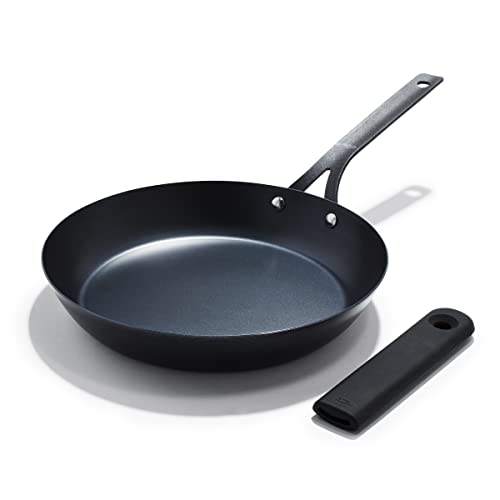
The removable silicone handle sleeve is the practical touch. Carbon steel handles reach the same temperature as the pan, and a sleeve you can pull off before the pan goes in the oven is a better answer than a permanently insulated handle that limits oven use.
The listing leads with “WIRECUTTER’S 2025 BEST PICK”, which is a third-party editorial endorsement rather than a manufacturer claim, and the only such citation in this comparison. We do not score on other people’s reviews, but citing one is more checkable than an adjective.
The limits: this pan is not nitrided, so it needs the ordinary care against rust that plain carbon steel does. No country of manufacture is stated. And at 10 inches it is a one or two person pan; the 12-inch version costs more.
- 660°F oven rating, the highest here, stated in both scales and correct.
- Pre-seasoned, with an honest description of how patina develops.
- States hand wash only rather than hiding it.
- Removable silicone handle sleeve for oven work.
- Induction compatible and cites a named third-party review.
- Not nitrided, so ordinary rust care applies.
- Country of manufacture not stated.
- 10 inches is small for family cooking.
- More expensive than the nitrided budget pans.
What we liked: Pre-seasoned and usable from the first meal, with the highest oven ceiling here at 660°F, in the lightest pan of the group.
Keep in mind: Ten inches is the smallest cooking surface in this field, and factory pre-seasoning is a starting layer rather than a finished one.
Best for: A first carbon steel pan, and anyone who sears then finishes in a hot oven.
Best materials disclosure: Lodge Carbon Steel Skillet
| Organic Integrity Score | 90 / 100 |
| Materials | “Made with only carbon steel and vegetable oil” |
| Made in | USA |
| Seasoning | Pre-seasoned with vegetable oil |
| Best for | Anyone who wants the shortest possible ingredient list |
The best-worded safety claim in any cookware guide we have written, and it works by inversion.
“Made with only carbon steel and vegetable oil, this PFAS-free cookware makes dependable, chemical-free cooking easy.” The word carrying the sentence is only. A complete statement of what is present is logically stronger than any list of what is absent, because a free-of list is limited by whatever the writer chose to enumerate, and a two-item materials statement is not.
It also happens to be a claim Lodge can stand behind, since the company has made seasoned cast iron the same way for over a century and states this pan is made in the USA. Country of manufacture appears on only two listings in this comparison.
On the pan itself: pre-seasoned, lightweight compared with cast iron, fast to respond to heat changes, and fitted with a long handle for leverage. All of that is standard for good carbon steel and the listing describes it without inflation.
Two genuine gaps. No oven temperature is stated anywhere, which is a real omission for a material whose main advantage is heat tolerance. And the final bullet is headed “About Lodge Cast Iron” on a carbon steel product, which is a copy inconsistency rather than a defect, but the sort of thing we note.
At 8 inches this is also the smallest pan here, suited to eggs and single portions rather than family searing. Lodge sells larger sizes, and the 8-inch is the one most likely to disappoint someone expecting a main pan.
- Complete positive materials statement: only carbon steel and vegetable oil.
- Made in the USA, stated explicitly.
- PFAS-free claim on a product where it is trivially true and verifiable.
- Pre-seasoned, lightweight and inexpensive.
- No oven temperature stated at all.
- 8 inches is small for anything beyond eggs and single portions.
- Not nitrided, so ordinary rust care applies.
- A bullet headed “About Lodge Cast Iron” on a carbon steel listing.
What we liked: The most complete materials statement in this whole cluster: carbon steel and vegetable oil, and nothing else. Long handle, lowest price.
Keep in mind: No nitriding, so it needs more attention in the first weeks to avoid rust, and the long handle is awkward in a small oven.
Best for: Eggs, single portions, and buyers who want the shortest ingredient list on the shelf.
The professional standard: Matfer Bourgeat 11-Inch
| Organic Integrity Score | 86 / 100 |
| Construction | Single piece of uncoated high-carbon steel |
| Seasoning | Not pre-seasoned; season to factory instructions |
| Heat | Open fires, grills, ovens, all hob types including induction |
| Best for | Cooks who want the traditional pan and will do the work |
The pan professional kitchens have used for generations, sold with a listing that assumes you know why you want it.
The construction claim is the strongest kind: “a single piece of uncoated high-carbon steel, free of PTFE, PFOA, or any other chemical coatings.” Single piece means no riveted joint to trap food or work loose. Uncoated means there is no coating chemistry to discuss, and the free-of list that follows is almost redundant, which is the point.
It is also the only listing here that describes the material’s real advantage properly: an ability to retain very high temperatures, and suitability for open fires and outdoor grills as well as ovens and hobs. That is what carbon steel is for, and no oven number would capture it.
The catch is that it arrives bare. The listing says to “season the pan according to factory instructions to achieve nonstick properties”, which means a stripping and seasoning process before first use, typically involving removing the protective wax coating and building several oil layers. That is an hour of work and a smoky kitchen.
We rate the honesty highly and we would not want a first-time buyer to miss it. If you want to cook tonight, this is the wrong pan. If you want the pan that will outlive you and you are willing to earn the surface, this is the traditional answer and the price reflects a professional tool rather than a consumer one.
It is the most expensive pan in this comparison, it is not nitrided, and the listing is sparse: no oven figure, no weight, and only two substantive bullets.
- Single piece of uncoated high-carbon steel, no rivets, no coating.
- Honest that seasoning is required rather than implying it is ready.
- Describes genuine high-heat and open-fire suitability.
- Professional standard with decades of kitchen use behind it.
- Arrives unseasoned; an hour of work before the first meal.
- Most expensive pan in this comparison.
- Sparse listing with no oven temperature or weight.
- Not nitrided, so it is the least forgiving here about moisture.
What we liked: A single piece of uncoated high-carbon steel with the handle welded rather than riveted, so there are no rivet heads inside the pan. Induction compatible.
Keep in mind: The most expensive pan here, it arrives unseasoned so the first hour of work is yours, and the steel handle gets genuinely hot.
Best for: Cooks who want the traditional professional pan and will put in the seasoning session.
Most honest about nitriding: Armorbear 12-Inch
| Organic Integrity Score | 80 / 100 |
| Surface | Deep nitrided, with the listing stating it gives no nonstick effect |
| Handle | Extended wooden handle; no oven temperature published |
| Size | 12 inch, the largest single pan here |
| Best for | Stovetop searing at family scale, not oven finishing |
This pan is here for one bullet, and it is a bullet we wish every manufacturer would copy.
Headed “ANTI-RUST TECHNOLOGY CLARIFICATION”, it reads: “Please remember that nitridation is purely for rust resistant durability and does not provide a non-stick effect.” In a category where “nitrided” is the premium word and buyers routinely assume it means a slicker pan, Armorbear has chosen to correct the assumption in its own listing. That is a manufacturer giving up an easy sale to prevent a disappointed customer, and it is exactly what we reward.
The pan itself is well suited to what a 12-inch carbon steel skillet is for. The extra-large surface genuinely helps with searing, since crowding a pan is what turns a sear into a steam. The FIBERGRID micro-texture claim, that oil stays under the food, is unverifiable but at least describes a mechanism.
Two things hold it back, and both are the handle.
The extended wooden handle keeps the grip cool, and it also means this pan cannot go in a hot oven. The listing never says so, and it publishes no oven temperature at all, which for a pan sold on “professional searing” is a significant omission. Searing frequently ends with a transfer to the oven, and this pan cannot make that move.
The other is the claim quality elsewhere. “100% toxic free” is meaningless on uncoated steel, and it sits directly above the careful nitriding note, which makes the contrast within one listing rather stark. Whoever wrote the clarification bullet was not the person who wrote that one.
- States outright that nitriding gives no nonstick effect, unique in this category.
- Deep nitrided surface for genuine rust resistance.
- 12 inch surface, the largest single pan here, good for real searing.
- Cool wooden handle and a low price.
- Wooden handle rules out oven finishing, and the listing does not say so.
- No oven temperature published at all.
- “100% toxic free” is filler on uncoated steel.
- FIBERGRID texture claim cannot be verified.
What we liked: Describes its nitrided finish accurately rather than dressing it up as a nonstick coating, on the largest surface here, with a wooden handle that stays cool.
Keep in mind: That wooden handle rules out sustained oven use, and nitriding slows corrosion without removing the need to season.
Best for: Stovetop searing at family scale, by someone who will never need the oven.
Best value, inconsistent numbers: stackbear 3-Pan Set
| Organic Integrity Score | 78 / 100 |
| Contents | 8, 10 and 12 inch nitrided skillets |
| Oven safe | 600°F stated here; the brand’s 12-inch listing states 460°F |
| Surface | NitrOx nitriding, pre-seasoned with food-grade oil |
| Best for | Equipping a kitchen with three sizes in one purchase |
Three nitrided pans for less than the price of one Matfer, which is a genuinely good offer, sold with numbers that do not line up across the brand’s own listings.
The value case is straightforward. Eight, ten and twelve inch skillets cover essentially every stovetop task, all nitrided for rust resistance, all pre-seasoned, all induction compatible, and 600°F is a healthy oven rating.
The problem is that stackbear’s separate 12-inch listing rates the same nitrided construction at 460°F, and renders it as “460%F” with a typo. A buyer looking at both pages sees a 140 degree discrepancy on what appears to be the same pan, with no explanation and no handle difference mentioned.
We cannot say which is correct. We can say that a specification appearing twice at two values is a specification you should not plan around, and if you intend to finish in the oven we would treat the lower figure as the safe assumption.
The nitriding description itself is accurate and appropriately scoped: “improving resistance to rust and corrosion while helping maintain long-term durability”. It does not claim nonstick from nitriding, which puts it ahead of much of the category even without Armorbear’s explicit clarification.
Beyond that the listing is thin. No country of manufacture, no weight, no handle material, no warranty. And a set of three pans is only good value if you will use three pans; two of these will likely live in a cupboard.
- Three sizes for less than the price of one premium pan.
- 600°F oven rating and induction compatible.
- Nitrided for rust resistance, described accurately without nonstick claims.
- Pre-seasoned and ready to use.
- The brand rates the same nitrided pans at 460°F on another listing.
- That other listing contains a typo in the temperature figure.
- No country of manufacture, weight, handle material or warranty stated.
- Three pans is more than most kitchens need.
What we liked: Three pans — 8, 10 and 12 inch — for roughly the price of one mid-range skillet, nitrided and pre-seasoned.
Keep in mind: Its published figures do not reconcile between the three sizes, and a set at this price means thinner steel than the single pans here.
Best for: Equipping a kitchen from scratch, planning around the lower oven figure.
What we left out and why
We left out woks, which are carbon steel’s other great application and a different purchase with different sizing, shape and burner requirements.
We left out enameled and coated carbon steel, since the entire argument for the material is that it has no coating.
We left out cast iron, which is a different metal with different handling: heavier, slower to heat, better at retaining it, and worth its own comparison. Where the two overlap, carbon steel is the lighter and more responsive option and cast iron is the better heat battery. We compare them in our guide to the best cast iron skillets.
And we left out stainless steel and ceramic, which we cover separately, because neither is seasoned and both answer different questions. Our guide to cookware materials compared sets the four side by side.
How to season and keep a carbon steel pan
Seasoning is the whole skill here, and it is much simpler than the internet suggests.
- If the pan is unseasoned, scrub off the factory wax or grease coating with hot water and a little dish soap. This is the one time soap is unequivocally right.
- Dry it completely on a warm hob until no moisture remains.
- Wipe a very thin layer of neutral high smoke point oil over the whole surface, then wipe it off again as if you made a mistake. The layer that remains is the correct amount.
- Heat until the pan just begins to smoke, then let it cool. Repeat two or three times.
- If the pan is pre-seasoned, skip all of this and cook something fatty in it.
- Cook fatty food early on. Bacon, sausages and fried potatoes build seasoning faster than anything you can do deliberately.
- Avoid acidic ingredients for the first few weeks. Tomatoes, wine and vinegar strip young seasoning, though a nitrided pan tolerates them better.
- Preheat properly before adding food, exactly as with stainless. A cold carbon steel pan sticks.
- Expect uneven color. Patchy bronze and black is normal and not a defect.
- Clean while warm with hot water and a stiff brush. Modern dish soap does not destroy seasoning, despite the folklore, but scouring does.
- Never put it in the dishwasher. This is the one instruction with no exceptions, and OXO is right to print it.
- Dry on the hob, not on a rack. Residual moisture is what causes rust, and this is where nitriding earns its money.
- Wipe a trace of oil over the surface before storing if the kitchen is humid.
- If rust appears, scrub it back to bare metal and re-season. Carbon steel is fully recoverable, which no coated pan is.
What it costs to own
Carbon steel is the cheapest cookware to own over any long horizon, because the surface is repairable and the pan does not wear out.
The consequence is that purchase price is nearly the whole cost. There is no coating to replace and no schedule to keep. A pan that is neglected into rust is scrubbed and re-seasoned rather than thrown away, which is the practical difference between carbon steel and everything with a surface applied to it.
The trade is your attention. A carbon steel pan asks to be dried and occasionally oiled, and it punishes a night in the sink. Nitriding softens that requirement considerably, which is the honest case for paying for it, and it is a different case from the one usually made.
Living with carbon steel
It gets better, then it plateaus. The first month is the worst it will ever be. Judging one of these pans in week one is like judging a cast iron pan straight out of the box.
Nitriding buys forgiveness, not release. The pan will still stick if it is unseasoned or under-heated. What it will not do is rust because you left it damp.
The handle is as hot as the pan. Carbon steel handles are the same metal, and a cloth or the silicone sleeve is not optional.
Wooden handles cap the oven. If a pan has one and publishes no oven temperature, assume it is not going in the oven at all.
Acid strips young seasoning. Save the tomato sauce until the surface is established, or make it in stainless.
Questions about carbon steel pans
Does nitriding make a carbon steel pan nonstick?
No. Nitriding is a heat treatment that diffuses nitrogen into the steel surface to harden it and resist rust and corrosion. Nonstick performance comes from seasoning, the layer of polymerized oil built up through cooking. One manufacturer in this comparison states this outright in its own listing, and it is the most useful sentence in the category.
Is a nitrided pan worth paying extra for?
If you want a pan that tolerates a damp dish rack and acidic ingredients better than untreated steel, yes. Nitriding cannot chip or peel because it is a change in the metal rather than a layer on top of it. Just buy it for the rust resistance rather than expecting a slicker surface.
What is the difference between carbon steel and cast iron?
Carbon steel is lighter, thinner and responds much faster to heat changes, which suits searing and stovetop work. Cast iron is heavier and slower but holds heat better, which suits long roasting and baking. Both are seasoned, both are repairable, and both last indefinitely.
Do carbon steel pans need seasoning before first use?
It depends on the pan. Four of the five here arrive pre-seasoned and can be used immediately. One, the Matfer, ships bare and requires stripping its protective coating and building several oil layers first, which the listing states honestly. Check before you plan dinner around it.
Can I use soap on a carbon steel pan?
Yes. Modern dish soap does not strip polymerized seasoning, contrary to a persistent piece of folklore. What damages seasoning is scouring, prolonged soaking and the dishwasher. Hot water, a stiff brush and thorough drying is the routine.
How hot can carbon steel pans go in the oven?
The steel itself tolerates far more than any domestic oven; published ratings are usually limited by the handle. Stated figures in this comparison run from 460°F to 660°F, and two pans publish no figure at all. A wooden handle effectively means no oven use.
Why is my carbon steel pan sticking?
Usually the seasoning is still young or the pan was not preheated. Carbon steel behaves like stainless in this respect: heat the pan first, add the oil second, add the food third, and leave it alone until it releases. A new pan sticks for the first few weeks regardless of what it cost.
Will a carbon steel pan rust?
Untreated carbon steel will if left wet. Nitrided pans resist it substantially better. Either way rust is not fatal: scrub it back to bare metal and re-season, which is something no coated pan allows.
Does carbon steel work on induction?
Yes, always. Carbon steel is magnetic by nature, so no special base construction is needed. All five pans in this comparison state induction compatibility.
Is carbon steel safe to cook on?
It is one of the simplest materials in the kitchen. There is no coating, so there is no coating chemistry: one listing here describes the product as made with only carbon steel and vegetable oil, and another as a single piece of uncoated steel. Claims like “100% toxic free” on bare steel are filler, because there was never anything there to be concerned about.
Organic Connection is reader supported. We read every product listing in full and say plainly when a claim cannot be verified. How we research and rate.