Last updated: September 14, 2026
We may earn a commission when you buy through links on this page, at no extra cost to you. How we research and rate.
The short version
After researching the sourcing, variety, and certifications of the most popular organic rices, our top pick is RiceSelect Organic Arborio Rice, which earned our highest Organic Integrity Score of 94 out of 100. For the strongest certification on the page, Lundberg Regenerative Organic Brown Rice is our pick — Regenerative Organic Certified sits a tier above USDA organic, adding soil health, animal welfare and farmworker standards on top of it. For the cheapest organic rice here, Royal Organic Basmati is the best choice.
The main decisions with rice are variety (basmati, jasmine, brown, arborio) and, importantly, sourcing, because rice can take up arsenic from soil and water. We favor USDA-organic rice from growers known for clean, tested, often California-grown or regeneratively farmed supply. We flag each pick’s variety and certification.
Best organic rice compared
| Best Choice | |||||
 |  |  |  |  | |
| Product | RiceSelect Arborio | Lundberg ROC Brown | Lundberg ROC Jasmine | Royal Basmati | Yupik Brown Jasmine |
| Organic Integrity Score | 94/ 100 | 90/ 100 | 88/ 100 | 86/ 100 | 79/ 100 |
| Our rating | 4.7 | 4.5 | 4.4 | 4.3 | 4.0 |
| Best for | Best overall | Versatile organic rice | Everyday brown | Fragrant white | Sustainable jasmine |
| Variety | Arborio (short grain) | White basmati | Long-grain brown | White jasmine | Brown jasmine |
| Certification | Non-GMO Project Verified, Gluten-Free Certified, Kosher | Non-GMO Project Verified, Certified Organic, Gluten-Free Certified | USDA Organic, Regenerative Organic, Gluten-Free Certified | USDA Organic, Regenerative Organic, Kosher | Kosher, Organic |
| Price | $9.85 $10.99 −10% View on Amazon | $7.01$0.22 / ounce View on Amazon | $8.59$0.27 / ounce View on Amazon | $7.57$0.24 / ounce View on Amazon | $11.99$0.34 / ounce View on Amazon |
Price and availability as of September 27, 2026 1:10 pm EDT. Product prices and availability are accurate as of the date/time indicated and are subject to change. Any price and availability information displayed on Amazon.com at the time of purchase will apply to the purchase of this product.
Nutrition facts side by side
Scores are ours, based on independent research of certification, sourcing, variety, and value, using the same 10-criteria method we apply to every product. See how we research and rate.
Key things to look for in organic rice
Good organic rice is about clean sourcing as much as variety. Here is what matters.
1. USDA organic sourcing
Organic certification confirms the rice was grown without synthetic pesticides or fertilizers, and the best brands add third-party testing and regenerative farming.
2. The right variety
Basmati and jasmine are fragrant long grains for everyday meals, brown rice keeps the bran for fiber, and arborio is the short, starchy grain for risotto.
3. Cleaner growing regions
Because rice can absorb arsenic from soil, growers with clean, tested supply, such as California or dedicated organic farms, are a plus.
4. Whole grain vs white
Brown rice keeps the fiber-rich bran and germ; white rice is lighter and quicker to cook. Both have a place depending on the dish.
Does organic rice matter, and what about arsenic?
Organic certification for rice means no synthetic pesticides or fertilizers were used, which is a genuine benefit for a staple you may eat several times a week. It is worth being clear, though, that organic does not by itself lower arsenic, because arsenic comes from the soil and water a plant grows in, not from sprays. That is why sourcing matters: rice from cleaner, tested growing regions, and simple home steps like rinsing and cooking in extra water, are what actually reduce arsenic exposure.
Our scoring rewards genuine organic certification, clean and transparent sourcing (including regenerative and California-grown supply), variety quality, and value, so you get rice that is both certified organic and thoughtfully grown, not just an organic label on an unknown supply.
The cooking method that removes most of the arsenic
This is the most useful thing anyone can tell you about cooking rice, and it is not widely known.
Why rice specifically. Rice is grown in flooded paddies, and those anaerobic conditions make soil arsenic far more available to the plant than in dry-field crops. Rice takes it up efficiently and concentrates it in the grain. The form that matters is inorganic arsenic, which is classed as carcinogenic.
The point worth being blunt about: organic does not solve this. Organic certification governs what is applied to a crop. Arsenic comes up out of the soil and water. Organic rice can carry just as much as conventional rice grown in the same paddy. This is the same pattern as heavy metals in protein powder and moringa: certification and contamination answer different questions, and buying organic for arsenic reasons is buying the wrong solution.
| Action | Effect on inorganic arsenic |
| Parboil-and-absorb cooking method | Removes roughly 50% from brown rice, up to about 74% from white |
| Choosing white over brown | Arsenic concentrates in the bran, so brown carries more |
| Origin | Basmati from India and Pakistan, and Californian rice, generally test lower than rice from the southern US |
| Rotating other grains | Reduces cumulative exposure |
| Rinsing before cooking | Helps a little, far less than the cooking method |
The parboil-and-absorb method, step by step. Research from the University of Sheffield found this removes most of the arsenic while retaining the minerals that a straight boil-and-drain approach washes away:
- Bring four parts water to the boil first, without the rice in it.
- Add the rice to the already-boiling water and boil for five minutes.
- Drain and discard that water, which now carries much of the arsenic.
- Add fresh water at roughly two parts to one part rice, cover, and cook on low until absorbed.
This beats the older advice of boiling rice like pasta in lots of water and draining it, because draining large volumes also strips water-soluble nutrients. Parboiling briefly first, then finishing by absorption, removes the arsenic and keeps the minerals.
Who should care most. Infants and young children, since exposure scales with body weight and rice cereal is often a first food, and anyone eating rice as a daily staple. For an adult eating rice twice a week, this is a good habit rather than an urgent concern.
How to choose an organic rice
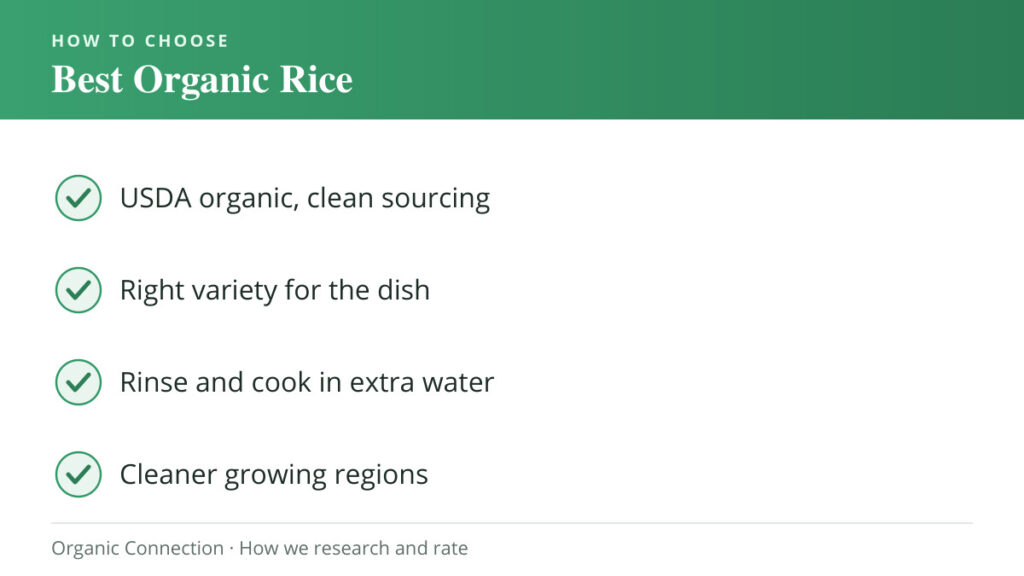
- Look for USDA organic and clean sourcing. Bonus points for regenerative farming or tested, California-grown supply.
- Pick the variety for the dish. Basmati and jasmine for everyday and aromatic meals, brown for fiber, arborio for risotto.
- Rinse and cook in extra water. This reduces arsenic and, for white rice, gives cleaner, fluffier grains.
- Consider whole grain. Brown rice keeps more fiber and nutrients, though it takes longer to cook.
- Buy a size you will use. Rice keeps well sealed and cool, but freshness and aroma are best within a reasonable window.
Who should buy organic rice
Cooking style decides the grain. For organic white basmati, our top pick is the one to buy. If you want an everyday brown rice, a sustainable jasmine, a fragrant white jasmine, or a creamy arborio for risotto, we have a pick for each.
What each certification on a organic rice label actually covers
A seal is a specific promise about a specific thing. These are the promises behind the marks on this page, in plain terms, along with the question each one leaves unanswered.
| Certification | Covers | Key exclusion |
| USDA Organic | Farming and handling: no synthetic pesticides or fertilizers, no GMOs, no sewage sludge or irradiation, audited yearly by an accredited certifier | Three different tiers share the one seal, and it makes no claim about worker pay, food miles, or nutrition |
| Regenerative Organic | Soil health, animal welfare and farmworker fairness, built on top of an existing organic certification | Requires organic certification as its baseline, so it is an addition to the USDA seal and never a replacement for it |
| Kosher | Ingredients and production comply with Jewish dietary law, verified by a rabbinic agency that inspects the facility | A dietary-law standard: it makes no claim about pesticides, GMOs or farming practice |
| Gluten-Free Certified | Testing to below 10 parts per million of gluten, stricter than the FDA threshold of 20 ppm | A gluten threshold and nothing more; unrelated to organic content or nutrition |
Kosher and organic answer entirely different questions. A kosher mark, OU, OK, Star-K and others, confirms that ingredients and production follow Jewish dietary law, verified by an agency that inspects the facility. It is a rigorous supply-chain audit and it says nothing about pesticides, GMOs or farming. The two seals appear together often precisely because neither substitutes for the other.
Best overall: RiceSelect Organic Arborio Rice
| Organic Integrity Score | 94 / 100 |
| Variety | Arborio, short grain |
| Certification | Non-GMO Project Verified, Gluten-Free Certified, Kosher |
| Best for | Creamy risotto and rice pudding |
RiceSelect Arborio is our pick for risotto. It is USDA organic, Non-GMO Verified, and certified gluten-free and kosher, a short, high-starch grain that releases its starch as it cooks to give risotto its signature creamy, silky texture with an al dente bite, in a reusable jar.
It takes first place on documentation: its listing names Non-GMO Project Verified and Kosher, where most of this category asks to be taken on trust.
What we liked: USDA organic and Non-GMO Verified, classic creamy arborio texture, gluten-free and kosher, in a reusable jar.
Keep in mind: Arborio is a specialty grain for risotto and puddings, not a general-purpose everyday rice.
What the listing discloses: RiceSelect commits to Non-GMO Project Verified, kosher certification and Certified Gluten-Free but stops short of whether the USDA seal applies and where it was grown or made.
Best everyday brown: Lundberg Regenerative Organic Brown Rice, Long Grain
| Organic Integrity Score | 90 / 100 |
| Variety | Long-grain brown, whole grain |
| Certification | Regenerative Organic Certified, USDA Certified Organic, Kosher, Non-GMO, gluten free |
| Best for | An everyday whole-grain staple with the strongest certification here |
This is the strongest certification on the page, and it is worth knowing why. The listing states Regenerative Organic Certified, and that is a tier above USDA organic rather than a synonym for it. Organic certification governs what may be applied to a crop. Regenerative Organic Certified takes organic as its floor and adds requirements on soil health, animal welfare and farmworker fairness — three things a USDA seal says nothing about.
The rice itself is what you want from an everyday brown: firm, nutty, separate grains that hold up in bowls, soups and meal prep, from a California family farm that has grown rice since 1937. The listing also names Kosher, non-GMO and gluten free certification.
Two honest notes. It costs more than generic bulk brown rice, and that premium is what the extra certification buys. And brown rice holds more arsenic than white by nature of the bran, so rinse it and cook it in excess water — a point we cover properly further down.
What we liked: Regenerative Organic Certified stated outright, which adds soil, welfare and labour standards on top of organic. Kosher, non-GMO and gluten free named too. Firm separate grains that hold up in meal prep.
Keep in mind: Dearer than generic bulk brown rice. Brown rice holds more arsenic than white, so rinse and cook in excess water.
What the listing discloses: Lundberg is explicit about USDA organic certification and kosher certification, and silent on where it was grown or made.
Best fragrant white: Lundberg Jasmine Rice, Regenerative Organic Certified
| Organic Integrity Score | 88 / 100 |
| Variety | White jasmine, long grain |
| Certification | Regenerative Organic Certified, California grown |
| Best for | A fast, fragrant white rice without dropping the certification |
The same Regenerative Organic Certification as the pick above it, on a white rice — which is the unusual part. Most of the certified-organic effort in rice goes into brown and bulk grains, so a fragrant white carrying the full credential is rarer than it should be.
It is a delicate floral jasmine, soft and slightly clingy, grown in California. It cooks in roughly half the time of brown rice, which matters more on a weeknight than most certification arguments do, and it pairs with the stir-fries and curries that jasmine exists for.
It sits below the brown only on nutrition rather than on integrity: milling off the bran removes the fibre. The upside of that same milling is less arsenic, since arsenic concentrates in the bran, so white rice is the safer choice if rice is a daily staple for young children.
What we liked: A fragrant white rice carrying full Regenerative Organic Certification, which is rare. California grown. Cooks in about half the time of brown.
Keep in mind: Milling removes the bran, so less fibre than the brown above. Clingier than basmati, which suits some dishes and not others.
What the listing discloses: Lundberg documents itself unusually well, stating a USDA organic claim, Regenerative Organic Certified, Certified Gluten-Free and an origin of California.
Best value basmati: Royal Organic Basmati Rice, 2 lb
| Organic Integrity Score | 86 / 100 |
| Variety | White basmati, long grain, aged |
| Certification | Organic — no certifier named on the listing |
| Best for | The cheapest organic rice on this page |
The cheapest organic rice on this page by a clear margin, and a genuinely good basmati. The listing says the grain is aged before milling, which is not marketing: ageing dries the grain so it cooks long, separate and non-sticky rather than swelling into clumps. It also states sourcing from growers in the Himalayan foothills, which is where basmati actually comes from.
Where it gives ground is disclosure. It says organic and stops there. No certifying agent, no Non-GMO Project mark, nothing you can look up — where the two picks above it name Regenerative Organic Certification outright. Organic is a regulated word on food, so the claim is not empty; it is simply the least documented on the page.
Buy it if you cook rice often enough that price per pound matters, and you want basmati specifically. If you want to know who checked the claim, pay the difference and move up the page.
What we liked: Much the cheapest organic rice here. Aged grain, so it cooks long and separate. Sourced from the Himalayan growing region basmati actually comes from.
Keep in mind: Says organic and names no certifier, the thinnest disclosure on this page. A 2 lb bag, so heavy users will reorder often.
What the listing discloses: Royal documents USDA organic certification and kosher certification, and leaves where it was grown or made unsaid.
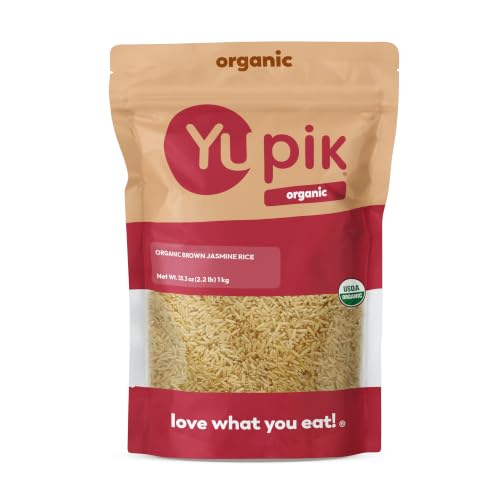
Best brown jasmine: Yupik Organic Brown Jasmine Rice, 2.2 lb
| Organic Integrity Score | 79 / 100 |
| Variety | Brown jasmine, whole grain |
| Certification | Organic — no certifier named on the listing |
| Best for | Aroma with the fibre of a whole grain |
Brown jasmine is the compromise nobody explains: the aroma of jasmine with the bran left on, so you get the fibre of a whole grain without the flat, plain character of ordinary brown rice. If you like jasmine but want the whole grain, this is the specific thing to buy.
The listing is plain to the point of terse — whole grain brown jasmine, fragrant and aromatic, gluten free, non-GMO, kosher. It claims organic without naming a certifier, which is why it sits last rather than because of anything about the rice.
Practical notes. Brown jasmine cooks longer than white and holds more arsenic than white, both consequences of the bran. Rinse it, cook it in plenty of water, and drain the excess.
What we liked: Jasmine aroma with the bran left on, which is a genuinely distinct thing to buy. Gluten free, non-GMO and kosher stated.
Keep in mind: Organic claimed with no certifier named. Cooks longer and holds more arsenic than white, so rinse and cook in excess water.
What the listing discloses: Yupik lists kosher certification. The gap is whether the USDA seal applies and where it was grown or made.
How to cook organic rice well
Rinse rice under cold water until it runs clear to remove surface starch and some arsenic. For the lowest arsenic, cook it like pasta: boil in a large pot of water (about six parts water to one part rice), then drain, which research shows removes a good share of inorganic arsenic. Otherwise, use roughly two parts water to one part white rice, or a bit more and longer for brown, then let it rest covered for a few minutes and fluff with a fork. Store rice sealed in a cool, dry place.
How we researched this guide
We are a research-based review site. We compared each rice against its certification, sourcing and growing region, variety and quality, and the weight of aggregated customer feedback, then scored each with our 10-criteria Organic Integrity Score. No brand paid to be included or ranked. Read the full method on our How We Research and Rate page.
Resistant starch, cooling, and how much it really changes
Rice attracts a lot of attention in weight discussions, and one specific claim about it is true, interesting, and smaller in effect than usually presented.
The claim concerns resistant starch. When cooked rice is cooled, some of its starch reorganises into a crystalline form that human enzymes cannot break down, called retrograded starch. It passes to the colon and is fermented by bacteria rather than absorbed as glucose, so it contributes fewer calories and feeds the gut microbiome. Reheating does not undo it.
This is genuine food chemistry and it is measurable. The effect size is the part that gets exaggerated. Studies cooling and reheating rice have found modest increases in resistant starch and correspondingly modest reductions in glycaemic response, on the order of 10 to 15% rather than anything transformative. Cooking rice today and eating it tomorrow is a small optimisation, not a way to eat rice for free.
The larger variable is which rice and how much. Brown rice retains bran and germ, delivering roughly 3.5 grams of fiber per cooked cup against under one for white, with a slower glucose response and better satiety. That difference is bigger than anything cooling achieves.
Portion is bigger still. A cooked cup of rice is around 200 calories, and restaurant and home servings are routinely two or three cups without looking excessive, because rice compacts.
Honest summary: the cooling trick is real and minor, brown beats white on fiber and satiety by more, and portion size dominates both. Measure dry rice rather than eyeballing the cooked bowl if the total matters.
Common questions about organic rice
What is the best organic rice?
Our overall pick is RiceSelect Organic Arborio, which scores highest here at 94. For everyday brown rice, Lundberg Regenerative Organic Brown is our pick, and it carries the strongest certification on the page: Regenerative Organic Certified, which adds soil health, animal welfare and farmworker standards on top of organic. For the lowest price, Royal Organic Basmati.
Does organic rice have less arsenic?
Not automatically. Arsenic comes from the soil and water rice grows in, not from pesticides, so organic certification alone does not lower it. Choosing rice from cleaner growing regions and rinsing and cooking rice in extra water are what reduce arsenic.
Is brown or white rice better?
Brown rice keeps the bran and germ, so it has more fiber and nutrients, while white rice is lighter, cooks faster, and tends to be lower in arsenic. Both can be part of a healthy diet; the best choice depends on the dish and your preference.
How do I reduce arsenic in rice?
Rinse the rice, then cook it in a large excess of water (about six to one) and drain it like pasta, which removes a significant share of inorganic arsenic. Varying the grains you eat also helps.
Which rice is best for risotto?
Arborio, a short, high-starch grain, is the classic choice because it releases starch as it cooks for a creamy, silky texture. Our organic pick is RiceSelect Organic Arborio.
- Organic Food and Pantry hub
- Best Organic Oatmeal
- Best Organic Olive Oil
- How we research and rate products
- Organic Product Database — search every product we have reviewed, by certification
- Best Organic Soy Sauce
- Best Organic Quinoa
- Heavy metals in organic food, explained
Price and availability as of September 27, 2026 1:10 pm EDT. Product prices and availability are accurate as of the date/time indicated and are subject to change. Any price and availability information displayed on Amazon.com at the time of purchase will apply to the purchase of this product.
Looking for other organic products?
We have checked more than 800 products across food, household goods, gardening, personal care and pet, every one against its stated certification. Browse all reviews.
Organic Connection is reader-supported. When you buy through links on this page we may earn a commission, at no extra cost to you. As an Amazon Associate we earn from qualifying purchases. We are not paid to feature or rank any product. How we research and rate.