Last updated: September 30, 2026
We may earn a commission when you buy through links on this page, at no extra cost to you. How we research and rate.
The short version
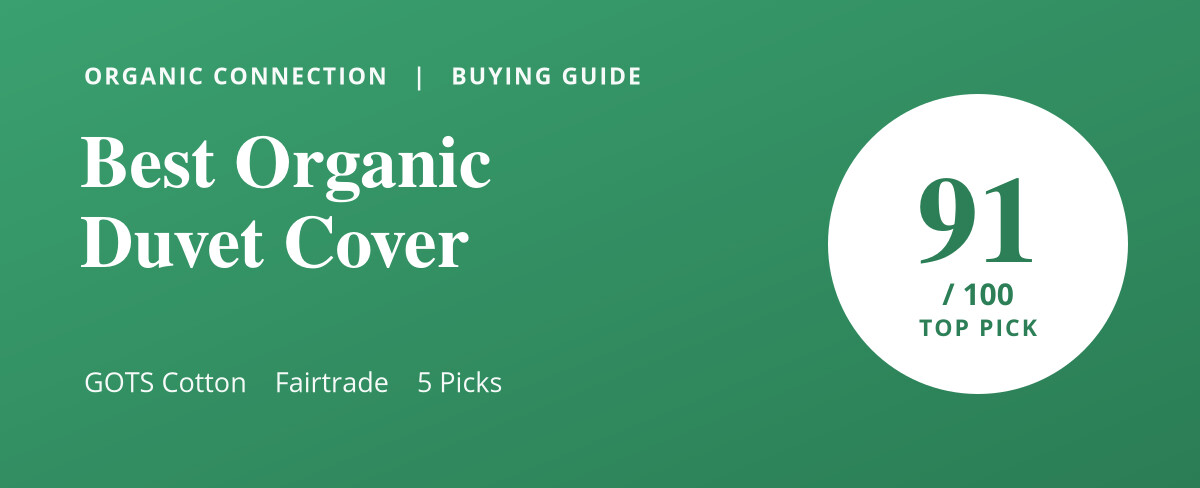
After researching the certifications, weave, and quality of the most popular organic cotton duvet covers, our top pick is the Bare Home GOTS Certified Organic Cotton Percale Duvet Cover Set. It is GOTS and Fairtrade certified, woven in a smooth 300-thread-count sateen, and breathable and skin-friendly, which is why it earned our highest Organic Integrity Score of 91 out of 100. For a luxe made-in-Portugal sateen, Delilah Home is our pick, and for a complete set with shams, the Whisper Organics cooling set is the best choice.
As with any “organic” bedding, the thing that actually matters is GOTS certification, which verifies both the organic cotton and clean, low-toxicity processing. We flag which are GOTS certified and their weave and thread count.
Best organic cotton duvet cover compared
| Best Choice | Best Value | ||||
 |  |  |  |  | |
| Product | Bare Home Percale | Bedsure PureWoven | Delilah Home | Whisper Cooling Set | Simple&Opulence Linen |
| Organic Integrity Score | 91/ 100 | 90/ 100 | 86/ 100 | 81/ 100 | 74/ 100 |
| Our rating | 4.6 | 4.5 | 4.3 | 4.1 | 3.7 |
| Best for | Best overall | Checkable certificate | Luxe sateen | Complete set | Linen, not cotton |
| Weave | 300TC percale | 300TC sateen | 300TC sateen | 300TC sateen + shams | 160 GSM linen |
| Certification | GOTS, OEKO-TEX, Organic | GOTS, OEKO-TEX, Certified Organic | GOTS, Certified Vegan, Organic | GOTS, Fair Trade, Organic | OEKO-TEX |
| Price | $67.99 $84.99 −20% View on Amazon | $82.99 View on Amazon | $139.99 View on Amazon | $79.99$26.66 / count View on Amazon | $138.99 View on Amazon |
Price and availability as of October 11, 2026 7:10 pm EDT. Product prices and availability are accurate as of the date/time indicated and are subject to change. Any price and availability information displayed on Amazon.com at the time of purchase will apply to the purchase of this product.
Scores are ours, based on independent research of certification, weave, construction, and value, using the same 10-criteria method we apply to every product. See how we research and rate.
The certification map for bedding, and what each one actually excludes
Bedding carries more competing seals than almost any category, and they cover genuinely different things. Here is what each one buys you.
| Certification | Covers | Key exclusion |
| GOTS | Organic fiber from farm to finished textile, plus labor criteria | Bans polyurethane foam and chemical flame retardants; requires wool as the fire barrier |
| GOLS | Latex specifically, at least 95% organic | Bans chemical flame retardants and polyurethane |
| OEKO-TEX Standard 100 | Tests finished product for 1,000+ harmful substances | Says nothing about whether fiber was organically grown |
| GREENGUARD Gold | Chemical emissions and VOC off-gassing | Stricter limits set for sensitive spaces such as nurseries |
| CertiPUR-US | Polyurethane foam only | Covers just the foam, not the rest of the product |
The one most misread is CertiPUR-US. It is a genuine certification and it applies only to the polyurethane foam in a product. It confirms that foam was made without formaldehyde, phthalates, ozone depleters, heavy metals, and TCEP flame retardants, and sets a VOC emission limit of 0.5 parts per million. What it does not do is tell you anything about the cover fabric, the fill, or the rest of the construction, and it certainly does not mean a product is organic. A CertiPUR-US mattress is still a polyurethane foam mattress.
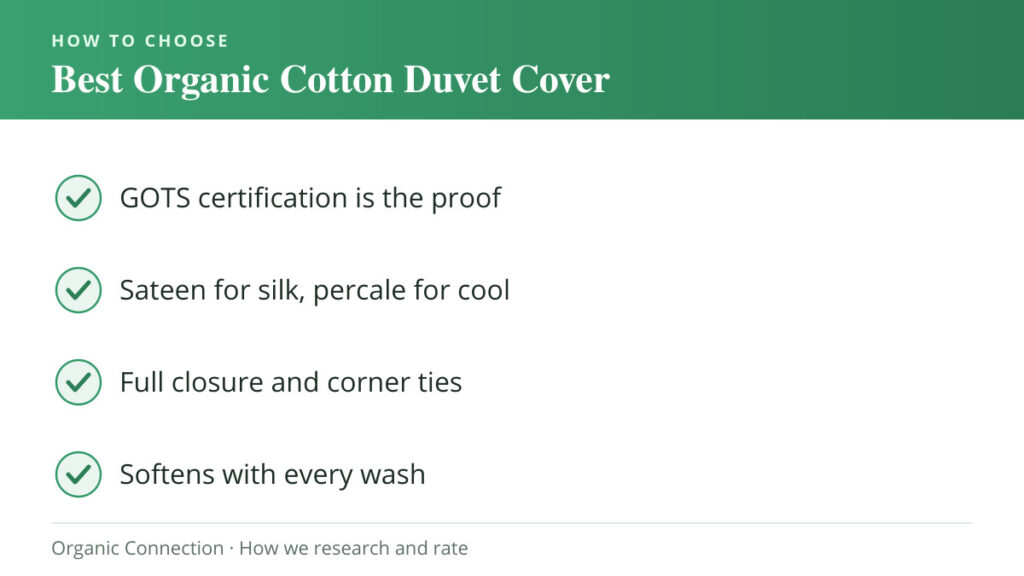
Key things to look for in an organic cotton duvet cover
A genuine organic duvet cover is about certification, weave, and closures. Here is what matters.
1. GOTS certification
It verifies organic cotton and clean processing from field to finished cover, the key proof of organic bedding.
2. Weave and thread count
Sateen weaves feel smooth and silky; percale is crisp and cool. A sensible thread count (around 300) balances softness and breathability.
3. Closures and ties
Look for a full-length button or zipper closure and internal corner ties to keep the insert in place.
4. Fair labor and honest sourcing
Fairtrade certification and transparent sourcing add ethical assurance on top of the organic fiber.
Why GOTS matters for a duvet cover
Unlike food, the word “organic” on bedding is not tightly regulated, so a duvet cover can be marketed as “organic” or “natural” while only a fraction of it is, or while it was dyed and finished with the same harsh chemicals as conventional textiles. GOTS closes that gap: it certifies the cotton was organically grown and that every processing step, spinning, weaving, dyeing, and finishing, met strict environmental and low-toxicity standards. For something that touches your skin all night, that whole-process assurance is what makes a cover genuinely organic.
Our scoring rewards GOTS (and where present, Fairtrade) certification, weave and construction quality, useful closures and ties, and durability, so you get a duvet cover that is both verifiably organic and genuinely nice to sleep under, not just an organic-sounding label.
Flame retardants: the reason certification matters here
This is the substantive issue in bedding and the strongest argument for paying more.
Mattresses and some bedding must meet flammability standards, and manufacturers have two broad ways to do it: add chemical flame retardants, or use a material that resists fire on its own. Wool is naturally flame resistant and is the standard approach in certified organic bedding, which is why GOTS-certified mattresses use a wool fire barrier rather than a chemical treatment. Both GOTS and GOLS explicitly prohibit chemical flame retardants.
Since you spend roughly a third of your life in direct, prolonged, warm contact with a mattress, and since children spend considerably more, this is a more defensible reason to buy certified than most organic purchasing decisions. It is not about pesticide residue in fiber; it is about what was deliberately added to the product to make it pass a burn test.
On off-gassing. The chemical smell from new bedding is volatile organic compounds vaporizing at room temperature. It is most pronounced with polyurethane foam and diminishes over days to weeks. If VOC emissions are your concern specifically, GREENGUARD Gold is the certification that tests for it, and it is the one worth prioritizing for a nursery, where the emission limits are set lower precisely because of who is sleeping there.
For a crib specifically, the sensible combination is GREENGUARD Gold for emissions plus GOTS or GOLS for materials. One without the other leaves a gap: organic materials that still off-gas, or low emissions from conventional materials.
How to choose an organic cotton duvet cover
- Insist on GOTS certification. It verifies the organic fiber and clean processing.
- Pick your weave. Sateen for smooth and silky, percale for crisp and cool.
- Check closures and ties. A full closure and internal corner ties keep the insert in place.
- Match the size and color. Confirm it fits your insert, and choose undyed natural or GOTS-dyed colors.
- Expect it to soften. Quality organic cotton gets softer with each wash.
Who should buy organic cotton duvet cover
Weave and color settle this one. Our top pick is the GOTS organic cotton cover to start with. If you want a luxe made-in-Portugal sateen, a complete cooling set with shams, a durable hemp alternative, or a premium high-thread-count sateen, we have a pick for each.
Best overall: Bare Home GOTS Certified Organic Cotton Percale Duvet Cover Set
| Organic Integrity Score | 91 / 100 |
| Certification | GOTS, OEKO-TEX, Organic |
| Weave | 300-thread-count sateen, breathable |
| Best for | An all-around certified organic duvet cover |
Bare Home Percale is our top pick because it nails certification and feel. It is both GOTS and Fairtrade certified, made from organic cotton grown by farming cooperatives in India, woven in a smooth, buttery 300-thread-count sateen that is breathable and gentle on sensitive skin, comes with corner ties and a full closure, and gets softer with every wash.
The trade-off is that a genuinely certified organic cover costs more than a conventional one. For a verifiably organic, ethically made, silky-smooth duvet cover, it is our first choice.
What we liked: GOTS and Fairtrade certified, smooth 300TC sateen, breathable and skin-friendly, with corner ties and a full closure.
Keep in mind: It is priced above conventional covers, and sateen can feel slightly warm for very hot sleepers versus percale.
What the listing discloses: You are told GOTS and OEKO-TEX for Bare Home; you are not told whether the USDA seal applies and where it was grown or made.
Best certificate transparency: Bedsure PureWoven GOTS Organic Cotton Duvet Cover Set
| Organic Integrity Score | 90 / 100 |
| Certification | GOTS, OEKO-TEX, Certified Organic |
| Fiber | 100% certified organic Turkish cotton |
| Weave | 300-thread-count sateen, 60×60 combed yarn, garment washed |
| Construction | Eight interior corner ties, hidden zipper, 15.3 lbf stated seam strength |
| Best for | Anyone who wants the certification to be checkable |
Every duvet cover on this page says GOTS. This is the only one that publishes the certificate number, GOTS-BVUS0552.
That string is the difference between a claim and a claim you can check. GOTS keeps a public database of licensed operators, so a number can be looked up against the issuing body in about a minute. A seal without a number asks to be taken on trust, and in a category where every listing carries the same logo, the number is the only thing separating them.
The rest of the specification is unusually concrete too. The fiber is named as Turkish organic cotton rather than left as “organic cotton”, the weave is given as 300 thread count in a 60×60 yarn construction, and the listing publishes a seam strength of 15.3 lbf, a measured figure where most bedding listings offer adjectives. It sits a point below our top pick only because that one adds Fairtrade certification on top of GOTS.
What we liked: A published GOTS certificate number, OEKO-TEX alongside it, a named fiber origin, and construction quoted as measurements rather than claims.
Keep in mind: Sateen rather than percale, so it is smoother and a little warmer than the pick above it. The price includes shams, which is money you may not want to spend if you only need the cover.
Best luxe sateen: Delilah Home Organic Cotton Duvet Cover
| Organic Integrity Score | 86 / 100 |
| Certification | GOTS, Certified Vegan, Organic |
| Weave | Long-staple 300TC sateen, made in Portugal |
| Best for | A luxurious, substantial sateen cover |
Delilah Home is our luxe pick. It is GOTS and Vegan.org verified, woven from long-staple organic cotton in a dense 300-thread-count sateen that is noticeably thicker and more substantial than standard cotton, proudly made in Portugal, and built to hold its dense, buttery feel through repeated washing, a genuinely upscale organic cover.
It scores just below our top pick mainly on price and the lack of Fairtrade certification (it is GOTS and Vegan.org instead), not quality, which is excellent. For a luxurious, weighty organic sateen, it is a standout.
What we liked: GOTS and Vegan.org verified, long-staple cotton, a dense luxurious 300TC sateen, and made in Portugal.
Keep in mind: It sits at the premium end on price, and it carries GOTS and Vegan.org rather than Fairtrade certification.
What the listing discloses: Delilah Home documents GOTS, and leaves whether the USDA seal applies and where it was grown or made unsaid.
Best complete set: Whisper Organics Cooling Duvet Set
| Organic Integrity Score | 81 / 100 |
| Certification | GOTS, Fair Trade, Organic |
| Weave | 300TC sateen, duvet cover plus decorative shams |
| Best for | A coordinated, ready-to-go set |
The Whisper Organics cooling set is our pick for a complete look. It is GOTS certified organic cotton in a naturally soft, lightweight, cooling 300-thread-count sateen, and it comes as a full set with matching decorative shams, so you get a coordinated, breathable bed in one purchase, ideal if you want everything to match without buying pieces separately.
It scores in the middle only because it overlaps with our top-pick cover; the added shams and cooling weave are the draw. For a complete, cooling, certified-organic set, it is a great choice.
What we liked: GOTS certified, a lightweight cooling sateen, and a complete set with matching shams for a coordinated look.
Keep in mind: It overlaps with our top-pick cover, so choose it for the shams and cooling weave.
What the listing discloses: Whisper Organics documents GOTS and Fair Trade, and leaves whether the USDA seal applies and where it was grown or made unsaid.
Best linen alternative: Simple&Opulence 100% Linen Duvet Cover Set
| Organic Integrity Score | 74 / 100 |
| Fiber | 100% linen, 160 GSM |
| Certification | OEKO-TEX |
| Set | Duvet cover plus two shams, button closure, seven corner ties |
| Best for | Hot sleepers who want linen rather than cotton |
Linen is the reason this is here. It is a bast fiber like hemp, it breathes better than cotton at the same weight, and it moderates temperature in both directions, which is why it has a following among people who sleep hot in summer and cold in winter.
It scores lowest on this page, and the reason is simple: it is not certified organic. The listing claims OEKO-TEX Standard 100 and nothing else. OEKO-TEX tests the finished textile for harmful substances, which is worth having, but it says nothing about how the flax was grown. On a page about organic bedding that is a real gap, and we would rather name it than let a certification logo do work it was not designed for.
We keep it because the alternative-fiber slot is worth filling and linen genuinely behaves differently from cotton. If organic certification is your reason for being on this page, buy one of the four above it.
What we liked: Real linen at a stated 160 GSM, OEKO-TEX tested, a complete set with shams, and a fiber that does something cotton cannot.
Keep in mind: No organic certification of any kind. Near the top of the price range here. Linen wrinkles by nature, which is either the look or the problem depending on your taste.
How to care for an organic duvet cover
Insert your duvet or comforter and secure it with the internal corner ties, then close the buttons or zipper. Machine wash on a gentle cycle in cold or warm water and tumble dry on low; skip bleach and fabric softener, which can coat the fibers, and the cover will get softer with each wash. Wash new colored covers with like colors the first couple of times. Organic cotton and hemp are breathable and durable, so a good cover lasts for years and only improves with use. For hot sleepers, a percale weave or lower thread count sleeps cooler than a dense high-count sateen.
Percale or sateen: the choice that decides how you sleep
Both are 100% cotton. The difference is entirely in how the threads cross, and it changes temperature more than any thread count does.
| Percale | Sateen | |
| Weave | One over, one under — a balanced plain weave | Float weave, three or four threads over one |
| Finish | Matte, crisp | Subtle sheen, smooth |
| Feel | Cool and crisp — the crispness tents it away from skin, letting air circulate | Silky and drapey; the float weave traps a thin layer of warm air |
| Best for | Hot sleepers, summer, anyone who likes hotel bedding | Cool sleepers, winter, pairing with heavier duvets |
| Wrinkling | Wrinkles freely — that is the look | Smoother out of the wash |
| Durability | Generally longer-lived | Long float threads are more prone to snagging and pilling |
If you run hot, percale is almost always the answer, and switching weave will do more than switching brand. If you have found cotton bedding clammy, you were probably in sateen.
Thread count is mostly marketing above 400
This is the most manipulated number in bedding, and the mechanism is worth understanding because it explains how a “1,000 thread count” cover can feel worse than a 300.
Single-ply woven cotton physically cannot exceed roughly 500–600 threads per square inch before the weave becomes structurally unsound. So how do you get to 1,000? Manufacturers twist two, three or four thinner threads into one “ply” and count each strand separately. A fabric with 250 actual threads per square inch made from 4-ply yarn gets marketed as 1,000 thread count — and the thinner strands used to achieve it are weaker than a single good thread would be.
| Thread count | Verdict |
| Under 200 | Thin, likely to wear through quickly |
| 270–350 percale | The sweet spot. Crisp, breathable, durable. |
| 300–400 sateen | The sweet spot, with diminishing returns above it |
| 500–600 | Achievable single-ply, dense and warm |
| Above 800 | Almost certainly multi-ply counting or marketing inflation |
Keep in mind: what actually determines quality is staple length — how long the individual cotton fibers are. Long-staple cotton produces smoother, stronger, less pilling yarn. A GOTS-certified long-staple cotton at 300 thread count outperforms any 1,000-thread-count short-staple fabric, and it is not close. Where a listing states staple length or names the cotton type, that is worth more than the headline number.
Closures and corner ties: the practical bit
Nobody thinks about the closure until they own the cover, and it is the source of nearly every daily annoyance with duvets.
| Closure | Character |
| Buttons | Classic and easy to use; does not hold as firmly as a zip, so the insert can creep out at the corners |
| Zip | The most secure. Better for restless sleepers, children and pets. Check it runs the full width and that the slider is metal rather than plastic. |
| Ties | Adjustable and gentle on fabric, but slow, and they work loose over a night |
| Envelope / no closure | Simplest to launder; the insert works its way out |
Interior corner ties are the feature that actually matters, and many covers omit them. They anchor the duvet at each corner so it cannot bunch into one end — the single most common complaint about duvet covers. If a cover has no ties, you can sew four loops of ribbon inside the corners in ten minutes, and it transforms the thing.
Getting the duvet in, the easy way: lay the cover inside out on the bed with the opening at the foot. Lay the duvet on top and tie the corners. Roll both together tightly from the head end into a long sausage. Then invert the opening over each end of the roll and unroll — the cover turns right side out around the duvet as you go. It takes about a minute and needs no wrestling.
Sizing: measure, do not assume
There is no standardized US duvet cover size, and dimensions vary substantially between brands. Twin covers can run anywhere from around 64 × 88 to 74 × 98 inches; full and queen are commonly about 95 × 98; king around 111 × 98. European sizing is different again, and a UK king is not a US king.
- Measure your existing duvet insert before ordering. It is the only reliable approach.
- Match the size, or go slightly larger. A cover smaller than the insert compresses the fill and kills the loft you paid for.
- Too large is also a problem — the insert swims, shifts and bunches even with ties.
- Allow for shrinkage: organic cotton typically loses 3–5% on the first wash unless pre-shrunk, which is enough to turn a good fit into a tight one.
- Note the duvet, not the mattress. Many people size to their bed, but the cover has to fit the insert, and the insert is often a size up from the mattress for better drape.
Care, and the first few washes
- Wash before first use. Organic cotton softens considerably in the first few washes, and a new cover out of the packet is never at its best.
- Wash at 40°C, or 60°C occasionally if you need to sanitize. Cooler is gentler on fibers and color.
- Close the fastening before washing. An open zip or unbuttoned cover swallows every other item in the drum and abrades itself on the way round.
- Do not overload. A duvet cover needs room to move; a stuffed drum cleans badly and creases severely.
- Skip fabric softener. It coats fibers and reduces breathability, and cotton softens naturally with washing anyway. Half a cup of white vinegar in the rinse does the job without the coating.
- Tumble low and remove slightly damp, then finish on the line or the bed. High heat is what shrinks and weakens cotton.
- Percale is meant to look rumpled. If you want it crisp, iron it slightly damp; sateen rarely needs it.
- Rotate two covers rather than washing one constantly. Over-washing wears out good cotton faster than sleeping under it does.
How we researched this guide
We are a research-based review site. We compared each cover against its certification (GOTS, Fairtrade), weave and construction, closures, and the weight of aggregated customer feedback on softness and durability, then scored each with our 10-criteria Organic Integrity Score. No brand paid to be included or ranked. Read the full method on our How We Research and Rate page.
Common questions about organic cotton duvet cover
What is the best organic cotton duvet cover?
Our overall pick is the Bare Home GOTS Certified Organic Cotton Percale Duvet Cover Set, because it is GOTS and Fairtrade certified, a smooth 300TC sateen, breathable, and softens with washing. For a luxe sateen, Delilah Home is our pick, and for a full set, the Whisper cooling set.
What does GOTS certified mean for bedding?
GOTS, the Global Organic Textile Standard, certifies that a textile’s cotton is organically grown and that all processing, spinning, weaving, dyeing, and finishing, avoids harmful chemicals. It is the strongest assurance that a duvet cover is genuinely organic.
Is sateen or percale better for a duvet cover?
Sateen is smooth, silky, and slightly warmer, while percale is crisp, matte, and cooler. Both can be GOTS organic; choose sateen for a luxe silky feel and percale if you sleep hot or prefer a crisp hand.
Are organic duvet covers worth it?
If you want to avoid the pesticides on conventional cotton and the harsh dyes and finishes in conventional textiles, for something you sleep against nightly, yes. A GOTS-certified cover verifies both, and quality organic cotton is breathable and gets softer over time.
How do I keep the duvet insert from shifting?
Use a cover with internal corner ties and a full-length button or zipper closure. Tie the insert corners to the cover’s ties before closing it, which keeps the insert from bunching or sliding inside.
Percale or sateen for a duvet cover?
Percale if you run hot. Its balanced one-over-one weave gives a crisp matte finish that tents away from skin and lets air circulate, and it generally lasts longer. Sateen’s float weave — three or four threads over one — gives a silky drape and traps a thin layer of warm air, which suits cool sleepers and heavier winter duvets, but the long float threads snag and pill more readily. If cotton bedding has felt clammy to you, you were probably in sateen.
Is a higher thread count better?
Not above about 400. Single-ply woven cotton physically cannot exceed roughly 500 to 600 threads per square inch before the weave becomes unsound, so anything above 800 is almost certainly multi-ply counting — manufacturers twist three or four thinner threads into one ply and count each strand, so 250 actual threads of 4-ply yarn becomes “1,000 thread count”. The thinner strands are weaker than a single good thread. Aim for 270 to 350 percale or 300 to 400 sateen.
What matters more than thread count?
Staple length — how long the individual cotton fibers are. Long-staple cotton produces smoother, stronger yarn that pills less. A GOTS-certified long-staple cotton at 300 thread count outperforms any 1,000-thread-count short-staple fabric, and it is not close. Where a listing states staple length or names the cotton type, that is worth more than the headline number.
Which duvet cover closure is best?
A zip, for security — check it runs the full width and has a metal rather than plastic slider. Buttons are classic and easy but let the insert creep out at the corners. Ties are adjustable but slow and work loose overnight. More important than any of them are interior corner ties, which anchor the duvet so it cannot bunch into one end; if a cover lacks them, sewing four ribbon loops inside takes ten minutes and transforms it.
What is the easiest way to put a duvet in a cover?
The roll method. Lay the cover inside out on the bed with the opening at the foot, lay the duvet on top and tie the corners. Roll both together tightly from the head end into a long sausage, then invert the opening over each end of the roll and unroll — the cover turns right side out around the duvet as you go. About a minute, no wrestling.
How do you choose the right duvet cover size?
Measure your insert, because there is no standardized US duvet cover size and dimensions vary substantially by brand. Twin covers run anywhere from around 64 × 88 to 74 × 98 inches, full and queen commonly about 95 × 98, king around 111 × 98, and European sizing is different again. Match the size or go slightly larger — a cover smaller than the insert compresses the fill and kills the loft.
Do organic cotton duvet covers shrink?
By about 3 to 5% on the first wash unless pre-shrunk, which is enough to turn a good fit into a tight one — allow for it when sizing. Wash at 40°C, tumble low and remove slightly damp, since high heat is what shrinks and weakens cotton.
How should you wash a duvet cover?
At 40°C with the fastening closed — an open zip or unbuttoned cover swallows every other item in the drum and abrades itself. Do not overload; a duvet cover needs room to move. Skip fabric softener, which coats fibers and reduces breathability, and use half a cup of white vinegar in the rinse instead. Wash it before first use, since organic cotton softens considerably over the first few washes.
- Organic Household hub
- Best Organic Cotton Sheets
- Best Organic Cotton Blanket
- How we research and rate products
- our searchable product database — compare all 800+ picks side by side
- Percale vs sateen, explained
Price and availability as of October 11, 2026 7:10 pm EDT. Product prices and availability are accurate as of the date/time indicated and are subject to change. Any price and availability information displayed on Amazon.com at the time of purchase will apply to the purchase of this product.
Looking for other organic products?
We have checked more than 800 products across food, household goods, gardening, personal care and pet, every one against its stated certification. Browse all reviews.
Organic Connection is reader-supported. When you buy through links on this page we may earn a commission, at no extra cost to you. As an Amazon Associate we earn from qualifying purchases. We are not paid to feature or rank any product. How we research and rate.