
Last updated: September 30, 2026
We may earn a commission when you buy through links on this page, at no extra cost to you. How we research and rate.
The short version
After researching the certifications, sourcing, and quality of the most popular organic ghee brands, our top pick is Pure Indian Foods Organic Grassfed Ghee. It is USDA certified organic, made from grass-fed cow’s milk by a family that has made ghee for five generations, and packed in glass, which is why it earned our highest Organic Integrity Score of 90 out of 100. For everyday value, Organic Valley Purity Farms Ghee is our pick, and for a traditional cultured ghee, Pure Indian Foods Cultured is the best choice.
With ghee, “organic” and “grass-fed” are two different claims, and the ones that matter most are USDA organic certification and grass-fed sourcing together. We flag exactly what each ghee carries.
Best organic ghee compared
| Best Choice | Best Value | ||||
 |  |  |  |  | |
| Product | Pure Indian Foods Cultured | Ancient Organics | Pure Indian Foods | Pure Indian Foods Quart | Purity Farms (Organic Valley) |
| Organic Integrity Score | 90/ 100 | 87/ 100 | 84/ 100 | 82/ 100 | 77/ 100 |
| Our rating | 4.5 | 4.4 | 4.2 | 4.1 | 3.9 |
| Best for | Best overall | Premium | Clean, grass-fed organic | Bulk | Everyday value |
| Type | Cultured, grass-fed | Grass-fed, CCOF/Kosher | Grass-fed, glass jar | Grass-fed, quart size | Organic, widely stocked |
| Certification | Certified Organic, Non-GMO, Gluten-free | CCOF, Certified Organic, Kosher | USDA organic claimed | Non-GMO, Gluten-free, Organic | — |
| Price | $29.89$2.14 / ounce View on Amazon | Currently unavailable See buying options | $26.44$1.89 / ounce View on Amazon | $47.02$1.63 / ounce View on Amazon | $48.87$1.88 / ounce View on Amazon |
Price and availability as of October 11, 2026 7:10 pm EDT. Product prices and availability are accurate as of the date/time indicated and are subject to change. Any price and availability information displayed on Amazon.com at the time of purchase will apply to the purchase of this product.
Scores are ours, based on independent research of certification, sourcing, packaging, and value, using the same 10-criteria method we apply to every product. See how we research and rate.
What each certification on an organic ghee label actually covers
Each certification below appears on at least one product on this page. They are not ranked against each other, because they measure different things, but knowing which is which changes what you buy.
| Certification | Covers | Key exclusion |
| USDA Organic | Farming and handling: no synthetic pesticides or fertilizers, no GMOs, no sewage sludge or irradiation, audited yearly by an accredited certifier | Three different tiers share the one seal, and it makes no claim about worker pay, food miles, or nutrition |
| Kosher | Ingredients and production comply with Jewish dietary law, verified by a rabbinic agency that inspects the facility | A dietary-law standard: it makes no claim about pesticides, GMOs or farming practice |
Kosher and organic answer entirely different questions. A kosher mark, OU, OK, Star-K and others, confirms that ingredients and production follow Jewish dietary law, verified by an agency that inspects the facility. It is a rigorous supply-chain audit and it says nothing about pesticides, GMOs or farming. The two seals appear together often precisely because neither substitutes for the other.
Key things to look for in organic ghee
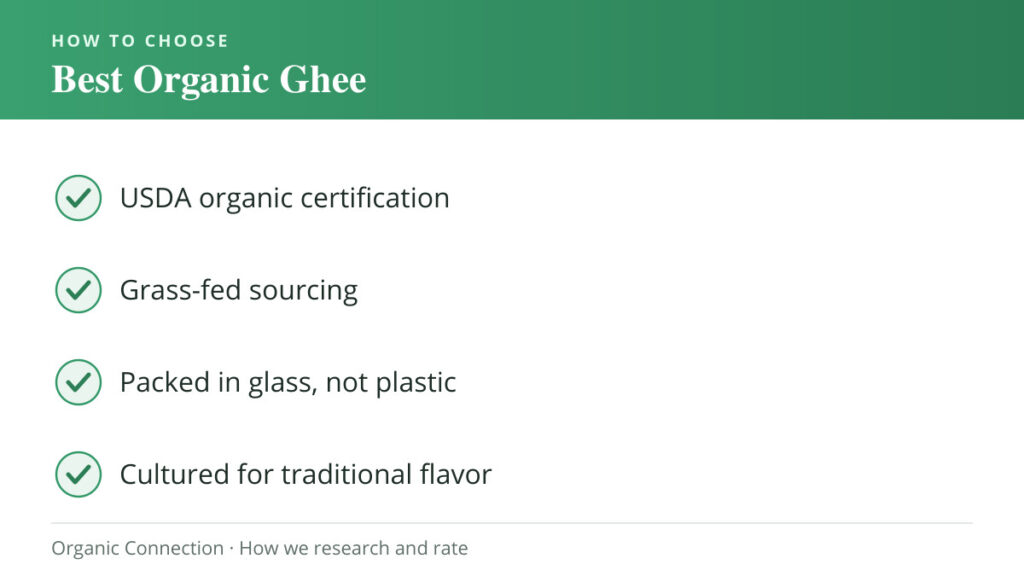
Great organic ghee is about certification, sourcing, and packaging. Here is what matters.
1. USDA organic certification
Look for the USDA organic seal, which verifies organic milk and clean processing, not just “natural” on the label.
2. Grass-fed sourcing
Grass-fed cows produce ghee richer in butyric acid, CLA, and vitamins; the best brands state it clearly.
3. Glass packaging
Quality ghee comes in glass jars, which do not leach and preserve flavor better than plastic tubs.
4. Cultured vs regular
Cultured ghee is made from fermented (cultured) butter for a deeper, traditional flavor and near-zero lactose and casein.
Why certified organic grass-fed ghee is worth it
Ghee is prized as a high-heat cooking fat with a high smoke point, a rich nutty flavor, and no lactose or casein, which makes it popular with Paleo, Whole30, and keto eaters and anyone sensitive to dairy. But because ghee is concentrated from butter, whatever was in the milk is concentrated too. Conventional butter can carry residues of synthetic hormones, antibiotics, and GMO feed; USDA organic certification rules those out and requires the whole process to meet the organic standard.
Grass-fed sourcing adds the nutritional edge: cows on their natural pasture diet give butter, and therefore ghee, with more butyric acid (a beneficial short-chain fatty acid), more CLA, and more fat-soluble vitamins. Our scoring rewards ghee that is both USDA organic and grass-fed, packed in glass, and honestly labeled, so you get the cleanest, most nutrient-rich clarified butter, not just an organic-sounding jar.
Ghee versus butter versus clarified butter
These three get used interchangeably and they are not the same thing, which matters both for cooking and for anyone avoiding dairy proteins.
| Butter | Clarified butter | Ghee | |
| Milk solids | Present | Removed | Removed, and browned first |
| Water | About 16% | Evaporated | Evaporated |
| Smoke point | Around 350°F (177°C) | High | Around 485°F (252°C) |
| Flavor | Creamy, mild | Clean, neutral butter | Nutty, caramelized, deeper |
| Shelf stable? | No, refrigerate | Better | Yes, months at room temperature |
All ghee is clarified butter; not all clarified butter is ghee. The difference is that ghee is simmered longer, which lightly browns the milk solids before they are strained out and develops the distinctive nutty flavor. Clarified butter is stopped earlier and tastes cleaner and more neutral.
The smoke point is the practical headline. Butter burns at around 350°F because it is the milk proteins that scorch, not the fat. Remove them and the smoke point rises to roughly 485°F. That makes ghee genuinely suitable for high-heat searing, roasting, and frying where butter would blacken, and it is one of the few traditional fats that handles that heat while still tasting of butter.
Lactose and casein. The milk solids carry the lactose and casein, and clarification removes them, leaving essentially pure butterfat. Well-made ghee contains only trace milk solids, commonly cited at under three parts per million. Many people who react to butter tolerate ghee perfectly well. That said, “virtually free” is not “free”, so anyone with a diagnosed milk allergy, as distinct from lactose intolerance, should treat ghee cautiously and take medical advice rather than assuming it is safe.
Why it keeps without refrigeration. Water and protein are what spoil in butter. With both removed, ghee is stable at room temperature for months in a sealed jar, which is why it predates refrigeration as a cooking fat. Keep it dry and always use a clean dry spoon, since introducing water or crumbs is what causes it to go off.
On grass-fed and organic. Ghee concentrates butterfat, so it concentrates whatever was in the milk fat. Milk from pasture-raised cows is higher in fat-soluble vitamins and carries a better fatty acid profile, and because ghee is a concentrate, that difference shows up more than it does in butter. This is one of the clearer cases where paying for grass-fed and organic buys a measurably different product.
How to choose organic ghee
- Confirm the USDA organic seal. It verifies organic milk and clean processing.
- Choose grass-fed. Richer in butyric acid, CLA, and vitamins A, D, E, and K.
- Prefer glass jars. They preserve flavor and do not leach into the fat.
- Decide cultured or regular. Cultured for deeper traditional flavor, regular for a clean buttery taste.
- Match the size to your cooking. Ghee is shelf-stable, so a larger jar is economical if you cook often.
Who should buy organic ghee
Sourcing or price will decide this for you. Our top pick is the USDA organic grass-fed ghee. If you want everyday value, a premium option, a traditional cultured ghee, or an economical bulk jar, we have a pick for each.
Best overall: Pure Indian Foods Organic Cultured Ghee
| Organic Integrity Score | 90 / 100 |
| Type | Cultured grass-fed ghee, batch-tested, glass jar |
| Certification | Certified Organic, Non-GMO, Gluten-free |
| Best for | Traditional flavor and near-zero lactose/casein |
Pure Indian Foods Cultured is our pick for tradition. It is USDA certified organic, made the traditional way from cultured (fermented) grass-fed butter, which develops a deeper, tangier, more complex flavor and further reduces lactose and casein, packed in glass, and batch-tested for casein and whey, the way ghee has been made in India for centuries, from the same five-generation family as our top pick.
It scores in the value range only because cultured ghee’s stronger flavor is a preference and it costs a bit more, but for authentic taste and the lowest lactose and casein, it is outstanding.
What we liked: USDA organic, traditionally cultured for deep flavor, grass-fed, glass jar, and batch-tested for casein and whey.
Keep in mind: Cultured ghee has a stronger, tangier flavor that is a matter of preference, and it is premium-priced.
What the listing discloses: On the PURE INDIAN FOODS label: Whole30 approval. Not stated: whether the USDA seal applies and where it was grown or made.
Best premium: Ancient Organics Grass-Fed Ghee
| Organic Integrity Score | 87 / 100 |
| Type | Grass-fed ghee, made in USA, glass jar |
| Certification | CCOF, Certified Organic, Kosher |
| Best for | A premium, carefully sourced ghee |
Ancient Organics is our premium pick. It is USDA and CCOF certified organic and Kosher, made from grass-fed butter sourced from California’s northern coast and New Zealand where cows have pasture access year-round, cooked in small batches to a traditional recipe, and rich in omega fatty acids and vitamins A, D, E, and K, with a deep golden color and full flavor.
It scores just behind our top two on price and value rather than quality, which is very high. For a carefully sourced, double-certified, grass-fed premium ghee, it is a standout.
What we liked: USDA and CCOF organic plus Kosher, grass-fed with year-round pasture, small-batch, and rich in omegas and vitamins.
Keep in mind: It is one of the pricier ghees, so it is a premium choice rather than an everyday value.
What the listing discloses: Everything we check for is on the ANCIENT ORGANICS listing: USDA organic certification, CCOF as the certifying agent, kosher certification and an origin of California.
Clean, grass-fed organic ghee: Pure Indian Foods Organic Grassfed Ghee
| Organic Integrity Score | 84 / 100 |
| Type | Grass-fed original ghee, packed in glass |
| Certification | USDA organic claimed |
| Best for | An all-around clean, grass-fed organic ghee |
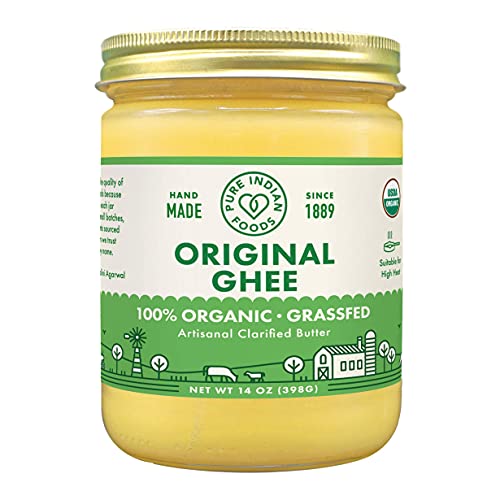
Pure Indian Foods holds its place on this page because it ticks every box. It is USDA certified organic and made from grass-fed cow’s milk produced from spring through fall, handcrafted in small batches by a family that has made ghee for five generations, packed in glass (not plastic), and it was the first ghee brand to become Whole30 Approved, with a rich, nutty, clean flavor and a high smoke point for any cooking.
The trade-off is a premium price versus conventional ghee. For a genuinely certified organic, grass-fed, glass-packed ghee with a heritage of quality, it is still worth buying.
What we liked: USDA organic and grass-fed, glass jar, five generations of expertise, Whole30 Approved, and a rich nutty flavor.
Keep in mind: It sits at the premium end on price, reflecting the grass-fed sourcing and glass packaging.
What the listing discloses: PURE INDIAN FOODS covers the ground, naming a USDA organic claim, Whole30 approval and an origin of the USA.
Best bulk: Pure Indian Foods Organic Grassfed Ghee Quart
| Organic Integrity Score | 82 / 100 |
| Type | Grass-fed original ghee, 28.8 oz quart |
| Certification | Non-GMO, Gluten-free, Organic |
| Best for | Frequent cooks who want the best price per ounce |
The Pure Indian Foods quart is our bulk pick. It is the same USDA certified organic, grass-fed original ghee as our top pick in a large 28.8 oz quart, which brings down the price per ounce for people who cook with ghee often, and since ghee is shelf-stable and does not need refrigeration, a big jar stays good for a long time.
It scores at the value end here only because it is a size choice rather than a different product and overlaps with our top pick, but for households that go through ghee, the quart is the smart, economical buy.
What we liked: Same USDA organic grass-fed ghee as our top pick, in an economical quart, shelf-stable, best price per ounce.
Keep in mind: It is a larger size of our top pick rather than a distinct ghee, so it suits frequent cooks, not occasional use.
What the listing discloses: PURE INDIAN FOODS documents itself unusually well, stating a USDA organic claim, Whole30 approval and an origin of the USA.
Best value: Organic Valley Purity Farms Ghee
| Organic Integrity Score | 77 / 100 |
| Type | Organic ghee from pasture-raised Organic Valley butter |
| Certification | — |
| Best for | A trusted organic ghee at everyday value |
Organic Valley Purity Farms is our value pick. It is USDA certified organic ghee slowly simmered from pure Organic Valley butter made with milk from pasture-raised cows, lactose- and casein-free, shelf-stable, and one of the most widely available organic ghees, from a name shoppers already know and trust, at a friendlier price than specialty brands.
It scores just below our top pick because it is packaged in a tub rather than glass and is not marketed with the same single-origin grass-fed detail, but as a reliable, certified organic everyday ghee, it is excellent value.
What we liked: USDA organic, made from trusted Organic Valley butter, pasture-raised, lactose- and casein-free, widely available, and great value.
Keep in mind: It comes in a tub rather than glass and emphasizes pasture-raised over an explicit grass-fed claim.
What the listing discloses: The listing is thin on detail, and does not say whether the USDA seal applies and where it was grown or made.
Cooking and storing ghee
Ghee shines at high heat: its smoke point is higher than butter or most oils, so it is ideal for sautéing, roasting, frying, and searing, and it adds a rich, nutty flavor to eggs, vegetables, rice, and baked goods. Because the milk solids are removed, ghee is shelf-stable and does not need refrigeration; keep the jar sealed at room temperature away from direct heat and light, and always use a clean, dry spoon to avoid introducing moisture. It will keep for many months, often a year or more. If it firms up or softens with the seasons, that is normal for a natural fat.
How we researched this guide
We are a research-based review site. We compared each ghee against its certification (USDA organic, and where present CCOF or Kosher), grass-fed sourcing, packaging, and the weight of aggregated customer feedback on flavor and quality, then scored each with our 10-criteria Organic Integrity Score. No brand paid to be included or ranked. Read the full method on our How We Research and Rate page.
Ghee against butter, and the claims that do not follow
Ghee has acquired a health reputation that outruns what it is, and the comparison with butter is the useful place to start.
Ghee is butter with the water and milk solids removed, which concentrates the fat. That makes it slightly more calorie-dense than butter per tablespoon, around 120 calories against 100, because you are getting more fat in the same volume. Removing milk solids raises the smoke point considerably and makes it suitable for high-heat cooking, and it removes most of the lactose and casein, which is a genuine benefit for people who react to those.
What it does not do is change the fatty acid profile in any meaningful way. Ghee is still roughly 60% saturated fat, the same as the butter it came from.
The MCT and butyrate claims are where it overreaches. Ghee contains small amounts of short and medium-chain fats including butyrate, and butyrate has genuinely interesting research behind it in gut health. The quantity in a spoon of ghee is very small, and most colonic butyrate comes from bacterial fermentation of dietary fiber rather than from eating it. Eating more fiber is a far more effective route to butyrate than eating ghee.
There is no evidence that ghee aids weight loss, and the popular framing that it is somehow a fat that burns fat has no support.
Where ghee genuinely earns its place is culinary: high smoke point, long shelf life without refrigeration, a nutty flavor butter does not have, and suitability for many people with dairy sensitivities.
Honest summary: marginally more calorie-dense than butter, genuinely better for high-heat cooking and for lactose sensitivity, and no metabolic advantage of any kind.
Common questions about organic ghee
What is the best organic ghee?
Our overall pick is Pure Indian Foods Organic Grassfed Ghee, because it is USDA certified organic, grass-fed, packed in glass, and made by a five-generation family. For everyday value, Organic Valley Purity Farms is our pick, and for cultured ghee, Pure Indian Foods Cultured.
Is organic ghee better than regular ghee?
Organic ghee is made from milk produced without synthetic hormones, antibiotics, or GMO feed, and certified organic processing. Combined with grass-fed sourcing, it delivers more butyric acid, CLA, and fat-soluble vitamins than conventional ghee, so for a concentrated fat, the sourcing matters.
What does grass-fed mean for ghee?
Grass-fed means the cows ate their natural pasture diet rather than grain. This produces butter, and therefore ghee, that is richer in butyric acid, CLA, beta-carotene (giving a deeper golden color), and vitamins A, D, E, and K.
Does ghee need to be refrigerated?
No. Because the milk solids and water are removed, ghee is shelf-stable and keeps at room temperature for many months when sealed and kept away from heat, light, and moisture. Always use a clean, dry spoon to prevent spoilage.
Is ghee lactose and casein free?
Ghee is very low in lactose and casein because the milk solids are removed during clarifying, and cultured ghee is lower still. Many people who are sensitive to dairy tolerate quality ghee, though those with a severe milk allergy should consult a doctor.
- Organic Food & Pantry hub
- Best Organic Olive Oil
- Best Organic Coconut Oil
- How we research and rate products
- Organic Product Database — search every product we have reviewed, by certification
Price and availability as of October 11, 2026 7:10 pm EDT. Product prices and availability are accurate as of the date/time indicated and are subject to change. Any price and availability information displayed on Amazon.com at the time of purchase will apply to the purchase of this product.
Looking for other organic products?
We have checked more than 800 products across food, household goods, gardening, personal care and pet, every one against its stated certification. Browse all reviews.
Organic Connection is reader-supported. When you buy through links on this page we may earn a commission, at no extra cost to you. As an Amazon Associate we earn from qualifying purchases. We are not paid to feature or rank any product. How we research and rate.