Last updated: September 30, 2026
We may earn a commission when you buy through links on this page, at no extra cost to you. How we research and rate.
The short version
After researching the certifications, form, and quality of the most popular organic ground ginger, our top pick is Frontier Co-op Organic Ginger Root Powder. It is the only ginger here carrying Regenerative Organic Certified status, a standard that requires organic certification first and then adds soil health, animal welfare and farmworker criteria on top, which is why it earned our highest Organic Integrity Score of 92 out of 100. For certified bulk, HQOExpress Organic Ground Ginger is our pick, and for the cheapest jar, 365 by Whole Foods Market.
With ginger, “organic” matters, and so does how it is processed, since many conventional spices are irradiated or fumigated with ethylene oxide (ETO). We flag each product’s certification, form, and processing.
Best organic ginger compared
| Best Choice | Best Value | ||||
 |  |  |  |  | |
| Product | Frontier Co-op | HQOExpress | Anthony’s | 365 Whole Foods | Simply Organic |
| Organic Integrity Score | 92/ 100 | 90/ 100 | 88/ 100 | 84/ 100 | 82/ 100 |
| Our rating | 4.6 | 4.5 | 4.4 | 4.2 | 4.1 |
| Certification | Regenerative Organic Certified | USDA Certified Organic, Kosher | USDA Organic | Kosher certified | — |
| Size | 1.31 oz bottle | 1 lb bag | 1 lb bag | 1.52 oz bottle | 1.64 oz bottle |
| Best for | Best-documented claim | Certification in bulk | Bulk baking and curries | Cheapest jar | Supermarket familiarity |
| Price | $6.99$5.34 / ounce View on Amazon | $14.99$1.07 / ounce View on Amazon | $14.99$0.94 / ounce View on Amazon | $3.99$2.63 / ounce View on Amazon | $5.82$3.55 / ounce View on Amazon |
Price and availability as of October 11, 2026 7:10 pm EDT. Product prices and availability are accurate as of the date/time indicated and are subject to change. Any price and availability information displayed on Amazon.com at the time of purchase will apply to the purchase of this product.
Scores are ours, based on independent research of certification, processing, form, and value, using the same 10-criteria method we apply to every product. See how we research and rate.
The certification map for organic ginger, and what each one actually excludes
A seal is a specific promise about a specific thing. These are the promises behind the marks on this page, in plain terms, along with the question each one leaves unanswered.
| Certification | Covers | Key exclusion |
| USDA Organic | Farming and handling: no synthetic pesticides or fertilizers, no GMOs, no sewage sludge or irradiation, audited yearly by an accredited certifier | Three different tiers share the one seal, and it makes no claim about worker pay, food miles, or nutrition |
| Fair Trade Certified | A price floor for producers, a community premium, and labor standards on the farms and in the facilities | An economic and labor standard; it is not an organic or pesticide claim |
| Kosher | Ingredients and production comply with Jewish dietary law, verified by a rabbinic agency that inspects the facility | A dietary-law standard: it makes no claim about pesticides, GMOs or farming practice |
Kosher and organic answer entirely different questions. A kosher mark, OU, OK, Star-K and others, confirms that ingredients and production follow Jewish dietary law, verified by an agency that inspects the facility. It is a rigorous supply-chain audit and it says nothing about pesticides, GMOs or farming. The two seals appear together often precisely because neither substitutes for the other.
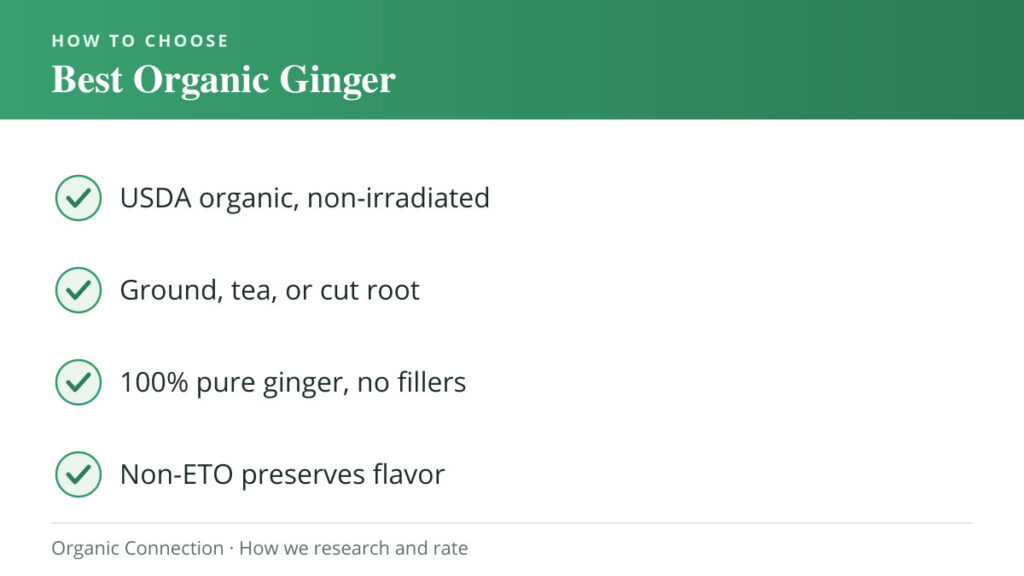
Key things to look for in organic ginger
Great organic ginger is about certification, processing, and form. Here is what matters.
1. USDA organic certification
It verifies clean growing and prohibits irradiation and ETO fumigation used on many conventional spices.
2. Non-irradiated and non-ETO
The best brands state this clearly, preserving the natural flavor and compounds of the root.
3. The right form
Ground powder for cooking and baking, tea bags for digestion, or cut root for brewing fresh ginger tea.
4. Pure ginger, freshly aromatic
Look for 100% ginger with no fillers, and a strong, fresh aroma that signals potency.
Ground, tea, or cut root?
Ginger’s form follows its use. Ground ginger powder is the kitchen workhorse: it dissolves into baking, curries, stir-fries, marinades, and golden-milk lattes, and a little goes a long way. Ginger tea bags are the convenient path to ginger’s traditional digestive benefits, giving a measured, ready-to-steep cup that is soothing after meals or when your stomach is unsettled. Cut and sifted ginger root is for people who want to brew their own strong ginger tea, make infusions, or fill capsules, offering the most control and the freshest brewed flavor, though it takes more effort.
There is no single best form; it depends on whether you are cooking, sipping for digestion, or brewing from scratch. Our scoring rewards genuine USDA organic certification, non-irradiated and non-ETO processing, 100% pure ginger with no fillers, and honest labeling across every form, so whether you reach for a spice jar, a tea bag, or a bag of cut root, you get clean, aromatic ginger rather than a sterilized or diluted product.
How to choose organic ginger
- Confirm USDA organic. It rules out synthetic pesticides, irradiation, and ETO fumigation.
- Look for non-irradiated, non-ETO. The best brands state it, keeping flavor and compounds intact.
- Pick your form. Ground for cooking, tea bags for digestion, cut root for brewing.
- Check for pure ginger. 100% ginger with no fillers, and a strong fresh aroma.
- Match the size to your use. A small jar for occasional cooking, bulk for frequent use.
Who should buy organic ginger
Baking and cooking pull different ways. For ground ginger in the kitchen, our top pick is the one. If you want bulk value, ginger tea for digestion, a big box of tea to stock up, or an everyday bottle, we have a pick for each.
Best overall: Frontier Co-op Organic Ginger Root Powder
| Organic Integrity Score | 92 / 100 |
| Certification | Regenerative Organic Certified, Kosher |
| Size | 1.31 oz bottle |
| Grind | Finely ground dried root |
| Best for | The strongest certification claim in the category |
This is the only ginger on the page carrying Regenerative Organic Certified, and that matters more than it might sound. Regenerative Organic sits on top of USDA organic rather than beside it: a product has to already be certified organic to apply, and then it adds soil health, animal welfare and farmworker fairness requirements that organic certification alone does not cover.
Frontier is a co-op, and was the first company in the United States to offer fair trade spices. The listing leans on that history, and the kosher certification appears in the product title rather than buried in a bullet, which is a small signal that the paperwork is real rather than decorative.
The practical catch is size. This is a 1.31 ounce bottle, so if you bake with ginger every week you will be rebuying it constantly, and the per-ounce price is the highest here by a wide margin. Buy this one when you want the best-evidenced claim in a jar that fits a spice rack, and buy in bulk lower down the page when you want volume.
What we liked: Regenerative Organic Certified is the most demanding credential in the category, and it is layered on top of organic certification rather than substituted for it.
Keep in mind: A 1.31 ounce bottle is the smallest format here and by some distance the most expensive per ounce.
What the listing discloses: Frontier Co-op names Regenerative Organic Certified status, kosher certification in the product title, and its history as the first US fair trade spice company. It does not state a harvest origin.
Best certified bulk: HQOExpress Organic Ground Ginger
| Organic Integrity Score | 90 / 100 |
| Certification | USDA Certified Organic, Kosher |
| Size | 1 lb bag |
| Grind | Ground ginger powder |
| Best for | Naming a certifier while still selling in volume |
HQOExpress states USDA Certified Organic and kosher certification directly in the product title, which is the distinction this guide keeps coming back to. Plenty of spice listings say “organic” as part of a brand name; far fewer name the standard they are certified against.
At a pound, this is a bulk format at a price that makes sense if ginger is a staple rather than an occasional baking spice. Ground ginger keeps its potency for roughly a year in a sealed container away from light, so a pound is realistic for a household that cooks curries, stir-fries or gingerbread regularly, and wasteful if it is going to sit.
What you give up against the Frontier bottle is the regenerative layer and the fair trade history. What you gain is a named certifier at a fraction of the per-ounce cost, which for most buyers is the better trade.
What we liked: Names USDA certification and kosher status in the title itself, at a bulk price per ounce.
Keep in mind: A pound of ground spice loses aroma well before you finish it unless ginger is genuinely a staple in your kitchen.
What the listing discloses: HQOExpress names USDA Certified Organic status, kosher certification and a non-GMO claim. It does not name the certifying agent or a country of origin.
Best for bulk baking: Anthony’s Organic Ground Ginger Root
| Organic Integrity Score | 88 / 100 |
| Certification | USDA Organic |
| Size | 1 lb bag |
| Grind | Ground ginger root |
| Best for | High-volume baking at a low per-ounce price |
Anthony’s states USDA Organic certification along with gluten-free and non-GMO claims, and sells in the same one pound format as HQOExpress at a lower price. For anyone making gingerbread in quantity, brewing ginger drinks, or cooking curries several times a week, this is the sensible volume choice.
The gluten-free claim is worth a sentence, because it is not redundant. Ground spices are a genuine cross-contamination risk: they are often milled on shared equipment, and ginger is frequently blended into mixes containing wheat. A stated gluten-free claim on a single-ingredient spice means the packer has thought about the mill.
What keeps it below HQOExpress here is the absence of a second credential. Anthony’s names the organic standard but nothing beyond it, where HQOExpress adds kosher certification covering a separate audit of the same facility.
What we liked: The lowest per-ounce price among the certified options, with a gluten-free claim that genuinely means something for a milled spice.
Keep in mind: Names organic certification but no second credential, and a pound is a lot of ginger for an occasional baker.
What the listing discloses: Anthony’s names USDA Organic certification, gluten-free and non-GMO claims, and batch testing. It does not name the certifier or state an origin.
Best value: 365 by Whole Foods Market Organic Ground Ginger
| Organic Integrity Score | 84 / 100 |
| Certification | Kosher certified; organic in the product name |
| Size | 1.52 oz bottle |
| Grind | Ground ginger |
| Best for | The cheapest jar on the page |
This is the least expensive ginger here, and for a spice you use a teaspoon at a time that argument carries real weight. The listing names kosher certification and a non-GMO ingredients claim, and carries “Organic” in the product name.
What it does not do is name an organic certifier. “Non-GMO ingredients” is also a claim rather than Non-GMO Project verification, which is a separate third-party audit. Neither absence means the ginger is not organic — 365 is Whole Foods’ own line and is subject to the same USDA rules as anyone else — but this guide ranks on what a listing evidences, and this one evidences less than the three above it.
For most kitchens that is a perfectly rational trade. You are buying a small bottle of a spice you will finish, from a retailer with its own supply chain standards, at the lowest price on the page.
What we liked: The cheapest option here, in a bottle size a normal kitchen will actually finish, with kosher certification named.
Keep in mind: Carries “organic” in the product name without naming the certifier, and its non-GMO wording is a claim rather than Project verification.
What the listing discloses: 365 by Whole Foods Market names kosher certification and non-GMO ingredients. It does not name an organic certifier or a country of origin.
Most familiar brand: Simply Organic Ground Ginger
| Organic Integrity Score | 82 / 100 |
| Certification | — |
| Size | 1.64 oz bottle |
| Grind | Ground ginger root |
| Best for | Buyers who already trust the brand |
Simply Organic is the spice brand most people picture when they think of organic seasoning, and this is the standard supermarket bottle. It is a clean, single-ingredient ground ginger that performs exactly as it should in baking and savoury cooking.
The certification column is an em dash, and that is deliberate. This listing does not name a single certifying body. The strongest statements it makes are that the company “works directly with sourcing partners… paying fair prices directly to them, without a middleman”, and that it is “the original, all-organic spice brand”. Those are sourcing and positioning claims, not certifications, and the direct-payment description is explicitly not the same as Fair Trade certification.
This page previously described this product as “USDA certified organic”. That was not supported by anything on the listing, and it has been corrected. The ginger is very likely certified — the brand would be in serious regulatory trouble otherwise — but a guide that audits certification claims cannot assert one the seller never made.
What we liked: A familiar, reliable single-ingredient ground ginger in the bottle size most kitchens want.
Keep in mind: Names no certifying body anywhere on the listing, and its direct-sourcing language is not Fair Trade certification.
What the listing discloses: Simply Organic names direct payment to sourcing partners and describes itself as an all-organic spice brand. It names no organic certifier, no kosher certification and no origin.
Cooking and brewing with ginger
Ground ginger is potent, so start small: about a quarter to half teaspoon flavors most dishes, and it shines in baking (gingerbread, cookies), curries, stir-fries, marinades, and golden-milk lattes. For ginger tea from powder, whisk a small spoonful into hot water with a little honey and lemon; for cut root, simmer it a few minutes for a stronger brew. Store ground ginger in an airtight container away from heat, light, and moisture, and use it within about a year, since ground spices fade; a strong aroma means it is still potent. Ginger is generally very safe, but if you take blood thinners or are pregnant, check with your doctor about larger supplemental amounts.
Gingerol, shogaol, zingerone: why fresh, dried and cooked ginger are different ingredients
The single most useful thing to understand about ginger is that its three main pungent compounds convert into one another depending on how you treat it. Recipes that say “substitute ground for fresh” are glossing over a genuine chemical change.
| Compound | Where it dominates | Character |
| Gingerol | Fresh raw root | Bright, sharp, lemony heat. Roughly 60,000 Scoville heat units. |
| Shogaol | Dried and ground ginger | Deeper, more penetrating heat — around 160,000 SHU, well over twice as pungent as gingerol. |
| Zingerone | Cooked and baked ginger | Sweet and mellow. Structurally close to vanillin, which is why gingerbread tastes warm rather than hot. |
The mechanism: drying eliminates a water molecule from gingerol to form shogaol, which is why ground ginger smells stronger than the fresh root despite having lost its volatile freshness. Cooking drives a different reaction — a retro-aldol split — producing the gentler zingerones. In stir-frying, studies tracking the conversion find 6-gingerol falling while 6-shogaol and zingerone rise as time and temperature increase.
What that means at the stove:
- Add fresh ginger late if you want the bright, sharp note — the gingerol character is what long cooking destroys.
- Use ground ginger for warmth and depth, not as a substitute for fresh in a stir-fry. It is a different flavor, not a weaker one.
- Baking mellows it deliberately. Gingerbread and ginger biscuits taste sweet-spiced rather than pungent because the oven has converted the compounds, which is the point.
- Some supplements standardize to gingerols and some to shogaols. If you are buying ginger for a specific effect rather than for cooking, that distinction is worth checking on the label.
Converting between fresh, ground and other forms
| Form | Equivalent | Best used for |
| Fresh grated | 1 tbsp | Stir-fries, curries, dressings, tea. The reference amount. |
| Ground / powdered | ¼ tsp = 1 tbsp fresh | Baking, rubs, spice blends. Far more concentrated than people expect. |
| Crystallized | 1 tbsp chopped ≈ 1 tbsp fresh, plus sugar | Baking, snacking, travel nausea |
| Ginger paste | 1 tbsp = 1 tbsp fresh | Convenience; check for added oil, acid and preservative |
| Ginger juice | 1 tsp ≈ 1 tbsp fresh | Drinks and dressings where you want no texture |
The most common mistake is substituting ground for fresh at a one-to-one ratio, which produces something acrid and dusty. Quarter teaspoon to the tablespoon is the working conversion.
What the evidence says about ginger and nausea
Ginger is one of the better-supported culinary botanicals, and the picture differs sharply by indication — which is worth knowing before you buy it for a specific reason.
Pregnancy nausea. This is where the evidence is strongest. Trials have used doses from roughly 500 mg to 2.5 g per day, with benefit generally seen below about 1,500 mg daily, usually split into several doses. It is widely included among non-pharmacological options for nausea and vomiting in pregnancy.
Keep in mind: data on fetal outcomes are limited rather than reassuring, and a Norwegian population study found women using ginger during pregnancy somewhat more likely to report vaginal bleeding after 17 weeks — 7.8% against 5.8%. That is an association in observational data, not a demonstrated cause, but it is a reason to raise ginger with your midwife or doctor rather than treat it as automatically safe because it is a food.
Chemotherapy-induced nausea. Weaker and genuinely mixed. Trials have used 170 mg to 1 g, three or four times daily, but a 2019 systematic review and meta-analysis found no significant association between ginger supplementation and reduced chemotherapy-induced nausea and vomiting. Individual trials point both ways. If you are undergoing chemotherapy, this is a conversation for your oncology team, not a supplement decision to make alone.
Motion sickness and post-operative nausea sit in between — some supportive trials, no settled consensus.
For everyday indigestion, a cup of ginger tea is a low-risk, traditional and pleasant thing to do, and nothing here argues against it. The distinction worth holding is between ginger as a comforting kitchen remedy and ginger as a clinical intervention with a defined dose.
Dose, upper limits and who should be careful
- Typical culinary and tea use is well within safe bounds and needs no calculation.
- Above about 4 g per day of concentrated ginger, heartburn, reflux, mouth irritation and diarrhea become common. More is not better.
- Anticoagulants. Ginger is widely described as a blood thinner and the evidence is thinner than the reputation. A randomized crossover study in 12 healthy volunteers taking 1.2 g of dried rhizome three times daily for two weeks found no effect on platelet aggregation and no effect on the pharmacokinetics or pharmacodynamics of warfarin. Case reports of interaction exist but are not convincing. Still, if you take warfarin or another anticoagulant, mention concentrated ginger supplements at your next review — culinary amounts are not the concern.
- Before surgery, most surgical teams ask you to stop concentrated botanical supplements one to two weeks ahead. Follow their instruction rather than the internet’s.
- Gallstones — ginger stimulates bile flow, so seek advice before taking supplemental doses.
- Reflux and GERD — ginger helps some people and worsens others. Small amounts first.
Ethylene oxide and irradiation: where organic certification genuinely matters
Dried spices are a category where the organic seal buys something concrete beyond pesticide residues, and ginger is a good example.
Conventional dried spices are commonly sterilized to reduce microbial load, and the two dominant methods are ethylene oxide fumigation and irradiation. Ethylene oxide is a recognized carcinogen and its residues in imported spices have triggered repeated regulatory alerts and recalls in Europe. Irradiation is a different technology with its own debate, effective and considered safe by regulators, but a process many people prefer to avoid and which is inconsistently disclosed on labels.
USDA organic rules prohibit both. Certified organic spices are instead treated with steam sterilization, which is why organic ginger powder sometimes has a slightly softer aroma — steam takes a small toll on volatile oils that fumigation does not. That is a real trade, and for most people a worthwhile one.
This is a stronger argument than the usual organic pitch, because it concerns processing rather than farming. It is also, notably, one of the few areas where organic certification addresses what happened after harvest rather than only what was applied to the crop.
Buying and storing ginger
Choosing fresh root: look for firm, plump rhizomes with taut, thin skin that scrapes away with a spoon. Wrinkled, dry or bruised ginger is old. Young ginger has pale, almost translucent skin and pink shoots, is far less fibrous and much milder — excellent for pickling, less useful when you want punch. Mature ginger has tougher tan skin and stronger flavor.
- Fridge: unpeeled, in a paper bag in the crisper, 3–4 weeks. Sealed plastic makes it mold.
- Freezer: the best method by a distance. Freeze whole and unpeeled, then grate from frozen straight into the pan — it grates more finely than fresh and keeps 6 months or more.
- Peeled and submerged in vodka or dry sherry in the fridge keeps for months, and the liquid becomes useful too.
- Ground ginger keeps 2–3 years technically, but potency falls noticeably after about a year. If it smells dusty rather than warm, replace it.
- Sprouting is fine — plant it or use it. Blue-gray rings inside a cut rhizome indicate a variety difference or aging rather than spoilage, but soft, wet or moldy patches mean discard.
Brewing tea properly: for fresh ginger, simmer thin slices — about a thumb-sized piece per cup — for 10 to 15 minutes rather than steeping, since the active compounds need heat and time to extract. Bagged ginger tea needs 5 to 7 minutes covered; covering matters because the volatile oils leave with the steam.
How we researched this guide
We are a research-based review site. We compared each product against its certification (USDA organic, and where present Fairtrade), processing (non-irradiated, non-ETO), form and purity, and the weight of aggregated customer feedback on flavor and quality, then scored each with our 10-criteria Organic Integrity Score. No brand paid to be included or ranked. Read the full method on our How We Research and Rate page.
Nausea, digestion, and a modest metabolic literature
Ginger has one of the better-evidenced traditional uses in the spice cabinet, and as with several others on this site the strong evidence is not about weight.
Where ginger performs well is nausea. Trials support its use for pregnancy-related nausea, motion sickness and some post-operative nausea, and this is the application with the most consistent findings. It also has reasonable evidence for accelerating gastric emptying, which is relevant to functional dyspepsia.
On body weight there is a small literature. Meta-analyses of ginger supplementation have reported modest reductions in body weight and waist-to-hip ratio, mostly in trials among people with overweight or metabolic conditions, with low certainty and considerable variation in dose and preparation. Proposed mechanisms involve thermogenesis and effects on lipid metabolism, neither firmly established in humans.
The gastric emptying finding is worth thinking about carefully, because it points in an ambiguous direction. Faster gastric emptying relieves the discomfort of a heavy meal, and it also means the stomach empties sooner, which is not obviously helpful for staying full. This is a case where a genuine effect does not translate cleanly into the outcome people want from it.
Fresh ginger, dried ground ginger and ginger extract differ substantially in gingerol content, and trials generally use standardised extracts at doses well above culinary quantities.
Honest summary: strong evidence for nausea, a small low-certainty weight literature, an interesting effect on gastric emptying that cuts both ways, and culinary doses well below what the trials used.
Common questions about organic ginger
What is the best organic ginger?
Our overall pick is Frontier Co-op Organic Ginger Root Powder, which scores highest here at 92, because it is the only ginger on this page carrying Regenerative Organic Certified status, a standard that requires organic certification first and then adds soil, welfare and farmworker criteria on top. For certified bulk, HQOExpress is our pick, and for the cheapest jar, 365 by Whole Foods Market.
Why choose organic ginger over conventional?
Many conventional dried spices are irradiated or fumigated with ethylene oxide (ETO) to sterilize them, which USDA organic prohibits. Certified organic ginger is non-irradiated, non-ETO, and grown without synthetic pesticides, preserving its natural flavor and compounds.
Is ground ginger or ginger tea better?
They serve different purposes. Ground ginger is for cooking and baking and dissolves into recipes; ginger tea is the convenient way to enjoy ginger’s traditional digestive benefits. Many people keep both, ground for the kitchen and tea for after meals.
Is ginger good for digestion and nausea?
Ginger has a long traditional use for supporting digestion and easing nausea, attributed to compounds called gingerols, which is why ginger tea is popular after meals or during travel. It is a food and herbal tea, not a medicine, so check with your doctor for specific concerns.
How much ground ginger should I use?
Ground ginger is concentrated, so a quarter to half teaspoon flavors most dishes, and roughly an eighth teaspoon of ground ginger equals about a teaspoon of fresh grated. Start small and add to taste, since it can quickly become spicy.
Why does ground ginger taste different from fresh?
Because drying chemically changes it. Fresh ginger is dominated by gingerol, a bright lemony heat at roughly 60,000 Scoville units. Drying eliminates a water molecule from gingerol to form shogaol, which is around 160,000 SHU — considerably more pungent, and deeper rather than brighter. Cooking drives a third reaction producing zingerone, which is structurally close to vanillin and is why gingerbread tastes warm rather than hot. They are three different ingredients, not three strengths of one.
How much ground ginger equals fresh ginger?
About a quarter teaspoon of ground ginger to one tablespoon of fresh grated. Substituting one-to-one is the most common mistake and produces something acrid and dusty. Ginger juice runs about a teaspoon to a tablespoon of fresh, and ginger paste is roughly one-to-one.
Does ginger actually help with nausea?
It depends heavily on the type. For pregnancy nausea the evidence is strongest, with trials using roughly 500 mg to 2.5 g daily and benefit generally seen below about 1,500 mg split into several doses. For chemotherapy-induced nausea the picture is mixed — a 2019 systematic review and meta-analysis found no significant association. Motion sickness and post-operative nausea sit in between. For ordinary indigestion, ginger tea is a pleasant low-risk traditional remedy.
Is ginger safe during pregnancy?
It is widely included among non-pharmacological options for pregnancy nausea, but data on fetal outcomes are limited rather than reassuring, and a Norwegian population study found ginger users somewhat more likely to report vaginal bleeding after 17 weeks — 7.8% against 5.8%. That is an association in observational data, not a demonstrated cause. Raise it with your midwife or doctor rather than assuming it is safe because it is a food.
Does ginger thin your blood?
Less than its reputation suggests. A randomized crossover study in 12 healthy volunteers taking 1.2 g of dried rhizome three times daily for two weeks found no effect on platelet aggregation and no effect on warfarin’s pharmacokinetics or pharmacodynamics. Case reports of interaction exist but are unconvincing. Culinary amounts are not a concern; if you take an anticoagulant and want concentrated supplements, mention it at your next review. Most surgical teams ask you to stop botanical supplements one to two weeks before an operation.
Can you take too much ginger?
Yes. Above roughly 4 g per day of concentrated ginger, heartburn, reflux, mouth irritation and diarrhea become common. People with gallstones should seek advice first because ginger stimulates bile flow, and those with reflux should start small — it helps some people and worsens others.
Why buy organic ginger powder?
Because of how conventional spices are sterilized, not only how they are farmed. Conventional dried spices are commonly treated with ethylene oxide fumigation, a recognized carcinogen whose residues have triggered repeated recalls in Europe, or with irradiation. USDA organic rules prohibit both, requiring steam sterilization instead. That is why organic ginger powder sometimes has a slightly softer aroma — steam costs a little volatile oil that fumigation does not.
What is the best way to store ginger?
The freezer, by a distance. Freeze the root whole and unpeeled, then grate from frozen straight into the pan — it grates more finely than fresh and keeps six months or more. In the fridge, unpeeled in a paper bag lasts 3 to 4 weeks; sealed plastic makes it mold. Ground ginger keeps 2 to 3 years technically but loses noticeable potency after about a year.
How do you brew fresh ginger tea?
Simmer rather than steep. Use a thumb-sized piece sliced thin per cup and simmer 10 to 15 minutes, because the active compounds need heat and time to extract. Bagged ginger tea needs 5 to 7 minutes with the cup covered — covering matters, since the volatile oils leave with the steam.
- Organic Food & Pantry hub
- Best Organic Turmeric
- Best Organic Green Tea
- How we research and rate products
- Organic Product Database — search every product we have reviewed, by certification
- Lead in cinnamon and ground spices
Price and availability as of October 11, 2026 7:10 pm EDT. Product prices and availability are accurate as of the date/time indicated and are subject to change. Any price and availability information displayed on Amazon.com at the time of purchase will apply to the purchase of this product.
Looking for other organic products?
We have checked more than 800 products across food, household goods, gardening, personal care and pet, every one against its stated certification. Browse all reviews.
Organic Connection is reader-supported. When you buy through links on this page we may earn a commission, at no extra cost to you. As an Amazon Associate we earn from qualifying purchases. We are not paid to feature or rank any product. How we research and rate.