Last updated: September 30, 2026
We may earn a commission when you buy through links on this page, at no extra cost to you. How we research and rate.
The short version
After researching the certifications, sourcing, and fatty-acid profiles of the most popular organic MCT oils, our top pick is Natural Force Organic MCT Oil, Glass Bottle. It is USDA certified organic, sourced entirely from coconuts rather than palm, and delivers a C8 and C10 blend with no fillers, which is why it earned our highest Organic Integrity Score of 92 out of 100. For the best value, Nature’s Way Organic MCT Oil, 16 oz is our pick, and for travel or a powder format, Sports Research Organic MCT Oil Powder is the best choice.
With MCT oil, the two things that matter most are whether the oil comes from coconut or palm and which medium-chain fatty acids are actually in the bottle. We flag each product’s certification and source.
Best organic mct oil compared
| Best Choice | Best Value | ||||
 |  |  |  |  | |
| Product | Natural Force Glass | Sports Research 32 oz | Sports Research 16 oz | Nature’s Way 30 oz | Sports Research Powder |
| Organic Integrity Score | 92/ 100 | 91/ 100 | 84/ 100 | 80/ 100 | 74/ 100 |
| Our rating | 4.6 | 4.6 | 4.2 | 4.0 | 3.7 |
| Source | Coconut | 100% coconut | 100% coconut | Coconut | Coconut + acacia fiber |
| Best for | Best overall | Daily coffee, smoothies | Starter size | Heavy daily use | Travel and texture |
| Certification | USDA Organic, Non-GMO, Kosher | USDA Organic, Non-GMO Project Verified, Gluten-free | USDA Organic, Non-GMO Project Verified, Vegan | USDA Organic, Non-GMO Project Verified | USDA Organic, Non-GMO Project Verified, Gluten-free |
| Price | $39.99$2.50 / fluid ounce View on Amazon | $26.95$0.84 / fluid ounce View on Amazon | $18.95$1.18 / fluid ounce View on Amazon | $25.21 $38.49 −35%$0.84 / fluid ounce View on Amazon | $24.95$2.35 / ounce View on Amazon |
Price and availability as of October 12, 2026 1:10 am EDT. Product prices and availability are accurate as of the date/time indicated and are subject to change. Any price and availability information displayed on Amazon.com at the time of purchase will apply to the purchase of this product.
Scores are ours, based on independent research of certification, sourcing, fatty-acid profile, purity, and value, using the same 10-criteria method we apply to every product. See how we research and rate.
The certification map for organic mct oil, and what each one actually excludes
Most shoppers read a certification as a general signal of quality. Every one of them is narrower than that, and the gaps between them are where the marketing lives.
| Certification | Covers | Key exclusion |
| USDA Organic | Farming and handling: no synthetic pesticides or fertilizers, no GMOs, no sewage sludge or irradiation, audited yearly by an accredited certifier | Three different tiers share the one seal, and it makes no claim about worker pay, food miles, or nutrition |
| Kosher | Ingredients and production comply with Jewish dietary law, verified by a rabbinic agency that inspects the facility | A dietary-law standard: it makes no claim about pesticides, GMOs or farming practice |
Kosher and organic answer entirely different questions. A kosher mark, OU, OK, Star-K and others, confirms that ingredients and production follow Jewish dietary law, verified by an agency that inspects the facility. It is a rigorous supply-chain audit and it says nothing about pesticides, GMOs or farming. The two seals appear together often precisely because neither substitutes for the other.
Key things to look for in organic MCT oil
Great organic MCT oil is about certification, source, fatty-acid profile, and purity. Here is what matters.
1. USDA organic certification
It verifies coconuts grown without synthetic pesticides and rules out non-organic processing aids and additives in the finished oil.
2. 100% coconut sourced
Coconut-only sourcing avoids the deforestation problems associated with palm kernel oil. The label should say coconut explicitly.
3. The C8 and C10 profile
C8 converts to ketones fastest, C10 is close behind. Blends of the two are the standard; oils heavy in C12 behave more like coconut oil.
4. Nothing else in the bottle
Liquid MCT oil should be one ingredient. Powders need a carrier, and acacia fiber is a better one than corn-derived maltodextrin.
C8, C10, or a blend? And oil versus powder
Pure C8 oils are marketed as the premium tier, and there is real science behind the claim that caprylic acid converts to ketones faster than the other medium-chain fats. What the marketing skips is that pure C8 is significantly more expensive and much harder on the digestive system, particularly at first. A C8 and C10 blend gives you most of the ketone-producing benefit at a lower price and with noticeably better tolerance, which is why it is the standard format and why every liquid pick in this guide is a blend. If you are following a strict ketogenic protocol and have already adapted to MCT oil, a pure C8 product is a reasonable upgrade; for everyone else it is paying more for a harsher experience.
Oil versus powder is a genuine trade-off rather than a quality question. Liquid oil is pure, cheapest per gram of MCT, and mixes into coffee or smoothies with a blender. Powder is easier on the stomach, dissolves without blending, travels without leaking, and produces the creamy texture people want in bulletproof-style coffee, but it requires a carrier to turn oil into powder. Acacia fiber is the better carrier because it is a prebiotic fiber; maltodextrin is a cheap corn-derived starch with a high glycemic impact that undercuts the point for anyone using MCT for ketosis. Read the powder’s ingredient list carefully, because that one detail is the whole story.
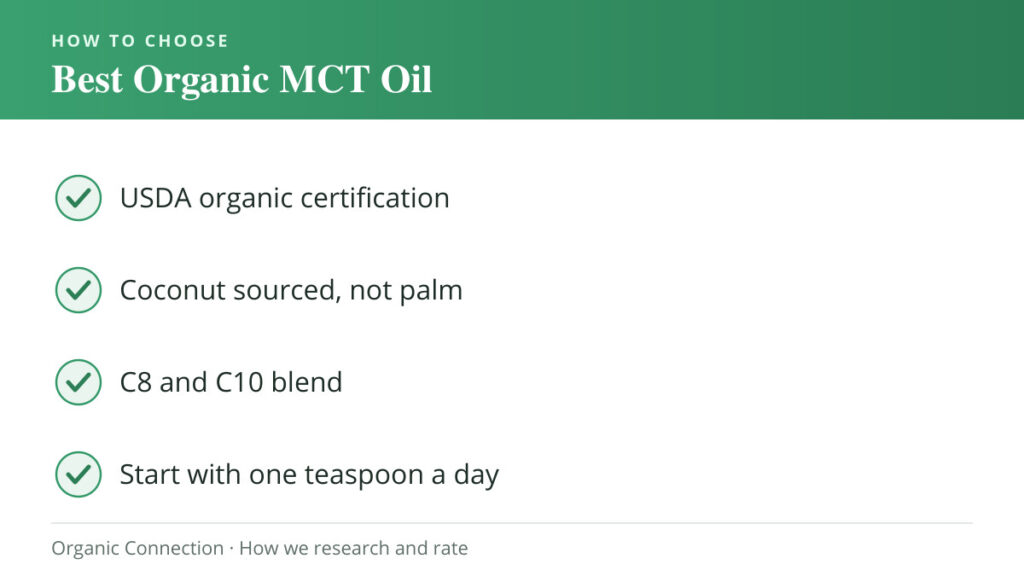
How to choose organic MCT oil
- Confirm USDA organic. It covers pesticide use on the coconuts and rules out non-organic additives.
- Check the source says coconut. Unspecified “MCT oil” often means palm kernel, with the deforestation baggage that carries.
- Prefer a C8 and C10 blend. Better tolerated and much better value than pure C8 for most people.
- Start small. One teaspoon a day for a week. Jumping straight to a tablespoon is how people end up with cramps.
- For powders, read the carrier. Acacia fiber, not maltodextrin.
Who should buy organic MCT oil
Usage decides this one. Buying in bulk, our top pick gives you the best organic oil per ounce. If you want the best value in a smaller bottle, a starter size, a large-format bottle for heavy daily use, or a travel-friendly powder, we have a pick for each.
Best overall: Natural Force Organic MCT Oil, Glass Bottle
| Organic Integrity Score | 92 / 100 |
| Per serving | 14 g full-spectrum MCTs (C8, C10, C12) per tablespoon; 0 g sugar, 0 g carbs, 125 calories |
| Source | 100% virgin coconut oil |
| Testing | Every batch lab tested, results available to customers |
| Certification | USDA Organic, Non-GMO, Kosher |
| Packaging | Glass bottle, biodegradable label, aluminum cap |
| Best for | Anyone who wants the MCT breakdown and the test results |
The only MCT oil in this comparison that tells you what is actually in the bottle. 14 g of full-spectrum MCTs per tablespoon, broken out as C8, C10 and C12.
Those letters are the whole product. MCT oil is a blend of medium-chain fats of different lengths, and they are not equivalent — C8 is the one most of the ketone research uses, C12 behaves more like ordinary coconut oil. A bottle that says only “MCT oil” is not telling you the ratio, and most do not.
The testing claim goes further than the usual. “Every batch undergoes laboratory testing… Testing results are available for customers to view.” Offering to show the results is the part that matters; plenty of brands say tested and stop there.
Packaging is described in unusual detail too: a glass bottle rather than plastic, a biodegradable label printed with plant-based inks, and a recyclable aluminum cap. Glass is the relevant choice for an oil that sits open for weeks.
It is made from 100% virgin coconut oil rather than palm, which is the other question worth asking about MCT oil and which this listing answers in the product name.
What we liked: The MCT profile broken out by chain length, per-batch lab testing with results offered, coconut rather than palm, and a glass bottle.
Keep in mind: Considerably more expensive than the plastic-bottled options, and no C8 percentage is given, only the full-spectrum total.
What the listing discloses: On the Natural Force label: a USDA organic claim and kosher certification. Not stated: where it was grown or made.
Daily coffee, smoothies: Sports Research Organic MCT Oil, 32 oz
| Organic Integrity Score | 91 / 100 |
| Source | 100% organic coconuts, no palm |
| Certification | USDA Organic, Non-GMO Project Verified, Gluten-free |
| Best for | Daily coffee, smoothies, and keto protocols |
Sports Research remains a sound option because it answers every question the category raises. It is USDA certified organic, sourced entirely from coconuts with no palm kernel oil, and it is a C8 and C10 blend, the profile that converts efficiently to ketones while staying tolerable. There is nothing else in the bottle: one ingredient, flavorless and colorless, so it disappears into coffee, tea, or a smoothie without changing the taste. The 32 oz size brings the cost per serving down to the lowest of any liquid oil here.
The trade-off is that a 32 oz bottle is a commitment if you are new to MCT oil, and the plastic bottle is bulky. MCT oil does not need refrigeration and keeps well, so the main risk is discovering you do not tolerate it after buying a quart.
What we liked: USDA organic, 100% coconut-sourced with no palm, C8 and C10 blend, single ingredient, and the best cost per serving in liquid form.
Keep in mind: A large first purchase if you have not used MCT oil before; start with a smaller bottle if you are unsure.
What the listing discloses: Sports Research is explicit about USDA organic certification and Non-GMO Project Verified, and silent on where it was grown or made.
Best starter size: Sports Research Organic Coconut MCT Oil, 16 oz
| Organic Integrity Score | 84 / 100 |
| Source | 100% organic coconuts |
| Certification | USDA Organic, Non-GMO Project Verified, Vegan |
| Best for | Trying MCT oil before committing to a large bottle |
This is our starter size pick’s formula in a bottle you can finish in a month. Same USDA organic, 100% coconut-sourced oil, same flavorless neutral profile, roughly 32 servings. Because MCT oil causes digestive complaints in a meaningful minority of first-time users, buying the smaller bottle first is the sensible way to find out whether you are in that group before spending on a quart.
The trade-off is straightforward: cost per ounce is meaningfully higher than the 32 oz version. Treat it as a trial purchase, then step up to the large bottle if it agrees with you.
What we liked: Identical quality to our top pick in a low-commitment size, ideal for testing tolerance.
Keep in mind: Noticeably more expensive per ounce than the 32 oz bottle.
What the listing discloses: Sports Research is explicit about a USDA organic claim and Non-GMO Project Verified, and silent on where it was grown or made.
Best large format: Nature’s Way Organic MCT Oil, 30 oz
| Organic Integrity Score | 80 / 100 |
| Source | Organic coconut |
| Certification | USDA Organic, Non-GMO Project Verified |
| Best for | Households where more than one person uses MCT oil daily |
The 30 oz Nature’s Way bottle is the alternative bulk option if you prefer that brand’s formula, delivering the same USDA organic coconut-derived C8 and C10 oil in a size that lasts a long time. For a household where two people put MCT oil in their coffee every morning, buying at this scale is simply cheaper.
The trade-off is the same as any large bottle: a big plastic container to store and pour from, and a longer window in which the oil sits open. MCT oil is stable and does not need refrigeration, but keep it capped, away from direct sunlight, and use it within a year of opening.
What we liked: USDA organic coconut MCT in a genuinely economical size for multi-person households.
Keep in mind: Bulky bottle, and it will sit open longer, so keep it capped and out of sunlight.
What the listing discloses: On the Nature’s Way label: a USDA organic claim and Non-GMO Project Verified. Not stated: where it was grown or made.
Best powder: Sports Research Organic MCT Oil Powder
| Organic Integrity Score | 74 / 100 |
| Source | Organic coconut MCT on organic acacia fiber |
| Certification | USDA Organic, Non-GMO Project Verified, Gluten-free |
| Best for | Travel, easier digestion, and creamy coffee |
The powder format solves three real problems: it does not leak in a bag, it dissolves into hot coffee without a blender, and it is markedly gentler on the stomach than liquid oil, which is the single most common complaint about MCT. Crucially, Sports Research uses organic acacia fiber as the carrier rather than maltodextrin, so you are not adding a high-glycemic corn starch to a product you are probably using for ketosis.
It scores lowest here for an unavoidable structural reason: turning oil into powder requires a carrier, so a scoop delivers less actual MCT than a tablespoon of oil, and the cost per gram of MCT is the highest in this guide. That is the price of the convenience, and for travel it is often worth it.
What we liked: Acacia fiber carrier instead of maltodextrin, much easier on digestion, dissolves without a blender, and travels well.
Keep in mind: The carrier means less MCT per serving and the highest cost per gram of MCT here.
What the listing discloses: Sports Research documents itself unusually well, stating a USDA organic claim, Non-GMO Project Verified and an origin of the USA.
How to use MCT oil without regretting it
The single most common mistake is starting too big. MCT oil is absorbed rapidly, and a full tablespoon on day one is a reliable way to spend an afternoon with cramps and urgency. Start with one teaspoon a day, taken with food, and increase over a week or two to one or two tablespoons if you want. Add it to coffee, tea, smoothies, or salad dressing; a blender or frother emulsifies it properly, otherwise it sits on the surface as an oil slick. Do not cook with it: MCT oil has a low smoke point and is not a frying oil. It is calorie-dense at roughly 115 calories per tablespoon, so it adds to your daily intake rather than replacing anything unless you account for it. MCT oil dissolves some plastics, so use glass or ceramic rather than a disposable cup, and store the bottle capped at room temperature away from light. If you are pregnant, managing a medical condition, or taking medication, check with your doctor first.
The palm oil question nobody asks about MCT
Keep in mind: this is the most important thing an organic buyer should know about MCT oil, and it is almost never disclosed on packaging. The two commercial sources of medium-chain triglycerides are coconut oil and palm kernel oil, and a great deal of MCT oil on the market is fractionated from palm kernel — which is cheaper — while being marketed with coconut imagery and sold to people who chose it partly for ethical reasons. Palm cultivation is a major driver of tropical deforestation.
The tell is the ingredient list. A product sourcing from coconut will say so explicitly: “100% coconut-derived”, “from organic coconut oil”, or name Cocos nucifera. A product that says only “MCT oil”, “medium chain triglycerides” or “fractionated coconut and palm kernel oil” is telling you what it is willing to tell you. If the label is silent on source, assume palm is involved.
USDA organic certification does not resolve this — organic palm kernel oil exists and is permitted. If sourcing matters to you, look for the explicit coconut claim, and ideally RSPO certification where palm is present.
C8, C10 and C12: what the numbers actually mean
MCTs are classified by carbon chain length, and the differences are large enough that two products both labeled “MCT oil” can behave quite differently.
| Type | Name | Behavior |
| C8 | Caprylic acid | The most ketogenic — roughly three times more so than C10, reaching peak liver absorption in about 10–15 minutes. Also the harshest on the stomach. |
| C10 | Capric acid | Slower, taking 20–30 minutes, and less efficient at ketone production. Gentler digestively. |
| C12 | Lauric acid | Technically an MCT, but metabolically it behaves much more like a long-chain fat. Dominant in coconut oil. |
C8 and C10 are absorbed via the portal vein, bypassing the standard fat digestion pathway, and convert to ketones within roughly 15–30 minutes. That speed is the entire point of MCT oil.
The C12 problem: lauric acid dominates natural coconut oil, and because it is technically medium-chain, a product can be labeled MCT oil while being largely C12 — which does not deliver the fast ketone response people are buying it for. Reputable manufacturers exclude it for exactly this reason. A “MCT oil” high in lauric acid is closer to fractionated coconut oil than to what the ketogenic literature describes.
| Product | Composition | Best for |
| C8 only (95–99%) | Pure caprylic | Maximum ketone response. Most expensive, hardest on digestion. |
| C8/C10 blend (usually 60:40) | The standard “MCT oil” | The sensible default — most of the effect, better tolerated |
| Includes C12 | Closer to coconut oil | Cheaper, weaker ketone effect. Check the breakdown. |
| Coconut oil | ~50% lauric | Cooking. Not a ketone tool. |
Dosing, and the side effect everyone finds out about the hard way
MCT oil’s reputation for causing urgent digestive trouble is entirely deserved and entirely avoidable. Around 10–20% of people get cramping when dosing rises too quickly, and the effect is dose-dependent rather than idiosyncratic.
| Stage | Dose | Notes |
| Days 1–4 | 1 tsp (5 ml) | With food. Do not skip this step. |
| Week 2 | 1 tbsp (15 ml) | Split across two doses if needed |
| Maintenance | 1–2 tbsp daily | Where most people settle |
| Upper | 3–4 tbsp | Rarely better; frequently worse |
- Always take it with food when starting. Fasted MCT on an empty stomach is the classic route to trouble.
- A C8/C10 blend is gentler than pure C8. If you react badly to a pure C8 product, blending down usually fixes it rather than abandoning MCT altogether.
- Symptoms typically resolve within about 48 hours of backing the dose off, and tolerance builds with consistent use.
- It is calorie-dense — roughly 115 calories per tablespoon — and it is fat you are adding, not substituting, unless you plan otherwise.
Never cook with it
- MCT oil has a low smoke point and is not a cooking oil. Frying with it produces off-flavors and degrades the oil. Coconut oil, which many people assume is interchangeable, is far more heat-stable — a genuine difference between the two.
- It will not solidify in the fridge, unlike coconut oil, which is why it works in cold applications where coconut oil seizes.
- Stir into finished food — coffee, smoothies, salad dressing, drizzled over cooked vegetables.
- It emulsifies poorly on its own. Blending is what produces the creamy texture in “bulletproof” style coffee; stirring leaves an oil slick.
- Do not put it in a plastic bottle or cup for long. MCT is an aggressive solvent and will degrade some plastics, including polystyrene. Glass or stainless steel.
Powder versus oil
MCT powder is easier to travel with, mixes without blending and is gentler on the stomach. The catch is that MCT is a liquid, so making a powder requires a carrier — and the carrier is a substantial share of what you are buying.
- Acacia fiber is the better carrier: a prebiotic fiber, low impact on blood sugar.
- Maltodextrin is the cheaper one, and it has a high glycaemic index — which rather defeats the purpose for anyone using MCT for ketosis. Check the ingredient list, since this is the single most common gap between what the front of the tub implies and what is inside.
- Expect roughly 50–70% MCT by weight, so a “serving” of powder delivers considerably less MCT than the same volume of oil. Compare cost per gram of actual MCT rather than per scoop.
What MCT oil does and does not do
- It raises blood ketones quickly. That is well established and is why it is used in ketogenic diets and studied in some neurological contexts.
- It is not a weight loss drug. There is modest evidence of a small thermogenic and satiety effect relative to long-chain fats, but the effect sizes are small and it is still 115 calories a tablespoon. Adding MCT to an unchanged diet adds calories.
- It does not put you in ketosis on its own if you are eating a normal carbohydrate intake. It raises ketones transiently; it does not override diet.
- Caution with liver disease. MCTs are metabolized in the liver, and people with cirrhosis or significant hepatic impairment should not use concentrated MCT without medical advice.
- Caution with diabetes — ketone production interacts with glucose management and warrants a conversation with your clinician.
- Store cool and dark, sealed. MCT is stable and resists rancidity well — 2 years or more is typical — but heat and light still degrade it.
How we researched this guide
We are a research-based review site. We compared each product against its certification (USDA organic), raw material source (coconut versus palm), fatty-acid profile, ingredient purity and carrier quality, and the weight of aggregated customer feedback on tolerance and mixing, then scored each with our 10-criteria Organic Integrity Score. No brand paid to be included or ranked. Nothing here is medical advice. Read the full method on our How We Research and Rate page.
Thermogenesis, ketones, and the size of the effect
MCT oil has the most legitimate mechanism of any fat sold for weight management, and it is also routinely oversold, so the size of the effect is what matters.
Medium-chain triglycerides, specifically the eight and ten carbon fats, are absorbed differently from long-chain fats. They travel directly to the liver via the portal vein rather than being packaged into chylomicrons, and are rapidly oxidised or converted to ketones. Because that pathway is quick and less prone to storage, MCTs produce a measurably higher thermic effect than an equivalent amount of long-chain fat.
Meta-analyses comparing MCT to long-chain fat substitution have found small reductions in body weight and fat mass, typically under a kilogram across several weeks. The finding is reasonably consistent and the effect is small.
Two things constrain it in practice. The benefit comes from replacing other dietary fat, not adding MCT on top. MCT oil is roughly 115 calories a tablespoon, and taken in addition to an unchanged diet it adds more than the thermic difference removes. And gastrointestinal tolerance limits the dose: cramping and urgency are common above a tablespoon or two, particularly at first.
The ketone argument is separate and often muddled. MCTs do raise blood ketones modestly even without carbohydrate restriction, which is of interest for cognitive and epilepsy research. Elevated ketones are not themselves evidence of fat loss, since these ketones come from the MCT you drank rather than from stored fat.
Honest summary: a real mechanism, a small and replicable effect when substituted rather than added, a firm ceiling set by digestive tolerance, and a ketone story that is frequently misread.
Common questions about organic MCT oil
What is the best organic MCT oil?
Our overall pick is Natural Force Organic MCT Oil, which scores highest here at 92, because its listing names USDA organic certification and kosher certification. For the best value, Nature’s Way Organic MCT Oil is our pick, and for travel or sensitive digestion, the Sports Research powder.
Is MCT oil the same as coconut oil?
No. MCT oil is a concentrated extract of the medium-chain fats found in coconut oil, mainly C8 and C10. Coconut oil itself is roughly half lauric acid (C12), which behaves more like a conventional saturated fat, plus long-chain fats. MCT oil is liquid at room temperature, flavorless, and converts to ketones faster; coconut oil is solid below about 76 °F and tastes of coconut.
Should I buy C8-only MCT oil?
Only if you have a specific reason to. C8 does convert to ketones fastest, but pure C8 costs considerably more and is harder on digestion, particularly at first. A C8 and C10 blend gives most of the benefit at a lower price with better tolerance, which is why it is the standard format and what we recommend for most people.
Can I cook with MCT oil?
No. MCT oil has a low smoke point and is not suitable for frying or high-heat cooking. Use it unheated or in warm liquids: stir it into coffee or tea, blend it into smoothies, or whisk it into a salad dressing.
Is MCT oil made from coconut or palm?
Both are used commercially, and a great deal of MCT oil is fractionated from palm kernel oil because it is cheaper — while being marketed with coconut imagery. Palm cultivation is a major driver of tropical deforestation, and USDA organic certification does not resolve it, since organic palm kernel oil is permitted. Look for an explicit claim: “100% coconut-derived”, “from organic coconut oil”, or Cocos nucifera named. If the label is silent on source, assume palm is involved.
What is the difference between C8, C10 and C12 MCT?
Chain length, and it matters. C8 (caprylic) is the most ketogenic — roughly three times more than C10 — reaching peak liver absorption in 10 to 15 minutes, and is also harshest on digestion. C10 (capric) takes 20 to 30 minutes and is less efficient but gentler. C12 (lauric) is technically an MCT but metabolically behaves like a long-chain fat, so a product high in it will not deliver the fast ketone response people buy MCT for.
Should you buy pure C8 or a C8/C10 blend?
A 60:40 C8/C10 blend is the sensible default — most of the ketone effect with noticeably better tolerance. Pure C8 at 95 to 99% gives the strongest response and is the most expensive and hardest on the stomach. If pure C8 disagrees with you, blending down usually solves it rather than abandoning MCT altogether.
Why does MCT oil upset my stomach?
Because the dose went up too fast. Around 10 to 20% of people get cramping when dosing rises quickly, and it is dose-dependent rather than idiosyncratic. Start at one teaspoon with food for four days, build to a tablespoon in week two, and settle at one to two tablespoons daily. Symptoms typically resolve within about 48 hours of backing off, and tolerance builds with consistent use.
Can you cook with MCT oil?
No. It has a low smoke point and is not a cooking oil — frying with it produces off-flavors and degrades it. Coconut oil, which people often assume is interchangeable, is far more heat-stable. Stir MCT into finished food instead, and blend rather than stir into coffee, since it emulsifies poorly and stirring just leaves an oil slick. Also avoid leaving it in plastic, since MCT is an aggressive solvent that degrades some plastics.
Is MCT powder as good as the oil?
It is more convenient and gentler, but check the carrier. MCT is a liquid, so a powder needs one, and it is a substantial share of what you are buying. Acacia fiber is the good option — a prebiotic with low blood sugar impact. Maltodextrin is the cheap one and has a high glycaemic index, which rather defeats the purpose for anyone using MCT for ketosis. Expect roughly 50 to 70% MCT by weight, so compare cost per gram of actual MCT rather than per scoop.
Does MCT oil help you lose weight?
Not meaningfully on its own. There is modest evidence of a small thermogenic and satiety effect relative to long-chain fats, but the effect sizes are small and MCT is still around 115 calories per tablespoon. Adding it to an unchanged diet adds calories. It also does not put you in ketosis if you are eating normal carbohydrate — it raises ketones transiently rather than overriding diet.
Who should avoid MCT oil?
Anyone with cirrhosis or significant liver impairment, since MCTs are metabolized in the liver, and concentrated MCT should not be used without medical advice in that situation. People with diabetes should also discuss it with their clinician, since ketone production interacts with glucose management.
- Organic Supplements & Wellness hub
- Best Organic Coconut Oil
- Best Organic Protein Powder
- How we research and rate products
- browse all our reviewed products — scores and certifications for 800+ products
Price and availability as of October 12, 2026 1:10 am EDT. Product prices and availability are accurate as of the date/time indicated and are subject to change. Any price and availability information displayed on Amazon.com at the time of purchase will apply to the purchase of this product.
Looking for other organic products?
We have checked more than 800 products across food, household goods, gardening, personal care and pet, every one against its stated certification. Browse all reviews.
Organic Connection is reader-supported. When you buy through links on this page we may earn a commission, at no extra cost to you. As an Amazon Associate we earn from qualifying purchases. We are not paid to feature or rank any product. This page is informational and is not medical advice. How we research and rate.