
Last updated: September 30, 2026
We may earn a commission when you buy through links on this page, at no extra cost to you. How we research and rate.
The short version
After researching the certifications, materials, and dye status of the most popular organic mulches, our top pick is Back to the Roots Organic Premium Mulch. It is OMRI Listed for organic production, made from shredded natural wood with no dyes or synthetic additives, and it is widely available in a manageable bag size, which is why it earned our highest Organic Integrity Score of 89 out of 100. For beds and pathways, OMRI Listed Pine Straw Mulch is our pick, and for suppressing weeds without chemicals, the EcoMulch biodegradable weed barrier roll is the best choice.
With mulch, the two things that matter most are what the material actually is and whether it has been dyed, because dyed mulch is very often recycled construction wood. We flag each product’s certification and material.
Best organic mulch compared
| Best Choice | Best Value | ||||
 |  |  |  |  | |
| Product | Back to the Roots Mulch | Pine Straw Mulch 3-Bag | EcoMulch Weed Barrier | Garden Elements Cocoa Shell | Cocoa Bean Shell 8 Qt |
| Organic Integrity Score | 89/ 100 | 85/ 100 | 82/ 100 | 77/ 100 | 72/ 100 |
| Our rating | 4.5 | 4.3 | 4.1 | 3.9 | 3.6 |
| Material | Shredded natural wood | Shredded pine needles | Biodegradable fiber roll | Cocoa bean shells | Cocoa bean shells |
| Best for | Beds, shrubs, all-purpose | Slopes, paths, acid lovers | Vegetable rows, weed control | Containers and small beds | Potted plants |
| Certification | — | OMRI Listed, Organic | OMRI Listed, Certified Organic | Not stated on the listing | — |
| Price | $28.99$1.81 / ounce View on Amazon | $84.95$42.48 / Bags (2 Cu. Ft.) View on Amazon | Currently unavailable See buying options | $38.94 View on Amazon | Currently unavailable See buying options |
Price and availability as of October 11, 2026 7:10 pm EDT. Product prices and availability are accurate as of the date/time indicated and are subject to change. Any price and availability information displayed on Amazon.com at the time of purchase will apply to the purchase of this product.
Scores are ours, based on independent research of certification, material source, dye status, coverage and value, and the weight of aggregated gardener feedback, using the same 10-criteria method we apply to every product. See how we research and rate.
The certification map for organic mulch, and what each one actually excludes
The labels on these products are not interchangeable, and several of them cover things that have nothing to do with each other. Here is what each one actually buys you.
| Certification | Covers | Key exclusion |
| USDA Organic | Farming and handling: no synthetic pesticides or fertilizers, no GMOs, no sewage sludge or irradiation, audited yearly by an accredited certifier | Three different tiers share the one seal, and it makes no claim about worker pay, food miles, or nutrition |
| OMRI Listed | Review of an input, a fertilizer, pesticide or soil amendment, as allowed in certified organic production | Reviews the product, not the farm: it cannot make your garden or your crop organic |
OMRI Listed is about the input, not the farm. The Organic Materials Review Institute reviews a fertilizer, pesticide or amendment and confirms it is permitted in certified organic production. That is genuinely useful when you are deciding what to put on your own soil. What it does not do is certify the manufacturer, the crop you grow with it, or your garden, and only an accredited certifier can do the last of those.
Key things to look for in organic mulch
Great organic mulch is about material, certification, particle size, and what it does as it decomposes. Here is what matters.
1. OMRI Listed or certified organic
OMRI listing means an independent body reviewed the input against the USDA organic standard. On mulch, it is the clearest signal available.
2. Undyed natural material
Skip black and red dyed mulch. The color is there to hide recycled construction wood, which can carry treatment chemicals.
3. The right material for the job
Shredded bark for beds and slopes, pine straw for acid-loving plants and paths, straw for vegetable beds, cocoa hulls for containers.
4. Weed-free and mold-spore free
Cheap straw and hay commonly bring weed seed with them. Good mulch states that it is weed-free and screened.
Wood, pine straw, cocoa hulls, or a barrier?
Shredded bark and wood mulch is the default for a reason: it looks tidy, holds moisture well, breaks down at a moderate rate that feeds soil without needing annual replacement, and it stays put on gentle slopes better than lighter materials. The one thing to know is nitrogen. As wood mulch decomposes at the soil surface, microbes drawing on nitrogen can temporarily deplete the very top layer, which is harmless for established shrubs and trees but can slow shallow-rooted annuals. Keeping it as a surface layer rather than tilling it in avoids the issue entirely.
Pine straw is lighter, knits together into a mat that resists washing away on slopes, and breaks down slowly. It suits acid-loving plants like azaleas, camellias, blueberries, and hydrangeas, though the commonly repeated claim that it dramatically acidifies soil is overstated; the effect is modest. Cocoa bean shell mulch smells wonderful and looks fantastic in containers and small beds, and it is genuinely rich in nutrients, but it is expensive, it can grow a harmless surface mold in humid weather, and it contains theobromine, which is toxic to dogs if eaten. Do not use cocoa mulch in a garden a dog has access to. Biodegradable weed-barrier rolls are a different tool entirely: rather than a loose layer, they are a paper or fiber sheet you lay over soil to smother weeds, then cover or leave to break down. They excel in vegetable rows and new beds where weed pressure is the main problem, and unlike plastic landscape fabric they decompose into the soil rather than shredding into it for years.
How to choose organic mulch
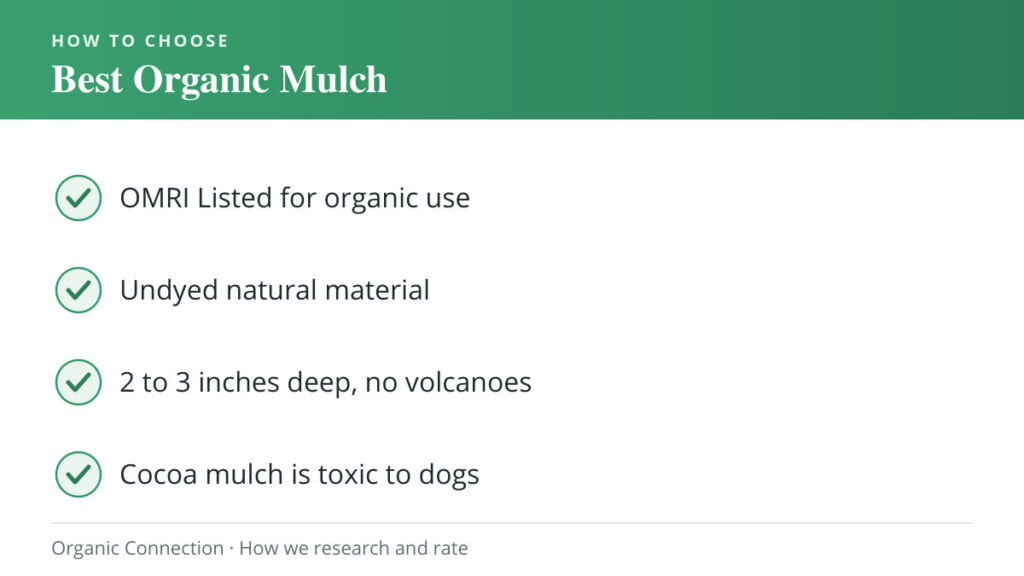
- Look for OMRI Listed. It is the clearest third-party signal that a garden input meets organic standards.
- Avoid dyed mulch. Black and red coloring frequently disguises recycled construction wood.
- Match the material to the bed. Bark for shrubs and slopes, pine straw for acid lovers, straw for vegetables, cocoa for containers.
- Check for a dog-safe material. Cocoa hull mulch contains theobromine and is toxic to dogs.
- Buy by cubic feet, not bags. A 2 to 3 inch layer over 100 square feet takes roughly 17 to 25 cubic feet.
Who should buy organic mulch
The right mulch depends on the bed. If you want a clean, all-purpose OMRI Listed wood mulch, our top pick fits. If you want pine straw for beds and slopes, a decorative cocoa hull mulch for containers, or a biodegradable barrier for a weedy vegetable patch, we have a pick for each.
Best overall: Back to the Roots Organic Premium Mulch
| Organic Integrity Score | 89 / 100 |
| Material | Shredded natural wood, undyed |
| Certification | — |
| Best for | Flower beds, shrub borders, and around trees |
This is our top pick because it is the rare mass-market mulch that carries a real third-party organic listing. It is OMRI Listed, which means an independent body reviewed it against the USDA organic standard, and it is shredded natural wood with no dyes, so you are not covering your beds in recolored construction lumber. The 1.5 cubic foot bag is manageable to carry and spread, and it holds moisture and suppresses weeds as well as any bark mulch at this price.
The trade-off is coverage per bag. At a proper 2 to 3 inch depth, a 1.5 cubic foot bag covers only about 6 to 9 square feet, so a decent-sized bed takes a lot of bags, and buying mulch by the bag online is always more expensive per cubic foot than bulk delivery. For small beds, containers, and top-ups it is ideal; for a whole yard, get a bulk load from a local supplier and use the OMRI listing here as your quality benchmark.
What we liked: Genuinely OMRI Listed, undyed natural wood, consistent shred size, and a bag size one person can handle.
Keep in mind: Coverage per bag is small, so bagged mulch is expensive for large areas compared with bulk delivery.
What the listing discloses: You are told an origin of the USA for Back to the Roots; you are not told whether the USDA seal applies.
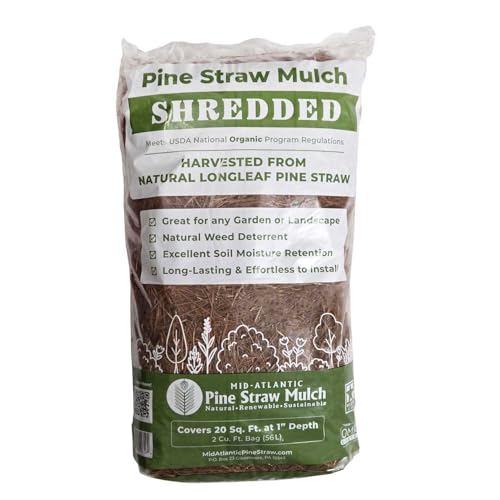
Best for beds and slopes: OMRI Listed Pine Straw Mulch, 3-Bag Box
| Organic Integrity Score | 85 / 100 |
| Material | Shredded longleaf pine needles |
| Certification | OMRI Listed, Organic |
| Best for | Slopes, pathways, and acid-loving plants |
Pine straw solves problems wood mulch does not. The needles knit together into a light mat that stays put on slopes where bark washes down in the first heavy rain, it is far lighter to carry and spread, and it looks natural in woodland and shrub plantings. This one is OMRI Listed and explicitly screened weed-free and mold-spore free, which matters because cheap pine straw and hay are a classic way to import a weed problem into a clean bed. It suits azaleas, camellias, blueberries, hydrangeas, and rhododendrons particularly well.
The trade-off is decomposition speed and appearance. Pine straw breaks down more slowly than shredded bark, so it contributes less to soil building, and it fades from copper to gray over a season, which means topping up for looks. The frequently repeated claim that it will meaningfully acidify your soil is overstated, so do not choose it as a soil amendment.
What we liked: OMRI Listed and screened weed-free, stays put on slopes, very light to handle, and looks natural in woodland planting.
Keep in mind: Fades to gray within a season and breaks down slowly, so it adds less to the soil than bark.
What the listing discloses: Mid-Atlantic Pine Straw Mulch commits to a USDA organic claim but stops short of where it was grown or made.
Best for weed control: EcoMulch Organic Biodegradable Weed Barrier
| Organic Integrity Score | 82 / 100 |
| Material | Biodegradable fiber sheet mulch |
| Certification | OMRI Listed, Certified Organic |
| Best for | Vegetable rows, new beds, and heavy weed pressure |
This is the answer to a weedy vegetable patch without reaching for herbicide or plastic. It is an OMRI Listed, fully biodegradable sheet you roll out over soil, cut planting holes in, and leave in place: weeds are smothered from lack of light, moisture is retained underneath, and at the end of the season the sheet breaks down into the soil rather than needing removal. Compared with plastic landscape fabric, which fragments into permanent shreds and eventually lets weeds root through it anyway, this is a much better long-term choice.
The trade-off is that it is a functional product, not a decorative one. It looks like what it is, a paper-like sheet over your soil, so it belongs in the vegetable garden rather than a front border, and a 36 inch by 100 foot roll covers 300 square feet, which is a specific row-crop shape rather than an open bed. It also breaks down within a season, so it is an annual purchase.
What we liked: OMRI Listed, genuinely biodegradable so there is nothing to pull up, and highly effective on weed pressure without chemicals.
Keep in mind: Functional rather than decorative, sized for rows, and needs replacing each season.
What the listing discloses: EcoMulch is thin on detail, and does not say whether the USDA seal applies and where it was grown or made.
Best for containers: Garden Elements Natural Cocoa Bean Shell Mulch
| Organic Integrity Score | 77 / 100 |
| Material | Cocoa bean shells, undyed |
| Certification | Not stated on the listing |
| Best for | Flower beds, containers, and potted plants |
Cocoa shell mulch is the prettiest material in this guide by some distance. It is a rich dark brown that sets off foliage beautifully, the particle size is fine enough to look deliberate in containers and small beds, and it smells genuinely of chocolate for the first week or two. It is a byproduct of chocolate production rather than a purpose-grown crop, and it is nutrient-rich, adding nitrogen, phosphorus, and potassium as it breaks down faster than wood mulch does.
A serious caution: cocoa shell mulch contains theobromine, the same compound that makes chocolate toxic to dogs, and dogs are attracted to the smell. Do not use it anywhere a dog has access. It also grows a harmless but unsightly white surface mold in humid weather, and it is expensive per cubic foot. It is not OMRI Listed, which is why it scores below the picks above despite being undyed and natural.
What we liked: Genuinely beautiful dark color, fine texture ideal for containers, nutrient-rich, and a byproduct rather than a purpose-grown material.
Keep in mind: Toxic to dogs, prone to surface mold in humid weather, expensive per cubic foot, and not OMRI Listed.
What the listing discloses: Garden Elements carries no organic claim, certified or otherwise.
Best small quantity: Organic Cocoa Bean Shell Mulch, 8 Quarts
| Organic Integrity Score | 72 / 100 |
| Material | Cocoa bean shells from cocoa hulls |
| Certification | — |
| Best for | A handful of potted plants or one small bed |
Eight quarts is roughly a quarter of a cubic foot, which is the right amount for dressing a few large containers or one small feature bed. If you want the look of cocoa mulch without buying a 2 cubic foot bag that will sit in the garage, this is the sensible quantity, and it is the same undyed natural cocoa hull material.
It scores lowest here on cost per cubic foot, which is by a wide margin the highest in this guide, and it carries all the same cautions as the larger cocoa bag: toxic to dogs, prone to surface mold in humid conditions, and not OMRI Listed. Buy it for a specific decorative job, not as a general garden mulch.
What we liked: Right-sized for containers, same attractive undyed cocoa hull material, no leftover bag to store.
Keep in mind: Highest cost per cubic foot here, toxic to dogs, and not OMRI Listed.
What the listing discloses: The listing leaves the basics open, including whether the USDA seal applies and where it was grown or made.
How to mulch properly
Depth and placement matter more than material. Aim for 2 to 3 inches of mulch, which is enough to block light to weed seeds and slow evaporation without suffocating the soil; more than 4 inches starts to impede water and air reaching roots. To calculate quantity, a 2 inch layer over 100 square feet needs roughly 17 cubic feet, and a 3 inch layer roughly 25. Pull mulch back 3 to 6 inches from tree trunks and plant stems: the “mulch volcano” piled against a trunk traps moisture against the bark, invites rot and rodents, and is one of the most common ways people slowly kill young trees. Weed thoroughly before mulching, since mulch suppresses germination but will not stop established perennial weeds. Water the bed before laying mulch, and top up annually as the layer thins. If you are mulching a vegetable bed, straw or a biodegradable sheet works better than bark, which is slow to break down and awkward to work around annual plantings.
Cocoa shell mulch and dogs: read this before buying
Keep in mind: cocoa bean shell mulch is a by-product of chocolate production, and it contains theobromine and caffeine — the same compounds that make chocolate toxic to dogs. It also smells strongly of chocolate for the first days after application, which is precisely what makes a dog investigate it. Dogs that eat cocoa shell mulch can develop signs of chocolate poisoning. If you have a dog, or dogs visit your garden, do not use cocoa shell mulch. We include it in this guide because it is genuinely excellent in a dog-free container or bed — light, attractive, and effective at 1–2 inches — but the risk is real and specific rather than theoretical, and it belongs at the top of the page rather than buried in a footnote.
If you want a fine-textured mulch for containers and have a dog, shredded leaf mold, fine bark or compost do the same job with no risk.
Volcano mulching: the mistake that kills trees
Piling mulch in a cone against a tree trunk is the most widespread error in residential landscaping, and it is genuinely lethal — slowly, over years, which is why the connection is rarely made.
What goes wrong:
- Constant moisture against the bark invites fungal disease and rot at the root flare — the part of the trunk that should be visible and dry.
- Rodents nest in it and gnaw bark through winter, girdling the tree out of sight.
- Roots grow upward into the mulch rather than outward into soil, then circle the trunk and eventually strangle it.
- Oxygen is cut off to the roots underneath.
The correct method is a wide, even ring — think doughnut, not volcano:
- 2–3 inches deep, no more. It will look deeper when first applied and settles.
- Pull it back 2–3 inches from the trunk so the root flare is exposed and dry.
- Extend outward as far as practical — ideally to the drip line. Width does far more good than depth.
- If you inherit a volcano, pull it back and expose the flare. If roots have already grown up into it, that needs an arborist rather than a spade.
The nitrogen myth, settled
You will be told that wood mulch robs nitrogen from your soil. The claim is not entirely wrong, but it is applied far too broadly.
Wood does tie up nitrogen while it decomposes — but that happens at the interface where wood meets soil, which for surface-applied mulch is a thin layer at the very bottom. Plant roots are well below it. The concern is real in two situations only: when fresh wood is dug into the soil, and around very small or shallow-rooted seedlings.
For an ordinary bed or a tree ring, surface-applied wood mulch does not meaningfully deplete nitrogen available to established plants. If it did, the woodland floor would not function. Practical takeaway: mulch on top, never dug in, and if you are mulching around brand-new seedlings, use compost or leaf mold instead of fresh chips.
Types, and where each belongs
| Mulch | Lasts | Best for | Watch out for |
| Shredded bark / wood chip | 1–3 years | Trees, shrubs, paths, beds | Artillery fungus near light-colored walls |
| Arborist wood chips | 1–2 years | Everything. Often free from tree surgeons and among the best mulches there is. | Mixed species and sizes; looks rustic |
| Straw | 1 season | Vegetable beds, strawberries, potatoes | Buy straw, not hay — hay carries weed seed |
| Shredded leaves / leaf mold | 1 season | Beds, seedlings, soil improvement. Free. | Mat down if not shredded |
| Pine straw | 1–2 years | Slopes — it knits together and does not wash | Myth that it acidifies soil meaningfully; it does not |
| Cocoa shell | 1 season | Containers, fine beds | Toxic to dogs — see above |
| Compost | Feeds as it goes | Vegetable beds; doubles as feeding | Poor weed suppression; weeds germinate in it |
| Rubber mulch | Indefinite | Nothing we would recommend | Not organic, does not feed soil, leaches, and a fire hazard |
Two problems people do not anticipate
- Artillery fungus. Sphaerobolus stellatus grows in decaying wood mulch and forcibly ejects sticky black spore masses several feet — onto house siding, cars and windows, where they cement themselves and are extremely difficult to remove. It is a genuine nuisance rather than a plant disease. Reduce the risk by keeping wood mulch away from light-colored walls and parked cars, refreshing the top layer rather than letting it sit and decay for years, and using bark nuggets or pine straw close to buildings.
- Dyed mulch. Colored mulches are frequently made from recycled waste wood rather than bark, which raises two concerns: the wood may include CCA-treated timber, and it breaks down differently from natural bark or chip while doing less for soil life. The dye itself is usually iron oxide or carbon-based and not the main issue; the source material is. If you want color, choose a natural dark bark rather than a dyed product.
Timing and application
- Wait until soil warms in spring. Mulching cold soil early keeps it cold, and delays growth. Late spring, once things are moving, is right for most beds.
- Autumn mulching is for protection, not warmth — apply after the ground has begun to cool, to moderate freeze-thaw cycles that heave plants out of the ground.
- Weed first, thoroughly. Mulch suppresses germination of new weed seeds; it will not smother established perennial weeds, which push straight through.
- Water the ground before mulching. Mulch slows evaporation, and it equally slows water getting in — mulching dry soil locks the dryness in.
- Cardboard underneath for a new bed: a layer of plain cardboard with mulch on top smothers grass and weeds effectively. Remove tape and heavy printing.
- Do not use landscape fabric under organic mulch. It stops the mulch reaching the soil as it breaks down, weeds root into the mulch on top of it anyway, and after a few years you have a fabric layer that is difficult to remove and does nothing useful.
- Top up rather than replace. Fluff the existing layer with a rake and add an inch as needed. Removing and replacing annually wastes the soil improvement you were paying for.
How we researched this guide
We are a research-based review site. We compared each product against its certification (OMRI listing where present), material source and dye status, suitability by application, coverage and value per cubic foot, and the weight of aggregated gardener feedback on performance and longevity, then scored each with our 10-criteria Organic Integrity Score. No brand paid to be included or ranked. Read the full method on our How We Research and Rate page.
Common questions about organic mulch
What is the best organic mulch?
Our overall pick is Back to the Roots Organic Premium Mulch, because it is OMRI Listed for organic gardening, made from undyed shredded natural wood, and available in a bag size that is easy to handle. For slopes and acid-loving plants, OMRI Listed pine straw is our pick, and for weed control in vegetable rows, the EcoMulch biodegradable barrier.
Is dyed mulch bad for the garden?
The dye itself is usually harmless, but it is often used to disguise the source material. Cheap black and red mulches are frequently made from recycled construction and demolition wood, which can carry chrome copper arsenate from older pressure-treated lumber, plus paint and adhesive residues. Undyed mulch from a known source, ideally OMRI Listed, avoids the question.
How thick should mulch be?
Two to three inches is the target. That is enough to block light to weed seeds and slow evaporation without impeding water and air reaching the roots. Depths over four inches start to cause problems, and mulch should always be pulled back three to six inches from tree trunks and plant stems.
Is cocoa mulch safe around pets?
No. Cocoa bean shell mulch contains theobromine, the compound that makes chocolate toxic to dogs, and its smell attracts them. Do not use cocoa mulch in any garden a dog can access. Shredded bark, pine straw, and straw are all safe alternatives.
Does wood mulch steal nitrogen from plants?
Only at the very surface, and only where it contacts soil. Microbes breaking down wood draw nitrogen from the thin layer immediately beneath the mulch, which is harmless to established shrubs and trees with deeper roots. The problem appears when wood mulch is tilled into the soil, so keep it as a surface layer.
Is cocoa shell mulch safe for dogs?
No. Cocoa bean shell mulch is a chocolate production by-product and contains theobromine and caffeine — the same compounds that make chocolate toxic to dogs — and it smells strongly of chocolate for the first days after application, which is exactly what draws a dog to it. Dogs that eat it can develop signs of chocolate poisoning. If you have a dog, or dogs visit your garden, use shredded leaf mold, fine bark or compost instead.
What is volcano mulching and why is it bad?
Piling mulch in a cone against a tree trunk — the most widespread error in residential landscaping, and genuinely lethal over years. Constant moisture against bark invites fungal disease and rot at the root flare, rodents nest in it and gnaw bark out of sight, roots grow upward into the mulch and then circle and strangle the trunk, and oxygen is cut off below. Apply a wide flat ring instead: 2 to 3 inches deep, pulled back 2 to 3 inches from the trunk so the root flare stays exposed and dry.
How deep should mulch be?
2 to 3 inches. It looks deeper when first applied and settles. Deeper than that suffocates roots and holds excessive moisture. Width matters far more than depth — extending the ring outward toward the drip line does much more good than piling it higher.
Does wood mulch steal nitrogen from soil?
Not when applied on the surface, which is how mulch is meant to be used. Wood does tie up nitrogen while decomposing, but that happens at the thin interface where wood meets soil, well above the root zone. The concern is real only when fresh wood is dug into the soil, or around very small and shallow-rooted seedlings. Mulch on top, never dug in, and use compost or leaf mold around new seedlings.
What is artillery fungus?
Sphaerobolus stellatus, which grows in decaying wood mulch and forcibly ejects sticky black spore masses several feet onto siding, cars and windows, where they cement themselves and are extremely hard to remove. It is a nuisance rather than a plant disease. Keep wood mulch away from light-colored walls and parked cars, refresh the top layer rather than letting it decay for years, and use bark nuggets or pine straw close to buildings.
Is dyed mulch bad?
The dye is usually iron oxide or carbon-based and is not the main issue — the source material is. Colored mulches are frequently made from recycled waste wood rather than bark, which may include CCA-treated timber, and they break down differently while doing less for soil life. If you want a dark look, choose a natural dark bark rather than a dyed product.
Should you use landscape fabric under mulch?
No, not under organic mulch. It stops the mulch reaching the soil as it breaks down, weeds root into the mulch sitting on top of it anyway, and after a few years you have a fabric layer that is difficult to remove and does nothing useful. Plain cardboard under mulch works far better for smothering an area, and it decomposes.
When should you apply mulch?
Late spring for beds, once the soil has warmed — mulching cold soil early keeps it cold and delays growth. Autumn mulching is about protection rather than warmth, moderating the freeze-thaw cycles that heave plants out of the ground. Weed thoroughly first, since mulch suppresses new seed germination but will not smother established perennial weeds, and water the ground before mulching, since mulch slows water getting in as much as it slows evaporation.
- Organic Gardening hub
- Best Organic Compost
- Best Organic Potting Soil
- Organic Gardening for Beginners
- every organic garden product we have reviewed — searchable by certification
- What OMRI Listed actually checks
Price and availability as of October 11, 2026 7:10 pm EDT. Product prices and availability are accurate as of the date/time indicated and are subject to change. Any price and availability information displayed on Amazon.com at the time of purchase will apply to the purchase of this product.
Looking for other organic products?
We have checked more than 800 products across food, household goods, gardening, personal care and pet, every one against its stated certification. Browse all reviews.
Organic Connection is reader-supported. When you buy through links on this page we may earn a commission, at no extra cost to you. As an Amazon Associate we earn from qualifying purchases. We are not paid to feature or rank any product. How we research and rate.