Last updated: September 16, 2026
We may earn a commission when you buy through links on this page, at no extra cost to you. How we research and rate.
The short version
Reading what each listing will actually stand behind, our top pick is the Amazon Basics 6-Piece Glass Baking Dish Set. It is the only product on this page that publishes a thermal shock tolerance — 270°F — alongside its oven rating, and thermal shock is the specific way glass bakeware fails. It is also the cheapest set here, which earned it our highest Organic Integrity Score of 92 out of 100.
The useful thing to understand before buying is that glass and ceramic are not two flavors of the same product. They fail differently and they carry different risks. Glass shatters from temperature change. Ceramic is where lead and cadmium in the glaze are a genuine historical issue. One listing here gives a thermal shock figure. One states lead-free and cadmium-free. Three say nothing about either.
What the listings leave out
| Best Choice | |||||
 |
 |
 |
 |
 |
|
| Product | Amazon Basics | MALACASA | M MCIRCO | Artena | Sweejar Home |
| Organic Integrity Score | 92/ 100 | 90/ 100 | 84/ 100 | 80/ 100 | 75/ 100 |
| Our rating | 4.6 | 4.5 | 4.2 | 4.0 | 3.8 |
| Best for | Best overall | Ceramic done properly | Deep dishes with lids | Oven to table | Most pieces, least said |
| Material | Borosilicate glass | Ceramic | Glass | Ceramic | Ceramic |
| Lead and cadmium | Not applicable to glass | Lead-free and cadmium-free, stated | Not applicable to glass | Not stated | Not stated |
| Thermal shock figure | 270°F differential | Not stated | Not stated | Not stated | Not stated |
| Lid material | BPA-free plastic | None supplied | Plastic | Polypropylene, named | None supplied |
| Price | $24.29 $36.15 −33%$4.05 / count View on Amazon |
$48.59 $53.99 −10% View on Amazon |
$35.99 $39.99 −10% View on Amazon |
$54.95$18.32 / count View on Amazon |
$45.99 View on Amazon |
Scores are ours, based on independent research of materials disclosure, published limits, lid construction and value, using the same ten-criteria method we apply to every product.
Why non-toxic bakeware means something different from non-toxic cookware
On a frying pan, “non-toxic” is a question about coatings. That is where PFAS lives, and our ceramic cookware guide spends most of its time there.
Baking dishes are not coated. They are glass or they are glazed ceramic, and neither has a polymer on it. So the phrase carries over from the frying-pan aisle and means almost nothing here, which is why you will see it attached to products that have no coating to be free of.
Each of the two materials has one genuine issue, and they are different issues.
Glass fails on thermal shock. Not on heat — on the rate of change. A dish that goes from fridge to a preheated oven, or from oven to a wet counter, can shatter. That is why a published thermal shock differential is a more useful number than an oven maximum, and why exactly one listing on this page giving one is worth noticing.
Ceramic’s issue is the glaze. Color in a glaze comes from metal oxides, and lead and cadmium were traditional ingredients. Modern US-sold cookware must meet FDA limits on leachable lead, and California’s Proposition 65 goes further. Where documented lead exposure from kitchenware does turn up, it is overwhelmingly from decorated, imported or vintage ceramics rather than from mainstream glass. Ceramic is the material where the question is live, and one of the three ceramic sets here answers it.
What each claim on a bakeware listing actually covers
| Claim | Covers | Key exclusion |
| Lead-free / cadmium-free | The glaze contains no lead or cadmium | The only claim on this page that addresses ceramic’s real issue, and only one set makes it |
| Thermal shock rating | The temperature differential the glass survives | Addresses how glass bakeware actually breaks; one set publishes a figure |
| Oven safe to X°F | The maximum steady temperature of the dish | Not the failure mode. A dish rated to 752°F still shatters on a 300°F swing |
| BPA-free | No bisphenol A in the plastic lid | Says nothing about the dish, which is glass or ceramic and never contained BPA |
| Non-toxic | Nothing defined. No standard, threshold or testing body | Carried over from coated cookware, where it had a meaning |
| Certified-safe PP | Polypropylene, a named food-contact polymer | Names the polymer, which is more than most; does not name the certification |
Notice which two rows have only one entry each. The claims that map onto how these products actually fail are made by one listing apiece. The claims that map onto nothing — BPA-free on a glass dish, non-toxic on an unglazed material — are everywhere.
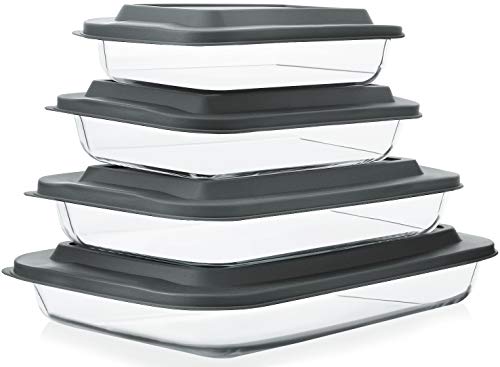
Best overall: Amazon Basics 6-Piece Glass Baking Dish Set
| Organic Integrity Score | 92 / 100 |
| Set | 6 pieces, 3 dishes with lids |
| Material | Borosilicate glass, BPA-free lids |
| Published limits | Oven safe to 752°F; thermal shock to 270°F |
| Best for | The only set that publishes the number that matters |
This is our top pick for one reason that outweighs everything else here: it publishes a thermal shock tolerance of 270°F. Nothing else on this page gives a shock figure, and thermal shock is how glass bakeware actually dies.
That number is also usable. It tells you a dish from a 40°F fridge can go into an oven up to about 310°F without drama, and that a 425°F roast should not be set down on a damp granite counter. An oven maximum of 752°F tells you nothing you will ever act on; a differential tells you how to behave.
It is the cheapest set here and among the best-selling. The lids are BPA-free plastic, which is the standard arrangement and fine for fridge storage, though they do not go in the oven.
What we liked: A published thermal shock differential, a stated oven maximum, borosilicate rather than unspecified glass, stackable non-slip bases, and the lowest price on the page.
Keep in mind: Plastic lids, and three dishes is a modest set if you cook for a crowd. Glass browns less aggressively at the edges than ceramic, which some bakers prefer and some do not.
Ceramic done properly: MALACASA Ceramic Baking Dishes, Set of 3
| Organic Integrity Score | 90 / 100 |
| Set | 3 rectangular dishes with handles |
| Material | Ceramic, stated lead-free and cadmium-free |
| Construction | Anti-chip, scratch resistant, double handles, stackable |
| Best for | The only ceramic here that answers the ceramic question |
Three ceramic sets are on this page. This is the only one whose description states lead-free, cadmium-free. On ceramic, that is the claim — the one that maps onto the material’s actual risk rather than onto a coating it does not have.
Ceramic also bakes differently from glass, and better for some things. It holds heat longer, browns edges harder, and comes out of the oven looking like something you can put on a table. If you make lasagne or gratins, that difference is the reason to choose ceramic at all.
The double handles matter more than they sound. A full lasagne dish is heavy and hot, and a lipped edge is not a handle.
It sits second rather than first because no set of published limits comes with it — no oven maximum, no shock figure — and because it costs more than twice our top pick for half as many pieces.
What we liked: The only lead-free and cadmium-free statement on the page, genuine double handles, an anti-chip claim, and ceramic’s better browning.
Keep in mind: No lids, no published temperature or shock limits, and a high price per dish. Ceramic is heavier than glass and less tolerant of a knock.
Deep dishes with lids: M MCIRCO 8-Piece Deep Glass Baking Dish Set
| Organic Integrity Score | 84 / 100 |
| Set | 8 pieces, 4 deep dishes with 4 plastic lids |
| Material | Glass; BPA-free stated in the title only |
| Construction | Deep sides, non-slip stackable design |
| Best for | Cooking and storing in the same dish |
The best-selling lasagne pan set on Amazon and the most practical arrangement here: four deep dishes, four lids, so what you baked goes in the fridge without being decanted.
Deep sides are underrated. Most bakeware is shallow because shallow photographs better; a deep dish is what you actually want for a lasagne with four layers or a casserole that bubbles.
It drops to mid-table on what the listing says. BPA-free appears in the title and nowhere in the description, there is no oven rating, no thermal shock figure, and the glass is described as glass without specifying borosilicate. On a product sold for oven use, the absence of any temperature statement is the notable gap.
What we liked: The category best seller, four dishes and four lids, genuinely deep sides, and a fair price for eight pieces.
Keep in mind: No oven rating, no shock figure, and the glass type is not specified. Lids are plastic and not oven safe.
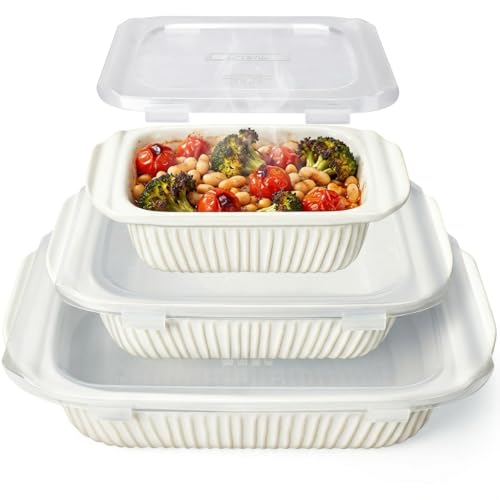
Oven to table: Artena Ceramic Casserole Dishes, Set of 3
| Organic Integrity Score | 80 / 100 |
| Set | 3 rectangular dishes with storage lids |
| Material | Ceramic; no lead or cadmium statement |
| Lid | Polypropylene, named, described as not airtight |
| Best for | Serving straight from the oven |
Artena does one thing better than anyone else here: it names the polymer in its lids as PP, polypropylene, rather than saying BPA-free and leaving you to guess what replaced it. Naming the material is more informative than denying a chemical.
It is also refreshingly honest about what the lids do not do. They are described as suitable for refrigerator storage and spill-resistant transport, “while not airtight”. A maker who tells you the limitation is a maker who has thought about it.
Against that, the ceramic itself gets no materials statement at all — no lead, no cadmium, no temperature. On a ceramic product that is the gap that counts, and it is the reason a set costing more than our top ceramic pick scores ten points below it. Its sales record is also the second weakest here.
What we liked: The lid polymer named rather than implied, honest wording about what the lids do not do, and a set that looks good on a table.
Keep in mind: Nothing stated about lead, cadmium or oven limits, which is the wrong silence on ceramic. Expensive for three dishes.
Most pieces, least said: Sweejar Home Ceramic Bakeware, Set of 4
| Organic Integrity Score | 75 / 100 |
| Set | 4 rectangular dishes with handles |
| Material | Ceramic; no materials statement of any kind |
| Best for | Four ceramic dishes at a low price, if disclosure is not your concern |
Four ceramic dishes for about thirty-five dollars is the best piece-count-per-dollar in ceramic here, and the handles are the right design for getting a full dish out of an oven.
It scores lowest because its description makes no claims whatsoever. Not lead, not cadmium, not oven safe, not a temperature, not a material specification beyond the word ceramic. There is nothing here to check.
That is not evidence of a problem. It is an absence of evidence either way, on the one material on this page where the safety question is genuinely live, and this site scores what a maker is prepared to put in writing.
What we liked: Four dishes at a low price, proper handles, and a straightforward rectangular shape that suits most recipes.
Keep in mind: No materials disclosure at all, and the weakest sales record on the page by a wide margin.
The Pyrex problem: one brand name, two different glasses
If you are shopping this category you will be told to buy Pyrex, and that advice is incomplete in a way that matters.
Pyrex made for the American market and Pyrex made in Europe are not the same material. The original formulation was borosilicate, the low-expansion laboratory glass. US production moved to tempered soda-lime glass, which is strengthened differently: it resists impact well, but it expands considerably more when heated, so it tolerates a smaller temperature swing. European-made Pyrex has continued with borosilicate.
Both are safe. Neither leaches. But they behave differently in the one situation that breaks glass bakeware, and a great deal of the folklore about Pyrex shattering traces back to people applying habits formed with one formulation to a dish made of the other.
The practical lesson generalises well beyond that brand, and it is why our top pick scores where it does: the word “glass” on a listing tells you almost nothing. Borosilicate and tempered soda-lime are both glass. What you want is the formulation named, and ideally a thermal shock figure attached to it. One listing on this page gives you both. Two say only “glass”.
If a listing does not specify, assume soda-lime and treat temperature changes conservatively. That costs you nothing if you were wrong and saves a dish if you were right.
The materials this guide does not cover, and why
Glass and ceramic are the two inert, uncoated options that most people mean by non-toxic bakeware, which is why this page compares them against each other. Four other materials come up, and it is worth being clear about where each sits.
Stainless steel is genuinely inert and effectively unbreakable, and it is the right answer for sheet pans, where glass is not. It browns hard and conducts fast. It is not on this page because sheet pans and casserole dishes are different jobs, not competing answers to the same one.
Stoneware is ceramic’s heavier cousin, fired hotter and fully vitrified so the body is non-porous even where the glaze ends. It holds heat longer than anything here and is what you want for bread. It is also expensive and slow to preheat.
Silicone is flexible, genuinely non-stick without a coating, and food-grade silicone is stable at baking temperatures. The reason it is not here is that it does not brown — there is no thermal mass and no conduction, so a silicone loaf pan gives you a pale, soft crust.
Coated ceramic bakeware — the sol-gel “ceramic nonstick” finishes — is a different product from the glazed ceramic on this page, and it brings back the coating question that choosing glass or ceramic was meant to avoid. We cover those claims in the ceramic cookware guide, where the distinction between a coating and a glaze does most of the work.
Glass or ceramic: which to actually buy
Buy glass if you want to see what is happening. You can watch the bottom of a gratin brown, which matters more than people expect. Glass also weighs less, costs less, and is easier to get properly clean.
Buy ceramic if you care how it looks on the table and how hard it browns. Ceramic holds heat longer after it comes out of the oven, so a lasagne keeps serving temperature through a meal rather than going lukewarm by the second helping.
Buy glass if you are storing in it. Only the glass sets here come with lids. Ceramic dishes on this page are cook-and-serve vessels, not storage.
Buy ceramic if you are hard on your kitchenware, with a caveat. Ceramic chips rather than shatters, which is a gentler failure. But a chipped glaze on ceramic exposes porous body underneath, and that is the point at which a dish should be retired rather than patched.
Getting the most from glass and ceramic bakeware
Never put a cold dish into a hot oven, and never set a hot dish on a cold or wet surface. This single rule prevents most breakages of both materials. A folded towel on the counter costs nothing.
Reduce oven temperature by about 25°F when a recipe was written for metal. Glass and ceramic both hold heat longer and conduct it differently, so edges brown faster than a metal pan at the same setting.
Do not use a dish with a chipped rim or a cracked glaze for food. On ceramic especially, a broken glaze exposes the porous body, which then absorbs whatever you cook in it.
Soak rather than scour. Baked-on cheese comes off with hot water and time; steel wool leaves scratches in glaze that make the next dish harder to clean. For stubborn residue, our baking soda guide covers what actually works.
Who should buy which
Anyone replacing coated metal bakeware. Both glass and ceramic sidestep the coating question entirely, which is the whole reason people arrive at this category.
Anyone who bakes casseroles, gratins or lasagne regularly. These are the dishes where deep sides and even, gentle heat genuinely improve the result.
Not the right buy if you mainly bake cookies, sheet-pan dinners or anything needing fast, direct heat transfer. Metal is better at that, and a glass sheet pan is not a thing you want.
Also worth pausing if you frequently move dishes between fridge and hot oven. Both materials dislike it, and a set with a published shock rating is the only one on this page that tells you how much it will tolerate.
How we researched this guide
We read all five listings in full, title and description, and recorded every materials and limits claim. We separated the claims that map onto each material’s real failure mode — thermal shock for glass, lead and cadmium in the glaze for ceramic — from claims carried over from coated cookware, where they had a meaning they do not have here. We compared piece counts against price, noted lid material where lids are supplied, and checked which sets publish any temperature figure at all. Scores reflect what each maker is willing to state, not what we assume about the brand.
Common questions about non-toxic bakeware
Is glass or ceramic bakeware safer?
Both are safe from mainstream sellers, and they carry different risks. Glass has no leaching concern but breaks on thermal shock. Ceramic does not shatter the same way but its glaze is where lead and cadmium historically appeared, so a lead-free statement is worth more on ceramic than on glass.
Does glass bakeware contain BPA?
No. BPA is used to make polycarbonate plastic and epoxy resin. A BPA-free claim on a glass dish is describing the plastic lid, if there is one.
What is thermal shock and why does it matter more than oven temperature?
It is the temperature difference a dish can survive in a short time. Glass rated to 752°F will still shatter if it goes from a fridge to a hot oven, because the failure is caused by the change, not the maximum. A published differential is the more useful number.
Should I worry about lead in ceramic bakeware?
Not with mainstream cookware sold in the US, which must meet FDA leaching limits. The documented cases overwhelmingly involve decorated, imported or vintage ceramics. It is still the right question to ask of ceramic, and only one set here answers it in writing.
Can I take a dish from the fridge straight to the oven?
Avoid it with both materials. Let the dish stand on the counter for twenty to thirty minutes first. If you must, put it into a cold oven and let them heat together.
Do I need to lower the oven temperature for glass?
Usually by about 25°F against a recipe written for metal. Glass and ceramic hold heat and brown edges faster at the same setting.
Are the plastic lids oven safe?
No. On every set here the lids are for refrigerator storage and transport only. Take them off before the dish goes in the oven.
Can I use a dish with a small chip?
For serving, yes. For cooking, no, particularly on ceramic, where a broken glaze exposes the porous body underneath and it will absorb what you cook.
Why does ceramic cost more than glass?
It is heavier to make and ship, and glazing is an extra firing step. You are also paying for appearance, since ceramic is designed to reach the table.
Is borosilicate better than regular glass bakeware?
For thermal shock, yes, meaningfully. Borosilicate expands less as it heats. Where a listing just says glass without specifying, assume soda-lime and treat temperature changes more carefully.
How many baking dishes do I actually need?
Two or three in different sizes handles most households. A large rectangular dish for lasagne and roasting, and a smaller one for sides, covers the majority of use.
Can these go under a broiler?
Generally not, and none of these listings say they can. Broiler heat is intense, direct and uneven, which is exactly the condition both materials handle worst.
Do I need to grease glass and ceramic dishes?
Yes, more than you would a coated pan. Neither material releases food on its own, and a glaze is smooth rather than non-stick. Butter or oil, and parchment for anything sugary, since caramelised sugar bonds to glaze and takes real effort to shift.
Why did my dish crack in the dishwasher?
Almost always thermal, not mechanical. A hot dish meeting a cold rinse, or a cold dish meeting a hot drying cycle, is the same shock that breaks them in an oven. Let dishes reach room temperature before loading, and both materials will outlast the machine.
Related reading