Last updated: September 12, 2026
We may earn a commission when you buy through links on this page, at no extra cost to you. How we research and rate.
The short version
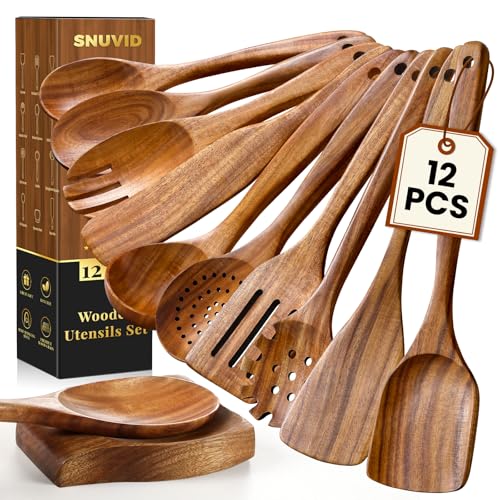
Judged on what each maker will put in writing, our top pick is the Snuvid 12-Piece Teak Utensil Set. It is the only set here that names its finish, the only one that gives a heat rating in degrees, and it makes the correct argument for wood over plastic instead of gesturing at it. That earned it our highest Organic Integrity Score of 91 out of 100.
Before anything else, a warning about a word. Three of these five listings contain “organic”, and not one of them is making an organic certification claim. They are describing teak’s natural oil content — the resin in the timber that makes it water-resistant. It is a botanical fact about a tree, and it happens to use the same word this site exists to audit.
Nobody is lying. But if you searched for organic kitchen utensils and landed on a listing that says “high organic oil”, you have been answered with a different meaning of the word than the one you asked with.
What the listings leave out
| Best Choice | Best Value | ||||
 |
 |
 |
 |
 |
|
| Product | Snuvid 12-Piece | ICSTI 6-Piece | Woodenhouse 10-Piece | AIUHI 11-Piece | Kikcoin 10-Piece |
| Organic Integrity Score | 91/ 100 | 86/ 100 | 82/ 100 | 79/ 100 | 76/ 100 |
| Our rating | 4.6 | 4.3 | 4.1 | 4.0 | 3.8 |
| Best for | Best overall | Cheapest, six essentials | Best selling set here | Most pieces with a holder | Hanging storage |
| Finish named | Clear food-grade coating, stated | Not named | Not named | Not named | Not named |
| Heat rating | 450°F, stated | Stated only as heat-resistant | Not stated | Not stated | Stated only as heat-resistant |
| One-piece wood | Whole-piece teak, stated | Single piece, stated | Not stated | One-piece teak, stated | Solid one-piece, stated |
| Timber certification | None named | None named | None named | None named | None named |
| Pieces | 12, with spoon rest | 6 | 10 | 11, with holder | 10 |
| Price | $29.69 $32.99 −10%$2.47 / count View on Amazon |
$18.99$3.17 / count View on Amazon |
$39.99$4.00 / count View on Amazon |
$33.99$3.09 / count View on Amazon |
$39.87$3.99 / count View on Amazon |
Scores are ours, based on independent research of materials disclosure, construction, published specifications and value, using the same ten-criteria method we apply to every product.
“High organic oil” is about the tree, not a certifier
Three listings on this page use the word organic, and all three use it the same way: teak is a close-grained hardwood with high organic oil content.
That is a true and relevant statement about the timber. Teak contains natural resins and oils in the wood itself, along with silica, which is why it resists water, resists rot, and has been the traditional choice for boat decks for centuries. It is the reason a teak spoon left in a sink recovers where a beech one swells and furs.
It is not an organic certification. There is no certifier, no standard and no audit involved. The word is doing chemistry, not agriculture.
We are flagging it because the failure mode is real. A shopper who searches for organic kitchenware, lands on a listing containing the word organic, and does not read closely will come away believing something the seller never claimed. That is worth naming even when nobody has done anything wrong.
If you want a certification on a wooden product, the one that exists is FSC, from the Forest Stewardship Council — an independent audit that follows timber from a managed forest through every processor, with a traceable license number. None of these five sets carries it, or names any other forestry scheme.
That gap matters more for teak than it did for the maple and walnut in our cutting board guide. Teak is a tropical hardwood with a genuine history of illegal logging, and the difference between plantation-grown and wild-harvested teak is a real one that no listing here addresses.
The finish is the food-contact material
A wooden spoon is not bare wood. Something has been put on the surface — an oil, a wax, or a clear coating — and that layer is what actually touches your food, sits in a hot pan, and eventually wears away.
This is the same structural gap we found in cutting boards, where every listing described the wood and none described the glue. Here every listing describes the teak and one describes the finish.
The possibilities are not exotic. Most wooden utensils carry mineral oil, a beeswax and oil blend, a plant oil such as tung or linseed, or a thin clear lacquer. All are ordinary and food-appropriate. They behave differently, though: an oil finish soaks in, dulls with washing and is easily reapplied by you, while a coating sits on top, looks glossier for longer, and cannot be repaired once it starts to wear.
Snuvid names a clear food-grade coating. That tells you which of those two worlds you are in, and it sets the right expectation — a coated utensil is low maintenance until the coating goes, at which point you are down to bare wood and should start oiling it yourself.
The other four say “smoothly polished”, “smooth surface”, or nothing at all. Polished describes how it was sanded, not what was applied afterward.
One piece, or glued?
This is the specification that predicts whether a set survives, and four of the five state it.
A utensil carved from a single piece of wood has no joint to fail. A cheaper one is laminated — strips glued together, sometimes with a separate handle — and the glue line is exactly where it splits after a year of getting wet, getting hot, and drying out again.
Four listings here say solid, single-piece or whole-piece teak. One does not mention construction at all, and on this specification silence should be read as a question rather than an answer.
It is also verifiable once the set arrives. Look along the handle in good light: a laminated piece shows a straight seam where the grain pattern changes abruptly, while a solid piece has grain that runs continuously from end to end.
What each claim on a wooden utensil listing covers
| Claim | Covers | Key exclusion |
| High organic oil content | Teak’s natural resins, which make it water-resistant | A property of the tree; it is not an organic certification |
| FSC certified | Audited chain of custody from a managed forest, with a license number | The real certification for timber; no set here carries it |
| Clear food-grade coating | A named surface layer between the wood and your food | The only finish named on this page; it cannot be repaired when worn |
| Smoothly polished | How the wood was sanded | Describes an abrasive step, not what was applied afterward |
| One-piece / solid teak | Carved from a single block, with no glue joint to split | The best predictor of lifespan; four listings state it |
| Heat resistant to 450°F | A stated temperature the utensil tolerates | Specific and checkable; one listing gives a number |
| Non-toxic | Nothing defined for a wood product | Names no excluded substance and references no standard |
| Non-reactive | Wood will not react with acidic food the way some metals do | True of all wood; not a distinguishing feature |
Best overall: Snuvid 12-Piece Teak Wood Kitchen Utensil Set
| Organic Integrity Score | 91 / 100 |
| Set | 12 pieces, including a spoon rest |
| Wood | Whole-piece teak, stated |
| Finish | Clear food-grade coating, stated |
| Heat | Resistant to 450°F, stated |
| Best for | The only set that describes its own surface |
This set wins on two sentences the rest of the category does not write.
It names the finish: a clear, food-grade coating, mentioned in the context of cleaning. That is the layer between the teak and your dinner, and it is the one thing about a wooden utensil you cannot determine by looking at it.
And it gives a heat number: resistant to 450°F, will not melt or deform. Every other set says “heat resistant” and leaves you to decide what that means beside a pan of frying oil.
It also makes the argument for wood correctly and without hysteria. Its case is that you stop worrying about plastic leaching, because unlike a plastic or silicone spatula there is nothing here to melt or deform at cooking temperatures. That is the honest version of the claim — a statement about heat behavior rather than a vague appeal to toxins.
The practical details are good too: whole-piece teak, hanging holes on every handle, an included spoon rest, and hand-wash instructions with no pretense that it is dishwasher safe.
What we liked: The finish named, a real temperature rating, whole-piece construction, twelve pieces with a spoon rest, and an accurate argument for wood over plastic.
Keep in mind: A coating cannot be repaired once it wears — expect to start oiling it yourself eventually. No timber certification and no origin. Hand wash only.
Cheapest, six essentials: ICSTI 6-Piece Natural Teak Utensil Set
| Organic Integrity Score | 86 / 100 |
| Set | 6 pieces: salad fork, serving spoon, slotted spoon, slotted spatula and more |
| Wood | Single piece of solid natural teak, stated |
| Handles | Long, with a comfort grip |
| Best for | The essentials only, at the lowest price here |
Around sixteen dollars for six utensils, and it explains its own construction better than sets costing twice as much: crafted from a single piece of solid natural teak, a close-grained hardwood, rather than glued from strips.
The six pieces are well chosen — a salad fork, a serving spoon, a slotted spoon, a slotted spatula and companions. That is the working set most people actually reach for, without the four extra pieces that live in the back of a drawer.
What we particularly like is a disclaimer, of all things. The listing states in capitals that it is normal for natural wood to vary in color, shade, smell and texture, and that they retain the product’s original features rather than correcting them. That is a seller setting an honest expectation about a natural material instead of implying every piece will match the photograph. Sellers who explain variation up front tend to be the ones not hiding anything else.
It scores below the Snuvid because the finish is never named and no heat figure is given, and because six pieces is a smaller commitment than twelve.
What we liked: Single-piece construction stated and explained, the lowest price on the page, a sensible six-piece selection, long comfortable handles, and honesty about natural variation.
Keep in mind: No finish named, no heat rating, no certification or origin. Six pieces will not cover a busy kitchen.
Best selling set here: Woodenhouse 10-Piece Teak Utensil Set
| Organic Integrity Score | 82 / 100 |
| Set | 10 pieces |
| Sales position | By far the strongest seller of the five |
| Materials claim | Non-toxic teak, non-reactive; construction not described |
| Best for | The set the most people have actually bought |
This is the set people buy. Its sales position is not close — it outsells everything else on this page by a wide margin, and a wooden utensil set that has passed through that many kitchens has been tested in a way listing copy cannot match.
The case it makes is the right one for the product: wood does not scratch non-stick pans the way metal does, and it is non-reactive, so it will not transfer anything into acidic food. Both are true, and the second is a fair point about wood generally.
Where it falls short is everything specific. “Non toxic” appears in the title with nothing behind it — no substance excluded, no standard named. The finish is not described. There is no heat rating. And unlike four of the five sets here, it never says whether the pieces are one solid piece of teak or glued, which on a wooden utensil is the specification that decides how long it lasts.
None of that makes it a bad set, and the sales record is real evidence in its favor. It means you are buying on reputation rather than on disclosure, which is a legitimate way to buy and not the way this site scores.
What we liked: An overwhelming sales record, ten pieces, a correct argument about not scratching non-stick, and non-reactivity noted.
Keep in mind: No construction claim, no finish, no heat rating, and “non toxic” in the title with nothing supporting it. The most expensive set here per piece.
Most pieces with a holder: AIUHI 11-Piece Teak Utensil Set
| Organic Integrity Score | 79 / 100 |
| Set | 11 pieces plus a holder |
| Wood | One-piece teak, noted for density and silica content |
| Care | Hand wash, dry thoroughly, do not soak — stated in capitals |
| Best for | A complete set that stands on the counter |
Eleven pieces and a holder, which covers essentially everything — spatulas, a soup ladle, a spaghetti server, tongs, a strainer spoon — and puts them within reach on the counter instead of jammed in a drawer.
The wood description is the most technically detailed here. It notes teak’s density, its close grain, its natural oil, and its silica content, which is genuinely part of why teak is hard-wearing and slightly abrasive to blades. That is real material knowledge rather than adjectives.
The care instruction is the best on the page and it is worth following exactly: hand wash in warm water, dry thoroughly, do not soak. Soaking is the single fastest way to destroy a wooden utensil — the fibers swell, the surface furs, and it cracks as it dries unevenly. A listing that shouts this at you in capitals is doing you a favor.
It scores where it does because the finish is never named, there is no heat figure, and no sourcing information appears at all. The holder is also a wooden object that will get splashed and needs the same drying discipline as the utensils.
What we liked: Eleven pieces plus a holder, one-piece construction stated, genuine technical detail about teak’s density and silica, and emphatic correct care instructions.
Keep in mind: No finish named, no heat rating, no certification. A counter holder needs drying too, or it goes moldy at the base.
Hanging storage: Kikcoin 10-Piece Teak Cooking Utensil Set
| Organic Integrity Score | 76 / 100 |
| Set | 10 pieces, hanging hole on every handle |
| Wood | Solid one-piece, high-density teak, handcrafted and polished |
| Claimed benefits | Resists cracking and warping; quieter against pans |
| Best for | Hanging to dry, which is how wooden utensils should be stored |
A hanging hole in every handle sounds like a trivial feature and it is the correct answer to the main way wooden utensils die. Standing them in a jar traps water at the bottom; hanging them lets both ends dry. This set is built around that.
It states solid one-piece construction, high-density teak, and that the pieces are handcrafted and polished. It also makes an unusual and rather charming point: wooden utensils are quieter, with no clatter against pans. That is true, it costs nothing to mention, and it is the kind of detail that comes from using a product.
It scores lowest here because the substance thins out quickly. “Non Toxic” is in the title with nothing supporting it — no standard, no excluded substance, no test. The finish is not named. “Heat resistant” appears with no temperature. And the remaining bullets are about the grain looking attractive and matching many styles, which is decoration rather than disclosure.
What we liked: Hanging holes throughout, solid one-piece construction stated, high-density teak, and an honest small observation about noise.
Keep in mind: “Non Toxic” in the title with nothing behind it. No finish, no heat figure, no sourcing. Among the most expensive sets here.
Why teak, and what else works
Teak is dense, close-grained and full of natural oil and silica, which makes it water-resistant and slow to crack. It is the reason every set on this page is teak rather than something cheaper. The trade is that it is a tropical hardwood, and sourcing is the question nobody here answers.
Beech and maple are the traditional European and American choices, cheaper and perfectly good, but they absorb more water and need oiling more often.
Olive wood is beautiful, extremely dense and expensive, usually sold as individual pieces rather than sets.
Bamboo is a grass, not a hardwood, and bamboo utensils are laminated from strips with adhesive — which puts them squarely in the glue-line problem we found in cutting boards. They are cheap and light and they delaminate.
Against silicone and plastic, the case for wood is straightforward: nothing melts, nothing deforms, and there is no polymer in contact with a hot pan. Against metal, wood will not scratch a non-stick or enameled surface. Our cookware materials guide covers which pans need which utensils.
Care: the two rules that matter
Never soak them, and never put them in a dishwasher. This is almost the whole of wooden utensil care. Prolonged water swells the fibers, and dishwasher heat then dries them violently and unevenly, which is what splits a spoon along its length. Two listings here say so explicitly and it applies to all five.
Dry them standing up or hanging. Laid flat in a puddle, one face swells and the other does not. In a jar, water runs to the bottom and sits there.
Beyond that: wash in warm soapy water and dry immediately. Oil them when they start looking pale and dry — food-grade mineral oil or a beeswax and mineral oil cream, never olive or sunflower oil, which turn rancid in the wood. If a surface goes rough, a light sand with fine paper and a re-oil restores it completely.
Replace one when it cracks through, splinters, or develops a stubborn smell it will not lose. Teak resists all three longer than most woods, which is what you are paying for.
How we researched this guide
We read all five listings in full, title and description, and recorded every materials, construction and care claim. Because the wood species is the same across all five, we scored on what differs: whether the surface finish is named, whether a heat rating is given as a number, whether the pieces are stated to be one solid piece rather than glued, and whether any forestry certification or country of origin appears. We noted every use of the word organic and checked its meaning in context — in all three cases it described teak’s natural oil content rather than any certification. Sales position was used as a check on whether claims have been tested by use. Scores reflect what each maker states in writing.
Common questions about wooden cooking utensils
Does “organic oil” mean the utensils are certified organic?
No. It describes the natural resin content in teak timber, which makes the wood water-resistant. There is no certifier, standard or audit behind it. It is a fact about the tree, not an agricultural certification.
Are wooden utensils treated with anything?
Almost always, with an oil, wax or clear coating. That layer is what touches your food. Only one listing here names it. Oil finishes soak in and can be reapplied; coatings sit on top and cannot be repaired once worn.
Is teak a sustainable wood?
It can be, from plantation sources, and it has a genuine history of illegal logging when it is not. No set on this page names FSC or any other forestry certification, so there is no way to tell from the listings.
Why does one-piece construction matter?
A glued utensil splits at the joint after repeated wetting, heating and drying. A piece carved from solid wood has no joint to fail. Four of these five state solid construction; one does not mention it.
Can wooden utensils go in the dishwasher?
No. Soaking swells the fibers and dishwasher heat dries them unevenly, which cracks them. Hand wash, dry immediately, and never leave them submerged.
How hot can a wooden spoon get?
Well beyond normal cooking temperatures — one listing here rates its set to 450°F. Unlike plastic or silicone, wood does not melt or deform. Do not leave one resting against a hot pan edge for an hour, though: it will scorch.
What oil should I use on wooden utensils?
Food-grade mineral oil, or a beeswax and mineral oil cream. Never cooking oils such as olive or sunflower, which oxidize in the wood and go rancid.
Are wooden utensils hygienic?
Yes, when kept dry. Wood’s structure draws moisture and bacteria below the surface where they do not readily multiply. Problems come from utensils that stay damp, not from the material itself.
Why do my wooden spoons feel rough now?
The grain has raised from washing, and the finish has worn. Sand lightly with fine paper along the grain and re-oil. They come back completely.
Is bamboo as good as teak?
Not for durability. Bamboo utensils are strips laminated with adhesive, so they have glue lines that eventually delaminate. Teak is a solid dense hardwood with natural oils.
Will wooden utensils scratch my pans?
No, which is the main reason to own them. They are the correct tool for non-stick, ceramic and enameled surfaces, where metal will cut through the finish.
When should I throw a wooden utensil away?
When it cracks through, splinters, or holds a smell that washing will not remove. Surface roughness and fading are not reasons — sand and oil those instead.
Related reading
- Best Wood Cutting Boards
- Ceramic vs Stainless vs Cast Iron vs Carbon Steel
- Best Cast Iron Skillets
- Best Organic Dish Soap
- Organic Product Database — search all 800+ products we have reviewed