Last updated: September 12, 2026
We may earn a commission when you buy through links on this page, at no extra cost to you. How we research and rate.
The short version
Judged on what each maker will put in writing, our top pick is the Aquach 74 oz Glass Teapot with Infuser. It names its infuser steel as 304, gives its capacity in ounces and milliliters, publishes three separate dimensions, and warns you about the two things that actually break glass teapots. That earned it our highest Organic Integrity Score of 91 out of 100.
The glass question is settled in this category, which is unusual and good. All five of these pots state borosilicate, so nobody is hiding behind “heat resistant glass”. That moves the real comparison to the part that is not glass: the infuser — the steel basket that sits in your tea for the whole steep.
Three of the five name a steel grade. Two just say “stainless steel”. And exactly one pot tells you the temperature the glass can actually take — which turns out to matter more than “stovetop safe” suggests.
What the listings leave out
| Best Choice | Best Value | ||||
 |
 |
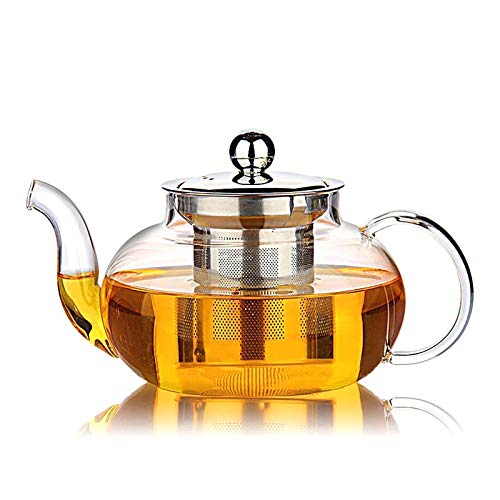 |
 |
 |
|
| Product | Aquach 74 oz | PARACITY 32 oz | Hiware | CNGLASS 20.3 oz | DOPUDO 40 oz |
| Organic Integrity Score | 91/ 100 | 89/ 100 | 85/ 100 | 81/ 100 | 77/ 100 |
| Our rating | 4.6 | 4.5 | 4.3 | 4.1 | 3.9 |
| Best for | Best overall | Temperature range stated | Highest infuser grade named | Smallest, non-drip spout | Middle capacity |
| Infuser steel grade | 304, stated | 18/8, stated in the title | 18/10, stated | Not named | Not named |
| Temperature rating | Not stated | −68°F to 302°F, stated | Not stated | Not stated | Not stated |
| Lead-free stated | Yes | Yes | No | No | No |
| Thermal care guidance | Avoid dry burning; do not set hot on cold | Not given | Not given | Use medium heat | Not given |
| Capacity | 74 oz / 2200 ml | 32 oz | Not stated in bullets | 20.3 oz | 40 oz |
| Price | $35.99 View on Amazon |
$18.99 View on Amazon |
$19.99 View on Amazon |
$24.99 View on Amazon |
$21.99 $23.99 −8% View on Amazon |
Scores are ours, based on independent research of materials disclosure, construction, published specifications and value, using the same ten-criteria method we apply to every product.
“Stovetop safe” has a ceiling, and one listing prints it
Every teapot on this page says stovetop safe. Only one tells you what that means in degrees, and the number is more interesting than you would expect.
PARACITY states a range of −68°F to 302°F. Water boils at 212°F, so for the actual job — heating water — there is comfortable headroom.
The problem is that a burner is not 302°F. A gas flame is well over a thousand degrees, and an empty or nearly empty glass pot sitting on one will pass its ceiling quickly. The rating is about the glass, and it holds only as long as water is there to carry heat away.
This is why the two most useful sentences in this whole category are warnings rather than features. Aquach tells you to avoid dry burning when empty, and not to put a heated pot down on a cold surface. CNGLASS tells you to use a medium heat source. Those two instructions cover both ways a borosilicate teapot actually dies.
Thermal shock is the first. Borosilicate expands about a third as much as ordinary soda-lime glass, which is why it tolerates boiling water. It is not immune. A hot pot set on a cold granite counter, or cold water run into a hot pot, cools one part of the glass much faster than the rest, and the stress cracks it.
Dry heat is the second. With no water inside, the glass at the flame goes far past its rating in seconds while the rest stays cool. That is the classic way a glass teapot fails on its first week.
Neither is a defect. But three of these five listings say “stovetop safe” and leave you to discover the conditions.
The infuser is the part that varies
The pot is glass and inert. The infuser is steel, it sits in near-boiling water for three to five minutes every time you use it, and it is where these products actually differ.
Three grades appear on this page, and they are worth untangling because listings use the names interchangeably.
304 and 18/8 are the same alloy. Roughly 18% chromium and 8% nickel. 304 is the AISI number, 18/8 is the composition shorthand. A pot claiming 304 and a pot claiming 18/8 are claiming the identical thing, and it is the standard food-contact grade.
18/10 has more nickel — around 10% — which makes it marginally more corrosion resistant and gives it a slightly brighter finish. In practice the difference in a teapot is small. It is still the highest grade named here, and naming it costs nothing.
“Stainless steel” with no number is the answer two listings give, and it covers everything from 201 up. For a basket that lives in hot water and then sits wet in a drainer, the grade is what decides whether it pits and stains in a year.
A second thing to check is mesh fineness. Aquach specifies high-density mesh and PARACITY an ultra-fine strainer; the others describe the infuser only as removable. Fine mesh matters if you drink rooibos, broken-leaf blends or anything dusty — a coarse basket lets fines straight through into the cup.
What each claim on a glass teapot listing covers
| Claim | Covers | Key exclusion |
| Borosilicate glass | Low thermal expansion, so the body survives boiling water | Not shatterproof, and not immune to thermal shock |
| −68°F to 302°F | The actual temperature window the glass is rated for | The only figure on this page; exceeded instantly by a dry burner |
| 304 / 18-8 infuser | The standard food-contact grade — the same alloy under two names | Describes the basket, not the lid ring or any other fitting |
| 18/10 infuser | Slightly more nickel, marginally better corrosion resistance | A real but small upgrade over 304 in this application |
| Stainless steel infuser | The basket is a steel alloy | Covers grades from 201 upward with different staining behavior |
| Stovetop safe | The pot may be heated directly on a burner | Only over moderate heat, with water in it; two listings say so |
| Lead-free | No lead in the glass | Standard for borosilicate; two listings state it, three do not |
| Dishwasher safe | The parts named survive a machine cycle | One listing restricts it to the top rack; check before assuming |
Best overall: Aquach 74 oz Glass Teapot with Infuser
| Organic Integrity Score | 91 / 100 |
| Capacity | 74 fl oz, stated as 2200 ml |
| Infuser | Removable 304 stainless steel with high-density mesh |
| Glass | Lead-free borosilicate, stated not to absorb flavor |
| Dimensions | 8.27 in tall, 4.9 in rim, 5.9 in base — all stated |
| Best for | Serving several people, and the most completely specified pot here |
This listing reads like a specification sheet, and in a category full of gift-box copy that is exactly what earns the top spot.
It gives three separate dimensions — height, rim width and base width — and each one is there for a reason. The 8.27-inch height is stated so you know it fits a fridge shelf for cold brew. The 4.9-inch rim is stated because you can get your hand inside to wash it, which is the single most common complaint about glass teapots. The 5.9-inch flat base is stated because a tall pot with a narrow foot tips.
It names the infuser as 304 with high-density mesh, and calls the glass lead-free borosilicate that will not absorb flavor between brews.
And it gives the two warnings that matter: avoid dry burning when empty, and do not set the heated pot on a cold surface. A seller telling you how to avoid breaking its product is a seller expecting you to keep it.
Seventy-four ounces is a lot of tea — more than two liters — which is the main thing to weigh. For one person that is too big; for a table of four, or for brewing a batch to chill, it is the right size and nothing else here comes close.
What we liked: 304 infuser named with mesh density, capacity in two units, three real dimensions each with a purpose, lead-free borosilicate, dishwasher safe, and honest thermal care guidance.
Keep in mind: Very large — overkill for one or two people. No temperature rating given. The most expensive pot here.
Temperature range stated: PARACITY 32 oz Glass Teapot
| Organic Integrity Score | 89 / 100 |
| Capacity | 32 oz |
| Infuser | Removable 18/8 stainless steel, ultra-fine strainer, named in the title |
| Glass | Lead-free borosilicate, rated −68°F to 302°F, scratch resistant |
| Guarantee | Refund or replacement within one year |
| Best for | The only pot that quantifies what its glass can take |
The best-selling teapot of the five, at a modest price, and the only one on this page that puts a number on its own heat tolerance.
−68°F to 302°F. That single line does more than every “heat resistant” claim in this category combined, because it lets you reason about the product: comfortable for boiling water, comfortable straight from a freezer for iced tea, and nowhere near what a bare flame delivers to dry glass. It also states scratch resistance and puts the 18/8 infuser grade in the title where you cannot miss it.
The spout is described as shaped like an eagle’s beak for continuous one-handed pouring, and there is a stated one-year refund or replacement policy.
One phrase we would strike. The listing says the pot is “free of any metals and toxins” — and two bullets later correctly explains that the infuser is 18/8 stainless steel, which is a metal. The intended meaning is presumably that no metals leach from the glass, which is true and fine. As written it contradicts the product’s own description, and on a site that reads listings closely we are going to say so.
At 32 ounces it is the more practical everyday size for one or two drinkers.
What we liked: A real temperature range, 18/8 named in the title, lead-free and scratch-resistant glass, an ultra-fine strainer, a one-year guarantee, and the strongest sales record here.
Keep in mind: “Free of any metals” contradicts its own steel infuser. No thermal care guidance despite giving a rating. No stated dimensions.
Highest infuser grade named: Hiware Glass Teapot with Infuser and Lid
| Organic Integrity Score | 85 / 100 |
| Infuser and lid | 18/10 stainless steel — the highest grade named on this page |
| Use | Stovetop, microwave and dishwasher, all stated |
| Glass | Premium grade borosilicate, stated optimized for durability |
| Best for | The best infuser metal at the lowest price here |
The cheapest pot on this page names the best steel on it. 18/10 stainless has more nickel than the 304 and 18/8 used elsewhere here, which makes it marginally more corrosion resistant — and the listing specifies that both the lid and the infuser are made from it, which nobody else bothers to separate out.
It is also the most versatile in use: stovetop, microwave and dishwasher are all stated explicitly. Microwave capability is genuinely handy for reheating a half-finished pot without putting glass back over a flame.
What holds it in the middle is that the rest of the listing is padding. “Redefine your brewing process”, “fantastic choice”, “risk-free purchase” and “we are sure of the durability” occupy most of the bullets and state nothing. The glass is “premium grade” rather than rated, there is no capacity in the feature text, no dimensions, and no lead-free statement.
There is one genuinely informative line, and it is easy to miss: the listing notes that the current edition has an upgraded lid and infuser and revised glass. A maker telling you the product changed is being more transparent than one quietly shipping a different item under the same reviews.
What we liked: 18/10 named for both lid and infuser, the lowest price here, microwave as well as stovetop and dishwasher use, and an honest note that the design was revised.
Keep in mind: Most bullets are filler. No temperature rating, no dimensions, no capacity in the feature text, and no lead-free statement.
Smallest, non-drip spout: CNGLASS 20.3 oz Glass Teapot
| Organic Integrity Score | 81 / 100 |
| Capacity | 20.3 oz — two to three cups of flowering tea, stated |
| Infuser | Glass infuser, detachable; steel grade not applicable |
| Heat guidance | Use a medium level heat source, stated |
| Warnings | Top rack only in the dishwasher; not for use with metal utensils |
| Best for | Blooming tea for one or two, where you want to watch it open |
The smallest pot here, and the one built around a specific pleasure: blooming tea. It states plainly that it serves two to three cups of flowering tea, which is an honest capacity claim rather than a maximum-fill number.
It uses a glass infuser rather than a steel one, which sidesteps the grade question entirely and is the better choice for blooming and delicate teas — there is no metal in contact with the leaf at all, and you can watch the flower open through it.
Three details are better than the competition. It says to use a medium level heat source, which is the correct instruction for any glass on a burner. It warns the dishwasher is top rack only, where others simply claim dishwasher safe. And it warns against metal utensils, which is how people chip glass infusers.
It sits fourth because beyond those warnings the substance thins. “Eco friendly” is applied to a glass teapot, which means nothing. The claim to be a manufacturer rather than a reseller is offered without anything to verify it. There is no lead-free statement and no temperature rating.
What we liked: Honest capacity in cups, a glass infuser with no metal contact, correct medium-heat guidance, top-rack dishwasher honesty, and a non-drip spout.
Keep in mind: Small at 20.3 oz. Glass infuser mesh is coarser than fine steel, so very fine leaf will pass. “Eco friendly” carries no information here.
Middle capacity: DOPUDO 40 oz Glass Teapot with Infuser
| Organic Integrity Score | 77 / 100 |
| Capacity | 40 oz |
| Infuser | Removable stainless steel — grade not named |
| Use | Microwave, stovetop and dishwasher |
| Design | Ergonomic handle, non-drip spout, wide base and narrow top |
| Best for | A middle size between the small pots and the very large one |
Forty ounces sits usefully between the 20-ounce pots and the 74-ounce one — enough for a small table without being a pitcher — and the physical design is sensibly described. A wide base for stability with a narrower top gives the leaves room to circulate while keeping the pot stable, and the non-drip spout and ergonomic handle are the right things to mention.
It is microwave, stovetop and dishwasher safe, and heat-resistant borosilicate is stated.
It scores lowest here because almost nothing in the listing is specific to this teapot. The infuser is “high-quality stainless steel” with no grade, which on the only non-glass component is the omission that matters most. The glass is “heat-resistant borosilicate” with no rating. There is no lead-free statement, no dimensions, and no care guidance about dry heat or thermal shock.
Phrases like “thoughtful design for tea lovers” and “combines convenience with style” fill the space where those specifications would go. It is very likely a perfectly good teapot; the listing simply does not commit to anything a competitor has not already committed to more precisely.
What we liked: A practical 40 oz middle capacity, microwave and stovetop and dishwasher use, a non-drip spout, and a wide stable base.
Keep in mind: Infuser grade never named. No temperature rating, no lead-free statement, no dimensions, and no thermal care guidance.
Glass, steel or ceramic infuser?
Fine steel mesh catches the most, including broken leaf and dust, and it is the right choice for rooibos, chai and blended teas. The tradeoff is a metal basket sitting in the brew, which is why the grade is worth knowing.
Glass infusers put no metal in contact with the leaf and let you watch the tea open, which is the point with blooming and flowering teas. Their apertures are necessarily coarser, so fine particles pass through.
Ceramic and cloth appear on traditional pots and are outside this comparison, but the same principle applies: fineness versus neutrality is the trade you are making.
One practical note for every type: a basket that only occupies the top third of the pot leaves the leaves stranded above the water line once you have poured a cup. A deep infuser that reaches most of the way down keeps steeping evenly, which matters more than the material for most people.
Brewing temperatures, since the pot will not tell you
A glass teapot on a burner gives you control that a whistling kettle does not, and different teas want genuinely different temperatures.
Green tea: roughly 175°F. Boiling water scorches green tea and turns it bitter and grassy — the most common mistake in tea.
White tea: around 175°F to 185°F. Delicate, and easily overwhelmed.
Oolong: about 195°F.
Black tea and herbal: full boil, 212°F, and herbal infusions genuinely need it to extract.
Steep times run from about two minutes for green through three to five for black, and longer for herbal. Take the infuser out when the time is up — leaving it in is what turns a good pot bitter by the second cup.
Our white tea, green tea and loose leaf tea guides cover the leaves themselves, and our stovetop kettle guide covers boiling the water if you would rather not heat the pot directly.
Care, and how glass teapots actually break
Never heat it empty, and never nearly empty. Water carries heat away from the glass. Without it, the spot over the flame passes the glass rating in seconds. This is the most common first-week failure.
Never set a hot pot on a cold surface, and never run cold water into a hot one. Both are thermal shock, and borosilicate resists it rather than being immune to it.
Use medium heat and keep the flame under the base rather than licking up the sides.
For cleaning, the wide-rim pots are far easier — you can get a hand and a cloth inside. Tea leaves a tannin film on glass that looks like a permanent stain and is not: a soak in warm water with a spoon of baking soda, or a denture tablet, lifts it without scrubbing. Avoid abrasive pads, which scratch glass and give the next stain something to hold onto.
Dry the steel infuser rather than leaving it wet in the sink. That is what causes pitting on lower-grade baskets, which is the whole reason the grade is worth naming.
How we researched this guide
We read all five listings in full, title and description, and recorded every materials and construction claim. Because every pot in this category states borosilicate, we scored on what differs: whether the infuser steel grade is named, whether any temperature rating is published, whether the glass is stated lead-free, whether capacity and dimensions are given as numbers, and whether the listing provides the thermal care guidance that determines whether a glass teapot survives its first month. We noted internal contradictions where a listing’s claims conflict with its own description. Sales position was used as a check on whether claims have been tested by use. Scores reflect what each maker states in writing.
Common questions about glass teapots
Can a glass teapot really go on the stove?
Borosilicate pots can, over moderate heat and with water in them. One listing here rates its glass to 302°F and another advises a medium heat source. A burner exceeds that instantly if the pot runs dry.
What is the difference between 304, 18/8 and 18/10?
304 and 18/8 are the same alloy under two names, roughly 18% chromium and 8% nickel. 18/10 has around 10% nickel, making it slightly more corrosion resistant. All three are appropriate for an infuser.
Why did my glass teapot crack?
Almost always thermal shock or dry heat — a hot pot set on a cold counter, cold water into a hot pot, or heating it empty. Borosilicate resists thermal shock but is not immune to it.
Is borosilicate glass safe for tea?
Yes. It is inert, does not absorb flavors between brews, and is the same glass used in laboratory equipment. Two listings here also state it is lead-free.
Glass infuser or steel infuser?
Steel mesh is finer and catches broken leaf and dust, so it suits blended and herbal teas. Glass puts no metal in contact with the leaf and lets you watch blooming tea open, but its openings are coarser.
What temperature should I brew green tea at?
Around 175°F, well below boiling. Boiling water scorches green tea and makes it bitter. Black and herbal teas want a full boil.
How do I remove tea stains from glass?
Soak in warm water with a spoonful of baking soda, or use a denture tablet, then rinse. Avoid abrasive pads — scratches give future stains something to grip.
Are glass teapots dishwasher safe?
Usually, though one listing here specifies top rack only. Check rather than assume, and hand washing is gentler on the finish and the infuser.
Can I put a glass teapot in the microwave?
Some, yes — two listings here state microwave use. You must remove any steel infuser first, since metal does not belong in a microwave.
What size teapot should I buy?
Around 20 ounces for one or two people, 40 ounces for a small table, and 70 ounces and up only if you are serving a group or batch-brewing for the fridge.
Does a wide opening matter?
Considerably, for cleaning. A pot you cannot get a hand into is a pot you will clean badly. One listing here states a 4.9-inch rim specifically for that reason.
Should I leave the infuser in while I drink?
No. Remove it when the steep time is up, or the tea keeps extracting and the second cup is bitter.
Related reading
- Best Organic Loose Leaf Tea
- Best Organic White Tea
- Best Organic Green Tea
- Best Stainless Steel Tea Kettles
- Organic Product Database — search all 800+ products we have reviewed