Last updated: September 30, 2026
We may earn a commission when you buy through links on this page, at no extra cost to you. How we research and rate.
The short version
After researching the certifications, ingredients, and processing of the organic instant ramen available in the US, our top pick is Lotus Foods Organic Millet & Brown Rice Ramen, 10 oz. It is USDA certified organic, made from whole grain brown rice and millet flour rather than refined wheat, and it is steamed and air-dried rather than deep-fried in palm oil, which is why it earned our highest Organic Integrity Score of 91 out of 100. For the best value, the 6-count 10 oz pack is our pick, and for a complete instant meal with broth, the 2.8 oz cakes with miso soup are the best choice.
With ramen, the two things that separate a decent noodle from a bad one are whether it was fried in palm oil and how much sodium comes in the flavor packet. We flag each product’s certification and processing.
Best organic ramen noodles compared
| Best Choice | Best Value | ||||
 |  |  |  |  | |
| Product | Lotus Foods 10 oz | Big Green Buckwheat | Koyo Shoyu 12-Pack | Lotus Foods 6-Count Cakes | Lotus Foods with Miso Soup |
| Organic Integrity Score | 91/ 100 | 88/ 100 | 86/ 100 | 80/ 100 | 76/ 100 |
| Our rating | 4.6 | 4.4 | 4.3 | 4.0 | 3.8 |
| Seasoning | None, plain noodles | None, plain noodles | None, plain noodles | None, plain cakes | Miso soup sachet |
| Best for | Best overall | Single ingredient | Baked not fried | Portioned cakes | Complete instant meal |
| Certification | Gluten-Free Certified, Organic | Non-GMO, Gluten-free, Vegan | Non-GMO, Vegan, Organic | Non-GMO, Gluten-free, Organic | Non-GMO, Kosher, Gluten-free |
| Price | $5.28 $6.92 −24%$0.53 / ounce View on Amazon | $8.99$0.92 / ounce View on Amazon | $31.79$1.26 / ounce View on Amazon | Currently unavailable See buying options | $25.51$0.91 / ounce View on Amazon |
Price and availability as of October 11, 2026 7:10 pm EDT. Product prices and availability are accurate as of the date/time indicated and are subject to change. Any price and availability information displayed on Amazon.com at the time of purchase will apply to the purchase of this product.
Scores are ours, based on independent research of certification, flour and grain quality, processing method, sodium, and value, using the same 10-criteria method we apply to every product. See how we research and rate.
What each certification on an organic ramen noodles label actually covers
A seal is a specific promise about a specific thing. These are the promises behind the marks on this page, in plain terms, along with the question each one leaves unanswered.
| Certification | Covers | Key exclusion |
| USDA Organic | Farming and handling: no synthetic pesticides or fertilizers, no GMOs, no sewage sludge or irradiation, audited yearly by an accredited certifier | Three different tiers share the one seal, and it makes no claim about worker pay, food miles, or nutrition |
| GOTS | Organic fiber from farm to finished textile, plus dyeing, finishing, wastewater and labor criteria | Has a weaker second tier, “made with organic”, that needs only 70% organic fiber and carries the same name |
What makes GOTS unusual is how far past the farm it reaches. Most organic marks certify how a crop was grown and stop there. GOTS carries the requirement through spinning, weaving, dyeing and finishing, bans a long list of processing chemicals, sets wastewater limits, and adds labor criteria at every stage. That is why a GOTS textile costs more than a fabric merely woven from organic cotton, and why the two are not the same claim.
Key things to look for in organic ramen
Great organic ramen is about certification, the flour, the drying method, and the sodium. Here is what matters.
1. USDA organic certification
It rules out GMO grains, synthetic pesticides on wheat and rice, and the artificial additives common in instant noodles.
2. Steamed and air-dried, not fried
Air-dried noodles carry almost no added fat and avoid palm oil entirely. Fried blocks are roughly a sixth fat by weight.
3. A whole grain flour
Brown rice, millet, and buckwheat give you fiber and protein that refined white wheat flour does not.
4. Low or no sodium in the packet
Plain noodles with no sachet let you build your own broth. If there is a sachet, check the milligrams.
Rice ramen versus wheat ramen, and why the sachet matters
Traditional ramen is a wheat noodle, and there are excellent organic wheat ramen products, but the organic instant category in the US is dominated by rice-based noodles for a practical reason: they are naturally gluten free, which widens the market enough to justify the production run. Brown rice and millet ramen has a slightly nuttier flavor and a firmer, springier bite than wheat ramen, and it holds up better to sitting in broth without going soft. It is also genuinely higher in fiber and protein than a refined wheat block. What it does not do is taste identical to the ramen you get in a Japanese restaurant, which is an alkaline wheat noodle; if that specific chew is what you want, rice ramen will not replicate it.
The bigger decision is whether to buy noodles with a seasoning sachet at all. A conventional ramen packet is where nearly all the sodium, MSG, and flavor enhancers live, and it is also the cheapest part of the product to make. Buying plain noodle cakes and building your own broth from good fat, miso, soy sauce, garlic, and ginger takes about four extra minutes, costs very little, and drops the sodium by more than half while tasting substantially better. It also lets you add protein and vegetables, which turns instant ramen from a snack into an actual meal. The bundled-broth products in this guide are for convenience, and they are meaningfully cleaner than conventional packets, but plain noodles plus your own broth is the better outcome.
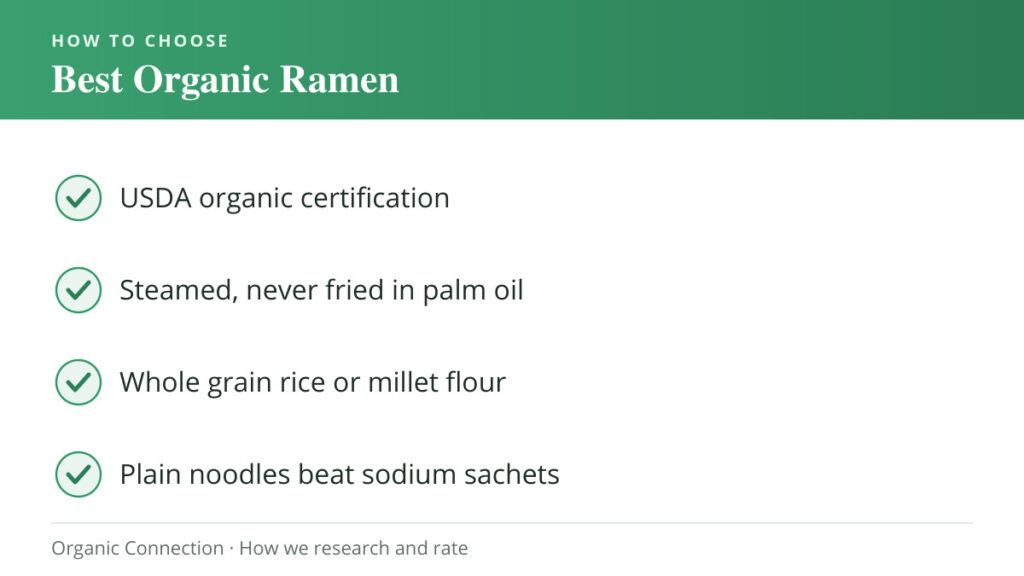
How to choose organic ramen
- Confirm USDA organic. It rules out GMO grains and the synthetic additives standard in instant noodles.
- Check for “steamed” or “air-dried.” If the pack does not say, assume it was fried in palm oil.
- Prefer whole grain flour. Brown rice, millet, or buckwheat over refined white wheat.
- Buy plain noodles where you can. Your own broth cuts sodium sharply and tastes better.
- Read the sodium if there is a sachet. Conventional packets run 1,500 mg and up per serving.
Who should buy organic ramen noodles
The right ramen depends on how you cook. If you want the cleanest organic noodle to build your own bowl around, our top pick fits. If you want bulk value, a small trial pack, a bundled broth for genuine convenience, or a nutty gluten-free noodle for a crowd, we have a pick for each.
Best overall: Lotus Foods Organic Millet & Brown Rice Ramen, 10 oz
| Organic Integrity Score | 91 / 100 |
| Flour | Organic brown rice flour and millet flour |
| Certification | Gluten-Free Certified, Organic |
| Best for | Building your own bowl with real broth and toppings |
Lotus Foods is our top pick because it gets the two things right that the rest of the category gets wrong. The noodles are steamed and air-dried rather than flash-fried in palm oil, so there is essentially no added fat and no deforestation footprint, and they are made from whole grain organic brown rice and millet flour rather than refined white wheat, which means real fiber and protein. They come as plain noodle cakes with no seasoning sachet, which is the point: you build the broth, so you control the sodium entirely. They cook in about four minutes.
The trade-off is that plain noodles are not a complete meal. If you want to open a packet and have soup, this is not that product, and you need miso, soy sauce, or stock on hand. Rice ramen also has a firmer, springier bite than wheat ramen, which is a preference rather than a fault.
What we liked: USDA organic, steamed and air-dried rather than fried, whole grain brown rice and millet, gluten free, no sodium sachet, and a four-minute cook.
Keep in mind: Plain noodles only, so you need to make a broth, and the texture is firmer than wheat ramen.
What the listing discloses: Lotus Foods is explicit about Certified Gluten-Free, and silent on whether the USDA seal applies and where it was grown or made.
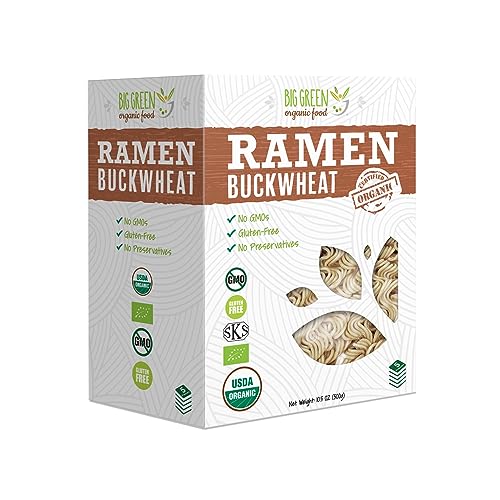
Best single ingredient: Big Green Organic Buckwheat Ramen, 10.5 oz
| Organic Integrity Score | 88 / 100 |
| Size | 10.5 oz |
| Ingredients | One: organic buckwheat flour |
| Certification | Non-GMO, Gluten-free, Vegan |
| Best for | Anyone who wants noodles with nothing else in them |
The shortest ingredient list in the comparison, and the listing states it flatly: “we use only 100% organic buckwheat flour, nothing else.”
That matters more in noodles than it sounds. Most ramen, including organic ramen, blends flours and often adds salt or a firming agent. A single-flour noodle is unusual, and buckwheat on its own is naturally gluten-free, so the gluten-free claim here follows from the recipe rather than from a separate process.
Worth knowing before you cook it: 100 percent buckwheat noodles behave differently from wheat ones. They are more brittle dry, cook faster, and will go soft if you leave them in the water, so treat the timing on the pack as an upper limit.
The second bullet is a customer service note rather than product information, and there is no certifier named.
What we liked: A genuine single-ingredient noodle, gluten-free by recipe rather than by processing, and an honest short listing.
Keep in mind: No certifier named, and one of two bullets is a request for feedback. Pure buckwheat overcooks quickly.
What the listing discloses: Big Green Organic Food commits to a single-ingredient formula but stops short of whether the USDA seal applies and where it was grown or made.
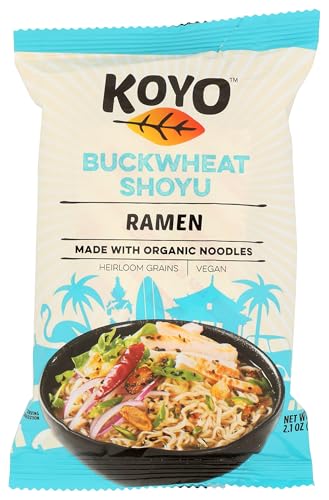
Best baked not fried: Koyo Buckwheat Shoyu Ramen Soup, 12 Pack
| Organic Integrity Score | 86 / 100 |
| Size | 2.1 oz x 12 |
| Process | Roll-and-cut, then baked rather than fried |
| Grain | Freshly milled organic heirloom grains |
| Excludes | MSG, preservatives |
| Best for | Instant ramen without the fried noodle block |
This is the one pick on the page that addresses what actually separates instant ramen from the rest. Conventional instant noodles are flash-fried in oil, which is how they are dried and why a block of instant ramen carries the fat it does.
Koyo says its noodles are “baked (not fried) to perfection making them low fat.” That is a real process difference with a real nutritional consequence, and it is the claim to look for on any instant ramen.
The rest of the sentence is unusually specific too: freshly milled organic heirloom grains, prepared by the traditional roll-and-cut method rather than extruded. Naming the forming method is something no other listing here does.
Read the organic claim carefully though. The product is “Made With Organic Noodles”, which is a claim about a component rather than the finished soup — the seasoning packet is not covered by those words. It also carries the no MSG and no preservatives exclusions.
Stock was limited at the time of our scan.
What we liked: Baked rather than fried, heirloom grains, the roll-and-cut method named, and MSG and preservatives excluded explicitly.
Keep in mind: “Made with organic noodles” covers the noodles, not the soup base. The most expensive option here per serving, and stock is intermittent.
What the listing discloses: Sparse documentation from Koyo — nothing on whether the USDA seal applies and where it was grown or made.
Best portioned cakes: Lotus Foods Gourmet Organic Rice Ramen, 6 Count
| Organic Integrity Score | 80 / 100 |
| Flour | Organic brown rice flour and millet flour |
| Certification | Non-GMO, Gluten-free, Organic |
| Best for | Single servings without weighing out noodles |
Individually portioned cakes solve a small but real annoyance: a 10 oz bag of loose noodles requires you to judge or weigh a serving, whereas a cake is one bowl. For lunch at work, for cooking for one, or for anyone who wants the convenience of a conventional ramen block without the frying and the sodium sachet, this is the format.
The trade-off is cost per ounce, which is higher than the bagged versions, plus more packaging per serving. The noodle itself is identical, so you are paying purely for portioning.
What we liked: Convenient single-serve cakes with no seasoning sachet, same organic air-dried noodle.
Keep in mind: More expensive per ounce than bagged, with more packaging per serving.
What the listing discloses: Little to verify on the Lotus Foods listing: no word on whether the USDA seal applies and where it was grown or made.
Best complete meal: Lotus Foods Organic Ramen with Red Miso Soup, 2.8 oz, 10-Pack
| Organic Integrity Score | 76 / 100 |
| Flour | Organic brown rice flour and millet flour |
| Certification | Non-GMO, Kosher, Gluten-free |
| Best for | Desk lunches and genuine grab-and-cook convenience |
This is the pick for people who want instant ramen to actually be instant. Each 2.8 oz cake comes with a red miso soup sachet, so it is a complete bowl in four minutes with nothing else required, and the sodium is substantially lower than a conventional supermarket ramen packet while the noodle is still organic, whole grain, and air-dried. For an office drawer or a camping trip it is a genuinely good product.
It scores lowest here on our purity-weighted method for the obvious reason: adding a seasoning sachet adds sodium and a longer ingredient list to what was otherwise a two-ingredient noodle. It is far better than conventional instant ramen, but it is a step away from the plain-noodle ideal. It is also the most expensive format per serving.
What we liked: A genuinely convenient complete bowl with an organic air-dried noodle and much lower sodium than conventional packets.
Keep in mind: The sachet adds sodium and ingredients, and it is the priciest format per serving.
What the listing discloses: Lotus Foods lists kosher certification. The gap is whether the USDA seal applies and where it was grown or made.
Building a better bowl in ten minutes
Plain organic noodles plus a homemade broth is faster than it sounds and dramatically better than a sachet. Start with a tablespoon of miso paste or soy sauce per bowl whisked into hot water or stock, add grated garlic and ginger, a teaspoon of sesame oil, and a splash of rice vinegar. Cook the noodles separately in plain water and drain them, rather than boiling them in the broth, because rice noodles shed starch that clouds and thickens a broth unpleasantly. Add protein and vegetables while the broth heats: a soft-boiled egg, leftover chicken, cubed tofu, frozen edamame, spinach that wilts in seconds, mushrooms, or scallions. Finish with chili oil, toasted sesame seeds, or a sheet of nori. The whole thing takes about ten minutes and lands at roughly a third of the sodium of a conventional packet while actually being a meal. If you are making it ahead, keep broth and noodles separate until serving, since rice noodles left sitting in liquid go soft.
Fried versus air-dried: the biggest variable on the shelf
Instant noodles are dried one of two ways, and which one decides most of the nutrition. Packaging rarely says so directly, but the nutrition panel gives it away instantly.
| Deep-fried | Air-dried / steam-dried | |
| How | Noodles fried in oil to drive off moisture | Hot air or steam drying |
| Fat per packet | Around 20 g total, with roughly 8 g saturated | Typically 1–3 g |
| Oil used | Usually palm oil | None added |
| Cooking time | Very fast — the frying creates porosity | Slightly longer, 4–6 minutes |
| Texture | Springy, familiar instant-noodle chew | Firmer, closer to dried pasta |
Keep in mind: the test is the nutrition panel, not the front of the pack. If a noodle block contains 15–20 g of fat before you have added anything, it was fried. Air-dried noodles cannot get there. Almost all certified organic ramen is air-dried or steamed, which is one of the genuine and easily verified differences in this category — along with the absence of TBHQ (tertiary-butylhydroquinone), the synthetic antioxidant used to keep fried noodle blocks shelf-stable, which is not permitted in organic products. Palm oil is likewise absent from air-dried noodles by definition.
Kansui: what makes a ramen noodle a ramen noodle
Ramen is not simply thin pasta. The defining ingredient is kansui — alkaline water containing sodium carbonate and potassium carbonate — and it does three things at once:
- Changes gluten behavior, tightening the protein network to produce ramen’s characteristic springy, slippery bite.
- Turns the noodles yellow by reacting with flavonoids in the wheat flour. That color is chemistry, not egg and not dye — a point that surprises people who assume yellow noodles contain egg.
- Contributes the faintly mineral aroma that distinguishes ramen from udon or spaghetti.
This matters for buying. A wheat ramen with no alkaline agent listed is essentially thin noodle, not ramen, and it will taste like it. Look for sodium carbonate, potassium carbonate or “kansui” on the ingredient list.
Rice and millet ramen are a different proposition. There is no gluten to work on, so the springiness comes from the starch structure and the extrusion process instead. They are genuinely good noodles, and they are not imitating wheat ramen — expect a cleaner, slightly softer bite and a shorter window before overcooking.
The sachet is the problem, not the noodle
A conventional instant noodle packet delivers roughly 1,500–1,800 mg of sodium, which is 65–78% of the 2,300 mg daily limit in a single bowl. Almost all of it is in the seasoning sachet rather than the noodles.
- Use half the sachet. This is the single highest-return change available, and most people cannot tell the difference once other ingredients are added.
- Or discard it entirely and build a broth from miso, a spoonful of stock paste, soy sauce, garlic and sesame oil. You control the salt and it tastes better.
- Organic ramen sold without a sachet — noodle cakes only — is the cleanest option, and it is what most of our picks are.
- Check the panel per packet, not per serving. Some brands label a single block as two servings, which halves every number on the panel and misleads a great many people.
What the research actually found
Instant noodles attract alarming headlines, and there is one real study behind most of them, which is worth reporting accurately.
A 2014 paper in The Journal of Nutrition analyzed dietary and health data from around 11,000 South Koreans aged 19 to 64. Women eating instant noodles two or more times a week showed roughly a 68% higher prevalence of metabolic syndrome, including raised triglycerides and blood pressure, independently of overall diet pattern. The association was not seen in men.
The caveats are substantial and are usually stripped out in reporting:
- It is cross-sectional and observational. It shows association, not causation, and cannot establish direction.
- Confounding is very likely. People eating instant noodles twice a week differ in many ways — time pressure, income, sleep, overall diet quality — and no statistical adjustment fully captures that.
- It studied conventional fried instant noodles with seasoning sachets, which is exactly the product profile described above: high saturated fat from palm oil, very high sodium, low fiber and low protein.
- Popular coverage inflated it considerably, including a widely circulated “Harvard study” framing that fact-checkers have since corrected.
Our reading: the finding is consistent with what you would expect from a food that is high in sodium and saturated fat and low in fiber and protein, eaten frequently. It is not evidence that a bowl of air-dried organic ramen with vegetables and an egg is harmful. What it does support is treating the conventional fried-and-sachet version as an occasional convenience rather than a staple — and it is a reasonable argument for the products in this guide, which change the fat and sodium profile substantially.
Cooking ramen properly
- Cook the noodles in plain water, not in the broth. Noodles release starch, and cooking them in your soup makes it cloudy and gluey. Drain, then add to hot broth. This single change makes home ramen dramatically better.
- Undercook by about a minute. They continue softening in hot broth, and mushy noodles are the most common failure.
- Rice ramen has a narrower window than wheat — check it 30 seconds early.
- Do not break the noodle block. It cooks evenly whole once submerged, and long strands are the point.
- Protein and vegetables cost little and change everything. A soft-boiled egg, a handful of spinach, spring onion, mushrooms, leftover chicken or tofu turn a 380-calorie carbohydrate bowl into an actual meal with fiber and protein.
- Add a fat at the end — a teaspoon of sesame oil or chili oil — off the heat, where it carries aroma rather than being cooked off.
- Never microwave noodles in a polystyrene cup unless it explicitly says microwave-safe. Cup noodle containers are designed for boiling water poured in, not for microwaving.
Storage
- Air-dried noodles keep 12–18 months; fried noodles have a shorter effective life because the oil eventually oxidizes, and TBHQ exists precisely to delay that.
- Organic air-dried noodles without synthetic antioxidants are best used within the printed date rather than long past it — there is nothing in them holding rancidity back.
- Airtight and dry. Noodle blocks absorb humidity and odors, and damp blocks go musty.
- Do not refrigerate dried noodles; condensation causes exactly the problem you are trying to avoid.
- Smell fried noodles before cooking if the pack is old. A sharp, paint-like smell is oxidized oil, and no amount of broth will hide it.
- Fresh and frozen ramen are different products entirely — refrigerate and use within days, or freeze, where they keep several months and cook from frozen.
How we researched this guide
We are a research-based review site. We compared each product against its certification (USDA organic), flour and grain quality, processing method (steamed and air-dried versus flash-fried), sodium content, and the weight of aggregated customer feedback on texture and taste, then scored each with our 10-criteria Organic Integrity Score. No brand paid to be included or ranked. Read the full method on our How We Research and Rate page.
Sodium, protein, and building a better bowl
Instant ramen is a convenience food with two specific nutritional weaknesses, and both are more addressable than people assume.
The first is sodium. A single packet frequently carries 1,500 to 1,900 mg, which approaches or exceeds the recommended daily maximum in one bowl. Most of it is in the seasoning sachet rather than the noodles, which is genuinely useful to know: using half the sachet halves the sodium and changes the flavor less than expected.
Sodium does not cause fat gain, but it does cause water retention, which moves the scale by a kilogram or more and confuses anyone weighing themselves regularly. A high-sodium meal the previous evening is the most common explanation for an unexpected morning reading.
The second weakness is that a packet is mostly refined carbohydrate with very little protein or fiber, typically around 8 grams of protein and 2 of fiber for 380 or more calories. That combination is poorly satiating, which is why a packet frequently does not feel like a meal despite the calorie count.
That is the more fixable problem. An egg, some tofu or leftover chicken, and a handful of frozen vegetables or spinach turns a packet into a genuine meal with protein and fiber for relatively few additional calories, and the volume of added vegetables does more for fullness than anything else available.
Air-dried noodles rather than fried ones cut the fat content substantially, and are worth looking for.
Honest summary: high sodium concentrated in the sachet, low protein and fiber in the packet, and a food that becomes reasonable with two additions rather than requiring replacement.
Common questions about organic ramen noodles
What is the best organic ramen?
Our overall pick is Lotus Foods Organic Millet & Brown Rice Ramen, because it is USDA certified organic, steamed and air-dried rather than fried in palm oil, made from whole grain brown rice and millet flour, and sold as plain noodles so you control the sodium. For the best value the 6-count pack is our pick, and for a complete instant meal, the version with red miso soup.
Is instant ramen fried?
Conventional instant ramen is, yes. Flash-frying in palm oil is the standard drying method, which is why a supermarket block has its wavy shape and long shelf life, and it leaves roughly 14 to 20 percent of the block’s weight as added fat. Steamed and air-dried noodles, like the ones in this guide, carry almost no added fat and avoid palm oil entirely.
Why is instant ramen so high in sodium?
Nearly all of it is in the seasoning sachet, which typically carries 1,500 to 1,800 mg per serving, most of a day’s recommended intake. The noodles themselves contribute comparatively little. Buying plain noodles and making your own broth from miso, soy sauce, garlic, and ginger cuts the sodium by more than half and tastes better.
Is rice ramen better than wheat ramen?
It is different rather than strictly better. Brown rice and millet ramen is naturally gluten free, higher in fiber and protein than a refined wheat block, and it holds its texture in broth well. It does not replicate the specific springy chew of a traditional alkaline wheat noodle, so if that texture is what you are after, rice ramen will disappoint.
How do you cook organic ramen noodles?
Boil them in plain water for about four minutes, then drain, and add them to broth you have made separately. Cooking rice noodles directly in the broth releases starch that clouds and thickens it. Keep noodles and broth apart if you are making a bowl ahead, since the noodles soften if they sit in liquid.
How do you tell if instant noodles were fried?
Read the fat line on the nutrition panel. A deep-fried noodle block carries around 20 g of total fat with roughly 8 g saturated, usually from palm oil; air-dried or steam-dried noodles run 1 to 3 g. If a block has 15 to 20 g of fat before you have added anything, it was fried. Almost all certified organic ramen is air-dried, which also means no TBHQ — the synthetic antioxidant used to keep fried blocks shelf-stable, which organic rules do not permit.
What is kansui in ramen noodles?
Alkaline water containing sodium carbonate and potassium carbonate, and it is what makes a ramen noodle a ramen noodle. It tightens the gluten network to give the springy slippery bite, turns the noodles yellow by reacting with flavonoids in the wheat — that color is chemistry, not egg or dye — and contributes the faintly mineral aroma. A wheat ramen with no alkaline agent listed is thin noodle rather than ramen.
Is rice ramen the same as wheat ramen?
No, and it is not trying to be. With no gluten to work on, springiness comes from starch structure and extrusion rather than kansui. Expect a cleaner, slightly softer bite and a narrower cooking window — check it about 30 seconds earlier than wheat ramen, since it goes from right to mushy quickly.
How much sodium is in instant ramen?
Roughly 1,500 to 1,800 mg per packet, which is 65 to 78% of the 2,300 mg daily limit in one bowl — and almost all of it is in the seasoning sachet rather than the noodles. Using half the sachet is the single highest-return change, and most people cannot tell once other ingredients are added. Check the panel per packet rather than per serving, since some brands label one block as two servings.
Do instant noodles cause metabolic syndrome?
One study is behind most of the headlines, and it deserves accurate reporting. A 2014 paper in The Journal of Nutrition analyzed around 11,000 South Koreans and found women eating instant noodles twice or more weekly had roughly 68% higher prevalence of metabolic syndrome, with no association in men. But it is cross-sectional and observational, confounding is very likely, and it studied conventional fried noodles with seasoning sachets — high saturated fat, very high sodium, low fiber. Popular coverage inflated it, including a “Harvard study” framing fact-checkers have corrected.
Should you cook ramen noodles in the broth?
No — cook them in plain water and drain, then add to hot broth. Noodles release starch, and cooking them in your soup makes it cloudy and gluey. This one change makes home ramen dramatically better. Undercook by about a minute too, since they keep softening in hot broth.
How do you make instant ramen healthier?
Halve or discard the sachet and build broth from miso, stock paste, soy, garlic and sesame oil. Then add protein and vegetables — a soft-boiled egg, spinach, spring onion, mushrooms, leftover chicken or tofu — which turns a 380-calorie carbohydrate bowl into a meal with fiber and protein. Add sesame or chili oil at the end off the heat, where it carries aroma rather than cooking off.
How long do dried ramen noodles keep?
Air-dried noodles 12 to 18 months. Fried noodles have a shorter effective life because the oil oxidizes, which is exactly what TBHQ delays — so organic air-dried noodles without synthetic antioxidants are best used within the printed date rather than long past it. Store airtight and dry, never refrigerated, since condensation causes the mustiness you are trying to avoid.
- Organic Food & Pantry hub
- Best Organic Pasta
- Best Organic Rice
- How we research and rate products
- every product we have reviewed — filter by USDA Organic, GOTS, Fair Trade and more
- Best Organic Soy Sauce
Price and availability as of October 11, 2026 7:10 pm EDT. Product prices and availability are accurate as of the date/time indicated and are subject to change. Any price and availability information displayed on Amazon.com at the time of purchase will apply to the purchase of this product.
Looking for other organic products?
We have checked more than 800 products across food, household goods, gardening, personal care and pet, every one against its stated certification. Browse all reviews.
Organic Connection is reader-supported. When you buy through links on this page we may earn a commission, at no extra cost to you. As an Amazon Associate we earn from qualifying purchases. We are not paid to feature or rank any product. How we research and rate.