Last updated: September 30, 2026
We may earn a commission when you buy through links on this page, at no extra cost to you. How we research and rate.
The short version
Our top pick is Elan Organic Raw Brazil Nuts, with an Organic Integrity Score of 92 out of 100, because it does the one thing we have spent this entire site asking for and almost never getting: it names the body that certified it.
Two things make this category unusual, and both are worth understanding before you buy.
The first is the scope. Brazil nuts are certified under a part of the organic regulation that almost no other food uses, because the tree cannot practically be farmed.
The second is a reversal of our normal rule. We usually mark a listing down for making a claim without a number. In this category, no brand states selenium content, and that silence is the honest answer — because the number genuinely cannot be known from the packet.
Best organic Brazil nuts compared
 |  |  |  |  | |
| Product | Elan Organic | Forest Up | Terrasoul Superfoods | Brazil Wild Nuts | Nut Cravings |
| Organic Integrity Score | 92/ 100 | 88/ 100 | 84/ 100 | 70/ 100 | 50/ 100 |
| Our rating | 4.6 | 4.4 | 4.2 | 3.5 | 2.5 |
| Certifier named | USDA and Ecocert | No | Earth Kosher | No | No |
| Organic claim | Certified organic | Certified Organic | Certified Organic | Title only | None |
| Freshness addressed | No | Modified atmosphere | No | No | No |
| Body bullets | 3 | 2 | 2 | 1 | 0 |
| Best for | Anyone who wants | Buyers who want | Buyers who want | Buyers moved | Price and volume |
| Size | 6.5 oz, shelled whole nuts | 15 oz | 1 lb | — | 1 lb, shelled and whole |
| Price | $9.07$1.40 / ounce View on Amazon | $25.95$1.73 / ounce View on Amazon | $25.49$1.59 / ounce View on Amazon | $23.99$1.50 / ounce View on Amazon | $23.89$1.49 / ounce View on Amazon |
- Organic Food and Pantry hub
- our organic product database — compare brands across every guide
Price and availability as of October 12, 2026 1:10 am EDT. Product prices and availability are accurate as of the date/time indicated and are subject to change. Any price and availability information displayed on Amazon.com at the time of purchase will apply to the purchase of this product.
The organic brazil nuts certifications, and the question each one leaves open
Certification names are easy to confuse and easy to trade on. Below is what each of these marks covers, and the part of the picture it says nothing about.
| Certification | Covers | Key exclusion |
| USDA Organic | Farming and handling: no synthetic pesticides or fertilizers, no GMOs, no sewage sludge or irradiation, audited yearly by an accredited certifier | Three different tiers share the one seal, and it makes no claim about worker pay, food miles, or nutrition |
| COSMOS Organic | Cosmetics: organic content thresholds, permitted processes and ingredients, and packaging rules | Its sister grade, COSMOS Natural, carries the same name and requires no minimum organic content at all |
| Kosher | Ingredients and production comply with Jewish dietary law, verified by a rabbinic agency that inspects the facility | A dietary-law standard: it makes no claim about pesticides, GMOs or farming practice |
COSMOS is two standards with one name, and the weaker one is easy to miss. COSMOS Organic requires at least 95% of the plant ingredients to be organic. COSMOS Natural, printed in the same typeface by the same body, requires no minimum organic content whatsoever: it governs which ingredients and processes are permitted, not how much of the product is organic. If the word after COSMOS is “Natural”, the organic question is still open.
Why Brazil nuts are certified under a different scope
The National Organic Program certifies operations under four scopes: crops, livestock, handling, and wild crops. The fourth is the one nobody ever needs to talk about, and it is the one that governs everything on this page.
Bertholletia excelsa, the Brazil nut tree, resists commercial cultivation in a way most crops do not. Its flowers are structured so that only certain large-bodied bees can force them open, and those bees depend on surrounding forest. Its seed pods are heavy and woody, and in practice the agouti — a large forest rodent — is the animal that opens them and buries the seeds.
Plantations lack the bees. Without the bees there is no pollination, and without pollination there are no nuts.
The practical consequence is that essentially all Brazil nuts in commerce are gathered from wild trees in standing rainforest, largely by collectors who walk the forest floor after the pods fall.
Organic certification under the wild crops scope works differently from farm certification. There is no farmer to audit for inputs, because nobody applied any. Instead the certifier examines the harvest area: that no prohibited substances have been applied to it for a defined period, that the harvest is conducted in a way that does not destroy the resource, and that the chain of custody from forest to bag is documented.
That reframes what the seal is telling you here. On a bag of oats it is a statement about farming practice. On a bag of Brazil nuts it is largely a statement about the forest and the supply chain.
It also means one listing’s headline claim is less impressive than it sounds. Selling nuts as “100% Wild Grown, Sustainably Collected” is selling the baseline condition of the entire category as if it were a differentiator.
For how the four scopes fit together, see our guide to the USDA organic database.
Selenium: the number nobody can print
Brazil nuts are the most selenium-dense food in the ordinary food supply, by a very wide margin. That is the reason most people buy them, and it comes with a dosing question that no other nut has.
The commonly cited figure is roughly 68 to 91 micrograms of selenium in a single nut. Set that against the reference intakes:
The recommended daily intake for adults is 55 micrograms. The tolerable upper intake level is 400 micrograms per day.
So one nut can exceed a day’s requirement, and a casual handful of six or eight can approach or pass the upper limit. Sustained excess selenium intake causes selenosis, whose signs include garlic-smelling breath, brittle hair and nails, hair loss and gastrointestinal upset.
This is a food where the sensible serving is one to three nuts, not a bowl. That is an unusual sentence to write about a nut, and it is the single most useful thing on this page.
Now the part that inverts our usual rule.
Selenium content in a Brazil nut depends on the selenium concentration in the soil where that particular tree grew, and Amazonian soil selenium varies enormously by region. Published measurements across different sourcing regions differ by more than an order of magnitude. Two nuts from the same bag can differ substantially.
Which means a brand that printed “70 mcg selenium per nut” on the bag would be printing a number it cannot stand behind.
Across this site we consistently score a published figure above an adjective. Here we do not, and we want to say so explicitly rather than quietly apply a different standard. “Rich in selenium” is the appropriate claim for this product, because a specific figure would be less honest, not more.
What we would credit, and what nobody offers, is a serving guide. A listing that said “we suggest one to two nuts daily” would be doing something genuinely useful with the space currently occupied by the word wholesome.
The thing that actually spoils these nuts
Brazil nuts are roughly two-thirds fat, much of it polyunsaturated, which is the fat most prone to oxidation. They go rancid faster than almost any nut on the shelf.
Rancid nuts are not dangerous so much as unpleasant — a sharp, bitter, paint-like taste that people often mistake for the nut simply being unpleasant rather than being off. If you have tried Brazil nuts and disliked them, there is a fair chance you have never had a fresh one.
One listing addresses this directly, and it is the most technically substantive claim in the comparison: “Packaged with modified atmosphere technology.”
Modified atmosphere packaging replaces the oxygen inside the pack with an inert gas, usually nitrogen. Less oxygen means slower oxidation, which means the fat stays fresh longer. For a nut that is two-thirds fat, that is not a marketing flourish; it is the correct engineering answer to the product’s main failure mode.
No other listing describes its packaging at all.
The related question is aflatoxin, which is worth mentioning calmly. Brazil nuts, particularly in shell, have historically drawn regulatory attention over aflatoxin, a mold toxin that forms when nuts are stored damp. It is managed through drying, sorting and testing, and shelled nuts from a controlled supply chain are the lower-risk form. Every product here is shelled. No listing mentions testing for it, which is a disclosure gap rather than a warning.
What we looked for
We read every feature bullet on every listing in full and scored on what each manufacturer put in writing.
Whether a certifying body is named. One listing names two.
Whether packaging or freshness is addressed, given how quickly this particular nut oxidizes.
Whether claims sit in the body or only in the title.
Whether sourcing claims describe a differentiator or the category baseline.
Whether any serving guidance is offered. None was.
Best overall: Elan Organic Raw Brazil Nuts
| Organic Integrity Score | 92 / 100 |
| Certification | Ecocert, Certified Organic, Non-GMO |
| Also claims | Gluten-free, kosher, GMO-free, sulfite-free, vegan, no additives |
| Size | 6.5 oz, shelled whole nuts |
| Best for | Anyone who wants a certification they can look up |
The first listing in months of scanning to name the body that certified it.
“Proudly certified organic (USDA & Ecocert).” Six words, and they do something we have asked for in every category on this site. USDA identifies the program. Ecocert identifies the accredited certifier that actually did the audit, which is the entity whose name would appear on the certificate and which a determined reader could look up.
Across every category we have scored — cosmetics, supplements, pantry staples, cured meat — the seal has appeared hundreds of times and the certifier essentially never. This is the exception, and it is worth rewarding.
The exclusions are specific rather than gestural. Naming sulfites explicitly is more useful than it looks: sulfites are a genuine sensitivity trigger for some people, they are common in dried fruit and processed nuts, and they are almost never mentioned on nut listings either way. Alongside gluten-free, kosher, GMO-free and no additives, it is an enumerated list rather than a summary word.
It is also the cheapest product on this page, though at 6.5 oz it is the smallest, so the per-ounce comparison against the one-pound bags is closer than the sticker suggests. For a nut this prone to going rancid, a smaller bag you will finish is arguably the right format.
Deductions. “Superfood” has no definition and appears in the first bullet. “Rich and creamy flavor” is fine as description and is not information. Nothing is said about packaging, freshness or storage, which for a two-thirds-fat nut is the omission that matters most. And there is no serving guidance, which no listing here provides.
- Names both USDA and Ecocert, the only certifying body named in our recent scans.
- Enumerates exclusions, including sulfites, rather than summarizing them.
- Cheapest product in the comparison.
- Small pack size suits a nut that goes rancid quickly.
- “Superfood” has no definition.
- Nothing about packaging, freshness or storage.
- No serving guidance, in a food where dose genuinely matters.
- Smallest quantity here; check price per ounce.
What the listing discloses: Elan documents USDA organic certification, Ecocert as the certifying agent and kosher certification, and leaves where it was grown or made unsaid.
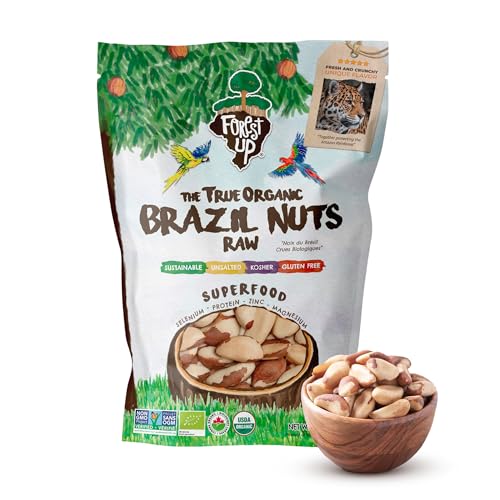
Best packaging: Forest Up Organic Brazil Nuts
| Organic Integrity Score | 88 / 100 |
| Packaging | Modified atmosphere technology, stated |
| Certifications claimed | Certified Organic, Kosher |
| Also claims | Vegan, gluten free, no preservatives, no artificial ingredients |
| Size | 15 oz |
| Best for | Buyers who want the freshest nut in the bag |
The best selling organic Brazil nuts in our search results, and the only listing that addresses the product’s actual failure mode.
“Packaged with modified atmosphere technology, our nuts arrive crunchy, without preservatives.” That is the correct technical answer to a two-thirds-fat nut. Replacing the oxygen in the pack with an inert gas slows the oxidation that turns these nuts bitter, and it does so without a preservative — which is why the two halves of that sentence belong together.
It is also a claim about the thing buyers most often complain about with Brazil nuts. Freshness is the difference between a rich, creamy nut and a sharp, papery one, and shelf-stable bulk nuts are frequently the latter.
The certification stack is unattributed but correct in form: Certified Organic, Kosher, plus free of artificial ingredients and gluten. “Elevated control of the production chain” and “safe and controlled production from start to finish” gesture at traceability without describing any of it.
At 15 oz it sits between the small pack and the one-pound bags, and its price per ounce is among the better ones here.
The deductions are for language. “Natural flavor and aroma of the forest” is atmosphere in the literal sense. “Forest Up Excellence” as a bullet heading, and “a commitment to traditions, health and the appreciation of Brazilian flavors”, are brand copy. No certifier is named, no origin region within Brazil is given, and nothing is said about selenium or serving size.
- Modified atmosphere packaging, the right answer for a high-fat nut.
- Best selling organic option in our search results.
- Certified organic and kosher, plus specific exclusions.
- Good price per ounce at 15 oz.
- “Aroma of the forest” and “excellence” carry no information.
- Traceability is gestured at but never described.
- No certifier named and no sourcing region given.
- Nothing about selenium or serving size.
What the listing discloses: You are told kosher certification for Floresta em Pé; you are not told whether the USDA seal applies and where it was grown or made.
Most attributes claimed: Terrasoul Superfoods Organic Brazil Nuts
| Organic Integrity Score | 84 / 100 |
| Attributes claimed | Certified Organic, Non-GMO, Earth Kosher, Raw, Gluten-Free, Vegan |
| Named agency | Earth Kosher, for the kosher certification |
| Size | 1 lb |
| Best for | Buyers who want the biggest bag from a known bulk brand |
Six claimed attributes in a single line, one of which names its certifying agency.
“Certified Organic, Non-GMO, Earth Kosher, Raw, Gluten-Free, Vegan.” Naming Earth Kosher rather than writing “kosher” is the kind of precision we look for. It is not the organic certifier, so it does not do what Elan’s listing does, and it shows the company knows the difference between a certification and an adjective.
The word raw is worth pausing on. It is unregulated for nuts and means, in practice, not roasted. That matters here because roasting accelerates the oxidation this nut is already prone to, so raw is the right default for Brazil nuts specifically.
We have credited this brand before for publishing a hard figure — its rolled oats state a gluten threshold in parts per million. That habit does not carry over to this listing, where the first bullet simply restates the product title and package weight.
At one pound this is the largest bag in the ranked comparison, which is good value per ounce and a lot of a nut that goes rancid quickly. If you buy this size, decant it into a sealed container and keep it cold.
Nothing is said about packaging, sourcing region, freshness, aflatoxin, selenium content or serving size. The title says “Rich in Selenium”, which as discussed is the appropriate claim, and the body does not develop it.
- Names Earth Kosher rather than claiming kosher generically.
- Six attributes claimed in a compact, checkable line.
- Largest bag in the ranked comparison.
- Raw rather than roasted, which suits this nut.
- First bullet restates the title and weight.
- No organic certifier named, despite naming the kosher agency.
- Nothing about packaging, freshness or storage on a one-pound bag.
- Most expensive per bag among the certified options.
What the listing discloses: You are told kosher certification for Terrasoul Superfoods; you are not told whether the USDA seal applies and where it was grown or made.
Claims in the title, one bullet in the body: Organic Brazil Wild Nuts
| Organic Integrity Score | 70 / 100 |
| Title claims | Organic, 100% wild grown, sustainably collected, prevents deforestation, rich in selenium, non-GMO |
| Body | One bullet, on sustainable sourcing |
| Certifier named | No |
| Best for | Buyers moved by the conservation framing |
Six claims in the title and one sentence in the body, which is the structural problem this listing has.
The body bullet reads: “Sustainably Sourced — Wild harvesting protects the Amazon and supports local communities.” That is the entire product description, and it opens with an emoji.
Two of the title claims deserve scrutiny.
“100% Wild Grown, Sustainably Collected” is true and is not a differentiator. As set out above, Brazil nut trees resist plantation cultivation, so essentially the whole category is wild harvested. This is the baseline condition of the product being sold as a premium feature.
“Prevents Deforestation” is a claim about outcomes in a complex system, made by a nut vendor, with nothing offered to support it. The underlying argument is real and well established — standing forest that generates income from nut collection has economic value alive, which is a genuine conservation mechanism. But “this bag of nuts prevents deforestation” is a different and much larger claim than “wild harvesting creates an economic reason to leave forest standing,” and only the second is defensible from a product listing.
What we credit: the conservation framing is pointed at something real, and unlike most sustainability copy it identifies a specific mechanism rather than expressing a commitment. Supporting local collector communities is also the accurate description of how this supply chain works.
No certifier, no origin region, no packaging detail, no freshness claim, no serving guidance, and no organic claim anywhere in the body.
- The conservation mechanism it points at is real.
- Accurately describes a collector-based supply chain.
- Wild harvest and non-GMO claims are true.
- Sells the category baseline as a premium differentiator.
- “Prevents deforestation” is an outcome claim with nothing behind it.
- One body bullet, opening with an emoji.
- No organic claim in the body at all, despite the title.
What the listing discloses: Sparse documentation from It’s Good Energy — nothing on whether the USDA seal applies and where it was grown or made.
Best seller, zero claims: Nut Cravings Raw Brazil Nuts
| Organic Integrity Score | 50 / 100 |
| Organic claim | None |
| Claims of any kind | None, in either the title or the body |
| Size | 1 lb, shelled and whole |
| Sales rank | Best selling Brazil nuts in our search results |
| Best for | Price and volume, with no certification |
The best selling Brazil nuts in our search results, and the first product we have scanned whose title and body contain no certification or attribute claims whatsoever.
Our scanner reports the title claims as none and the body claims as none. Not thin — empty. The listing states what the product is, how much of it there is, that it is unsalted, and that the shells are off.
There is a case to be made for this. A pound of shelled raw Brazil nuts at a competitive price is a perfectly clear proposition, and the listing does not decorate it with a single unverifiable adjective. In a category where a competitor is claiming to prevent deforestation, saying nothing has a certain integrity.
It is also not organic, and this is a comparison of organic Brazil nuts. On our criteria there is nothing to score.
The practical note: since Brazil nuts are wild harvested regardless, the difference between this and a certified bag is not about pesticide application in a field. It is about whether the harvest area and the chain of custody have been audited, and whether anyone has verified what happened between the forest floor and the bag.
- Best selling product in the category.
- Competitive price for a full pound, shelled.
- Claims nothing whatsoever, so nothing is overstated.
- No organic certification, on a page about organic Brazil nuts.
- No claims of any kind in the title or the body.
- Nothing about sourcing, packaging, freshness or selenium.
- No audited chain of custody from forest to bag.
What the listing discloses: Nut Cravings carries no organic claim, certified or otherwise.
What we left out and why
In-shell Brazil nuts. A different product with a different risk profile. Shelled nuts from a controlled supply chain are the lower-risk form where aflatoxin is concerned, and cracking Brazil nut shells is genuinely hard work.
Roasted and salted Brazil nuts. Roasting accelerates the oxidation this nut is already vulnerable to, and salted versions move the discussion to sodium. For a nut bought primarily for selenium, raw is the sensible default.
Mixed nuts containing Brazil nuts. The dosing question becomes unanswerable when you cannot control how many Brazil nuts are in a handful, which is precisely the situation this food does not suit. Our comparison of organic nuts covers mixes and other varieties.
Larger multi-pack listings from brands already ranked here. Same product, different quantity, and including both would have padded the comparison without adding information.
Buying, dosing and storing Brazil nuts
- One to three nuts a day is a sensible habit. A single nut can cover an adult’s full daily selenium requirement.
- The tolerable upper intake level is 400 micrograms of selenium a day, which a generous handful can approach.
- Selenium content varies with the soil the tree grew in, so treat any figure as an estimate and err on the low side.
- If you are already taking a selenium-containing supplement or a multivitamin, count that too. Doubling up is the easiest way to overshoot.
- Buy raw rather than roasted. Roasting speeds up the oxidation this nut is most prone to.
- Prefer a pack size you will finish in a month or two over the best price per ounce.
- Look for any statement about packaging. Modified atmosphere or vacuum packing is worth paying for in this particular nut.
- Shelled is the practical form. In-shell keeps longer but is difficult to open and carries a higher aflatoxin risk profile.
- Refrigerate after opening, or freeze if the bag is large. Cold slows oxidation more than anything else you can do at home.
- Decant into an airtight container. A rolled-over bag is not airtight and oxygen is the problem.
- Smell and taste before eating from an older bag. Rancid nuts taste sharp, bitter and slightly like paint.
- Keep them away from the stove and out of direct light, the same as any high-fat food.
What the field adds up to
One listing in five names the body that certified it, which is one more than every other category we have audited combined. One addresses the packaging question that determines whether the nuts arrive fresh. None offers a serving guide for a food where the serving genuinely matters.
The rule for Brazil nuts is unlike the rule anywhere else on this site. The certification is a statement about the forest and the supply chain, not about farming. The missing selenium number is honest rather than evasive. And the most useful piece of information in the category — how many to eat — appears on none of the packets.
Questions about organic Brazil nuts
How many Brazil nuts should I eat a day?
One to three is a sensible habit. A single nut commonly contains 68 to 91 micrograms of selenium against an adult daily requirement of 55 micrograms, and the tolerable upper intake level is 400 micrograms a day. A generous handful can approach that limit, so this is not a nut to eat by the bowl.
Why does no brand state the selenium content?
Because it depends on the selenium concentration in the soil where each tree grew, and that varies enormously across the Amazon. A printed figure would be unreliable, so “rich in selenium” is the honest claim here. This is the one category where we do not mark a listing down for the missing number.
Can Brazil nuts be farmed?
Not practically at commercial scale. The flowers require specific large-bodied bees that depend on surrounding forest, and plantation attempts have generally failed to produce economically. Essentially all Brazil nuts in commerce are gathered from wild trees in standing rainforest.
What does organic certification mean if the trees are wild?
It is issued under the wild crops scope of the National Organic Program, which certifies the harvest area rather than a farm: that no prohibited substances have been applied to it, that harvesting does not destroy the resource, and that the chain of custody is documented. It is a statement about the forest and the supply chain.
Is “wild harvested” a meaningful claim on Brazil nuts?
Not as a differentiator, since it describes the whole category. It is accurate and it is the baseline condition of the product, so a listing presenting it as a premium feature is selling you something every competitor also has.
Do Brazil nuts go rancid quickly?
Faster than most nuts. They are roughly two-thirds fat, much of it polyunsaturated, which is the fat most prone to oxidation. Refrigerate or freeze after opening, decant into an airtight container, and buy a size you will finish within a month or two.
Should I worry about aflatoxin in Brazil nuts?
It is a known issue in the category, particularly for in-shell nuts, and it is managed through drying, sorting and testing in controlled supply chains. Shelled nuts from a certified operation are the lower-risk form. No listing in this comparison mentions testing for it.
Is raw better than roasted for Brazil nuts?
For this nut specifically, yes. Roasting accelerates the oxidation that Brazil nuts are already unusually vulnerable to, so raw keeps better and tastes fresher for longer. Raw is also an unregulated term meaning, in practice, not roasted.
What is Ecocert?
An accredited organic certification body, headquartered in France, that certifies operations to the USDA National Organic Program among other standards. When a listing names it alongside USDA, it is telling you which organization actually performed the audit, which almost no product listing does.
Does modified atmosphere packaging matter?
In this category, more than in most. It replaces the oxygen in the pack with an inert gas, slowing the oxidation that turns high-fat nuts bitter, and it does so without a preservative. For a nut that is two-thirds fat, it is the right engineering answer.
Organic Connection is reader supported. We read every product listing in full and say plainly when a claim cannot be verified. How we research and rate.